One of the fundamental claims of generative linguistics is that language acquisition is made possible by Universal Grammar (UG) – a set of innate principles and simple parameters which specify the dimensions along which languages differ. A child equipped with UG is able to acquire the abstract rules of ‘core’ grammar rapidly and effortlessly, on the basis of very limited experience. However, not all aspects of language can be accommodated by the principles and parameters of UG: children must also acquire a large body of language-specific, idiosyncratic knowledge which forms what is known as the ‘periphery’. The periphery consists of exceptions to the principles of core grammar, historical residues and lexical properties of individual words. Since, by definition, such knowledge cannot be inferred from UG, it must be learned from the input. Very little is known about how this happens, since most generative linguists do not regard it as a theoretically interesting issue; however, it is generally agreed that peripheral aspects of language are acquired relatively late, and that their acquisition should be more error prone and more piecemeal (Chomsky, Reference Chomsky1981: 8; Hyams, Reference Hyams1987).
Proponents of constructivist or ‘usage-based’ approaches, in contrast, reject the claim that children have innate linguistic knowledge, arguing that grammar is acquired gradually on the basis of linguistic experience. Children begin with relatively concrete units – invariant formulas and formulaic frames with frame-specific slots such as RUNNER run, PUSHER push PUSHEE, give RECIPIENT GIVEN, etc. More abstract categories such as subject and object emerge later in development as a result of gradual generalization over such lexically specific constructions (see Tomasello, Reference Tomasello2000 and Reference Tomasello2003, for a review of the evidence). Constructivists also reject the core/periphery distinction, claiming that the development of all aspects of grammar depends on the same set of cognitive abilities. However, much of the research in this framework has concentrated on basic argument structure constructions in English, and especially the English transitive construction – undeniably a part of ‘core’ grammar.
This is unfortunate, since investigations of how children come to master these aspects of language are a valuable source of evidence about the kinds of things that they are able to learn. Furthermore, comparing the acquisition of core and peripheral constructions could help us to evaluate the claim that different learning mechanisms are involved. In this paper, therefore, we examine the acquisition of a relatively abstract category that we know must be learned from experience because it is idiosyncratic and language specific: the Polish instrumental case. Our main focus will be to determine when children acquire a general instrumental construction – that is to say, when they discover that the different inflections that mark the instrumental case signal the same category – and whether knowledge about this ‘peripheral’ category is indeed more difficult to acquire than aspects of language that are assumed to be part of the ‘core’.
The Polish instrumental
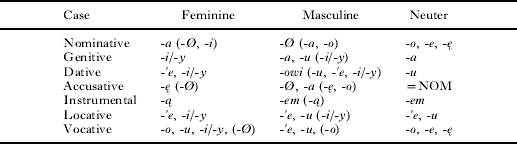
Polish is a morphologically rich language with a fairly elaborate system of case inflections (see Table 1). There are seven cases, each signalled by several different suffixes. The suffixes are portmanteau morphs which signal number as well as case: in other words, there are different sets of case inflections for singular and plural nouns. The single most important determinant of the choice of ending is gender, which can be fairly reliably predicted from the phonological form of the nominative: nearly all feminine nouns end in -a or -i; the vast majority of masculines end in a consonant; and neuters typically end in -o, -e, or -ę. Other factors, such as the phonological make-up of the stem and semantics (especially animacy) come into play when there is more than one ending for a particular gender.
The Polish case marking system (the singular endings)

note: Endings in parentheses are restricted to fairly narrow classes of exceptions. The [′] symbol before an ending indicates that it triggers palatalization of the preceding consonant(s). The distribution of -i and -y is governed by very general phonotactic constraints and they are usually regarded as variants of the same ending.
The instrumental endings are -em [em] for the masculine and neuter singular and -ą [
 ] for the feminine singular and for masculine nouns which end in -a (which decline like feminines in all cases, not just the instrumental.) Like other Polish cases, the instrumental is a polysemous category with a number of different ‘uses’ or functions. The most important of these are listed below. (All the examples are drawn from parental utterances in the Marysia corpus collected by the first author, which consists of transcripts of a thirty-hour sample of the linguistic experience of a two-year-old girl.)
1. Instrument (including body parts)
(1) MOT: pisać kredką chcesz? write:INF crayon:F.INS want:2SG.PRES ‘Do you want to write with the crayon?’
(2) MOT: nie dotykaj tego palcem. not touch:IMP this:GEN finger:M.INS ‘Don't touch it with your finger.'
2. Material/substance
(3) MOT: wodą popryskał mamę. water:F.INS splashed mummy:F.ACC ‘He splashed Mummy with water.’
3. Means of transport (with verbs like jechać ‘to go’, lecieć ‘to fly’, etc.)
(4) MOT: chciałabyś pojechać pociągiem? like:COND.3SG.F go:INF train:M.INS ‘Would you like to go by train?’
4. Companion (with the preposition z ‘with’), and with other senses of z
(5) FAT: razem z misiem. together with teddy:M.INS ‘Together with teddy.’
5. Subject predicative
(6) FAT: wiesz, że jesteś niegrzecznym know:2SG.PRS that be:2SG.PRS naughty:M.INS misiem? teddy:M.INS ‘You know that you're a naughty teddy?'
6. Ground object (with the locative prepositions pod ‘under’, nad ‘over/above’, przed ‘in front of’, za ‘behind’)
(7) MOT: pod fotelem. Under armchair:M.INS ‘Under the armchair.’
7. Manipulated object
(8) MOT: no to rusz tą myszką. PRT PRT move:IMP this:F.INS mouse:F.INS ‘Go on, move the mouse.’
(9) FAT: a po co rzucasz tym but what-for throw:2SG.PRS this:M.INS słoniem? elephant:M.INS ‘But what are you throwing the elephant (INS) (around) for?’
(10) FAT: kółeczkiem kręcisz? little.wheel:N.INS turn:2SG:PRS ‘You're turning the little wheel?'
(11) MOT: czym macha? what:INS wave:3SG:PRS ‘What is he waving?’
In addition, the instrumental marks the objects of verbs like bawić się ‘play with’, zająć się ‘occupy oneself with’ and zwać ‘to call’; it also occurs in a some fixed expressions, e.g. wieczorem ‘in the evening’ (evening:M.INS), tyłem ‘backwards’ (back:M.INS), bokiem ‘sideways’ (side:M.INS), przypadkiem ‘by chance’ (chance:M.INS).
Note that the different uses of the instrumental cannot be subsumed under a single semantic characterization, although there are many local similarities between individual uses (Dąbrowska, Reference Dąbrowska1987, Reference Dąbrowska1994) – for instance, the instrument, material and means of transport all enable the agent to perform the action; an instrument, like the patient of a manipulation verb, is handled by the agent; instruments are often conceptualized as metaphorical companions (cf. Lakoff & Johnson, Reference Lakoff and Johnson1980: 135); and so on. Some of these extensions are attested cross-linguistically (see, for example, Lakoff & Johnson, Reference Lakoff and Johnson1980, and Stolz, Reference Stolz1996, on the ‘instrument as companion’ metaphor). However, the precise configuration of meanings that the instrumental signals and, of course, the actual endings, are language-specific facts about Polish; they are, therefore, aspects of language which the child must learn from the input.
It is also worth noting that the instrumental case is relatively infrequent, comprising only about 4% of noun tokens in the input. The ‘structural’ cases are considerably more frequent, with accusative forms accounting for 19% of all noun tokens, genitive forms, 12% and nominatives, 54% (Dąbrowska & Szczerbiński, Reference Dąbrowska and Szczerbiński2006).
Finally, it should be pointed out that although instrumental endings – and oblique case inflections generally – attach to a noun, they mark a particular role in a relationship between the entity designated by the noun and another participant. The relationship can be expressed by a verb (uses 1, 2, 3, 5, and 7), in which case we are dealing with a sentence-level construction, or a preposition (uses 4 and 6), in which case the relevant syntactic domain includes the prepositional phrase and the verb or noun that the prepositional phrase combines with.
In this paper, we focus on the use of the instrumental to mark the object of verbs of manipulation. This use is associated with a cluster of semantically similar verbs such as ruszać ‘move (around)’, rzucać ‘throw (around)’, kręcić ‘turn, spin’, machać ‘wave’, kołysać ‘rock’, suwać ‘slide (back and forth)’. The use of the instrumental implies that the patient was moved but not displaced (i.e. the endpoint of the movement coincides with the starting point) or that the displacement is not deemed relevant (what matters is that the patient has been manipulated). The verb is normally imperfective, thus implying repeated movement, as in examples (9)–(11) above.
The use of the instrumental to mark the object of manipulation verbs is an example of what generativists call lexical or ‘quirky’ case, since objects normally take accusative marking.Footnote 1 Furthermore, although instrumental verbs of manipulation share some semantic properties, the choice of the instrumental case is lexically governed, in that some verbs belonging to this semantic class take accusative objects and some allow both cases. For instance, according to a standard reference dictionary (Bańko, Reference Bańko2000), włóczyć ‘to drag’ takes accusative objects, but the nearly synonymous derived form powłóczyć governs the instrumental; szarpać ‘to wrench or pull’ allows both cases, but (po)ciągać ‘to pull’ only the accusative; suwać ‘to push back and forth’ allows both the instrumental and accusative, but the morphologically related form przesuwać ‘to push across repeatedly’ requires the accusative; and szurać ‘to push, making a scraping sound’ only allows the instrumental.
When a verb allows both accusative and instrumental objects, there is usually a subtle difference in meaning, in that the use of the accusative, as in (12) and (13) below, suggests that the object was displaced.
(12) FAT: kto rusza pieska? who:NOM move:3SG:PRS doggie:M.ACC ‘Who is moving the dog?’
(13) FAT: rzucać też go? throw:INF also 3SG.M.ACC ‘Throw him as well?’
In sentences with instrumental objects, the focus is on the manipulator's action rather than displacement of the object. For instance, a sentence such as (9), with rzucać ‘throw’ and an instrumental object, would normally be used if the child repeatedly threw the toy elephant from one location to another; the nearest English equivalent would be What are you throwing the elephant around for? However, it would also be appropriate when the child threw the elephant only once, if the speaker wanted to indicate simply that the elephant had been thrown as opposed to being carried (perhaps to express disapproval for the rough way the child is handling her toys): what is relevant in this situation is the manner in which the elephant is handled, not the fact that it changed location as a result of the child's actions.
Outline of the experiment
In the experiment described below, we exposed children to two novel verbs of manipulation which govern the instrumental. One of the verbs was modelled in construction with three masculine patient nouns, and the other in construction with three feminine patient nouns. We then elicited sentences with the novel verbs and new patient nouns of the same gender (the matching gender condition) and a different gender (the non-matching gender condition). If children rely on concrete generalizations such as MEEKER+mikuje+MEEKED-em Footnote 2 ‘MEEKER meeks MEEKED-em’, they should be able to apply the correct ending to nouns of the same gender as the nouns they were trained with, but use gender-inappropriate endings in the non-matching gender conditions. On the other hand, if they have access to a more abstract instrumental construction which subsumes these relatively concrete schemas, they should be able to use the novel verb with nouns of both genders. Children could also ‘correct’ to canonical (i.e. accusative) case marking; this would indicate that they have acquired a verb-general accusative construction.
Most previous research on the acquisition of case marking has concentrated on questions such as when particular inflections first emerge in children's speech and when they become productive. This paper has a rather different focus. The main question that we are interested in is how much children know about the instrumental as a syntactic category, specifically, whether they know that -em and -ą are both exponents of the same case. In order to maximize the chances of the children being able to reveal their knowledge about the syntactic category, we used nouns which are frequently used in the instrumental for both training and testing. High-frequency forms are likely to be stored as ready-made units, and hence children should be able to supply the correct ending when they know that an instrumental form is required, even if they are not fully productive with instrumental inflections.
METHOD
Participants
Fifteen two-and-a-half-year-olds (mean age 2 ; 6, range 2 ; 3–2 ; 9) and 15 three-year-olds (mean age 3 ; 2, range 3 ; 0–3 ; 3) from two daycare centres in Gdańsk participated in the experiment.
Stimuli and materials
The children learned two novel verbs in the course of the experiment: mikować ‘push back and forth’ and grusiać ‘spin (on a tray)’. Both verbs designated non-translational movement (i.e. movement which does not imply displacement) and were similar in meaning to existing instrumental verbs such as potrząsać ‘to shake’, machać ‘to wave’, kręcić ‘to keep turning’ and ruszać ‘move (in no particular direction)’.
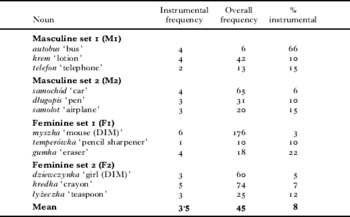
The verbs were presented in the third person singular present tense form (mikuje, grusia) and the third person singular past tense form (mikował/mikowała, grusiał/grusiała) in construction with familiar agent and patient nouns while the experimenter modelled the action using the appropriate props. There were 16 agent nouns designating various dolls and animals and 12 patient nouns divided into four sets of three (see Table 2). The order of presentation and pairing of verb with training set was counterbalanced across participants. During the testing stage, verbs trained with nouns from set M1 or F1 were tested with nouns from sets M2 and F2; and verbs trained with nouns from set M2 or F2 were tested with nouns from sets M1 and F1.
Patient nouns used in the experiment

note: The frequency information is based on the Marysia corpus.
The patient nouns used in the experiment were relatively common, with a mean frequency in the Marysia corpus of about 45 (i.e. about 1·5 per hour). The mean frequency of the instrumental forms of these nouns in the corpus was 3·5, or 0·12 per hour (see Table 2 for details). This means that, if we assume that language development begins at twelve months of age and that children are exposed to five hours of speech per day, even the youngest children in our study, i.e. those aged 2 ; 3, would have heard, on average, about 270 tokens of each noun in the instrumental (15 months×30 days×5 hours×0·12 token per hour). Thus, there was a reasonable chance that the children have acquired these forms as ready-made units, and hence would be able to supply the correct inflected form even if they were not fully productive with the instrumental endings.
Half the patient nouns used in the experiment were masculine and the other half were feminine. Both of these genders are relatively large classes (48% and 40% respectively of the nouns in the input), while the neuter class is much smaller (12% of input nouns). Thus the nouns were closely matched in terms of the size of the class to which they belong as well as their individual frequencies.
Procedure
The children were tested in a quiet room at the centre by two experimenters. Experimenter 1 interacted with the child; Experimenter 2 prepared the props, kept a log of the child's responses and audio-recorded the testing session for later checking. Both experimenters were employed at the centre, and were thus well known to the children.
Each child learned two verbs, one introduced with feminine nouns and one with masculine nouns. The verbs were modelled in four sessions, as detailed in Table 3.
Experimental sessions

The two training sessions for each verb occurred on consecutive days; sessions 1b and 2a were about a week apart to minimize interference between verbs.
Training
During each of the training sessions, one novel verb was presented with three familiar patient nouns of the same gender. The training sessions consisted of three blocks, with different agents used in each block. Each block contained three different verb+patient combinations, which were repeated three times. Thus, the child heard the novel verb 27 times during each training session (and also produced it three times: see below).
In the first block, the children simply listened while the experimenter provided a running commentary on the actions she demonstrated:
(T1) Zobacz, piesek mikuje autobusem. look:IMP doggie:M.NOM meek:3SG.PRS bus:M.INS ‘Look, doggie is meeking the bus.’
(T2) Piesek mikuje autobusem. doggie:M.NOM meek:3SG.PRS bus:M.INS ‘Doggie is meeking the bus.’
(T3) Piesek mikował autobusem. doggie:M.NOM meek:3SG.PST bus:M.INS ‘Doggie meeked the bus.’
(T4) A teraz piesek mikuje telefonem. and now doggie:M.NOM meek:3SG.PRS phone:M.INS ‘And now doggie is meeking the phone.’
(T5) Widzisz, piesek mikuje see:2SG.PRS doggie:M.NOM meek:3SG.PRS telefonem. phone:M.INS ‘See, doggie is meeking the phone.’
(T6) Piesek mikował telefonem. doggie:M.NOM meek:3SG.PST phone:M.INS ‘Doggie meeked the phone.’
(T7) A teraz piesek mikuje kremem. and now doggie:M.NOM meek:3SG.PRS lotion:M.INS ‘And now doggie is meeking the lotion.’
(T8) Widzisz, piesek mikuje kremem. see:2SG.PRS doggie:M.NOM meek:3SG.PRS lotion:M.INS ‘See, doggie is meeking the lotion.’
(T9) Piesek mikował kremem. doggie:M.NOM meek:3SG.PST lotion:M.INS ‘Doggie meeked the lotion.’
In the second block, the children first observed and then were invited to perform the action themselves:
(T10) A teraz małpka mikuje autobusem. and now monkey:F.NOM meek:3SG.PRS bus:M.INS ‘And now monkey is meeking the bus.’
(T11) Widzisz, małpka mikuje autobusem. see:IMP monkey:F.NOM meek:3SG.PRS bus:M.INS ‘See, monkey is meeking the bus.’
(T12) A teraz ty pokaż jak małpka and now you show:IMP how monkey:F.NOM mikuje autobusem. meek:3SG.PRS bus:M.INS ‘And now you show how monkey meeks the bus.’
(T13) A teraz małpka mikuje telefonem. and now monkey:F.NOM meek:3SG.PRS phone:M.INS ‘And now monkey is meeking the phone.’
(T14) Widzisz, małpka mikuje telefonem. see:IMP monkey:F.NOM meek:3SG.PRS phone:M.INS ‘See, monkey is meeking the phone.’
(T15) A teraz ty pokaż jak małpka and now you show:IMP how monkey:F.NOM mikuje telefonem. meek:3SG.PRS phone:M.INS ‘And now you show how monkey meeks the phone.’
(T16) A teraz małpka mikuje and now monkey:F.NOM meek:3SG.PRS kremem. lotion:M.INS ‘And now monkey is meeking the lotion.’
(T17) Widzisz, małpka mikuje kremem. see:IMP monkey:F.NOM meek:3SG.PRS lotion:M.INS ‘See, monkey is meeking the lotion.’
(T18) A teraz ty pokaż jak małpka and now you show:IMP how monkey:F.NOM mikuje kremem. meek:3SG.PRS lotion:M.INS ‘And now you show how monkey meeks the lotion.’
In the final training block, the children listed to the experimenter's description of the scene and were then invited to repeat it (and perform the action if they wanted to):
(T19) A teraz kangur to będzie robić. and now kangaroo:M.NOM it:ACC will:3SG:FUT do:INF ‘And now kangaroo will do it.’ Zobacz, kangur mikuje autobusem. look:IMP kangaroo:M.NOM meek:3SG.PRS bus:M.INS ‘Look, kangaroo is meeking the bus.’
(T20) Potrafisz powiedzieć „Kangur can:2SG.PRS say:INF kangaroo:M.NOM mikuje autobusem”? meek:3SG.PRS bus:M.INS ‘Can you say “Kangaroo is meeking the bus”?’
(T21) Bardzo dobrze, kangur mikuje very good kangaroo:M.NOM meek:3SG.PRS autobusem. bus:M.INS ‘Very good, kangaroo is meeking the bus.’
(T22) A teraz, zobacz, kangur mikuje and now look:IMP kangaroo:M.NOM meek:3SG.PRS telefonem. phone:M.INS ‘And now, look, kangaroo is meeking the phone.’
(T23) Potrafisz powiedzieć „Kangur can:2SG.PRS say:INF kangaroo:M.NOM mikuje telefonem”? meek:3SG.PRS phone:M.INS ‘Can you say “Kangaroo is meeking the phone”?’
(T24) Bardzo dobrze, kangur mikuje very good kangaroo:M.NOM meek:3SG.PRS telefonem. phone:M.INS ‘Very good, kangaroo is meeking the phone.’
(T25) A teraz, zobacz, kangur mikuje and now look:IMP kangaroo:M.NOM meek:3SG.PRS kremem. lotion:M.INS ‘And now, look, kangaroo is meeking the lotion.’
(T26) Potrafisz powiedzieć „Kangur can:2SG.PRS say:INF kangaroo:M.NOM mikuje kremem”? meek:3SG.PRS lotion:M.INS ‘Can you say “kangaroo is meeking the lotion”?’
(T27) Bardzo dobrze, kangur mikuje very good kangaroo:M.NOM meek:3SG.PRS kremem. lotion:M.INS ‘Very good, kangaroo is meeking the lotion.’
Testing
The test was administered immediately after the second training session with each verb, i.e. at the end of sessions 1b and 2b. It began with a warm-up phase during which the child was invited to supply the instrumental form of the three nouns which were presented with the novel verb during training. The experimenter chose a new toy to act as agent and said:
A teraz żabka to będzie robić, a ty powiesz, co ona robi.
‘And now froggie will do it, and you will say what she is doing.’ (The noun żabka ‘froggie’ is feminine.)
Then the experimenter acted out the action using the frog as agent and asked the child to describe the scene:
First prompt: Co robi żabka? what:NOM do:3SG.PRS froggie:F.NOM ‘What's froggie doing?’
If the child did not respond, the experimenter began the sentence for him:
Second prompt: Żabka mikuje … froggie:F.NOM meek:3SG.PRS ‘Froggie is meeking … ’
If the child still did not respond, the experimenter produced the entire sentence and the beginning of the test noun. (In the example below, the target form is autobusem, where -em is the instrumental ending.)
Third prompt: Żabka mikuje autobu … froggie:F.NOM meek:3SG [beginning of word] ‘Froggie is meeking the [beginning of word] …’
Thus, the child had three chances to supply the target form; in the last trial, he/she only had to produce the final syllable of the noun. The same procedure was used to elicit the instrumental forms of the remaining two nouns from the training set.
Immediately after the warm-up phase, the same procedure was used to elicit instrumental forms of the six test items (three nouns of matching gender and three nouns of non-matching gender) presented in random order. As in the warm-up, if the child did not respond to the first prompt (‘What is froggie doing?’), the experimenter attempted to elicit the target form using two additional prompts (‘Froggie is meeking … ’ and ‘Froggie is meeking [beginning of test word]’.
RESULTS
Target responses
All uses of gender-appropriate instrumental endings (-em with masculine nouns and -ą with feminines) were counted as target. Since we are interested only in whether children are able to use the appropriate ending to mark the patients of novel verbs, not in whether they are able to use the novel verbs themselves, a child was given credit for producing the target form regardless of which prompt s/he responded to.
Target responses for the warm-up trials averaged 97% for masculine nouns and 80% for feminines. However, a closer analysis revealed that while most children provided the target answers on all warm-up trials, seven (four two-year-olds and three three-year-olds) achieved scores of only 0% or 33% on warm-ups with one of the verbs, and correspondingly low scores in the test conditions. Since they had clearly not learned the non-canonical case-selection properties of one of the novel verbs, their data were excluded from further analysis.
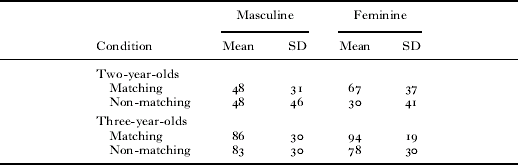
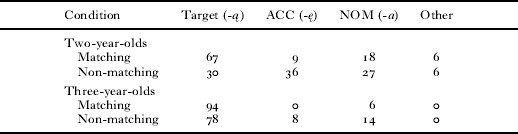
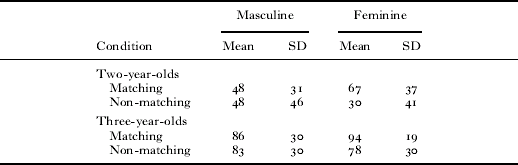
A summary of the children's responses for nouns of both genders in the two experimental conditions (converted into percentages) is given in Table 4. The data were analyzed using a (2) gender×(2) presentation condition×(2) age ANOVA. The analysis revealed a significant main effect of age (the three-year-olds gave more target responses than the younger children (F(1, 21)=9·95, p=0·005, ηp2=0·32)) and presentation condition (both age groups performed better in the matching-gender condition (F(1, 21)=18·95, p<0·001, ηp2=0·47)) and a significant interaction between presentation condition and gender (F(1, 21)=5·73, p=0·026, ηp2=0·21). No other effects or interactions were significant (gender: F(1, 21)=0·02, p=0·878, ηp2<0·01; gender×age: F(1, 21)=0·02, p=0·88, ηp2<0·01; presentation condition×age: F(1, 21)=1·74, p=0·201, ηp2=0·08; presentation condition×gender×age: F(1, 21)=1·15, p=0·297, ηp2=0·05). The presentation condition and gender interaction was followed up with planned pairwise comparisons, which revealed that the effect of presentation condition was significant for feminine nouns (t(22)=3·76, p=0·001), but not for masculine nouns (t(22)=0·27, p=0·788).
Target responses (%)
As explained earlier, seven children were excluded from the analysis because they had not learned the non-canonical case-selection properties of the novel verbs. To ensure that this did not bias our sample, we ran a second analysis on the full data set. The pattern of results was similar: there was a significant main effect of age (the three-year-olds gave more target responses than the younger children (F(1, 28)=5·58, p=0·025, ηp2=0·17)) and presentation condition (both age groups performed better in the matching-gender condition (F(1, 28)=8·16, p=0·008, ηp2=0·23)), although the interaction between presentation condition and gender was no longer significant (F(1, 28)=0·03, p=0·86, ηp2=0·001). The main effect of gender and the interactions between presentation condition and age, gender and age, and presentation condition, gender and age were also not significant (gender: F(1, 28)=0·62, p=0·440, ηp2=0·02; presentation condition×age: F(1, 28)=0·10, p=0·753, ηp2<0·01; gender×age: F(1, 28)=0·07, p=0·796, ηp2<0·01; presentation condition×gender×age: F(1, 28)=0·77, p=0·386, ηp2=0·03).
Table 4 shows that even the younger children were able to supply the correct instrumental ending 48% of the time in the masculine non-matching gender condition and 30% of the time in the feminine non-matching gender condition. In principle, such a result could arise if about half of the children had an abstract instrumental construction and so consistently applied the target ending to all masculine nouns (and somewhat less consistently to feminine nouns); alternatively, it could be due to a larger proportion of children applying the target ending less consistently. It is therefore interesting to see how many children supplied at least one correct instrumental form for either a masculine or a feminine noun in the non-matching gender condition. Eight out of the 11 two-year-olds in our sample and all 12 three-year-olds were able to do this. If we look at the genders separately, the figures are somewhat lower: 7 out of 11 two-year-olds and 11 out of 12 three-year-olds succeeded on at least one trial with masculine nouns; for feminine nouns, the relevant figures are 5 out of 11 and 12 out of 12 respectively.
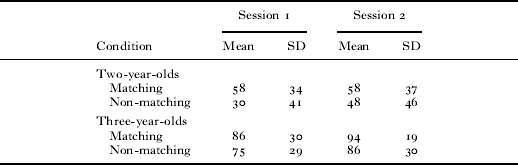
The non-matching gender nouns tested with the second verb (i.e. in session 2b) were the same as the nouns used for training the first verb. Although the second testing session occurred seven days after training for the first verb, it is possible that repeatedly hearing the instrumental forms of the same nouns (though with a different verb) during the training session made the children more likely to use these forms a week later, thereby inflating their performance in the non-matching gender condition in the second testing session. To determine whether this was the case, we compared the children's performance in testing sessions 1 and 2 (see Table 5). As shown in the table, performance on the non-matching condition was better in session 2; however, the difference is not statistically significant (for two-year-olds, t(10)=1·40, p=0·192; for three-year-olds, t(11)=1·17, p=0·266; for both groups together, t(22)=1·86, p=0·076; the reported significance levels have not been corrected for multiple comparisons – which would make them even higher). A similar picture emerges if we compare the number of children who used the target ending at least once in the non-matching gender condition in sessions 1 and 2: for two-year-olds, the figures are 5 out of 11 and 7 out of 11 respectively, and for three-year-olds, 12 out of 12 and 11 out of 12. Thus, even if exposure to instrumental forms in the first two training sessions did have an effect on their performance on the second test, this effect had a relatively small impact on the results. (Note, too, that the improved performance on the second test could also be due to other factors, such as increased familiarity with the testing situation.)
Target responses (%) by session

The proportion of target responses for individual nouns in the non-matching gender condition ranged from 30% for the noun dziewczynka ‘girl’ to 75% for krem ‘lotion’. To explore some possible reasons for these differences, we computed the correlations between the proportion of target forms of individual nouns and the absolute frequency of the instrumental forms of the nouns, the nouns' overall frequency, and the relative frequency of the instrumental form (i.e. the number of instrumental forms divided by the overall frequency of the noun). The relevant information is presented in Table 6; because some of the frequencies are skewed towards the lower end (cf. Table 2), we report both Pearson's product-moment coefficients and Spearman's rank correlation coefficients. Since only 12 nouns were used in the experiment, the results must be viewed with caution; however, the figures in the table strongly suggest that there is no relationship between the proportion of target responses in the non-matching gender condition and the noun's overall frequency or the relative frequency of the instrumental form. The correlation between the number of target responses and the frequency of the instrumental form is also not significant; however, in this case the p values are considerably lower, which suggests that a significant relationship might be found with a larger number of data points.
Relationship between proportion of target forms in the non-matching gender condition and the frequency of individual nouns

Non-target responses
The most frequent non-target response in the masculine was the use of the zero ending. Such responses are difficult to interpret, since they could be either overgeneralizations of the accusative ending or failure to inflect (that is to say, use of the citation form, the nominative – cf. Table 1). Feminine nouns, however, have distinct endings for the nominative (-a) and the accusative (-ę), so in the following discussion, we will analyze non-target responses for feminine nouns only.
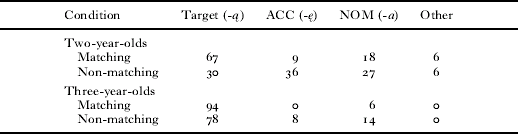
Six out of 11 two-year-olds and 2 out of 12 three-year-olds used the accusative ending with at least one of the three feminine nouns in the non-matching gender condition; accusative responses account for 36% and 8% respectively of all the children's responses in this condition (see Table 7). Another common non-target response involved the use of the nominative form: such errors account for 27% of the two-year-olds' responses and 14% of the responses produced by three-year-olds in the non-matching gender condition. Although a number of children occasionally resorted to this strategy, only one consistently applied it to all nouns in the non-matching gender condition. Other responses included 2 failures to respond at all, and 2 overgeneralizations of the masculine ending (both by the same child, one in the matching and one in the non-matching gender condition).Footnote 3
Responses for feminine nouns (%)
DISCUSSION
Evidence for abstract schemas
As we have seen, our two-year-olds supplied the target form 58% of the time in the matching gender condition and 39% of the time in the non-matching gender condition; for three-year-olds, the corresponding figures were 90% and 81% respectively. Does this indicate abstract knowledge of the instrumental construction, or could the children have produced the target responses by guessing – for example, by choosing a frequent form of the patient noun?
To answer this question, we should first note that the distribution of the children's non-target responses is far from random. The most common non-target response was the use of the accusative instead of the instrumental to mark the patient. Since most verbs take accusative objects, the use of this case is clearly motivated: in fact, since many instrumental nouns also allow accusative objects, such responses cannot really be considered incorrect. The only true error which occurred with any frequency in our data is the use of the nominative instead of the instrumental. The nominative is the citation form – i.e. it is used in grammatically neutral contexts such as lists or labels – and is also sometimes used by young children as a kind of default in grammatical contexts requiring other cases (Smoczyńska, Reference Smoczyńska and Dan1985; Dąbrowska, Reference Dąbrowska2001; Dąbrowska & Szczerbiński, Reference Dąbrowska and Szczerbiński2006): that is to say, children sometimes substitute the nominative for oblique case forms. Note that the opposite error – substitution of an oblique for a nominative (or for another oblique) is very rare. This suggests that the use of the nominative is a kind of avoidance strategy employed when the child does not know how to inflect the noun. Thus the pattern of errors observed in the experiment suggests that they are systematic rather than random, which argues against a guessing strategy.
Secondly, the proportion of correct responses in the non-matching gender condition is much higher than one would expect by chance alone. As indicated earlier, instrumental forms are relatively rare, accounting for only 4% of all noun tokens in child-directed speech. For the patient nouns used the experiment, this figure is somewhat higher (8%), since we deliberately chose nouns that are frequently used in the instrumental – but still almost five times lower than the proportion of target responses in the two-year-olds (39%), and ten times lower than the corresponding figure for three-year-olds (81%).
Finally, if children were simply choosing a relatively frequent form of the patient noun, we would expect them to supply the target inflection most reliably with those words which are used predominantly in the instrumental, and least reliably with words which are used predominantly in other forms. However there is no significant correlation between the number of target responses for individual nouns and the relative frequency of their instrumental forms, i.e. the frequency of the instrumental form divided by the noun's overall frequency (r=0·244, p=0·445).
We conclude that the children's performance, though far from perfect, is clearly systematic and cannot be explained by appealing to crude probabilistic strategies: in other words, it reveals that the children have formed some kind of linguistic generalization about the verbs they learned during the experiment.
How is this generalization best characterized? During the training phase of the experiment, the children were exposed to a number of sentences consisting of a subject, a novel verb and (in the masculine-training condition) a patient noun with the masculine instrumental ending -em. The simplest and most conservative generalization about these data would be a lexically specific schema of the form MEEKER+mikuje+MEEKED-em, where the plus sign indicates that the representation is not necessarily linearly ordered (cf. footnote 2). Such a representation – similar to the ‘verb island’ constructions which, according to the constructivist literature, are prevalent among young English-speaking children – would capture the generalization that mikuje takes two arguments and that the participant undergoing the action is marked with -em. It would also enable the child to produce novel utterances by inserting new material into the MEEKER and MEEKED slots. The resulting sentences would be grammatical when the new patient verb was masculine, but ungrammatical if it was feminine: in other words, it would enable the children to produce the target form in the matching gender condition, and lead to a high number of gender-inappropriate responses in the non-matching gender condition.
There is only one instance of this kind of error in our data, made by a two-year-old who added the masculine ending (-em) to one of the feminine nouns. This child used the accusative ending with one of the other feminine nouns, and failed to respond at all to the third. Thus, he clearly did not know what form of the noun was required after the novel instrumental verb; moreover, he also used the masculine ending with one of the feminine nouns in the matching gender condition, suggesting that the error may have been due to inability to consistently apply the feminine inflection.
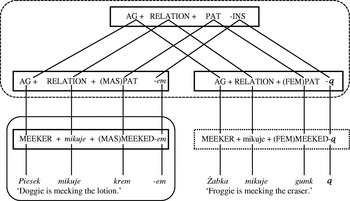
In order to produce the target form in the non-matching gender condition, the child must be able to categorize the input sentences as instances of a more general construction, namely AGENT+RELATION+PATIENT-INS, which has two variants, AGENT+RELATION+PATIENT-em (for masculine nouns) and AGENT+RELATION+PATIENT-ą (for feminine nouns). The child can then use this more general construction to infer something that he/she had not directly experienced, namely, that a verb that takes -em with some nouns will require a different ending, -ą, when used with some other nouns (see Figure 1). A more traditional way of expressing this would be to say that the child knows that the novel verb governs instrumental objects, or assigns the instrumental case. However we choose to capture this knowledge, the point is that the child has access to a generalization that expresses the relationship between the noun and other elements in the sentence, and that the generalization makes reference to an abstract language-specific category, namely, ‘instrumental’. (Note that it is not necessary to assume that the generalization is explicitly represented in the child's, or even the adult's mind: it could be immanent in stored exemplars – cf. Langacker, Reference Langacker1990, 2000; Abbot-Smith & Tomasello, Reference Abbot-Smith and Tomasello2006).
The abstract instrumental construction and its more specific variants.

It could also be argued that in order to select the appropriate ending for the instrumental case, the child needs to know a morphological rule stipulating that while masculine nouns take -em in this case, feminine nouns require -ą – i.e. a rule which makes reference to another abstract and language-specific category, namely gender. Clearly, Polish-speaking children must acquire such knowledge at some point, and there is good evidence that it is acquired very early: Smoczyńska (Reference Smoczyńska and Dan1985) points out that Polish-speaking two-year-olds overwhelmingly use gender-appropriate endings in spontaneous speech and make few gender-agreement errors; and Dąbrowska & Szczerbiński (Reference Dittmar, Abbot-Smith, Lieven and Tomasello2006) show that they also generally correctly restrict endings to the appropriate gender class when inflecting nonce nouns in experimental conditions.
The present experiment, though certainly compatible with the claim that Polish-speaking two-and-a-half-year-olds have access to rules which make reference to gender classes, does not provide conclusive evidence in its favour, since it is possible that the children were able to supply the gender-appropriate forms of high-frequency familiar nouns simply by ‘trying out’ both endings. For example, to supply the correct instrumental form of gumka ‘eraser’, they could assemble both gumką and *gumkiem and then choose the form that sounded familiar.
On the other hand, our data suggest that the children had access to another verb-general case category, namely accusative, since they often used this case to mark the objects of novel verbs which they only heard with instrumental objects.
Local marking
A number of studies have shown that English-speaking children initially use verbs in the constructions in which they experienced them: thus, if exposed to a new verb in one construction they will produce novel sentences with the same argument structure, but are unable to use the novel verb in a different construction (for reviews, see Tomasello, Reference Tomasello2000, 2003). In a typical experiment of this kind, children observe an action (for instance, a toy horse pushing a toy cow down a ramp) and hear linguistic descriptions containing a novel verb in an intransitive construction (Look! The cow is meeking!), a passive (Look! The cow is getting meeked!) or simply as a label (Look! Meeking!). In the second stage of the experiment, the children are shown the same action with different characters (e.g. a dog pushing a cat down the ramp), and the experimenter asks questions about the agent's actions (What's the dog doing?), thus attempting to elicit a transitive sentence with the novel verb (The dog/He/It is meeking the cat). Only about 20% of English-speaking two-and-a-half-year olds and about one-third of three-year-olds succeed in this task; by age four, however, the success rate is about 70% (Tomasello, Reference Tomasello2003: 130).
As we have seen, over 70% of our Polish two-and-a-half-year-olds and all the three-year-olds were able to supply the correct instrumental marking on the object of a novel verb governing the instrumental case even when the noun belonged to a different class than the nouns in the training set, showing that they have access to an abstract instrumental category. Thus, Polish children are able use the instrumental to mark agent–patient relationships with novel verbs considerably earlier than English-speaking children learn to use word order productively for the same purpose, in spite of the fact that the instrumental case is relatively infrequent and clearly part of the ‘periphery’. The reason for this, we suggest, is that case markers are local cues in the sense that one can determine the role the noun plays in the event described in the sentence from the case marker alone, without having to hold the entire sentence in working memory. In the English transitive construction, on the other hand, the identity of the agent and patient is conveyed through word order, an inherently ‘topological’ cue (Kail & Charvillat, Reference Kail and Charvillat1988): that is to say, information about the noun's role is conveyed not by any particular morpheme, but by its position relative to other sentence constituents.
The suggestion that grammatical distinctions conveyed by local cues are easier for children to acquire than those signalled by more distributed cues was first put forward by Slobin (Reference Slobin, Wanner and Gleitman1982), who observed that children learning languages such as Turkish and Serbo-Croatian, which code agent–patient relations using case markers, comprehend transitive sentences earlier than children learning languages like English, which code these relationships by means of word order. More recent research by Lindner (Reference Lindner2003) and Dittmar, Abbot-Smith, Lieven & Tomasello (2006) has shown that within the same language, children exploit local cues in comprehension tasks before they learn to exploit more distributed cues. Most relevant in the context of the present discussion, however, are two recent studies of the acquisition of basic argument structure constructions by German children reported in Wittek & Tomasello (Reference Wittek and Tomasello2005). The first study was basically a replication of the earlier research with children learning English: the authors taught children novel verbs in either active or passive sentences, and then elicited the same verbs in the other construction. In the second study, children learned novel nouns in the nominative or the accusative, and then were invited to produce them in grammatical contexts calling for the other case. The main finding of the first study was that 37% of the children aged 2 ; 10 were productive with the transitive construction, that is to say, they could produce a full active transitive sentence with a novel verb which they experienced only in the passive. Thus, their performance was similar to that of English-speaking children of the same age. In the second study, however, about half of the children were found to be productive with the nominative, and two-thirds succeeded on the accusative trials, providing additional evidence that, other things being equal, case marking is easier to acquire than word order.
How much exposure is needed to acquire the instrumental?
Although even the younger children were able to supply the correct ending in the non-matching gender condition, there are good reasons for thinking that this is a relatively recent achievement. First, their performance was quite unreliable: they supplied the instrumental form less than 50% of the time with masculines, and only 30% of the time with feminines. Secondly, almost a third were not able to supply a single instrumental form in the non-matching gender condition. Finally, in a pilot study with slightly younger children (aged 2 ; 0 to 2 ; 6), we were unable to get them to complete the task: they refused to respond at all when asked to use the instrumental with a novel verb, in both the matching- and the non-matching gender condition.
This allows us to provide a rough estimate of the amount of exposure to instrumental forms that children need in order to discover that two different suffixes, -em and -ą, are used with different sets of nouns (masculines and feminines respectively) to express the same range of semantic functions. The average frequency of instrumental forms in the Marysia corpus is 10·9 per hour. Assuming that this figure is representative, that grammatical development begins at twelve months, and that a typical child is exposed to language for five hours per day, by age 2 ; 6 he or she will have heard about 30,000 noun tokens in the instrumental case (10·9×5 hours×548 days). This figure makes the acquisition of the instrumental appear somewhat less miraculous: it is true that it is acquired relatively early, but only after children have had a considerable amount of experience with the relevant forms.
CONCLUSION
Both generative and constructivist theories predict late acquisition of the instrumental case, though for different reasons. According to the generativists, knowledge about the instrumental is part of the periphery, and hence the acquisition process is not buttressed by innate knowledge encapsulated in Universal Grammar. According to constructivist theories, both ‘core’ knowledge (e.g. knowledge about structural case) and the periphery (lexical case and the actual inflectional endings for all cases) are acquired by relying on the same learning mechanisms; however, one might expect the instrumental to be acquired late due to its relatively low frequency.
In fact, Polish children acquire knowledge about the instrumental case as a syntactic category very early: 72% of the two-year-olds and all of the three-year-olds in our study were able to supply the target ending at least once in the non-matching gender condition; the overall frequency of instrumental responses in the non-matching gender condition was 39% for the two-year-olds and 81% for three-year-olds. These results indicate that children came to the experiment with some relatively abstract knowledge about the instrumental. Thus, on being exposed to a nonce verb with patient nouns of one gender (e.g. Piesek mikuje autobusem ‘Doggie is meeking the bus:M.INS’, Małpka mikuje telefonem ‘Monkey is meeking the phone:M.INS’, Kangur mikuje kremem ‘Kangaroo is meeking the lotion:M.INS’), they were able to categorize them as instances of a general construction (AGENT+RELATION+PATIENT-INS) and hence use the gender-appropriate endings with new nouns of both genders.
Our experiment did not provide evidence for early lexically specific frames consisting of a verb and the ending (e.g. mikuje … em, grusia … ą): not only were most children able to supply the target form in the non-matching gender condition in at least one trial, but in fact, for masculine nouns there was no difference in performance in the two conditions. It is true that with feminine nouns, both age groups performed better with nouns of the same gender as the nouns in the training set; however, this difference is most likely attributable to morphological difficulties with the feminine inflection. The masculine class is larger and phonologically more heterogeneous than the feminine. Both of these factors are associated with productivity, and there is experimental evidence that Polish children tend to be more productive with masculine inflections than with feminines (Dąbrowska & Szczerbiński, Reference Dittmar, Abbot-Smith, Lieven and Tomasello2006). As explained in the Method section, the nouns used in the study occur relatively frequently in the instrumental case in the input, and were thus likely to be available to the children as preconstructed units – but of course there is no guarantee that this was the case. It seems, then, that the most likely explanation for these results is that the children had an abstract syntactic construction, but were not fully productive with the feminine inflection, and thus found it easier to supply the target ending in the matching gender condition – i.e. immediately after they had heard a number of feminine instrumental forms. We cannot, or course, rule out the possibility that younger children rely on more concrete schemas: as indicated earlier, when we piloted the experiment with children aged from 2 ; 0 to 2 ; 6 we were unable to get them to respond at all.
The early acquisition of the instrumental shows that children are able to form abstract language-specific categories with relative ease. It is true that instrumental marking is acquired somewhat later than the accusative and the genitive (cf. Smoczyńska, Reference Smoczyńska and Dan1985), but this can be explained by its relatively low frequency (4% compared to 19% and 12% respectively for the other two cases; see Dąbrowska & Szczerbiński, Reference Dąbrowska and Szczerbiński2006). The early acquisition of the instrumental case thus undermines the claim that different mechanisms are involved in the acquisition of ‘core’ and ‘peripheral’ structures, at least to the extent that this assumption is based on observed differences in the speed of acquisition. It also shows that early and rapid development of an abstract category does not necessarily indicate that development is guided by innate knowledge.
Universal Grammar is generally thought to contain substantive universals (categories such as ‘noun’ and ‘accusative’) and formal universals such as the principles of case theory (V assigns accusative, etc.). Our results show that children are able to acquire language-specific categories (‘instrumental’) and rules (‘mikować assigns the instrumental’) of comparable degrees of abstractness on the basis of information available in the input, without the benefit of UG, and that they are able to do this relatively quickly. This, of course, does not prove that UG does not exist; but it does make much of it redundant, since learning mechanisms powerful enough to learn the instrumental are powerful enough to learn more regular parts of the linguistic system such as the accusative construction.
Finally, we should point out that the fact that children were able to supply the target form in the non-matching gender condition does not necessarily mean that their knowledge about the instrumental case is adult-like in every way. We have already observed that they are not fully productive with the inflectional endings used to signal the case, particularly the feminine ending, which the two-year-olds supplied in only 30% of the trials in the non-matching gender condition. Performance improved considerably with age, but even the three-year-olds did not reliably provide the target forms with familiar nouns which frequently occur in the instrumental. It is also likely that children have not yet learned the full set of uses of this case. Thus, while abstract constructions can emerge very early in some circumstances, children need a great deal of additional experience to consolidate this knowledge.