Introduction
Most older adults do not relocate to long-term care (LTC) homes for the purpose of receiving end-of-life (EOL) support. However, the majority of residents who relocate to LTC both live and die there (Canadian Institute for Health Information, 2017). Further, studies on the location of death across the globe suggest that between a quarter and a fifth of older persons die in LTC homes (Broad et al., Reference Broad, Gott and Kim2013). Hence, supporting a “good death,” which includes addressing symptoms associated with dying (such as pain, shortness of breath, anxiety, and agitation) and enhancing serenity and peace during the dying process, is an important aspect of quality care in LTC (Vohra et al., Reference Vohra, Brazil and Szala-Meneok2006; Fosse et al., Reference Fosse, Schaufel and Ruths2014; Oliver et al., Reference Oliver, Washington and Kruse2014; Steinhauser and Tulsky, Reference Steinhauser, Tulsky, Cherney, Fallon, Kaasa, Portenoy and Currow2015).
While supporting a good resident death is irrefutably important to residents, it is also critical for their family/friend caregivers, whose grief reactions are influenced by their perceptions of a good resident death (Vohra et al., Reference Vohra, Brazil and Hanna2004; Thompson et al., Reference Thompson, McClement and Menec2012; Abbott et al., Reference Abbott, Prigerson and Maciejewski2014; Garrido and Prigerson, Reference Garrido and Prigerson2014; Reinhardt et al., Reference Reinhardt, Boerner and Downes2015). In fact, when caregivers perceive residents to have died a good death, their sense of overall distress and risk of complicated grief are significantly reduced (Boerner and Schulz, Reference Boerner and Schulz2009; Chiu et al., Reference Chiu, Huang and Yin2010). Unfortunately, such positive perceptions of resident deaths are rare in LTC (De Roo et al., Reference De Roo, van der Steen and Galindo Garre2014, Reference De Roo, Albers and Deliens2015; Bolt et al., Reference Bolt, Verbeek and Meijers2019).
Despite the importance of supporting a good resident death and the growing recognition that this outcome may be more of an exception than a rule in LTC, only a handful of researchers have examined care practices that impede or support caregivers’ positive perceptions of resident death in LTC (De Roo et al., Reference De Roo, van der Steen and Galindo Garre2014; Vandervoort et al., Reference Vandervoort, Houttekier and Vander Stichele2014; Bolt et al., Reference Bolt, Verbeek and Meijers2019). Vandervoot et al. (Reference Vandervoort, Houttekier and Vander Stichele2014), for example, explored associations between care practices documented by nurses and perceptions of a good resident death reported by surviving family members. Their finding that a documented advance directive may impact caregivers’ perceptions of a good resident death lends some support to the premise that engaging in EOL communication with families may positively impact their perceptions of a good resident death. Bolt et al. (Reference Bolt, Verbeek and Meijers2019) and De Roo et al. (Reference De Roo, van der Steen and Galindo Garre2014), by contrast, who explored the more narrow outcome of resident peacefulness at EOL found that the availability of nursing staff (De Roo et al., Reference De Roo, van der Steen and Galindo Garre2014) and respect and attention toward residents (Bolt et al., Reference Bolt, Verbeek and Meijers2019) could enhance caregivers’ perceptions that residents died peacefully at EOL. Their collective work suggests that it is direct resident care rather than staff communication that impacts caregivers’ perceptions of residents’ peaceful deaths. Their focus on one component of a good resident death that of peacefulness may explain these divergent results.
A larger body of research has explored the aspects of EOL care valued by family members supporting dying relatives in LTC (Oliver et al., Reference Oliver, Porock and Zweig2005; Munn and Zimmerman, Reference Munn and Zimmerman2006; Vohra et al., Reference Vohra, Brazil and Szala-Meneok2006; Flock and Terrien, Reference Flock and Terrien2011; Jackson et al., Reference Jackson, Derderian and White2012; Gage et al., Reference Gage, Washington and Oliver2016). Findings from this research suggest that staff availability at EOL (Burge et al., Reference Burge, Lawson and Johnston2014), attention to residents’ care needs (Oliver et al., Reference Oliver, Porock and Zweig2005; Munn and Zimmerman, Reference Munn and Zimmerman2006; Vohra et al., Reference Vohra, Brazil and Szala-Meneok2006), good communication with families (Flock and Terrien, Reference Flock and Terrien2011; Jackson et al., Reference Jackson, Derderian and White2012; Oliver et al., Reference Oliver, Washington and Kruse2014; Gage et al., Reference Gage, Washington and Oliver2016), and the availability of privacy during the final days of life (Vohra et al., Reference Vohra, Brazil and Szala-Meneok2006) are all valued and important components of good EOL care. While this work has contributed to a knowledge base that highlights EOL practices of high value to caregivers, it does not identify which, if any, of these practices impact caregivers’ perceptions of a good death in LTC.
Redressing these gaps in the literature, this study examines the relationship between caregivers’ perceptions of care at EOL and their perceptions of a good resident death. It builds on the findings in the literature, which identifies EOL care practices valued by caregivers (e.g., communication, privacy, and attention to residents’ needs) and the scant research that explores if the presence of such care practices supports caregivers’ perceptions of a good death. By identifying care practices that support or impede caregivers’ perceptions of a good resident death, this study hopes to inform directions for practice in LTC that support family caregivers during and beyond the death of their relatives.
Methods
Study design and setting
This study used a retrospective cross-sectional survey design to meet the study aims. It was a component of a larger study aimed at Strengthening a Palliative Approach to Care in LTC (Sussman et al., Reference Sussman, Kaasalainen and Mintzberg2017; Kaasalainen et al., Reference Kaasalainen, Sussman and Thompson2019). The sample was drawn from five LTC homes in Ontario, Canada, purposefully selected to represent the mix of contexts found in LTC homes across Canada (Berta et al., Reference Berta, Laporte and Zarnett2006). More specifically, the homes represented a mix of for-profit (three) and not-for-profit (two); ranged in size from small (two, less than 100 beds) and mid-large (three, 100 beds or more); included context with a high staff turnover (two) and a low staff turnover (three); and comprised of religious-based (two) and secular (three) facilities.
Sample and recruitment
With approval from the institutional review boards at McGill University, Brock University, and McMaster University, caregivers of residents who died in one of five LTC homes in Ontario, Canada, were invited to participate in the study. For recruitment purposes, a caregiver was defined as a family member or friend who took primary responsibility for supporting a resident while they resided in LTC.
Initially, one staff member from each of the participating LTC homes contacted primary caregivers who were documented to have been present during the final days (i.e., last two weeks) of a resident's life. In this initial call, an overview of the study was provided and permission sought to pass the caregiver's name on to the research team. No caregiver was contacted until they had been bereaved for six weeks. Next, caregivers who agreed to learn more about the study were contacted by phone by a member of the research team, who described the study in more detail and confirmed that the caregiver considered themselves to have been a primary support for the deceased resident, and that they were in a position to comment on the resident's experiences in their final days of life (i.e., the last two weeks of life). Those who were eligible and agreed were then sent a study package that included a consent form, the survey package, and a pre-addressed and stamped return envelope.
To encourage participation, three telephone reminders were issued to participants who had been sent the study package (Dillman et al., Reference Dillman, Smyth and Christian2009). The first phone call was initiated two weeks after the package was sent to ensure it was received and all information was clear. During this initial phone call, participants were offered the opportunity to complete the survey by telephone with support from the research staff. The research staff followed up with non-completers two weeks and four weeks after the initial call. A total of 134 eligible caregivers were sent a survey package, of whom 78 (58%) returned and completed the survey.
Measures
Dependent variable
A good resident death was measured using the 14-item Comfort Assessment in Dying with Dementia (CAD-EOLD) scale (Volicer et al., Reference Volicer, Hurley and Blasi2001). This multi-dimensional scale comprehensively captures the elements found to represent a good death, including physical distress (four items: shortness of breath, pain, restlessness, and discomfort), dying symptoms (four items: shortness of breath, gurgling, choking, and difficulty swallowing), emotional distress (four items: crying, fear, moaning, and anxiety), and well-being at EOL (three items: serenity, peace, and calm). Responses for each item were ranged from 1 (a lot) to 3 (not at all), with a combined total score ranging from 15 to 45. When well-being items are reverse coded, higher scores indicate a more positive death. The CAD-EOLD has a reported Cronbach's alpha of 0.85 (Volicer et al., Reference Volicer, Hurley and Blasi2001). The Cronbach's alpha for the current study was similar (0.86). Although the measure was developed to capture death experiences of persons with dementia, the scale captures aspects of dying of importance to the general population of older frail persons at EOL (Flemming et al., Reference Flemming, Calloway and Perrels2017).
Independent variables
Caregivers’ perceptions of EOL care. EOL care was defined as the subjective assessment by the caregiver of the EOL care their family member received in an LTC facility and was measured by the 26-item Family Perceptions of Care Scale (FPCS) (Vohra et al., Reference Vohra, Brazil and Hanna2004). This scale is comprised of 25 items across four subscales measuring: Resident care (e.g., the staff treated my family member with dignity), Family support (e.g., the staff informed me about care options during my family member's last days), Communication (e.g., the staff were friendly to me), and Rooming (e.g., my family member's room offered privacy). The scale also includes one question which invites caregivers to rank order the three items they believe are most important regarding EOL care.
Item responses are on a 7-point Likert scale that ranges from 1 (strongly disagree) to 7 (strongly agree). Total possible scores range from 25 to 175, with higher scores representing more positive perceptions of care. The FPCS has a reported Cronbach's alpha of 0.96 for the full scale and high subscale alphas for resident care (0.95), family support (0.85), communication (0.88), and rooming (0.78) (Vohra et al., Reference Vohra, Brazil and Hanna2004). Our study yielded similar results with a Cronbach's alpha of 0.95 for the full scale and high subscale alphas for resident care (0.90), family support (0.83), communication (0.84), and rooming (0.85).
Characteristics of LTC homes. The size and affiliation of the LTC homes where care was received were also considered as independent variables. Both features have been found to impact EOL care or care more generally (De Roo et al., Reference De Roo, van der Steen and Galindo Garre2014). Care received in small (<100 beds) LTC homes versus mid-large LTC homes (100+ beds) and care received in religiously based (i.e., a home that was identified to service a particular religious community) versus non-religiously based (i.e., secular) LTC homes were compared.
Control variables
Demographic information, such as caregiver age, gender, relationship to the deceased resident (e.g., spouse and adult child), and resident length of stay in LTC, were captured for both descriptive purposes and to use as control variables. These variables have been used as controls in other studies exploring caregivers’ perceptions of a good (Vandervoort et al., Reference Vandervoort, Houttekier and Vander Stichele2014) or peaceful resident death (Bolt et al., Reference Bolt, Verbeek and Meijers2019).
Data analysis
Data management. All paper-based survey responses were entered into the statistical software program SPSS, version 24.0 by a trained RA. All entered data were also cross-checked for accuracy by the second RA.
Missing data. Prior to data analysis, we ran statistical tests on missing data for our primary outcome and independent variables using Little's MCAR test in STATA, version 14.2. Results suggested that missing data in both measures could be considered random [independent variable: χ 2 = 366.78, df = 351, p = 0.27 and outcome variable: χ 2 = 89.99, df = 81, p = 0.23]. Hence, listwise deletion was used when analyzing results for missing cases (Kang, Reference Kang2013).
Statistical analysis. Descriptive statistics were conducted to provide an overview of sample characteristics, the LTC home characteristics, caregivers’ perceptions of care at EOL, and caregivers’ overall perceptions of a good resident death. For descriptive purposes, responses to the FPCS were grouped into three categories: agreement (strongly agree, agree, or mildly agree), neutral, and disagreement (strongly disagree, disagree, or mildly disagree). This was done to simplify the item level reporting for this scale. Bivariate associations between the LTC home characteristics, perceptions of care at EOL, and perceptions of resident comfort in dying were conducted using Pearson's correlation coefficients. A multiple regression analysis was used to examine associations between aspects of EOL care and overall perceptions of a good resident death, controlling for caregivers’ characteristics. Independent variables were entered in a two-step sequence: (1) participants’ background information and (2) aspects of EOL care.
Results
Participant characteristics and study variables
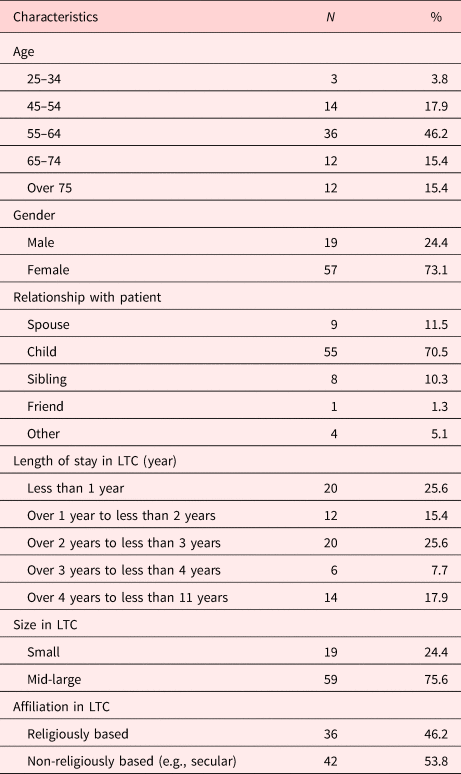
Seventy-eight caregivers completed and returned the survey. Table 1 shows the characteristics of these participants. Participants ranged in age from 25 to 75+ with 46% reporting their ages to be between 55 and 64. The majority of participants were female (73%) and adult children (70%) who had supported residents in LTC for less than 1 year (25.6%) or between 2 and 3 years (25.6%). Caregivers were relatively evenly distributed with respect to LTC home characteristics: residence in mid-large versus small LTC homes (59, 75.6% vs. 19, 24.4%) and non-religiously versus religiously based LTC homes (42, 53.8% vs. 36, 46.2%).
Caregiver demographic characteristics and study variables (N = 78)

Caregiver perceptions of a good resident death
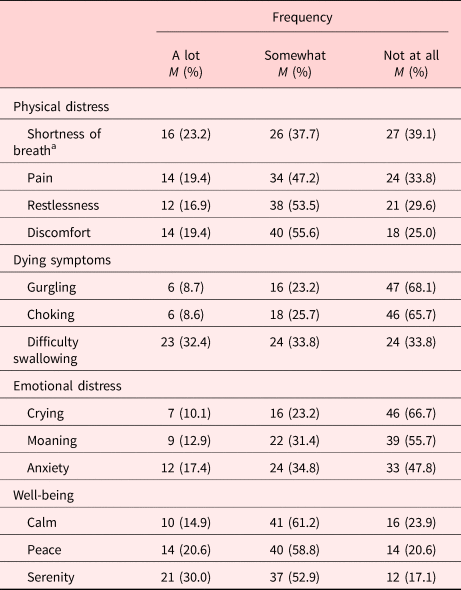
Table 2 shows caregivers’ perceptions of a good resident death. Caregiver participants reported high levels of overall resident comfort and peace (i.e., a good death) (M = 31.66, range = 10–39, SD = 5.86). Specifically, the majority of caregivers reported observing no signs of emotional distress (e.g., crying, moaning, and anxiety) and/or dying symptoms (e.g., gurgling and choking) from their relatives in the final days of life. Physical distress was more commonly perceived at least some of the time, with the majority noting the presence of some shortness of breath, pain, and/or discomfort. Finally, the majority of caregivers reported that peace, serenity, and calm were at least somewhat present during the dying process.
Caregiver perceptions of a good resident death

a The item is also included in the Dying Symptoms subscale.
Caregivers’ perceptions of EOL care
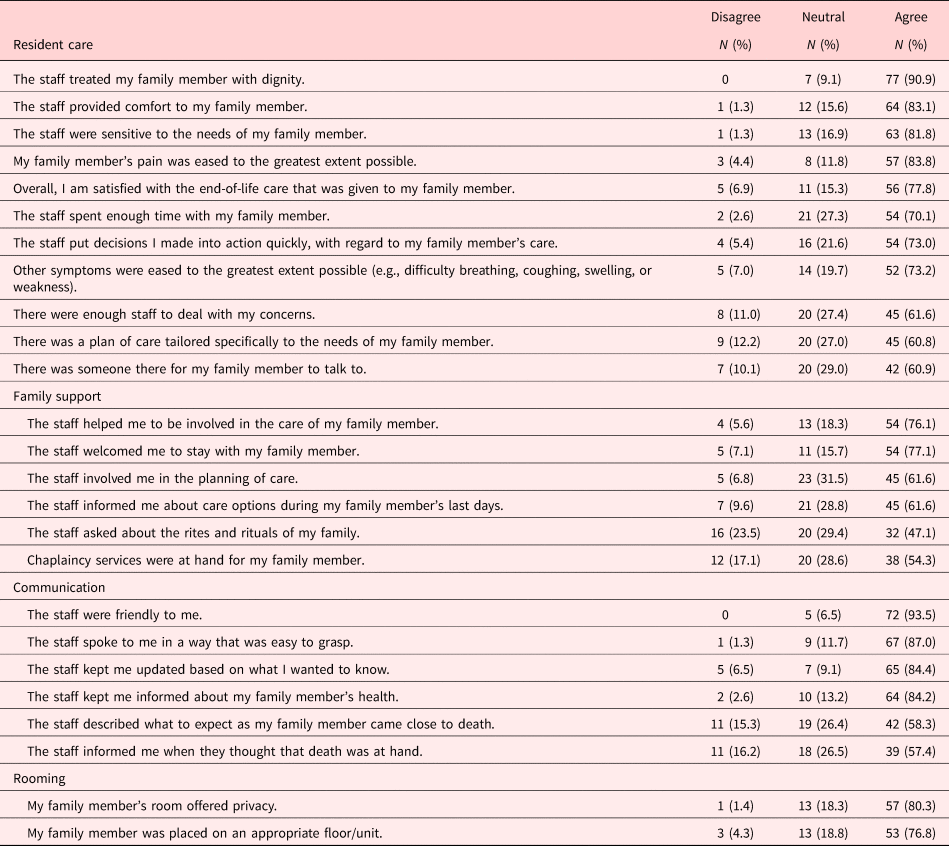
Table 3 shows caregivers’ perceptions of EOL care. Overall, caregiver participants in this study reported positive experiences with EOL care by staff in LTC homes (M = 137.19, range = 25–175, SD = 32.07). However, participants were least likely to agree that they had been asked about rites and rituals, offered chaplaincy services at the EOL, informed that the resident was near death, told what to expect when death was near, and that staff were available for residents to talk to (42% or fewer participants reported the presence of these elements of care). These results suggest that communication and spiritual support during the final days of life were the least consistently available aspects of care.
Caregiver perceptions of EOL care

Participants’ identified the following three items as most important to them: (1) treating their family member with dignity and respect, (2) involving them (family/friends) in the planning of care, and (3) describing what to expect as their family member approached death.
Relationships between aspects of EOL, LTC home characteristics, and a good resident death
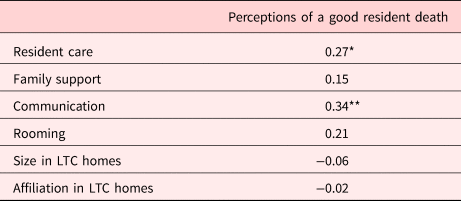
Table 4 reports the relationships between aspects of EOL, LTC home characteristics, and overall perceptions of a good resident death. We found that both communication (r = 0.34, p < 0.01) and resident care (r = 0.27, p < 0.05) were positively correlated with overall perceptions of a good resident death. However, the rest of the EOL care subscales and the LTC home characteristics were not statistically correlated with overall perceptions of a good resident death.
Correlation among study variables

* p < 0.05, **p < 0.01.
Predictors of perceptions of a good resident death
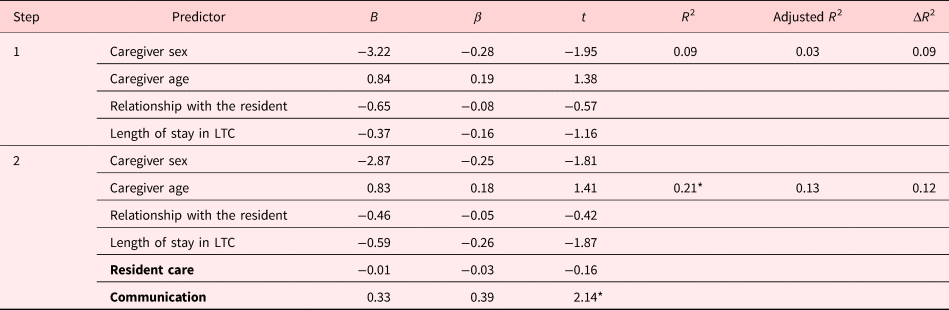
Table 5 reports on the relationship between perceptions of care at the EOL and perceptions of a good resident death, controlling for caregiver characteristic and length of stay. For this analysis, only two of the four perceptions of care variables (i.e., resident care and communication) were included in the analysis as they were the only variables associated with a good resident death at the bivariate level. The first model, explored the relationship between control variables (caregiver demographic variables and length of stay) and perceptions of a good resident death. This model explained 9% of the variance in the overall perceptions of a good resident death; however, the model was not a significant predictor of overall perceptions of a good resident death, F(4, 56) = 1.39, p = 0.25. The second model explored the relationship between resident care and communication and perceptions of a good resident death after controlling for caregiver characteristics and length of stay. This model explained 12% of the variance, F(6, 54) = 2.43, p = 0.03. While communication was statistically and positively associated with overall perceptions of a good resident death: b = 0.33, p = 0.03, 95% CI [0.02, 0.64], resident care was not.
Regression model of perceptions of a good resident death

* p < 0.05.
Discussion
The primary aim of this study was to examine the relationship between EOL care practices and caregivers’ perceptions of a good resident death. Our findings suggest that good communication with family members at EOL bears an important impact on caregivers’ perceptions of a good resident death. Our findings further illuminate that while communication regarding what to expect in the final days of life is an important component of good EOL communication, it is rarely implemented in LTC. This finding builds on the work of Vandervoot et al. (Reference Vandervoort, Houttekier and Vander Stichele2014) who found that conversations with caregivers about resident care preferences at EOL support their perceptions of a good resident death. It also affirms the value caregivers place on discussions about expectations in the final days of life documented elsewhere (Vohra et al., Reference Vohra, Brazil and Hanna2004; Hancock et al., Reference Hancock, Clayton and Parker2007; Parker et al., Reference Parker, Clifton and Tuckett2016). Seen alongside former findings our work suggests that beneficial EOL communication which includes conversations about the dying process may support caregivers’ perceptions of quality EOL care and enhance their perceptions of a good resident death in LTC.
While participants in this study generally reported that residents died a death free of physical and emotional symptoms, such as pain, agitation and strained breathing, peacefulness, serenity and calmness at death, were less frequency reported. This finding affirms that of others who noted up to 46% of resident deaths in LTC were reportedly unpeaceful (De Roo et al., Reference De Roo, van der Steen and Galindo Garre2014, Reference De Roo, Albers and Deliens2015; Bolt et al., Reference Bolt, Verbeek and Meijers2019). One possible explanation for this finding was the relatively infrequent attention to spiritual care issues reported by our study participants, even when residents lived and died in religiously affiliated LTC homes. For example, only half of the participants in our study were offered chaplaincy services at EOL, and less than half were asked about last rites or other EOL rituals, a trend affirmed in the broader literature (Vohra et al., Reference Vohra, Brazil and Szala-Meneok2006; Hamilton et al., Reference Hamilton, Daaleman and Williams2009; Abarshi et al., Reference Abarshi, Echteld and Donker2011; Balboni et al., Reference Balboni, Sullivan and Amobi2013). Seen alongside preliminary support in the literature for the relationship between attention to spiritual issues at EOL and peacefulness and serenity at death (De Roo et al., Reference De Roo, van der Steen and Galindo Garre2014), our findings suggest that attention to spiritual issues in LTC may improve outcomes related to quality dying in LTC.
Practice Implications and Recommendations
Our findings suggest that improving LTC homes staffs’ capacities to engage in discussions about the dying process and to offer spiritual care at EOL may improve caregivers’ perceptions of a good and peaceful resident death. What follows are a series of practice implications and recommendations that may lend themselves to better EOL communication and more consistent attention to spiritual issues in LTC.
Improving staffs’ capacities to discuss death & dying
With the high value placed on communication amongst caregivers, particularly surrounding the final days of resident life, communication around death and dying is of high priority to caregivers. To address this, improvements may be needed to help staff recognize that death may be near and feel equipped with the knowledge and confidence to activate this type of communication (Munn et al., Reference Munn, Dobbs and Meier2008; Waskiewich et al., Reference Waskiewich, Funk and Stajduhar2012).
While staff in LTC are well-positioned to identify clinical indicators that may suggest that death is near, such as decreased participation in social activities, reduced food and fluid intake, and increased time in bed (Cable-Williams and Wilson, Reference Cable-Williams and Wilson2014), their close relationships with residents sometimes preclude them from associating these signs with imminent dying (Cable-Williams and Wilson, Reference Cable-Williams and Wilson2014). To address this challenge, triggering mechanisms, such as the Palliative Performance Scale, can be used alongside clinical judgment to help attune staff to residents who may be transitioning from restorative care to palliative care and remind staff to engage in discussions with their families about symptoms and expectations associated with dying (Gill et al., Reference Gill, Hillier and Crandall2011; Kaasalainen et al., Reference Kaasalainen, Brazil and Kelley2014a). Indeed, when such triggering mechanisms are used to activate EOL communication with families in the form of EOL care conferences, families report having a better understanding of what to expect in the final days of life and feeling involved in EOL care planning (Parker et al., Reference Parker, Clifton and Tuckett2016; Durepos et al., Reference Durepos, Kaasalainen and Sussman2018).
Booklets and informational material designed to describe anticipated signs and symptoms for conditions prevalent in LTC can also serve as resources for staff to support conversations with families about what to expect in the final days of life. This may serve to help families understand “what is happening” as they observe dying symptoms (Pillemer et al., Reference Pillemer, Suitor and Henderson2003; Hebert et al., Reference Hebert, Schulz and Copeland2008; Arcand et al., Reference Arcand, Monette and Monette2009; Sussman et al., Reference Sussman, Kaasalainen and Eunyoung2019).
To ensure broad-based implementation and access to such conversations, training around the implementation of resources must extend beyond clinical staff and include personal support workers/care aides, and other support staff such as dietary and recreation aides (Kaasalainen et al., Reference Kaasalainen, Sussman and Bui2017). These front-line staff provide up to 80% of care for residents living in LTC and are most likely to be present when caregivers visit at night and on weekends during the final days of residents’ lives (Zheng and Temkin-Greener, Reference Zheng and Temkin-Greener2010; Berta et al., Reference Berta, Laporte and Deber2013; Kaasalainen et al., Reference Kaasalainen, Brazil and Kelley2014b).
Improving attention to spiritual care in LTC
Our findings suggested that spiritual issues were those least attended to by LTC staff. Yet, spiritual care represents a critical component of quality EOL care by facilitating the creation of meaning and hope in the face of death (Edwards et al., Reference Edwards, Pang and Shiu2010; Nolan, Reference Nolan2011; Balboni et al., Reference Balboni, Sullivan and Amobi2013). Some challenges associated with attending to spiritual concerns in LTC include limited access to trained spiritual and religious care providers to support and promote such engagement, limited capacity on the part of LTC staff to recognize and engage with spiritual/existential distress (e.g., finding peace, fear of the unknown, and searching for meaning) and discomfort around engaging in discussions about religion, and related existential issues (Tschida, Reference Tschida2012; Gijsberts et al., Reference Gijsberts, van der Steen and Hertogh2019).
Including spiritual counselors as active members of interdisciplinary teams may improve staff comfort in identifying and addressing spiritual issues with residents and/or their families (Tschida, Reference Tschida2012; Landau et al., Reference Landau, Brazil and Kaasalainen2013; Gijsberts et al., Reference Gijsberts, van der Steen and Hertogh2019). If access to on-site support is limited, volunteer-driven spiritual support with oversight by a trained spiritual counselor may be an alternate strategy to increase LTC homes’ capacities to deliver spiritual care to dying residents (Landau et al., Reference Landau, Brazil and Kaasalainen2013).
Improving staffs’ capacities to identify spiritually related issues may also be facilitated by the use of spiritual screening tools developed to guide health providers in exploring how spiritual issues may impact EOL care (Saguil and Phelps, Reference Saguil and Phelps2012). For example, the Faith and Belief, Importance, Community, and Address in Care (FICA) tool includes a series of questions designed to elicit reflections on spirituality and its potential influence on health, including how a patient wishes their care providers to address spirituality in their care (Puchalski and Romer, Reference Puchalski and Romer2000). The Hope, Organized Religion, Personal Spirituality, and Effects on Care (HOPE) tool similarly guides health professionals to ask patients about their personal sources of hope and meaning, their affiliation with organized religions, their personal spiritual practices, and the effect spirituality may have on both their medical care and their EOL care (Anandarajah and Hight, Reference Anandarajah and Hight2001). These tools have shown some promise in helping staff to identify and explore spiritual, religious, and existential issues and should be considered as standard resources to screen for and address spiritual issues in LTC (Keast et al., Reference Keast, Leskovar and Brohm2010).
Study limitations
The findings from this study should be considered in light of four important limitations. First, caregivers’ perceptions captured in this study were based on a small self-selected sample which may have impacted the generalizability of the study results. Second, caregivers retroactively reported on the EOL care provided by LTC staff, and hence, their reports may be subject to recall bias. Third, given the limited sample size, variables that may have impacted caregivers’ perceptions, such as relationship type (e.g., spouse and adult child) or gender, could not be explored. Fourth, this study was cross-sectional and therefore cannot claim causation. Future research exploring the impact of EOL communications on caregivers’ perceptions of death using a larger sample and prospective design is warranted.
Conclusions
This study identified that LTC home staff play a critical role in supporting caregivers’ perceptions of a good resident death. By keeping caregivers informed and prepared for what may transpire at EOL and by addressing spiritual issues, staff at all levels can enhance caregivers’ perceptions that their relative/friend died a good and peaceful death. Practices and programs that improve EOL communication between staff, family and residents, and that empower LTC staff to pay attention to spiritual issues are both timely and warranted.
Funding
This work was supported by the Canadian Frailty Network [grant number SIG 2014-IS].