




No CrossRef data available.
Article contents
- Extract
- Acknowledgements
- I. INTERNAL IMPROVEMENTS AS A POLITICAL FAILURE
- The Political History of Federal Improvements
- A Failure?
- Competing Explanations for Failure
- II. INSTITUTIONAL ARRANGEMENTS AND INTERREGIONAL COOPERATION
- Republican Principles and Legislative Organization: 1789–1822
- A Working Set of Legislative Bargaining Tools: 1824–1837
- Standing Committees and Policy Leadership
- The Tools of Legislative Cooperation
- Adapting to a New Era
- III. STATE BUILDING AND NATION BUILDING IN THE EARLY REPUBLIC
Internal Improvements and the Union, 1790–1860
Published online by Cambridge University Press: 01 March 2005
Article contents
- Extract
- Acknowledgements
- I. INTERNAL IMPROVEMENTS AS A POLITICAL FAILURE
- The Political History of Federal Improvements
- A Failure?
- Competing Explanations for Failure
- II. INSTITUTIONAL ARRANGEMENTS AND INTERREGIONAL COOPERATION
- Republican Principles and Legislative Organization: 1789–1822
- A Working Set of Legislative Bargaining Tools: 1824–1837
- Standing Committees and Policy Leadership
- The Tools of Legislative Cooperation
- Adapting to a New Era
- III. STATE BUILDING AND NATION BUILDING IN THE EARLY REPUBLIC
Extract
A federal role in funding and constructing internal improvements – building roads, canals, and railroads, river and harbor projects, and erecting lighthouses and other aids to navigation – was one of the most persistent and contentious issues of antebellum American politics. Elites based in the various regional economies of the American coastal plain shared an interest in developing the transportation infrastructure of the country: They were isolated from one another by poor inland transportation links and the legacy of colonial trading patterns; furthermore, they were separated from the interior by formidable geographic obstacles. Many Americans also shared the belief that increased interregional communications would strengthen the fragile union by fostering shared economic interests. The case for federally funded internal improvements was thus strong – the program could serve both local and national economic interests as well as a critical nation-building role. Further, promoters made a convincing case that only the federal government could effect the desired projects – the federal budget typically operated in surplus while the states lacked adequate resources, and the states faced difficult coordination problems best solved through national political institutions (see, for example, Albert Gallatin's 1808 plan). Despite all of this, a significant and sustained federal internal improvements program was not achieved, although appropriations did increase long enough for us to identify a short-lived “era of internal improvements” extending from about 1825 to 1837 (18th through 25th Congress). In short, the study of internal improvements is a study of political failure, which we can define as the prolonged failure of a majority to establish its favored policy.
Information
- Type
- Research Article
- Information
- Copyright
- 2004 Cambridge University Press
Acknowledgements
An early version of this paper was presented at the annual meeting of the American Political Science Association (Atlanta, 2000); I would like to thank the members of that panel, especially Andrew Polsky and Ronald Formisano. I would also like to thank the anonymous reviewers for their many helpful comments as well as my dissertation chair, Charles Stewart. Steve Minicucci can be reached through mini@alum.mit.edu. The Consortium on Financing Higher Education is funded by its 31 member institutions and is hosted by MIT.
A federal role in funding and constructing internal improvements – building roads, canals, and railroads, river and harbor projects, and erecting lighthouses and other aids to navigation – was one of the most persistent and contentious issues of antebellum American politics. Elites based in the various regional economies of the American coastal plain shared an interest in developing the transportation infrastructure of the country: They were isolated from one another by poor inland transportation links and the legacy of colonial trading patterns; furthermore, they were separated from the interior by formidable geographic obstacles. Many Americans also shared the belief that increased interregional communications would strengthen the fragile union by fostering shared economic interests.1
Stephen Minicucci, “The ‘Cement of Interest’” Social Science History 25 (2001): 247–74.
The problem of internal improvements is representative of a general class of problems in political economy involving the development and maintenance of cooperation among rival economic regions. Successful nation building would make this cooperation easier, but in this case the object of cooperation was itself a nation-building program. This catch-22 demonstrates the essential relation between state and nation building and the special character of both in antebellum America. State building always precedes nation building because the power of the state must be mobilized in the nation-building effort; indeed, nation building is often little more than an expression and consolidation of state power. In the United States, cultural, institutional, and philosophical constraints confined active nation-building strategies to materialistic policies such as internal improvements and limited the application of cultural approaches such as those described in the “imagined communities” literature.2
Benedict Anderson, Imagined Communities (London: Verso, 1983). E. J. Hobsbawm, “The Nation as Invented Tradition,” in Nationalism, ed. J. Hutchinson and A. D. Smith (1983; New York: Oxford University Press, 1994), 76–83.
For example, see Stephen Skowronek, Building the New American State (New York: Cambridge University Press, 1982), 23.
I argue here that the promoters of internal improvements failed to establish a strong federal program because they were slow to build and effectively use the legislative tools and structures that could facilitate interest-based trades in the national legislature. That is, they needed to attend to state building. Central among these institutions and tools were committee-centered logrolls and the use of omnibus legislation with universalistic distributions of benefits.4
Here, practices are raised to the status of institutions, which some readers may find problematic. They should not. The existence of certain formal institutions and rules within the legislature is a necessary but not sufficient foundation for the practices explored here. Individual legislators must learn to exploit these possibilities and the legislature, collectively, must develop a norm around their use (perhaps modifying other rules and practices to accommodate this) before they will develop their everyday character. For an example, see David Mayhew, “Supermajority Rule in the U.S. Senate,” Political Science and Politics 36 (2003): 31–36.
Stephen Minicucci, Finding the Cement of Interest: Internal Improvements and American Nation Building, 1790–1860 (Ph.D. diss., Massachusetts Institute of Technology, 1998).
The principal source for these data is the United States Treasury Department, Statement of Appropriations and Expenditures for Public Buildings, Rivers and Harbors, Forts, Arsenals, Armories, and Other Public Works (Washington, DC: Government Printing Office, 1881) augmented by United States Treasury Department, “Expenditures in Each State and Territory from 1789 to 1860” (S. P. Chase, Exec Doc No. 9, 37th Cong., 1st Sess., 1861). Spending by the Army Corps of Engineers was allocated to the regions based on annual reports by the Chief Engineer to Congress (Annals of Congress, various years). Contact the author for regional definitions.
Land grant listings were drawn from Arthur H. Cole, “Cyclical Variations in the Sale of Public Lands: 1816–1860,” in Vernon Carstensen, ed., The Public Lands (1927; Madison: University of Wisconsin Press, 1963); and Benjamin Hibbard, A History of The Public Land Policies (Madison: University of Wisconsin Press, 1965). These figures were crosschecked against John Bell Rae, “Federal Land Grants in Aid of Canals,” Journal of Economic History 4 (1944): 167–77, and Harry Scheiber, “State Policy and the Public Domain: The Ohio Canal Lands,” Journal of Economic History 25 (1965): 86–113. The grants were valued at the going federal rate of $1.25 per acre, which is consistent with Treasury (1861) and typical tax expenditure estimation practices.

I. INTERNAL IMPROVEMENTS AS A POLITICAL FAILURE
Federal appropriations for internal improvements amounted to $119.8 million between 1790 and 1860. The bulk of this amount, $77.2 million, was distributed to the states through indirect methods, such as land grants or distributions of land sale revenues, which would today be labeled “off-budget.” And this figure includes the 1836 “deposit” of the federal surplus in state banks, which was not explicitly earmarked for improvements. Thus, the first thirty-five Congresses appropriated $42.6 million in federal funds for improvements to transportation of all sorts. Table 1 breaks down these aggregates into categories, the largest of which is aids to navigation, totaling $14.9 million. Roughly equal amounts were expended on rivers and harbors, taken together, and somewhat less on roads. Of the $10.4 million in direct road spending, the majority was dedicated to the National Road, the single largest federal project of the antebellum era.

Direct spending on improvements, 1790–1860 as a share of outlays.
The bottom-line figure for direct spending is strikingly small both in relation to the aggregate federal budget of the period, $1.7 billion, and to the comparable state and local efforts, estimated by Carter Goodrich at $300 million and $125 million, respectively.8
Carter Goodrich, Government Promotion of American Canals and Railroads (New York: Columbia, 1960).
Veto Messages of the Presidents (Washington, DC: Government Printing Office, 1886).
Daniel Feller, The Public Lands in Jacksonian Politics (Madison: University of Wisconsin Press, 1984), 48. See fn. 23 below.
Total federal outlays were flat between the late 1810s and the early 1840s at about $1.50 per capita (with a peak in the mid-1830s and a trough in the early 1840s) but rose to about $2.50 per capita with the Mexican War and the territorial expansion that followed. Prior to 1812, they were lower still, at about $1.00 per person. See Paul Studenski and Herman Krooss, Financial History of the United States, Second Edition (New York: McGraw-Hill, 1963).
The Political History of Federal Improvements
Aside from regular spending on lighthouses, which never met significant political opposition, the federal government spent very little on internal improvements before the War of 1812. This was not for lack of political interest. The Federalist Party, with the important exception of New Englanders, generally supported improvements. George Washington, in his brief retirement from public service, had made river improvements his primary private concern, becoming president of Virginia's first two river improvement companies, the Potomac Company and the James River Company. Alexander Hamilton expressly supported the policy, but placed it third in importance after the bank and the tariff. For his part, Thomas Jefferson also repeatedly supported improvements in word and action, signing the Cumberland Road bill – the first major federal project – and calling repeatedly for a Constitutional amendment clarifying the federal power. The Constitution was mostly silent on the issue, containing only one reference to the power of Congress to “establish” post roads. Although the Constitutional objection was the most common rhetorical tool used by opponents of improvements, the text never seemed to preclude action, so it is difficult to assess its independent impact.12
At issue here is whether constitutional arguments represented a real constraint or, instead, a legitimating device used by opponents. I take the latter position, though it would take more space than is available here to demonstrate this. One piece of evidence to support this claim is that the constitutional objection took time to take shape and appears not to have played a major role in the earliest debates on post roads, Ohio statehood (and improvements), and so forth. On these, see John L. Larson, Internal Improvement (Chapel Hill: University of North Carolina Press, 2001), 48, 55. I acknowledge that many writers have seen the constitutional argument as adequate. See, for example, Edward Stanwood, American Tariff Controversies in the Nineteenth Century (Boston: Houghton, Mifflin & Co., 1903), vol. 1.
Promoters of federal internal improvements relied heavily upon nation-building arguments to support their cause.13
Minicucci, “The ‘Cement of Interest’.”
George Washington, letter to Richard Henry Lee, Aug. 22, 1785, in Jared Sparks, ed., Writings of George Washington, # vols. (Boston: Ferdin & Andrews, 1838), 9:119.
Letter to Jacob Read, Nov. 3, 1784, in John C. Fitzpatrick, ed., The Writings of George Washington from the Original Manuscript Sources, vol. 27 (Washington, DC: Government Printing Office, 1931). Accessed on-line from the Library of Congress. http://memory.loc.gov/ammem/gwhtml/gwhome.html.
Thomas Jefferson, Annual Message of 1806.
The topic of improvements was extensively discussed in the decade before the War of 1812. The entry of Ohio into the Union in 1802 raised the issue of whether the United States or Ohio should control the public lands in the territory. In a major precedent, the older states retained for the Union full sovereignty over these lands but agreed to allocate 5 percent of the proceeds of land sales in Ohio for building roads to and through the state. As they entered the Union, all other “public land” states (a category that excluded Vermont, Kentucky, and Tennessee before Ohio, and Texas after) made similar arrangements to retain a portion of the proceeds of public land sales. Between 1802 and 1860, inclusive, this method of revenue sharing returned $5.4 million to the states.
In 1806, Congress approved an effort to build a road from Cumberland, Maryland, on the Potomac, to the Ohio River. Alternatively known as the Cumberland Road or the National Road, it later pressed on through Ohio and Indiana and halfway through Illinois as well along what is now U.S. Route 40. It was the single largest project of the antebellum era, with nearly $7 million in federal dollars spent between 1806 and 1841. During the debates on Ohio statehood and on the Cumberland Road, there was apparently no significant discussion of the Constitutional questions involved.
The other major prewar development was the presentation, in 1808, of Secretary of the Treasury Gallatin's comprehensive plan to construct a national system of internal improvements which bridged the Appalachian barrier and improved land and sea transportation along the Atlantic coast.17
Albert Gallatin, Report on Public Roads and Canals (1808; New York: Augustus Kelley, 1968). Excellent summaries are provided in several sources, including: Carter Goodrich, “National Planning of Internal Improvements,” Political Science Quarterly 63 (1948): 16–44; Goodrich, Government Promotion; John L. Larson, “‘Bind the Republic Together’: The National Union and the Struggle for a System of Internal Improvements,” Journal of American History 74 (1987): 363–87; and D. W. Meinig, The Shaping of America, Vol. 2: Continental America (New Haven, CT: Yale University Press, 1993). To summarize, the plan called for two north-south connections: a Maine-to-Georgia coastal road and a parallel coastal waterway with canals to bridge the great necks of Cape Cod, New Jersey, Delaware-Chesapeake, and Dismal Swamp; a set of east-west connections linking coastal rivers and the “western” rivers of the Allegheny, Kanawha, Tennessee, and, eventually, a trans-south crossing to Natchez; improvements to link the Hudson with the Great Lakes and Lake Chaplain and the western river system to the lakes; and, finally, a set of roads to the western terminals of Detroit, St. Louis, and Natchez.
In his report, Gallatin made a number of strong public goods arguments. Federal action was needed because private capital was too scarce, and other uses too profitable, to rely upon private action. And the states could not independently overcome the coordination problems associated with large and interconnected interstate projects. The value of a network of improvements far exceeded the worth of any one project, so the system should be developed all at once. Gallatin also endorsed the older nation-building argument and emphasized the military value of good inland transportation.
Loss of international trade during the period of embargo and war and the military difficulties caused by poor inter-regional transportation under the British blockade led to renewed interest in the home market and in improvements.18
On the shift toward a focus on the internal market, see Daniel Feller, The Public Lands in Jacksonian Politics, (Madison: University of Wisconsin Press, 1984), chap. 2.
Annals 14 (2) 854.
Monroe's announced support of the Bonus Bill veto handcuffed improvements legislation during the early part of his administration. Yet, acting through Secretary of War Calhoun, the President used his discretion to bolster a number of small projects and began to use the Army Corps of Engineers to assist local improvements efforts. In 1822, Monroe vetoed a bill to fund and collect tolls on the Cumberland Road. In an unprecedented step, however, the president used the occasion to present a report titled “Views of the President of the United States on the Subject of Internal Improvements.” In this critical document, Monroe made clear that while the Constitution did not empower Congress to establish any “system” of internal improvements, “To the appropriation of the public money to improvements, . . . I do not see any well-founded constitutional objection.”20
Veto Messages, 52. Although Monroe, like Madison, was careful to preserve his Jeffersonian credentials; the record outlined here suggests that he used all the tools at his disposal to further a developmental agenda. Many historians misread the Cumberland Road veto, and Monroe's overall record, as yet another blow to the improvements effort. Robert Remini, for example, casts Monroe as an unambiguous opponent of public works and points to this very veto as evidence (Henry Clay [New York: Norton, 1991], 225–26). This only leads to confusion. Maurice Baxter can only find Monroe's support for improvements in principle (via a Constitutional amendment) “strange” given the President's opposition to improvements and obvious fear of centralization (Henry Clay and the American System [Lexington: University of Kentucky Press, 1995], 51). The truth is very nearly the opposite: a pro- development Monroe, constrained by a set of institutional assumptions (or, more properly, ambiguities about these assumptions) and pressured by anti-improvements elements of his home constituency, sought a creative solution to his problem. In my view, Charles Sellars was correct in concluding that Monroe “shaped his administration to the National Republican vision of a powerfully activist national state.” The Market Revolution: Jacksonian America: 1815–1846 (New York: Oxford University Press, 1991), 80.
The clarification provided by the veto opened the door for Congress to increase rapidly the level of spending on improvements. The first true river and harbor bill, appropriating $75,000 for the improvement of the Ohio and Mississippi rivers was passed in May 1824. Earlier that year, Congress passed and Monroe approved the General Survey Act (GSA), establishing an official role for the Army Corps of Engineers. Seeded with an appropriation of $30,000, a total of $425,000 was provided to the Corps between 1824 and 1837, with few restrictions, to undertake surveys and plan improvements under the direction of the Executive. Although the act does not explicitly authorize it, much of this activity supported river and harbor projects, which the Corps planned and undertook, as well as road and canal (and railroad) surveys. Forest Hill, who provides an excellent treatment of Army Engineer activities in the entire antebellum era, reports that the Corps made 120 surveys and assisted or constructed 90 projects between 1824 and 1837.21
Forest Hill, Roads, Rails, and Waterways: Army Engineers and Early Transportation (Norman, OK: Oklahoma University Press, 1957).
For some time, Speaker Henry Clay had been linking support for internal improvements with a protective tariff as the cornerstones both for a pro-development strategy of economic nationalism as well as for a political alliance between agricultural regions and emerging manufacturing interests. By 1824, these had been rhetorically linked in a cross-policy linkage that Clay called “the American System.” Fully articulated, the System also included a strong pro-Bank stance with opposition to the reduction of public land prices and a nonaggressive Indian policy, both of which were intended to support orderly development rooted in the East. The System was a main focal point of the presidential election of 1824.22
Remini, Henry Clay. Baxter, Henry Clay and the American System.
The most famous history of this period, Schlesinger's Age of Jackson (Boston: Little, Brown & Co., 1945), seriously misrepresents the role of the American System in this election. He implies that improvements and the American System are already well established and that many emerging Democratic elements oppose the “growing sense of cramp the American System inflicted on the nation” (34). The fact is that improvements as a significant federal activity were only just beginning in 1824 and the “American System” only just crystallizing as a real and rhetorical device. Clay's first reference to the American System in the sense in which we take it here was in his speech on the Tariff of 1824, made on March 30, 1824 (The Life and Speeches of Henry Clay [Hartford, CT: Silas Andus and Sons, 1854], 497–534). Jackson did not run “against” the American system in 1824. (It is fair to say that Crawford did.)
Under the administration of John Quincy Adams, elected in the House of Representatives with Clay's help, presidential support for internal improvements reached its apex. Adams retained a nearly eighteenth-century conception of publicly directed improvements. There was a public duty to achieve “the progressive improvement in the condition of the governed.” In this conception, “roads and canals . . . are among the important means of improvement” but “moral, political, and intellectual improvement” are connected in the same breath.24
John Quincy Adams, First Annual Message to Congress, Dec. 6, 1825.
As noted above, Jackson entered office with a vague pro-improvements stance. As the policy views of his administration and the ideology of the nascent Democratic Party developed, they became increasingly opposed to the American System and to many forms of internal improvements as well. On May 27, 1830, Jackson's initial volley against Clay's vision came when he vetoed a plan to purchase $150,000 in stock in the Maysville, Washington, Paris, and Lexington Turnpike Road Company. While personal tensions may well have been in play in the rejection of a project benefiting Clay's home state, Jackson meant the veto to change policy and followed a consistent course on stock subscriptions thereafter. In his second annual message, on December 7, 1830, he explained that “The practice of thus mingling the concerns of the Government with those of the States or of individuals is inconsistent with the object of its institution and highly impolitic.”25
Veto Messages, 87.
For example, the Gallatin Report, Peter Porter's speech of Feb. 8, 1810 (Annals, 11 [2], 1385–401): Calhoun's report and Bonus Bill positions (Annals, 14 [2], 851–58, 923–33, 1817), and Hemphill's committee report (Register of Debates, 21 [2], app. xxxv–xlii, 1831) all recommended stock buys as a reasonable way of leveraging limited federal resources. This shift is a good indicator of how Jacksonian “republicanism” differed from that of an earlier generation.
John Ashworth, Agrarians and Aristocrats: Party Political Ideology in the U.S., 1837–1846 (New York: Cambridge University Press, 1987).
Jackson followed the Maysville Road veto with a number of other internal improvements vetoes on similar grounds. As his policy emerged, Jackson made clear that projects of a national character were appropriate objects of Congressional action (these included projects related to ports of entry and those dealing with the Mississippi and Ohio River systems). Thus, the link between nation building and improvements was still clearly in evidence. From as early as the Northwest Ordinance of 1787, Congress had declared that the navigable portions of the Mississippi, and of the waters feeding it, were “common highways.” The principle was reinforced in the statehood legislation of Louisiana, Missouri, Iowa, Minnesota, and Wisconsin. The Mississippi system was thus “nationalized by acts of Congress.”28
Issac Lippincott, “A History of River Improvement,” Journal of Political Economy 22 (1914): 630–60, 648.
Jackson's improvements vetoes closed one avenue for transportation-related projects but federal improvements activity, as measured by total spending, continued to rise. The common historical truism that “President Jackson's veto of the Maysville Road Bill essentially ended efforts to implement a national transportation program”29
Meinig, Shaping of America, 334.
Although Jackson did not slow the expansion of federal internal improvements spending, he did bring about a significant shift in its composition away from canals (more than one-third of direct improvements spending under Adams, but less than 1 percent under Jackson) and toward territorial roads and river improvements, especially in the West. While I suggest here that this shift is based in principle, it is fair to wonder about the role that the highly touted “spoils” system played in these geographic shifts. This is difficult to assess. During the Jackson presidency, substantial funds continued to flow toward projects that benefited eastern trading interests not usually seen as pro-Jackson. The Delaware Breakwater project was allocated a total of $1.5 million from the 21st through 24th Congresses, for example, which was approximately equal to the allocation for Mississippi River projects. There is no drop-off in project spending in anti-Jackson New England, though there is a rise in New York state river and harbor activity – perhaps a nod to Martin Van Buren. Alternatively, one could argue that many of these projects were “ripe;” that is, population shifts and other changes made them development priorities.
Indirect spending also reached its apex late in the Jackson administration due to the enormous boom in public land sales in the mid-1830s and the decision to “deposit” the surplus of 1836 into state coffers. The idea of distributing the annual federal surplus to the states had been proposed many times, beginning with the Bonus Bill. In the 1830s, Clay came to emphasize distribution as a more politically expedient way of supporting improvements and maintaining an outlet for the revenues generated by the tariff. Jackson opposed distribution, arguing, in part, that it would make the states too dependent upon the federal government – “a more direct road to consolidation cannot be devised.” With the national debt retired and land sale revenues booming, the surplus in 1836 promised to be extraordinary.30
Veto Messages, 116. More than 20 million acres were sold in 1836 alone. Twice as much land was sold during Jackson's tenure (1829–1836) than during the entire period before (50 million versus 25 million acres). Officially (after the distribution), the surplus was nearly $20 million on a revenue base of $51 million.
Across the nation, the popularity of improvements schemes was never greater than during the last six years of Jackson's administration. State constitutions written during the period, in Tennessee, Michigan, and Arkansas, contained explicit clauses encouraging state support for internal improvements. In part inspired by the success of New York's $7 million Erie Canal, opened in 1825, a number of states undertook very ambitious schemes of improvement and were willing to incur substantial debts to do so. Ohio and Pennsylvania imitated New York's aggressive style first, in the late 1820s, Maryland in the early 1830s, and a host of states by mid-decade. Collectively, the states that borrowed only $25 million during the 1820s, incurred more than $40 million in debt in the first five years of the 1830s, and almost $108 million in the three boom years before the depression.31
The figures, from B. U. Ratchford, American State Debts (Chapel Hill, NC: Duke University Press, 1941), are as follows: 1820–1824, $12.7 million; 1825–1829, $13.7 million; 1830–1834, $41.5 million; 1835–1838, $107.8 million. Of the $172 million in outstanding state debts in 1838, roughly $109 million was explicitly for improvements ($60 million for canals, $42.9 million for railroads, and $6.6 million for turnpikes) and most of the remainder ($54 million) was used to launch state banks, most notably in Louisiana.
The Panic of 1837 brought an abrupt end to both state and federal improvements activities. The federal government was thrown into a deficit for the first time since 1824 and federal improvements spending nearly halted. Suddenly, too, state improvement efforts seemed reckless, not ambitious. As the downturn lengthened into 1841 and 1842, nine states (Florida, Mississippi, Arkansas, Indiana, Illinois, Maryland, Michigan, Pennsylvania, and Louisiana) defaulted on debts, with four of these (Arkansas, Florida, Michigan, and Mississippi) actually repudiating debts of $13.8 million.32
The nine were: Florida, Mississippi, Arkansas, Indiana, Illinois, Maryland, Michigan, Pennsylvania, and Louisiana. The four: Arkansas, Florida, Michigan, and Mississippi.
See Carter Goodrich, “The Revulsion Against Internal Improvements,” Journal of Economic History 10 (1950): 145–69, quoted at 156–57. The New York case is treated by L. Ray Gunn, “The Crisis of Distributive Politics: The Debate Over State Debts and Development Policy in New York. 1837–1842,” in New York and the Rise of American Capitalism: Economic Development and the Social and Political History of an American State, 1780–1870, ed. William Penack and Conrad E. Wright (New York: New York Historical Society, 1989). Democratic divisions are discussed by H. Ershkowitz, and W. Shade, “Consensus or Conflict? Political Behavior in the State Legislatures during the Jacksonian Era,” Journal of American History 58 (1971): 591–621.
The Whig government elected in 1840 was finally able to enact a permanent distribution bill. The 1841 Act also included a general preemption measure and a set of unrestricted grants through which each public land state was to receive 500,000 acres for internal improvements and public education.34
Preemption referred to the preemptive rights of squatters on the public lands to buy these as they came on market. This issue was a perennial one. Up until this time, preemption rights had been granted on an episodic, after-the-fact basis in response to specific crises.
Thomas Donaldson, The Public Domain (Washington, DC: Government Printing Office, 1884), 753.
Hibbard, Public Land Policies, 188.
The untimely demise of William Henry Harrison left the Whig 27th Congress with a virtual-Democratic president in Tyler. This, combined with the fact that the government was still in deficit, led to rather limited internal improvements advances beyond the 1841 Act described above. And the Whig majority was short-lived. Presidents Tyler, Polk, and Pierce all adopted less flexible positions than Jackson on acceptable federal spending, emphasizing more strongly than he projects of national scope. The 1842 river and harbor bill, for example, was almost entirely for improvements on large western rivers. In 1844, Congress prepared two bills. A “Western” rivers and harbors bill, somewhat broader than the 1842 version and including topics such as Great Lake harbor projects, met with Tyler's approval. When an “Eastern” bill appropriating funds for Virginia rivers, the Delaware Breakwater, and a number of other objects was passed later that year, the president vetoed it, however. Congress responded with a smaller version of the bill, which apparently met the president's objections. In 1846, Polk vetoed a very large river and harbor bill (containing at least forty projects and valued at $1.4 million) offering mainly Jacksonian arguments in his message, in particular that the bill was not restricted to foreign commerce and ports of entry. Congress nearly overturned this veto (27–15).
Fiscal stress and Democratic scruples aside, the level of public demand for internal improvements did not subside in the 1840s. The failure to pass a river bill repeatedly led to memorials from western centers such as Cincinnati and Saint Louis. A number of river and harbor conventions were convened as mechanisms to exert pressure on Washington. The first of these was held in Memphis in 1845, followed by meetings in Chicago (1847) and Burlington (1851). The Chicago event was called in response to the Polk veto of 1846 and represented an attempt by Whig organizers to capitalize on an issue which divided Democrats across regions. Writing on the convention, Mentor Williams claims that the veto “shook the northern wing of the Democratic Party to its foundation and gave the Whigs the favorable tactical opening they had long hoped for.”37
Mentor Williams, “The Chicago River and Harbor Convention, 1847,” Mississippi Valley Historical Review 35 (1948): 607–26, 608.
A new surge in spending for improvements began in the 32nd Congress (1851–1853) fueled by the recovery of federal and state public finances, the election of Zachary Taylor, a Whig, to the presidency, and the opening of California. A very large ($2.1 million) rivers and harbors bill, enacted in 1852, funded more than 100 separate projects. Significant sums were also dedicated to surveys for the prospective transcontinental railroad and for wagon roads to California. The technique of offering grants of land as a subsidy for internal improvements, used in the Adams administration to promote canal-building, was used on an unprecedented scale in the 31st, 32nd, and 34th Congresses to promote railroads. Between 1851 and 1857, inclusive, nearly 29 million acres were granted for this purpose alone.
A major shift in the composition of direct spending also occurred in the late antebellum. Much of the late surge in appropriations, especially in the 32nd through 34th Congresses, was due to a dramatic increase in spending for navigational aids such as lighthouses. Typically averaging about $250,000 per Congress, spending on lighthouses suddenly rose to nearly $2 million per Congress. Between the 31st and 35th Congresses, inclusive, $7.8 million was spent on aids to navigation. The rise was geographically broad-based, with only about $500,000 of the total increase attributable to projects on the new coasts of California and Texas. This shift is harder to explain than the increasing desire to aid railroads; there was no dramatic breakthrough in lighthouse technology that created an entirely new outlet for demand. What did happen was a continuous rise in the overall level of inter-sectional trade in the United States. Lighthouses, originally thought of mainly as aids to international commerce, were increasingly seen as central to the rising coastal trade. Coastal trading, always more important than foreign shipping, exploded after 1846.38
Diane Lindstrom, Economic Development in the Philadelphia Region: 1810–1850 (New York: Columbia, 1978).
The return of Democrat Franklin Pierce to the White House renewed interbranch conflict on internal improvements. Pierce took a very hard line on improvements, vetoing a number of appropriations based on Constitutional objections. With the new pro-improvements Whig-Republican majority in the House, there were enough votes in Congress to override Pierce's vetoes of river projects five times in 1856. Pierce, with a strong southern presence in his inner circle, was able to overlook any principled opposition he may have had long enough to seek the Gadsden Purchase in 1853 in order to bolster the Southern Pacific railroad route. An economic downturn again slowed spending in the late 1850s. President Buchanan took a position similar to his predecessor and pocket vetoed two river bills.
The debate over how best to bridge the vast expanse between the Mississippi and California was the last critical episode in antebellum internal improvements. In a rerun of now antique Appalachian arguments, establishing good western communications was deemed urgent so that the government could dispatch troops for effective defense. Secretary of War Jefferson Davis, in what proved to be ironic recollection of Washington himself, argued that “unless there could be a constant and speedy interchange of intelligence and goods between the people on the east side of the Rockies and those on the other, estrangement would arise and eventually political separation might occur.” There was a new surge in federal road-building in the 1850s, beginning in Minnesota in the first half of the decade, and following northern (from Minnesota via the Nebraska Territory), southern (via New Mexico), and central (through Utah) routes west to the Pacific, and to establish basic transportation in Oregon and Washington.
My overall sense of these figures is that reasonably equal efforts were made on all three latitudes: I count $220,000 explicitly for very northern routes west, $480,000 for roads in Oregon and Washington, $465,000 for southern ones (including roads within New Mexico and Arizona), and $387,000 for wagon roads passing through Utah. The key trans-Mississippi link, however, was the much talked about Pacific railroad. Again, Southerners, no less than Northern developers, sought the most advantageous route for the coming railway. Indeed, Southerners may have desired the route more earnestly, now that so many were convinced of “southern decline” and sought solutions for it. The choice of a route was critical and was the key obstacle to a prewar resolution of the issue; with northerly, southerly, and central routes practicable, a majority was always opposed to each specific proposal.39
Robert Russel, Critical Studies in Antebellum Sectionalism, Contributions in American History, no. 7 (Westport, CT: Greenwood, 1978), 113, 115.
The importance of the Pacific rail issue is generally overlooked. As a new Representative from Illinois in 1845, Stephen Douglas was very interested in a Chicago terminus for the railroad. He recognized that this required the organization of the Nebraska Territory, and sought out a position on the Committee on Territories. Several multiple-route bills were introduced in the early 1850s, but were impractical. Northerners were generally able to block single southern routes by insisting that no single state (Texas) receive too much direct aid. Southerners had a stronger ploy to use against single northern routes because all of these required the organization of the Nebraska Territory and therefore raised Missouri Compromise issues, the specter of slavery, and the promise of crisis. With this complication hanging over Northern aims and Davis at the War Department, Southern interests had an advantage. Davis surveyed three routes, two of which were southern (one from Fort Smith, Arkansas, and the other roughly from Fort Leavenworth), and excluded Douglas's middle route altogether (opting for a Northern route from St. Paul). The significance of the Gadsden Purchase has already been noted. An interesting counterfactual in American history would begin by assuming that a southern rail link was actually commenced in the mid-1850s.40
Ibid., 138.
Douglas's efforts to open Nebraska were ultimately successful, leading to the Kansas-Nebraska Act of 1854 and a flurry of railroad proposals from the territories. Both Potter and Russel make excellent cases that the railroad was Douglas's main motivation all along.41
David Potter, The Impending Crisis: 1848–1861 (New York: Harper & Row, 1976), 170. Russel, Critical Studies.
Figure 2 provides a visual summary of this long history. It plots both direct appropriations and indirect spending in per capita terms for each of the first 35 Congresses. The shift toward land grants is evident beginning with the 27th Congress (1841–1843) as is the elevation in direct appropriations from the 18th Congress, the last of Monroe's presidency, through the 25th, the first of Martin Van Buren's (1825–1839).

Direct appropriations and indirect spending per capita, 1st through 35th Congress.
A Failure?
To label this or any other proposed program a political failure is problematic. Many proposals are rejected or fail because of inadequate resources or lack of support. Failure implies more. The case of internal improvements was a political failure because resources were adequate to meet a compelling public interest for which adequate political support was at least potentially available. Each of these criteria is treated briefly below.
While sensitive to the budget surplus, appropriations for internal improvements rarely strained the nation's fiscal capacity. This is especially evident if the deficit years associated with the War of 1812 and the Mexican War are excluded. Improvements appropriations were about one-half as large as the operating surplus for the accumulated years between 1791 and 1860, but only 19 percent as great if 1812–1815 and 1847–1849 are set aside. Stated another way, only 16 percent of available resources (including what was spent and what was not in the denominator) were used for this purpose during peacetime. Even during the eighteen years in which internal improvements appropriations were greater than $1 million, they amounted to only one-third the size of the surplus (34.5 percent), and thus represented only about one-quarter of all available resources. Figure 3, which plots appropriations in thousands of dollars for internal improvements and the surplus, visually reinforces this conclusion. There were plenty of resources available for this purpose.
That there were adequate objects on which to expend infrastructure dollars does not appear to be disputed. Numerous testimonials describe the difficult transportation conditions of the antebellum era and project proposals were often long-standing. After the Civil War created a strong pro-improvement Republican majority, Congress had no difficulty in sustaining appropriations, or of finding projects to spend them on. Even before the War, roll calls in Congress typically evinced modest majorities in favor of improvements. In 334 House roll calls relating to internal improvements between the 14th and 35th Congresses (1815–1859), 54.5 percent of members cast a pro-improvement vote. Constituencies in favor of improvements can be found in every American region, including the Southeast where opposition was strongest. With the exception of tidewater Virginia (but not the west), Georgia, up-country South Carolina (but not Charleston), and Cape Fear North Carolina (but not Albemarle), every region produced pro-improvements congressional delegations at least some of the time. The success of promoters in securing state-level majorities is further evidence of strong popular support for public spending on improvements.

Improvements spending and the surplus.
The failure to consistently mobilize this apparent majority suggests that the root problem was institutional. This conclusion follows the basic public choice insight that stable majorities based only on preferences are rare. Only the addition of institutional constraints leads to “structure-induced” democratic equilibria.42
Kenneth Arrow, Social Choice and Individual Values, 2d ed. (New Haven, CT: Yale University Press, 1963). Richard McKelvey, “Intransitivities in Multidimensional Voting Models,” Journal of Economic Theory 12 (1976): 472–82. Kenneth Shepsle, “Institutional Arrangements and Equilibrium in Multidimensional Voting Models,” American Journal of Political Science 23 (1979): 27–59.
An emerging literature in American political development has emphasized that securing majorities was a central problem faced by the legislatures of the early republic and that a poverty of institutions was at least partly at fault. Calvin Jillson and Rick Wilson argue that the Continental Congress lacked the institutional framework, and especially the “stable leadership structures,” needed to schedule and constrain debate and in general counter the instability of majority rule. The absence of such structures allowed the free play of sectional and centralization jealousies, leading to the failure of the “nationalist” coalition. In the last years of the Congress, no majorities of any sort could be reliably obtained. John Aldrich makes similar claims about the early Congresses that met under the new Constitution. “Majority voting” in the First and Second Congress, he writes, “was highly unstable, shifting, and chaotic.”43
Calvin Jillson and Rick Wilson, Congressional Dynamics: Structure, Coordination, and Choice in the First American Congress. 1774–1789 (Palo Alto, CA: Stanford University Press, 1994). John H. Aldrich, Why Parties? (Chicago: University of Chicago Press, 1995), 76.
Competing Explanations for Failure
Most of the older literature on internal improvements focused on reversing the myth that American economic policy had always been based on the principle of laissez faire, not on explaining the relatively low level of appropriations.44
Internal improvements illuminate many themes in antebellum business-government relations. Carter Goodrich, editor, Government and the Economy, 1783–1861 (Indianapolis, IN: Bobbs-Merrill, 1967) is helpful here, as is Robert Lively, “The American System: A Review Article,” Business History Review 29 (1955): 81–96; and Harry Scheiber, “Government and the Economy: Studies of the “Commonwealth” Policy in Nineteenth-Century America,” Journal of Interdisciplinary History 3 (1972): 135–51. Improvements problems are central to the development of corporation and corporation law. On this, see Guy Callender, “The Early Transportation and Banking Enterprises of the States in Relation to the Growth of Corporations,” Quarterly Journal of Economics 17 (1902): 111–62, and Morton Horwitz, The Transformation of American Law: 1780–1860 (Cambridge, MA: Harvard University Press, 1977). Among important themes not discussed here is the literature that focuses on the economic impact of improvements efforts. See, for example, Robert Fogel, The Union Pacific Railroad: A Case in Premature Enterprise (Baltimore, MD: Johns Hopkins University Press, 1960); Albert Neimi, “A Further Look at Interregional Canals and Economic Specialization: 1820–1840,” Explorations in Economic History 7 (1970): 499–520; John Bell Rae, “Land Grants in Aid of Canals,” Journal of Economic History 4 (1944): 167–77; and Roger Ransom, “Canals and Development: A Discussion of the Issues,” American Economic Association Papers and Proceedings 54 (1964): 365–76; “Social Returns from Public Transportation Investment,” Journal of Political Economy 5 (1970): 1041–60; “A Closer Look at Canals and Western Manufacturing,” Explorations in Economic History 8 (1971): 501–8; and “Public Canal Investment and the Opening of the Old Northwest,” in Essays in 19th Century Economic History: The Old Northwest, ed. David Klangaman and Richard Vedder (Athens, OH: Ohio University Press, 1975).
Callender, “Early Transportation and Banking Enterprises,” 111.
Oscar Handlin and Mary Handlin, Commonwealth: A Study of the Role of Government in the American Economy: Massachusetts. 1774–1861 (Cambridge, MA: Harvard University Press, 1947). Louis Hartz, Economic Policy and Democratic Thought: Pennsylvania. 1776–1860 (New York: Cambridge University Press, 1948). An example of a state-level study is Milton Heath, Constructive Liberalism (Cambridge, MA: Harvard University Press, 1954).
Larson, “Bind the Republic Together.”
See Goodrich, “Revulsion;” Gunn, “Crisis of Distributive Politics;” and Wiley Hodges, “The Theoretical Basis for Anti-Governmentalism in Virginia: 1789–1836,” Journal of Politics 9 (1947): 325–54.
Students of internal improvements have offered many explanations why the central government failed to develop a national system of internal improvements. Carter Goodrich offers a broad list, including hostility to taxation, disapproval of public subsidies of private enterprise, fear of centralization, and a belief in state-level capacities to effect improvements. In Goodrich's view, however, the most important barrier to federal improvements was that commercial rivalries blocked particular and combined projects.49
Goodrich, Government Promotion, 45.
John L. Larson reviews this same history up to the election of Andrew Jackson in an attempt to explain why no Gallatin-like plan of improvements was ever adopted. Where Goodrich decided finally that commercial rivalries were the key barrier to action, Larson points to a fear of consolidated federal power: An improvements plan implied the “power to guide development from the center” but there was a “lingering fear of just such consolidated power.” He writes,
A national system of internal improvements promised to consolidate the union of the United States, and that is precisely why no program ever passed. Too few people desired such a national union.50
Larson, “Bind the Republic,” 365, 384.
It is not possible to distinguish between these two conflicting explanations – fear of consolidation and the failure of commercial rivals to cooperate – because they are rooted in the same fundamental political economic problem, a fear of exploitation. The political problem is to overcome the mutual distrust that inhibits interregional cooperation. Nation building would facilitate cooperation by fostering shared conceptions of interest, increasing the chance that legislators can escape the zero-sum game of competition and rivalry and value projects benefiting other regions (either because they help the country or because of the recognized economic links between regions). This path to cooperation was of limited use to the supporters of internal improvements; they were attempting to enact the very program of nation building that would produce this hoped-for cooperation. Before they could be nation builders, the promoters of improvements had to be state builders. They had to develop legislative tools designed to secure policy trades.
This analysis focuses on the legislative institutions of cooperation. This is consistent with the view that both the antebellum state and the “state of courts and parties” were centered in Congress. A complete model of antebellum political dynamics, however, would pay more attention to the executive than is possible here. Democratic presidents are, after all, the key obstructionists in the historical sketch presented above: first as hard-line constitutional guardians (Madison's veto of the bonus bill is especially noteworthy), then as keepers of an exaggerated Jacksonian purism. While a majority of the Democratic Party was opposed to federal improvements, this majority is large only during Polk's presidency. As noted below, the actions post-Jackson presidents are most intelligible in the context of the two-thirds nomination rule and other explicit efforts to placate the southern minority by exaggerating their power.
II. INSTITUTIONAL ARRANGEMENTS AND INTERREGIONAL COOPERATION
The history sketched above can be broken down into three legislative eras: a long opening period of inaction and indecision; a decade or so of successful improvements appropriations; followed by an equally long period of collapse that showed signs of recovery as the Antebellum moved to a close. This suggests two distinct puzzles or questions. First, what blocked federal improvements in the Federalist and Jeffersonian eras? Put another way, what was new in the Adams and Jackson years? In brief, my answer is that action required effective use of the legislative tools of interest-based trades but these were underdeveloped and viewed with suspicion in the early republic. During the second historical period, the era of internal improvements, Congress did use these tools – the logroll, the universalistic omnibus, and committee-centered bargaining – and appropriations rose. The collapse of appropriations creates a second puzzle: Why did it take so long to revive spending? In the third period, legislators had to readapt these tools to a new era dominated by mass-based parties that were designed to elect presidents, not promote policies, and to avoid, rather than address, competing regional demands.
Republican Principles and Legislative Organization: 1789–1822
Jefferson's political reservations regarding internal improvements legislation were that it fostered an unseemly pursuit of localism and appeared to require unacceptable lawmaking techniques, such as logrolling. These conflicted both with Jefferson's classical republican concern about “corruption” and with his idealized model of legislative organization. Jefferson revealed his reservations as early as 1796, when Madison proposed building a national road from Maine to Georgia as part of a Post Office bill. Jefferson wrote to Madison that the proposal would be “a source of boundless patronage” and the “cause of eternal scramble among the members, who can get the most money wasted in their State. . . .”51
Thomas Jefferson to James Madison, Mar. 6, 1796. Digi- tal collection of Thomas Jefferson Papers viewed online at http://memory.loc.gov/ammem/mt.html/mt.home.html. These documents were originally drawn from The Works of Thomas Jefferson,12 vols., Federal ed., collected and edited by Paul Leicester Ford.
Thomas Jefferson to Albert Gallatin, Oct. 13, 1803, viewed online at Library of Congress site.
Cited in Philip Jordan, The National Road (Indianapolis, IN: Bobbs-Merrill, 1948), 79.
The Gallatin Plan was a direct outgrowth of republican disgust with legislative deal-making and reveals the republican approach to the problem. John Quincy Adams (at this time still an opponent of improvements) called for the plan in response to a proposed vote trade between Senator Bayard of Delaware, seeking aid for the Chesapeake and Delaware Canal, and Senator Clay of Kentucky, seeking aid for a canal to circumvent the falls at Louisville. Adams was unable to carry the measure, but a successful copy was introduced by a strong supporter of improvements, Thomas Worthington of Ohio, a few weeks later. To Adams's republican scruples, an orderly, balanced plan was the reasonable approach; the idea struck a chord with Jefferson and Gallatin as well.
The extraordinary circumstances of embargo and war helped to guarantee that the Gallatin Plan would not pass, yet neither did any Gallatin-like plan in the years following the war. A major reason was that the comprehensive character of these efforts made distributive politics a one-time, high-stakes game. The fact that plans for a second National Road were developing very slowly underscored the risks of being excluded from the initial systemic internal improvements bill. Another omnibus may not be coming along. Because exclusion from a national bill would seriously disadvantage a region in commercial competition with assisted regions, it was rational for local promoters of internal improvements to try to block any federal action in which they were not assured inclusion. Without the dimension of repeated play, there was little to reassure those initially excluded that the initial beneficiaries would reciprocate. Indeed, once they have their project, the initial winners had even more incentive to renege. Joseph Hemphill, while chairman of the Committee on Roads and Canals in 1831, wrote that the effort to enact whole systems of improvements led only to “procrastination.” “The wisdom and experience of legislative bodies constitute the tribunals which govern as the objects are presented.”54
Annals 21 (2): app.: xl.
In order to translate a potential majority for interregional cooperation into sustained action, institutional mechanisms must be adopted that provide a framework promoting repeated play and coordinating and even enforcing distributive trades over time. The forum for repeated play was the ordinary annual appropriations process. The institution which could manage the process over time was the standing committee.
Funding for internal improvements was brought into the realm of the general appropriations process by Monroe's veto message of 1822. This one act ended efforts to create a system of improvements in one blow and effectively began the real effort to build such a system incrementally. Daniel Feller agrees with this interpretation, arguing that the veto presented a critical opening and a real “retreat from strict construction.”55
Feller, Public Lands, 57.
A simple test supports the claim that the 1822 veto was the critical moment in this narrative. I segmented a regression model that predicts appropriations for internal improvements into two regimes divided by the veto. If the hypothesis that Monroe's veto removes a political block is true, fiscal and economic conditions should affect appropriations, but only after 1822. The model, presented in Table 2, predicts appropriations by Congress using the surplus, public lands revenue (a proxy for revenue windfalls and the degree of development pressure), the total land area of the U.S. (also an indicator of demand), and a business cycle indicator, the monthly average of the Cleveland Trust Company index of business activity for each congress.56
D. Diamond and J. Guilford, U.S. Economic History (Morristown, NJ: General Learning, 1973), 70–71.

where MONROE equals one after the veto (1823). The model also includes political variables indicating the existence of divided government and the extent of Whig control of the government. The latter variable ranges from 0 to 3, indication the number of the House, Senate, and presidency controlled by Whigs, National Republicans, or modern Republicans. Following the usual story about government gridlock, divided government is expected to be associated with lower spending.

In the baseline (pre-veto) period, very few of the independent variables evince any degree of predictive power. (Land sale revenues are, however, positively related to road appropriations.) After the veto, spending levels generally respond as predicted to changes in the independent variables, with the level of surplus and the business cycle indicator strongly predictive. The veto lever itself (the modified constant term) is positive and significant. Finally, the divided government marker has the anticipated dampening effect on spending, but the Whig indicator has a negative overall effect, perhaps because of the particular situations of the few Whig governments. (I do not code Tyler as a Whig.) When the model in Table 2 is rebuilt using the Maysville Road veto as the key policy lever, it performs less well, with only the surplus and business index remaining significant and the marker for the policy positive and insignificant where we would have expected it to be negative.
A Working Set of Legislative Bargaining Tools: 1824–1837
The above analysis speaks to when and why appropriations for internal improvements rose, yet it says nothing about how or who. Although there is some debate about the scope and efficacy of each technique, there is a general consensus that majorities for distributive legislation in the modern Congress are crafted through explicit and implicit vote trading (logrolls and reciprocity systems), universal distribution of benefits, and simultaneous coordinated action through omnibus bills. The job of coordinating and managing this legislation goes to party and especially committee leaders.
Standing Committees and Policy Leadership
During its developmental phase, Congress employed committees extensively for the explicit purpose of collecting information and drafting legislation. Initially, the vast majority of these were select committees, often created with explicit instructions regarding bill creation, and typically completing their work in six months or less.57
Charles Stewart et al., “Taking Care of Business: The Evolution of the House Committee System before the Civil War,” paper presented at the 1995 annual meeting of the American Political Science Association. See Table 9.
Jeffery Jenkins and Charles Stewart, “Order from chaos: The transformation of the committee system in the house, 1816-1822,” paper presented at the annual meeting of the American Political Science Association, 1997.
A quick look at four “distributive” committees – roads and canals, commerce and manufacturing (commerce after the 16th Congress), public lands, and post offices and post roads – that handled improvements legislation suggests that these committees enjoyed a stability of membership and leadership that emerged after the War of 1812 and peaked during the period I have dubbed the “Era of Internal Improvements.” Table 3 tracks the average number of terms served by members of these committees, counting discontinuous periods of service; an asterisk marks whether the chair of the committee served as chair in some previous congress. The latter three of these are standing committees by the 10th Congress (1807–1809), when the table begins, the Committee on Roads and Canals was a select committee between the 14th and 22nd Congress, when it became a standing committee as well. The table then shows a dramatic drop-off in both the average tenure of committee members and, especially, the number of returning chairs after the 25th Congress (1837–1839). The Committee on Roads and Canals, in particular, experienced a significant rise in membership stability between the 19th and 25th Congresses (1825–1839) and had only two chairs (Hemphill, PA, and Mercer, VA) between 1821 and 1839. Across these four committees, average tenure drops by one-third between the era of internal improvements (19th through 25th Congresses) and the late antebellum (26th through 35th Congresses) and the number of returning chairmen drops from two-thirds to only 10 percent. Some of this decline in stability is due to increased turnover in the House (mean terms of service fell by 19 percent over the same period) but this does not explain the entire fall. The Committee on Post Offices and Post Roads shows more stability than the others, but also never amasses a very experienced membership. The drop-off in average tenure in the Commerce Committee is the most dramatic largely because Thomas Norton of Virginia, chair of the committee between the 10th and 19th Congress (1807–1827) and member for three terms after that, brought up the experience mean for the whole seven-member committee. The decline in committee stability corresponds to the collapse of appropriations for internal improvements, suggesting some relationship between the two. Below, I argue that the newly established committee system had to adapt to an even newer partisan era, and this took time.
The Tools of Legislative Cooperation
Supporters of internal improvements employed universalism, the legislative omnibus, and logrolls in order to develop and maintain a working coalition. The use of these tools tracks the committee history noted above: each began slowly, was used extensively during the period of high appropriations, and fell into disuse during the late Antebellum.
Universalism and the Legislative Omnibus. Students of distributive politics in the modern congress have found that distributive legislation is generally enacted with larger than minimum winning coalitions, that these super-majorities are typically facilitated through simultaneous action – the legislative omnibus – and results in a universalistic distribution of benefits.59
Since it seems reasonable that members of a winning majority would seek to exclude others in order to maximize their own benefits, following William Riker (The Theory of Political Coalitions [New Haven, CT: Yale University Press, 1962]), this finding presents a puzzle. Several promising responses have been offered. Barry Weingast reasons that legislators uncertain of their participation in this or future coalitions have an interest in an inclusive process (“A Rational Choice Perspective on Congressional Norms,” American Journal of Political Science 23 [1979]: 245–63). Niou and Ordeshook argue that legislators have an electoral incentive to deliver some district benefits, no matter how small or economically inefficient (“Universalism and Congress,” American Journal of Political Science 29 [1985]: 246–58). Several political scientists have claimed to find super-majorities for distributive legislation, including E. E. Schattschneider on tariffs (Politics, Pressures, and the Tariff [1935; Hamden, CT: Archon Books, 1963); John Ferejohn (Pork Barrel Politics: Rivers and Harbors Legislation:1947–1968 [Palo Alto, CA: Stanford University Press, 1974]) and Arthur Maass (Muddy Waters: The Army Engineers and the Nation's Rivers [Cambridge, MA: Harvard University Press, 1951]) on twentieth-century river and harbor bills; Rick Wilson on turn-of-the-century river and harbor bills (“An Empirical test of Preferences for the Political Pork Barrel: District Level Appropriations for River and Harbor Legislation:1889–1913,” American Journal of Political Science 30 [1986]: 729–54); and John Manley on tax policy (The Politics of Finance [Boston: Little Brown, 1970]). Still, the existence of widespread universalism has been challenged by Robert Stein and Kenneth Bickers (“Universalism and the Electoral Connection: A Test and Some Doubts,” Political Research Quarterly 47 [1994]: 295–317).
The issue is complex, as many behaviors similar to logrolling have been studied. Morris Fiorina describes norms of reciprocity (“Universalism, Reciprocity, and Distributive Policy Making in Majority Rule Institutions,” in Research in Public Policy Analysis and Management, ed. John P. Crecine (Greenwich, Conn.: JAI Press, 1981), 1:197–221); Douglas Arnold discusses queuing systems (Congress and the Bureaucracy: A Theory of Influence [New Haven, CT: Yale University Press, 1979]); and Gary Cox and Matthew McCubbins explore the relationship between party systems and universalism (Legislative Leviathan [Berkeley: University of California Press, 1993]). Barry Weingast provides additional insights (“Reflections on Distributive Politics and Universalism,” Political Research Quarterly 47 [1994]: 319–27). Universalism may even be institutionalized in formulae like the modern highway distribution (James Murphy, “Political Parties and the Pork Barrel: Party Conflict and Cooperation in House Public Works Committee Decision Making,” American Political Science Review 68 [1981]: 169–74; Douglas Arnold, “The Local Roots of Domestic Policy,” in The New Congress, ed. T. E. Mann and N. J. Ornstein, [Washington, DC: American Enterprise Institute, 1981]). The evolution of universalism in improvements distributions provides insights to the modern debate. In particular, I note that super-majorities of coastal districts received lighthouse construction funds in sequences of appropriations (like Arnold's queue) well before the practice of passing large omnibus bills that simultaneously achieved this goal.
Melissa Collie, “Universalism and the Parties in the U.S. House of Representatives, 1921–1980,” American Journal of Political Science 33 (1989): 865–83.
Aldrich, Why Parties?
Leonard D. White, The Jacksonians: A Study in Administrative History, 1829–1861 (New York: MacMillan, 1954).
Aldrich, Why Parties? 107.

The simplest technique for ensuring universalism is to act simultaneously through what became known as the legislative omnibus. The use of omnibus bills follows the same track as the other techniques. Figure 6 plots all identified appropriation acts for internal improvements (n=254) by the number of projects (plotted on a logarithmic scale) as well as the average number of projects funded per act during the calendar year. Lighthouse bills are identified separately in black. The total number of omnibus bills shown depends upon the definition: 52 acts if a low threshold of 10 or more projects is used, but only 19 with as many as 50 projects and only 6 with 100 or more. These bills have a large effect on spending: Almost 10 percent of all direct and indirect spending was authorized in the 6 largest acts, and almost half in the 20 percent of acts that included 10 or more projects. The pattern followed in this chart is similar to the two exhibits on committee stability and universalism, above. Only a handful of bills include as many as 10 projects before 1820. During the era of improvements, about one-third of all bills can be described as omnibuses. This drops after 1837. Between 1850 and 1860, only 8 non-lighthouse bills can be described as omnibuses. Table 4 summarizes the data.
Logrolls. The logroll, or vote-trade, is another tool for managing legislative majorities, but one which is empirically more elusive. The available evidence suggests, however, that logrolling activity around internal improvements followed the same pattern as we have seen above. This is so whether the logroll involves a narrow trade between supporters of two types of improvements (for example, river and harbor improvements and road building) or between internal improvements and the tariff, the classic logroll of Henry Clay's American System.
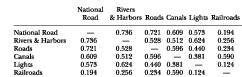
Strong correlations between roll call voting patterns for policy pairs are a preliminary indicator that a logroll may have occurred. With the exception of railroad votes, roll calls for different types of improvements were in fact strongly correlated. About 45 percent of all inter-item correlations between the 15th and 35th Congress, inclusive, were greater than 0.5, and almost 20 percent were greater than 0.7. Supporters of the National Road, in particular, were very likely to support other types of improvements. The average correlation among internal improvements roll calls falls in the late antebellum, but this appears to be mainly the result of an increasing number of railroad votes, which are poorly correlated (typically less than 0.25) with other types of aid.64
For the whole period between the 15th and 35th Congresses, the correlations between indices of support for the given pair of project types for all Congresses for which both can be computed are as follows:

Districts benefiting from current spending, Percent of all districts.

Internal improvements roll calls, distribution of pro votes, House.

A somewhat more complicated story must be told for the key elements of the American System. Recall that the key elements of this system were the protective tariff, a national bank, and internal improvements. Unlike improvements, for which I identified 334 roll call votes of interest beginning in the 14th Congress (1815), votes on the tariff (13) and the National Bank (8) are far more rare.65
There are significant tariff votes in 1816, 1818, 1820 (which failed), 1824, 1827, the 1828 “Tariff of Abominations,” 1832, the Compromise of 1833, 1842, 1846, and 1857. National Bank votes, proper, occur in 1816, establishing the Second Bank of the United States, and in 1832 to renew its charter, but related votes occur in 1834 and 1836, and a number of votes are taken on the Independent Treasury (1840, 1841, 1844, and 1846).
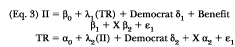
While conceptually simple – one representative offering support for a policy favored by another in exchange for a reciprocal consideration – logrolls present difficult empirical questions. Most fundamentally, there is an observational equivalence between coalitions of interest and logrolling coalitions. In the first case, two legislators support the same two policies for their own reasons; that is, independently of each other. Typically, the policy is seen as favorable to district interests. In the second, legislators vote for a policy that they would otherwise not support, perhaps one not in the district interest as narrowly defined, because of a logrolling arrangement. What we observe in both cases, however, are two representatives supporting the same two policies. Ordinary least squares will distort the measured effects of observable predictors of support for each policy, and therefore cannot be used to measure the logrolling effect. In response to this difficulty, I employ a simple two-stage least squares procedure inspired by that outlined by Thomas Stratmann.66
Thomas Stratmann, “Logrolling in the U.S. Congress,” Economic Inquiry 23 (1995): 441–56. One key difference is that Stratmann does not include party. His logic is that, if parties help organize logrolls, the inclusion of a party parameter will bias the estimates of the logroll parameters. The party variable is, in part, “a variable measuring membership in logrolling coalitions” (445). If the logroll is mainly within the party, the logroll parameters will be completely useless. While this line of reasoning is sound, excluding party leaves us with no mechanism for investigating what the role of party really was. I estimated Equations 2 and 3 with and without the party coefficient. Where the results do not differ substantially, a party role in logrolls is unlikely.

where II is an index of support for improvements (average level of support for all relevant votes in a Congress),

are the imputed levels of support, Benefit are the current and historical (last five Congresses) appropriations made for the Member's region for the type of improvement modeled, and Χ is a matrix of district characteristics associated with support for the modeled type of improvements (but not the other type). These characteristics include measures of district geography (such as the percentage of the district population living in river counties) and district economy (such as the percentage of the district population employed in manufacture) that were reconstructed for congressional districts from county-level census data.
67This procedure is possible because of the almost exclusive use of counties as building blocks for districting. The exception was Massachusetts, which used town boundaries. Fortunately, the Massachusetts data could be re-aggregated into three artificial multimember districts (Worcester and west, Old Colony, and Greater Boston). Congressional district information was drawn from Kenneth C. Martis, The Historical Atlas of U.S. Congressional Districts: 1789–1983 (New York: Macmillan, 1982); county boundaries were verified with William Thorndike and William Dollarhide, Map Guide to the U.S. Federal Censuses: 1790–1920 (Baltimore, MD: Genealogical Publishers, 1987).

Omnibus activity: Number of projects funded by date.
Table 5 summarizes the results for internal improvements estimated for all congresses for which votes for each of the relevant policy pairs were taken (the models include estimates for temporal fixed effects by Congress, not shown). The entries are the estimated effect of imputed support for the independent (row) variable on support for the dependent (column) variable. The instruments used are listed below the table. Almost all of the logroll estimates (λ) are positive. Of the fifteen possible pairings of the six policy types shown, eight have significant estimates for both policies, indicating that a logroll likely took place. Another four pairs have at least one significant logroll parameter, suggesting a possible logrolling arrangement. The weakest results obtain for logroll pairs that include railroads. Of the five possible, only the logroll with roads is strongly suggested, logrolls with the National Road and lighthouses very unlikely. Two of three clear “no” pairs involve railroads. When the model is re-estimated without the party coefficient (δ), the results are virtually identical, suggesting that, over this whole period, parties did not play a major role in organizing these logroll efforts – no “legislative leviathan” is in evidence.68
Cox and McCubbins, Leviathan.

Re-estimating these models for each congress separately gives a sense of the path of logroll activity. A total of fifty-four pairings among the improvement types listed here for which a test could be conducted69
An additional sixteen pairs could not be estimated for want of adequate instruments.
The estimated logroll parameters for the American System trade between internal improvements and the tariff are presented in Table 7, this time showing the results with and without a party effect. The estimates for each congress with both tariff and improvements roll calls are shown along with the pooled result (again estimated using temporal fixed-effects).
The pooled results strongly indicate that logrolls between supporters of internal improvements and supporters of the tariff did occur during the sample period and that, overall, party did not play a central role. Most of the Congress-specific estimates also show some evidence of logroll activity, although the results are unambiguous only in a few years. Further, the party and non-party models generate similar results only in the 14th through 18th Congresses (1815–1825), the near party-less Era of Good Feelings. The nonparty model suggests the existence of logrolls in all of the Congresses after 1825, but the party model suggests one only on three occasions. First was the 20th Congress, when many Democrats supported the later-dubbed Tariff of Abominations. This support can definitely be characterized as partisan, but the legislative history of this complex bill suggests that the deal-making related to improvements only tangentially.70
Stanwood, American Tariff Controversies, 1:268–90. Stanwood aptly notes that “nothing could be more difficult for the student” (1:270) than understanding the machinations of the 1828 tariff, but at least some of the legislative strategy was tied up with the candidacy of Andrew Jackson and therefore is intimately (if not deliberately) tied to the formation of the Democratic Party.

Adapting to a New Era
The preceding section showed that the same historical pattern of delay, rise, and decline held for appropriations, committee stability, universalism, use of the omnibus, and to a lesser extent, logrolling. Each of these tools was used relatively effectively between 1822 and 1837 but was then nearly absent until 1852. Why? After considering a number of possibilities, I argue tentatively that each had to be adapted to a new era dominated by the mass-based party, and that this took time.
There are a number of possible explanations why appropriations failed to recover after the Panic of 1837. The first is that the fiscal situation was poor, which is true only to a point. The Mexican-American War created deficits between 1847 and 1849 and a new depression hit in 1857 just as spending levels were recovering. However, relatively healthy surpluses from 1844 through 1846 and in 1850 through 1852 (see Figure 3) did not occasion higher spending levels. The mix of spending shifted as well, with a far higher percentage of all improvements spending going for noncontroversial lighthouses, so other sorts of demands were left unmet. The shift to land grants as the policy tool of choice may have met these demands, yet this seems unlikely. Land grants could be used for only a limited range of projects, and could not be used (directly) to fund projects in the original thirteen states or in the other nonpublic land states of Vermont, Tennessee, Kentucky, or Texas.
Another possibility is that a rise in sectional tensions made it more difficult to secure majorities. I have already noted how simple sectional rivalries appeared to block any chance for a Pacific railroad bill in the 1850s. Roll call patterns in the House do not bolster this view. Support for internal improvements was estimated using roll call data from the 14th through the 35th Congress. The model includes estimates for the effects of section (allowing for a four-way division with both an East-West and a North-South dichotomy) and party (Democrat) for each Congress and single estimates for the pooled effects of district benefits, geography, and economic structure. The results are presented in Table 8. Our interest here is on the estimated effects of section, presented only as an average in the table. These coefficients are almost always significant at the 5 percent level (only the 32nd Congress is not for NORTH, only the 14th, 24th, and 35th for EAST). Figure 7 plots the four sectional intercepts that can be imputed from the coefficients on North and East, the overall intercept, and the estimates of temporal fixed-effects by Congress.71
The intercept for Northeastern states is NORTH+EAST+CONGRESS+CONSTANT, the one for the Southwest is just the CONSTANT plus the temporal fixed effect, CONGRESS, and so forth.

A more plausible story can be constructed based on presidential politics. President Polk successfully vetoed river and harbor bills in 1846 and 1847 that had an aggregate value of nearly $2 million. If these had been implemented, my interpretation of Figure 3 would have been different. Pierce successfully vetoed two river and harbor bills in 1854 as well, although the 35th Congress was able to override him on five occasions in 1856. Furthermore, Buchanan pocket vetoed two river bills in early 1860. Democratic presidents, therefore, made it more difficult to sustain appropriations levels. This is, in and of itself, somewhat puzzling because improvements were not an especially partisan issue. Indeed, while the “conservative” parties (Federalists, National Republicans, Whigs, and modern Republicans) typically supported improvements strongly, Democrats (in both the Jeffersonian and Jacksonian eras) did not collectively present a strong opposition to the policy. The lines on Figure 8 depict actual roll call support for internal improvements by Democrats and “non-Democrats” beginning in the 14th Congress. This division lacks meaning until the 20th Congress (1827–1829), after which non-Democrats typically provided a 24 percent majority for improvements. Democratic opposition, on the other hand, typically sustained only a 10 percent majority, and is very strong only in between the 27th and 29th Congress (1841–1847), a period which included the Debt Repudiation Crisis. The bar in Figure 8 shows the estimated coefficient on DEMOCRAT that was summarized in Table 8. All of the estimates beginning with the 20th Congress are significant. The figure shows that the role of partisanship peaked in the 22nd Congress (1831–1833) and the 28th Congress (1843–1845) but generally declined after that.72
Note that, although the average level of roll call support for internal improvements in the House is below 50 percent in the 27th through 29th Congresses (1841–1847), majorities were typically obtained for omnibus bills.

Sectionalism. Estimated intercepts for four sections.
There is a mismatch between the very obstructionist Democratic presidents, especially Pierce and Buchanan, and to a lesser extent Polk, and the relatively weak opposition that the party as a whole manifested against improvements. This situation reflects two facts about the Democratic Party: first, that its leadership took great pains not to offend, and even to favor, key partners in the Old South; and second, that it had yet to master the use of particularistic benefits as a party-building tool.
When Martin Van Buren masterminded the organization of a new national Democratic party for the election 1828, his intention was to create a tie among local politicians which would impose few, if any, policy constraints, relying only on a vague commitment to Jeffersonian principles. Indeed, the party would avoid policy stances whenever possible, especially sectionally divisive ones, especially slavery. Writing to Richmond's Thomas Ritchie, Van Buren cautioned against “geographical divisions founded on local interests, or what is worse prejudices between free and slave holding states will inevitably take their place.”73
Aldrich, Why Parties, 107–8.
Annals, 4 (2): 2872–73.
While I have tried to show that internal improvements were not especially divisive in sectional terms, the core opponents of the policy were concentrated in the old tidewater South. The most extreme of these, John Randolph of Virginia, tied the power to construct improvements to the power to abolish slavery: “If Congress possesses the power to do what is proposed by this bill [empower the Army Corps of Engineers to work on improvements in the states], they may not only enact a sedition law . . . but they may emancipate every slave in the United States.”75
Annals, 18 (1): 1308.
For a defense of this view, see Richard McCormick, The Second American Party System (Chapel Hill: University of North Carolina Press, 1966), and McCormick, The Presidential Game (New York: Oxford University Press, 1982).

By unnecessarily interpreting improvements through the lens of sectional conflict, the Democratic Party missed the opportunity to employ the distributive benefits of improvements as part of the regular process of party building and maintenance. Although the Democrats executed a winning electoral strategy, I would hypothesize that the party as party was weakened as a result. As the discussion of the American System logroll showed, the more issue-minded Whigs were able to use these benefits to maintain majorities. We now take particularistic distributive benefits to be nondivisive and noncontroversial almost by definition, and therefore available for both parties to use as inducements for local cooperation.77
See, for example, Weingast “Reflections.”
Skowronek, New American State.
McCormick, Second Party System, 211, 208.
Despite its enormous success organizing and mobilizing voters, McCormick concludes that the Second Party System simply “could not govern.”80
Ibid., 355.
III. STATE BUILDING AND NATION BUILDING IN THE EARLY REPUBLIC
These two episodes in the history of federal internal improvements, considered as puzzles, provide insightinto the nature of the republican nation-building process. The first episode underscores how state building must precede nation building. In the United States, Congressional institutions and legislative techniques had to be developed that would allow representatives of rival localities to cooperate in the absence of any clear sense of the national interest. The tools of distributive legislation – universalism, the omnibus, and logrolling – in the institutional context of the standing committee, offered legislators a way to recognize and accommodate conflicting economic interests. Both the process of legislative bargaining and its nation-building object promised to slowly forge a nonzero sum game out of economic rivalry.

Support for internal improvements, U.S. House, by party.
The dramatic shift in the national political process occasioned by the rise of the mass political party in the 1830s challenged the state-building solution in place by the early 1820s. Where the legislative techniques developed and mastered in a nearly party-less era relied upon interest-based trades in order to craft post-electoral majorities on critical issues, the new parties created electoral majorities by mobilizing and organizing voters, and trying to avoid issues altogether if possible. Issue avoidance was itself a kind of passive nation-building scheme intended to sidestep sectional conflicts. Clay's efforts to build an electoral majority based upon the legislative American System represented an alternative approach that recognized and attempted to accommodate rival sectional interests – literally extending the principles of legislative bargaining learned in the first thirty years of the republic to a new electoral sphere. Clay failed, and his Whig Party found success by copying, and even exaggerating, the Democrats' issue-less style.
The emerging state of parties could not directly apply the statecraft developed in the Era of Good Feelings. The parties would learn to use distributive goods in a different way, to link national leaders and local partisans, but this was a new skill which would also take time to develop and learn. The evidence presented here regarding this second puzzle is still speculative. Further work on how the electoral device of party became the central institution of the legislative-centered state is needed.

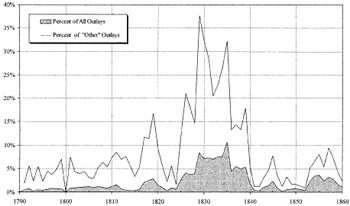
Direct spending on improvements, 1790–1860 as a share of outlays.

Direct appropriations and indirect spending per capita, 1st through 35th Congress.
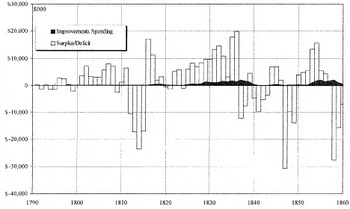
Improvements spending and the surplus.
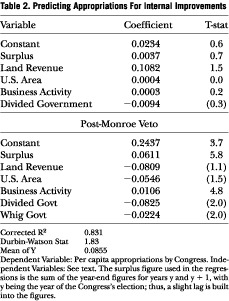

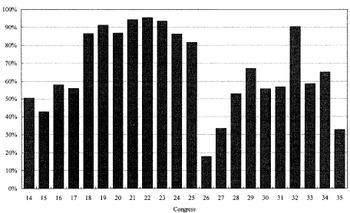
Districts benefiting from current spending, Percent of all districts.
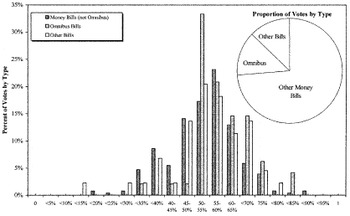
Internal improvements roll calls, distribution of pro votes, House.
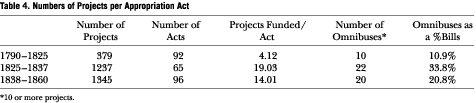
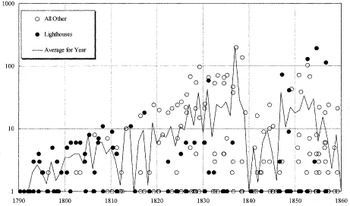
Omnibus activity: Number of projects funded by date.
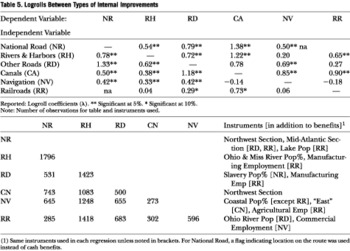
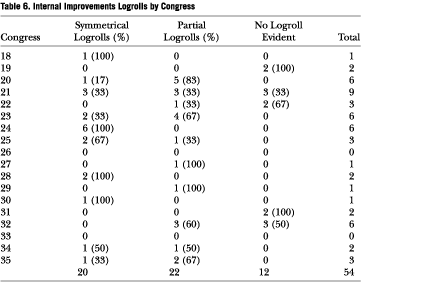
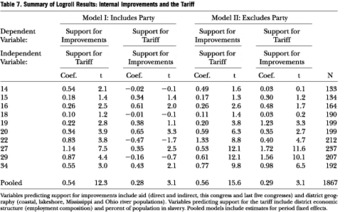

Sectionalism. Estimated intercepts for four sections.
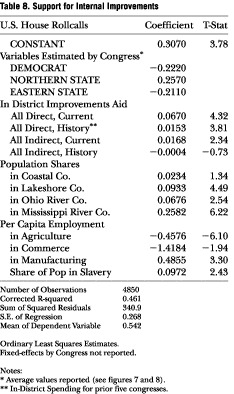
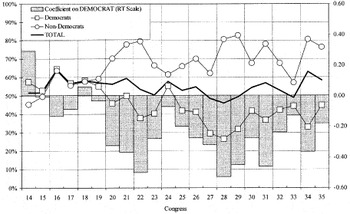
Support for internal improvements, U.S. House, by party.
 You have
Access
- 16
- Cited by