Increasing microbial antibiotic resistance has given new impetus to keeping hospitals clean.Reference Plowman, Graves and Griffin 1 Hospital-acquired infection (HAI) is rightly seen as an unacceptable burden on the patient, as well as inflating hospital costs.Reference Plowman, Graves and Griffin 1 While there is general agreement on the need to control HAI, there is diversity of opinion regarding the best solution. A major problem is the difficulty of conclusively establishing a causal link between surface contamination and HAI,Reference Dancer 2 compounded by the lack of universally accepted standards for measuring cleanliness.Reference Dancer 3 Nevertheless, it is plausible to assert that there is such a link,Reference Dancer 4 allowing us to debate the most cost-effective method for reducing contamination in the healthcare environment.
Current decontamination strategies include daily detergent-based and disinfectant-based cleaning. Enhanced disinfection methods are available for rooms housing HAI patients and when an outbreak occurs.Reference Donskey 5 Powerful disinfectants require caution because few have been properly evaluated under actual conditions of use, and they may ultimately be no better than traditional detergent-based cleaning.Reference Dancer 6 , Reference Stewart, Bogusz and Hunter 7 Manual cleaning has deficits, usually attributed to personnel rather than product, and recontamination inevitably begins immediately after the cleaning.Reference Hota, Blom, Lyle, Weinstein and Hayden 8 , Reference Boyce, Havill, Lipka, Havill and Rizani 9
Among recent technologies are photocatalytic antimicrobial coatings.Reference Ramsden 10 They kill microbes by generating powerful oxidizing radicals on a semiconductor surface following light absorption in the presence of O2 and H2O. The most important photocatalytic material is titanium dioxide (titania) because the bandgap of the semiconductor overlaps sufficiently with the spectrum of natural and common artificial light sources. The band edges are positioned appropriately for generating the radicals, and the material is stable with respect to self-destruction.Reference Ramsden 10 , Reference Hashimoto, Irie and Fujishima 11 The illuminated semiconductor acts as a source of reactive oxygen species (ROS), which are known to be highly effective microbicides,Reference Ramsden 12 and the mechanism of antimicrobial destruction is believed to involve bacterial cell-wall damage.Reference Pulgarin, Kiwi and Nadtochenko 13 Those ROS generated by illuminated titania are particularly reactive and it is thought that resistance against them cannot develop.Reference Ramsden 12
Although there have been in vitro investigations of photocatalytic antimicrobial action with titania, very little work in real-life situations has been reported.Reference Ramsden 10 A commercial titania coating (Altimate EnviroCare Services, Singapore) did not significantly prevent environmental microbial contamination.Reference Leng, Soe and Wui 14 This coating was, however, constituted from titania particles dispersed in a binder to ensure their attachment to the coated surfaces; the binder possibly encapsulated the particles and not only scavenged the photogenerated radicals but also formed a physical barrier between the particles and the microbes. Titania nanoparticles in suspension have been shown to be effective photocatalytic antimicrobial agents, but they adhere very weakly to most surfacesReference Ramsden 10 , Reference Wolfrum, Huang and Blake 15 from which they would, therefore, be continuously lost. Petti and MessanoReference Petti and Messano 16 dispersed titania nanoparticles in polyvinyl chloride (PVC) and observed antimicrobial action on the surface of blocks made from the polymer, but this approach is obviously unsuitable for retrofitting existing objects.
We resolved to evaluate a material (MVX, Hi-tech, Kitakyushu, Japan) that is applied as a dilute aqueous sol of titania nanoparticles and dries to form a tough, adherent monolithic film on the coated surface. Given evidence that photocatalytic antimicrobial activity can be synergistically enhanced by the presence of copper or silver,Reference Hashimoto, Irie and Fujishima 11 we chose to use a product doped with a small proportion of silver zeolite. While it was tempting to coat all surfaces in a ward due to ease of application (by spraying), we focused on near-patient high-touch surfaces. They were coated immediately after annual deep cleaning of the wards. Following the application, the microbial burden and associated pathogens were monitored over 3 months using standardized methods.
Setting
The coated bay was in an acute-care general medical ward, and an untreated control bay was selected in the stroke unit. The decision to spatially separate the treated and control bays, rather than having them in the same ward, was taken to avoid introducing a confounding factor in the form of a possible effect of the coating on resident staff hands, who potentially have access to all patients on the same ward. Both wards are located in part of the hospital that was constructed in 2004, and architecturally, they are almost identical. The bays have a rectangular shape and a volume of approximately 144 cubic meters. They are naturally ventilated with windows along one of the long sides facing north; artificial light is provided during waking hours (dimmed during the hours of sleep) from “daylight” fluorescent lamps. At patient level the illuminance was ~400 lux.
METHODS
Choice of Surface Sites for Coating
The following surfaces were coated according to the manufacturer’s protocol: (1) left-hand side rails and (2) right-hand side rails of a standard hospital bed; (3) the front face of the bed control panel; (4) the top of the bedside table; (5) the bedside locker (coated in its entirety, but only the top was sampled); and (6) the bed footboard (only the top was sampled). There is consensus about the potential HAI risk from these sites.Reference Huslage, Rutala, Sickbert-Bennett and Weber 17 The furniture (table and locker) was made from laminated wood. Each of these 6 sites was replicated for all 4 bed spaces occupying a single bay of the selected ward.
Ward Preparation
Prior to coating, the wards were deep cleaned, which comprises thorough cleaning with a 5,000 ppm solution of Actichlor Plus (a combination of a chlorine-compatible detergent with sodium dichloroisocyanurate, NaDCC, also known as troclosene sodium; Ecolab, Northwich, Cheshire, UK) followed by steam cleaning and, as a final step, enhanced cleaning with hydrogen peroxide vapor (HPV, Deprox, Specialist Hygiene Solutions, Kings Lynn, UK). The stroke ward was deep-cleaned in the week commencing August 1, 2016, and the acute medical ward was deep-cleaned in the week commencing September 10, 2016. No patients were admitted to the ward between deep cleaning and coating.
Coating Procedure
The coating is a dual one, comprising a colorless primer (ie, the primary coating) over which the photocatalytic titania coating MVX is laid. Final coating thickness was approximately 1 µm. The precursors of both are dilute aqueous solutions of the active ingredients, titania (1.5%) and silver zeolite (0.1%). 18 These solutions, as well as the final coating, are nontoxic to humans. 18 Primary coating (MVX, Hi-tech) was sprayed onto the selected surfaces and allowed to dry for 20–30 minutes; the ambient temperature in the ward during coating was 26±1oC and the relative humidity was 59±3%. The MVX was then applied likewise by spraying and similarly allowed to dry. After drying, the coating was invisible to the eye, even on mirrors (which are integral on some lockers). All coated objects were discretely fitted with trackers for the TeleTracking Technologies real-time location system (RTLS; Pittsburgh, PA) installed at the hospital as part of the “Safe Hands” program, to ensure that the coated objects could always be unambiguously located, even if clinical exigence (eg, to reduce the risk of falls, or simply to make the patient more visible) led to a patient (with bed and bed-space equipment and furniture) being moved, generally within the ward.
Sampling Protocol
The approach followed that described by Bogusz et alReference Bogusz, Stewart and Hunter.19 Starting at 7:00 am on Tuesdays and Thursdays, for 12 weeks from September 22 to December 21, 2016, after locating the objects with the RTLS, the coated sites and their uncoated equivalents were sampled using double-sided dipslides (Hygiena International, Watford, UK) coated with nutrient and Baird Parker agars, pressing the slides at 25 g/cm2 for 5 seconds.Reference Lewis, Griffith, Gallo and Weinbren 20 Within the sites, the actual locations were determined at random,Reference Ramsden 21 according to the judgment of the (sole) sampler.
Microbiology
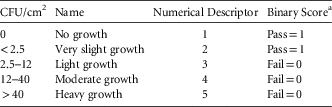
Dipslides were incubated for 48–72 hours at 36±1°C according to laboratory protocol, after which the number of aerobic colony-forming units (CFU) was determined from the nutrient agar side. Baird Parker agar highlighted potential coagulase-positive staphylococci, which were subcultured onto blood agar and identified as methicillin-susceptible or -resistant according to laboratory protocol. The aerobic colony count (ACC) was quantified using a 5-point scale (Table 1).Reference Dancer 3 , Reference Stewart, Bogusz and Hunter 7 , Reference Bogusz, Stewart and Hunter 19 Staphylococci were classified as either “isolated” or “not isolated.”
Classification of Aerobic Colony Counts (ACCs)

NOTE. CFU, colony-forming units.
a According to Dancer (2008).Reference Dancer, White and Robertson 26
Ward Environment
Every day, the ward cleaning team cleaned all items in the patient bed space with Hospec general surface cleaner (containing alcohol ethoxylate as the detergent) (Robert McBride, Middleton, Manchester, UK), typically during the morning after sampling. No exceptional cleaning (HPV or Actichlor Plus) was requested for the control ward during the study. Actichlor Plus was requested on 3 occasions in the treated ward, but for side rooms away from the treated bay. Unlike the strongly bactericidal ionic surfactants, nonionic surfactants are generally considered less bactericidal, although they interfere with bacterial membrane fluidity.Reference Glover, Smith, Jones, Jackson and Rowlands 22 It is difficult to separate the physical bactericidal effect of the mechanical wiping action from the biochemical bactericidal effect associated with the surfactant,Reference Dancer 23 but some attempts at quantification have been made.Reference Stewart, Bogusz and Hunter 7 , Reference Bogusz, Stewart and Hunter 19
Bed occupancy was high in both treated and control wards, averaging 97.6% for the former and 88.0% for the latter during the study (data for the entire ward). Locally agreed staffing levels are recorded for all wards at the hospital. The stroke ward was generally better staffed than the acute-care ward. Medical staff, allied health professionals (AHP, including physiotherapists, occupational therapists, and speech and language therapists) and domestics were not included, nor were visitor numbers monitored. The degree of dependency (acuity) of the patients occupying the beds was also examined. The median degree was invariably level 1b using the Hurst classification.Reference Hurst, Smith, Casey, Fenton, Scholefield and Smith 24
The hospital’s research and development department determined not to class the study as research but rather as a service evaluation. Therefore, approval from the research ethics committee was not required.
Statistical Methods
The sampling protocol resulted in a maximum of 102 bed-space observations for each ward subsequently available for statistical analysis. Each observation produced 6 measurements of ACCs, which were allocated a numerical descriptor from 1 to 5 (Table 1). For the statistical analysis, a mean “numerical descriptor” score (ie, arithmetic mean of the 6 test sites) was calculated for each bed space. This score was dichotomized into a pass/fail outcome variable (1–2=“pass” and >2–5=“fail”). Although dichotomizing may lead to a loss of statistical power,Reference Altman and Royston 25 it is in concordance with the previously introduced pass–fail dichotomy for bioburden.Reference Dancer 3 , Reference Dancer, White and Robertson 26 Furthermore, the conventional classification (Table 1) gives a highly nonlinear mapping of ACCs onto a numerical descriptor; by dichotomizing we avoid having to discuss whether to express the results in terms of CFU/cm2 or in terms of the “degree of growth” descriptor.
The difference in pass–fail rates between the 2 wards (experimental and control) was assessed using the χ2 independence test. Straightforward binary logistic regression analysis was used to further explore the probability (odds) of failing the pass–fail test on the 2 wards.Reference Bagley, White and Golomb 27 Additional factors (introduced as continuous covariates) included the number of days into the study (0–90) and the bed occupancy rate (%) for each ward. The multiple regression logit model was fitted using the binary logistic regression analysis option in SPSS software (SPSS, Chicago, IL). The analysis allowed both fixed and categorical factors and continuous covariates to be used as explanatory variables when estimating the probability (or, more correctly, the odds) of failing the test. P<.05 was used as a measure of significance.
RESULTS
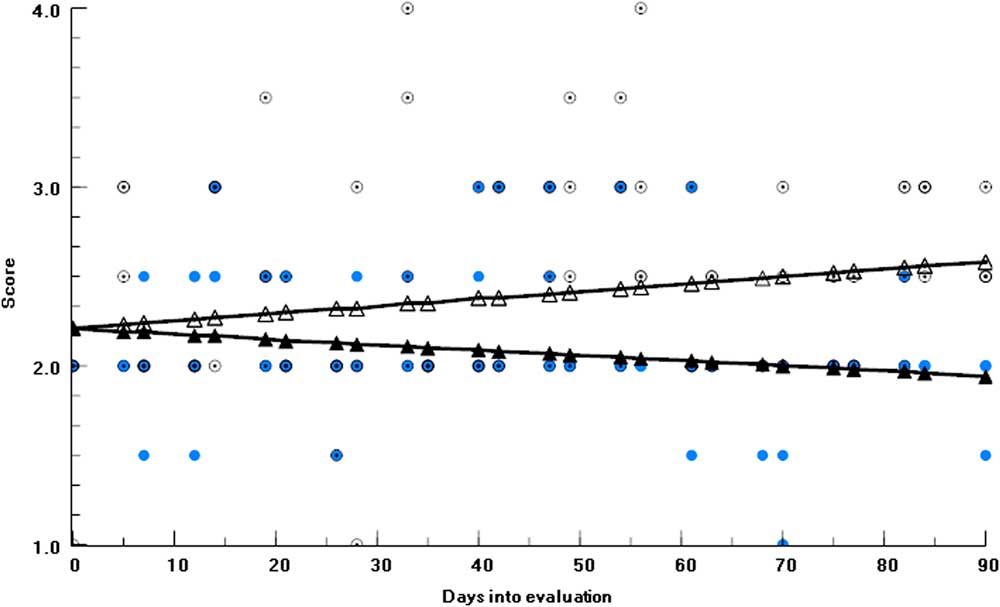
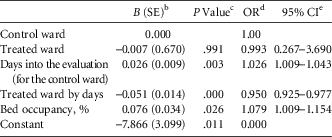
The overall pass rate for the coated bay was 80.4% (82 passes of 102 total samples), while for the control bay it was 52.9% (54 passes of 102 samples). The results of the binary logistic regression analysis, using the control ward as the reference condition, are given in Table 2. The analysis identified no difference in the odds of failing the test between the 2 wards at the beginning of the experiment (odds ratio [OR], 0.993; 95% confidence interval [CI], 0.267–3.69; P=.993). However, the odds of failing the test in the control bay increased by 2.6% per day (B=0.026; OR, 1.026; 95% CI, 1.009–1.043; P=.003) but declined by 2.5% per day in the treated bay (B=0.026–0.051; OR, 0.95; 95% CI, 0.925–0.977; P<.001). These trends are plotted in Figure 1.
Actual data (open circles) and predicted values (open triangles) for the control sites and treated sites (data: closed blue-grey circles; predicted values: closed triangles) for the duration of the evaluation. The vertical axis is microbial growth according to the 5-point scale (Table 1).

Factors (Variables) Found to Influence the Probability p of Failing the Test, Estimated Using Binary Logistic Regression, Adopting (Fail vs Pass) as the Dichotomous Response VariableFootnote a

a Estimated parameters B i for the logit model: Log[p/(1−p)]=Constant + B i , where the subscript i=1 refers to the untreated sites and i=2 to the treated ones. The control ward was estimated as the baseline constant parameter (at day 0), and the treated ward effect was estimated as a deviation from this constant parameter. The number of days from day 0 and bed occupancy were introduced as continuous covariates.
b Slope parameter of the continuous covariate (days), with its standard error in parentheses.
c Measure of significance.
d Odds ratio, equal to exp(B).
e Confidence intervals for exp(B).
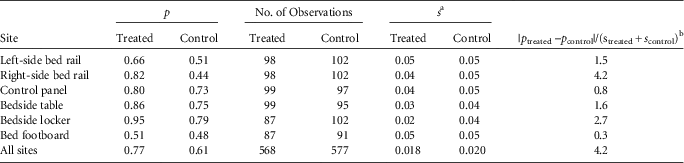
For the individual sites, we considered the sampling as a sequence of independent Bernoulli trials with the binary outcome of “pass” or “fail” and an initially unknown probability p of passing, which was found from the maximum of the likelihood of p, given the observed sequence.Reference Edwards 28 The results are given in Table 3. Surface treatment with MVX significantly improved microbial cleanliness at every site, although only borderline significance was achieved for the bed footboard. The left-hand and right-hand bed rails were conceived as internal controls for each other but yielded different probabilities of passing; there may have been physical differences in accessing the bed rails, such as one bed rail being closer to a wall or some other obstruction.
Success Probabilities p for the (lack of) Aerobic Growth at the Various Sites

a The span s is the square root of the observed formation, which is a measure of the uncertainty of p.Reference Edwards 28
b The difference between the probabilities divided by the sum of the spans is an index of the significance of the result: the greater the index, the greater the significance.
Staphylococcus aureus was isolated from only ~10% of the dipslides: 97 isolates were recovered from a total of 635 for the treated surfaces (all sites together), compared with 68 isolates from a total of 655 for the control surfaces. The low S. aureus counts rendered the difference insignificant.
DISCUSSION
The gradual diminution of bioburden on the treated surfaces occurred even though bed occupancy was higher than in the untreated bay, which would have likely encouraged heavier microbial contamination on ward surfaces.Reference Dancer, White and Robertson 26 This result implies that gradual removal of the coating by mechanical abrasion from touching or cleaning, initially considered as a possibility, did not occur.
Among the possible confounding factors considered (ie, Hawthorne effect; bed occupancy; staffing levels; and degree of patient dependency) only bed occupancy differed markedly between the treated and control bays. Although the patients differed between the 2 study bays, we found no evidence for a clinically significant difference with respect to the likelihood of individual patients and attendant staff contributing to the microbial burden in their environment.
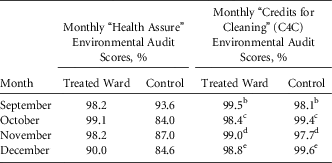
Environmental audits undertaken to appraise housekeeping compliance with cleaning are reported in Table 4 for the interval of the study. They show little difference between the 2 wards.
Environmental Audits for Housekeeping Compliance With CleaningFootnote a

a The audits do not directly observe the staff actually cleaning but inspect the whole ward environment, including high-touch surfaces.
b Week commencing September 19.
c Week commencing October 24.
d Week commencing November 28.
e Week commencing January 9.
It is interesting to compare the bioburden reduction provided by the photocatalytic coating with conventional detergent or disinfectant application to high-touch surfaces (UK hospitals generally use detergents, and hospitals in the United States generally use disinfectants). Microbial counts from a wide range of hand-touch sites cleaned with detergent ranged from 2.5 to 40 CFU/cm2;Reference Griffith, Cooper, Gilmore, Davies and Lewis 29 detergent cleaning was shown to reduce bioburden from a preclean level of 6.7 to 3.5 CFU/cm2.Reference Bogusz, Stewart and Hunter 19 On the other hand, disinfectant reduced median counts for high-touch sites to 0.1–0.6 CFU/cm2.Reference Boyce, Havill, Havill, Mangione, Dumigan and Moore 30 A major difficulty is that sampling methods, surfaces, sites (ie, near-patient hand-touch sites host different amounts and types of bioburden than floors or bathroom sites), cleaning agent exposure, and culture techniques are not standardized across studies. Another confounding factor is sampling methodology: greater quantities of bioburden are recovered from moistened swabs placed in broth than agar methods such as RODAC plates or dipslides.
Our results suggest that the chosen wards were already rather clean, especially with respect to S. aureus; the effect of the photocatalytic coating in lowering bioburden might be more prominent in a less stringently clean hospital. Conversely, a recent study of the effect of MVX in the critical-care environment, which is always afforded priority for cleaning (eg, is routinely cleaned with alcohol thrice daily), found no significant microbiological benefit, despite in vitro data from the same coating showing pathogen inactivation.Reference de Jong 31 The duration of the study was only 4 weeks, however, which may be inadequate to provide sufficient statistical power to show any significant difference between treatment and control.
Although a photocatalytic surface continuously maintains its antimicrobial action, the action is slow. Kinetic laboratory studies, in which surfaces were deliberately contaminated with known amounts of bacteria, suggest that ~1 hour is needed to destroy half the bacteria.Reference Sunada, Watanabe and Hashimoto 32 , Reference Dunlop, Sheeran, Byrne, McMahon, Boyle and McGuigan 33 Hence, if a site had been adventitiously heavily contaminated a few minutes prior to sampling, the result would indicate a high bioburden, whereas sampling 2 hours later might indicate low contamination.
The ultimate objective for hospitals regarding cleanliness is to reduce the incidence of HAI. At present, the relationship between microbial burden on hospital surfaces and the incidence of HAI remains unclear. No extant model allows the prediction of the change in HAI incidence as a result of lowering the environmental bioburden by a defined amount, and thus far, no empirical study appears to have tackled this deficit. A few studies have examined the link between standardized measurements of bioburden and HAI rates but with inconclusive outcomes.Reference Dancer 2 Much attention has been given to the proposition that hands are the main vectors for transmission and, therefore, that frequent hand hygiene is the key to reducing HAI, although the limitations of this approach were noted decades ago.Reference Ojajärvi, Mäkelä and Rantasalo 34 Furthermore, although hand hygiene is strongly promoted in the healthcare setting, compliance is still far from ideal but may, nevertheless, have already reached a practical limit.Reference Larson 35 In any case, hand contamination is most likely to be transmitted via the intermediary of high-touch surfaces, such as those investigated in the present study, rather than directly to another hand.
“Routine cleaning and disinfection is apparently not sufficient.”Reference Wang, Chen and Chen 36 Detailed investigation of routine processes may reveal weaknesses, in addition to those already discussed, alongside their irreducible intermittency.Reference Boyce, Havill, Lipka, Havill and Rizani 9 , Reference Williams, Denyer, Hosein, Hill and Maillard 37 In contrast, a photocatalytic surface is continuously active. Some of the physicochemical changes induced in titania by light persist for many hours or days in the dark, reinforcing this continuity.Reference Stevens, Priest, Sedev and Ralston 38 A photocatalytic coating of the type evaluated here offers a new perspective for overcoming some of the present limitations in cleaning, disinfection, and hand hygiene. A further advantage is that the mechanism whereby photocatalytic antimicrobial coatings inactivate microbes is unlikely to lead to the development of resistance,Reference Ramsden 12 the increase of which is of grave concern to public health authorities.
In conclusion, coating high-touch surfaces with a titania-based photocatalytic material significantly lowered bioburden compared with a control bay. The trend of continuously diminishing bioburden in the treated bay is encouraging, not least in comparison with the untreated control bay, in which the bioburden appeared to continuously increase. A much larger and longer study should now be undertaken with sufficient power to observe whether coating high-touch surfaces with an antimicrobial coating reduces the incidence of HAI. Although there is no evidence that nontouch surfaces (walls, ceilings, etc) are reservoirs for microbes, empirically verifying or otherwise the proposition that coating all surfaces with a photocatalytic material reduces the incidence of HAI will be a further useful addition to infection prevention efforts.
ACKNOWLEDGMENTS
We thank Lee Turner for performing the dipslide sampling throughout the study. We thank Sue Lovegrove of the Microbiology Laboratory, New Cross Hospital for processing the dipslides. We thank Dr Khaled Hussein, MVX Hi-tech Company (Kitakyushu, Japan), for valuable discussions about the photocatalytic coating and its properties, and MVX Hi-tech for providing the photocatalytic materials and the personnel to spray them onto the chosen surfaces.
Financial support: The Collegium Basilea (Institute of Advanced Study) partly funded this work.
Potential conflicts of interest: All authors report no conflicts of interest relevant to this article.