The growth of demand for woolen textiles led to a major expansion of the world's production of raw wool in the second half of the nineteenth century.Footnote 1 New Southern Hemisphere producers—Australia, New Zealand, South Africa, Argentina, and Uruguay—accounted for nearly all of the increase in global supply. By the 1870s, a regionalized set of markets had become global as the price of wool converged.Footnote 2 The shift in the geography of production was matched (with some lag) by a shift in the point of sale, from auctions in the consuming countries, predominantly in London and Continental cities, to sales in the producing countries. Our interest is in the notable differences in marketing methods in the main exporting countries, ranging from auction to a hybrid of auction and private sale to solely private sale. Marketing methods did not converge. A contemporary expert noted that “an examination of the system of marketing wool which is in vogue reveals astonishing differences in methods for so important an article of commerce.”Footnote 3 Two threads of institution theory that are rarely applied in tandem—a process of isomorphism, where different institutions become the same, and of rational self-interest of market participants—both suggest, for different reasons, that convergence towards a single form of marketing should have occurred.
Our objective, therefore, is to show why the differences in marketing methods were sustained when two strands of institution theory predict that one form of organization would win out. We first review the seminal ideas of Paul DiMaggio and Walter Powell, who argued that firms are motivated by the promise of legitimacy to copy the behaviors of leading firms in an organizational field, in a process of isomorphism.Footnote 4 We explore, first, the degree to which the marketing methods employed within countries prior to the relocation of sales to the country of production were altered as a result and, second, the impediments faced in transferring London's auction-based system used for the sale of colonial wools to new hosts. The choices made in each of the wool-exporting countries in the late nineteenth century with respect to local selling institutions were perpetuated by the maturing of organizational fields. An alternative argument for convergence, about which organizational form is superior in terms of efficiency or profitability, comes from the economic rationalist school within institution theory. Douglass C. North makes the point that more efficient organizational forms will drive out less efficient forms.Footnote 5 We employ this insight to determine whether or not there were significant differences in the efficiency of the various marketing systems for each or any combination of participants.
We conclude that a lack of convergence can be explained by two complementary arguments. First, deep-seated differences in the historical experiences of the five major exporters shaped the evolution of their political and economic structures in such a way as to create localized organizational fields, despite being in an era of economic globalization. Second, the economics of transforming raw wool into tops (a fiber produced by combing the wool but not yet twisting it into thread) entrenched the continued divergence of marketing methods.Footnote 6 A surprising result is that the different forms of sale were efficiency-neutral to the growers and buyers because the differences in the prices received and paid were greater for the same quality of wool offered at auction than at private sale. This reflected the value provided by the grower regarding superior information about the character of the wool and its better preparation prior to sale.
The article begins with a brief review of the changing geography of global raw wool production and consumption from the late nineteenth century until 1939. We then describe the marketing methods used in the wool trade both before and after the relocation of the point of sale to the exporting countries. Following this, we explain the several aspects of institution theory that anticipate convergence in the methods of marketing, before providing our account of why the “iron cage” of isomorphism remained unlocked.
Global Wool
The growing demand for raw wool reflected the broad-based stimuli of population growth and rising real income in Western Europe, the United States, and Britain's dominions.Footnote 7 Adopting many of the technical advances made by the cotton textile industry, the woolen textile and hosiery industries mechanized, thus reducing the cost of production while raising the quality and, importantly, the variety.Footnote 8 Gradually and unevenly across countries, clothing advanced from a staple and a necessity to a discretionary fashion item for many. New forms of retailing, notably department stores, and new forms of merchandising, relying heavily on advertising, altered the attitudes of consumers to their wardrobes.Footnote 9 On the eve of World War I, four countries—Britain, France, Germany, and the United States—“probably accounted for over 90 per cent of world production of wool textile fabrics and an even higher proportion of tops and yarn.”Footnote 10 The balance came predominantly from other European countries, such as Austria-Hungary, the Netherlands, Italy, and Belgium.Footnote 11 Japan was to emerge as an important producer after World War I. The interwar years were a period of slower growth for woolen textile production, as spending was restricted by a combination of declining population growth in Europe, rising unemployment in the 1920s followed by the Great Depression, and growing competition from cheaper cotton and synthetic fibers.
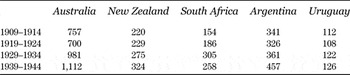
Beginning in the mid-nineteenth century, the textile-producing countries could not continue to source their wool domestically. Sheep numbers in Britain, France, Germany, and Spain declined from 90 million to 72 million between 1840 and 1909 as industrialization shifted comparative advantage away from land-intensive activities. The switch to global supply was accelerated by the reduction in ocean freight rates and by a lowering or abolishing of tariffs on wool imports in Britain in 1844, and later in France (1860) and Germany (1879). The heavily protected United States market remained an anomaly. By contrast, the new wool-growing countries of Australia, New Zealand, South Africa, Argentina, and Uruguay, all of whom enjoyed an overwhelming comparative advantage in land-intensive activities, increased their collective sheep numbers from five million to 239 million over the same period (1840–1909). Merino sheep arrived in South Africa and Australia at the end of the eighteenth century. Wool growing on a large scale began later elsewhere, in the 1840s in New Zealand and Argentina and in the 1860s in Uruguay. By World War II, these five countries supplied 70 percent of the world's apparel wool.Footnote 12 The story of the rapid spread of sheep over the grasslands of these countries is one of a European merino livestock diaspora. It proved to be an adaptive breed and, with careful selection, particularly in Australia, the weight and quality of its fleece increased.Footnote 13 As shown in Table 1, Australia became the undisputed leader in wool production, producing as much as the other four exporting countries combined through the first half of the twentieth century. Moreover, during this same period Australia was the preeminent producer of merino wool, accounting for roughly one-half of the world's output.Footnote 14 South Africa's climate also favored the production of merino wool, while the damper and colder climates of New Zealand and Latin America were better suited to British longwool sheep and crossbred sheep with coarser wool and bigger carcasses. The latter became increasingly valuable following the development of the chilled and frozen meat trade in the late nineteenth century.Footnote 15
Raw Apparel Wool Production by Main Exporting Producers, 1909–1944
(millions of lbs., 5-year avg.)

Source: Gerda Blau, “Wool in the World Economy,” Journal of the Royal Statistical Society 109 (1946): 184.
The global wool trade relied on intermediaries to bring growers and buyers together, as it had since medieval times.Footnote 16 However, the geographic connection changed dramatically around the end of the nineteenth century. Britain had been the great market for foreign wool throughout the nineteenth century. Auctions conducted in London by a small group of selling brokers supplied the British, Continental European, and American textile industries with wool. Textile manufacturers purchased at auction on their own accounts and/or through brokers and were able to tap into an extensive secondary market of wool held by speculators, dealers, and merchants.Footnote 17 Growers in the new producing countries in the early days possessed neither the knowledge nor the means to get their wool to the central auction markets. Price information was fragmentary before the completion of the telegraphic cable to countries in the Southern Hemisphere in the 1860s and 1870s. Local growers had to wait months between the shearing of their flocks and the selling in London of their wool. Consequently, general merchants and banks operating in the exporting countries assumed the risks, buying directly from growers to sell themselves in London, or they supplied services and credit that allowed growers to consign their wool to London for sale. By the late nineteenth century, there were better information flows within the market about prices and stock. Moreover, the wool trade was able to use the infrastructure in place that supported the huge increase in international trade, improved land and sea transport, and trade finance.
Over time, as the volume of wool being handled increased, specialist intermediaries—a combination of domestic firms, foreign participants with permanent local representation, and migratory buying agents who visited to attend sales—came to dominate the trade.Footnote 18 By 1928, Skinner's Wool Trade Directory identified over two thousand firms as “wool merchants (exporters of raw wool, wool buyers, fellmongers), wool washers and scourers.”Footnote 19 More than three-quarters of these firms were located in the four major importing countries and the five leading exporters. Moreover, many firms operated across multiple markets. A leading Dutch firm, Kreglinger & Fernau Ltd., for example, had offices in London, Buenos Aires, and Montevideo as well as in Boston, Sydney, and Christchurch. The Bradford-based Robert Jowitt & Sons had offices in both South Africa and Australia. William Haughton & Co., a Melbourne-based firm of buying brokers and merchants, had offices in London, four Australian states, New Zealand (two offices), and Toronto. It also acted as a buying broker for British, American, French, Greek, Swiss, and Italian textile manufacturers.Footnote 20
Between the 1890s and World War I, the location of wool sales shifted decisively to the countries of production.Footnote 21 A central market was becoming less appropriate for a textile industry that was expanding both within Europe and more broadly to include the United States and, later, Japan. Sales of foreign wool outside London had begun in a number of European textile centers and ports between the 1840s and the 1880s, with some South American and Cape (South African) wool being auctioned along with local supplies.Footnote 22 However, the growth of these emergent European auctions was also checked by the relocation of wool selling to the countries where it was grown.Footnote 23 Having credit providers in the countries exporting wool was a critical precondition to breaking down the consignment model that was financed by trade bills drawn on import agents in Britain. Australian stock and station agents accessing the London capital market became quasi-bankers in the late nineteenth century.Footnote 24
Having all started with some combination of direct sales to local merchants or the use of the services of local consignors, the exporting countries came to sell their wool through different channels. In Australia, combinations of selling brokers operated a centralized auction system in the major port cities that operated de facto as an integrated national system. Private treaty sales were vigorously opposed.Footnote 25 New Zealand and South Africa also adopted local auctions, starting in the 1880s, but there was a lack of coordination between selling centers in both countries as compared to Australia.Footnote 26 However, in both countries, auctions ran side by side with large private treaty sales.Footnote 27 John Clapham noted before World War I that South African small growers “always sold their wool locally, in many cases to storekeepers. These in turn dispose of it to buyers for European firms, or to export houses at the ports—houses which frequently do business of a very general character, in which wool dealing forms but a single item.”Footnote 28 Little had changed by the 1930s.Footnote 29 The Latin American countries persisted with private treaty sales, although local brokers and European manufacturing interests took over from the import-export houses.Footnote 30 However, unlike in South Africa, a small number of very large private buyers dealt directly with the estancias, the large estates. These large estates had considerable market power in negotiating with buyers. Wool from smaller-scale growers found its way to markets in the major ports, which provided a location at which to regulate private dealings, settle disputes, grade and inspect produce, and disseminate market information generally.Footnote 31 An American authority, Alston Garside, noted in the late 1930s that, having made their purchases, buyers then sold “direct to importing companies in foreign consuming countries and to buyers in South America who represent those companies.”Footnote 32
The Iron Cage Unlocked?
Several strands of institution theory predict that organizational structures and behaviors within an industry or organizational field will be driven towards a common form. Competitive forces and/or the striving for the legitimacy attached to the practices of dominant participants will tend to result in homogeneity of practice. We will argue that the evolution of diverse marketing institutions and their continued operation over a long period of time in a global context tests the explanatory power of these arguments. We maintain that the specific geographies and histories of each of the exporting countries provided different national environments in which the organizational fields associated with the wool trade developed.
DiMaggio and Powell expounded a novel explanation of the convergence of organizational structures and behaviors that enjoys wide currency within the organization studies discipline. We will not delve into the details of a wide and contested literature.Footnote 33 Our purpose is to employ elements of the DiMaggio and Powell argument to explain why isomorphism did not occur across countries in global wool marketing. They suggest that in the twentieth century, “structural change in organizations seems less and less driven by competition or the need for efficiency.”Footnote 34 As an alternative explanation, they employ the ideas of sociologist Anthony Giddens on the structuration of organizational fields, arguing that “once a field becomes well established . . . there is an inexorable push towards homogenization.”Footnote 35 In those organization fields with high levels of mutual recognition among participants, the push for isomorphism takes on a new form: competition for “resources and customers, [and] for political power and institutional legitimacy, for social as well as economic fitness.”Footnote 36
Do the wool marketing methods we have identified above correspond to organization fields as defined by institutional theorists? We believe so; a market is as much an institution as an association of firms.Footnote 37 Each market comprises a collective of actors—in our case, those individuals and firms engaged in supplying and making a market in raw apparel wool. The three marketing methods that operated after the relocation of the wool markets to producing countries, as outlined above (i.e., auction, hybrid, and private sale), display the necessary attributes of organization fields. All forms of sale shared the following common elements: a supply chain that extends from wool growers to merchants and/or specialist intermediaries such as brokers; formal institutions for the sale of wool, such as markets and auctions; and wool buyers and/or their agents. A central auction system required more specialized off-farm labor inputs, such as wool classers, physical assets in auction rooms and specialist warehouses, and an industry group to control the auction system. The wool markets were dependent on the provision of additional infrastructure and specialist intermediaries, such as transport routes from the farm to the port, storehouses, merchants or agents, a marketplace where sellers and buyers could meet, and the provision of credit to buyers to pay the growers. Importantly, the wool market was situated in a wider network of economic activity. The geographic concentration of wool markets, clustered in major ports, and the frequent interaction between them generated high levels of mutual awareness among participants, which strengthened the emergence of these markets as organization fields.Footnote 38
What pushes firms within an organizational field to become more alike over time? DiMaggio and Powell describe three mechanisms: coercive, normative, and mimetic.Footnote 39 All are both external and internal to each firm, which can work in various combinations. Broadly speaking, the coercive mechanism represents the “rules of the game” as set by formal and informal institutions.Footnote 40 Normative mechanisms have the descriptor of professionalism. Decision makers whose training and experience lead to common patterns of thought and action, particularly among professional classes such as accountants, lawyers, and engineers, prompt the isomorphism of organizations' structures and behaviors. Finally, mimetic behaviors drive firms to moderate uncertainty and to obtain legitimacy by copying the structures and behaviors of the most successful firms.
We have seen that the initial response by textile producers to the rise of new sources of supply was to buy directly from growers or to buy, at auctions in Europe, wool that had been sent on consignment by growers or acquired by merchants. Various marketing methods were becoming established in the producing countries. There was a transition from private sale to auctions in some countries, but not in others.
Each of the marketing systems, being a narrow organization field, developed within a wider set of national institutions. The evolution of national metainstitutions in the five wool-exporting countries was shaped in part by the transmission of institutional characteristics from the imperial powers of Britain to Australia, New Zealand, and South Africa and from Spain to Argentina and Uruguay. Colonial influences within the formal and informal British Empire were moderated by the culture and ethnicity of the recipients.Footnote 41 Australia and New Zealand benefited from stable relations with Britain from the earliest years of the wool trade. South Africa had a more checkered association with the Dutch and then British; eventually, the creation of the Union of South Africa, in 1909, gave the new country dominion status in the British Empire. Argentina and Uruguay were at odds with their Spanish colonizer but drew upon an intermediating economic and political relationship with Britain that was sometimes referred to as “informal empire.”Footnote 42
Numerous comparative studies have sought to explain differences in national development and prosperity. Climate, geography, and culture are often referred to as contributory factors.Footnote 43 Economist Daron Acemoglu and political scientist James Robinson argue that institutions matter most in determining outcomes and development trajectories, whether they provide incentives that reward work and investment or permit elites to extract rents. It is not our purpose to undertake a detailed comparison of institutions among the five countries, except to note that Acemoglu and Robinson describe Australia's institutions as inclusive and those of both Argentina and South Africa as extractive.Footnote 44 The emergent institutional framework of each of the wool-producing countries shaped the direction and strength of the coercive mechanisms contributing towards an international convergence.
The choice of marketing method by each of the exporting countries reflected the nature of their institutions in a number of ways. The terms and conditions under which wool growers had access to land differed across countries. A wool industry made up of farmers with large flocks was more conducive to the development of auctions than one populated by many small-scale growers who, out of necessity, sold directly to merchants. Clapham noted that “the large squatters of Australia could afford to wait for the whole or part of their money; the smaller farmers at the Cape, especially the native flockmasters, very seldom could.”Footnote 45 The average size of Australian and New Zealand flocks around World War I was nearly twice that of Argentina.Footnote 46 In the first half of the nineteenth century, “squatters” took possession of vast areas of grazing land in Australia. The British government, when permitting self-government to the colonies in the 1850s, imposed a far wider franchise than was sought by this group, who had hoped to entrench their power. As a consequence, a democratic political system introduced land reform that offered many other settlers access to pastures while still allowing for very large holdings.Footnote 47 The Australian experience contrasts with that of Argentina and Uruguay, where access to land became concentrated in the hands of the elite, and of South Africa, where nonwhites were denied access to land held exclusively for settlers of European descent.Footnote 48 Moreover, Boer farmers operated on smaller farms than did British settlers.Footnote 49 Countries such as Australia and New Zealand, whose inclusive institutions protected property rights and provided incentives for enterprise, were also better placed to invest in the public and private infrastructure required for the central auction system. Private financial institutions provided credit more liberally in environments where property rights were assured. Specialist intermediaries servicing the pastoral industries were common in Australia and New Zealand—and conspicuous by their absence elsewhere.Footnote 50
Normative pressures for institutional isomorphism did exist in the global wool trade. The industry was steeped in shared knowledge about the nature of the raw material and the process of its conversion into thread and fabric. Cities like Bradford, in England, that were the home of a cluster of closely associated industries dealing in and processing raw wool and making tops, were at the heart of the creation of both knowledge and institutions, supporting the industry through the establishment of technical colleges, conditioning houses, trade associations, and arbitration mechanisms. Knowledge was shared and information was transmitted via the movement of people across borders and the publication of technical manuals and prices.Footnote 51 Global trade and challenges from competing fibers motivated greater standardization and cooperation between the wool-growing and wool-consuming countries. The establishment of the International Wool Trade Organization in the 1920s was prompted by two needs: to standardize sales contracts for raw wool and tops, and to create an arbitration mechanism to deal with disputes. Further, the wool exporters set up the International Wool Secretariat in 1937 as a cooperative enterprise to promote wool as a fiber.Footnote 52 By the 1930s, there were regular conferences between representatives from both the exporting and the importing countries on a range of issues.
However, these developments, important as they were, had none of the power of professionalism—a dominant paradigm of thought and action shared by individuals within all organizations in the field—that would, in DiMaggio and Powell's argument, motivate isomorphism. Significant country-based differences in outlook and experience remained within the wool trade. For instance, custom and practice in the manner of classifying types of wool continued to differ among the textile-producing countries, despite negotiations in the 1920s between the American and British government and trade representatives.Footnote 53 Skinner's trade directory still published a comparative table of international standards of wool qualities shortly after World War II.Footnote 54 We are unaware of any pressure from the consuming countries for the wool-producing countries to adopt a uniform marketing method. Indeed, the importing countries were divided among themselves regarding the establishment of futures markets for wool tops; France and the United States opted to do so, while Britain declined until 1953.Footnote 55 In this respect, wool marketing differed sharply from the isomorphic tendencies of the cotton trade, in which “the old-fashioned importers, brokers and factors declined” beginning in the mid-nineteenth century, replaced by a unified system of marketing centered around a small number of cotton exchanges that dealt in futures for a standardized product, linking growers directly with manufacturers. Such exchanges, in the words of Kenneth Lipartito, “helped impose worldwide supply and demand conditions on local markets, thus moving the entire cotton trade towards the ideal of a single market with a single, internationally determined price for each grade of cotton.”Footnote 56 The marketing arrangements for wool were disturbed only during World War I and in the early 1920s, when Britain acquired all of Australia's and New Zealand's wools from 1916, and this unused stock was fed back into the market.Footnote 57 Contemporary experts were correct in their belief that a centralized auction, as operated in Australia, was the best system for both growers and buyers. It involved the largest concentration of buyers competing for wool—with large clips, wool shorn from the sheep pastured on particular farms or stations, offered in multiple lots ranging from two or three bales up to dozens of like wool, enabling many buyers access to their preferred type—and generated the best prices for growers.Footnote 58 Auctions saved time. At the Brisbane sales in 1914 and 1915, six to seven thousand bales were sold each day, with each lot selling in around ten seconds.Footnote 59 Was it a lack of knowledge of the superiority of auctions over the alternative forms of marketing that prevented its adoption in other countries? The strength of a mimetic impulse to copy the leader might depend upon knowledge—that is, how much participants in the raw wool market knew about systems operating elsewhere and the comparative benefits and costs of those systems. International buyers were most aware of the differences between the markets in which they acquired wool. Growers, more remotely located and less directly engaged with the trade, may have been less aware. We argue below that the end users, the top makers, were indifferent.
Even if participants in the wool trade in countries using predominantly private sales wanted to change their marketing method to the use of auctions, there would be costs and risks in doing so. In Table 2, the far-right-hand column shows the ascending costs to third-party market makers as marketing modes shift from private sales, direct from growers and at markets, to auctions. Little institution building was required where storekeepers bought directly from growers, especially if those growers were indebted to them. City-based merchants seeking out larger clients would invest in building some ongoing relationships. Markets were more complicated affairs, as some third parties provided the physical infrastructure in which growers and buyers could have wool available for inspection and to trade. The market would provide a standard contract of sale as well as a dispute-resolution mechanism. Auctions relied on a more formal set of institutional arrangements. Selling brokers needed to make significant investments in the warehouses in which wool was stored before and after sale, and they also needed to provide buyers with an extensive opportunity to examine wool prior to the auction. Auction house associations needed to liaise with those other intermediaries on whom the smooth operation of the auction system depended, such as wool dumpers, carriers, railway and port authorities, shipping agents, and banks.
Information, Risk, and Investment in Marketing Channels

Source: Compiled by authors.
* Includes classing, skirting, packing, branding, transport, storage, and handling charges.
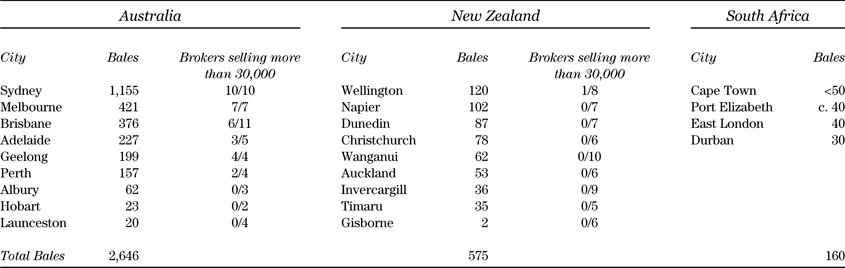
Persuading wool growers and buyers to change their behaviors took time, as the Australian experience demonstrates. Whereas private sales are not scale reliant for their success, the auction system enjoyed increasing returns as throughput rose due to the high fixed costs associated with the physical assets used by selling brokers.Footnote 60 The inability of auctions to make substantial headway against private sales in New Zealand and South Africa lessened the prospective rewards to brokers making further investments in building a national auction system like the one operating in Australia. As shown in Table 3, there were marked differences in the volume of wool handled through auction centers in Australia, New Zealand, and South Africa. By the late 1920s, Sydney was the world's largest market for wool, surpassing sales in London. With this location and an additional four centers, Australia outstripped the volumes sold at New Zealand's leading auction centers by a large margin. We estimate that a broker needed to sell around thirty thousand bales per season to operate at a profit.Footnote 61 The majority of brokers in the New Zealand centers were operating at volumes well below profitable levels. Due to the geography of New Zealand, which, with its long coastlines and shallow but rugged hinterlands, differs significantly from that of Australia, the plethora of scattered small brokering firms earned low profits. Around the turn of the twentieth century, one contemporary publication bemoaned New Zealand's “want of one great centre” from which economies of scale similar to those in Australia could be derived.Footnote 62 The successful and relatively swift transition to auctions at the expense of private sales or consignment in Australia rested heavily on prior relationships between large pastoral service providers and growers who relied on them for credit. Growers were locked into the auction system, and selling brokers were bound to it by association rules. Pressure from buyers for a decisive shift to a coordinated set of auction sales was also crucial in prompting change.Footnote 63
Size of Auction Markets in Australia, New Zealand, and South Africa, 1928–29
(thousands of bales)
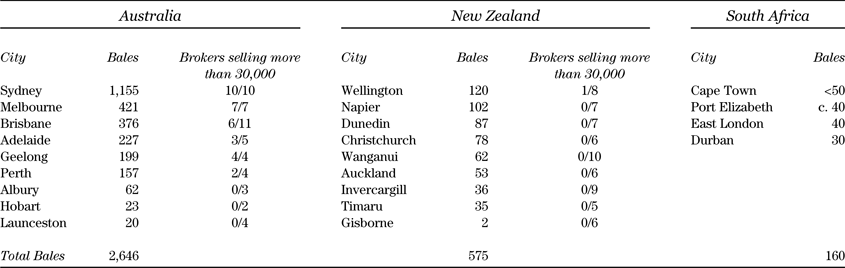
Sources: Australian and New Zealand data from Dalgety's Annual Wool Review, 1928–29 (Sydney, 1929), 180–81; South African data from A. Foster Du Plessis, The Marketing of Wool (London, 1931), 182–84.
Buyers of “colonial wool” in Britain in the late nineteenth century had many decades of experience using a central auction system.Footnote 64 We might expect there to have been a strong mimetic pressure to replicate this form of marketing in the wool-producing countries. Auctions took hold more strongly in countries that were British colonies and, later, dominions. By comparison, Latin American wools had bypassed London, instead going directly to Continental markets. The textile-producing countries Britain, France, Germany, Belgium, and the United States produced roughly a quarter of the world's apparel wool between the wars.Footnote 65 However, in those countries, wool buyers purchasing domestic wool did so almost entirely through private sales.Footnote 66 Buyers were accustomed to buying through multiple channels.
The three isomorphic mechanisms—coercive, normative, and mimetic—may also have interacted in unforeseen ways. Those countries with extractive institutions may have suppressed entrepreneurial ambition, a vital ingredient of a mimetic process. It was not an inability to change the organization of wool marketing per se in countries with “rules of the game” that favored entrenched elites. We think it more likely that the opportunity to identify and exploit new areas of economic activity in such countries was captured by the elite. Not only was Australia the largest wool exporter, but wool was also the nation's dominant industry in most years, and most sheep were found on sheep stations, not mixed farms. Thus, the interests of those associated with the industry were closely aligned with the national interest.Footnote 67 This was less the case in any of the other exporting countries. In twentieth-century Argentina and Uruguay, sheep farming was fast losing ground to cereal and meat production. The growing export trade in hides and frozen meat brought a vigorous response from both local and foreign capital to develop a vertically integrated supply chain.Footnote 68 Likewise, mining took precedence over pastoral activities in South Africa as an opportunity for those with capital and connections. In New Zealand, small mixed farming was more prominent.
Information, Risk, and Investment in Marketing Methods
The lack of institutional convergence is all the more surprising given that, as we argued earlier, auctions were a more efficient form of marketing wool than private treaty sales. Why did these alternative systems coexist? Our argument is that the buyers of raw wool were largely indifferent to the method, because the prices paid reflected how much preparatory work of converting raw wool had been done by the growers and brokers, or remained to be done by the top maker. The costs of such transformation were set by the technology in use. By the late nineteenth century, the textile industry had progressed from a domestic to a factory-based system in all of the major producing countries. Mechanization replaced hand labor and similar technologies were universally applied. David Jenkins reports that “the first forty years of the twentieth century saw remarkably little technical development beyond relatively minor adjustments to well-tried machinery.”Footnote 69
To understand the formation of the price of raw wool we work backwards down the value chain in the wool textile industry. Prices paid in wholesale markets for clothing, hosiery, and other woolen products set the prices paid for intermediate inputs such as tops and yarn. The price spinners paid for tops in turn set the prices top makers would pay for raw wool. Top makers faced considerable uncertainty and potential processing costs when purchasing raw wool. This uncertainty came from two sources. First, they had to determine whether the wool purchased was of the required quality. Wool is a heterogeneous fiber whose quality differs within a single fleece, within flocks of similar breeds of sheep from the same farm, between similar breeds from different countries, and among different breeds. There were no objective measures of wool fiber characteristics or quality. Grading or classing wool was an art rather than a science. Experienced classers and sorters, working by feel and sight, allocated wool into trade categories, by breed of sheep, and then attributes of wool, usually the British system of “counts,” reflecting its fineness and fiber length. For example, merino wool had “counts” of sixty and above, crossbred wool ranged between fifty-eight to forty and all numbers below forty were considered only fit for carpets.Footnote 70 Second, wool fleece contains a large volume of grease, as well as dirt and vegetable matter, which must be removed prior to its conversion into tops. Nearly all wool was presented for sale in an uncleansed, or greasy, state. Shrinkage rates differ between breeds and between countries.Footnote 71 The top maker or his buying agent had to estimate the “yield,” or the weight, of wool after washing and scouring. Buyers used ready reckoners to calculate what they would pay for raw wool after having estimated the yield and knowing the going price for tops.Footnote 72 The guarantees of clean yield offered by wool merchants in Buenos Aires and Montevideo suggest that some buyers found the risk of receiving less clean weight than expected so great that they lowered their offer price to compensate or sought alternative sources of supply.Footnote 73
Clean wool of known type and quality had to be made ready for the top manufacturers. Wool classers, sorters, and blenders provided valuable information to top makers by accurately classifying the type and quality of wool before or after purchase. Growers, especially small producers, generally lacked the skills to do this. In Australia and New Zealand, professional classers worked in the shearing sheds, filling up bales with wool of a consistent type and skirting fleeces to separate out the dirtiest and most stained wool of lowest value.Footnote 74 Fleeces were packed in bales with information about the character of wool contained therein and the name of the grower and/or farm clearly displayed. Aldred Barker and E. Priestley, both instructors at Bradford Technical College, observed that South American wools were “badly marketed” and blamed the poor standards of shearing, classing, and packing.Footnote 75 Consequently, wools required classing or reclassing after their purchase in the exporting countries either by top makers or by specialist sorting and blending firms working on their account or on commission. Scouring wool and removing extraneous matter required the application of factory-based chemical or mechanical processes, and these were usually undertaken in the textile-producing countries, as wool scoured in the Southern Hemisphere tended to arrive “discoloured and felted.”Footnote 76
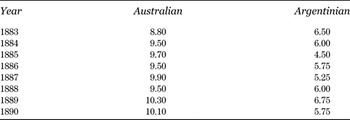
There is a fault line dividing the marketing methods with respect to what a buyer knew prior to purchase about the quality of the wool and its weight after cleaning. Private sales, whether directly from growers or at markets in Latin American ports, offered raw wool that had not been subject to any of the conversion processes required by top makers to have clean wool of known type and quality. The risks facing the buyer in private sales were markedly higher than those faced when buying at auction. Auctions usually meant that the grower had undertaken the first stage of classing and packing fleeces, indicating type. Geoffrey Jeffrey and Henry Smith both argued that by doing this, Australian growers received a price well above the cost of providing the service.Footnote 77 It is likely that this reflected a premium the buyer was prepared to pay for the reduced risk regarding the final wool volume and quality. Moreover, as shown in Table 2 above, a grower using auctions paid for part of the marketing costs, including transporting his wool to the port, and for services provided by the selling brokers in their stores. Marketing costs comprised roughly 10 percent of the expenses Australian wool growers incurred in the 1930s.Footnote 78 By comparison, Latin American growers paid none.Footnote 79 (See Tables 4 and 5.)
Average Price for Australian and Argentinian Wool in London, 1883–1890
(pence per lb.)

Sources: Alan Barnard, The Australian Wool Market, 1840–1900 (Melbourne, 1958), 229–30, table 27, col. 8; Hilda Sabato, “Wool Trade and Commercial Networks in Buenos Aires, 1840s to 1880s,” Journal of Latin American Studies 15, no. 1 (1983): 62, table 5.
Notes: Australian wool is average medium crossbred greasy. Argentinian wool is crossbred greasy and contains vegetable matter.
Prices per Pound for Fine Greasy Wool at London Auction, 4 Oct. 1929
(pence per lb.)

Source: Textile Mercury, Wool Year Book, 1930 (Manchester, 1930), 51.
Our argument is that the differences in the “efficiency” of the private and auction systems of sale were largely offset by the lower prices offered by buyers in the former. Hypothetically, any difference in the prices paid by a Bradford comber for greasy crossbred wool of comparable count, quality, and potential “yield” from Australia and from Argentina should have reflected two things: the respective cost of transport to the United Kingdom and the expense of preparing wool for tops manufacture that remained to fall on the buyer.Footnote 80 As noted above, some of the preparatory work was undertaken at the expense of the grower in the auction system. Buyers paid a lower price in private markets to compensate for the higher risks resulting from the lack of knowledge about the wool being purchased and because they would then have to pay for the transformation processes required before the wool could be made into tops. We find a consistent price differential in favor of greasy crossbred wool that had been well classed, skirted, and packed from Australia and New Zealand compared with similar wools from South America that were poorly prepared.Footnote 81 Our data is supported by Hilda Sabato's observation that when an Argentinian “grower sold his produce at the door of his estancia, he did not cover any of the costs involved in the process of marketing, but he received a price that was normally lower than that which was quoted in the Buenos Aires markets.”Footnote 82 Moreover, Sabato argues that the differential between the price received for similar types of wool offered by Argentinian and Australian growers existed “because the condition in which each of them reached the market was not the same.”Footnote 83
Conclusion
In his treatise on The Marketing of Wool, Foster Du Plessis expressed his wonderment at the variety of marketing methods for apparel wool.Footnote 84 Wool was an outlier compared with trade in other fibers. The world's textile industry relied on large volumes of cross-border trade in fibers such as wool, cotton, other natural fibers, and synthetics.Footnote 85 Wool was condemned to sale through physical markets until an effective form of objective measurement was developed and reluctantly accepted by the trade in the 1980s.Footnote 86 By contrast, increasing standardization of the classification of cotton fibers, particularly in the United States in the 1920s, and the increasing production of synthetic fibers encouraged the use of different marketing methods: sale by description and trading in futures contracts.Footnote 87 Moreover, the relatively small number of industrial firms producing synthetic fibers swapped technical information and attempted international market sharing.Footnote 88 Wool lagged behind substitute fibers in modernizing its market methods.
The global wool trade persisted with different country-based marketing methods after the relocation of wool markets to the five major wool-exporting countries in the decades straddling the turn of the twentieth century. Argentina and Uruguay continued with the nineteenth-century form of wool marketing: sales direct from farmers. Australia, by contrast, shifted decisively to an almost universal central auction system. Marketing in New Zealand and South Africa fell somewhere in between, with a mix of private sales and poorly coordinated auction sales.
The puzzle that motivated this article is why these differences persisted when there are strong arguments from institution theory and the new institutional economics that some convergence in marketing methods should occur. Our argument is that the history and geography of these countries, broadly defined, gave rise to a particular form of isomorphism, as defined by DiMaggio and Powell and later scholars: country-specific organizational fields.Footnote 89 The shift of wool markets from the consuming to the producing countries resulted in the development of localized organizational fields, not only between countries but sometimes locally between selling centers within countries.Footnote 90 Once these became mature, the likelihood of any convergence between them was very low. Each of the wool-exporting nations had a unique set of natural resources whose comparative advantage shaped the path of economic development. However, social and political institutions, themselves influenced by the nature of their relations with colonizing European powers, gave rise to distinct patterns of access to resources, particularly land, power, and influence. The coercive mechanism facilitating isomorphism has greater predictive and operational power within a single nation-state or jurisdiction. The international wool trade was not tamed by normative pressures. Geography and history had bequeathed a variety of husbandry techniques and country-specific classifications of wool types. Pressures from the wool-consuming countries did lead to some standardization and cooperation in wool sale contracts, dispute resolution, and so on; however, this development owed little to “professionalism,” as discussed by the institution theorists. The wool trade remained a craft industry, where experientially acquired tacit knowledge was the dominant prerequisite for evaluating the nature and quality of wool. We argue that the power of the mimetic mechanism was weakened by information asymmetries between market participants in the various countries. Growers may have been the least informed about alternative systems, while buyers from the wool-importing countries, many of whom operated in several markets, were most aware. Scale considerations also helped shape comparative marketing choices. Moreover, Skinner's directory of the wool trade reveals that most of the multicountry operators were in British dominions rather than in Latin America. Understanding the possibility of different outcomes would be a precondition to undertaking a regime change. More difficult is finding a group of institutional entrepreneurs who would build the required new institution. Australian stock and station agents were uniquely well placed to undertake this move.
An explanation for lack of institutional convergence can also be understood through economic rationality on the part of the principal actors. An auction system has benefits for both growers and buyers, in that by offering smallish lots of wool of the same quality the maximum number of buyers can bid for the growers’ wool. Moreover, auctions are more economical in transaction costs and time than private sales. We argue that there was little pressure from either growers or buyers to shift from private sales to auctions because of the economics of preparing raw wool for combing and carding. In the private sale, buyers bore the cost of accurately classing and cleaning wool. In the auction system, many of these preparations were performed by growers prior to sale. Buyers paid more at auction for the same quality of wool, in part because their processing costs prior to combing were reduced.
Blending two streams of institutional theory—isomorphism and the new institutional economics—has guided our explanation of a lack of convergence at a supranational level for a key international commodity trade. This lack of convergence occurred in the wake of the first phase of globalization, in the later nineteenth century, and provides some insights into the limitations of that process. Relatedly, the continuation of divergent marketing methods also speaks in general terms to the broad literature on the so-called great divergence from which we have drawn, including the work of Acemoglu and Robinson.Footnote 91 Our contribution reminds us of the geographical, historical, and cultural differences that shape the distinctive development paths of each nation in the face of apparently immutable forces of convergence.