


Introduction
It is well documented that exposure-based cognitive behavioural therapy (‘exposure therapy’) is highly effective in the treatment of pathological anxiety (Butler et al., Reference Butler, Chapman, Forman and Beck2006; Chorpita et al., Reference Chorpita, Daleiden, Ebesutani, Young, Becker, Nakamura and Trent2011; Deacon and Abramowitz, Reference Deacon and Abramowitz2004; Olatunji et al., Reference Olatunji, Cisler and Deacon2010). Due to its substantial empirical support, exposure therapy is recommended as the first-line psychological treatment for anxiety disorders, post-traumatic stress disorder (PTSD), and obsessive-compulsive disorder (OCD) in clinical practice guidelines around the world (American Academy of Child & Adolescent Psychiatry, 2007; American Psychiatric Association, 2007, 2009; Baldwin et al., Reference Baldwin, Anderson, Nutt, Bandelow, Bond, Davidson and Scott2005; Bandelow et al., Reference Bandelow, Sher, Bunevicius, Hollander, Kasper and Zohar2012; Bandelow et al., Reference Bandelow, Lichte, Rudolf, Wiltink and Beutel2015; Katzman et al., Reference Katzman, Bleau, Blier, Chokka, Kjernisted and Van Ameringen2014; National Institute for Clinical Excellence, 2005, 2011, 2013, 2018). Unfortunately, exposure therapy suffers from a ‘public relations problem’ whereby many therapists have negative beliefs about its safety, ethicality and tolerability (Olatunji et al., Reference Olatunji, Deacon and Abramowitz2009). Pervasive negative beliefs about exposure therapy helps explain why many therapists forgo exposure therapy with anxious clients (Becker et al., Reference Becker, Zayfert and Anderson2004; Böhm and Külz, Reference Böhm and Külz2008; Gunter and Whittal, Reference Gunter and Whittal2010; Hipol and Deacon, Reference Hipol and Deacon2013; Marcks et al., Reference Marcks, Weisberg and Keller2009; Whiteside et al., Reference Whiteside, Deacon, Benito and Stewart2016; Wolitzky-Taylor et al., Reference Wolitzky-Taylor, Zimmermann, Arch, De Guzman and Lagomasino2015). Such negative beliefs may also help explain why even among therapists who use exposure therapy, many implement it in an overly cautious manner, whereby therapists use their own ‘therapist safety behaviours’ to assist clients in avoiding or alleviating pathological anxiety (Deacon et al., Reference Deacon, Farrell, Kemp, Dixon, Sy, Zhang and McGrath2013a; Freiheit et al., Reference Freiheit, Vye, Swan and Cady2004; Harned et al., Reference Harned, Dimeff, Woodcock and Contreras2013; Hipol and Deacon, Reference Hipol and Deacon2013; Waller and Turner, Reference Waller and Turner2016). Some examples of therapist safety behaviours include teaching the client controlled breathing strategies, implementing progressive muscle relaxation, and encouraging a client to utilise their own safety behaviours during exposure (Deacon et al., Reference Deacon, Farrell, Kemp, Dixon, Sy, Zhang and McGrath2013a; Deacon et al., Reference Deacon, Lickel, Farrell, Kemp and Hipol2013c; Hipol and Deacon, Reference Hipol and Deacon2013).
Exposure therapy is more effective when it is delivered in a prolonged and intense manner (Blakey and Abramowitz, Reference Blakey and Abramowitz2016; Craske et al., Reference Craske, Treanor, Conway, Zbozinek and Vervliet2014; Hedtke et al., Reference Hedtke, Kendall and Tiwari2009; Helbig-Lang et al., Reference Helbig-Lang, Richter, Lang, Gerlach, Fehm, Alpers and Gloster2014; Schmidt et al., Reference Schmidt, Woolaway-Bickel, Trakowski, Santiago, Storey, Koselka and Cook2000; Sloan and Telch, Reference Sloan and Telch2002; Tolin et al., Reference Tolin, Hannan, Maltby, Diefenbach, Worhunsky and Brady2007). As such, therapist safety behaviours – which can reduce the intensity and/or duration of exposure therapy – are concerning. For instance, another therapist safety behaviour is allowing clients to terminate exposure tasks if their anxiety becomes too high. However, there is strong evidence of a dose–response relationship between duration/frequency of exposure tasks and therapeutic outcome among individuals with OCD (Abramowitz, Reference Abramowitz1996), panic disorder with agoraphobia (Gloster et al., Reference Gloster, Wittchen, Einsle, Lang, Helbig-Lang, Fydrich and Alpers2011), and elevated anxiety sensitivity (Deacon et al., Reference Deacon, Kemp, Dixon, Sy, Farrell and Zhang2013b). Consequently, therapist safety behaviours such as shortening exposure tasks may subject clients to opportunity costs associated with investing time, money and resources for less effective, less efficient treatment (Gunter and Whittal, Reference Gunter and Whittal2010).
Therapist safety behaviours are especially important in the context of anxiety treatment, as therapists are in positions of power; therapist behaviour can directly impact client behaviours, attitudes and emotions (Waller and Turner, Reference Waller and Turner2016). For example, when a therapist instructs a client to perform anxiety reduction techniques such as controlled breathing, it may communicate to the client that the therapist believes the client is unable to tolerate distress and therefore must use controlled breathing exercises to reduce their physiological arousal. Similarly, allowing a client to terminate an exposure task when the client’s anxiety is high may unintentionally convey to the client that the therapist believes the client’s distress is intolerable and/or that the client’s fear is valid. Unfortunately, these messages directly conflict with a major goal of exposure therapy – for the client to learn they can tolerate distress and that their expectations regarding negative outcomes are inaccurate (Craske et al., Reference Craske, Kircanski, Zelikowsky, Mystkowski, Chowdhury and Baker2008; Craske et al., Reference Craske, Treanor, Conway, Zbozinek and Vervliet2014).
Cognitive behavioural theory (Abramowitz et al., Reference Abramowitz, Deacon and Whiteside2019) posits that beliefs directly influence behaviour. In other, non-therapist populations, beliefs about the necessity of safety behaviours predict safety behaviour use (Meyer et al., Reference Meyer, Clapp, Whiteside, Dammann, Kriegshauser, Hale and Deacon2018). For example, Meyer and colleagues (Meyer et al., Reference Meyer, Kirk, Arch, Kelly and Deacon2019) found that among individuals with high social anxiety, the belief that safety behaviours are necessary to function in life emerged as a significant predictor of safety behaviour use. Therapist safety behaviours may also be predicted by the therapist’s beliefs about their necessity; however, this relationship has not yet been examined and very little is known about what beliefs therapists may have regarding the necessity of their own safety behaviours.
Considering that therapists who have negative beliefs about the safety, tolerability and ethicality of exposure therapy itself are more likely to use therapist safety behaviours (Deacon et al., Reference Deacon, Farrell, Kemp, Dixon, Sy, Zhang and McGrath2013a; Farrell et al., Reference Farrell, Deacon, Kemp, Dixon and Sy2013), it is possible that therapists believe their safety behaviours are necessary to keep the client safe, ensure the client is able to tolerate their distress, and/or prevent a breach of ethical guidelines. Similarly, therapists who falsely believe that exposure therapy is associated with higher treatment refusal, poor therapeutic alliance, higher drop-out and greater chance of legal risks (Olatunji et al., Reference Olatunji, Deacon and Abramowitz2009) may believe that therapist safety behaviours are necessary to avoid these negative outcomes. Additionally, Waller and Turner (Reference Waller and Turner2016) posited that therapists may engage in a therapist safety behaviour because they believe it will decrease their own distress.
Awareness of the beliefs therapists have about the necessity of their own safety behaviours may contribute to the empirical understanding of why therapists use safety behaviours. Furthermore, if a link between beliefs about safety behaviours and safety behaviour use is found, it may enable exposure therapy training resources (e.g. textbooks, manuals, lectures and workshops) to be improved by including components that directly address such maladaptive beliefs. For example, in addition to didactic instruction on how to implement exposure therapy, training workshops could incorporate (1) empirical evidence refuting positive beliefs about therapist safety behaviours, (2) client testimonials describing therapist safety behaviours as unnecessary, and (3) experiential exercises to test therapists’ maladaptive beliefs regarding the necessity of their safety behaviours. These three techniques have been used by Farrell et al. (Reference Farrell, Kemp, Blakey, Meyer and Deacon2016) to successfully influence clinician beliefs about exposure therapy itself, which mediated improvement in self-reported delivery of exposure therapy. If used to target therapist beliefs regarding their own safety behaviours, these techniques may lead to a reduction in therapist safety behaviour use, thereby improving treatment outcome.
This study aimed to identify beliefs exposure therapists have regarding the necessity of therapist safety behaviours and to examine the relationship between this construct and therapist safety behaviour use. To this end, the Exposure Implementation Beliefs Scale (EIBS; see Supplementary Material) was created and its psychometric quality evaluated. The EIBS consists of ten items that assess positive beliefs about the necessity of therapist safety behaviours during exposure therapy (e.g. therapist safety behaviours are necessary to prevent the client from dropping out). Australian psychologists were surveyed using an assessment battery that included the EIBS and existing measures of therapist safety behaviour use, therapist negative beliefs about exposure therapy, likelihood to exclude anxious clients from exposure therapy, and use of intensifying exposure techniques. It was hypothesized that the EIBS would demonstrate sound item-level psychometric properties, significant positive correlations with measures of therapist safety behaviour use, therapist negative beliefs about exposure therapy, likelihood to exclude anxious clients from exposure therapy, and a significant negative correlation with the use of intensifying exposure techniques (e.g. encouraging clients to conduct exposure to their most feared situation). No a priori hypotheses were made regarding which belief(s) about therapist safety behaviour would be significant in predicting therapist safety behaviour use.
Method
Participants
Participants were required to hold current registration as a psychologist with the Psychology Board of Australia and to endorse using exposure therapy to treat anxiety. Of the 134 individuals who responded to the survey, two participants’ data were omitted as they did not endorse registration with the Psychology Board of Australia. Of the remaining 132 participants, 117 responded ‘Yes’ to using exposure therapy in the treatment of anxiety, 12 responded ‘No’ to using exposure therapy in the treatment of anxiety, and three did not respond to this question. The 12 individuals who denied using exposure therapy to treat anxiety endorsed one or more of the following reasons for their omission of exposure therapy: ‘I choose to use other methods of treating anxiety’ (n = 8), ‘I have not been trained in implementing exposure therapy’ (n = 3), ‘I do not work with clients who have anxiety disorders’ (n = 1) and ‘The organization/employer I work for does not permit exposure therapy’ (n = 1). Of the 117 individuals who reported using exposure therapy in the treatment of anxiety, 19 did not pass one or both of the attention checks embedded in the survey. Therefore, the final sample consisted of 98 exposure therapists registered with the Psychology Board of Australia.
The mean age of the sample was 36.8 years (SD = 11.1). The majority of the participants identified as women (n = 79; 80.6%) and identified their cultural origin as Australian (n = 86; 87.8%). Most exposure therapists had completed a Master’s degree (n = 57; 58.2%) or a doctoral degree (n = 24; 24.5%). Slightly more than half of the sample reported holding registration with Medicare (n = 57; 58.2%), which allows psychologists to receive rebates for psychological services from the universal health care system in Australia. Over half of the sample (n = 53; 54.1%) held a practice endorsement with the Psychology Board of Australia, which allows psychologists with specific qualifications and advanced supervised practice to work in particular area(s). Of the 53 participants who held a practice endorsement, 52 were endorsed in the area of clinical psychology, two were endorsed in the area of clinical neuropsychology, two were endorsed in the area of counselling psychology, and one was endorsed in the area of educational and developmental psychology. Participants reported having the following theoretical orientations (some participants selected multiple orientations): cognitive behavioural (n = 83; 84.7%), acceptance and commitment (n = 55; 56.1%), behavioural (n = 34; 34.7%), family/systems (n = 33; 33.7%), cognitive (n = 25; 25.5%), supportive/Rogerian (n = 19; 19.4%), eclectic (n = 19; 19.4%), psychodynamic (n = 18; 18.4%), experiential/humanistic (n = 12; 12.2%), psychoanalytical (n = 5; 5.1%) and ‘other’ (n = 14; 14.3%). On average, participants reported beginning exposure therapy with anxious clients 3.2 sessions (SD = 1.2) after the initial evaluation.
Measures
Exposure Therapy Delivery Scale (ETDS)
The ETDS (Deacon et al., Reference Deacon, Meyer, Kemp, Farrell, Blakey, Benito and Whitesideunpublished manuscript) is an 18-item measure that assesses the manner in which clinicians deliver exposure therapy. Two subscales assess the frequency with which therapists use 10 intensive exposure techniques (e.g. encouraging exposure to the most feared situation, assigning exposure homework) and eight therapist safety behaviours (e.g. teaching of relaxation techniques, encouragement of anxiety-reduction strategies in the context of exposure). These two subscales are called the Intensive Exposure subscale and the Coping Exposure subscale, respectively. Items are rated on a 5-point Likert-type scale ranging from 0 (never use) to 4 (always use). Past research has found the internal consistency for the ETDS Intensive Exposure subscale (α = .88) and the ETDS Coping Exposure subscale (α = .90) to be good (Deacon et al., Reference Deacon, Meyer, Kemp, Farrell, Blakey, Benito and Whitesideunpublished manuscript). ETDS subscale scores are calculated by averaging the items on each subscale. In the present sample, the internal consistency for the ETDS Intensive Exposure subscale (α = .86) and the ETDS Coping Exposure subscale (α = .88) were also good. Participants first completed the ETDS Intensive Exposure subscale, followed by the ETDS Coping Exposure subscale. Participants were then asked to complete the Exposure Implementation Beliefs Scale based on the behaviours they endorsed on the ETDS Coping Exposure subscale.
Exposure Implementation Beliefs Scale (EIBS)
The EIBS was created for the current study to assess the beliefs therapists hold regarding their own safety behaviours when delivering exposure therapy. An initial pool of 10 items was generated based on an informal review of the literature on therapist reservations about exposure therapy (Benito et al., Reference Benito, Conelea, Garcia and Freeman2012; Deacon and Farrell, Reference Deacon, Farrell, Storch and McKay2013; Deacon et al., Reference Deacon, Lickel, Farrell, Kemp and Hipol2013c; Farrell et al., Reference Farrell, Deacon, Kemp, Dixon and Sy2013; Harned et al., Reference Harned, Dimeff, Woodcock and Contreras2013; Olatunji et al., Reference Olatunji, Deacon and Abramowitz2009), exposure therapy treatment manuals (Abramowitz et al., Reference Abramowitz, Deacon and Whiteside2019; Barlow and Craske, Reference Barlow and Craske2006; Foa et al., Reference Foa, Yadin and Lichner2012; Kendall and Hedtke, Reference Kendall and Hedtke2006), and clinical experience of the authors. Respondents rate items based on the degree to which they believe that their safety behaviours while delivering exposure therapy (as determined by the ETDS Coping Exposure subscale) are necessary for a variety of outcomes (e.g. ensuring the client’s safety, maintaining therapeutic alliance, decreasing the therapist’s own distress, preventing a breach of legal guidelines). Items are rated on the following 5-point scale: 0 = very little; 1 = a little; 2 = some; 3 = much; 4 = very much. The EIBS total score is obtained by averaging the 10 items on the scale, with higher scores indicating stronger positive beliefs about therapist safety behaviours. The EIBS can be obtained by contacting the first author or by viewing the Supplementary Material for this manuscript.
Therapist Beliefs about Exposure Scale (TBES)
The TBES (Deacon et al., Reference Deacon, Farrell, Kemp, Dixon, Sy, Zhang and McGrath2013a) measures therapists’ negative beliefs about the ethicality, tolerability and safety of exposure therapy. Respondents indicate to what extent they agree with 21 negative statements about exposure therapy (e.g. ‘Most clients have difficulty tolerating the distress exposure therapy evokes’). Items are rated on a 5-point Likert-type scale ranging from 0 (disagree strongly) to 4 (agree strongly). All items are summed to yield a total score ranging from 0 to 84, with higher scores indicating stronger negative beliefs about the ethicality, tolerability and safety of exposure therapy. The TBES has demonstrated high internal consistency (Deacon et al., Reference Deacon, Farrell, Kemp, Dixon, Sy, Zhang and McGrath2013a; Farrell et al., Reference Farrell, Deacon, Kemp, Dixon and Sy2013; Meyer et al., Reference Meyer, Farrell, Kemp, Blakey and Deacon2014), a clear single-factor structure, a normal distribution in a large and diverse sample of therapists, and excellent 6-month test–re-test reliability (r = .89) and criterion validity (Deacon et al., Reference Deacon, Farrell, Kemp, Dixon, Sy, Zhang and McGrath2013a). In the present sample, the TBES demonstrated high internal consistency (α = .91).
Broken Leg Exception Scale (BLES)
The BLES (Meyer et al., Reference Meyer, Farrell, Kemp, Blakey and Deacon2014) measures the likelihood of a therapist excluding a client from exposure therapy due to 25 client characteristics (e.g. co-morbidity with a substance use disorder, poor insight, emotional fragility). Respondents rate each item on a 4-point Likert-type scale ranging from 0 (very unlikely to exclude) to 3 (very likely to exclude). All items are summed to create a total score ranging from 0 to 75, with higher scores indicating a greater likelihood of excluding clients from exposure therapy due to client characteristics. The BLES has demonstrated excellent internal consistency (α = .93) and a normal distribution in a large and diverse sample of therapists (Meyer et al., Reference Meyer, Farrell, Kemp, Blakey and Deacon2014). In the current sample, the internal consistency of the BLES was excellent (α = .94).
Procedure
In order to maximize the generalizability of findings, recruitment occurred via two methods. First, the Australian Psychological Society (APS) advertised the study in a fortnightly newsletter email and posted a description of the study and a link to the study website on the APS website. Second, the snowballing technique was used, whereby one author (J.M.) sent an email invitation to participate in the study to eligible colleagues and asked them to participate and forward the invitation on to their eligible colleagues who were then asked to participate and forward the invitation on to their eligible colleagues. and so on. Previous studies have been successful in recruiting participants using both of these techniques simultaneously (Duncan et al., Reference Duncan, Williams and Knowles2013; Politis and Knowles, Reference Politis and Knowles2013). Unfortunately, a response rate could not be calculated, as it is unknown how many individuals were notified of the survey.
Data were collected anonymously via www.surveymonkey.com. Participants first provided informed consent to participate in the study and then completed study measures including the demographic questionnaire, ETDS Intensive Exposure subscale, ETDS Coping Exposure subscale, EIBS, TBES and the BLES. As an incentive, participants could choose to enter a draw to win one of six Visa gift cards worth $50 (×5) or $100 (×1). Participants who wished to enter the draw were asked to provide their email address at the end of the survey. Email addresses were separated from the survey data to maintain anonymity. All study procedures were approved by the Social Sciences Human Research Ethics Committee at the University of Wollongong (ethics number: 2017/383).
Results
Factor structure of the EIBS
The factor structure of the EIBS was assessed in order to explore whether any underlying factors exist within beliefs about therapist safety behaviours. A principal components analysis (PCA) was used for the purpose of data reduction (Floyd and Widaman, Reference Floyd and Widaman1995), as authors did not have an a priori hypothesis about the latent structure of the construct. An oblique (oblimin) rotation was used as it was assumed any emerging factors would be correlated.
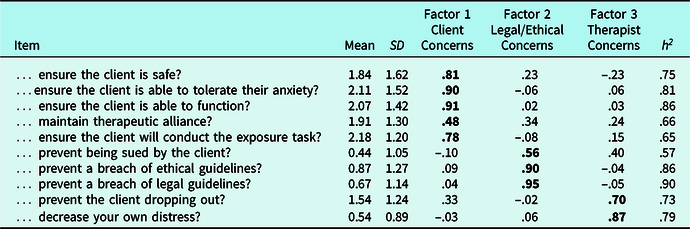
The first four eigenvalues were: 5.06, 1.46, 1.04 and 0.84. A three-factor solution was indicated based on factor interpretability, common rules for factor retention (Kaiser, Reference Kaiser1960; Longman et al., Reference Longman, Cota, Holden and Fekken1989), and examination of the scree plot, which accounted for 75.66% of the variance in EIBS scores. Items on the first (mean = .78; range = .48 to .91), second (mean = .80; range = .56 to .95) and third (mean = .79; range = .70 to .87) factors had salient (>.40) loadings. High communalities for each item indicate that the three-factor solution accounted for a large proportion of the variance in each EIBS item. Means, standard deviations, factor loadings and communalities for each EIBS item for the three-factor solution are displayed in Table 1.
The Exposure Implementation Beliefs Scale (EIBS): means, standard deviations, factor loadings and communalities for the three-factor solution

Salient factor loadings (>|.40|) are given in bold. SD, standard deviation.
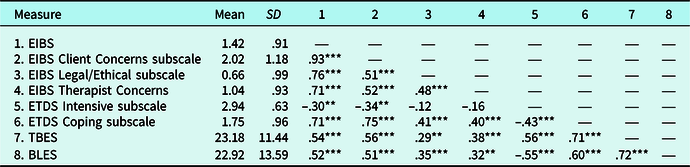
Factor 1 (five items), labelled ‘Client Concerns’, measures beliefs about the necessity of therapist safety behaviours in protecting the client. Factor 2 (three items), labelled ‘Legal/Ethical Concerns’, measures beliefs about the necessity of therapist safety behaviours in upholding legal and ethical standards. Factor 3 (two items), labelled ‘Therapist Concerns’, measures beliefs about the necessity of therapist safety behaviours in managing the therapist’s own distress. Three separate subscales were created by averaging items that loaded onto each factor. Table 2 displays means and standard deviations for the EIBS and its three subscales.
Descriptive statistics and zero-order correlations between study variables

**p < .01; ***p < .001. SD, standard deviation; EIBS, Exposure Implementation Beliefs Scale; ETDS, Exposure Therapy Delivery Scale; TBES, Therapist Beliefs about Exposure Scale; BLES, Broken Leg Exception Scale.
Corrected item-total correlations and inter-item correlations for items on all three EIBS subscales were within acceptable ranges. The Cronbach’s alpha (α) of the Client Concerns subscale (.89) and the Legal/Ethical Concerns subscale (.83) were good, while the Cronbach’s alpha of the Therapist Concerns subscale (.66) was questionable. Men and women did not have significantly different scores on any of the EIBS subscales (d ≤ .33, p ≥ .24). Similarly, participants with Master’s degrees did not have significantly different scores on any of the EIBS subscales compared with participants with doctoral degrees (d ≤ .34, p ≥ .19). Age was found to be significantly correlated with the Client Concerns subscale (r = .27, p = .007) but not with the Legal/Ethical Concerns or Therapist Concerns subscales (r ≤ |.06|, p ≥ .57).
Psychometric properties and descriptive statistics of the EIBS
Reliability analyses for the EIBS demonstrated that corrected item-total correlations (mean = .63) and inter-item correlations (mean = .44) were within acceptable ranges (Nunnally and Bernstein, Reference Nunnally, Bernstein, Nunnally and Bernstein1994). The Cronbach’s alpha (α) of the EIBS was good (.89) and would not have improved with the deletion of any EIBS items. The most strongly endorsed beliefs about therapist safety behaviours were that they are necessary to: ensure the client will conduct the exposure task, ensure the client is able to tolerate their anxiety, and ensure the client is able to function. The least strongly endorsed beliefs about therapist safety behaviours were that they are necessary to: prevent being sued by the client, decrease the therapist’s own distress, and prevent a breach of legal guidelines. Descriptive statistics for each EIBS item are displayed in Table 1.
The total mean score for the EIBS was 1.42 (SD = .91). Total mean EIBS scores did not differ significantly based on age (r = .16, p = .13) or gender (d = 0.09, p = .48). No significant difference in EIBS scores was found between exposure therapists with Master’s degrees (mean = 1.56, SD = .93) and doctoral degrees (mean = 1.40, SD = .78), t (78) = .70, p = .48, d = .18.
Correlations between the EIBS, its subscales, and study measures
Means, standard deviations and correlations between all study measures are displayed in Table 2. All correlations between the EIBS and the ETDS Intensive subscale, ETDS Coping subscale, TBES and BLES supported hypotheses, providing preliminary support for the convergent validity of the EIBS. Specifically, the EIBS was significantly positively correlated with the use of therapist safety behaviours during exposure, as measured by the ETDS Coping subscale. Conversely, the EIBS was significantly negatively correlated with the use of intensive exposure techniques, as measured by the ETDS Intensive subscale. The EIBS was also significantly positively correlated with therapist negative beliefs about the ethicality, tolerability and safety of exposure therapy (TBES) and therapist likelihood of excluding an anxious client from exposure therapy (BLES).
Exploratory correlations between the EIBS subscales and study measures were also calculated. The EIBS Client Concerns subscale behaved very similarly to the EIBS total mean score in the strength and direction of its correlations with study measures. The EIBS Legal/Ethical Concerns and Therapist Concerns subscales also demonstrated significant, positive correlations with measures of therapist safety behaviour use (ETDS Coping subscale), therapist negative beliefs about the ethicality, tolerability, and safety of exposure therapy (TBES) and therapist likelihood of excluding an anxious client from exposure therapy (BLES). However, correlations involving the EIBS Legal/Ethical Concerns and Therapist Concerns subscales were, in general, weaker than those involving the EIBS total mean score and EIBS Client Concerns subscale. Furthermore, EIBS Legal/Ethical Concerns and Therapist Concerns subscales did not demonstrate a significant correlation with the use of intensive exposure techniques (ETDS Intensive subscale).
Beliefs about therapist safety behaviours in the prediction of therapist safety behaviour use
The hypothesis that beliefs about therapist safety behaviours would predict therapist safety behaviour use was tested in two ways. First, the correlation between beliefs about therapist safety behaviours (EIBS) and therapist safety behaviour use (ETDS Coping subscale) was calculated and found to be significant (r = .71, p <.001). Second, a multiple regression was conducted in order to determine whether any types of beliefs about therapist safety behaviours (Client Concerns; Legal/Ethical Concerns; Therapist Concerns) uniquely predicted a significant amount of variance in therapist safety behaviour use. The three EIBS subscales were simultaneously entered as independent variables predicting the ETDS Coping subscale. This multiple regression model predicted 54.90% of the variance in therapist safety behaviour use (p <.001). Only the EIBS Client Concerns subscale emerged as a significant predictor of unique variance in therapist safety behaviour use (sr 2 = .34, p < .001). Results from the multiple regression are displayed in Table 3.
Types of beliefs about therapist safety behaviours predicting therapist safety behaviour use

***p < .001. ETDS, Exposure Therapy Delivery Scale; EIBS, Exposure Implementation Beliefs Scale.
Results from the above analyses support the hypothesis that beliefs held by exposure therapists about the necessity of therapist safety behaviours significantly predict therapist safety behaviour use. Furthermore, these results demonstrate that beliefs about the necessity of therapist safety behaviours in protecting the client are particularly important in predicting therapist safety behaviour use.
Discussion
The goals of the present study were to (1) identify the beliefs exposure therapists have regarding the necessity of therapist safety behaviours and (2) to assess the relationship between this construct and therapist safety behaviour use. To this end, the EIBS was created to assess beliefs about therapist safety behaviour use. Ninety-eight exposure therapists registered with the Psychology Board of Australia completed measures assessing the use of intensifying exposure techniques, the use of therapist safety behaviours, beliefs about therapist safety behaviours, beliefs about exposure therapy, and likelihood of excluding anxious clients from exposure therapy.
As hypothesized, the EIBS demonstrated adequate item-level psychometric properties. Results of a PCA suggested that beliefs about therapist safety behaviours fall into three categories: client concerns, legal/ethical concerns, and therapist concerns. Hypotheses regarding the correlations between the EIBS and other study measures were also supported, with stronger positive beliefs about therapist safety behaviours being significantly related to more frequent use of therapist safety behaviours, less frequent use of intensive exposure techniques, stronger negative beliefs about exposure therapy, and greater likelihood of excluding an anxious client from exposure therapy. Specifically, therapist safety behaviour use was significantly predicted by beliefs that therapist safety behaviours are necessary to protect the client. These results provide preliminary support for the validity of the EIBS and highlight the importance of beliefs about therapist safety behaviours in predicting therapist safety behaviour use.
Although the PCA yielded a clear three-factor solution based on common rules for factor retention and examination of the scree plot, factor interpretability was less straightforward for Factor 3 (Therapist Concerns) compared with Factor 1 (Client Concerns) or Factor 2 (Legal/Ethical Concerns). At first glance, items 5 (…prevent the client from dropping out) and 8 (…decrease your own distress) on Factor 3 may seem unrelated to one another. However, one explanation for the high loadings of these items on the same factor is that client drop-out is highly distressing to therapists (Klein et al., Reference Klein, Stone, Hicks and Pritchard2003; Pekarik, Reference Pekarik1985). When clients drop out of therapy, therapists may perceive it as an indication that they are incompetent (Thériault et al., Reference Thériault, Gazzola and Richardson2009) and have failed (Scamardo et al., Reference Scamardo, Bobele and Biever2004). There is some truth to this inference, as therapist factors (e.g. experience, training, skills) do impact drop-out (Roos and Werbart, Reference Roos and Werbart2013; Saxon et al., Reference Saxon, Barkham, Foster and Parry2017; Zimmermann et al., Reference Zimmermann, Rubel, Page and Lutz2017). Therefore, therapists may believe that engaging in therapist safety behaviours will prevent clients from dropping out, thereby protecting themselves from the associated distress.
One unexpected finding was that beliefs about the necessity of therapist safety behaviours in protecting the client (Client Concerns) emerged as the only significant predictor of unique variance in therapist safety behaviour use. It is possible that beliefs within this domain stem from an underlying adherence to a doctrine coined the ‘spun-glass theory of the mind’ by Paul Meehl (Reference Meehl and Meehl1973). This doctrine assumes that humans are psychologically fragile, like spun-glass, and will face major traumatic consequences if faced with minor emotional distress. However, clients with anxiety disorders, by definition, experience persistent and clinically significant distress; if they have not ‘broken’ like spun-glass in their daily lives, it is unlikely that they will break in the context of exposure therapy. Unfortunately, by engaging in therapist safety behaviours aimed at protecting the client, it could communicate to the client that they are in need of protection – that the therapist believes the client is incapable of tolerating distress and/or that the client’s threat appraisal is accurate. Those messages are problematic, as they are in direct contrast to two major lessons intended to be learned in exposure therapy – that the client is able to tolerate distress and that the client’s threat appraisals are inaccurate (Craske et al., Reference Craske, Kircanski, Zelikowsky, Mystkowski, Chowdhury and Baker2008; Craske et al., Reference Craske, Treanor, Conway, Zbozinek and Vervliet2014).
Results from the present study have important empirical, clinical and training implications. Firstly, findings support the core assumption of cognitive behaviour models that beliefs directly relate to behaviour (Abramowitz, Reference Abramowitz2013). Secondly, the present study demonstrates that beliefs about the necessity of therapist safety behaviours – in particular, beliefs about the necessity of therapist safety behaviours in protecting the client – predict therapist safety behaviour use. Understanding why therapists believe their own safety behaviours are necessary could be an important step in reducing therapist safety behaviour use, which may improve therapeutic outcomes (Blakey and Abramowitz, Reference Blakey and Abramowitz2016; Craske et al., Reference Craske, Treanor, Conway, Zbozinek and Vervliet2014; Hedtke et al., Reference Hedtke, Kendall and Tiwari2009; Helbig-Lang et al., Reference Helbig-Lang, Richter, Lang, Gerlach, Fehm, Alpers and Gloster2014; Schmidt et al., Reference Schmidt, Woolaway-Bickel, Trakowski, Santiago, Storey, Koselka and Cook2000; Sloan and Telch, Reference Sloan and Telch2002; Tolin et al., Reference Tolin, Hannan, Maltby, Diefenbach, Worhunsky and Brady2007). As such, exposure therapy training media (e.g. textbooks, manuals, lectures, workshops) should aim to address maladaptive beliefs about therapist safety behaviours, especially beliefs about the necessity of therapist safety behaviours in protecting the client.
It is important to interpret the results of this study while considering its limitations. Firstly, although the present methods of data collection have been successful in recruiting psychologist samples in previous research (Duncan et al., Reference Duncan, Williams and Knowles2013; Politis and Knowles, Reference Politis and Knowles2013), it is likely that the majority of individuals who were contacted to take part in the study declined to participate. Therefore, the extent to which results can be generalized to all therapists is unclear. Secondly, the cross-sectional nature of the data prevents any causal conclusions from being drawn. Thirdly, although the present study yielded preliminary psychometric support for the EIBS, some common markers of psychometric quality (e.g. test–re-test reliability, discriminant validity) were not assessed. In light of these limitations, future research should endeavour to experimentally examine the hypothesized causal relationship between beliefs about therapist safety behaviours and therapist safety behaviour use, as well as examine other psychometric properties of the EIBS in larger, more diverse samples. In addition, future research may seek to identify variables that predict beliefs about therapist safety behaviours themselves, which could facilitate more targeted training in relation to therapist beliefs about their own safety behaviours.
In summary, this study yields several novel findings. First, beliefs about therapist safety behaviours predict therapist safety behaviour use. Second, beliefs about therapist safety behaviours seem to fall into three categories including client concerns, legal/ethical concerns, and therapist concerns, with the client concerns category emerging as the strongest and only significant predictor of unique variance in therapist safety behaviour use. Therefore, therapy training media (e.g. textbooks, manuals, lectures, workshops) could aim to decrease therapist safety behaviour use by focusing on modifying maladaptive beliefs about the necessity of therapist safety behaviours, with particular emphasis on beliefs about the necessity of therapist safety behaviours in protecting the client. This study also introduced the EIBS and provided preliminary data on its psychometric quality. It is hoped that this measure may be useful in empirical and training environments to assess beliefs about the necessity of therapist safety behaviours. Future research should aim to identify optimal methods of modifying maladaptive beliefs about therapist safety behaviours. For example, exposure therapy training workshops have proven to be effective platforms for successfully identifying and modifying negative beliefs about the safety, tolerability and ethicality of exposure therapy (Deacon et al., Reference Deacon, Farrell, Kemp, Dixon, Sy, Zhang and McGrath2013a), which is associated with superior self-reported delivery of treatment (Farrell et al., Reference Farrell, Kemp, Blakey, Meyer and Deacon2016). Perhaps such training workshops could be expanded to identify and modify maladaptive beliefs about the necessity of therapist safety behaviours.
Supplementary material
To view supplementary material for this article, please visit https://doi.org/10.1017/S1754470X20000112
Acknowledgements
The authors would like to thank the participants who gave up their time to take part in the study.
Financial support
This research has been conducted with the support of the Australian Government Research Training Program Scholarship.
Conflicts of interest
Johanna Meyer, Peter Kelly and Brett Deacon have no conflicts of interest with respect to this publication.
Ethical statement
The authors assert that all procedures contributing to this work comply with the Ethical Principles of Psychologists and Code of Conduct as set forth by the APA. This study was reviewed and approved by the Social Sciences Human Research Ethics Committee at the University of Wollongong (ethics number: 2017/383).
Key practice points
(1) Efforts to reduce therapist safety behaviours may be improved by modifying the beliefs therapists have about the necessity of therapist safety behaviours, with particular emphasis on beliefs about the necessity of therapist safety behaviours in protecting the client.
(2) The EIBS may be useful in empirical and training environments to assess beliefs about the necessity of therapist safety behaviours.
(3) Therapists should be wary of how their own beliefs about therapist safety behaviours may impact their use of therapist safety behaviours during exposure therapy.





Comments
No Comments have been published for this article.