Management Implications
Rhodomyrtus tomentosa (downy rose myrtle) is an exotic weed that forms dense thickets in mesic and wet forest understories in Florida and Hawaii. We developed an equation to predict the weed’s biomass without destructive sampling. Crown area can be used to estimate R. tomentosa biomass. Furthermore, height is also a predictor of fruit production, and plants taller than 1 m contribute almost exclusively to the propagule pressure. As plants become taller, they produce more fruits. These fruit-producing individuals should be prioritized for control to reduce local invasion, with smaller shrubs and seedlings/saplings to follow.
Introduction
Quantifying invasive species’ biomass is critical for understanding how the life histories of these plants promote invasion and how control methods can impact invasions. Constructing allometric equations that estimate parameters such as aboveground biomass and fruit production from easily measurable plant metrics allows for repeated measurements of individuals over time and space (Phillips et al. Reference Phillips, Malhi and Vinceti2002). This process involves destructively harvesting several individuals of varying cohorts and developmental stages over a large area of the invaded range and measuring all crown components (fruits, leaves, stems, etc.) to develop a mathematical equation that will predict biomass and size based on some type of dependent variable (diameter at breast height, basal area, height, etc.).
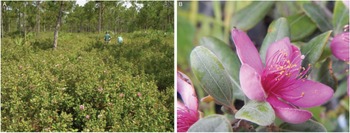
Downy rose myrtle [Rhodomyrtus tomentosa (Aiton) Hassk.; Myrtaceae] is an invasive tropical evergreen shrub that forms a nearly monodominant layer in the understory of Florida’s southern and central slash pine (Pinus elliottii Engelm.) flatwoods (Possley Reference Possley2001). In Naples, Florida, R. tomentosa is even found invading cypress [Taxodium distichum (L.) Rich.] stands, where it is a facultative wetland species in the understory (USFWS 1996). Rhodomyrtus tomentosa was introduced into Florida through the horticulture trade in the early 20th century (Langeland and Craddock Burks Reference Langeland and Craddock Burks1998). This exotic weed naturalized shortly after introduction, and by the 1970s, it was widely distributed throughout Florida, with heavy infestations in Palm Beach, Martin, Collier, Lee, and Charlotte counties (Alexander Reference Alexander1981; Austin Reference Austin1978, Reference Austin1999; Possley Reference Possley2001). It produces prolific showy pink flowers that give way to edible globose fruits with multiple seeds that are dispersed by birds and occasionally mammals (e.g., feral hogs [Sus scrofa L.], black bear [Ursus americanus Pallas]) (Campbell Reference Campbell1977; Csurhes and Hankamer Reference Csurhes and Hankamer2011; Starr et al. Reference Starr, Starr and Loope2003) (Figure 1). In addition to shading out native understory species, R. tomentosa alters fire regimes and further impacts these ecologically and economically important communities (Langeland and Craddock Burks Reference Langeland and Craddock Burks1998; Possley Reference Possley2001; Starr et al. Reference Starr, Starr and Loope2003). Rhodomyrtus tomentosa readily resprouts after fire and is frequently more dominant in post-fire impacted communities than native plants, which primarily regenerate from the soil seedbank (Csurhes and Hankamer Reference Csurhes and Hankamer2011). Controlling R. tomentosa remains expensive and labor-intensive (Stocker and Possley Reference Stocker and Possley2001).
(A) Rhodomyrtus tomentosa invades a mesic Pinus elliottii stand in Florida. (B) Rhodomyrtus tomentosa was introduced to Florida and elsewhere because of its large showy flowers.

To establish long-term research and monitoring plots before treatments (e.g., physical, chemical, biological control), we sought to develop an equation for determining total biomass and fruit production from nondestructive measurements. This approach has been applied to trees traditionally, but also to vines and tropical shrubs (Ali et al. Reference Ali, Xu, Zhao, Zhang, Zhou, Yang and Yan2015; Dudley and Fownes Reference Dudley and Fownes1992; Erickson et al. Reference Erickson, Pratt, Rayamajhi and Horvitz2017; Litton and Kauffman Reference Litton and Kauffman2008; Rayamajhi et al. Reference Rayamajhi, Rohrig, Tipping, Pratt and Leidi2020). Though our primary motivation is to quantify the negative impacts of an invasive species, tropical shrubs are frequently underrepresented in tropical forestry surveys, which primarily focus on canopy trees (Cavanaugh et al. Reference Cavanaugh, Gosnell, Davis, Ahumada, Boundja, Clark, Mugerwa, Jansen, O’Brien, Rovero, Sheil, Vasquez and Andelman2014). Several studies have shown that variables such as height, crown area, and diameter are strong predictors of aboveground biomass in tropical shrubs (Ali et al. Reference Ali, Xu, Zhao, Zhang, Zhou, Yang and Yan2015; Paul et al. Reference Paul, Roxburgh, England, Ritson, Hobbs, Brooksbank, Raison, Larmour, Murphy, Norris, Neumann, Lewis, Jonson, Carter and McArthur2013). Rhodomyrtus tomentosa could also provide important information about how tropical and subtropical woody shrubs grow in the northernmost extent of their range. Allometric studies of tropical shrubs have frequently applied models developed for tropical trees that can incorrectly estimate shrub biomass or have not measured a sufficiently wide geographic area to extrapolate to other areas (Litton and Kauffman Reference Litton and Kauffman2008; Litton et al. Reference Litton, Sandquist and Cordell2006).
In this study, we aim to ascertain species-specific allometric equations for biomass and fruit production of R. tomentosa based on easily measurable parameters. Furthermore, we will determine whether this approach requires a site-specific application or can be used for a general Florida model.
Materials and Methods
Sites
We chose three sites in south Florida with dense R. tomentosa populations from which to harvest our sample plants. Yucca Pens Preserve is a 157-ha preserve in Cape Coral, Lee County, Florida, and contains upland P. elliottii–dominated pinelands and wetland habitats. Rookery Bay National Estuarine Research Reserve is in Naples, Collier County, Florida, and includes wide swaths of the pine flatwood community in addition to estuarine and mangrove (e.g., Rhizophora mangle L.) resources. Cypress Creek Natural Area is 809 hectares (2,000 acres) of flatwoods, wet prairies, cypress domes, and hammocks outside Jupiter, Palm Beach County, Florida. This entire region is considered part of the Greater Everglades Ecosystem, an ecologically unique area with temperate and subtropical species coalescing due to the warm and humid conditions (Duever et al. Reference Duever, Meeder, Meeder, McCollum, Davis, Ogden and Park1994). Freezing events occur extremely rarely and limit the northward expansion of several nonnative plant species, including R. tomentosa. Summer and winter are determined by shifts in daylight and precipitation: like most tropical Caribbean climates, peninsular Florida experiences a warm, wet summer and a somewhat cooler, drier winter, although this may be punctuated by winter storms that bring off-season precipitation (Duever et al. Reference Duever, Meeder, Meeder, McCollum, Davis, Ogden and Park1994). Soils in each site vary little and are composed of nutrient-poor, fine sandy soils (entisols) with limestone substratum (USDA-NRCS 2020).
Experimental Design and Measurements
Between August 2012 and October 2014 (timing that coincided with fruit maturity), we conducted three sampling events wherein we randomly chose 10 plants from each site that ranged from among the smallest to the largest individuals to capture size differences (N = 30 plants per site, 90 plants total). Before plants were harvested, each individual plant was measured for the following parameters: height and two widths bisecting the plant perpendicularly (Width 1 and Width 2). Width 1 (W1) is the widest width of the plant using the center stem halfway from the soil to the tallest branch as reference (visually estimated) and W2 is the width perpendicular to W1. This method aimed to consistently estimate the ground area covered by the shrub. Individual plants were then harvested; sorted into leaves, stems, and branches; and weighed (fresh weight). Fruits were also separated and counted at this time. After fresh weight was taken, all samples were dried at 60 C until they reached a constant mass, after which all parts were weighed again for dry biomass. Crown area is a calculated variable equal to the area of an ellipse:
 ${\rm{Crown\;area}} = 2*\pi {\left( {{\rm{W}}1*{\rm{W}}2} \right)^2}$
Statistical Analysis
We used RStudio (v. 1.3.1047 for Mac) for all statistical analyses. Ten samples were taken from each site over 3 yr, so we first ascertained the effects of site and year on plant metrics. A Shapiro-Wilks test determined that the data are not normally distributed (Shapiro.test). Based on this finding, we utilized a permutation two-way ANOVA to test for effects from site and year or the interaction (lmperm) on each response variable (e.g., height, dry biomass, crown area, fruit). This type of ANOVA is useful for data sets that do not meet assumptions of normality by transforming the data to reduce the effects of nuisance variables (Frossard and Renaud Reference Frossard and Renaud2006). Neither site, year, nor their interaction had a significant effect on any of the response variables. Based on this result, we combined the data for all sites and all years for a total of 90 data points.
We performed linear regressions for all independent and dependent variable combinations using the lm function in RStudio. In addition to a normal linear regression, we also forced the line through the origin (i.e., intercept = 0). This was done because biomass starts at zero and does not occupy a negative space in real life. The only case where we did not apply this was to fruit production, because there is essentially no production below 1 m in height. The data for fruit production are heavily populated with zeros due to the high variability of fruiting at sites. A zero-inflated Poisson regression is inappropriate here, due to the nominal nature of the independent variable; therefore, we performed a regression analysis with the data points above 1 m (i.e., we forced the x-intercept to go through 100 cm).
Results and Discussion
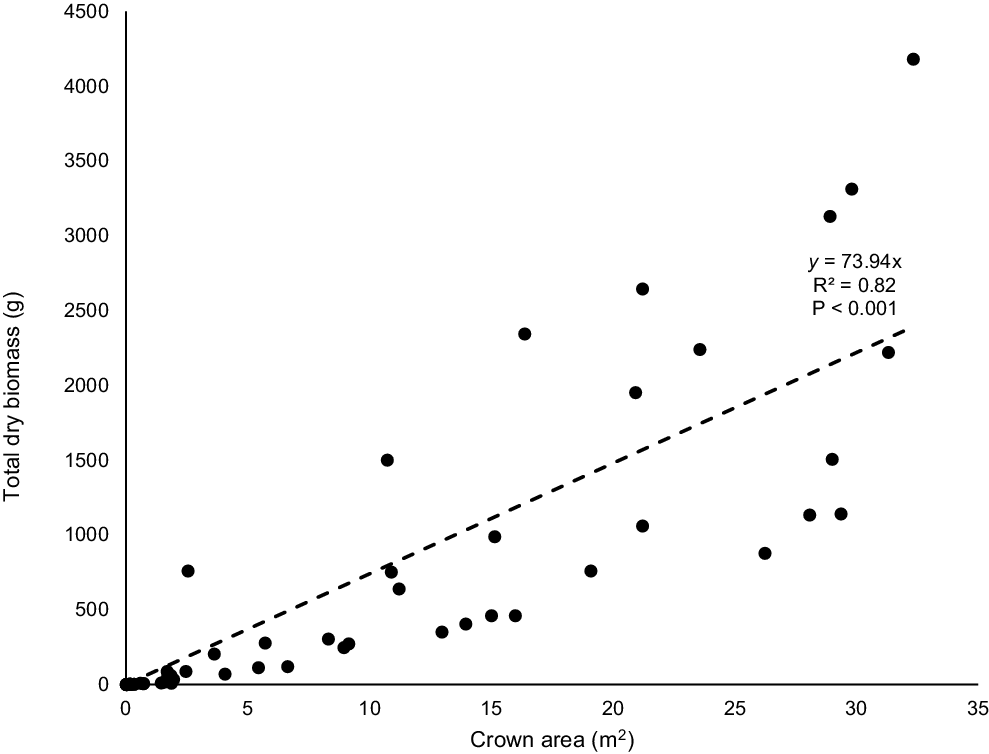
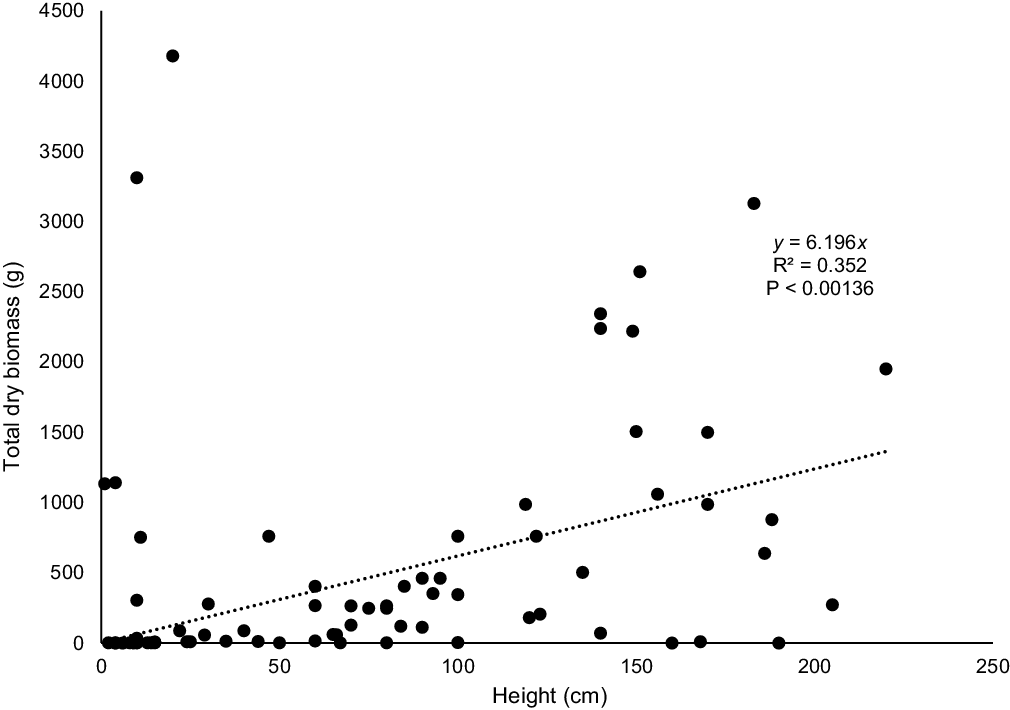
Both crown area and height are significantly related to dry biomass, but crown area has a tighter-fitting relationship (F(1, 90) = 241.2, P < 2.2−16, R2 = 0.852) (Table 1). Inspection of the crown area scatter plot reveals a linear relationship: as crown area increases, dry biomass increases linearly (Figure 2). As mentioned, height also has a significant linear relationship, although it is weaker than that of crown area (F(1, 90) = 230.8, P < 2.2−16, R2 = 0.352) (Figure 3).
Rhodomyrtus tomentosa equations.

Crown area is significantly linearly related to total dry biomass (P < 0.001). The data points are untransformed, and the regression line has been forced through a zero intercept.

Height also has a significant relationship to total dry biomass, but it is weaker than crown area. Again, the intercept has been forced through zero to reflect real-life conditions.

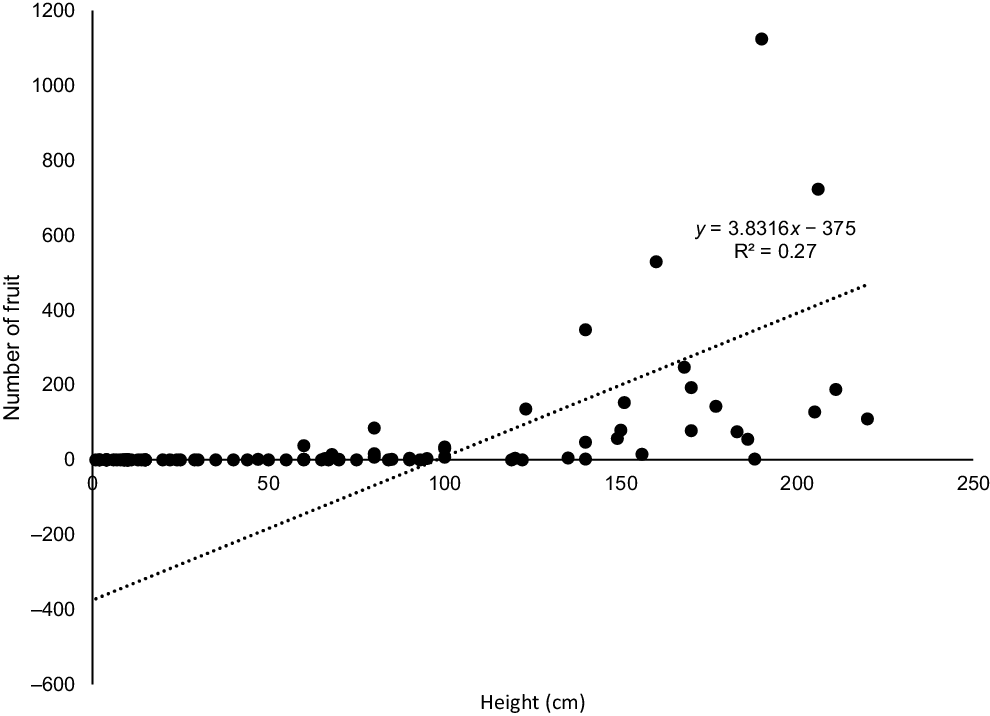
Fruit is poorly predicted by all variables, because it is highly variable. Generally, only plants above 1 m produce fruit. Shrub height is significantly related to fruit production above 1 m, although this relationship is weak (F(1, 20) = 13.62, P < 0.00136, R2 = 0.27; Figure 4).
Fruit production is significantly related to height above 1 m, although this relationship is not particularly strong (R2 = 0.27). Despite the variability in fruit production, most fruit is produced by taller plants, so these should be prioritized for removal.

Biomass in shrub-dominated understories is important for several purposes, including gauging understory recruitment of dominant canopy species, accurately calculating net primary productivity of various community types, and estimating the indirect impact of invasive species on various ecosystem responses such as evapotranspiration, biogeochemical cycling in soils, and pathogen dynamics (Cai et al. Reference Cai, Di, Chang, Wang, Shi, Geng and Jin2015; Elias et al. Reference Elias, Lubelczyk, Rand, Lacombe, Holman and Smith2006; O’Brien et al. Reference O’Brien, O’Hara, Erbilgin and Wood2007; Prater et al. Reference Prater, Obrist, Arnone and DeLucia2006). In highly impacted (and imperiled) landscapes like south Florida, particularly the Pinelands habitat type, it becomes ever more important to adequately quantify the effect of each invasive species on the landscape. The ability to do this rapidly and frequently necessitates equations like the ones derived herein. Furthermore, R. tomentosa is not freeze tolerant, but minimum temperature limits are likely to migrate northward as climate change warms these areas and alters precipitation and weather patterns—further motivation for quantifying biomass of these species as their range potentially expands (Vergés et al. Reference Vergés, Steinberg, Hay, Poore, Campbell, Ballesteros, Heck, Booth, Coleman, Feary, Figueira, Langlois, Marzinelli, Mizerek and Mumby2014).
Rhodomyrtus tomentosa is similar to other shrubs in that biomass is explained primarily by crown area (Ali et al. Reference Ali, Xu, Zhao, Zhang, Zhou, Yang and Yan2015). We explored several other models to explain biomass, including models that incorporated stepwise forward regression, multiple variables (height and crown area, branch volume, etc.), correlative indices (Pearson’s and Spearman’s), and even other single variables (e.g., crown volume). While some of these models produced significant predictive correlations, none were stronger or more parsimonious than the simple linear regression model using crown area. The predictability of biomass from crown area reinforces the theory that dominant understory shrubs like R. tomentosa maximize light capture by spreading laterally (Zinnert et al. Reference Zinnert, Shiflett, Vick and Young2013). Biomass can be a proxy for estimating invasive impact, because it relates to light interception, alterations to the soil C:N ratio, and native seedling recruitment (Lieurance Reference Lieurance2007; Standish et al. Reference Standish, Robertson and Williams2001), although nonnative invasive species can often have impacts that are disproportionately large compared with their biomass (Peltzer et al. Reference Peltzer, Bellingham, Kurokawa, Walker, Wardle and Yeates2009). Further exploration of the partitioning of aboveground parts could elucidate some finer-scale explanatory mechanisms for the invasiveness of R. tomentosa.
For management in areas impacted by R. tomentosa, our results reveal that fruit is primarily produced by plants that exceed 1 m in height. Removing reproductive plants taller than this height would impact propagule spread and should be prioritized, followed by smaller plants and seedlings. Further, although we did not address long-term seedling viability in our study, others have looked at the impact of site and hydrology on germination rates and found wide variation in R. tomentosa seed germination (<10% to >70%) (Hue et al. Reference Hue, Abdullah, Sinniah and Abdullah2013). Limiting further inputs into the seedbank would be an effective way to mitigate R. tomentosa.
Rhodomyrtus tomentosa continues to be a problematic invasive species in Florida, because it forms dense thickets that are difficult to treat. Our biomass equation, which utilized easily measurable plant metrics, will enable both researchers and land managers to better account for impacts from treatments (e.g., biological control, chemical control), quantify the amount of biomass that needs to be removed, and provide justification for prioritizing the removal of reproductive plants.
Acknowledgments
We wish to thank Luke Kasarjian Jr for his work removing whole plants from sites and leading the effort to process the samples. This research was supported in large part by support from the South Florida Water Management District (Agreement 586032-002 “Biological Control of Melaleuca and Invasive Australian Plants”). Any use of trade, firm, or product names is for descriptive purposes only and does not imply endorsement by the U.S. government. The authors have no conflicts of interest to report.