Introduction
Bringing to mind the concert enjoyed last evening and the details of the cellist's performance, recalling to a companion the musical scores played, and planning for the next concert require the co-ordination of both individual and cultural memories. How and what we remember, where we focus our attention and what we anticipate are socially performed acts bound by normative constraints. We learn what is relevant and irrelevant, what to regard and disregard, what to remember and what to forget. As Eviatar Zerubavel (Reference Zerubavel1997) has reminded us, we think and act as both individual and social beings.
Discussions of individual remembering and of collective memory are disciplinarily divided, the former being of interest to psychologists, educationalists and linguists, the latter to cultural historians (e.g. Frisch Reference Frisch1989), anthropologists (e.g. Bal, Crewe and Spitzer Reference Bal, Crewe and Spitzer1999), and sociologists (e.g. Zerubavel Reference Zerubavel1996b, Reference Zerubavel1997). Of note is that ‘cultural’ interests are separated from the ‘psychological’ (White Reference White2000) and ‘physical’ dimensions (Kontos Reference Kontos2004, Reference Kontos, Leibing and Cohen2006), and the ‘collective’ aspects from the ‘individual’, yet acts of remembering are at once individual and collective, traversing the ‘out there’ of collective representation and the ‘in here’ of personal cognition (White Reference White2000). To elaborate, many theories of memory in psychology focus on remembering as information processing that is internal to the individual. Endel Tulving (Reference Tulving, Tulving and Donaldson1972), for example, proposed a concept of memory that is both autobiographical and episodic. Episodic memory refers to the capacity to recollect individual and specific events or episodes located in time and space (Tulving Reference Tulving2002). Yet memory is not only about information, it is also about meaning, a process shaped by historical and developmental events in interaction with natural and social environments (Rose Reference Rose1993).
This paper reports the findings of a qualitative study that made regular visits to the homes of people with mild to moderate Alzheimer's disease (AD) who were being treated with anti-dementia medication. In contrast to the clinical perspective on memory in AD, which is informed by performance scores on recognition and recall tasks, we locate memory in context-rich observations and the subjects' accounts of their experiences and expectations of living with AD. Importantly for our argument, people with AD and their carer(s) remember and describe while engaged in social interactions. Their past is lodged in constellations of memories of activities and experiences; their present activities entail remembering events and happenings from the past (analogous to golfers' recognition of ‘muscle memory’), and their hopes and anticipation for future events are built upon what has gone before (e.g. anticipating the usual Sunday morning visit of a relative). We call these performances of relationships, memories and abilities, memorabilities.Footnote 1 While Tulving (Reference Tulving2002) and others have suggested that the individual can relive in the here and now, or project to the future something experienced earlier, temporal relations between memory episodes are located in the individual. The social and relational aspects are absent in those accounts.
Our approach eschews strict adherence to the more usual psychological distinctions between, for example, autobiographical, working, semantic, episodic and procedural memory. Psychologists have been addressing these constructs for well over a generation (e.g. Tulving Reference Tulving, Tulving and Donaldson1972; Baddeley Reference Baddeley2000). Recently, innovative neuro-imaging technologies have provided evidence of interactions among memory systems that previous studies kept separate (Schacter, Wagner and Buckner Reference Schacter, Wagner, Buckner, Tulving and Craik2000). The field data were collected by participant-observation during one year of the lives of 58 couples living with AD. The narratives and notes support the argument that different types of memory are not ‘really’ distinct but converge in social practice. The qualitative accounts differ from the clinical representations that house memory solely in the individual, towards a pragmatic synergy of memories that are located neither in a social nor individual environment but infuse between the two. We maintain that memory is simultaneously individual and social, and that memorabilities are shared, co-constructed events and experiences that variously exist in the past, present and future.
Three themes emerged from the data and were identified as awareness, attention and anticipation. They were readily apparent in the everyday activities and commentaries of people with AD, who remember as well as forget. The participants referred to awareness when discussing acts of recognising, recollecting, recalling and remembering. Awareness, for them, is the ability to reflect back to the past and connect it to the present and/or the future. This awareness (of a previous experience) depends upon the ability to pay attention (to both self and to a present occurrence). People with AD and their carers described attention as the ability to focus on a task, activity or event; they referred to ‘paying attention’ and ‘concentrating’. The ability to anticipate a task, activity or event that might occur in the future requires awareness of a past and attention to the present. Anticipation, then, is an orientation towards the future that is based on being aware in the present of past events and experiences.
In contrast with neuro-psychological tests that measure specific and isolated aspects of memory and attention in a laboratory or clinic, largely devoid of the everyday entangled social milieu, these context-rich accounts describe both the ‘memor-abilities’ of a socially-situated, recent, personal past and their effect on present and future functioning. Although the nouns used for the themes that emerged have specific meanings in psychology and the cognitive neurosciences, in this conception the referents are different (Hacking Reference Hacking, Sperber, Premack and Premack1996). Awareness, attention and anticipation (and indeed memory and cognition) are here recognised as culturally-embedded but individual acts. To understand these, we draw on the participants' recounted experiences.
From the fifth century BC until the late 19th century, the art of remembering, mnemonics, was both a studied skill and a way of understanding the world. Using limitless techniques for fixing (encoding) knowledge into images, mnemonics assisted in the ready recall at a later date of an event seen or a story heard. Late 19th century science relocated memory from the community's soul to a new object of study, the individual's brain (Hacking Reference Hacking and Hacking1995). Forgetfulness, which had affected community survival and identity, became the subject matter of cognitive neuroscientists and psychologists. When the interest in awareness and attention to one's community (mindfulness of a group) gave way to the study of the individual's brain, the inability to recall readily (forgetfulness) came to be perceived in a new light as an individual attribution. Scientific attention to neurons, synapses and brain mechanisms has tended to lose sight of the social and affective context of remembering and of inter-individual experiences.
Selfhood and memory
In late modernity, a defining feature of selfhood is a continuous sense of being one and the same person over time (Archer Reference Archer2000; Sabat and Harré Reference Sabat and Harré1992). In continuously revised, biographical narratives, the future is organised in the present by a self-exercising agency that draws from the experiences and knowledge of the past (Emirbayer and Mische Reference Emirbayer and Mische1998; Giddens Reference Giddens1991; Shilling Reference Shilling1993). Through reflection, one becomes an object (or aware) of one's self; and turns back one's experience onto one's self (Mead Reference Mead1934; Callero Reference Callero2003; Tulving Reference Tulving1983). Memory is implicated in the reflexive self (Klein, Chan and Loftus Reference Klein, Chan and Loftus1999). Socio-cognitive norms, that is, the social rules of thinking and remembering, affect the way we think and what we remember (Zerubavel Reference Zerubavel1997). The strategies used to remember, information selected for processing, and individual beliefs about ageing and therefore experiences, are influenced by social and cultural factors (Moran Reference Moran2001; Park and Gutchess Reference Park and Gutchess2002; Park, Nisbett and Hedden Reference Park, Nisbett and Hedden1999). Culture provides a ‘tool-kit’ of symbols, stories and rituals that influence what we remember and what we forget (Swidler Reference Swidler1986). Speciality-specific tool-kits are used to diagnose disease (Graham Reference Graham, Leibing and Cohen2006), and a sophisticated system of signs and gestures facilitate as well as constrain perception, reflection and action (Callero Reference Callero2003).
The construction of self is never a solely individual act but requires the co-operation of others (Basting Reference Basting2003; Giddens Reference Giddens1991; Sabat and Harré Reference Sabat and Harré1992). As White (Reference White2000) argued in relation to national history and, as we argue, in relation to family memory, collective histories and the selves that inhabit them are co-constructed as people discuss, dispute, commemorate and revise accounts of the past. Remembering is interactive, and memories may be verified by others (Santamaría and de la Mata Reference Santamariá and de la Mata2002). We have unique personal experiences that are shared with no one else, certain moments that we share with some people and not others, and occasions in our past about which others have better access than we have. Autobiographies are accompanied by socio-biographies. Our individual past is not only shared in common with others but is jointly remembered or co-memorated (Zerubavel Reference Zerubavel1996b). The social environment plays a major role in defining what is memorable (Zerubavel Reference Zerubavel1997).
Memory, self and Alzheimer's disease
Continuity, in the form of a consistent narrative, is destabilised in dementia. The trajectory of self, described by Giddens (Reference Giddens1991), in which an individual sifts through his or her past in light of an anticipated future is disrupted by Alzheimer's disease (Mills Reference Mills1997). The self of the person with AD may be seen as lost or relinquished (MacRae Reference MacRae2002). The conditions required for selfhood (self-identity, abstract thought, accountability and social interaction) are not recognised (Rimmon-Kenan Reference Rimmon-Kenan2002). Therapies that engage people with dementia in life stories seek to reinstate a con-tinuity of selfhood while anticipating its decline (Moos and Björn Reference Moos and Björn2006).
Despite the extensive literature on loss of self in dementia, several studies have shown that it endures in the face of declining memory. Selfhood, rather than being ascribed to an individual, is co-constructed in social relationships of reciprocity (Graham and Bassett Reference Graham and Bassett2006). Sabat and Harré (Reference Sabat and Harré1992) show continuity in the persistence of selves across time and space among people with dementia. They continue to identify with their former selves, as professionals and as people with personal values, behaviours and meanings, although these are too frequently unrecognised by others. The familial role is maintained through time as a coherent identity in dementia (Cohen-Mansfield, Golander and Arnheim Reference Cohen-Mansfield, Golander and Arnheim2000), and despite the decrements, individuals sustain self-representation even in the face of limited verbal communication (Li and Orleans Reference Li and Orleans2002). A corporeally- and culturally-located, pre-reflexive selfhood persists in the primordial capacity of the body to convey meaning (Kontos Reference Kontos2004, Reference Kontos, Leibing and Cohen2006). Selves exist beyond memory alone, and the depletion of memory does not equal loss of self (Basting Reference Basting2003).
The Alzheimer's literature is currently turning away from ‘loss of self’ towards ‘locating a self’ in the person with dementia (e.g. Basting Reference Basting2003; Sabat and Harré Reference Sabat and Harré1992), and reflects an important move away from the mind/body duality in western thought. While the turn to the presence of selfhood does not completely dispense with cognition and memory, the tendency has been to seek aspects of selfhood elsewhere (e.g. Kontos Reference Kontos2004, Reference Kontos, Leibing and Cohen2006). Still, cognition and memory remain components of selfhood in modern western society, and cannot be merely written off. We have undertaken to address cognition and memory not as the location of the quintessential self but as simultaneously individual, social, collective and relational. In this effort to move beyond an individual accounting of memory and its loss, we engaged with, listened to and reported the accounts of people with dementia. Although the dementia literature generally treats memory as an individual attribute, it is notable that in individual assessments, such as the Mini Mental State Examination (MMSE) (Folstein, Folstein and McHugh Reference Folstein, Folstein and McHugh1975), the questions actually encompass shared, collective, and relational memories, e.g. what country are we in? (Moran Reference Moran2001).
The ACADIE Study
The ‘Atlantic-Canada Alzheimer's Disease Investigation of Expectations’ (ACADIE) was a multi-site, prospective, descriptive study that aimed to identify the expectations and effects of treatment with donepezil among people with AD (Rockwood, Graham and Fay Reference Rockwood, Graham and Fay2002). The sample was 108 people in Maritime Canada with mild to moderate AD. They were followed in a clinic and their homes at 12-week intervals over one year. The clinic visits involved standardised physical, cognitive and behavioural assessments. The qualitative component took place in the participants' homes. Field researchers conducted conversational, unstructured, open-ended interviews of one to three hours with the person diagnosed with AD and their carer(s). The interviews and ethnographic notes about domestic activities and family dynamics observed during the interview were audio-recorded and later transcribed. The participants were asked about their current everyday activities, their hopes and fears for the future, and their expectations of treatment. Rich and meaningful narrative descriptions of the problems encountered with everyday activities were provided by both those with dementia and their carers. Perceived changes in these individual accounts during the subsequent home visits were carefully tracked by the study participants and the field researchers. Clinicians and field researchers were blind to one another's findings until a consensus conference at the end of the study, when the information and descriptors collected separately at the clinic and in the participants' homes were shared and compared by the study personnel (Graham and Bassett Reference Graham and Bassett2002). The blinding helped to ensure that the clinicians and ethnographers from the two separate components of the ACADIE study did not influence one another's observations by relaying information from their several visits over the course of the year.
The transcriptions from each of the five home interviews conducted with each of the study participants ranged from 12 to 40 pages. They were edited by field researchers who listened to the taped interview while reviewing the document. The transcribed interviews were entered into a qualitative data analysis program (QSR NUD*IST revision 4) (Richards and Richards Reference Richards and Richards1997). An in-depth examination of these accounts was undertaken. Themes that described, organised and interpreted the participants' experiences were identified by examining the words and phrases that were used (Table 1). A label or description for the pattern of words and phrases was applied, and the patterns were clustered and sorted until sufficiently distinct and comprehensive themes were generated (Boyatzis Reference Boyatzis1998; Luborsky Reference Luborsky, Gubrium and Sankar1994). The theme (code) development was discussed during frequent analysis meetings, and a data dictionary with the operationalised definitions of the emerging themes was compiled and systematically updated.
After over 10 per cent of the transcribed documents had been coded, when the rate of emergence of new themes was low, the codes were re-evaluated, duplications eliminated and different codes explaining the same concept combined. The data dictionary together with an instruction manual specific to the study provided common guidelines for all coders. To augment the consistency of the accepted themes, and when blinded to the original coding, RB cross-checked the coding at regular intervals. Inter-coder and intra-coder reliability was evaluated by providing coders with the same set of documents to code (inter-rater) and with a set of documents that they had previously coded (intra-rater). Coder agreement was examined, and a kappa statistic used to adjust for agreement through chance. Both intra- and inter-coder reliability was almost perfect (k=1.0) for many themes, and in a few themes, ranged from moderate to almost perfect agreement (k=0.62 to 1.0) (for guidance on the statistic, see Landis and Koch Reference Landis and Koch1977). Some disagreement in coding was to be expected, because coders made judgments about which theme to assign a section of text based on participants' accounts. Coding disagreements were discussed and the coding amended (Graham and Bassett Reference Graham and Bassett2002).
In vivo components of the themes of awareness, attention and anticipation

Analytical inclusion criteria
Probing to obtain precise and thorough accounts of events identified in earlier visits often proved difficult. Only those participants who completed the 52-week study and for whom complete follow-up information could be obtained for each subsequent home interview were included. Of the 108 people diagnosed with AD recruited to the ACADIE study, 58 (54%) provided such retrospective accounts and were included in this analysis.
Socio-demographic profiles
We explored the relationships, memories and abilities through the lives of 58 participating dyads formed by the person diagnosed with AD and their carer. The average age of the people with AD was 76 years; 43 (74%) were women and 37 (64%) lived in the same house as their carer. At the start of the study, 56 lived in the community. The average age of the carers was 59 years, with a range from 29 to 91 years; 38 (66%) were women and 50 (86%) were married. They were the wives (22%), husbands (22%), daughters (26%), sons (12%), sisters (3%), daughters-in-law (5%), and great nieces (2%) of the individuals with dementia. Three people were paid-caregivers.
Themes of awareness, attention and anticipation
Any data gathered from elderly people suffering multiple co-morbidities, neuro-degeneration and social decline are necessarily complex and multi-faceted, and comprise multiple, interactive and sometimes redundant items (Graham et al. Reference Graham, Mitnitski, Mogilner, Gauvreau and Rockwood1996). Everyday conversations commonly have overlaps, redundancies and verbosity, yet the specific themes of awareness, attention and anticipation were ascertained, distinguished, defined and refined. We recognise and have taken into account that these key conceptual themes interact in complex ways with other processes.
Awareness, attention and anticipation emerged as three important themes from all accounts of individual problem areas in the everyday activities of people with AD. We noticed that some people could not recall things, such as where they had put items, nor remember information or what had happened yesterday or a few minutes ago. They had forgotten, for example, that they had quilted for many years, or that they collected police emblems or ornamental shoes. Some of those with dementia reminisced about a previous period of their life, such as childhood, and recollected specific past experiences, at times reliving them in the present. We noted that a common thread through people's efforts to remember, recall, reminisce and recollect was an ability to look back to their past experiences. These people often described being aware that they could no longer remember their experiences in the recent or more distant past, and were frequently depicted by their carers as having lost awareness. We coded these occurrences in the data as awareness. A similar process was undertaken to define and sort occurrences of the themes labelled as attention and anticipation. These key conceptual themes emerged as three clusters and often occurred in the same conversation. We suggest that the co-occurrence is important to our understanding, and represents well the actual experiences of people with dementia. Conceptually and in practice, individuals merge what psychologists distinguish as autobiographical and working memory. Indeed, our data show that the three themes expand upon the existing psychological notion of distinct types of memory (Graham and Bassett Reference Graham and Bassett2006).
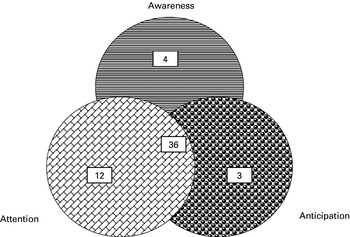
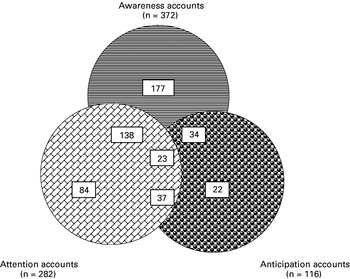
Fifty-five of the 58 participant dyads addressed at least one of the themes of awareness, attention and anticipation in 515 of the 644 recorded accounts that focused on patient- or carer-identified problem areas in everyday activities (Figures 1 and 2). Both those with dementia and their carers talked about remembering, forgetting, losing and misplacing. Individuals with dementia paid attention to some things but invariably not to the same concerns as their carers. According to the carers, they lacked interest and an inability to look forward to the future, and they sometimes anxiously anticipated their carer's absence. Only three dyads made no mention of awareness, attention or anticipation.
Emerged themes by number of participant dyads.

Emerged themes by number of accounts.

Awareness
Fifty-five participant dyads reported awareness and its loss in 372 (72%) of the 515 accounts (Figure 2). Awareness for the study participants was the ability to reflect back to experienced events.
I go swimming. I used to jump in the water and swim 24 lengths and then stop and talk for a little bit. Then I'd turn around and do the same thing over. But now, I can't swim more than the length of this house. My strength is gone (Woman with dementia, aged 72 years).
In practice, awareness of some experiences was often accompanied among those with dementia by loss of awareness of other experiences. An unrecalled past affects the present, as with the ability to locate an item, which requires remembering where it was most recently placed, or where it has usually been stored (perhaps for decades). At the first visit, Mrs B's husband told the researcher that Mrs B, a 69-year-old homemaker, was misplacing items, that she tucked her money away and then could not find it, that her purse was often misplaced, and that things were put away and then could not be found. Six months later, the frequency of misplaced items had increased, and Mrs B's husband could no longer find many of them. Mrs B is unable to recall from the distant past where she would normally put the items.
With a growing loss of awareness, eventually ordinary tasks are left undone. The person with dementia no longer remembers the very recent past in relation to a specific task. A distraction takes them away from mending the fence, doing the dishes, or vacuuming the floor. Unable to draw upon personal past experiences to interpret the present, the task is not remembered and is left unfinished. The person is commonly then described by their carer as ‘avoiding tasks’, ‘content to do nothing’, or as ‘wasting time working on unnecessary chores’. Mr C's wife said it was becoming more difficult to get Mr C, a 57-year-old farmer of Irish descent, to do chores, for when she asked him to do something, he did not complete it and did not remember that he had started it. One day he went out to the field to harrow, worked for a few hours and then just quit; he did not return to the task. Three months later, his wife said that he knows that tasks have to be done but will not do them, and is content to sit all day doing nothing. The connection between past experience and the task at hand is no longer made by the person with dementia, as Mr C recognised.
Mr C's wife: Well, if he quits in the middle of something, it doesn't seem to bother him that it's not done.
Researcher: Have you noticed that yourself, Mr C?
Mr C: No, but I wish I had a' been at it for years (laughs), I'd be twice as good now (laughs). It doesn't bother me though, I guess because I don't notice it.
Despite not associating an activity with a task, or an item with a place, people often retained some awareness of these limitations, as when Mrs D, a widowed 97-year-old who lived in a care facility, said, ‘I'm so discouraged because I can't remember things, and I'm so scared of doing something stupid or foolish. I put things down and I can't remember where I put them'. Awareness and its loss in dementia were observed in their accounts that recorded the ability to recognise, recall, recollect and remember. They experienced problems associated with misplacing items, family interactions, baking, cooking, eating meals, and collecting as a hobby. No longer able to remember in the present something experienced earlier, functioning in the present is affected.
Attention
Attention requires a focus on the present, and attention to self: aspects of temporality and identity. It is the ability to reflect upon oneself in the present. Some people made mention of a previous self. Mrs E, a single, 70-year-old professional, said of herself, ‘now, the old girl is not much good’, and laughed quietly and ruefully. Others, like Mrs F (73 years-old, and living with her husband), recognised how their memory loss affected those close to them. She said, ‘it's hard for me, because he doesn't want to realise what's wrong with me. To him, everything's got to be perfect, and I'm not perfect anymore’. Some people talked insightfully and at times with remorse about no longer knowing who they were, using phrases such as, ‘I don't know myself now’. Not being oneself or knowing who one is in the present is frightening and upsetting. Mr C said that he was not himself, and that he took it out on his loved ones. He was often angry and irritable, felt like crying, and did so privately when he had hurt a member of his family with an angry outburst.
Loss of attention to one's self affects the completion of tasks and the multitude of behavioural, social and environmental interactions that contribute to task completion. Whereas with the loss of awareness, a task is not completed because the person does not remember that they had begun, a loss of attention means that the focus on the task at hand is reduced and the task is not completed. People with dementia find themselves taking longer to complete tasks, and carers commonly find that they have to complete the unfinished tasks. Decreased attention also affected those activities that required extended concentration. The participants noted a decline in the attention span, as with that required to read a book. Changes in reading patterns were discerned, from reading novels to short stories, and from journals and magazines to the daily newspaper. Pages of books are increasingly re-read, and old newspapers read as though they are today's. The information read may be remembered but not the personal experience of reading.
Problems with ‘seeing’ and ‘hearing’ were given as explanations for not paying attention. A decline in attention may be described as a loss of hearing. In order to hear, a person must pay attention, specifically to the object of interest. People with memory problems talked about not having ‘heard’ what was said. Announcements over a public-address system, telephone calls from family and friends, and information conveyed in conversations are missed and interpreted as not having been heard. The ability to ‘see’ is also associated with paying attention. Several carers discussed the inability of their loved one to ‘see’ in relation to the task or activity that they undertook. For example, the person with dementia may always select the same clothes, apparently unable to see other clothes in the closet; or while playing golf, be unable to see the ball. ‘Seeing’ in this sense, as with ‘hearing’, is about being able to pay attention or focus long enough to locate the item visually or audibly and to know or remember what it is. Attention is required to filter the stimuli present in the environment in order to locate the particular item of interest. Loss of the ability to ‘see’ results in only the partial completion of a task. A few carers reported that their loved ones ‘missed spots’ in the tasks they were undertaking. It was as though they remembered how to do the task, but could not focus on the detail, as when they did not vacuum every section of the floor, mow every sward of grass, blow all the snow, or peel the vegetable all around.
Loss of attention was sometimes referred to as ‘loss of interest’ by carers. Focusing on an activity for only a few minutes was described variously as losing interest, being bored or laziness. At the field researcher's first visit, Mrs H, a 79-year-old widow who lived in a nursing home, shuffled, dealt and cut the cards, and played four or five games without mistakes. During the next few games, however, she took tricks that were not hers, lost interest and no longer wished to play. Six months later, when initiated by her daughter, Mrs H played two games, lost interest and made mistakes. Her daughter said that her mother no longer liked playing cards, and speculated that her mother was covering up her loss of ability; she wondered if her mother was aware that she could no longer play well. Nine months after the first visit, Mrs H played cards about twice a week, for about 10 minutes, before becoming bored and making mistakes.
Another woman's proficiency in washing dishes decreased over time. At the second visit, her daughter, eager for a sign of her mother's improvement, noted that she checked to see if there were more dishes to wash close by. Three months later, the recently widowed, 86-year-old mother washed only the dishes in her sight and missed those on the counter or stove; these were neither remembered nor recognised. Her daughter described her as lazy. The mother's performance of the task continued to worsen during the remainder of the study. She could not attend to the details. The dishes were not satisfactorily cleaned and some were dried before washing and put away dirty in the cupboard. Although prompting helped the mother maintain her attention to the task, its effect was transitory.
While much clinical information was derived from the proxy informant interview, we found through the participant observation that memorabilities occur in common happenings that usually go unnoticed. Mr C's wife told us that he could not pay attention long enough to complete a task, or remember to return to it, but Mr C laughed sympathetically about the field-worker driving past his house. With a clear view of the road for some kilometres, Mr C watched the researcher driving towards his farm. He recalled and later joked with her about her mishap:
Researcher: Good morning, how are you?
Mr C: Not bad, I'll be right with you. I saw you drive up – you went by the gate again, eh?
Researcher: I did, yes; you noticed that?
Mr C: I thought you did, I've been watching you since you left town (laughs).
Researcher: I was looking (laughs), looking for a white house. I was looking for the barns too, and then as soon as I went by I realised I'd gone too far. So you were keeping an eye on me were you, all the way from town (laughs)?
Mr C: Yeah, watching you all the way.
Remembering demands attention; forgetting or a failure to remember takes place in the present. Unless an individual can attend to or focus on an item, task or event, it will not be remembered. One 72-year-old woman with AD, a former sales-person, said, ‘it's not because of my mind I forget, it's because I never think’. ‘Thinking’ in this phrase surely refers to paying attention in the present. She knew that she doesn't remember because she can no longer pay attention in order to do so. Tasks take longer or may not be completed as abilities decline. Our informants, both carers and those with AD, developed their own explanatory models for these limitations, and they were replicated in several of the relationships. The participants described loss of attention as loss of interest, boredom or even laziness, and non-task related and repeated performances of attention went unnoticed.
Anticipation
An orientation towards the future indicates anticipation. To anticipate something, an individual must be able to think forward in time and imagine the task, activity or event in relation to him or herself. Individuals mentally project themselves into a subjective future and reflect on expected experiences at a later time. Nine months after the researcher's first visit, Mrs D, anticipating her future, said, ‘I have nothing to contribute now. I'm just going to be a nuisance to people. It's a pity it wasn't my heart or something else going first, rather than my brain’. Mrs L, an 83-year-old homemaker who lived with her husband, pictured how others saw her when she repeated herself: ‘I may not notice it myself but I imagine the person I'm speaking with knows’. Anticipation or its loss was most often described by the carer or person with AD as ‘being interested’, and appeared in 116 (23%) narrative accounts (Figure 2). Several layers emerged for this theme based on actual or misplaced memories. Anticipating the future could be seen in a person readying herself or himself for a forthcoming event or activity, importantly in ways that may or may not be related to real events in present time. Mrs I, aged 81 years and living with her husband, was very interested in going out, and got herself ready even when there were no plans to go anywhere.
The commonly-used phrase, ‘looks forward to’, perhaps best captures the theme of anticipation. A decline in anticipation became evident when the person no longer looked forward to or suggested going anywhere or taking part in activities, but still participated willingly when someone else suggested doing so. At the field researcher's first visit to the nursing home, she recorded that Mrs K, aged 76 years and recently resident in an institution, noticed activities as they took place, but didn't look forward to things or remember that they had happened. Three months later, Mrs K participated in musical events on the ward, loved fiddle music, and sang the old songs, remembering all the words. She loved to play with a sponge ball and threw it forcefully at the staff. These exercise activities occurred three times a week; she looked forward to them and mentioned them to the staff, but Mrs K pushed staff away when they tried to get her to do something she didn't want to do (e.g. bathing). Six months after the field researcher's first visit, Mrs K continued to enjoy music and singing and actively sang along at musical events, but she no longer asked when they were happening, nor indicated any other anticipatory interest. At the final visit, the staff said that Mrs K was less interested in activities and needed to be persuaded to join in, even in the sing-songs that she loved. She was quieter and interacted less with others but was not reclusive, and just sat for much of the day.
Loss of a future orientation was captured succinctly by a son who described his mother's decline. As he realised, it is not that the person with AD did not want to help with the dishes, nor had no interest in doing so, but she did not anticipate doing the dishes because she no longer saw herself in relation to the task. In his words, ‘Mom (a recently widowed 74-year-old) doesn't do the dishes any more. She doesn't think of doing so, not that she won't help, but it seems not to occur to her to help now’. A decline in the ability to imagine and foresee undertaking activities in the future marked the loss of anticipation. As with most of these changes, individual and circumstantial factors come into play. Sometimes those with AD were aware that they missed an activity, and that they had no interest in it, but at other times they incorrectly recollected a particular event or time. The performance of tasks, behaviours or actions is affected by loss of anticipation. The activity no longer gets done, or may have no intended precedent. Eventually, the person with dementia no longer thinks of herself or himself in relation to the activity. The relationship between the self and the action is severed.
Awareness, attention and anticipation
As with the synergies and antagonisms of symptoms witnessed in AD (Graham et al. Reference Graham, Mitnitski, Mogilner, Gauvreau and Rockwood1996, Reference Graham, Mitnitski, Mogilner and Rockwood1999), we found that loss of awareness, attention and anticipation were most often inter-related in people's daily lives. Only four of the 55 caring relationships provided narrative accounts of awareness alone, without mention of the other two themes (Figure 1). Most (36) of those with dementia included descriptions of all three themes in their accounts. The theme that was mentioned most often by both people with AD and their carers was awareness and its loss. Attention and anticipation occurred frequently with awareness, and the themes co-occurred in most accounts (Figure 2). The co-occurrence of attention with awareness is a necessary synergy in remembering. The following account shows the interdependence of sequencing to complete a task. Getting dressed requires both attention, in order to follow instructions, and awareness of the sequence in which one dressed oneself in the past. Mrs G's son said that she was able to do the physical tasks of getting dressed but did not know what to put on and needed instruction. Even then, she might appear with shoes instead of a jacket and ask, ‘is this what I was supposed to do’? He said, ‘It seems like more a memory thing than an ability thing’. His 74-year-old widowed mother needed help with knowing and remembering the steps but could fasten buttons and such.
Twenty-three (4%) of the 515 accounts of problem areas include all three themes – awareness, attention and anticipation. The inter-connectedness is apparent in the following account. Miss M (a professional aged 77 years) was unable to recall where some things were kept, to replace them after use, or to remember where they were when she wished to use them again. Her carer made the perceptive suggestion that Miss M cannot imagine where to find a misplaced item, and referred to the necessary link between the past and the future for it to be found. Not only could Miss M not recall where she placed an item in the past, she could not envisage where she would put it in the future. Decline in attention in the present affects the remembering of personal experiences and events, which interferes with their later retrieval. Being unable to relive past memories in the present allows no future to anticipate.
Discussion
This paper has described three important themes that emerged from the 644 accounts by elderly people living with Alzheimer's disease of the way they go about their everyday social and relational lives. It has been shown that AD is not only about loss of awareness, attention and anticipation, and therefore self, but also that the associations of the self with time guide and define events, activities and memories. People are very aware of changes in their memory and abilities, and show awareness, attention and anticipation in other, often unrecognised, instances. In contrast to objective accounts of what is, of what has happened or of what might be, the participants' narratives were subjective accounts that evinced a search for continuity of one's present and anticipated self in past experiences.
People who experience dementia can identify trackable symptoms of particular meaning to them in their lives. Tracking these self-identified symptoms is an element of what Feinstein (Reference Feinstein1987) referred to as a clinimetric approach – people can both identify and describe their own phenomenal experiences, and these can then be used to determine clinical strategies for treatment and management. The qualitatively derived accounts that we identified provide support for Feinstein's advocacy of a more humanistic, patient-oriented perspective in clinical practice. The elderly people and their carers in this study were aware that they were not paying attention as they had been, and that this loss of attention affected their ability to remember and to anticipate. A fluctuating pattern of decline was set in motion, with loss of attention leading to loss of awareness, which resulted in loss of anticipation. The initial loss in attention was loss of attention to self, while attention to objective facts, such as a significant news item, often remained for a longer period of time until it too was gone. With loss of attention to self, retrieval of a personal past was not possible, nor was imagining a personal future.
The accounts that we have analysed were the observations made by individuals with AD and those who care for them. They were enriched by the narrators' knowledge of each other. Attributions based upon past knowledge were made to explain behaviour. Mrs H shuffled cards, dealt and played several games before taking tricks from others and then leaving the game altogether; her daughter suggested that she had become bored. Previously a source of pride, Mr C no longer thought of performing or completing the tasks around the farm. His wife suggested that he avoided the tasks and ‘sits around doing nothing all day’. These attributions were made by carers from their knowledge of the person with AD and on their expectations of how the person would behave in a particular situation. Perhaps Mrs H could remember previous card-games and retain the experience in her mind for a short time, which allowed her to play cards with her usual skill. Distractions could not be prevented, however, and eventually she could not consciously relive the past experiences cued by card plays nor anticipate the next response and ceased to play. Her daughter remembered her mother's previous ability and could only make sense of her decreased participation by describing it as boredom.
Remembering, reflecting and imagining are not simply individual acts; they are socially constrained (Zerubavel Reference Zerubavel1997). The importance of the normative dimension in relation to memory is largely ignored in the Alzheimer's literature. Our cognitive socialisation teaches us how to focus our attention, think about our experiences, and reason in a socially appropriate manner. We expect of ourselves and of others that when a task is started it will be completed, and that individuals will be responsible for their own grooming and care. Further, we learn through a shared social lens to see and hear certain things and to ignore others. We expect that a person will see that the dishes on the counter need washing, or will hear broadcast announcements – they always did before. These are normative, socially learned and shared expectations. ‘Seeing’, ‘hearing’ and ‘paying attention’ are unmistakably social actions (Park and Gutchess Reference Park and Gutchess2002; Zerubavel Reference Zerubavel1997).
Our memor-abilities cannot be separated from our social environments. As a social being, ‘I’ cannot exist without addressing and being addressed by ‘you’ (Butler Reference Butler2001). Constituting a self requires another person, either fictional or actual (Sabat and Harré Reference Sabat and Harré1992). Norms of recognition define who and what will be recognised. A diagnosis of AD renders a person with declining memory recognisable, as also their loss of self. Not vacuuming the entire floor, not peeling the entire carrot, making mistakes when playing cards, and forgetting to wash some of the dishes, all distinguish the person with dementia from those around them. Although we all may miss spots and be distracted when vacuuming the floor, a disease classification socially clusters people as similar, and ignores the differences among them (and misses their unclassified similarities) (Zerubavel Reference Zerubavel1996a). Marked as different from the norm (Brekhus Reference Brekhus1998), and put in the negative categories of being lazy, uninterested, a quitter or easily bored, the person with AD becomes unrecognisable as their former self – they no longer meet the social norms that make them recognisable. Some of the respondents with dementia said that they did not recognise themselves, and their carers said they no longer recognised the person for whom they cared. To bring certainty and order to a chaotic experience, a carer may ‘see’ the disease rather than the person (Herskovitz Reference Herskovitz1995).
An uninterrupted self, able to reflect and sustain a consistent narrative, is recognisable (Butler Reference Butler2001). Sustaining a consistent self-understanding provides for both self and others a sense of stability and predictable understanding in the world (Callero Reference Callero2003). The temporal irregularity that ensues with loss of awareness, attention and anticipation replaces continuity with chaos. While interrupted narratives are permitted for those who suffer other illnesses, those that describe cognitive impairment are more apparently pathologised. No longer knowing who they are or who they will become, people with dementia are perceived as lost selves. A discourse about memory decline and loss-of-self, through repetition by both medical professionals and lay observers, becomes entextualised (viz. routinised and fixed in social memory) (Silverstein and Urban Reference Silverstein, Urban, Silverstein and Urban1996). Yet continuity of self over time is more illusion than representative (Ewing Reference Ewing1990; Rimmon-Kenan Reference Rimmon-Kenan2002). Our own accounts are seldom recited in exactly the same way. We may tell several versions of the same story in different circumstances. Others may have access to information about us that we ourselves do not have; and language may fail us when attempting to make transparent our experiences. While hard lines delineating events and their memories may dissolve, areas remain where memorabilities stay intact.
This paper has added contextually-relevant, qualitative and socially-significant empirical evidence to the literature about self in relation to the past, present and future, and illustrated the effects for people's lives of both an individual and social formation of self over time. Gilboa (Reference Gilboa2004) cautioned against extrapolating from the laboratory to everyday life. ‘Events’ recollected in lists learned in the laboratory differ from recollection of life events in terms of time (minutes versus months and years), context and significance. Ethnographic studies such as this, with in-depth interviews and participant observation of everyday happenings over time, supplement the data collected in laboratory studies. The paper has augmented those laboratory findings by embedding theoretical concepts of social influences on memory in temporally and contextually relevant real-life events.
Acknowledgements
We thank the reviewers whose suggestions have helped clarify the data interpretation and argument. The research design and data collection stages of the ACADIE study received funding from Pfizer Canada, but the sponsor has had no role in the analysis, interpretation or formulation of the conclusions. The principal investigators were Janice Graham and Kenneth Rockwood. We are indebted to the generosity, kindness, and time given by our study participants. The field researchers were: Kimberley Bent, Marion Campbell, Jeanette Ireland, Anne Kells, Ann McNulty, Clare Parks and Vikki Sweeney. The study physicians were Peter Bailey, Daniel Carver, Julie Chandler, Mary Gorman, Reginald Hutchings and Roger McKelvey. The study nurses were Diane Campbell, Janet Coles, Jody Kempton, Florence Landry and Amelia Maxwell. Sherri Fay and Sue Winch co-ordinated the field research and clinical components at the Halifax Study Centre. Carolyn Wentzel provided statistical analyses. During the preparation of this paper, Raewyn Bassett was partially supported by a Drummond Foundation fellowship and by a grant to Janice Graham from the Novartis Foundation for Gerontological Research. Janice Graham is supported by the Canadian Institutes of Health Research and by a Canada Research Chair in Bioethics.