Implications
Piglet mortality constitutes a major problem in outdoor organic pig production. The vast majority of mortalities occur within the 1st week after parturition, and a substantial proportion of piglets are crushed to death by the sow. In the current study we identified high parity, fat sows, stillborn littermates and being born during the summer as risk factors for early piglet mortality. Furthermore, large litter size and high parity were identified as risk factors for crushing. Better management of sow body condition, heat exposure and breeding strategies towards smaller litters are possible ways to decrease piglet mortality in the future.
Introduction
High piglet mortality is a major problem in organic pig production affecting both farm economy and animal welfare. In the Danish organic pig production, sows farrow outside in small A-shaped farrowing huts, and weaning takes place after 7 weeks of lactation. This system provides sows with several potential beneficial conditions allowing them to exercise and perform behaviours that the sow is highly motivated to do, such as rooting and nest building, and providing an isolated and quiet environment around parturition. In spite of this, an excessive mortality is reported compared with the outdoor production in other countries such as Sweden (Wallenbeck et al., Reference Wallenbeck, Gustafson and Rydhmer2009) and England (KilBride et al., Reference KilBride, Mendl, Statham, Held, Harris, Marchant-Forde, Booth and Green2014) and to the conventional indoor production in Denmark (Jessen, Reference Jessen2016). A small study including 835 farrowings performed in 2007 and 2008 in seven Danish organic sow herds (Sorensen and Pedersen, Reference Sorensen and Pedersen2013) revealed that 12.6% of liveborn piglets die within 3 to 7 days postpartum (pp) accounting for ~65% of the total liveborn pre-weaning mortality. This is in accordance with Wientjes et al. (Reference Wientjes, Soede, van der Peet-Schwering, van den Brand and Kemp2012) who found that 79% of pre-weaning liveborn deaths in organic loose-housed sows occur within the first 7 days after parturition. The most prevalent cause of death in outdoor-housed sows is crushing by the sow, accounting for between 61% (Roehe et al., Reference Roehe, Shrestha, Mekkawy, Baxter, Knap, Smurthwaite, Jarvis, Lawrence and Edwards2009) and 74% (KilBride et al., Reference KilBride, Mendl, Statham, Held, Harris, Cooper and Green2012) of the pre-weaning mortality. Large litters are a well-known risk factor for early piglet mortality both in conventional and organic production (Wientjes et al. Reference Wientjes, Soede, van der Peet-Schwering, van den Brand and Kemp2012; Hales et al., Reference Hales, Moustsen, Nielsen and Hansen2014 and Reference Hales, Moustsen, Nielsen and Hansen2015). The risk of piglets suffering from asphyxia after a long farrowing has been associated with larger litter size in conventional production (Herpin et al., Reference Herpin, LeDividich, Hulin, Fillaut, DeMarco and Bertin1996). To date, a few studies have been performed to investigate the influence of the body condition of the sow on early piglet mortality. A study by Oliviero et al. (Reference Oliviero, Heinonen, Valros and Peltoniemi2010) found that the duration of farrowing was longer in sows with a higher back-fat thickness, which could negatively influence the piglet’s chance of survival after parturition. It has been shown that an increase in BW of the sow increased the risk of piglet mortality (Wulbers-Mindermann et al., Reference Wulbers-Mindermann, Algers, Berg, Lundeheim and Sigvardsson2002; Oliviero et al., Reference Oliviero, Heinonen, Valros and Peltoniemi2010) and that litters with an increased number of stillborn piglets also had a higher pre-weaning mortality of the liveborn piglets (Leenhouwers et al., Reference Leenhouwers, van der Lende and Knol1999). The parity of the sow has previously been shown to influence piglet mortality with increased parity, resulting in increased early piglet mortality (Wientjes et al., Reference Wientjes, Soede, van der Peet-Schwering, van den Brand and Kemp2012; Hales et al., Reference Hales, Moustsen, Nielsen and Hansen2014). Season and ambient temperature have also been shown to affect piglet mortality. Berger et al. (Reference Berger, Dagorn, LeDenmat, Quillien, Vaudelet and Signoret1997) found that pre-weaning piglet mortality in outdoor production systems was higher in late autumn and early winter in France, and Wegner et al. (Reference Wegner, Lambertz, Das, Reiner and Gauly2014) found that increasing temperature at the day of parturition reduced pre-weaning mortality in an indoor production system.
Most of the current knowledge on sow level risk factors for piglet mortality originate from studies performed in conventional indoor production systems or from outdoor production systems that differ from the Danish outdoor production by using sows with a markedly smaller litter size. The risk factors might have a different impact and magnitude when investigated in a Danish outdoor production system. Large studies performed in a commercial outdoor setting, including a substantial number of farrowings, are needed in order to determine not only which risk factors are important but also their magnitude and how much, in terms of lower mortality, is gained by reducing these risk factors.
The objectives of this study were to evaluate season, litter size, parity, sow body condition and stillborn littermates as risk factors for (1) early mortality of liveborn piglets and (2) crushing of piglets in nine commercial Danish organic sow herds. Early piglet mortality is defined as liveborn piglets dying within the period from parturition until castration at day 3 to 5 pp (mean=4.1; SD=1.7).
Material and methods
The study was performed in nine commercial Danish organic sow herds during a 1-year period. Herds were organically certified by the Danish veterinary and Food Administration according to EU Council regulation (EC) No. 834/2007 and current Danish legislation: LBK no. 21 of 04/01/2017. The herds were not randomly selected but included in the project based on their willingness to take on the extra workload involved in data collection and on their specific interest in the study outcome. The size of the herds varied from 80 to 910 productive sows per year. In the study period, the total number of productive sows in the organic production in Denmark amounted to ~6000 of which around 3105 were included in the present study. The nine study herds constituted one third of all organic certified sow herds with a minimum of 50 productive sows per year.
Study design
The study was an observational prospective study performed from June 2014 to May 2015 in eight herds. One herd only collected data from July 2014 to May 2015. The data collection consisted of two parts: (1) A detailed recording of dead/alive piglets together with information about the sows in the farrowing unit and (2) Collection of dead piglets for necropsy from selected sows once in every season during the 1-year study period. The owner or the staff working in the herd performed both recordings and collection of dead piglets. The number of observers varied from one to five different persons, depending on the size of the herd. All observers were carefully instructed in how to register sow information correctly and count dead/alive piglets, perform the recordings, distinguish between stillborn and liveborn dead piglets and collect dead piglets, before the study period. Training, including practical instructions and demonstrations, was done in the farrowing unit to test, and if necessary adjust, the observers’ ability to perform the recordings correctly. The herds were visited five times during the study period, and the procedures regarding recordings were continuously validated in order to assure the quality of the collected data.
Animals and housing
The sows in the study were Danish Landrace – Yorkshire (LY) crossbreeds (DanAvl). Sows were artificially inseminated with semen from DanAvl boars of which 80% to 90% were Duroc and 10% to 20% were Yorkshire or Landrace. During gestation, sows were kept in groups according to their size: small sows (mostly parity 1 and gilts), medium-sized sows and larger and older sows. In smaller herds, all sows were kept in one big group throughout gestation. Housing of gestating sows was either indoors on straw bedding with access to an outdoor enclosure or on pasture with access to a large shared hut with deep straw bedding. During gestation, the sows were fed restricted (2.5 to 3.5 kg/sow per day of a commercial gestation diet (~13 MJ ME/kg)). Daily allowance depended on sow body condition, management strategies and ambient temperature. All sows had ad libitum access to grass, straw or other similar roughage. All sows farrowed outdoors all year round. Sows were moved from the gestation group into the farrowing unit 10 to 14 days before expected parturition and were kept in individual paddocks of variable size (approximately between 270 and 450 m2) containing a single hut (~4 m2) with deep straw bedding and a fender to keep piglets from roaming freely outdoors. The piglet area outside the hut was ~1 m2, and the fender was removed 10 to 14 days pp. In one herd, two huts were kept in each paddock. Sows were not fixated or restricted, at any time, during their stay in the farrowing unit in any of the nine herds. Reproduction in the herds was planned in order to cluster farrowings in groups of sows with expected farrowing date within 5 to 7 days. The interval between the groups was most commonly 3 weeks, and the number of sows in each farrowing group ranged from 15 to 100 between the study herds.
Recordings in the farrowing unit
Upon transfer to the farrowing unit, the sow identification number, body condition score (BCS) and parity were recorded. At the first check-up after parturition (0 to 24 h pp), the date of parturition was recorded along with the number of piglets that were liveborn, stillborn and liveborn that died pp. Alive piglets in the litter were counted once again, most often at castration. In some litters, castration took place at the first check-up after parturition. This being the case, piglets were counted a few days later. The time interval between parturition and the second counting varied from day 1 to day 10 (mean=4.1; SD=1.7) pp. Throughout the paper, the second counting of piglets will be referred to as having taken place at castration.
The number of piglets removed or added to a litter was recorded. The number of dead piglets within each litter from parturition until castration was calculated in the following manner: the number of liveborn piglets at parturition plus the number of piglets added to the litter from other sows minus number of piglets removed from the litter and given to other sows minus number of piglets alive at castration. Dead piglets at the first check-up after parturition were separated into stillborn piglets and liveborn that died pp. Stillborn piglets were macroscopically distinguished from liveborn piglets based on specific criteria. A piglet with intact cartilaginous tips on the hoofs without sign of wear in combination with the presence of a wide and uncontracted umbilical cord or intact or partially intact foetal membrane covering the piglet was classified as stillborn. If none of these signs were present, the piglet was classified as liveborn dead.
The BCS scale used on the sows was divided into three categories and modified from the scale described by Holinger et al. (Reference Holinger, Edwards, Illmann, Leeb, Milsova, prunier, Rudolph and Früh2015). The categories were defined as follows: thin – ribs, backbone and hip bones are obvious or easily detected with pressure; normal – ribs, backbone and hip bones are barely visible or are barely felt with firm pressure and fat – ribs, backbone and hip bones cannot be seen or felt when firm pressure is applied, or fat deposits are clearly visible. In addition to the written description, pictures and drawings were provided as a visual aid to elaborate the differences between the three groups.
Sampling of dead piglets
Dead piglets were collected from around 25 sows during four separate time periods (once per season) in each herd: in total, around 100 sows in each herd.
In herds with more than 25 sows per farrowing group, the sows from whom to collect piglets were selected before parturition. The number of gilts to include was based on the percentage of gilts in the entire herd. Multiparous sows were included based on their gestation group so that one third of the sows were selected from each of the three gestation groups. The goal was to include sows representing each parity group. Sows from each gestation group were randomly distributed between the individual farrowing pens. After moving sows into the farrowing field, the observers marked the huts with sows for piglet sampling. This ensured that the sampled sows were not scattered throughout the entire farrowing field and thus making collection of piglets practically possible. In smaller herds with less than 25 sows per farrowing group, piglets were collected from all sows.
Postmortem examinations
Postmortem examinations were performed on a subset of the study population (all dead piglets in all nine farms). Dead piglets were sampled four times (summer, autumn, winter and spring) during the same 12-month period as the mortality recordings explained above were performed. Dead piglets were bagged together with a note stating the sow number, date and whether the piglet was euthanized (including the reason for euthanasia) or found dead. The observers were instructed to collect all dead piglets or remnants of piglets from the 25 sows with no regard to the state of decomposition or missing body parts. Piglets were kept frozen and were thawed before postmortem examinations, which were all conducted at the farms by the first author who has expertise in pathology. Piglets were diagnosed to have died from sow-inflicted injuries (crushed, trampled or savaged) if they were crushed with subcutaneous blood-tainted oedema or had other visible signs of trauma, such as internal bleedings, broken ribs or crushed skulls. The term crushed piglets will hence throughout the paper be used to describe all piglets that died of sow-inflicted injuries. Only piglets that died before castration were included in the present study.
Statistical analyses
Negative binomial regression analysis of risk factors for number of dead piglets
The relationship between the outcome variable: number of dead piglets within litter from parturition until castration and the explanatory predictive variables presented below were analysed with a negative binomial regression analysis using the glm.nb function with a log-link in R using the MASS-package.
A variable called live-time risk (LTR) was constructed by multiplying number of liveborn piglets to number of days from parturition until castration. The number of days at risk and the size of the litters varied, leading to a difference in exposure between litters. Information about time of death or time of removal or adding of individual piglets was not available and thus not included in the calculation of the LTR. The log (LTR) was used as the offset of the model to account for the differences of time at risk and litter size between litters.
Herd is included in the model as a factor with nine levels, one for each herd. The BCS of the sow was included as a factor with three levels: thin, normal and fat. Season was included as a factor with four levels: summer (June to August), autumn (September to November), winter (December to February) and spring (March to May). Parity was included as a factor with three levels: parity 1, parity 2 to 4 and parity >4. Stillborn piglets (still) were included as a dichotomous factor: 0=no stillborn piglets and 1=at least one stillborn piglet in the litter.
The initial full model included the following variables and interactions: herd, BCS, parity, still, season and BCS×parity, BCS×still, BCS×season, parity×still, parity×season, still×season.
The model analysis relies on these assumptions:
Let y i =number of dead piglets in litter i . Since y i is a realisation of the random variable y i that takes the values of 0,1,2,3 …. y i can then be modelled as negative binomial as y i ~Negbin(π, κ) and variance Var (y i )=π+(π 2/κ). The observed number of dead piglets in litter i (y i ) is distributed as an underlying mortality rate π and with a dispersion parameter κ.
For the model fitted, a strategy with a backward elimination of variables was applied using the deviance test with a significance level of 5% to exclude interactions and variables. During sequential backward elimination, the parameter estimates for the model were accessed to detect possible confounders and to evaluate model stability.
The final reduced model was as follows:
 $$\eqalignno{ {\rm log}\left( {{{y_{i} } \over {LTRi}}} \right)=\beta _{0} {\plus}\beta _{1} {\rm herd}{\plus}\beta _{2} {\rm parity}{\plus}\beta _{3} {\rm BCS}{\plus}\beta _{4} {\rm season}\cr \qquad\ \quad\qquad{\plus}\beta _{5} {\rm still} \cr & \Downarrow \cr & {\rm log}(y_{i} )\,{\minus}\,{\rm log}({\rm LTR}_{i} )=\beta _{0} {\plus}\beta _{1} {\rm herd}{\plus}\beta _{2} {\rm parity}{\plus}\beta _{3} {\rm BCS} \cr\qquad\qquad\qquad\qquad{\plus}\beta _{4} {\rm season}{\plus}\beta _{5} {\rm still} \cr & \Downarrow \cr & {\rm log}(y_{i} )=\beta _{0} {\plus}\beta _{1} {\rm herd}{\plus}\beta _{2} {\rm parity}{\plus}\beta _{3} {\rm BCS}{\plus}\beta _{4} {\rm season} \cr\qquad\qquad{\plus}\beta _{5} {\rm still}{\plus}\log ({\rm LTR}_{i} ) $$
Logistic analysis of risk factors for crushing of piglets
Data used for analysing the risk factors for crushing of piglets consisted of mortality recordings from litters containing necropsied piglets combined with the results of the postmortem examinations. Thus, all litters containing necropsied piglets were included with information about presence of crushed piglets in the litter.
A dichotomous outcome variable was used describing whether at least one piglet was diagnosed as crushed in litters with mortality. 1=crushed piglets in the litter and 0=no crushed piglets in the litter. The relationship between the outcome variable and the explanatory predictors listed below was analysed with a logistic analysis with the logit transform as the link function using the glm function in R. The explanatory variables: herd, parity, season, stillborn piglets, and BCS was included in the model as described for the negative binomial regression analysis. In addition, liveborn litter size (LS), along with the quadratic liveborn litter size (LS2), was included as continuous variables.
The initial full model included the following variables and interactions: herd, parity, still, season, BCS, LS, LS2, and parity×BCS, season×parity, season×still, parity×LS, still×LS, parity×still, BCS×LS.
The model analysis relies on these assumptions:
Let y i =observation of at least one crushed piglets in litter i.
We now consider y i as a realisation of the random variable y i that can take the values 0 or 1. Then y i is binomial with parameters π i and n i . That is y i ~Bin(1, π i ). This provides the stochastic basis for the model. Then assume that the logit of the underlying probability (π i ) can be described by a linear function of the predictive variables. Therefore, what we model is the probability of at least one piglet in litters with mortality is diagnosed as crushed from parturition until castration within each litter. For the model fitted, a strategy with a backward elimination of variables was applied using the deviance test with a significance level of 5% to exclude interactions and variables. During sequential backward elimination, the parameter estimates for the model were accessed to detect possible confounders and to evaluate model stability.
The final reduced model was:
 $${\rm log}\, {it}(y_{i} )=\beta _{0} {\plus}\beta _{1} {\rm parity}_{i} {\plus}\beta _{2} {\rm LS}_{i} $$
Model assumptions were checked by plotting the Pearson’s residuals against the predictive values.
Results
Mortality recordings: negative binomial regression analysis
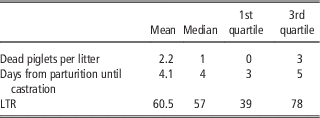
The data included recordings from 5175 farrowings. A total of 120 farrowings were removed due to missing recordings of the date of castration, and 17 farrowings were removed because the number of piglets alive at castration was missing. The remaining 5038 farrowings were performed by 3434 sows of which 1938 sows were included with one litter, 1388 sows were included with two litters, and 108 sows were included with three litters. All sows with more than one litter were identified, and one litter from each of these sows was randomly selected to be included in the analysis. This was done to eliminate the correlation between litters produced by the same sow and in total 1604 farrowings were removed. In addition, 41 litters with LTR=0 were removed before analysis. Thus, the analysis included 3393 farrowings from 3393 sows. In these litters a total of 53 911 piglets were born of which 6.7% were stillborn and 14.8% of liveborn piglets died within the study period from parturition until castration. The average number of total born and liveborn piglets per litter was 15.9 (SD=4.2) and 14.8 (SD=3.9), respectively. The distributions of number of dead piglets per litter, number of days from parturition until castration and LTR are presented in Table 1.
The mean, median and 1st and 3rd quartile of dead piglets per litter, days from parturition until castration and live-time risk (LTR)

LTR: live-time risk calculated as number of liveborn piglets multiplied by number of days from parturition until castration.
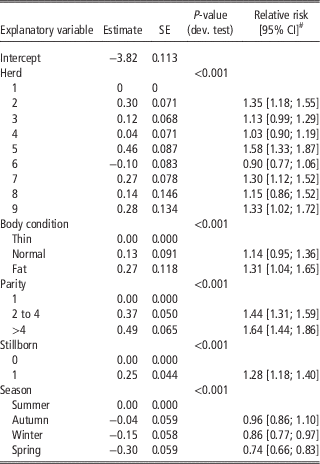
The negative binomial regression analysis showed a significant effect of herd, season, BCS, parity and the presence of stillborn piglets in the litter on the number of dead piglets from parturition until castration. None of the tested interactions significantly affected the outcome. The result from the negative binomial regression analysis is presented in Table 2.
Estimates from the negative binomial regression analysis describing the effects of the explanatory variables on the relative risk of a piglet being born alive and dying between parturition and castration

# The relative risk is of early mortality compared with the category of the variable used as the intercept with an estimate of zero.
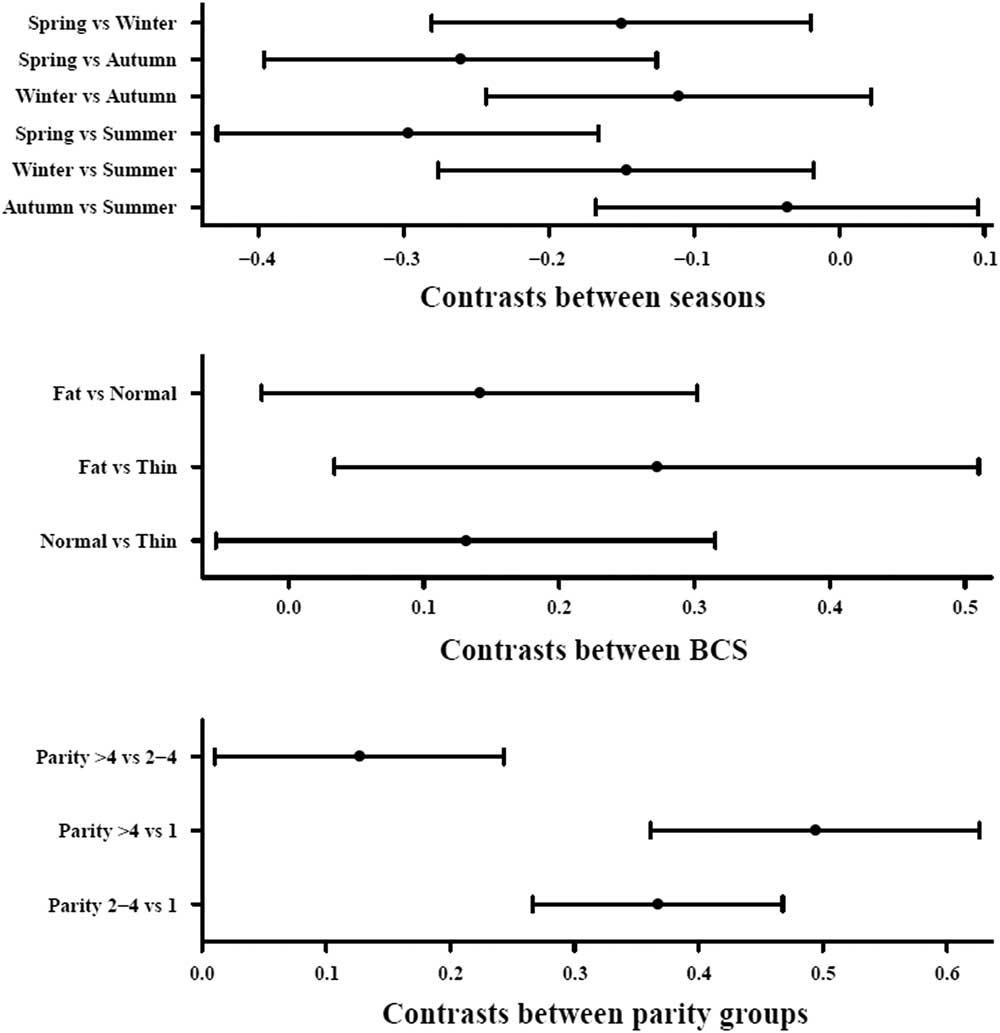
The analysis showed a significant effect of BCS with greatest risk of dying when born by a fat sow. A significant effect of parity was found with differences between all three parity groups with the greatest risk of mortality in the oldest sows. The effect of being born into a litter with one or more stillborn piglets provided a 1.28 times greater risk of dying compared with litters with no stillborn piglets. A significant effect of season was present with the lowest risk of mortality during spring and the highest risk during summer. Pairwise comparisons of the differences between all categories of BCS, parity and season together with the confidence intervals are illustrated in Figure 1.
Pairwise comparisons of differences between the estimates of the various levels of the explanatory variables and the 95% confidence intervals of the differences. The estimates describe the effect of the explanatory variables on the relative risk of a piglet being born alive and dying before castration. Numbers on the x-axes are the differences between the estimates from the categories of the explanatory variables shown on the y-axes. Confidence intervals including zero equal no significant difference between variables shown on the y-axes. Top figure: Pairwise comparisons of differences between all four seasons included in the model. Middle figure: Pairwise comparisons of differences between the three categories of body condition score (BCS) included in the model. Bottom figure: Pairwise comparisons of differences between the three categories of parity included in the model.

To illustrate possible mortality outcome, two examples are given in Table 3 with different combinations of the risk factors.
Combinations of the estimates illustrating possible piglet mortality outcome

BCS=body condition score; MLS=mean litter size.
The examples include the intercept and a constructed estimate for an average herd.
¤ MLS: mean litter size of 14.8×4 days (median time at risk).
# MLS3+: mean litter size of 14.8+3 piglets×4 days (median time at risk).
Crushed piglets: logistic analysis
In total, 3304 piglets from 839 litters were collected for postmortem inspection of which 325 piglets were discarded due to a high level of decomposition or missing body parts. The remaining 2979 piglets were collected from 818 litters, and crushing by the sow was the final cause of death in 1376 piglets (46%). In all, 286 litters were removed from the data due to insufficient information either about the sow (parity, BCS, sow identification number, liveborn piglets, etc.), the piglets (date of death or castration) or because mortality in the litter occurred after castration. In the remaining 532 litters, mortality due to crushing by the sow occurred in 395 (74%) of the litters. In 137 litters, only mortality due to other reasons than crushing occurred. The proportion of sows of parity 1, 2 to 4 and >4 were 20%, 58% and 22%, respectively. The distribution of observations between summer, autumn, winter and spring were 27%, 25%, 23% and 25%, respectively.
In first parity sows, 56% of the litters had crushed piglets. In sows with parity 2 to 4, 77% of the litters had crushed piglets, and in litters from sows of parity above four, 84% of the litters had crushed piglets. Mean liveborn litter size was 13.9 (SD=4.4) in litters with no crushed piglets and 15.8 (SD=3.8) in litters with crushed piglets.
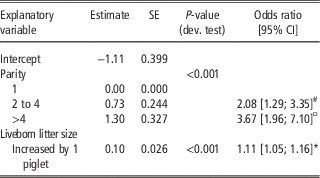
The logistic analysis showed a significant effect of parity where the odds of at least one piglet in a litter with mortality was diagnosed as crushed increased with increasing parity. A linear effect of liveborn litter size was seen where the odds of at least one piglet in a litter with mortality was diagnosed as crushed increased with an odds ratio of 1.11 with an increase of liveborn litter size by one piglet. None of the tested interactions was found to significantly affect the outcome. The results of the logistic analysis together with odds ratios are presented in Table 4
Parameter estimates from the logistic analysis and odd ratios describing the effect of the explanatory variables on the risk of at least one piglet in a litter with mortality being diagnosed as crushed

# The odds ratio of at least one piglet in a litter with mortality being crushed when comparing parity two to four sows to parity 1 sows.
¤ The odds ratio of at least one piglet in a litter with mortality being crushed when comparing parity >4 sows to parity 1 sows.
* The odds ratio of at least one piglet in a litter with mortality being crushed when increasing liveborn litter size with one piglet.
Discussion
This study showed a clear effect of parity on risk of mortality with older sows being more at risk of high mortality than younger sows, which is in accordance with previous studies. Wientjes et al. (Reference Wientjes, Soede, van der Peet-Schwering, van den Brand and Kemp2012) showed that highly prolific organic sows with parity above four had a significantly higher early mortality compared with sows with lower parities, and Hales et al. (Reference Hales, Moustsen, Nielsen and Hansen2014) showed that early piglet mortality was lower in first parity sows compared with older sows housed indoors in both pens and crates. Earlier studies on organic sows housed outdoors (Wientjes et al., Reference Wientjes, Soede, van der Peet-Schwering, van den Brand and Kemp2012) and indoor crated and loose sows (Weber et al., Reference Weber, Keil, Fehr and Horat2009; Hales et al., Reference Hales, Moustsen, Nielsen and Hansen2014) show a positive relationship between parity and litter size and between litter size and piglet mortality (Baxter et al., Reference Baxter, Jarvis, Sherwood, Robson, Ormandy, Farish, Smurthwaite, Roehe, Lawrence and Edwards2009; Hales et al., Reference Hales, Moustsen, Nielsen and Hansen2015). In the present study, the number of total born piglets was not directly included in the statistical analysis as a predictive variable but was only taken into account by the offset LTR and by the dichotomous variable stillborn piglets being correlated to litter size. Thus, increased litter size with increasing parity may partly explain the parity effect. In a study by Vasdal and Andersen (Reference Vasdal and Andersen2012) it was found that less than half of the functional teats were accessible to suckle during the important colostrum period. This effect was more pronounced in older sows due to sub-functional udder morphology, making it difficult for piglets to reach teats even if the sow is lying in lateral recumbancy during lactation, resulting in an insufficient ingestion of colostrum by piglets, consequently increasing piglet mortality. When interpreting the effect of parity in a commercial production setting it is important to be aware of the selected culling of sows where farmers only permit sows assumed fit for farrowing to remain in production. The sow lines used in organic farming in Denmark are Danish Landrace-Yorskshire (LY) crossbred (DanAvl) with a high genetic potential to produce large litters (Su et al., Reference Su, Lund and Sorensen2007). In the present study, the average of total born and liveborn piglets per litter was 15.9 (SD=4.2) and 14.8 (SD=3.9), respectively. This is less than what is seen in the Danish conventional production system where the number of total born piglets is 17.6 on average, and the number of liveborn piglets was 15.9 in 2015 (Jessen, Reference Jessen2016). This difference could be due to the increased risk of liveborn dead piglets from an organic production system disappearing (predation, getting lost in the straw bedding or being eaten by the sow) before the first check-up after parturition and thereby lowering the observation of total born piglets.
The present study showed increased risk of piglet mortality in fat sows, which is in accordance with an earlier study on indoor and outdoor loose-housed sows (Wulbers-Mindermann et al., Reference Wulbers-Mindermann, Algers, Berg, Lundeheim and Sigvardsson2002). A high BCS has previously been shown to be associated with prolonged farrowing (Oliviero et al., Reference Oliviero, Heinonen, Valros and Peltoniemi2010) with an increased risk of piglets late in the birth order suffering from hypoxia at birth, rendering them less viable with an increased risk of dying later in lactation (Herpin et al., Reference Herpin, Hulin, Le Dividich and Fillaut2001).
Litters with one or more stillborn piglets had higher mortality compared with litters with no stillborn piglets. This is in accordance with a study including both outdoor-housed, indoor loose sows and crated sows by Leenhouwers et al. (Reference Leenhouwers, van der Lende and Knol1999) and KilBride et al. (Reference KilBride, Mendl, Statham, Held, Harris, Cooper and Green2012) showing an increase in mortality in litters with two or more stillborn piglets. Reasons for this association could be that presence of stillborn littermates might be due to dystocia rendering the liveborn piglets less viable. In addition, stillborn piglets might be associated with illness of the sow negatively influencing her capacity to nurse and to be attentive towards her piglets, consequently increasing piglet mortality and in particular crushing (Spicer et al., Reference Spicer, Driesen, Fahy, Horton, Sims, Jones, Cutler and Prime1986).
Mortality was highest during summer (June to August), but the mortality rate was also higher during autumn and winter than during spring, being the season with the lowest mortality rate. Sows have a thermal comfort zone around 20°C, whereas piglets thrive at temperatures above 30°C (Black et al., Reference Black, Mullan, Lorschy and Giles1993). It is, therefore, likely that the increase in early mortality during the warmer months of June to August is due to potential heat stress in sows rather than the temperature negatively affecting the piglets directly. In the outdoor production system, ambient temperatures cannot be controlled, and sows therefore need to be able to thermoregulate through wallowing. During the first days pp it has been shown that sows spend most of their time inside the hut together with the piglets and that, during this period, they use the wallow less frequently compared with later in gestation (Schild et al., Reference Schild, Rangstrup-Christensen and Pedersen2016), potentially leading to an increased risk of heat stress during periods of high ambient temperatures. High ambient temperature has previously been shown to have a negative effect on milk production with a decrease in milk production with temperatures above 25°C (Quiniou and Noblet, Reference Quiniou and Noblet1999), potentially leading to piglet mortality. In a study by Rangstrup-Christensen et al. (Reference Rangstrup-Christensen, Krogh, Pedersen and Sørensen2016) it was found that the risk of stillbirth increased during the months of May to August compared with the rest of the year. As discussed previously, the mortality increases in litters with stillborn piglets. As no temperature or humidity recordings were performed, the mentioned causalities are somewhat speculative, and further studies, including behavioural observations and recordings of temperatures and humidity, on the subject are needed to determine which factors are directly involved in the effect of season on early piglet mortality.
Crushed piglets
In accordance with the present study, previous studies have shown that crushing accounts for the vast majority of early piglet mortality in both crated and indoor and outdoor loose-housed sows (Damm et al., Reference Damm, Pedersen, Heiskanen and Nielsen2005; Roehe et al., Reference Roehe, Shrestha, Mekkawy, Baxter, Knap, Smurthwaite, Jarvis, Lawrence and Edwards2009; KilBride et al., Reference KilBride, Mendl, Statham, Held, Harris, Cooper and Green2012). The significant effect of parity on the odds that at least one piglet in a litter with mortality is crushed could be explained by young sows being smaller in size (not necessary leaner) than older sows. A small sow occupies less of the hut, leaving the piglets more space to withdraw to, while she is lying down and getting up thus decreasing the risk of piglets being crushed. Older sows are larger, with potentially poorer leg health and mobility impairing the sows ability to control lying and react to piglet crushing. In a study by Vieuille et al. (Reference Vieuille, Berger, Le Pape and Bellanger2003) comparing behaviour of first and second parity sows housed in outdoor farrowing huts with regard to crushing of piglets, it was found that first parity sows were more responsive to squeals from piglets trapped underneath the sow. Vieuille et al. (Reference Vieuille, Berger, Le Pape and Bellanger2003) also found a relationship between crushed piglets and increasing litter size as was the case in the present study. The effect of litter size might be explained by the lack of space in the hut where many piglets might lead to crowding, making it difficult for the sow to lay down on a piglet-free area. In addition, large litters lead to crowding at the udder with a potential reduced milk consumption, resulting in hungry and weak piglets that are more exposed to crushing by the sow. Variation in birth weight within litter increases with litter size (Milligan et al., Reference Milligan, Fraser and Kramer2002; Quiniou et al., Reference Quiniou, Dagorn and Gaudre2002) and with sow parity (Quesnel et al., Reference Quesnel, Brossard, Valancogne and Quiniou2008). In heterogeneous litters, the number of small underweight piglets are higher (Quesnel et al., Reference Quesnel, Brossard, Valancogne and Quiniou2008). Piglets with a low birth weight have greater risk of suffering from hypothermia (Herpin et al., Reference Herpin, Damon and Le Dividich2002) and have a longer latency to first suckle than heavier piglets (Pedersen et al., Reference Pedersen, Berg, Jorgensen and Andersen2011). In addition, small piglets in heterogeneous litters have difficulties obtaining a functional teat when competing with their heavier littermates. Weary et al. (Reference Weary, Pajor, Thompson and Fraser1996) found that piglets with poor growth spend more time underneath a sitting and standing sow and thus are more prone to crushing.
Conclusion
The risk of early piglet mortality increased with increasing sow BCS and parity, with being born into a litter with one or more stillborn littermates and with being born during summer, autumn or winter compared to spring. In addition, increasing parity and liveborn litter size increased the probability of piglets being crushed in litters with mortality. Further studies, including behavioural observations and recordings of temperatures and humidity, are needed in order to determine the causal relationships and to suggest methods to prevent high mortality.
Acknowledgements
The authors would like to thank all the participating producers and their employees for their hard work and dedication throughout the 1-year study period. A special thanks to technician Pia Haun Poulsen for help and support during the study period. This work was funded as part of the VIPiglets project under the Organic RDD 2 programme, which is coordinated by International Centre for Research in Organic Food Systems (ICROFS). It has received grants, J.nr. 34009-13-0679, from the Green Growth and Development programme (GUDP) under the Danish Ministry of Food, Agriculture and Fisheries.