From the supposition that culture is an end in itself it does not automatically follow that the state has a particular responsibility for it. To the contrary, one could claim that if, for the citizens, culture really represented an end in itself it would be reasonable to assume that they themselves would want to maintain a high and varied supply of its goods.1
My translation of Beckman, “Vad vill staten,” 45.
Svante Beckman
Dr Antje Vollmer, a former Vice-President of the German Parliament and spokesperson for cultural policy of the Green Party, organized on 30 March 2000 a public hearing that turned out to be a political bombshell. The subject of the hearing, held in the German Parliament (Bundestag), was an expert report commissioned by Vollmer from Dieter Hoffmann-Axthelm.2
Hoffmann-Axthelm, Kann die Denkmalpflege; see also Hoffmann-Axthelm, “Alles bewahren”.
Hoffmann-Axthelm, “Plädoyer”.
E.g. Dolff-Bonekämper, “Restauration oder Restaurierung”.
The topic of the Parliamentary hearing was an assessment of the future of cultural heritage management in Germany. Its provocation was twofold. First, heritage management in Germany is nearly in its entirety devolved to the Federal States (Bundesländer) so that, essentially, the German Parliament has no business discussing it. As a matter of fact, this was the first time heritage management had ever been discussed by the national parliament. Second, the report suggested nothing less than an extensive withdrawal of the state from heritage management and a much stronger “democratization” of the way cultural heritage is managed in Germany. This was reflected in the provocative title of the report which asked “Can heritage management be decentralized [entstaatlicht]5
The German term “entstaatlicht” is at the heart of the argument but difficult to translate into English. It is used by Hoffmann-Axthelm to denote a removal of political responsibility for the preservation of cultural heritage (Denkmalpflege) from the level of the state (i.e. in this context the German Länder) and give it to the citizens themselves. An alternative translation as “privatize” is not suitable for its strong private sector and economic connotations in English which is far from how “entstaatlicht” is used in German. Another alternative, “de-nationalize” gives significance to the nation which the German term does not.
Whereas the first provocation was essentially a legal matter that does not need to concern us here very much, the second provocation constituted a fundamental attack against many of the principles and practices of heritage management taken for granted. It raised important issues which deserve discussion even outside the borders of Germany. The following account seeks to review some of the key issues of the German debate and begin a discussion of how it might relate to heritage management in other countries.
WHAT'S WRONG WITH HERITAGE MANAGEMENT IN GERMANY
In his report, Hoffmann-Axthelm discusses two fundamental problems regarding the status quo of heritage management in Germany. It is important to remind us here that he deals exclusively with architectural and urban heritage—the archae-ological heritage faces very different challenges and is neither the subject of his report nor of my present discussion.6
See Lettmann, “Denkmalpflege”; Holtorf, From Stonehenge.
The first problem concerns the way heritage management at present relies on an authoritarian state model. According to Hoffmann-Axthelm, during the 19th century the state advanced the preservation of heritage with the aim to prevent particularly significant old buildings in its own possession from decay and destruction. The current management of cultural heritage still rests on some of the same principles, even though the context has changed completely. Now, the preservation of heritage predominantly concerns buildings in private possession and the kind of sites and buildings protected is growing constantly. The heritage authorities, Hoffmann-Axthelm argues, use the existing planning and building laws and regulations to impose strict conditions on ever more private clients. In that process they come across as authoritarian, self-righteous, and unable to take into account the view of the owners and users of heritage. Indeed, Hoffmann-Axthelm claims that the strict German planning and building laws and regulations contain many remnants from the absolutist age. In other words, the ideals for the preservation of collectively owned national treasures have been transferred unchanged to the preservation of privately owned buildings. The first issue Hoffmann-Axthelm raises is thus to what extent it is justified for the state to assume a collective responsibility and use authoritarian means when regulating building work on privately owned sites.
The question which decisions can best be left to the citizens themselves, possibly with some guidance and support, and for what aspects the state and its authorities need to take main responsibility on account of the larger, collective interest is relevant to any state ruled by law. It is particular relevant and intricate in democracies because they explicitly seek to implement the rule of the people. Why should the people not be allowed to decide themselves how much of their own heritage they wish to preserve and in what way? At what level of decision-making are judgments concerning the preservation of cultural heritage best taken ‘by the people themselves’: at national or state level by elected representatives and their (civil) servants, or much closer to the man or woman ‘on the street’ at regional, local or street level? In other words, is the preservation of the cultural heritage a common good of such high priority that it can and must be imposed on all citizens by democratically controlled experts (like health and safety regulations or environmental laws, for instance)? Or should it best be left to the individual people who actually inhabit or own ancient buildings how much of the old character and structure they wish to preserve? Dieter Hoffmann-Axthelm argues that citizens should be able to make these decisions for themselves.
The second problem Hoffmann-Axthelm raises concerns the criteria that are to be applied to decisions about cultural heritage made by the state authorities. According to the provocateur, as it stands, heritage management is not based on the existing principles and values meant to govern its practice but is de facto politically negotiable. When their own financial interests are affected, the state and local councils as well as individuals with connections either to politicians or to the media find heritage authorities much more lenient than others. The same goes for businesses who can plausibly argue that jobs may be at stake. Hoffmann-Axthelm thus claims that the burden of the costs for the preservation of heritage is largely—and unfairly—carried by all those ordinary citizens without much political leverage.
In addition, sometimes civil servants employed in the state heritage sector appear to confuse their own political convictions and preferences for certain academic schools with their role as disinterested assessors and judges of heritage on behalf of society at large. More and more buildings are listed as part of the cultural heritage, and they are of more and more recent age. This could be explained by individual civil servants using the preservation of heritage as a pretext for influencing contemporary architecture and urban planning on the basis of their own aesthetic preferences. Or they might be using academic criteria of a particular kind in determining which buildings are ‘historically representative’ and therefore in need of conservation, even though the preserved structures may not be of interest to any but a few specialists. There may even be politically motivated strategies prevailing within some state heritage authorities, e.g. in cases when remains of the German Democratic Republic are being protected simply because they date to the time of the German Democratic Republic (1949–1990). Such policies serve Ostalgia and specifically the PDS Party, i.e. the successor of the Communist party in Eastern Germany.
Whether or not there is merit in any of these charges and suspicions, Hoffmann-Axthelm claims that weighing up specific values in individual cases always involves a high degree of subjectivity. The reasons for a specific decision can be difficult to convey to the clients who ultimately have to pay for its consequences. Specific decisions and conditions imposed on clients' projects are not always easily comprehensible. They can appear to be arbitrary and solely dependent on personal attitudes and preferences of individual civil servants. All that, if true, is hardly appropriate in a democratic state in which the people are said to rule and civil servants are required to be directly accountable to the people through their elected representatives.
Some elements of Hoffmann-Axthelm's polemic found their way into Antje Vollmer's “12 Theses on the preservation of heritage, the need for reforms and the possibilities of change” from May 2000. This fairly short document chiefly emphasises the need to have a comprehensive, open and taboo-free debate about the preservation of heritage in Germany. Vollmer also calls for a new “culture of dialogue” between heritage officials and citizens, where the former would be more willing to account fully for their reasoning and be more open to reach compromises with the latter.7
Vollmer, 12 Thesen.
Vollmer, “In Augenhöhe reden”; see also Rüsch, “Unter Verdacht” and “Ist das ”öffentliche Interesse“”. A similar suggestion has been discussed again recently, see Donath, “Was bedeutet Kategorisierung?”.
THE HERITAGE PEOPLE WANT?
Taking the two problems outlined earlier as the starting points of his analysis, Dieter Hoffmann-Axthelm develops a number of theses and suggestions for a new kind of heritage management in Germany. These can be summarized as follows:
a. The term heritage has been overstretched—too much is being preserved. This has led to reduced public credibility of the state heritage authorities, as almost anything might be taken to be a significant part of the cultural heritage. The more items preserved, the less understanding of the purpose. This trend ought to be broken.
b. A lack of state protection for a given building does not mean that it can be demolished without further ado. What it means is merely that the building is not protected by the state. There may be others than the state, such as the owners of a building, local companies, citizens' initiatives, independent foundations like Deutsche Stiftung Denkmalschutz, or bodies like the National Trust in the U.K., who accept their own responsibility for the cultural heritage and take it upon themselves to try and preserve a building. The long-standing link between the cultural heritage and its state administration needs re-thinking.9
cf. Beckman, “Vad vill staten”.
c. In a state, what should be treasured is not whatever is representative of past ages but what its citizens appreciate as worth preserving. Towns should not be treated as archives or museums. The value of a protected building must be apparent to any resident or visitor and must not depend on written academic appraisals that fill many pages or entire books. The most important criterion for preservation should thus be the aesthetic appeal of the building for onlookers, in other words its “beauty”. In short, buildings that people do not love because they do not appeal to them, do not deserve to be protected and preserved either. Only such structures should be preserved “without which we would be poorer and the world would be cooler.” We should be saving buildings “whose demise would break one's heart”. For “what does not move any hearts—why should it be saved?”10
My translations from Hoffmann-Axthelm, Kann die Denkmalpflege, 22, 33.
d. The criterion of beauty will invariably favour older buildings, such as medieval churches or castles, over more recent ones, such as factories and other functional buildings constructed from the mid-19th century onwards. In many cases, the construction of the latter was the reason for destroying the old towns which often had been more beautiful than our present centres. Moreover, most modern buildings were anyway not designed to last longer than a few decades. Accordingly, it is wrong to preserve a large number of these buildings now.
In sum, Dieter Hoffmann-Axthelm argues that in principle it is not the task of the state to implement the aesthetic, academic, or political demands of heritage specialists, when these demands lack support among the local population. Instead, the citizens themselves ought to determine to a larger extent what should and should not be preserved as cultural heritage, and thus give their towns and cities the character they prefer. That this is not entirely unrealistic shows a new representative study. It concludes that 88% of all German adults prefer conserving and restoring old city centres to demolishing old structures and building anew. Likewise, more than half of them are willing to pay more for being able to live in a renovated listed historic building.11
Vivacon AG, Schaubilder.
FOR EXAMPLE: DRESDEN
The Neumarkt district of Dresden, currently being restored, provides a useful illustration of some of Hoffmann-Axthelm's ideas. Even though state heritage management is not directly at stake in this case, recent developments in Dresden can serve as an example for the popular preferences concerning cultural heritage. The Neumarkt area in Dresden does not tell a sad story about the failures of heritage management but rather an uplifting tale about the hopes—and first achievements—of a citizen-led initiative promoting a particular version of cultural heritage.
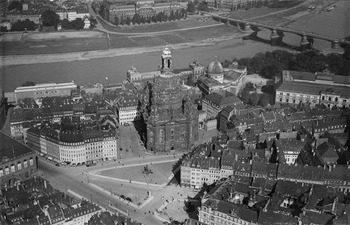
Dresden, the capital of the German state of Saxony, is famous for its baroque architecture from the first half of the 18th century. Much of it did not, however, stand for very long. During the Seven Years' War (1756–63) Prussian artillery destroyed extensive parts of the city centre. Yet in the area of the Dresden Neumarkt vernacular baroque architecture had survived uniquely. The centre of this area consisted of an irregular space made up of three squares: Jüdenhof, Neumarkt and An der Frauenkirche. The Neumarkt was crowned by the distinctive dome of the Frauenkirche built by George Bähr (Figs. 1, 3).

Dresden Neumarkt with Frauenkirche in 1933. Photograph: SLUB/Deutsche Fotothek, Dresden.
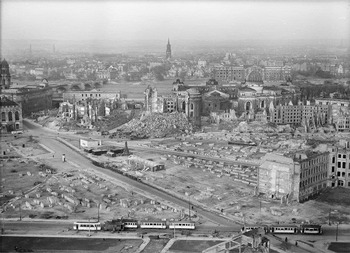
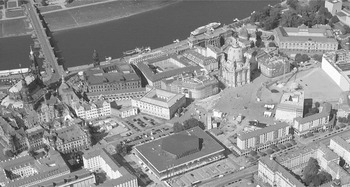
In February 1945, comprehensive air raids erased the entire town, including all the residential buildings in the Neumarkt area. After the war some historic buildings, like the Zwinger and the Semper Opera, were reconstructed by the authorities of the socialist GDR but at the same time planning authorities demolished all but a few of the ruins that remained in the Neumarkt district, intending to build here part of the new, socialist Dresden (Fig. 2). Yet the Neumarkt remained undeveloped until the 1980s when a concrete extension of the police headquarters (pulled down in 2005) and the Hilton Hotel were erected in the area. Following German unification in 1990, the Frauenkirche, often described as the soul of Dresden and a symbol of the destruction of the city during the war, was rebuilt from the remaining pile of rubble of the original church's ruins thanks to private and corporate donations amounting to more than 100 million Euros. It reopened in 2005 (Figs. 4, 6).12
See Dresdner Geschichtsverein, Die Dresdner Frauenkirche.

Dresden Neumarkt area without Frauenkirche in 1951 (showing the extensive war damage). Photograph: SLUB/Deutsche Fotothek, Dresden.

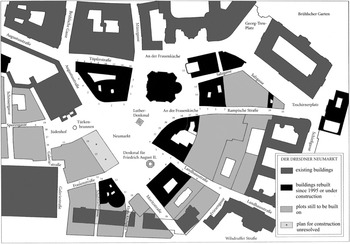
Dresden Neumarkt with Frauenkirche, plan from 2006. After Donath 2006.

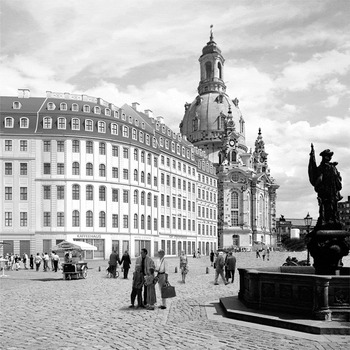
Dresden Neumarkt with reconstructed Frauenkirche in 2006. Photograph: Jens-Uwe von Berg.
Hoffmann-Axthelm states that individual buildings which people do not love do not deserve to be protected and preserved either. As cited earlier, we should be saving only those structures “whose demise would break one's heart”. The destroyed Neumarkt district in Dresden evidently did break sufficient people's hearts in order to let a strong citizens' initiative arise.13
Hertzig, “Die historische Rekonstruktion”; Seiss, “Im Rückwärtsgang”; Donath, “Der Dresdner Neumarkt”; http://www.neumarkt-dresden.de.
“We want that Dresden regains its identity and that the heart of the Old Town beats again:
1. We stand for the restoration of the conditions immediately before the war (no pseudo-historic urban development)
2. We support the historical true-to-the-original reconstruction of all art- and culture-historically significant town houses (15 key buildings are not sufficient)
3. Between the reconstructed houses we want exclusively to put up buildings in traditional architecture with simple plaster exteriors and garrets (no inappropriate glass-steel oriels)”14
My translation of: “Wir wollen, daß Dresden seine Identität wiederfindet und das Herz der Altstadt wieder schlägt: 1. Wir treten für die Wiederherstellung des unmittelbaren Vorkriegszustandes ein (kein pseudohistorischer Städtebau). 2. Wir setzen uns für die originalgetreue historische Rekonstruktion aller kunst- und kulturgeschichtlich bedeutenden Bürgerhäuser ein (15 Leitbauten reichen nicht). 3. Wir wollen nur Neubauten in traditioneller Bauweise mit einfachen Putzfassaden und Mansardendächern zwischen die rekonstruierten Häuser setzen (keine unpassenden Glas-Stahl-Erker).”
The overall sentiment is well expressed by the references to Dresden's “identity”, the “heart” of the Old Town, “true-to-the-original reconstruction”, “traditional architecture”, and the rejection of “pseudo-historical urban development” (Fig. 5). The express preference of “simple plaster exteriors and garrets” over “inappropriate glass-steel oriels” reveals the professional expertise of some of the citizens involved.15
See also the account of the art historian and leading member of the initiative Stefan Hertzig, “Die historische Rekonstruktion” and “Frauenkirche und Neumarkt”.

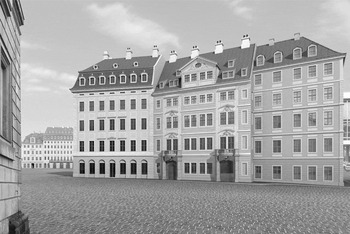
The planned reconstruction of the buildings at the southern side of Jüdenhof at Dresden Neumarkt. Graphics by Andreas Hummel. Copyright: Gesellschaft Historischer Neumarkt Dresden e.V., 2006.
Although the initiative has some 700 members in total (of which around half live in Dresden), some leading members of the initiative were intellectuals from the West who had moved to Dresden after German unification in 1990. That could be seen as an indication that a minority of outsiders is trying to impose its will on the majority of Dresden inhabitants. However there is another way of interpreting this. Arguably, intellectuals who have been growing up in the Federal Republic since the 1960s do not only have far-sighted visions for sustainable development but are also very good at running competent and effective political campaigns.
Both the efficiency of the people behind the initiative and the wide support it enjoyed in Dresden after all was born out by a petition in favour of reconstructing the historic Neumarkt area. When in 2003 the petition was handed over to the Mayor of Dresden it had been signed, within a few months, by nearly 68,000 people including more than 63,000 citizens on the electoral register of Dresden, amounting to 15% of the entire electorate.16
http://www.neumarkt-dresden.de/buergerbegehren1.html (accessed March 15, 2007).
Gesellschaft Historischer Neumarkt Dresden e.V.
The Foundation Gesellschaft Historischer Neumarkt Dresden e.V. was founded in 1999 by a group of architects, historians, heritage managers, art historians, lawyers and other engaged citizens. We are convinced that the reconstructed Frauenkirche and the reconstructed Neumarkt belong together. We believe that the rebuilt Frauenkirche requires the surroundings of the old Neumarkt to be rebuilt as accurately as possible too.
With the historic Neumarkt thoroughly reconstructed, Dresden could regain a historic heart in its town centre. The Foundation will give a voice to the many citizens of Dresden and other friends of the town. They are refusing to tolerate modern architectural ideas at the feet of the Frauenkirche. To our horror it is now planned to rebuild the 300 houses of the Neumarkt area in a modern way, except for fifteen reconstructed buildings where less steel and glass will be used so that a somewhat more old-fashioned impression will be given.
We, on the other hand, are in favour of a different but equally realistic concept. We want the old Neumarkt to be rebuilt as one of the most beautiful old towns in Europe. We prefer an archaeological reconstruction of 70 to 80 well documented and art historically valuable old town houses, based on existing plans, sketches, original remains and photographs. There will however also be room for some modern designs in a symbiosis of reconstructed and modern elements.
We should not lose our unique chance to regain at the Neumarkt a piece of historical identity for our town, for the sake of our children and grandchildren. Let us give the new old Frauenkirche its old setting!
These days, modern architecture can and should be built in most parts of Dresden. However, on this half square kilometre, architects should consider themselves as humble servants in a historic context. We are convinced that most of the population in Dresden want it this way.
Based on Hans Joachim Neidhardt, What we want. http://www.avoe.org/dresdenwhat.html (accessed 15 March 2007)
This is not the place to discuss the merits of reconstructing from scratch old buildings in modern cities. But a citizens' initiative enjoying wide support promoting the reconstruction of baroque architecture gives cause to consider their possible motivations and values. Although politicians and developers may be contemplating the benefits of a historical city centre for the development of tourism and retail, this is not the most important concern of ordinary citizens.17
Seiss, “Im Rückwärtsgang”.
To be clear, the heritage being desired is emotionally loaded. Earlier I have cited references to the “heart of the Old Town” and the “identity” of Dresden. Arguably, the restored Neumarkt district around the Frauenkirche will first and foremost be beautiful (Fig. 6). This has been made crystal clear by the Prince of Wales. Supporting the campaign in Dresden for traditional architecture, he announced that
“I know that many people—visitors as well as citizens of Dresden—yearn to see the historic form of the Neumarkt restored. They yearn to see beauty and elegance restored once again as an antidote to so much of the ugliness and brutality of the 20th century.”18
Undated statement of HRH The Prince of Wales, available at http://www.intbau.org/statemente.htm (accessed 15 March 2007).
The heritage that is wanted here may not be representative of the entire history of Dresden but it is considered worth preserving (or rather worth reconstructing) by the citizens of Dresden. Although the Gesellschaft Historischer Neumarkt Dresden is careful to avoid playing out traditional against modern architecture, the desired buildings in the heart of Dresden will evoke the 18th century, while modern architecture is to be banned to the outer parts of the city. Significantly, during the communal election campaign in 2004, the local liberal party (FDP) courted the citizens of Dresden with the slogan “Baroque instead of concrete!” (Barock statt Beton!). All of that is highly reminiscent of Hoffmann-Axthelm's controversial proposals.

View of Dresden Neumarkt with Frauenkirche. Graphics: Quartier an der Frauenkirche GmbH & Co. KG, 2006. For a similar view today see the webcam at http://panorama.dresden.de/.
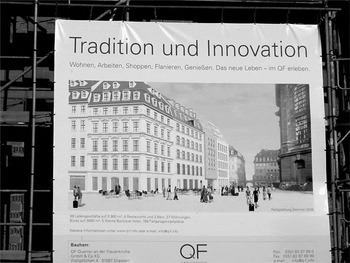
The discussion about the future development in the Dresden Neumarkt district is not about scheduled monuments and thus heritage management in the strict sense, for the old buildings have long been destroyed. But the planned or already carried out popular reconstructions can nevertheless make three important points in the context of the Denkmalpflegediskussion. Firstly, Hoffmann-Axthelm formulated democratic principles and aesthetic criteria for heritage management that are not only his own but shared by many people. Secondly, all these people are anything but ignorant of history and hostile to heritage: they love history and heritage! Thirdly, the already completed restoration projects in Dresden, such as the Frauenkirche, illustrate that there is indeed much to be gained from restoring cultural heritage in this way. Arguably, the restored Neumarkt is not merely going to be a signifier of some misplaced nostalgia, as some critics might have it, but indeed (becoming) a beautiful cultural treasure of the new Dresden (Fig. 7).

The “new life” of “tradition and innovation” at Dresden Neumarkt (showing the Quartier an der Frauenkirche while under construction). Photograph: Cornelius Holtorf 2005.
HOFFMANN-AXTHELM IN THE LINE OF FIRE
In the hearing of the German Parliament on 30 March 2000 practically everybody spoke against the analysis and the specific proposals made in the expert report by Dieter Hoffmann-Axthelm. The same is true for the following debate that took place in some of the largest national German newspapers (including Frankfurter Allgemeine Zeitung, Die Zeit, Süddeutsche Zeitung) as well as in some regional papers (e.g. Der Tagesspiegel, Berliner Zeitung). Within a few months, more than 30 contributions were published. Radio and TV reported too. Subsequently, a comprehensive webpage featuring a public forum, the publication of a reader containing all key texts, and the organisation of workshops and panel discussions carried the debate further, albeit not on the same scale.19
www.denkmalpflegediskussion.de (now defunct); Donath, Dokumentation (out of print); Petra Kelly Stiftung, “Denkmalschutz”; Maaß, “Denkmalschutz”; Donath, Paschke and Bongiorno, “Wie ewig”.
Most writers were fairly critical about Dieter Hoffmann-Axthelm's report. The criticisms ranged from disputes of his historical knowledge (as regards the history of heritage management and the real significance of early preservation driven by the state) to claims that his arguments were misinformed (concerning the status quo), misconceived (neglecting how decisions are made in a representative democracy), or misplaced (trivializing the destructive consequences of his proposals for many historic buildings currently protected by the state).20
e.g. Dolff-Bonekämper, “Restauration oder Restaurierung”; Rauterberg, “Ballast abwerfen”; cf. Hoffmann-Axthelm, “Alles bewahren”.
Two other objections are, however, far more problematic. First, there is a risk for heritage management to become driven by “populist” demands and an “arbitrary” popular aesthetics dependent on short-lived fashions. Heritage management would lose whatever academic credibility it still has—although this could also be seen as a good thing given the undemocratic nature of academic criteria. As a consequence, policies might change relatively quickly and thus prevent urban planning and sustainable development in the long term. Moreover, the destruction of a historic building is irreversible.21
Rauterberg, “Ballast abwerfen”; cf. Vollmer, “In Augenhöhe reden”.
A second serious risk is that much of the cultural heritage is going to be preserved—and aesthetically valued—by well organized and vocal minorities rather than by a majority of citizens as intended by Dieter Hoffmann-Axthelm. Experience with local government shows how minorities can dominate decision making processes. Even in Dresden it is still unclear whether really a majority of citizens is behind the proposals of extensive reconstruction in the Neumarkt district. But who should be counted anyway? What about those people who may chose not to get involved in such matters at all? What about those who inhabit their accommodation only for a few months or years or lack competence to make up their minds for other reasons? These problems are the same as those that emerge in any political election, and yet we would never want to question anybody's right to vote in a particular constituency. It nevertheless raises the question why, in a democracy, a minority of (self-selected) citizens should be trusted more than a minority of (elected) politicians and (appointed) civil servants. If individual owners could decide by themselves how to deal with a historic building in their possession, the problem becomes even more pressing. However, even concerning these dilemmas procedures might be found that allow the voices of all stake-holders to be heard and to influence any major decision regarding the cultural heritage on the local level. Arguably we must at least try.
A KERNEL OF TRUTH
Although only a few commentators and politicians spoke out in favour of the parliamentary report22
e.g. Brülls, “Das Unbehagen”; Donath in Donath, Paschke and Bongiorno, “Wie ewig”.
e.g. Habich, “Wohin steuert”; Rüsch, “Unter Verdacht,” “Ist das ”öffentliche Interesse“”; Echter, “Preservation in Germany”; Greipl, “Denkmalschutz in Bayern”; Maaß, “Denkmalschutz”.
— there are too many scheduled monuments. Due to a lack of resources these monuments cannot all be properly managed. The existing scheduled monuments therefore need to be reviewed, with the purpose of de-scheduling some of them;
— there is a lack of theorizing concerning the preservation of heritage and its aims. There is no consensus about common values and best practices. Many terms and categories regularly used are confusing and inconsistently applied.
— there is confusion about the existing responsibilities between the lower level of heritage authorities (towns, communities, districts), the higher level of heritage authorities (Landesdenkmalämter in each federal state) and the highest levels of authority in the relevant state ministries. Often, the precise role of various independent advisory bodies is also unclear. To complicate matters further, there are large differences between the various states within Germany. All this leads to inefficiency and occasionally to contradictory decisions taken on different levels.
— there are deficiencies in public outreach. Many events, such as Open Days satisfy only people's basic curiosity to see a building from the inside but are otherwise lacking in educational ambitions. Partly as a result of the lack of adequate theorising, fundamental questions concerning both the aims and purposes of the preservation of the cultural heritage and the kind of ‘public interest’ that would justify state involvement in heritage management remain unanswered and unaddressed.24
Rüsch, “Unter Verdacht”. Brülls, “Das Unbehagen” raises many similar issues.
Rüsch agreed with Hoffmann-Axthelm that state heritage management in Germany runs the risk of continuing to function in the authoritarian way of former centuries:
“Die bevormundende Anwendung des Ordnungsrechts auf die Freiheit des Denkens und Erinnerns ist das ungelöste Grundproblem der gesamten staatlichen Denkmalverwaltung, in dessen Widersprüchlichkeiten sie sich seit jeher verausgabt.”25
Rüsch, “Ist das ”öffentliche Interesse,” 103.
The fact that this enormous discussion took place at all demonstrated, too, that a sore point had been touched. Without much doubt, the heritage state authorities and the preservation of heritage as such have an image problem in Germany (and possibly, as we will see, elsewhere too). The authorities failed to gain sufficient public trust in their abilities and their judgement. They have not been able to convey precisely what they are doing and why. In everyday life in Germany, heritage smacks of non-sellers, sleeve protectors, and 19th century.26
Greipl, “Denkmalschutz in Bayern,” 18. My translation of “Denkmalpflege … klingt nach Ladenhüter, Ärmelschoner und neunzehntem Jahrhundert.”
“Gott schütze uns vor Staub und Schmutz, vor Feuer, Krieg, und Denkmalschutz”.27
Greipl, “Denkmalschutz in Bayern,” 20. Rough translation: “May God protect us from dust and dirt, from fire, war and the preservation of cultural heritage.” For a similarly negative reputation of Swedish heritage managers as ‘no-sayers’ to the people's wishes, see Agenda Kulturarv, Agenda Kulturarv, 113.
Arguably the most significant outcome of the Denkmalpflegediskussion in Germany was that it brought home the fact that the preservation of heritage is not (no longer?) something to be taken for granted in the public domain. Instead, it is contested. Back in 2000, the state heritage authorities in Germany were largely unprepared to deal with the frontal challenge offered by Dieter Hoffmann-Axthelm and Antje Vollmer. But decisions concerning the preservation of heritage must be subject to the same rules of accountability that apply elsewhere in a democracy governed by the rule of law.
RELEVANT BEYOND GERMANY?
To what extent is this debate relevant to states other than Germany? Obviously this depends on the degree to which the preservation of heritage by the state suffers from the same shortcomings. It is beyond the scope of this paper to make detailed assessments regarding whether or nor this might be the case in any individual states.
There is a sense though in which the German debate has been addressing issues that are of a general nature and apply to many if not all representative democracies, even beyond the specific example of the preservation of cultural heritage. What is the adequate role of state authorities in representative democracies ruled by law, and how should civil servants act? To what extent should they follow governmental directions, to what extent should they be malleable by citizens' preferences, and to what extent should they be experts accountable only to higher principles of academic wisdom? When should state authorities be re-active, responding to what already goes on in society, and when should they be pro-active, persuading people to act in particular ways? Should the state encourage citizens to behave according to specific political values of an existing majority, or should people be encouraged to do anything they like, limited only by the requirements of the law? Clearly, these are complex matters relevant to very many states and of considerable interest to political scientists and others.28
Blomgren, Staten och filmen, 8–17, 25–35; Rüsch, “Ist das ”öffentliche Interesse“”; Aronsson, “Demokratiskt kulturarv”.
It is evident that the German Denkmalpflegediskussion revolved in large parts around Hoffmann-Axthelm's suggestion to minimise the active role of the state (and government) in heritage matters, while maximising the liberty of the citizens in relation to what is ultimately perceived as an aesthetic matter. The accountability of state heritage management and the best distribution of power and responsibility between expert civil-servants on the one hand and the citizens who are most affected by their decisions on the other hand are not however entirely new questions or even specifically German problems. Yet curiously, the entire debate in Germany has not found much echo in other countries nor has it until now been accessible in languages other than German.29
The only other texts in English to date are Echter, “Preservation in Germany,” and Holtorf, “Should heritage management”.
There is much to be gained for other state's heritage management though from taking this discussion seriously. In closing I wish to make a few comments as to its relevance to the situation in Sweden where I have lived for the past five years, two of which as an employee of the central National Heritage Board (Riksantikvarieämbetet) in Stockholm. Just as in Germany, we could ask about the relations between heritage, citizens and the state in Sweden. What is the appropriate role and purpose of the Swedish National Heritage Board, the relevant County Museums (Länsmuseer) and County Council Departments (Länsstyrelser), in particular regarding buildings not owned by the state? Which aspect of heritage management in Sweden requires state authorities, and precisely what is it they seek to preserve, for what reasons? It has already been asked whether Riksantikvarieämbetet and the state heritage authorities in Sweden, like their German counterparts according to Hoffmann-Axthelm, are nothing but relics of a past age that was characterised by a body of shared national values.30
Beckman, “Vad vill staten”; Grundberg, Historiebruk; Aronsson, Historiebruk, 150.
Sandström, På den tiden, 152–5.
e.g. Holmström, “Kulturarvens nytta”, Aronsson, “Demokratiskt kulturarv”.
It is evident that at present there is little sensibility within the Swedish heritage sector for questions concerning authoritarian tendencies in heritage management and the legitimacy of state heritage management as such. It is taken as self-evident that experts employed by the relevant state authorities inform the citizens about the significance of the cultural heritage, and not vice versa. Riksantikvarieämbetet's work is characterised by a strong top-down attitude. For example, in its vision and strategy document for 2004–2006, citizens are said to need opportunities for making the cultural heritage their own. Riksantikvarieämbetet sees its role as offering and increasing such opportunities. Moreover, it considers it as one of its tasks to reveal to citizens how cultural heritage can be relevant to society. People's own relations to the cultural heritage, the responsibilities they assume, and the desired ‘dialogue' with them are assumed to be dependent on the suggestions offered by the state.33
Riksantikvarieämbetet, Kulturarv i tiden; see also Gustafsson and Karlsson, Plats på scen, 9–13; Kulturarv som samhällsdialog?, 25–29.
Riksantikvarieämbetet, Kulturarv ger livskraft, 13–15; cf. Aronsson's distinction between four different meanings of ‘democratisation’ in Historiebruk, 42–3.
A similar way of thinking can be found in the Operation Heritage (Agenda Kulturarv) project.35
http://ux-ra-kmsap2.raa.se/agenda/ (accessed 15 March 2007); Agenda Kulturarv, Agenda Kulturarv.
“in dialogue with the society at large, we must continually re-examine our selection criteria and the ways in which we evaluate the historic environment. […] every time we make some kind of selection, we should ask ourselves questions such as: What do we want to accomplish? Who will be affected? Whose viewpoints and values are we reflecting?”36
Agenda Kulturarv, Putting People First, 13.
Yet in the end this concern did not extend very far. The project never really moved from ‘asking ourselves’ these questions to openly discussing them with the people directly affected. It remained unclear how the state preservation of heritage actually affects citizens in Sweden and what they themselves would want to accomplish with their heritage. This was no simple oversight but the result of a systematic design flaw in the project. In limiting the project's participants to representatives of the heritage sector, even excluding the relevant university departments, the dominant role of state authorities in managing the culture heritage in Sweden was never to be put in question. The same policy statement expresses a view that is precisely of the patronizing kind Hoffmann-Axthelm attacked so vehemently in Germany:
“Society has assigned us the task of enabling and encouraging people to draw on the power of their history and heritage to shape their lives and surroundings.”37
Agenda Kulturarv, Putting People First, 7.
In other words, the Swedes are said to need the state heritage sector in order to appreciate and use their own cultural heritage and history! Arguably, the outcome of the entire Agenda Kulturarv project is little else but a reform of the specific strategy employed by the state in informing citizens about the heritage managed by the state on their behalf. A fundamental change of direction, involving citizens in the management itself, is not on offer. According to an analysis by the anthropologist Birgitta Svensson, the project “provides a good example for how the state struggles to maintain its power over the citizens”.38
My translation of Svensson, “Identifiering och kategorisering,” 186.
Only very recently have some voices in Sweden begun to scrutinize the attitude underlying all such strategies chosen by the state and its authorities vis-à-vis the citizens. For example, Sören Holmström has been calling for involving to a far greater extent than at present the communities affected in each case in the local decision making processes concerning heritage preservation.39
Holmström, “Kulturarvens nytta,” 81.
Gustafsson and Karlsson, Plats på scen, 10.
The Denkmalpflegediskussion in Germany addressed some of the very same issues as those now raised in Sweden. Even if none of the specific solutions suggested for Germany may be applicable elsewhere, it seems that the underlying question deserves to be taken seriously in other countries too: to what extent does heritage management need to be further democratized?