Introduction
A large amount of different product information is available to consumers during their purchase decision processes for most product categories. This is particularly the case for product categories where competition is fierce, such as the broad variety of fast moving consumer goods (FMCG). Most consumers spend a limited period of time when choosing among different products belonging to a certain low-involvement food product category, and rely only on a few key cues which reflect the overall product quality dimension. The concept of food quality is not unique and depends on the author of the definition (Wandel and Bugge, 1996; Verbeke and Viaene, Reference VERBEKE and VIAENE1999; Becker, Reference BECKER2000). The consumer research literature suggests that the quality perception process actually captures two phases. Based on perceived intrinsic and extrinsic quality cues, expectations are formed at the purchase point, and after meal preparation and consumption of the product at home. This is the moment when quality experience is formed when expectations are actually confirmed or rejected. This confirmation or rejection of the expectations further on determines the final satisfaction with the product and repeat purchase (Oliver, Reference OLIVER1980). Several approaches have been used to study the perception process of food quality by consumers (Acebrón and Dopico, Reference ACEBRÓN and DOPICO2000; Bernues et al., Reference BERNUES, OLAIZOLA and CORCORAN2003; Banović et al., Reference BANOVIĆ, GRUNERT, BARREIRA and FONTES2009). Within a widely accepted 'multi-attribute approach', quality is a multi-dimensional phenomenon, described by a set of characteristics (attributes) that are subjectively perceived by the consumers (Grunert, Reference GRUNERT1997). One of these characteristics is COO information, which is also the indicator of quality. Some studies have demonstrated that COO information is used to signal product quality (Hoffmann, Reference HOFFMANN2000), while others have concluded that consumers use COO as an attribute (Bilkey and Nes, 1982; Hong and Wyer, Reference HONG and WYER1990).
Our research explores the impact of COO information on brand perception and the consumer evaluation of other product properties. The aim of the research is to determine consumer perceptions of chicken meat regarding its origin and potential impact of its origin on the evaluation of other chicken meat properties.
Country of origin evaluation
During the past several decades, COO research has attracted significant attention from researchers and practitioners alike around the globe (Johansson et al., Reference JOHANSSON, DOUGLAS and NONAKA1985; Han and Terpstra, Reference HAN and TERPSTRA1988; Roth and Romeo, Reference ROTH and ROMEO1992; Balabanis et al., Reference BALABANIS, MUELLER and MELEWAR2002; Kaynak et al., Reference KAYNAK, KUCUKEMIROGLU and HYDER2000; Kaynak and Kara, Reference KAYNAK and KARA2002; Papadopoulos and Heslop, Reference PAPADOPOULOS and HESLOP2002; Balabanis and Diamantopoulos, Reference BALABANIS and DIAMANTOPOULOS2004; Bhaskaran and Sukumaran, Reference BHASKARAN and SUKUMARAN2007; Koubaa, Reference KOUBAA2008; Vukasovič, Reference VUKASOVIČ2009a). Part of the reason for this continuous interest in the subject area is attributable to the increased global competition among foreign firms operating in different parts of the globe. These firms, in most cases, not only offer more variety, but also have very competitive prices. This, coupled with the increased standards of living, improved lifestyles of consumers around the world, greater global communication and increased use of internet-based communication, means that the target customers in the worldwide markets are being exposed to and are selecting from a wider range of foreign products/brands than ever before (Kaynak and Kara, Reference KAYNAK and KARA2002). From a marketing standpoint, companies operating in competitive domestic and foreign markets need to understand consumer perceptions and evaluations of foreign-made products more than ever before. The COO of a product is an important marketing element, known to influence consumer perceptions as well as behaviour.
In the existing literature, there is a proliferation of studies to document COO perspectives. In general, past studies draw two diametrically opposite conclusions. Some conclude that COO influences consumer choice significantly (Agrawal and Kamakura, Reference AGRAWAL and KAMAKURA1999; d'Astous and Ahmed, Reference D'ASTOUS and AHMED1999; Laroche et al., Reference LAROCHE, PAPADOPOULOS, HESLOP and BERGERON2002), whereas others conclude that it does not (Lim and Darley, Reference LIM and DARLEY1997). These contradictory conclusions have constrained the generalisation of findings, theory building, the replication of research in other contexts and the overall usefulness of findings to marketing practitioners. The examination of past research suggests that the contradictions are often the outcome of different contextual and methodological underpinnings (Bhaskaran and Sukumaran, Reference BHASKARAN and SUKUMARAN2007).
The COO affects the consumer perceptions of product properties as well as the consumer decision making process (Vukasovič, Reference VUKASOVIČ2009c). Consumers differentiate between products from different countries, a phenomenon known as the COO effect. This effect is rooted in the image the consumer has of the quality of specific products to the point where consumers use COO as a cue for determining product quality, either alone or in conjunction with other product information (Shnettler et al., 2008). COO has a greater impact on product evaluation when consumers are less motivated to process available information, for example, when involvement is low (Maheswaran, Reference MAHESWARAN1994), as in food products. With respect to the differing perception of products as per their origin, there is a great deal of evidence to suggest general preference for domestic products (Nagashima, Reference NAGASHIMA1970). Several studies have suggested that consumer ethnocentrism may be an important construct in predicting consumer attitudes and perceptions about foreign products (Sharma et al., Reference SHARMA, SHIMP and SHIN1995; Witkowski, Reference WITKOWSKI1998). A consumer with a high level of ethnocentrism tends to think that purchasing imported products is damaging the domestic economy and causing unemployment (Schnettler et al., Reference SCHNETTLER, RUIZ, SEPULVEDA and SEPULVEDA2008).
The food industry context
The food industry is one of the most competitive international branches and is in its mature stage of development. In order to maintain their competitive position in the market, companies have to constantly prove themselves by providing supplies of innovative products and processes. Surveying the studies conducted so far in Slovenia, we can establish that there are few studies that attempt to measure the impact of a product origin on the value of a brand and other product properties with consumers. The results of past research (Vukasovič, Reference VUKASOVIČ2009c) show that Slovenian consumers perceive poultry meat as a tasty and healthy meat. Since it is easy to prepare and suitable for picnics and social gatherings, it also represents a very popular type of meat. In one study, Vukasovič (Reference VUKASOVIČ2009a) researched the factors which consumers found to be the most important when deciding on a purchase of poultry meat and thus the importance of meat origin in the buying-decision-making process were analysed. The survey of the Slovenian market showed that the most important factors influencing the buying decision-making process for poultry meat were meat origin (the evaluation of significance in the decision-making purchasing process was 9.5), quality, safety, use by date, taste and price. COO is also an indicator of quality and safety. The paper continued with the results of the quantitative research of Slovenian FMCG market, part of which is also chicken meat. An FMCG was chosen because COO effects in this area are comparatively under-researched. Consumers are rarely involved in the purchase of such products and thus unlikely to engage in lengthy information search and processing. Moreover, attribute information is often very limited at the point of purchase, where decisions concerning these products will often be made. Thus it seems reasonable to expect consumers to rely, to a large extent, on readily available extrinsic cues, such as brand name and COO. The basic aim of the quantitative research conducted in Slovenia was to determine the relations between chicken meat origin and its consumer sensory evaluation and brand perception. The basic research question is: how is chicken meat perceived by consumers regarding its COO?
Research design and structure of the sample
State-of-the-art market research guidelines that emphasise the use of the methods for determination of key variables, the use of multi-item measurement scales and the use of various research plans were considered in analyses of the research results. In continuation, the selected method used in the research is presented. Details of the research methods can be found in Caporale et al., Reference CAPORALE, POLICASTRO, CARLUCCI and MONTELEONE2006; Gacula and Singh, Reference GACULA and SINGH1984; Hair et al., Reference HAIR, ANDERSON, TATHAM and BLACK1998; Malhotra et al., 1999; Žižmond and Novak, Reference ŽIŽMOND and NOVAK2006; Vukasovič, Reference VUKASOVIČ2009b.
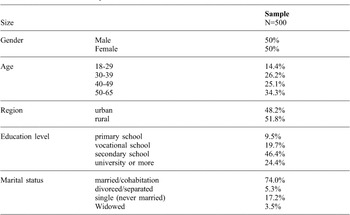
In order to establish the impact of the origin of chicken meat on valuing a brand and other features of chicken meat with consumers, we conducted quantitative market research. The research was conducted in Slovenia, which has a long tradition of chicken meat production and consumption. The method used for interviewing was a personal interview, accompanied by a structured questionnaire. The 500 person research sample that we used was representative regarding age, which ranged between 18 and 65 years, gender, region, and the population settlement type in Slovenia. The sample was drawn from the pool of respondents by way of a questionnaire, and was a random sample selected at household levels. The research included respondents that consume fresh chicken meat at least once a month and that have already heard of the chosen brand of chicken meat. The number of males and females were balanced accordingly: 50% of the consumers were males and 50% females. More than 50% of the respondents fell into two age groups, namely from 30 to 39 years of age (26.2%) and from 40 to 49 years of age (25.1%). These two groups were followed by the age group between 50 and 65 years of age (34.3%) and the age group including the youngest participants of the research aged from 18 to 29 years (14.4%). The majority of the respondents held secondary school (46.4%), 24.4% of the respondents had university and post-graduate degrees, while 19.7% of the respondents had vocational school education and 9.5% of the respondents had primary school education. Table 1 shows socio-demographic properties of the respondents, who participated in the research, conducted in Slovenia.
Structure of the sample.

Questionnaire
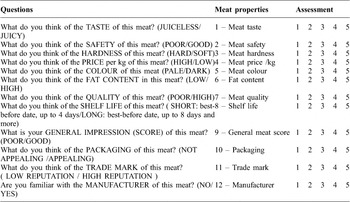
A questionnaire, consisting of twelve questions, was developed to collect the data for this study. All questionnaires carried a stamped number for the purpose of adding factual consumer data. The participants answered the questions listed in Table 2. Variables representing separate questions were scored by Likert's scale, where 1 is the least desirable property and 5 represents the most desirable property. The first nine questions were answered in a ‘blind’ test (Test 1). The last three questions (packaging, trade mark and manufacturer) were answered where the meat of known/visible COO was tested (Test 2). A Latin square design was used for rotating the questions (see details about Latin square design in Gacula and Singh, Reference GACULA and SINGH1984). The questionnaire was designed with the help of findings from a preliminary focus-group interview, in order to lend greater validity to the terms used.
Questionnaire used in the research.

In the frame of the quantitative research, two tests were performed: one blind and one with the known or visible origin of chicken meat. In the both tests the participants tasted three meat samples and evaluated their properties. The questions relating to this were selected beforehand, and evaluated how much each individual preferred certain chicken meat properties. The questions were processed by the Latin square technique, which is usually used in the social and behavioural sciences, and nullifies the impact of the sequence of stimuli presentation. Meat samples of three European producers, in direct competition with each other, were included in the research. The properties of chicken meat, evaluated in the research by the respondents, are presented in Table 3.
Properties of chicken meat - whole chicken samples, evaluated in the research.

The respondents first tasted the meat A sample and evaluated nine properties. After neutralizing the taste, they tasted the meat B sample and evaluated nine properties. They again neutralized the taste by a sip of water and at the end tasted the meat C sample and again evaluated the nine properties (sequence of the samples A–B–C). At the end of this test phase each of the respondents also answered the question: which meat sample is of Slovenian origin?
Properties evaluation of the selected chicken meat samples in the second phase, with a known /visible COO, was performed in the same way. Additional three properties (packaging, brand reputation and product manufacturer) of the original package of the evaluated sample were included in this test. All the participants in this research tasted the same piece of meat in both tests (either white or red meat of the whole chicken), therefore, an optimal comparison of the property assessments between the three grading samples was assured. Before the research was implemented we cooked all the three samples of chicken meat in the oven, all samples being exposed to the same cooking method. The duration of filling in the questionnaire was 15 minutes on average. A sample of the evaluation form is presented in Table 4.
Data obtained by the evaluation form were calculated by the SPSS statistics program. Repeated measures within analysis of variance were used for data analysis. By processing our data, frequency distributions, their shares expressed in percentage, variance analysis, t-test, and basic as well as bivariant data comparison were elucidated. Nine dependent variables (chicken meat properties) of three independent variables (group, product sample and test type) were observed in the research. In this case, there were more dependent variables which needed observing at the same time. For this reason, a multiple analysis of variance was suitable as it enables more varieties to be included (multivariate technique). The second property of the model was repeated measurements. This was the reason why the multiple analysis of variance for repeated measurements was selected.
Survey findings
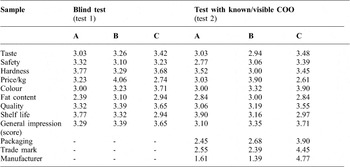
In this part of the research the basic descriptive statistics which are helpful for interpretation are listed. The results of nine questions (dependent variables) in the blind trials or the results of twelve questions respectively (dependent variables) were compared in the trial with the known/visible COO. In both, i.e. in the blind trial (Test 1) as well as in the trial using a known/visible COO (Test 2), all three product samples were evaluated by a set of questions used for evaluation of likableness of a certain chicken meat property. Scores, used for preference of a certain chicken meat property, were the basis for the arithmetic mean calculation of the dependent variables. First, the arithmetic means of the scores and the standard deviation of all dependent variables and differences in scores regarding the trial were analysed. Changes in the arithmetic means of the scores for chicken meat properties and similarity of the scores regarding the evaluated product samples are presented in Table 5.
Arithmetic means of all dependent variables.

Following on from this, the differences in grading chicken meat properties are presented. By way of detailed statistical analysis it was established if information about the origin of meat had a statistically significant influence on the evaluation of the selected properties of chicken meat. There were differences between the blind trial and the trial with known/visible meat origin. The changes in average grading of the selected properties of chicken meat in the blind trial are shown in Figure 1.
The average score for the selected properties of chicken meat in blind test (Test 1).
Note:
Blind test (Test 1):
A - Italian chicken meat
B - German chicken meat
C - Slovenian chicken meat

In the blind trial (Figure 1) it was determined that the arithmetic means of the estimated samples of chicken meat products were similar for the four evaluated properties: safety, fat content, quality and general score. Bigger differences among samples A, B and C were determined in the sample C for variables taste, safety and price per kilogram. Taste and product safety for sample C (Slovenian products) were evaluated higher, while the variable price per kilogram for sample C was evaluated lower regarding to sample A (Italian origin) and B (German origin).
Blind identification of country-of-origin (COO)
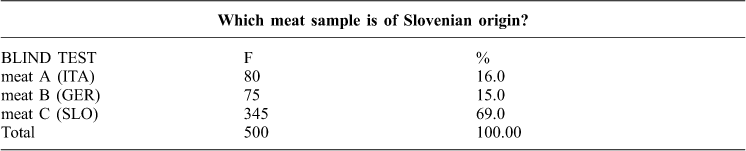
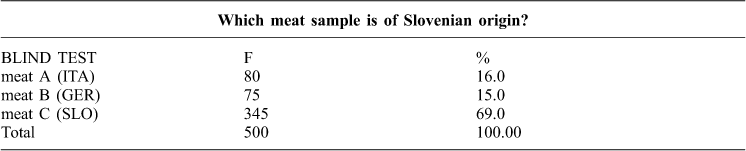
At the end of the blind trial the respondents were asked which of the samples were of Slovenian origin.
Nearly 70% of the respondents were able to identify the meat of Slovenian origin (Table 6). We assume they were led by preference and recognisable taste.
After the blind trial the respondents answered the questions regarding the property assessment of the chicken meat of the known origin. The respondents were informed about the origin of the chicken meat in separate tested samples by way of the original packaging which was, for this purpose, set on the table for each sample separately. The arithmetic means of chicken product scores from the test with the known/visible COO are presented in the following section.
Identification of the chicken meat products of Slovenian origin.
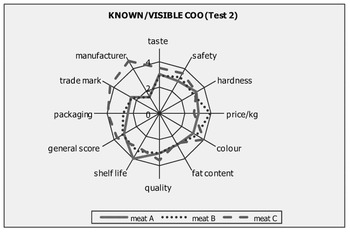
The average evaluation in the test with the known COO (Test 2).
Note:
Known/visible COO (Test 2)
A – Italian chicken meat
B – German chicken meat
C – Slovenian chicken meat

Figure 2 shows the average evaluation in Test 2 for all participants (N=500), where meat of the known origin was evaluated. The results show that the Slovenian meat was evaluated much higher than the other two meat types. The high scores originated from the manufacturer, trade mark, packaging, quality, colour and general score. High arithmetic means of the grades with the two variables - the producer and the trade mark - indicate a high recognition of the chicken meat products of Slovene origin. A high level of confidence in the chicken meat products of Slovene origin was also indicated, which is related to a high grading of product safety.
Identification of differences in packaging, trade mark and manufacturer between meat types
The circle diagram (Figure 2) shows the average values of the observed variables. In the diagram, the average values for the variables packaging, trade mark and manufacturer for the meat type C were much higher than for the other two meat types. First, the survey was concerned with whether the participants differently (statistically significantly) answered the questions when asked about different meat types. A 95% confidence interval was calculated for separate variables, which showed that the lower trust limit for the Slovenian meat (meat type C) was much higher than the upper trust limit for the other two meat types. Thus in those two questions the Slovenian meat was scored much higher than the other two meat types. This finding was confirmed by t-test (Table 7) for differences between arithmetic means of even samples (the repeated measurements).
T-test for differences between the arithmetic means in the test with known/visible COO (Test 2).

Note: DF = 999
* statistically significant at the 1% level,
superscripts denoted sig. (2-tailed) differences between the pairs
Statistically significant differences between the arithmetic means were found for all comparisons between different meat types, except for the pair A-B for trade mark and for the pair A-B for manufacturer. The latter means that the difference in the variables trade-mark and manufacturer was not statistically significant for the pair A-B. It was determined that the participants evaluated the variables packaging, trade mark and manufacturer for the Slovenian meat significantly higher than for the other two chicken meat types of foreign origin. The information on meat origin significantly influenced the evaluation of the selected properties of the Slovenian chicken meat.
Past COO studies (Bilkey and Nes, 1982; Han, Reference HAN1990) have not considered the potential influences, interactions and interrelations of factors such as COO, brand name and other product properties. Previous COO studies (Johansson et al., Reference JOHANSSON, DOUGLAS and NONAKA1985) have shown effects on consumer perceptions of product properties but they have not considered the potential influences, interactions and interconnectedness of factors such as COO, brand name and other product (chicken meat) properties. Most studies discuss products of durable goods, fewer studies relate to the field of non-durable goods or FMCG respectively.
Conclusions
Food consumption in most developed countries has attained a saturation point in quantity terms, and consumer food choices are broader than in the past. In this saturated market environment, distribution channels, marketing activities, diversification strategies, and food quality are increasingly important. In addition, consumers have become more concerned about the nutrition, health, and quality of food they eat (Radman, Reference RADMAN2005). Therefore, during the last years the production and consumption of chicken meat have increased substantially.
The field of FMCG, which is the topic of our research, is not well researched in the existing scientific literature. Some of the results of earlier research into Slovenian consumer choices (Vukasovič, Reference VUKASOVIČ2009a), showed that COO plays an important role in the buying decision process for poultry (chicken and turkey) meat. The survey of the Slovenian market showed that the most important factors influencing buying decision-making process for poultry meat were meat origin (the evaluation of significance in the decision-making purchasing process was 9.5), quality, safety, use by date, taste and price. A positive perception for poultry meat and the importance of its origin in the buying-decision process were evident from the survey, and knowing meat origin played a key role in the purchase-decision process. The origin of a product thus affects a buying decision in combination with other factors (Vukasovič, Reference VUKASOVIČ2009c).
The conducted studies to date have not researched the relations between product origin and its impact on trade-mark valuation as well as on valuation of other product properties with Slovenian consumers. The results of this empirical research confirm the interrelations and influence of product origin information (COO) on the value of other product properties by consumers. Our survey confirmed that meat origin information significantly affected the perceived value of the selected properties of Slovenian chicken meat, which was much higher than the other two meat types. The high scores came from knowing the manufacturer, trade mark, packaging, quality, colour and general score. High scores in arithmetic means related to the variables producer and trade mark, indicating high recognition of Slovenian chicken products. A good level of trust or confidence in a Slovene chicken meat was demonstrated, which was related to perceived meat quality and safety. This signified the superiority of Slovenian chicken meat and its trade mark.
All the presented findings revealed important information for both academics, researchers and practitioners. Marketing managers cannot treat COO as a self-contained marketing and communications strategy, but need to consider the effects, interactions and interrelations of other influences on consumer beliefs, buying intentions and brand perceptions. It is of utmost importance to understand the significance of product origin in the process of its perception with consumers as well as in the process of taking the guidelines or guidance criteria on future development, sales, pricing policy and marketing on the FMCG market. An increasing number of competitors and, above all, the aggressive marketing strategies of domestic retailers providing lower prices of their products oblige producers to pay more attention to total product management (care or concern for quality, safety, taste, packaging, trade mark, price, advertising) with particular emphasis on focusing on the domestic origin of a product. Consequently, consumer loyalty and a higher value of a product as well as its trade mark are being created. Moreover, the success on the market is guaranteed.