Introduction
For most of the last thirty years, since Prime Minister Zulfiqar Ali Bhutto was removed from power in a military coup led by General (later President) Zia-ul-Haq in 1977, the education sector in Pakistan has become increasingly privatized. Insofar as this push in the direction of the private sector has become more firmly entrenched, however, a deeper understanding of emerging education-sector trends has gradually come to rest upon a deeper understanding of the underlying pressures associated with local consumer demands. Earlier research has revealed that religious education plays an important role in the context of these demands.Footnote 1 And, yet, within this demand-driven push for a modern religious education, a closer look at the existing literature reveals that basic statistics designed to show ‘how many’ children are provided with a religious education, or ‘how much’ religious education they receive, have tended to attract far more attention than specific details regarding the content, or the quality, of that religious education. What follows is an attempt to correct this imbalance in light of more than 750 qualitative interviews conducted in various parts of Pakistan (2003–2005), drawing special attention to (a) new data regarding the shape of existing enrolment patterns (religious v. non-religious) and (b) new data regarding the content, or the quality, of local ‘religious’ demands.
This second set of concerns, regarding the ‘content’ of local religious demands, is closely related to a rapidly expanding body of literature focusing on the relationship between religion, religious education, and democracy.Footnote 2 Here, the question boils down to enduring concerns about the extent to which it might be possible for those with an interest in ongoing market-oriented reforms to work within the context of local consumer demands(that is, within the context of local demands for a sound religious education)while, at the same time, working to advance the cause of democracy. When is a modern religious education and, more specifically, a modern Islamic education also, already, compatible with terms of democracy?
In what follows, I maintain that religious responses to the question of religious and sectarian difference—that is, religious responses to the question of religious and sectarian pluralism—lie at the very heart of this issue. Many of those I met in the context of my interviews (2003–2005) insisted that the underlying terms of democracy and, especially, democratic ‘equality,’ would be enhanced if, in the context of a modern religious education, students were instructed to move beyond the terms of ‘diversity’ in an effort to illuminate and, in due course, actually embrace the terms of religious or sectarian homogeneity, solidarity, unity, conformity, or consensus. In effect, they argued, the terms of democratic ‘equality’ would require an effort to ‘overcome’ the specific terms—indeed, the very existence—of diversity: e pluribus unum (out of many, one). There were a few, however (approximately 8 percent of my sample; N = 794), who, in the context of my interviews, appeared to embrace a rather different view. This group—in effect, the pluralism-friendly minority—argued that the underlying terms of democratic equality could be enhanced even without this move in the direction of religious (or sectarian) homogeneity. In effect: in uno plures (in one, there are many).Footnote 3 These are in fact the competing approaches to religious education, religious and sectarian diversity, and democratic equality that I aim to introduce, and examine, in the context of this article.
Given the nature of local consumer demands in Pakistan, I argue that future efforts to combine the terms of Islam, Islamic education, and democracy will not involve any effort to move away from the terms of a modern religious education. Instead, I argue, these efforts will involve an attempt to move toward what is, at the moment, a minority understanding of that education—one that seeks to acknowledge and, in due course, actually embrace the underlying terms of religious pluralism and sectarian diversity: in uno plures (in one, there are many). The question that frames my work, in other words, is not whether religious education is valuable for those with an interest in embracing the terms of democracy, but rather, simply, how this education might begin to appreciate the terms of difference, diversity, and (within this) the terms of ongoing political debate.
The structure of this article stresses two main questions. The first section, entitled ‘Who Studies Where?’ draws attention to the link between local consumer demands and the nature of persistent demands ‘in favor of religion.’ The second section, entitled ‘Who Studies What?’ takes up the competing views of pluralism and equality mentioned above (e pluribus unum v. in uno plures). Here, the challenge of pluralism and diversity within Islam (for example, sectarianism) is given special attention. What are the implications of this challenge—this challenge of internal (sectarian) diversity—for those with an interest in bridging the gap between Islam, Islamic education, and democracy? Can the terms of a modern religious education contribute to the construction of such a bridge? And, if they can, how should they be encouraged to proceed?
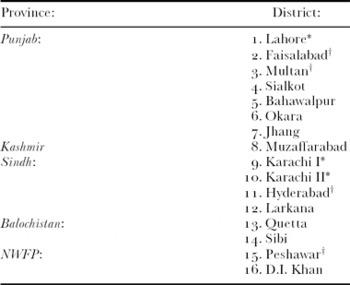
Field Research (2004–2005): Districts.

Note: ** Urban A: 5 million +
* Urban B: 1–5 million
Local Educational Demands (Religious vs. Non-Religious): Who Studies Where?
During the summer of 2003, and then again in 2004–2005, I worked with two research assistants from Lahore to interview (and videotape) the parents of roughly 3,500 school-aged children throughout Pakistan. In 2003, these interviews were used to document the nature of local educational demands in and around the district of Rawalpindi. In 2004–2005, this effort was expanded to include sixteen districts nationwide.Footnote 4
In each district, we interviewed 40–50 respondents, including a mix of men and women, rich and poor, educated and illiterate, Muslim, non-Muslim, Sunni, Shi'a, and so on, along with several different sectarian sub-groups (Ahl-e-Hadith, Deobandi, Barelwi, etc.). As compared to the population as a whole, our sample of 794—each of whom represented an average of 4–5 children—was biased in favour of (a) urban respondents, (b) male respondents, and (c) those with slightly higher levels of education. This bias was not intentional. But in the analysis of our data, this bias was important; in fact, when it came to specific questions regarding the meaning of ‘a good education,’ male respondents (as a group) tended to be slightly more conservative than those living in urban areas and those with slightly higher levels of education. Indeed, competing biases within our sample (for example, conservative male respondents versus progressive urban respondents) made for robust ‘aggregate’ data that, nevertheless, require careful scrutiny.
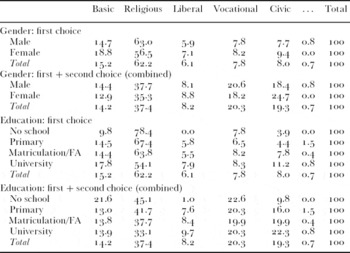
Regarding the nature of local consumer demands, for instance, we asked our respondents to identify their top two educational priorities from a list of five options—options that included (a) basic education, that is, basic literacy, (b) religious education, (c) vocational education, (d) liberal education, that is, education focused on the development of critical thinking skills, and (e) civic education.Footnote 5 In response, we found that ‘religious’ education was selected nearly twice as often as anything else, particularly among local men and those with lower levels of education (see Table 2, below). In fact, overall, we found that more than 62 per cent of our respondents identified religious education as their ‘top’ educational priority.Footnote 6
Educational Preferences: Religious v. Non-Religious.

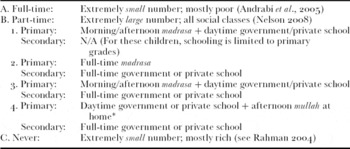
Even if it's true that most parents are strongly inclined to stress the merits of a sound religious education, however, we also noticed that the overwhelming majority do not approach their educational options (for example, religious v. non-religious education) as a zero-sum game. Instead, we found that most families are inclined to construct a careful balance of sorts, including both types of education at the same time. In fact, existing attachments to religious education notwithstanding, most parents do not seek to educate their children exclusively in a local maktab (mosque-based school) or madrasa.Footnote 7 On the contrary, most children are simply expected to attend more than one school at the same time, usually traveling to their local maktab or madrasa before (or after) their ‘regular’ school day.Footnote 8
The importance of this pattern—this pattern of ‘part-time’ enrolments—is almost impossible to overstate. In fact as my research unfolded in various parts of Pakistan, I discovered that ‘part-time’ enrolments were extraordinarily important for those with an interest in religious education broadly defined.Footnote 9 In particular, I found that multiple (overlapping) educational priorities had come to be associated with multiple (overlapping) enrolments. In other words, while it may be true, as a popular World Bank study pointed out, that the number of students enrolled in their local madrasa on a ‘full-time’ residential basis is (for the most part) extremely small—less than 1.5 per cent of the total student population—the total number of students who receive a maktab or a madrasa-based religious education on a ‘part-time’ basis is, in fact, extremely large.Footnote 10
Local attachments to religious education, in other words, do not express themselves in terms of aggregate full-time enrolment data. Instead, they emerge in the form of specific part-time data—data that, I would argue, remain woefully under-represented in the literature regarding religious education in South Asia as a whole.
This is an important point to keep in mind because, more often than not, scholars have turned to quantitative data regarding ‘full-time’ enrolment patterns—for example, in the context of private local madrasas or elite English-medium schools—to establish or explain larger political trends, trends that push in the direction of (secular) ‘democracy’ or (religious) ‘extremism.’ The underlying conclusion is of course rather familiar: ‘more’ religious education is said to be associated with ‘more’ religious extremism, less religious education is said to produce less extremism, and so on—not only at the level of individuals, but also in aggregate terms, for instance, in the Northwest Frontier Province as a whole, where ‘more madrasas’ are said to produce ‘more extremism’ and, in due course, more unrest, instability, and violence. Indeed, this approach to existing (full-time) enrolment data has become almost de rigueur in the policy-oriented literature regarding religious education and, more specifically, Islamic education in South Asia.Footnote 11
Religious Education in Pakistan: Madrasa Enrolment Options.

*Note: Even middle and upper-middle-class children who rarely visit local maktabs and madrasas are not set apart from this larger ‘part-time’ trend. More often than not, their parents simply call the local mullah—in many cases, the mullah from their local maktab or madrasa—to teach their children at home.
In his book Denizens of Alien Worlds: A Study of Education, Inequality, and Polarization in Pakistan (2004), Tariq Rahman draws a great deal of attention to this view.Footnote 12 In particular, he notes that ‘where you study’ (on a full-time basis) tends to structure ‘how you think’ about the underlying terms of religion, religious diversity, and democracy. Those enrolled full-time in the context of their local madrasa, for instance, are said to remain considerably less enthusiastic about the notion of ‘equal rights’ for religious and sectarian ‘others’ (defined as Hindu others, Christian others, or Ahmedis) than their ostensibly less religious peers. In other words, Rahman explains, children enrolled in the context of their local madrasa on a full-time basis tend to be considerably less ‘tolerant’ and, as such, considerably more susceptible to various forms of ‘extremism,’ than those who receive their training in other types of schools.
Even as Rahman notes that full-time madrasa students tend to express higher levels of anxiety regarding the possibility of ‘equal rights’ for religious and sectarian ‘others,’ however, a thorough understanding of the link between local madrasas, their students, and the question of religious or sectarian extremism (in Pakistan as a whole) tends to remain somewhat elusive. Indeed, full-time madrasa students may express higher levels of anxiety regarding the ‘equal rights’ of religious and sectarian ‘others,’ but of course, this observation merely draws our attention back to some of the data collected by the World Bank (2005)—data suggesting that, throughout Pakistan, ‘full-time’ madrasa students continue to represent a very small portion of the total student population. In other words, full-time madrasa students may hold particular views—views that, even apart from the question of extremism or violence, many would probably be inclined to regard as incompatible with democracy—but the number of these students, defined as a percentage of ‘all students’ or even ‘students of religion’ (broadly defined), is actually rather small. In fact a closer look at all of the available data reveals that a deeper understanding of the relationship between Islam, Islamic education, and democracy, nationwide, is almost impossible to extract from any account of Pakistan's ‘full-time’ (exclusively religious) minority. For this, I would argue, a deeper understanding of Pakistan's ‘part-time’ (mixed education) majority is essential.
This is particularly true because, so far, our understanding of this mixed-education part-time majority remains deeply divided. On the one hand, of course, Tariq Rahman maintains that this mixed-education majority is relatively ‘tolerant,’ at least when compared to the ‘intolerant’ minority enrolled (full-time) in the context of their local madrasa. And yet, at the same time, Peter Bergen and Swati Pandey (2006) have pointed out that 70 of the world's 79 leading Muslim terrorists (that is, 89 per cent) were drawn from precisely this group—that is, this modern (mixed-education) majority.Footnote 13
In fact for those with an interest in developing a more refined and sophisticated understanding of the relationship between religious education, on the one hand, and extremism, or democracy, on the other, the challenge does not lie in drawing attention to, or fleshing out, the demographic extremes (defined in terms of exclusive ‘full-time’ enrolment patterns). On the contrary, the challenge lies in grappling with the divergent trajectories that exist even within what I have chosen to describe as Pakistan's modern, mixed-education majority.Footnote 14 What is the nature of the religious ‘content’ that students in this mixed-education majority encounter in the context of their religious education? And, perhaps more importantly, how does this content address the question of ‘tolerance’ vis-à-vis specific religious and sectarian ‘others’? Is this modern mixed-education majority pushed in the direction of moderation, as Rahman suggests, or militancy, as Bergen and Pandey contend? In what follows, this is the question that I will take up and address in more detail.
Religious Education and the Challenge of Diversity in Pakistan: Who Studies What?
As noted above, the nature of local educational demands in Pakistan is fairly clear. Parents are attracted to the possibility of a ‘mixed’ education that combines ‘religious’ as well as ‘non-religious’ elements. Within this context and, especially, with particular reference to the issue of religion, however, the question arises: what exactly is the nature of the religious community that most parents would like their children to join? In fact, turning to the issue of religious and sectarian diversity, the question becomes: how exactly should this issue—the issue of diversity—be examined, addressed, or explained? Do local parents believe that some of the different groups within Islam—for instance, Sunnis and Shi'as—should be acknowledged (or ignored) in the context of their children's school?
In the course of my interviews with local parents, questions regarding the status of different groups within Islam were given special attention. Should these groups be mentioned (or not) in the context of local schools? And, if they should be mentioned, how should they be mentioned?
Surprisingly, the responses that we received to such questions were not related to a general pattern in which local parents sought to reinforce specific expressions of difference. On the contrary, most of our respondents drew attention to a general pattern in which religious and sectarian differences were consistently, and repeatedly, denied. In fact, apart from occasional references to Prime Minister Zulfiqar Ali Bhutto's constitutional intervention during the summer of 1974, clearly stating that the Ahmediyya (Qadiani) community was (legally speaking) a ‘non-Muslim’ community—by all accounts, an intervention designed to appease his right-wing religious opponents—I discovered that, throughout Pakistan, religious and sectarian differences of opinion had come to resemble something like the proverbial ‘elephant in the living room.’
Everyone could see these internal ‘sectarian’ differences. Everyone could feel the mounting pressure associated with their expanding influence and importance. Everyone knew about the sectarian massacres in Sialkot (October 2004), Multan (October 2004), and Islamabad (May 2005)—just to name a few. But even so and, I would argue, in a remarkable challenge to most of the existing literature concerning the question of religious education and sectarian diversity in Pakistan, the differences themselves had become surprisingly difficult for the public at large to discuss.Footnote 15 As one of my respondents said, lowering his voice, in Faisalabad: ‘ikhtilafaat ke bare men baat kar-ke, ladai shuru hoti hai; hamen chup rahna chahiye!’ Or, ‘people fight if they talk about differences; we should just keep quiet!’
This was, in so many ways, not the response I expected. In fact the closer I came to a deeper understanding of the issues surrounding religious education in Pakistan, the more I began to see that some of the most important issues—for example, questions regarding the nature of the Muslim community and the place of ‘sectarian difference’ within that community (widely regarded as a common feature of contemporary approaches to religious education)—these issues had become remarkably difficult to articulate. They were, in many ways, almost ‘unspeakable.’
For several years, scholars like A.H. Nayyar and Ahmed Salim in Islamabad (2004) and Rubina Saigol in Lahore (1994, 2000) have attempted to break this silence, looking for ways to revisit—and, in many ways, revitalize—the study of religious ‘difference’ and ‘diversity’ in the context of local religious (and non-religious) schools.Footnote 16 In particular, Nayyar, Salim, and Saigol, along with scholars like K.K. Aziz (2004), have gone to considerable lengths to discuss the treatment of ‘Muslim’ versus ‘non-Muslim’ differences in an effort to show exactly how local schools have attempted to erase or eliminate any sympathetic appreciation for these differences, first by constructing a simple awareness of ‘non-Muslim’ others and then, in due course, by encouraging an explicit effort to erase, eliminate, or exclude these others ‘for the sake of the nation.’Footnote 17
My own interviews throughout Pakistan led me to many of the same concerns. As my work unfolded, however, I found myself returning to the question of religious and sectarian difference in a slightly different way, turning away from ‘Muslim’ versus ‘non-Muslim’ differences (that is, religious differences) toward the question of difference among local Muslims (that is, sectarian difference) instead. In fact, following up on some of the work completed by Mohammad Qasim Zaman (1998, 2002), Syed Vali Reza Nasr (2000), and Yoginder Sikand (2004), my own research drew my attention, increasingly, to the fact that many of the most conspicuous expressions of religious identity and community in Pakistan, particularly in the context of local madrasas, did not emerge from any effort to highlight or exploit the terms of ‘religious’ difference. Instead, I found, the question of ‘sectarianism’ was far more important.Footnote 18
Even here, in the context of ongoing efforts to grapple with the challenge of enduring differences within Islam (that is, sectarianism), however, the most conspicuous expressions of identity did not grow out of any explicit effort to highlight, or exploit, the terms of religious or sectarian difference. On the contrary, I found, the most conspicuous expressions tended to emerge—somewhat surprisingly—from a deliberate effort to emphasize, even exaggerate, the terms of religious (or doctrinal) uniformity.Footnote 19
The most consistent message in the context of a modern religious education, in other words, was not: ‘They're different!’ (referring, quite specifically, to the substantive differences associated with any number of religious or sectarian ‘others’). No, the most conspicuous message was exactly the opposite. The most conspicuous message targeting local students was: ‘We are, and must remain, exactly, and permanently, the same!’Footnote 20 Sunnis, Shi'as, Deobandi Sunnis, Barelwi Sunnis, Twelver Shi'as, and Ismailis, all one and the same. One faith; one prophet; one text; one way. E pluribus unum.
Indeed, as my research unfolded, I quickly discovered that it was not any specific expression of religious or sectarian difference, but rather the terms of difference itself, that left my respondents feeling uneasy and uncomfortable. In fact, I discovered, difference itself was the thing that most of my respondents had been taught to regard as undesirable, unacceptable, and, at some level, ostensibly ‘un-Islamic.’Footnote 21
Of course, Nayyar, Salim, and Saigol were not entirely incorrect in their attempt to highlight the importance of ongoing educational efforts to construct and then eradicate specific notions of ‘otherness.’ They simply highlighted the rhetoric of eradication as religious expulsion over and above the far more prominent rhetoric of eradication as religious and sectarian assimilation. The former, if you will, pushes ‘others’ away. The latter pulls them in. And, as my research unfolded, I discovered that the latter was actually far more common.
To be sure, some insist that specific efforts to downplay or deemphasize the existence of specific differences—even to the point of denying their existence—must be regarded as an indication of ‘moderation,’ particularly insofar as local Muslims attempt to deny local expressions of difference in an effort to avoid any possibility of disagreement or conflict. But in my view, these efforts to deny the existence of difference are, themselves, an important source of friction. Indeed, for those with an interest in fortifying the relationship between Islam, Islamic education, and democracy, the question becomes: what does it mean to privilege an educational approach that seeks to deny the very existence of specific ‘differences’ and, more specifically, specific ‘differences of religious opinion’? What does it mean to believe that the terms of democracy require a persistent effort, not to acknowledge these differences, but rather, simply, to ignore them—indeed, to require their eradication through some form of assimilation? What does it mean to speak of a ‘democracy’ without any appreciation for ‘difference’?
Dealing with Diversity: Sectarianism the Elephant . . . in the Living Room
The religious landscape in Pakistan is of course deeply fragmented. But in every part of this landscape I encountered an astonishingly similar trend—in many ways, a deeply assimilationist trend. Muslims in sectarian group A seek to assimilate those in sectarian groups B and C; Muslims in sectarian group B seek to assimilate those in A and C; and so on. In fact, this language of assimilation (and, more specifically, assimilation as a bid for ‘equality’)remained almost exactly the same as I began to travel from one part of the sectarian landscape to the next. Those in group A, for instance, expressed their assimilationist aspirations in almost exactly the same language as those in groups B and C (and so on). The denial of difference, in particular, remained astonishingly consistent.Footnote 22 Each group used almost exactly the same expressions to insist that, ultimately, there is ‘only one Islam.’ Any sectarian differences that might for the time being appear to exist, they noted, merely betrayed the terms of a purely temporary situation in which certain individuals simply ‘failed to appreciate’ the terms of their own (underlying) ‘equality’. In fact with utter sincerity, most of my (literate) lower middle class respondents seemed to agree upon, and then insist upon, an inherently ‘inclusive’ interpretation of Islam—one that, for all practical purposes, simply ‘excluded’ those who were, apparently, ‘not yet included’ in a particular understanding of the faith.
For those with an interest in promoting the terms of peace and social harmony, however, the implications of this religiously ‘aspirational’ language—this language of inclusion-as-assimilation bound up with the notion that, ultimately, there can be only one Islam—these implications are actually quite profound.Footnote 23 In fact the remainder of this article will take up and assess these implications in the context of two very different approaches to the question of difference in general.
The first approach, drawn from the work of scholars like Nayyar, Salim, and Saigol, maintains that, throughout Pakistan, local schools have paid ‘too much’ attention to the construction of religious and sectarian differences. Here, the terms of peace and social harmony—in effect, the antidote to this enduring preoccupation with difference—these are believed to lie in a specific effort to ensure that persistent attachments to the language of difference are diminished: e pluribus unum (out of many, one). The second approach is, of course, exactly the opposite. This approach maintains that, by and large, the problem in Pakistan cannot be defined in terms of ‘too much’ attention to specific expressions of difference, but rather ‘too little.’ In fact from this perspective, the terms of peace and social harmony are believed to expand if the terms of difference are not diminished, but rather continually, and carefully, discussed: in uno plures (in one, there are many).
In order to explain exactly how my analysis of religious education in Pakistan came to stress the second approach, defining ‘the problem’ as one of avoiding rather than exaggerating or exploiting the question of difference, however, I should turn, more specifically, to some of the (rather unexpected) challenges I faced in the context of my field research—challenges that emerged whenever I tried to ask effective questions about the notion of sectarianism, or sectarian difference, in the context of local schools.Footnote 24
When I arrived in Pakistan, I assumed that I could simply step off the bus in Karachi, Quetta, or Jhang and ask local parents to tell me about the nature of local sectarian ‘boundaries.’ I simply assumed, for instance, based on my reading of specific disputes articulated by local religious scholars (ulema) that I would be able to ask local parents to tell me how (or if) they wanted their children to hear about sectarian ‘differences of opinion’ regarding, say, the status of the first four caliphs—that is, Abu Bakr, Omar, Uthman, and Ali—or different ‘styles’ in the context of one's daily prayers (namaz).
Needless to say, I assumed too much. In fact, when my respondents were confronted with a series of ‘pre-test’ questions regarding issues as common as the status of the first four caliphs—that is, the khalifa-e-rashidun, or the ‘rightly guided caliphs’ (and the notion, typically associated with Shi'as, that the fourth caliph, Ali, was particularly important)—many of my respondents simply looked at my research team with a profound sense of concern, as if they were being confronted with a pop quiz that would decide the fate of their souls. ‘Men to aap ki baat bilkul nahin samajhta hun’, they complained. ‘Mere khyaal men, aap ko kisi maulvi se baat karna chahiye,’ or ‘I don't really know what you're talking about. You'll have to ask a maulvi about that.’
During the first two weeks of my field research, I must have gone through forty test questions, each round more refined than the one before it, to determine exactly where local parents would place the (sectarian) boundary surrounding their children's religious education:
‘Do you think that, in the context of Islamiat [Islamic Studies],’ I asked, ‘local schools should employ different teachers for different sects, or one teacher for everyone?’ Most Common Answer: One teacher for everyone.
‘Okay,’ I continued, ‘if you're a Sunni [in the case of Sunni respondents], would you be upset if your child's teacher were a Shi'a?’ Most Common Answer: Yes, absolutely.
‘Okay. Why should Sunni teachers prevail?’ Most Common Answer: Because Sunnis are in the majority.
‘Right. If the population of both groups were exactly the same, do you think they should receive exactly the same amount of attention in the curriculum?’ Most Common Answer: Yes—yes of course.
Eventually, after several false starts, I came to understand that my respondents were less concerned about the finer points of religious doctrine, ritual practice, or religious and sectarian boundaries than they were about essentialized (political) majorities—a formulation in which everyone was simply expected to favor, or promote, membership in a majority that included them. In fact, the focus was rarely placed on the terms of religious doctrine. More often than not, it was placed on the terms of religious conformity, political solidarity, community consensus, and compliance, as if the terms of ‘conformity’ and ‘majority rule’ had, themselves, come to be regarded as a proxy for religious ‘truth.’ In effect, ijma as ‘majoritarianism.’ Muslim majoritarianism here; Sunni majoritarianism there; ‘Deobandi’ Sunni here; ‘Madani’ Deobandi there—each one defined as religiously ‘superior’ for a particular group at a particular moment in time for no reason other than its role in the construction of an instrumentalised (political) ‘consensus.’
In fact, apart from the shifting terms of religious or sectarian conformity (read: majoritarianism set apart from any specific attention to the question of minority rights), the finer points of Muslim discourse were generally regarded as elite matters, better left to those with knowledge and understanding—that is, quite literally, the ulema. At the very least, I found, most people were inclined to leave enduring matters of religious ‘discussion’ or sectarian ‘debate’ to those who had read the Qur'an in a language they could actually understand—an experience that, owing to a set of highly regarded pedagogical traditions associated with the memorization of the Holy Qur'an in Arabic, most of my respondents had never actually had.
As I was running out of pre-test questions, however, it dawned on me that, even as I was trying to sketch out the boundaries of a particular sectarian elephant, looking for specific and illuminating comments regarding the substance of specific sectarian differences, my respondents were simply on a different page. It isn't that they were oblivious to the existence of substantive sectarian differences. On the contrary, they simply didn't feel that they were in a position to discuss these matters in any great detail. In fact for all practical purposes, questions of religious and sectarian difference for most people boiled down to a rather familiar question of religious ‘conformity’ versus kufr (infidelity), Muslims versus murtadd (apostates), solidarity versus ‘sin,’ and so on.Footnote 25
As noted above, the sectarian massacres in Sialkot, Multan, and Islamabad were no secret. But for so long, there'd been an effort to keep up appearances. In fact, even as the ‘elephant,’ representing the problem of sectarian difference, began to rear its head in violence, it remained extremely difficult for the overwhelming majority to discuss. Efforts to keep up the appearance of solidarity, conformity, and consensus remained firmly entrenched. Indeed, I soon began to realize that relentless efforts to stress the terms of religious and sectarian homogeneity and consensus over the course of several decades had actually truncated my respondents’ ability to grapple with the question of religious difference in specifically religious terms.
As Khaled Ahmed pointed out in his round-up of the Urdu press for The Daily Times in Lahore (May 2006), ‘sectarian conflict is routinely denied by all concerned, as if an admission of it would destroy Islam.’ ‘All mullahs do it,’ he added, ‘but so do most citizens.’Footnote 26
Dealing with Diversity: Sectarianism the Elephant . . . Goes to School
Again and again, in the context of my fieldwork, my research team was informed that ‘a good education’ is a ‘mixed’ education—one that, apart from providing a thorough grounding in non-religious subjects like English, Urdu, mathematics, and the natural sciences, must teach children to follow ‘the example of the Prophet.’ This of course made a great deal of sense, but the more we asked about this focus on ‘the example of the Prophet,’ the more we found that most people were simply unprepared to provide very much in the way of specific details. In fact, every individual in every sectarian community seemed to articulate exactly the same relatively undifferentiated desideratum: every individual was expected to become a perfect reflection of the Prophet himself. ‘Out of many, out of millions,’ they said, ‘one perfect example.’ One prophet, one faith, one practice, one way: e pluribus unum.
Again, this isn't to say that religious or sectarian differences had been eliminated; on the contrary, they simply weren't discussed. When our respondents pointed out, for instance, that ‘a good education teaches children to follow the example of the Prophet,’ the overwhelming majority were not saying that ‘good Muslims follow the example of the Prophet, but they do so in a variety of different ways.’ No, this would have involved an effort to ‘acknowledge the elephant.’ Indeed, this would have involved an effort to acknowledge local differences. Instead, most were inclined to believe that ‘all good Muslims interpret the example of the Prophet exactly as I do.’ The notion that different Muslims might live, as Muslims, in more than one way, in keeping with their position as individuals (or the expositors of a specific interpretive account), this notion remained largely taboo.Footnote 27
As one respondent said, summing up the substance of this majoritarian view with specific reference to the problem of equality: ‘Jab sab bilkul ek jaise hain, to sab baraabar hote hain. Jhagda ka matlab jaahil hai.’ ‘When the community is united/when everyone is exactly the same,’ he argued, ‘equality is enhanced.’ ‘Difference,’ he added, ‘implies disagreement [jhagda], and disagreement implies a deep lack of religious understanding [jahiliyya].’ As a matter of fact, he noted, the language of local Muslims was actually a language that people around the world had come to regard as deeply familiar—even favored. This language, he noted, was, first and foremost, a language of ‘equality.’ Indeed the language of local Muslims was not a language of difference. Instead, it was a language of equality—equality as similarity, homogeneity, identity, harmony, and consensus.
Eventually, as our interviews drew to a close, we asked our respondents to address a series of five rather critical questions, questions designed to find out exactly how local parents—rich parents, poor parents, middle-class parents, Muslim, non-Muslim, Sunni, Shi'a, and so on—understood the content of their children's religious education vis-à-vis the question of religious and sectarian difference. Did local parents feel that the notion of equality required local students to move ‘beyond diversity’ (e pluribus unum) or not (in uno plures)?
First, we asked our respondents whether the curriculum for Islamic Studies should ‘mention’ some of the different groups within Islam—for example, Sunnis, Shi'as, Deobandi Sunnis, Barelwi Sunnis, and so on. Fully two-thirds of our respondents (from a low of 52 per cent in Balochistan to a high of 89 per cent in Azad Jammu and Kashmir) revealed an attachment to the notion of equality-as-homogeneity, arguing that ‘these differences within Islam should be ignored’ before adding something like ‘it's not necessary to mention these things,’ because ‘there is only one Islam.’
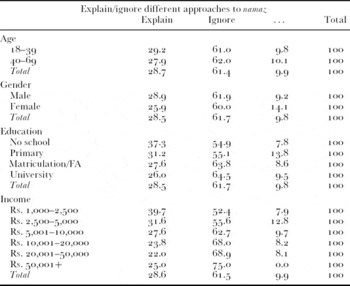
We then proceeded to ask a slightly more specific question to solicit the same type of information. ‘Everyone knows that different Muslims say their namaz in different ways,’ we noted. ‘Sunnis have one style; Shi'as another.’ Then, having established that this was in fact the case, we asked our respondents whether the syllabus for Islamic Studies should attempt to explain these differences or ignore them. Again, about 62 per cent said that these differences should be ignored, noting that all students should be expected (even required) to say their prayers in exactly the same way.
In the next question, we concentrated, more directly, on the views of those who said that religious education should ‘ignore’ sectarian differences in the performance of namaz. If sectarian differences were ignored, we asked, how should the terms of namaz be explained in their children's schools? ‘If everyone thinks that their style is the correct style,’ we'd say, ‘how should disagreements be resolved?’
At this point, you can literally see individual respondents (on film) struggling to come to grips with the implications of sectarian difference. Most appeared profoundly vexed. Eventually, however, most people came up with one of two types of answers. Seventy per cent continued to insist that there should be one style of namaz for all students and, within this group, more than half said something like, ‘I don't know how to do this, but there should be one method according to the Qur'an and the hadiths [that is, the sayings of the Prophet].’ (In other words, all children should be taught to follow what they believed to be ‘the [singular] example of the Prophet Mohammad.’) The remaining 30 per cent said, ‘there should be one method, and that method should be decided by (a) the Sunni majority, (b) the ulema, or (c) the government.’
Dealing with Diversity (Part One).

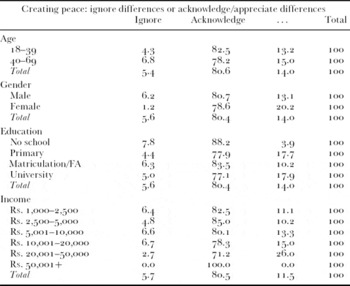
Note: When looking at these figures, it's important to keep in mind that those with higher levels of education and higher incomes are more likely to express an assimilationist view. In general, this reflects a pattern in which those with higher levels of education and higher incomes tended to believe that the majority—that is, the more ‘religious’ lower classes—would be unable to cope with a discussion of religious and sectarian differences. Interestingly, the lower classes themselves do not tend to express this view to the same extent. All groups, however, included more than 50 per cent who felt that specific differences in the context of namaz should be downplayed or ignored (nazr andaaz karna).
Finally, cutting straight to the heart of the matter, we posed an open-ended question, asking our respondents to tell us why Sunnis and Shi'as occasionally come to blows. This time, nearly 75 per cent were inclined to ignore the elephant of sectarian difference altogether (or shift the blame): ‘What are you talking about?’ they'd say. ‘There hasn't been any sectarian conflict in my area.’ Or, ‘there's really no tension [read: ‘no difference'] between them; they simply fight at the behest of local maulvis, local politicians, and (especially) foreign interlopers.’ Indeed, after noting that ‘sectarian conflict is routinely denied by all concerned,’ Khaled Ahmed (May 2006) went on to point out that, in this climate of persistent denial, ‘a kind of collective sickness [tends to] makes us blame sectarian violence on [outside agents associated with] the US and India.’ Or, as Imtiaz Ahmed explained in The News (April 2006), this ‘attitude of self-denial’ has a tendency to ‘preempt self-introspection.’ In particular, he noted that, more often than not, ‘leading clerics would have us believe that [there] is always an alien hand . . . at work’ when it comes to ‘sectarian killings.’Footnote 28
At the end of our interviews, however, we posed one last question, and this question almost invariably turned the conversation upside down. ‘If there are Sunnis and Shi'as today, and there will continue to be Sunnis and Shi'as in the future,’ we asked, ‘how should we teach our children to avoid fighting?’ ‘Should we teach them to pretend that differences don't exist—to imagine that everyone is exactly the same? Or should we teach them to acknowledge and appreciate the differences that do exist?’
At this point, roughly 80 per cent said that sectarian differences should be recognized. In other words, when confronted with the fact of difference, even conflict, and the need to address it, rather than historically dubious claims regarding the possibility of unity (at some point in the future), more than half of the 62 per cent who had originally cast their votes for similarity (‘ignore differences’) were inclined to reverse their position and cast a vote for diversity.
Moving Forward: From ‘E Pluribus Unum’ to ‘In Uno Plures’
Slowly but surely, as my research drew to an end, I began to see that Pakistan's private-sector educational marketplace is shaped by two (closely related) trends. In the first instance, existing markets are shaped by local demands for a modern multi-faceted Muslim education, one in which religious education plays an important and persistent part—in many ways, the first among several equal parts. In the second instance, however, existing education-sector markets appear to be shaped by a persistent push in the direction of religious or sectarian homogeneity. In fact, among those I met, in the context of my research, homogeneity is often believed to be the most appropriate expression of a modern Muslim identity, such that, for most of my respondents, what would ordinarily be considered standard market regulations designed to protect and preserve the terms of local market ‘diversity’ have come to be regarded as ‘an affront to Islam itself.’
Dealing with Diversity (Part Two).

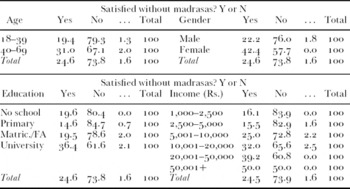
Educational Preferences: ‘Madrasa’ v. ‘No Madrasa’ (Footnote 3):

Insofar as this is the case, however, the underlying parameters of the educational landscape in Pakistan become fairly easy to discern: on the one hand, market structure (and market demands) and, on the other, local values. The first aspect (market structure/market demands) was described in Part I (above). The second, focusing, specifically, on the value of conformity and ‘the singular example of the Prophet’ (local values) was discussed in Part II. In the end, however, the underlying thrust of my argument comes to rest on an account of the combined effect of these two elements: (a) market structure and (b) local values.

Briefly stated, the educational landscape in Pakistan appears to combine an appreciation for two closely related processes—on the one hand, the emergence of market-oriented forces that compel each educational ‘firm’ (for example, each madrasa) to expand its ‘market share’ (up to, and including, the pursuit of a ‘monopoly’); and, on the other, an appreciation for ‘the unity, the equality, and indeed the stability’ that this emerging ‘monopoly’ could be said to represent.
In fact as my research unfolded, I began to see how the quest for monopoly control that emerges in the context of a contemporary private-sector religious education is, ultimately, a quest that derives its core support, not merely from the fact that leading madrasas are committed to the creation of religious, sectarian, or doctrinal ‘monopolies’, but rather from the widely held notion that ‘monopoly control in the context of religious education’ amounts to a good thing. Indeed, as my work progressed, I discovered that this push for monopoly control—indeed, this push for a monolithic conception of Islam—was generally regarded as a push for unity, harmony, stability, and a particular conception of ‘equality’ (e pluribus unum) as opposed to, say, ‘fragmentation’ or fitna (chaos).Footnote 29 And of course, insofar as this was the case, efforts to push in the direction of monopoly control tended to enjoy wide (and growing) support—even in the context of several different and, indeed, several otherwise competing local (sectarian) groups. Each group, as it were, simply expected to establish its own ‘true’ monopoly.
Conclusion
Economists with an interest in market forces typically argue that the terms of social harmony are less dependent on the creation of a homogenizing monopoly than the persistence of variety and diversity. In fact, they note, anti-trust regulations are generally regarded as desirable insofar as they attempt to limit the strength of some market actors for the sake of the market as a whole. Unfortunately, this logic appears to become less and less attractive as we begin to shift our attention away from local ‘markets’ toward ‘the nation’; indeed, when it comes to the nation and, for that matter, the ummah as a whole, appeals for market-oriented diversity appear to run into all kinds of resistance, with many remaining firmly convinced that diversity-enhancing regulations merely enhance the destructive terms of ‘competition’ at the expense of some larger community ‘whole.’
Significantly, the terms of ‘monopoly control’ in Pakistan have come to be regarded as the most appropriate expression of core ‘religious’ values by a sizable Muslim majority. In fact, for many different sections of this majority, religious and sectarian ‘diversity’ (ikhtilaaf) have come to be regarded as, for all intents and purposes, ‘religiously anathema.’ Precisely insofar as this is the case, however, the terms of pluralism, as a common feature of democracy, appear to face a number of rather serious constraints. Indeed the question arises: how might those with an interest in bridging the gap between Islam, Islamic education, and democracy begin to address this attachment to the language of monopoly even within the context of a modern Muslim education?Footnote 30 Is it possible to engage local demands for a modern ‘religious’ education while, at the same time, finding ways to appreciate, and perhaps even promote, the terms of religious difference, sectarian diversity, and modern political debate?
In its most recent White Paper regarding education (December 2006), the Government of Pakistan noted that, in the context of ongoing educational reforms, public-sector schools should, in the course of constructing new syllabi, seek to avoid what the government described as religious or doctrinal ‘details’ if these details' are known to be divisive.’ In particular, the government asserted that, across existing curricula, Pakistani ‘textbooks must never foster, or lead to, sectarianism.’ ‘All divisive material,’ the government explained, ‘[must] be weeded out of the national curriculum and [each provincial] textbook.’Footnote 31
This was of course an astonishingly familiar refrain. In fact, for all intents and purposes, the Government of Pakistan merely succeeded in reinforcing the language of the private sector and, within this, the language of local educational demands—in effect, the demands of those (namely, the majority) who sought to ignore the terms of religious and sectarian difference in favor of a persistent appeal for unity, conformity, and consensus: e pluribus unum (out of many, one).
Moving beyond the homogenizing aspirations of this demand-driven majority, however, I found that, on the margins, the language of monopoly did not persist entirely unopposed. On the contrary, as my data clearly reveal, ‘exceptional’ cases remained. To be sure, the views expressed in the context of these exceptional cases were, themselves, quite mixed. In fact most of those who said that religious and sectarian differences should be acknowledged (as opposed to ignored) in the context of local schools went on to say that these differences should be acknowledged only in an effort to expose local children to ‘that which must be avoided.’ In other words, even apart from the majority 62 percent who felt that religious and sectarian differences should be ignored altogether, an additional 29 percent felt that these differences should be mentioned only in an attempt to insure that local children would be prepared to recognize (and, in due course, presumably, avoid) specific expressions of difference.
There was, however, one set of exceptional cases that seemed to depart, quite dramatically, from this rather deeply embedded trend. This category, representing just 8 percent of the total, appeared to articulate an entirely different language—one that, I believe, points to the construction of what Martin Marty (2005) has described as an expression of religiously informed civic pluralism.Footnote 32 ‘There is, of course, only one Islam,’ explained one member of this rather exceptional 8 percent. And of course, he noted, ‘there is no god but God.’ But even so, he declared, coming closer to his main point, ‘there may be many different ways to find Him.’ In fact, he noted, drawing special attention to the terms of a commonly cited (but deeply contested) hadith, ‘the differences within Islam are, themselves, an important blessing.’ ‘Iktilafaat hamaare, vo bhi Allah ki rehmat hoti.’ ‘These differences [within Islam],’ he said, ‘these differences are also a sign of God's grace.’Footnote 33
In Pakistan, private-sector educational demands appear to reflect a persistent set of demands ‘in favor of religion.’ But more often than not, these demands appear to be expressed in a language of religious ‘uniformity’ and, ultimately, a language of unbending ‘monopoly’ control. The challenge, I argue, does not involve any effort to move away from these demands ‘in favor of religion.’ Instead, it involves an effort to preserve a specific appreciation for these demands while, at the same time, addressing their allergic reaction to—in effect, their persistent denial of—the terms of ‘difference’ within.
Throughout Pakistan, many insist that the terms of democratic ‘equality’ cannot be combined, or reconciled, with the terms of religious and sectarian ‘diversity.’ In fact, in an ideal sense, most of those I met appeared to favor the construction of a ‘democracy without difference.’ Those who disagree, I discovered, tend to represent a rather small minority. But as my work progressed, I began to realize that the religious and political importance of this minority should not be underestimated. Indeed, those who succeed in apprehending what I have chosen to call ‘the [sectarian] elephant in the living room’ represent an important religious and political alternative—an alternative that, I believe, remains in a far better position to address the fact of sectarian difference while, at the same time, working to avoid its most fearsome, and destructive, effects.
Acknowledgements
The author would like to thank the following individuals for their help with this project: Christopher Candland, Mohammad Maqbool Illahi, Erik Jensen, and Mohammad Riaz. Earlier versions of this paper were presented at the School of Oriental African Studies (SOAS), London, the University of California, Berkeley, the International Research and Exchanges Board (IREX) in Washington DC, and the annual meetings of the Association of Muslim Social Scientists, the British Association of South Asian Studies, and the Association for Asian Studies.