I. INTRODUCTION
African poverty and stagnation is the greatest tragedy of our time. Poverty on such a scale demands a forceful response. And Africa—at country, regional, and continental levels—is creating much stronger foundations for tackling its problems.Footnote 1
Following the end of the Cold War, the division between developed and developing countries has marked the deepest rift in the contemporary international system. More than 80 per cent of the world's population lives in over 100 developing countries that produce less than 20 per cent of the world's products and services.Footnote 2 Development economists and policy-makers have used different expressions to describe this divide: ‘unimaginable’,Footnote 3 the ‘greatest single problem and danger’ confronting the century,Footnote 4 ‘the greatest scandal of our age’,Footnote 5 and so on. The question of what factors account for this gap is fundamental; according to Rodrik and others, ‘it is hard to think of any question in economics that is of greater intellectual significance, or of greater relevance to the vast majority of the world's population.’Footnote 6
Although there are some controversiesFootnote 7 about the role of international trade in economic growth,Footnote 8 its potential contribution is acknowledged even by scholarsFootnote 9 and Non-Governmental Organizations (NGOs)Footnote 10 that are often critical of the current state of economic globalization.Footnote 11 It has been demonstrated that engaging in world markets is vital for overall economic development.Footnote 12 Indeed, trade liberalization has been a key part of the policy prescriptions often made by international financial institutions to support economic development.Footnote 13
Partly as a result of these prescriptions and the accepted wisdom that they represent, many African countries have progressively undertaken significant trade liberalization measures unilaterally or through the General Agreement on Tariffs and Trade (GATT)/World Trade Organization (WTO) process or via the structural adjustment programmes of the International Monetary Fund (IMF) and the World Bank.Footnote 14 This has not, however, prevented the African Continent from falling further behind the rest of the developing world.Footnote 15 On the contrary, World Bank research shows that Africa's share of world exports has dropped ‘by nearly two thirds in three decades: from 2.9 percent in 1976 to 0.9 percent in 2006’.Footnote 16 As a result, Africa has become increasingly marginalized in world trade.Footnote 17
African countries face serious impediments in their effort to use international trade as an instrument of long-term economic development. In order to assess the extent of this challenge, we have studied closely the export performance of the livestock sector in seven countries in the Horn of Africa.Footnote 18 These countries are among the poorest in the world, but they have a large livestock resource with a recognized potential to supply the world market.Footnote 19 This potential, however, remains unrealized.
There are several explanations for this mismatch between Horn countries' comparative advantages and their trade performance, but one thing is clear: trade in livestock products poses serious risks to human and animal health—a sensitive issue in any country—and such trade is highly regulated. Foreign products in particular are vulnerable to public-health-motivated sanitary import barriers; they can penetrate a market only if they meet the relevant sanitary standards of the importing country.Footnote 20 This will depend to a significant extent on the exporting country's institutional capacity (internal factors), namely the quality of its regulatory framework, the type of product and process standards in place, the capacity of government institutions to enforce compliance with standards and the credibility abroad of the certificates they issue. However, the success of domestic institutions also depends on the nature, stringency, complexity and stability of the sanitary standards in foreign countries (external factors).
The development literature employs various theoretical approaches to understand and explain lack of economic development;Footnote 21 this article takes an institutional approach to examine the failure of Horn countries to translate their comparative advantage in the livestock sector into export-led growth. The institutional perspective emphasizes the role of domestic institutions in economic development as well as the links between institutional quality and capacity to trade. We use institutional analysis to explore three issues: first, the role of domestic institutions in export-led development; second, institutional quality in Horn countries; and, finally, the potential of international law to address national institutional capacity challenges in Horn countries.
The interaction between the external and internal factors is critical in this analysis. We examine the external factors using specific examples of sanitary measures that affect livestock exports, along with the animal disease or other health concerns that they are meant to address, and how they stand vis-à-vis relevant rules of international law and international standards set by scientific institutions. To assess the internal factors, we have collected information on relevant national laws, policies and enforcement capacities of the Horn countries through field research in the region, which included visits to five of the seven countries, face-to-face interviews with government officials, livestock producers and traders and other stakeholders, and a review of official documents.Footnote 22 In order to set the livestock-specific observations in their broader institutional context in these countries, we also consider three major indices compiled by the World Bank, Transparency International (the global civil society organization leading the fight against corruption) and freedom House (the civil society organization that campaigns for the expansion of freedom, democracy and human rights). We then examine the interaction of the external and internal factors with an institutional lens.
The article is structured as follows: section II presents the central tenets of the New Institutional Economics (NIE) theory. Section III introduces the basic facts regarding the national economies and livestock resources in Horn countries and the attempts of these countries to utilize their comparative advantage in this sector as an instrument of export-led growth, and concludes that Horn countries have enormous livestock resources but sanitary measures pose a considerable impediment to their ability to export. Section IV presents a brief overview of the international regulatory terrain in which national sanitary measures operate, focusing on GATT/WTO law, and demonstrates that most of these restrictive national measures are likely to be compatible with WTO law. Section V assesses the state of domestic institutions in Horn countries on the bases of national indicators in relevant global indices and our own field observations. This analysis reveals that Horn countries suffer from weak institutions, poor commitment to the rule of law and pervasive corruption, and that the livestock sector suffers as a result. Our conclusions in Section IV (that most national sanitary measures are likely to be WTO-compatible) and section V (that Horn countries lack the necessary institutional capacity to meet external sanitary requirements) raise a daunting question: what measures are required to promote Horn institutional capacity to a level where it can meet international sanitary requirements? Section VI attempts to answer this question from the perspective of international law and institutions. It concludes that international law cannot be expected to generate swift and substantial institutional changes at the domestic level. However, international legal rules and institutions may contribute to this goal by promoting the rule of law and tackling corruption, supporting national capacity-building (both technical and financial) related to sanitary standards and facilitating regional cooperation. Section VII provides a summary of our conclusions.
II. THE NEW INSTITUTIONAL ECONOMICS APPROACH TO ECONOMIC DEVELOPMENT
The effort to explain economic development,Footnote 23 or the lack of it, may be approached from several perspectives, such as the neo-liberal approach (highlighting the importance of pro-market and open trade policies),Footnote 24 the dependency theory (suggesting that underdevelopment in poor countries stems from exploitation by the rich)Footnote 25 or various state-led development approaches (underlining the need for national governments to play an active role in the economy and facilitate industrialization).Footnote 26 Recent developments in economic theory and particularly the growing influence of the NIE approach have led to significant changes in development studies.Footnote 27 NIE is ‘the branch of economics that concerns itself with the ways that economic behavior, whether by individuals or by firms, is affected by the institutional setting in which actors find themselves’.Footnote 28 It is now widely recognized that domestic institutions play a pivotal role in economic development. As Dani Rodrik put it, the quality of institutions ‘holds the key to prevailing patterns of prosperity around the world’.Footnote 29
According to Douglass North, the 1993 Nobel laureate in economics, the NIE approach does not aim to replace the widely held liberal theory; rather, it builds on, modifies and extends it so as better to address a new range of issues. The point of departure for NIE is that major assumptions of the neo-liberal theory prevail only in rare cases. Typically, transactions are not costless; individuals act on incomplete and asymmetric information; they have limited mental capacity to process information; and markets are imperfect.Footnote 30 Problems of information and enforcement underscore the need for appropriate institutions for the efficient functioning of markets as well as organizations, both public and private.Footnote 31 As the Growth Report noted, economists have now acquired ‘a deeper appreciation of the underlying institutions that make mature markets work. These institutions define property rights, enforce contracts, convey information, and bridge informational gaps between buyers and sellers.’Footnote 32
The rise of the new institutional approach has narrowed the gap between state-led development approaches and the neo-liberal approach.Footnote 33 Recent advances in development studies underline the fact that markets and institutions are closely intertwined, and that markets do not exist in a vacuum but rather require an institutional framework.Footnote 34 Indeed, empirical studies show that institutions play a determining role on aggregate income and economic performance,Footnote 35 and that the quality of domestic institutions is more important than international trade for countries' average income levels.Footnote 36
However, institutions do not function effectively in many developing countries. As noted in the Growth Report, ‘the immaturity of these institutions is synonymous with underdevelopment’.Footnote 37 Myrdal coined the term ‘soft states’ to describe countries in which rulers are unwilling to impose obligations on the governed, and the corresponding unwillingness of the latter to obey rules laid down even by democratic procedures. Many developing countries lack the capability to perform vital institutional tasks (such as coordinating functions in the private sector).Footnote 38 However, the NIE approach also has its own critics who argue, inter alia, that it tends to downplay the role of power and elevates transaction costs at the expense of other factors such as geography.Footnote 39 Critics also emphasize the reciprocal and dynamic interactions between law and economic development, as well as the manifold functions of law beyond the protection of property rights.Footnote 40
Although the term ‘institutions’ encompasses several elements,Footnote 41 this article addresses some of its core components: the rule of law and tackling corruption, property protection and government effectiveness. Recent literature stresses that corruption of government officials depresses economic growth and disproportionately burdens the poor.Footnote 42 Studies show that corruption generates ‘adverse effects on the incentives, prices and opportunities that private and public agents face’.Footnote 43 Consequently, countries with lower corruption levels tend to have higher levels of GDP per capita.Footnote 44 Corruption affects growth by changing private investment patterns (that is, an improvement in corruption increases investment), and distorts public expenditure away from growth-promoting areas (such as health and education) towards those that are less so.Footnote 45 Similarly, higher levels of corruption are associated with lower government revenues, lower expenditures on operations and maintenance, and a lower quality of public infrastructure.Footnote 46 Such negative consequences of corruption have been documented in studies on economic development in several African countriesFootnote 47 as elsewhere around the world. Corruption is by no means unique to developing countries, but it is more widespread in these countries.Footnote 48 For example, the Africa Union estimates that up to 25 per cent of Africa's gross domestic product is lost to corruption every year, amounting to US$148 billion annually.Footnote 49
NIE proponents attach particular importance to domestic legal systems. The design and functioning of legal rules and institutions are considered to play an essential part in economic growth.Footnote 50 Empirical studies have established a positive correlation between the rule of law and economic growth.Footnote 51 Scholars such as Kenneth Dam focus on the key role of property and contractual rights (and their enforcement)Footnote 52 for sustained economic development as well as that of corporate and financial laws.Footnote 53 Others underline the significance of public law and constitutional rules for long-lasting economic growth.Footnote 54
The rule of law is a complex and dynamic conceptFootnote 55 but, as Daniels and Trebilcock explain, literature on the rule of law and development has identified two principal strands: procedural and substantive. The procedural conception refers to a system in which the laws are public knowledge, clear and apply equally to everyone. This positivistic conception does not impose any particular substantive requirement regarding the content of the norms. The substantive conception, on the other hand, considers the outcomes of a particular set of rules against more absolute standards such as justice and fairness. Unlike the procedural conception, the substantive conception requires that the law be grounded in a moral framework.Footnote 56 The basic requirements for the ‘thinner’ (procedural) conception of rule of law include an independent and impartial judiciary accessible to all and applying equally to everyone (non-retroactive) legal rules made through a transparent process.Footnote 57 It is this crucial strand of the rule of law that we find missing in the Horn.Footnote 58
III. LIVESTOCK RESOURCES AND EXPORT-LED GROWTH IN THE HORN OF AFRICA: EXPECTATIONS AND DISILLUSIONS
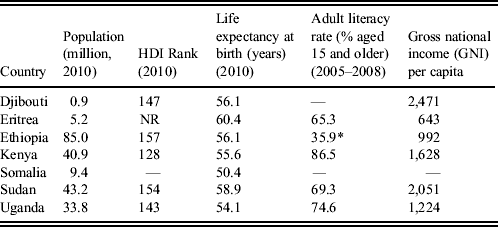
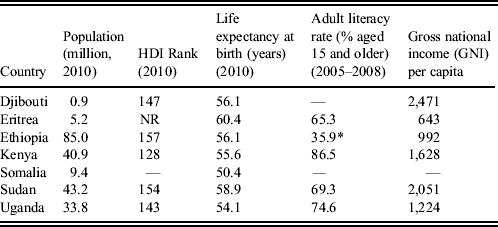
The Horn of Africa is one of the poorest regions in the world. Poverty in SSA remains ‘the highest among all regions’, and experienced ‘the largest increase in the number of people living on less than $1.25 a day, from nearly 300 million in 1990 to 388 million in 2005’.Footnote 59 The Horn sub-region is the poorest within SSA.Footnote 60 All Horn countries except Kenya are classed as Least Developed Countries (LDCs),Footnote 61 ranking between 128 (Kenya) and 157 (Ethiopia) out of 169 countries on the 2010 Human Development Index (HDI); their GDP per capita ranges from US$643 (Eritrea) to US$2,471 (Djibouti).Footnote 62 In the four-tier grouping of countries according to their level of human development (low, medium, high and very high), all Horn countries fall in the low category. Socio-economic data reproduced in Table 1 illustrate the state of these countries.
General profile and economic information on Horn countries
Source: UNDP, Human Development Report 2010.
* ‘Refers to an earlier year than that specified’ (UNDP (n 62)). The HDR then refers specifically to Ethiopia's primary school enrolment, which ‘rose from 33 percent in 1991 to 95 percent in 2007, astounding for a country with a per capita income of less than $1,000’ (ibid).
A. Livestock Production
Agriculture remains the mainstay of the economies of Horn countries, employing about three-quarters of their populations. The region is particularly well endowed with livestock resources, which account for over 57 per cent of its agricultural GDP.Footnote 63 Most of the countries in the region are highly dependent on the sector for economic growth and for the livelihoods of a large proportion of their populations. With a head count of over 98 million cattle and 173 million sheep and goats, the region has about 50 per cent of the population of these animals in the whole of SSA.Footnote 64 According to the Food and Agriculture Organization (FAO), the importance of livestock in the region is explained in part by the fact that about 60 per cent of the land is classified as arid or semi-arid, which leaves livestock production as ‘the only viable form of land use’.Footnote 65 Indeed, the region is among the lowest-cost producers of livestock in the world, owing mainly to the extensive arid and semi-arid lands that are particularly conducive to traditional animal husbandry practices and the large, unskilled labour force.Footnote 66
Different sources show that Ethiopia is the tenth largest producer of livestock in the world, and ‘by far the biggest in Africa’.Footnote 67 According to an FAO report, Ethiopia's livestock sector makes up about 18.8 per cent of its GDP and supports the livelihoods of an estimated 80 per cent of the rural poor.Footnote 68 Sudan has the second largest livestock population in Africa, which accounts for about 20 per cent of national GDP.Footnote 69 The livestock sector is even more critical in the economy of Somalia, where it employs about 55 per cent of the population and accounts for about 80 per cent of its export earnings in a normal year.Footnote 70 In Kenya, the livestock sector accounts for about 12 per cent of national GDP.Footnote 71 Uganda's livestock sector represents about 7.5 per cent of GDP,Footnote 72 while Eritrea and Djibouti have smaller livestock wealth.Footnote 73
B. The Mismatch: Export-led Growth Expectations and Disillusions
Standard international economic analysis, which emphasizes the close link between trade and economic development,Footnote 74 suggests that the comparative advantage of Horn countries in the livestock sector would enable them to export significant quantities of livestock products and use the sector as a launch pad for export-led economic growth.Footnote 75 Under this approach, international trade and increased exports enable developing countries to achieve faster and more sustained economic growth.Footnote 76 Indeed, an export-led strategy has delivered impressive results for countries such as South Korea, Singapore, Hong Kong and Taiwan within a relatively short period.Footnote 77 Thus, theoretically, the capacity of Horn countries to produce livestock products at low cost should enable them to increase their export earnings, which should in turn stimulate the expansion of output and usher in the benefits of ‘economy of scale’.Footnote 78 This chain of events should then lead to export-led growth and higher standards of living in these countries.
Several other factors support this general economic expectation. For example, geographical and cultural proximity to the increasingly affluent markets of the Middle East is likely to create competitive advantages for Horn products. Likewise, Horn countries are also, in principle, eligible to benefit from several unilateral as well as regional preferential terms of access to some of the most lucrative markets around the world.Footnote 79 The EU–ACP preferential arrangement under the Lomé-Cotonou agreements (in place since 1975), the EU's unilateral Everything-but-Arms (EBA) initiative (operative since 2001),Footnote 80 the US unilateral African Growth and Opportunity Act (established 2000),Footnote 81 and Japan's GSP scheme (active since 1971)Footnote 82 are just a few of the important ones. These considerations suggest that the livestock sector has the potential to serve as a natural point of entry into the world market for Horn countries.
In reality, however, the amount of livestock and livestock products exported from these countries remains minuscule. Getting up-to-date or meaningful data on Horn livestock exports is difficult, partly because a substantial amount of the trade takes place informally (owing to the inability of national institutions to provide the necessary regulatory control, oversight and support).Footnote 83 International Trade Centre (ITC) data on the export of the five main livestock product categoriesFootnote 84 reveal a bleak picture. With a total export value of just over US$167 million for 2008, Ethiopia is the most successful in the region, with Sudan following in second place with a total of US$101 million, and Somalia third with about US$87 million. Then come Kenya (about US$76 million), Djibouti (US$43 million), Uganda (US$34 million USD) and Eritrea (just under US$3 million).Footnote 85
Despite modest improvements in some cases recently, the quantity and variety of livestock exports, coupled with the number of destinations, have declined over the past four decades for virtually all of the Horn countries. This contrasts with the promising developments witnessed in the sector until the early 1970s, when many of these countries exported their products to European markets.Footnote 86 It is thus possible to conclude that Horn livestock exports today are small, largely limited to Middle East markets, and generally declining. The key question is why these countries have not converted their comparative advantage in this sector into export-led growth, and to what extent the international regulatory framework within which livestock trade takes place has contributed to this reality.
C. The Promise of Export-led Growth and GATT Provisions
The expectation that Horn countries would exploit their comparative advantage as an instrument of economic growth is consistent with classical international economics that emphasizes the close link between trade and development. This link is explicitly recognized in GATT article XXXVI(1)(b), which provides that ‘export earnings of the less-developed contracting parties can play a vital part in their economic development’. Based on this, article XXXVII(1)(a) thus exhorts developed countries to ‘accord high priority to the reduction and elimination of barriers to products currently or potentially of particular export interest to less-developed contracting parties’. Finally, article XXXVII(1)(b) goes further and requires developed countries to ‘refrain from introducing, or increasing the incidence of, customs duties or non-tariff import barriers on products currently or potentially of particular export interest to less-developed contracting parties’. These provisions are couched in largely declaratory and non-binding language,Footnote 87 but they contain authoritative political endorsement of the view that exports are vital for the development of poor countries.Footnote 88
As noted earlier, however, Horn countries have hardly managed to enter foreign livestock markets. Various factors may explain this fact,Footnote 89 but this section focuses on the role of the regulatory framework within which international trade in these products takes place, covering national and multilateral rules and institutions. It is widely acknowledged that export competitiveness is generally determined by three main factors: (i) domestic productivity, which determines the costs of production; (ii) trade costs, which determine the cost of exporting the good; and (iii) the effective level of market access, which is determined by the extent of unilateral, regional or multilateral trade reforms, as well as the capacity to meet standards and overcome information gaps in export markets.Footnote 90 An examination of the livestock sector in the Horn of Africa against these three determinants clearly shows that the key obstacle to increased livestock exports mainly lies in the third factor—namely standards and information gaps about export markets.
D. Livestock Products and Sanitary Measures
Livestock exports, like other products, are subject to traditional trade barriers such as tariffs and quantitative restrictions, but the main impediments to trade in this sphere take the form of non-tariff barriers (NTBs), primarily sanitary measures—that is, national rules aiming to protect the life and health of humans and animals in the importing countries. International trade in livestock products is highly sensitive to sanitary regulations, and empirical studies have established that such regulations particularly limit developing-country exports to developed-country markets. As UNCTAD underlined, the most important obstacles for LDC exports are ‘environmental barriers’, a term defined to include sanitary and technical standards.Footnote 91 Disdier and others analysed the impact of sanitary and technical measures on agricultural trade and found that developing and least developed countries are ‘negatively and significantly affected’ in their exports to OECD countries.Footnote 92 Bureau and others found that unilateral preferences granted to developing countries by the EU and the US failed to generate significant export flows from most SSA countries and LDCs owing to their inability ‘to match the technical, sanitary, phytosanitary and traceability requirements imposed by developed countries, and in particular the private standards imposed by importers and retailers’.Footnote 93 A 2005 World Bank study recognized the ‘growing concern’ that standards ‘present insurmountable barriers’ to food trade by developing countries.Footnote 94 It is thus possible to conclude that sanitary measures constitute a considerable impediment to Horn countries' ability to export livestock products to developed countries. The existing preferential market access schemes for the benefit of Horn countries do not remedy this problem; indeed, there is no sanitary equivalent to preferential treatment.Footnote 95
This is not to suggest that importing countries always use sanitary measures to disguise protectionist motives; nevertheless, where importing countries employ sanitary standards even for genuine reasons of protecting health, Horn countries often face insurmountable difficulties because of the dynamic and complex nature of the standards,Footnote 96 their diversity among importing countries and the poor technical and financial capacity within the Horn to identify those standards and work towards compliance.Footnote 97 The next section addresses the legality of these sanitary restrictions under WTO law.
IV. GATT/WTO LAW ON SANITARY MEASURES
Trade liberalization is the principal mission of the GATT/WTO system, but it also recognizes that trade is only a means to an end, that end being welfare maximization. In pursuing trade liberalization, the multilateral trading system has always been sensitive towards other public policy objectives such as food safety and the environment. Realizing the twin goals of promoting international trade, on the one hand, and protecting human, animal or plant life or health, on the other, has thus been one of the most daunting challenges for the trading system. Indeed, the trade-restrictive impact of sanitary measures has been a constant source of tension between developed countries and the poorest developing countries. The traditional propensity of most developed countries to keep their agricultural markets closed for competition often exacerbates the fear that health and safety standards could be used to disguise measures with purely protectionist motives.Footnote 98 At the same time, for many middle-income agricultural-exporting developing countries, rising sanitary standards in OECD countries are a double-edged sword: they raise the unit cost of production for their products but they also effectively drive out of the world market lower-cost competitors from the poorest countries.
The rules of international livestock trade at any particular time thus reflect the balance struck between these competing interests. This balance is subject to a perpetual process of shifts and adjustments in response to the emergence of new pathogens, advances in science and technology, popular risk perception and tolerance levels, and pressure exerted by interest groups.Footnote 99 This process of fine-tuning the balance between competing interests is discernible within the evolution of the GATT/WTO system over the past six decades, embodied particularly in GATT article XX(b) and the WTO Agreement on Sanitary and Phytosanitary Measures.
A. GATT Article XX(b)
Under article XX(b) of the GATT, countries are allowed to adopt measures ‘necessary to protect human, animal or plant life or health’ provided that such measures do not serve as means of arbitrary or unjustifiable discrimination between countries or as disguised restriction on international trade. Under this system, as long as countries are able to demonstrate that a certain measure is ‘necessary’ to achieve the specified health objectives, and the implementation of such measures passes the discrimination and disguised trade restriction tests, they can develop their measures with considerable discretion.Footnote 100 GATT article XX(b) is thus an exception that ‘clearly allowed contracting parties to give priority to human health over trade liberalization’.Footnote 101
In practice, many countries tried to justify sanitary and phytosanitary (SPS) measures on the basis of GATT article XX(b), but failed on the necessity requirement. An oft-quoted paragraph from the WTO Appellate Body (AB) ruling in Korea—Various Measures on Beef summarizes the current understanding of the term ‘necessary’ as used in GATT article XX(d), which also applies to the use of the same term under article XX(b):
Measures which are indispensable or of absolute necessity or inevitable to secure compliance certainly fulfil the requirements of Article XX(d). But other measures, too, may fall within the ambit of this exception. As used in Article XX(d), the term ‘necessary’ refers, in our view, to a range of degrees of necessity. At one end of this continuum lies ‘necessary’ understood as ‘indispensable’; at the other end, is ‘necessary’ taken to mean as ‘making a contribution to’. We consider that a ‘necessary’ measure is, in this continuum, located significantly closer to the pole of ‘indispensable’ than to the opposite pole of simply ‘making a contribution to’.Footnote 102
The AB clarified, in Brazil—Retreaded Tyres, that to be characterized as necessary, a measure ‘does not have to be indispensable’ but ‘its contribution to the achievement of the objective must be material, not merely marginal or insignificant’.Footnote 103 Furthermore, a measure qualifies as ‘necessary’ only if it is the least-trade-restrictive option available to a country to achieve its policy goals.Footnote 104 To determine whether this is the case, the AB said that the preliminary conclusion that a measure is necessary ‘must be confirmed by comparing [it] with its possible alternatives, which may be less trade restrictive while providing an equivalent contribution to the achievement of the objective pursued’.Footnote 105
In cases where respondents passed the necessity test, their defences often failed on the requirements of the chapeau of GATT article XX: that the application of such measures must not cause arbitrary or unjustifiable discrimination between countries or a disguised restriction on international trade.Footnote 106 As the AB said in Brazil—Retreaded Tyres, the requirements in the chapeau serve ‘to ensure that Members’ rights to avail themselves of exceptions are exercised in good faith to protect interests considered legitimate under article XX, not as a means to circumvent one Member's obligations towards other WTO Members'.Footnote 107
The history of GATT/WTO dispute settlement shows that it has never been easy to invoke GATT article XX(b) successfully as a justification for an otherwise illegal trade-restrictive measure. In the food sector in particular, however, this did not prevent GATT-contracting parties from using SPS measures, for protectionist ends as well as for other reasons. It is thus hardly surprising that one aim of the Uruguay Round was to minimize the adverse effects of SPS regulations on agricultural trade.Footnote 108 The resulting SPS Agreement supplemented and clarified GATT article XX(b) but also went further and imposed a ‘new and comprehensive set of rules’.Footnote 109
B. The WTO SPS Agreement
Like GATT, the SPS Agreement reaffirms that ‘no Member should be prevented from adopting or enforcing measures necessary to protect human, animal or plant life or health’.Footnote 110 This is, however, subject to a series of conditions intended to reduce the likelihood of such rights being used for protectionist purposes.Footnote 111 It does this by recognizing scientific evidence as the final test.Footnote 112 In the same vein, the Agreement also encourages harmonization of SPS measures around international standards, but again it recognizes the right of countries to set their standards at whatever level they deem appropriate, even higher than the level of corresponding international standards. In such cases, however, members must ensure that measures are, inter alia, based on a risk assessment, scientific principles and a scientific justification.Footnote 113 The resulting balance is generally perceived to be a reasonable compromise between food safety and trade interests, but the latitude it affords to the WTO members is susceptible to abuse.
Since its entry into force, the provisions of the SPS Agreement have been interpreted fairly strictly by the AB,Footnote 114 causing sharp divisions of opinion among WTO law experts.Footnote 115 From the perspective of Horn countries, the interpretation of the SPS Agreement provisions cannot be strict enough; even the strictest interpretation possible will hardly make the markets of many of the richest WTO members accessible to their products. The SPS Agreement, despite its aim to ‘minimize the negative effects of standards on trade’, still allows countries a significant measure of discretion to adopt their standards unilaterally, occasionally more restrictive ones than those recognized by international standard-setting institutions. Indeed, the AB has specifically recognized a WTO member's right to ‘determine its own appropriate level of protection to be “zero risk” ’,Footnote 116 which virtually rules out the concept of proportionality between the interest pursued (for example, 100 per cent protection from risk) and the harm that this could inflict (such as its impact on the economic condition of those countries that cannot satisfy every SPS requirement imposed in the pursuit of such goals).Footnote 117
A 2001 World Bank paper quantified the possible impact of standards on aflatoxins implemented by the EU on food exports from African countries, finding that the implementation of new standards that were higher than those suggested by the Codex Alimentarius Commission (Codex) would have ‘a significant negative impact on African exports of cereals, dried fruits and nuts to Europe. The EU standard, which would reduce health risk by approximately 1.4 deaths per billion a year, will decrease these African exports by 64% or US$ 670 million in contrast to regulation set at an international standard.’Footnote 118 A later World Bank study questioned the data and methods used in this study but, ultimately, the difference between the two studies lies in the magnitude of Africa's trade loss rather than whether Africa loses at all.Footnote 119
The WTO approach accepts the prospect that each country can have its own standards. Differing standards in different importing countries inevitably mean higher compliance cost for exporters. In recognition of these challenges, during the Uruguay Round negotiations developing countries sought to minimize the risk of SPS measures being used ‘as an alternative form of protection‘Footnote 120 by pushing for ‘the widest possible use of international standards’.Footnote 121 However, the EC and others successfully argued against binding harmonization. They contended that ‘countries which had achieved high health standards would find it difficult to accept moving to lower standards’.Footnote 122 The result was article 3 of the SPS Agreement, which sets harmonization as a goal for the future,Footnote 123 encourages members to harmonize their national standards around international standards set by three technical institutions (Codex, the World Organization for Animal Health (OIE) and the International Plant Protection Convention (IPPC)) and recognizes their right to exceed those international standards, in some cases including a right to take measures on the basis of the precautionary principle.Footnote 124 This has led to the widely shared conclusion that the SPS Agreement largely reflects the interests of developed countries.Footnote 125
The SPS Agreement also established transparency and consultation mechanisms through the SPS Committee, which serves as a regular forum for consultations and carries out ‘the functions necessary to implement the provisions of this Agreement’.Footnote 126 However, Horn interests are hardly represented in this forum. Eritrea, Ethiopia, Somalia and Sudan are not members of the WTO, and hence not members of the SPS committee, while the other three (Djibouti, Kenya and Uganda) have no active part in the work of the committee.Footnote 127 This has meant that, although Horn livestock products have faced frequent import bans of questionable legality in the past decade,Footnote 128 no Horn country has raised any specific trade concerns at the SPS Committee. It is thus clear that Horn countries are not making effective use of the institutional mechanisms of the SPS Agreement to defend their interests.
C. International Standard-setting Institutions
The WTO does not set its own product and process standards; it only sets limits to what countries may do in the establishment and enforcement of their national sanitary standards. On the other hand, WTO law gives certain legal effect to otherwise voluntary international standards set by international standard-setting institutions. The livestock industry is one in which two of the three institutions identified by the SPS Agreement directly converge—the OIE and Codex on food safety.Footnote 129 These two institutions serve a vital purpose in international trade by setting science-based standards on animal health and food safety, on the bases of which national standards can be developed and evaluated. The role of these technical institutions in international trade has always been significant, but they have become even more so since 1995 when the SPS Agreement accorded legal recognition to their standards. This section provides a highlight of these institutions and their standards and discusses their particular relevance to Horn livestock trade.
1. The World Organization for Animal Health (OIE)
Established in 1924, the OIE is a key player in international livestock trade. It was created in response to the rinderpest outbreak in Europe in the early 1920s, but its disease coverage has always been broader and open-ended.Footnote 130 While animal disease control remains its central goal, the OIE also aims to safeguard world trade by publishing health standards for international trade in animals and animal products.Footnote 131
Pursuing its philosophy that disease freedom is the best guarantee of safety, since the 1990s the OIE has developed detailed procedures by which countries or parts of them could be recognized as free of some of the most contagious and economically damaging animal diseases, becoming the only international body that can confer a disease-free status on countries or zones within countries. OIE recognition of a country or parts of it as disease-free is considered essential for it to engage in international trade; indeed this can be the single most important factor in an otherwise resource-rich country's ability to export its livestock products.Footnote 132
The OIE has so far established an official list of disease-free countries for four of the most important animal diseases—foot and mouth disease (FMD), rinderpest, contagious bovine pleuro-pneumonia (CBPP) and bovine spongiform encephalopathy (BSE). The first two diseases, together with rift valley fever (RVF), have effectively crippled Horn countries' ability to export livestock products for a long time.Footnote 133
(a) OIE standards and contagious animal diseases in the Horn
Many of the most contagious animal diseases are already endemic in the Horn. This section provides a summary of the status of Horn countries regarding three livestock diseases—rinderpest, FMD, and RVF—which are of major historical (in the case of rinderpest) and contemporary significance for the export of livestock products from Horn countries.Footnote 134
Rinderpest: for many years this was one of the most dangerous viral animal diseases, its severity persuading countries to establish the OIE in 1924. After several decades of high-level and globally coordinated effort, rinderpest is now completely eradicated from the face of the earth, with the Global Rinderpest Eradication Programme (GREP), launched in 1994 under the auspices of the FAO and the OIE, having been successfully concluded.Footnote 135 With the last known case of rinderpest occurring in Kenya in 2001, the Horn region was the only remaining area. Yet Ethiopia was declared free of infection in 2008, Kenya in 2009 and Somalia in 2010.Footnote 136 In October 2010 the FAO announced the global eradication of rinderpest.Footnote 137
Foot and mouth disease (FMD): This is a contagious viral disease that affects cloven-hoofed mammals and has a great potential to cause severe economic loss.Footnote 138 As a priority disease for the OIE, FMD was the first disease for which an official list of disease-free countries without vaccination was established in 1996.Footnote 139 The OIE has established a procedure by which a country or a zone within a country can be recognized as FMD-free without vaccination or FMD-free with vaccination. Any country or zone that does not satisfy the requirements for either of these options is considered FMD-infected.Footnote 140
To be recognized as FMD-free without vaccination, a country must have a record of regular and prompt animal-disease reporting and send a declaration to the OIE stating that there has been no FMD outbreak or infection over a 12-month period and that no FMD vaccination has been given during that period. The country must also supply documented evidence that FMD surveillance is in operation, that regulatory measures for its prevention and control are implemented and that no FMD-vaccinated animals have been imported during that period.Footnote 141 The trade reward for the costly effort to achieve FMD freedom comes in the form of lighter demands from the veterinary authorities of importing countries.Footnote 142
As of January 2011, 65 countries are recognized as FMD-free where vaccination is not practised, and one other as FMD-free with vaccination. No African country appears in either list except the islands of Madagascar and Mauritius. Botswana, Namibia and South Africa are the only African countries in a list of ten with FMD-free zones where vaccination is not practised. No African country appears in the list of six countries having FMD-free zones with vaccination.Footnote 143
The trade effects of this situation cannot be overstated. The FMD status of a country plays a decisive role in its livestock export performance. The market is effectively controlled by those countries that have acquired disease-free status. A study published by the US Department of Agriculture observed that the distinction between countries judged FMD-free and those judged not free
largely defines world trade in fresh, chilled, or frozen beef and pork. For most of the last 50 years, the FMD-free zone consisted chiefly of the United States, Canada, Australia, New Zealand, Japan, South Korea, Taiwan, and Denmark. Most trade in uncooked beef and pork occurred among these areas…Footnote 144
To illustrate, the EU does not allow imports of live domestic biungulates (such as cattle, pigs, sheep and goats) from countries that vaccinate against FMD, or where the disease is present, regardless of any preventive measures taken by the country of origin.Footnote 145 This means that no live domestic biungulates can be imported to the EU from virtually all the African continent.
Rift Valley Fever: RVF is a dangerous zoonotic disease that is endemic to the Horn region, with a ‘historic distribution’ in SSA and the Arabian Peninsula. The RVF virus was first identified in Kenya in the 1930sFootnote 146 and has since served as one of the most recurring and damaging causes of restrictions on Horn livestock exports to the Middle East and other regions.Footnote 147
The OIE has established procedures through which a country or zone may be considered free of RVF infection or RVF-infected but without disease.Footnote 148 Once again, the RVF status of a country determines the type of conditions set and information required by importing countries. A country or zone is RVF infection-free if it lies outside, and not adjacent to, the historically infected regions, or if a surveillance programme has demonstrated no evidence of RVF infection in humans, animals or mosquitoes in the country or zone during the four years immediately following an RVF epidemic. An RVF-infected country can be considered ‘RVF-disease-free’ provided that the disease has not occurred in humans or animals in the past six months and climatic changes likely to induce RVF outbreaks have not occurred during this period. Unlike the cases of rinderpest or FMD, a country is considered RVF-infected with disease only if a clinical disease in humans or animals has occurred within the previous six months.Footnote 149
The OIE maintains a list of FMD- and rinderpest-free countries, but not for RVF. This is partly a result of the low gravity of the problem at the global level, and partly because of RVF's limited historical and geographical distribution. It is clear, however, that RVF is a priority disease for Horn countries that would benefit from further research and attention from the OIE and other scientific institutions.
2. Codex Alimentarius Commission
Established jointly by the FAO and the WHO in 1963, Codex is a key player in international food trade. It was set up to implement the Joint FAO/WHO Food Standards Programme, whose purposes include protecting consumer health, ensuring fair practices in food trade and coordinating the development and harmonization of food standards.Footnote 150 With a membership of 183 countries, Codex is the principal global institution with the mandate to develop international food safety and hygiene standards.
Codex has developed over 300 product-specific and general standards, guidelines and recommendations. These standards are often technical and detailed. The Codex General Standard for Food Additives,Footnote 151 the authoritative source for the type of additives that are ‘recognized as suitable for use in foods’, provides a good illustration. For each additive that is so recognized, the standard sets the conditions under which they may be used, assigns an Acceptable Daily Intake (ADI) level and prescribes maximum use levels in various food groups to ensure that the intake of an additive from all its uses does not exceed its ADI.Footnote 152
(a) Codex standards and Horn livestock exports
Livestock and livestock product exports from the Horn region are still largely in the form of live animals and fresh or chilled meat. Codex has few or no standards for such products. This does not, however, mean that Codex standards are irrelevant for the Horn because countries have an incentive to add value and export processed products rather than live animals. Processing adds value but also mitigates the adverse effects of a country's animal disease status on its exports, for processed products are less likely to be banned for reasons of disease transmission than live animals.Footnote 153 Such processed products are likely to be subject to Codex.
Codex also sets more general standards, such as the Code of Hygienic Practice for Meat, which makes it a highly relevant institution for Horn countries. The Code covers the hygiene of the environment in which animals grow, their feed, the manner of transportation to slaughterhouses, the design and construction of the slaughter area, the entire food chain after slaughter and a traceability requirement back to the beginning.Footnote 154
The trade effect of standards such as this can be seen in practice from relevant EU regulations. Article 11(1) of EC Regulation 854/2004 laying down specific rules for the organization of official controls on products of animal origin intended for human consumption provides that such products be imported ‘only from a third country or a part of third country that appears on a list drawn up and updated in accordance with the procedure referred to in Article 19(2)’.Footnote 155 One criterion for qualification to be included in the list relates to the hygiene conditions of production, storage and transportation of meat, which must be verified by EU inspectors.Footnote 156 None of the Horn countries is included in this list for livestock products.Footnote 157
In sum, the multilateral system of sanitary regulation is complex, and developing countries do not exercise much influence on the key players of the OIE and Codex.Footnote 158 Horn countries, like many others in similar situations, are ‘standards takers’ rather than full participants in the development of those standards. They often lack the technical capacity to satisfy various sanitary requirements set by Codex and OIE standards.Footnote 159 When different importing countries impose different standards of their own that go beyond those international standards (as they have already done in several areas), the challenge for Horn countries becomes insurmountable.
The above discussion shows that the GATT/WTO approach to the regulation of national sanitary measures has allowed developed countries in particular to adopt measures that effectively exclude significant quantities of food and other agricultural products from Horn countries without violating WTO obligations. This leaves Horn countries with only two options—to comply with the standards or to stay out of the market. The preference is clear, but so are the costs and the institutional challenge that it poses.
V. INSTITUTIONS MATTER: DOMESTIC INSTITUTIONS AND HORN LIVESTOCK EXPORTS
Compliance with international sanitary standards requires significant institutional capacity from exporting states, including establishment of effective veterinary and related services, setting and enforcing sanitary standards for slaughterhouses, undertaking various surveillance and inspection operations and issuing certificates that can be readily recognized by importing countries. Most importing countries, including the EU, require that such services be provided, and certificates issued, by public authorities, which effectively precludes imports ‘from countries that lack adequate public regulatory infrastructure, even if individual foreign firms can meet importers’ standards’.Footnote 160
The quality of domestic institutions thus plays a decisive role in the capacity of farmers and traders in any country to meet sanitary standards and supply a foreign market. The regulatory capacity to set and enforce national animal health standards, and the amount and quality of information required to comply with OIE notification requirements, clearly demonstrate the critical importance of domestic institutions in order to engage in international trade in the livestock sector. The fact that none of the Horn countries has managed to satisfy FMD disease-freedom requirements under the OIE indicates that institutions matter not just for purposes of engaging in international trade but also for domestic production and consumption, with significant adverse implications for the livelihoods of poor livestock farmers and national public health. The same conclusion applies to the Codex standards and the ability of Horn countries to meet them. Compliance with rising sanitary standards also requires financial and technical capacity to establish and operate the necessary scientific and laboratory facilities, as well as a skilled workforce to carry out the complex work of conformity assessment procedures. All of these are in short supply in the region, and the sector-specific institutional deficiencies discussed here are only part of much wider and deeper institutional challenges, including lack of effective government, non-observance of the rule of law and pervasive corruption. This section examines such key institutional features of Horn countries based on indices by international institutions and our own field observations.
A. Indices
A survey of international indices on these variables depicts a gloomy picture for the Horn. Among the most widely cited indices are the World Bank's Worldwide Governance Indicators (WGI), Transparency International's Corruption Perceptions Index (CPI) and Heritage Foundation's Economic Freedom Index (EFI).
1. Worldwide Governance Indicators (WGI)
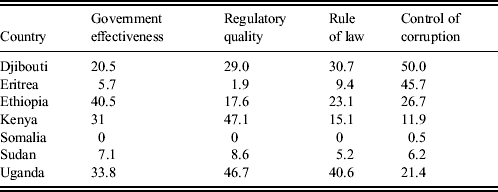
The WGI measure governance in over 200 countries and territories on six criteria: voice and accountability, political stability, government effectiveness, regulatory quality, rule of law and control of corruption.Footnote 161 A country can score between 0 and 100 for each indicator. Percentile rank indicates the percentage of countries worldwide that rate below the selected country.Footnote 162 As Table 2 shows, Horn countries rank very low on virtually every indicator. On government effectiveness, Horn countries' scores range from 0 per cent to 40.5 per cent, while, on regulatory quality, scores range from 0 per cent to 47.1 per cent. The general level of commitment to the rule of law in the region is also relatively low, ranging from 0 per cent to 40.6 per cent. Thus, about 60 per cent of countries perform higher than Uganda, the highest performer on the role of law in the Horn, while Sudan and Eritrea are near the bottom. In all cases, the data clearly show that domestic institutions in the Horn are weak and, given the sensitivities surrounding the issue of food safety and the resulting strict production and trade regulation, they lack the minimum capacity necessary for meaningful participation in international trade.
Horn countries in WGI 2010 (in percentile rank, 0–100)
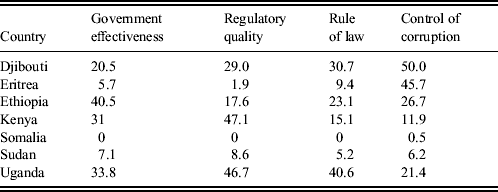
Source: World Bank WGI <http://info.worldbank.org/governance/wgi/sc_country.asp>. The index is based on 2009 data for all countries.
2. Corruption Perceptions Index (CPI)
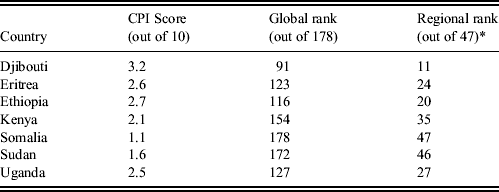
Widespread corruption in a country increases the incentives for farmers and traders to circumvent sanitary regulations and undermines the credibility of certificates issued by the national authorities. The CPI measures the perceived level of public-sector corruption in 178 countries and territories by ranking them with scores on a scale of 0 (highly corrupt) to 10 (highly clean).Footnote 163 As Table 3 shows, Horn countries are ranked between 91st (Djibouti) and 178th places (Somalia). At the regional level, Horn countries perform poorly even by SSA standards. With the exception of Djibouti and Ethiopia, all of them fall within the more corrupt half of the SSA group.
Horn countries in CPI 2010

* All Horn countries classified under the 47-country group of SSA except Djibouti, which has been put under the 19-country group of Middle East and North Africa.
3. Economic Freedom Index (EFI)
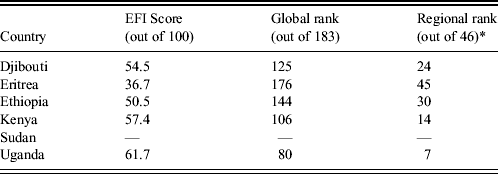
The EFI measures the economic freedom of 183 countries on 10 components: business freedom, trade freedom, fiscal freedom, government spending, monetary freedom, investment freedom, financial freedom, property rights, freedom from corruption and labour freedom. Countries are given a score of between 0 and 100 on each component, which are then averaged to get the country's final EFI score.Footnote 164 With a score of 61.7 per cent on the EFI, Uganda ranks 80th in the world and is the only Horn country to make it into the category of the ‘moderately free’, whereas Kenya, Ethiopia and Djibouti are classified as ‘mostly unfree’ and Eritrea as ‘repressed’.The indices reported above are only averages of the scores of their respective components. A closer look at the detailed report for each Horn country under each index provides useful insights on their performance on components of the Index that are more directly relevant to institutional quality, as well as to livestock production and trade in the region.
Horn countries in EFI 2011
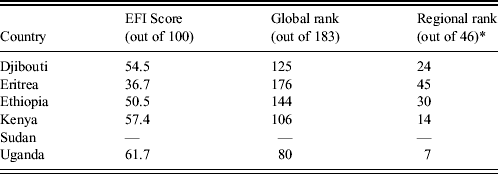
* All Horn countries classified under a 46-country group of SSA. Somalia is not covered, while Sudan is included but not graded.
Uganda: Uganda's government effectiveness is assessed at 33.8 per cent in the 2010 WGI and its regulatory quality at 46.7 per cent (best in the region). Uganda scored 40.6 per cent for rule of law, 15.1 per cent for political stability and 33.2 per cent for voice and accountability.Footnote 165 In CPI 2010, Uganda scored 2.5 out of 10 and came 127th from 178 countries.Footnote 166 Uganda is the best scorer on the EFI 2011. With 30 per cent for property rights, the Report noted that shortage of judges and funding drives most commercial cases to outside arbitration or settlement. Uganda suffers from the perception that corruption is widespread and the will to combat it at the highest levels of government questionable.Footnote 167
Kenya: Under the 2010 WGI, Kenya scored 47.1 per cent for regulatory quality, the best in the Horn. It scored 31 per cent for government effectiveness, 15.1 per cent for rule of law, 12.3 per cent for political stability and 37.4 per cent for voice and accountability.Footnote 168 On corruption, Kenya scored a mere 2.1 out of 10 in CPI 2010, ranking 154th out of 178 countries.Footnote 169 Under the EFI 2011, Kenya scored only 30 per cent in property rights and the Report noted that enforcement of property and contractual rights are subject to long delays. Kenya scored only 22 per cent on freedom from corruption, which is perceived as pervasive. According to the Report, corruption has led to disinvestment and has drained resources needed for education, health and infrastructure development.Footnote 170
Ethiopia: The 2010 WGI puts Ethiopia's government effectiveness at 40.5 per cent, the best in the Horn. It scored 17.6 per cent on regulatory quality, 23.1 per cent on rule of law, 6.1 per cent on political stability and 12.3 per cent on voice and accountability.Footnote 171 With a score of only 2.7 out of 10, Ethiopia ranked 116th out of 178 countries on the CPI 2010.Footnote 172 Ethiopia scored 30 per cent on property rights and the Report notes that the business and investment regime is burdensome and opaque and the judicial system underdeveloped.Footnote 173 Ethiopia scored only 27 per cent on corruption, which is perceived as pervasive.Footnote 174
Djibouti: Under the 2010 WGI, Djibouti scored 20.5 per cent on government effectiveness, 29 per cent on regulatory quality, 30.7 per cent on rule of law, 63.2 per cent on political stability and 15.6 per cent on voice and accountability.Footnote 175 In the CPI 2010, it scored 3.2 out of 10 and came 91st out of 178 countries, the least corrupt country in the Horn.Footnote 176 Under the EFI 2011, Djibouti scored 30 per cent on property rights, protection of which is weak as the courts are frequently overburdened and lacking credibility. The Report notes that corruption is perceived as widespread in Djibouti and that anti-corruption laws are rarely enforced.Footnote 177
Eritrea: Under the 2010 WGI, Eritrea scored only 5.7 per cent on government effectiveness, 1.9 per cent on regulatory quality, 9.4 per cent on rule of law, 20.3 per cent on political stability and only 0.9 per cent on voice and accountability.Footnote 178 In the CPI 2010, it scored 2.6 out of 10 and came 123rd out of 178 countries.Footnote 179 Under EFI 2011, Eritrea is one of the two ‘most “repressed” economies’ in Africa or the world's fourth least-free economy. The Index notes that arbitrary and complex regulatory requirements discourage investment from both foreign and domestic sources. Eritrea scored only 10 per cent for property rights and 26 per cent for freedom from corruption, which is perceived as pervasive.Footnote 180
Sudan: With a score of only 7.1 per cent, Sudan came out poorly in terms of government effectiveness under the 2010 WGI. It scored 8.6 per cent for regulatory quality, 5.2 per cent for rule of law, 1.4 per cent for political stability and 6.2 per cent for voice and accountability.Footnote 181 On corruption, Sudan scored 1.6 out of 10 and came 176th out of 178 countries in the CPI 2010.Footnote 182 The EFI 2011 notes that there is little respect for private property in Sudan, the government influences the judiciary, and the military and civil authorities do not follow due process to protect private property. The Report notes that corruption is perceived as rampant.Footnote 183
Somalia: Somalia has lacked a functioning central government since the former president Mohamed Siad Barre was ousted in 1991. Consequently, assessing the situation in Somalia through standard measurements of government effectiveness, regulatory quality and the rule of law is next to impossible. It is thus hardly surprising that, under the 2010 WGI, Somalia's score stands at 0 per cent on these components.Footnote 184 In the CPI 2010, Somalia scored 1.1 out of 10 and came 178th out of 178 countries.Footnote 185
In sum, all three indices show that the Horn region suffers from weak government institutions, lack of respect for the rule of law and rampant corruption. Several other studies and reports confirm these findings.Footnote 186 The next section presents a brief summary of our own empirical observations in the field.
B. Field Observations
The indices discussed above are only broad indicators, but the overall picture emerging from them is consistent with the information gathered during our field visits and personal interviews of business people, government officials and civil society representatives in five of the seven Horn countries. We have found sufficient evidence that the livestock sector in these countries suffers from legal uncertainties, lack of access to information regarding laws and regulations, slow and corrupt judicial institutions, disregard for the rule of law in day-to-day administrative decision-making, lack of effective coordination among different levels of government in the enforcement of laws, and absence of established communication channels between livestock business operators and relevant government institutions.Footnote 187 The following examples are only illustrative of a much larger picture.
Access to the laws in force is difficult or impossible in all Horn countries except Kenya. In two of the countries we visited, some laws are kept confidential and access to them required authorization from higher government officials. Needless to say, it is difficult to reconcile confidentiality of laws with the idea of government by law.
In countries with a federal system, such as Ethiopia and Sudan, businesspeople complain about multiple and excessive taxation of animals and farmers by central and regional administrative bodies, while letting responsibility for critical disease surveillance and control fall between the cracks. In an interview held in Khartoum, a director of Sudan's Animal Resources Service Company (ARSC), a public–private partnership in which the government has a 20 per cent stake, stated that the livestock sector was affected by legal uncertainty in the division of powers between the central government and the regional administrations. The judicial system in the country is such that when ARSC instituted legal proceedings against two regional governments, Gezzira and White Nile, the courts took over five years to decide. The ARSC eventually won both cases, but the cost to the company was far in excess of the relief granted by the courts. At the time of the interview, the ARSC was waiting for action from the central government on a legislative proposal it had submitted to delineate more clearly the division of powers between the centre and the regions regarding the production and marketing of animals.Footnote 188
Similar problems in Uganda have left the responsibility for critical disease surveillance and control activities in legal limbo. With decentralization of government since 1997, the formerly centralized livestock movement control system had been replaced by uncoordinated and district-specific programmes, with no reporting system between the districts and the centre.Footnote 189 In 2004 Uganda reported to the OIE that it was ‘considering recentralising most aspects of veterinary services in the country in order to address animal disease problems more effectively’.Footnote 190
We also learned that business people often ignore the courts and other official channels for the settlement of contractual and other disputes, resorting instead to informal channels, and in some cases abandoning their rightful claims altogether. There is a pervasive lack of capacity, and possibly of will, to use law as an instrument to implement policy decisions in the region.Footnote 191 Trust in the state is often missing in many Horn countries, and even the firmest-looking legal guarantees on paper are unlikely to be taken seriously, whether by the state or the citizens. Under these circumstances, doing business within these countries is already hard and engaging in exportation profitably even harder.Footnote 192
It follows that trade and economic development in the Horn are hampered not only by sanitary measures imposed by potential export markets (external factors) but also, and primarily, by inadequate institutional capacity, widespread corruption and a lack of commitment to the rule of law within the Horn countries themselves (internal factors). The external and internal factors are closely interlinked. Weak and ineffective domestic institutions diminish the capacity of livestock keepers and traders to comply with international sanitary standards. An extreme example is Djibouti, a country with modest livestock resources of its own but an important transit route through which thousands of mainly Ethiopian live animals are exported. At the time of the field research, there was only one qualified government veterinarian in the whole country.Footnote 193
The absence of competent and credible institutions explains to a significant extent the Horn's inability to benefit from trade in livestock products. The establishment of such institutions and the enforcement of necessary regulations requires financial resources, qualified experts and significant investment in general infrastructure. All these are in short supply in the Horn. Although this is clear from our research on the livestock sector in Horn countries, the relevant literature suggests that institutional problems are not unique to this region or to this sector.Footnote 194 The next section briefly assesses whether and to what extent international law could assist Horn countries in addressing their institutional deficiencies and thereby break the damaging cycle identified above.
VI. THE POTENTIAL AND LIMITS OF INTERNATIONAL LAW
The discussion thus far has shown that, while numerous factors may account for Horn countries' failure to translate their comparative advantage in the livestock sector into meaningful export-led growth, two legal-institutional factors stand out: rising sanitary standards in importing countries and weak institutional capacity within the Horn. Our investigation into the potential of international law considers both aspects of this challenge.
A. Exporting Country Institutions: Rule of Law and Corruption
The evidence is clear that Horn countries suffer from weak domestic institutions, poor commitment to rule of law and pervasive corruption. As elaborated above, the capacity of farmers and traders in the Horn to comply with sanitary standards is significantly constrained by the lack of capacity of public authorities to establish and enforce sanitary standards, carry out credible surveillance and inspection operations and award reliable certificates. The question now is whether, and to what extent, international law can assist these countries in overcoming these ailments.
Our research does not enable us to make general policy prescriptions that are likely to engender substantial and rapid institutional changes in all countries in the region. The institutional approach emphasizes that domestic institutions are highly context-dependent and that they interact with the particular informal norms, values and traditions of the society in which they are embedded.Footnote 195 It is not feasible to expect that a single model of successful regime, Western or otherwise,Footnote 196 would apply across more than one country.Footnote 197 Furthermore, domestic institutions are not amenable to deliberate short-term changes.Footnote 198 Such changes must come from within and require genuine political commitment to economic and socio-cultural changeFootnote 199 and, in most cases, some level of legal reform. Meaningful institutional change requires substantial and sustained involvement from local actors,Footnote 200 which normally takes place incrementally and over the long term.Footnote 201 International law is not the decisive factor in this process. However, international rules and institutions do have the potential to make a significant contribution to gradual and long-term processes of strengthening domestic institutions in this sphere, inter alia by supporting domestic groups in their campaign to promote the rule of law and reduce corruption in these countries, by enhancing technical and financial capacity-building support and by promoting regional approaches to address regional challenges.
1. Rule of law
Lord Bingham recently wrote that the core of the rule of law as a principle is ‘that all persons and authorities within the state, whether public or private, should be bound by and entitled to the benefit of laws publicly made, taking effect (generally) in the future and publicly administered in the courts’.Footnote 202 The rule of law for purposes of the livestock sector is essentially about setting appropriate production standards through law, making them accessible and applicable to all, and ensuring that all decisions taken by public authorities are based on such laws rather than personal relationships. A system that lacks these essential attributes denies adequate guidance to livestock keepers about what they need to do in order to meet national and international product standards, and undermines confidence in a government's ability to enforce appropriate standards. Thus it is hardly remarkable that a Standards and Trade Development Facility (STDF) project in the Horn region identified strengthening veterinary legislation in line with OIE standards, including the establishment of reliable veterinary certification, as a priority for these countries in order to secure long-term access to international markets and to satisfy the requirements of importing countries.Footnote 203
The promotion of the rule of law is often linked to the protection of civil and political rights.Footnote 204 It is notable that these rights are protected by universal and regional treaties (including the African Charter) that require, inter alia, equal protection under the law,Footnote 205 judicial independence and equality before the courts,Footnote 206 freedom of expression,Footnote 207 freedom of assembly,Footnote 208 freedom of associationFootnote 209 and protection of liberty.Footnote 210 A commitment to the rule of law is an end in and of itself, but it is also a means to the goal of building a regulatory environment in which livestock keepers and traders can use their entrepreneurial skills to engage in production and trade for their own benefit and that of others.
2. Corruption
Corruption is often a symptom of overall institutional weakness; however, it also directly affects the capacity of livestock keepers to comply with sanitary standards. Widespread corruption in an exporting country is likely to reduce the incentives for farmers and traders to comply with sanitary standards and to undermine the credibility of certificates issued by the national authorities. It is notable that corruption, once established in a system, corrodes the entire fabric of public administration, with the poor livestock keepers and traders being among the earliest casualties. To mention just one example, Kenya's loss of its OIE-recognized disease-free zones and the collapse of the once thriving Kenya Meat Commission are attributed to corruption.Footnote 211 The trade consequence of these two adverse developments for the country was swift—Kenya soon lost its quota-guaranteed access to the lucrative EC market.Footnote 212
Corruption in poor countries often has a transnational dimension, with significant amounts of illicit money originating from multinational corporations in developed countries. In addition, certain global financial centres in developed countries facilitate this by providing a safe haven for corrupt officials to launder, hide and invest their ill-gotten wealth.Footnote 213 International law and institutions can be used to address both the supply and demand sides of corruption.
Corruption and money-launderingFootnote 214 practices are increasingly being addressed through international treaties,Footnote 215 such as the Inter-American Convention against Corruption (1996),Footnote 216 the OECD Convention on Combating Bribery of Foreign Public Officials in International Business Transactions (1997),Footnote 217 the UN Convention against Corruption (2003),Footnote 218 and the African Union Convention on Preventing and Combating Corruption (2003).Footnote 219 These international treaties share numerous features in common: most have provisions on prevention of corrupt practices (for example, establishing standards of conduct and independent bodies to tackle corruption), criminalization of such acts (requiring the parties to define acts of corruption and related offences) and international cooperation in the enforcement of their provisions (primarily by extradition of suspected offenders).Footnote 220 But they also present some distinctive features. For example, the African Convention recognizes the link between corruption and development, stressing its ‘devastating effects on the economic and social development of the African peoples’.Footnote 221 The OECD Convention is the only multilateral instrument to focus on the supply side of transnational bribery.Footnote 222
The international campaign against corruption has raised public awareness of the harmful effects of corruption, and national authorities increasingly investigate and prosecute instances of transnational bribery.Footnote 223 Still, despite the existence of laws against transnational corruption in most developed countries, criminal prosecution is at times only half-hearted.Footnote 224 Corruption causes serious harm to economic development in some of the poorest countries, and the fight against transnational corruption needs to be intensified through a more rigorous enforcement of existing treaties and the development of new ones that respond to the evolving sophistication of the methods and channels of corruption. Such conventions should include more stringent rules regarding corruption carried out through intermediaries (often used to circumvent anti-bribery laws and treaties), narrow or abolish existing exceptions (either formal or non-formal) for ‘facilitations payments’, clarify and restrict the scope of treaty provisions on investigative and prosecutorial discretion and enhance the level of international legal cooperation among contracting parties.Footnote 225
On the supply side, the adoption of rigorous accounting provisions in developed countries can contribute towards ensuring that foreign bribery does not continue unnoticed. Along this line, developed countries should adopt laws requiring publicly traded companies to certify the accuracy of financial statements, confirm that management had full control over the company's assets, and have the financial statements verified by an independent auditor. Effective implementation of strengthened corruption conventions with robust accounting provisions is likely to make it harder to hide transnational bribery.Footnote 226
Efforts to combat corruption should not be limited to international and national law-making; international tribunals also have a major role to play in deterring individuals and firms from engaging in corruption. Indeed, arbitral tribunals in World Duty Free Footnote 227 and Vallisoletana Footnote 228 dismissed claims arising from investments procured by corruption or fraud.Footnote 229 A consistent and more vigilant approach by investment tribunals is likely to diminish the incentives of foreign investors to engage in such illicit practices.
The WTO multilateral agreements lack any specific substantive rules that explicitly condemn corruption, but numerous provisions in various WTO instruments are designed to create a rules-based, transparent and predictable trading regime unfavourable to corruption.Footnote 230 The plurilateral Agreement on Government Procurement (GPA) also has provisions that are designed to ensure a transparent and accountable decision-making process, including a requirement to publish regulations.Footnote 231 However, the revised GPA, on which parties have ‘reached provisional agreement’, goes a significant step further and imposes a substantive obligation on contracting parties to prevent corruption in the procurement process.Footnote 232
The direction being taken by the revised GPA is encouraging, but the WTO's overall approach to the issue of corruption clearly remains unsatisfactory. To enhance the international campaign against corruption, the WTO should further explore the impact of corruption on trade relations. A WTO declaration condemning corruption and calling for a coordinated effort to eliminate it from trade relations would be a step in the right direction. Such a non-binding declaration might acknowledge the damaging effects of corruption on economic growth and its potential to undermine the goal of establishing a liberal and rules-based multilateral trading system,Footnote 233 recognize its potential to threaten the principles of non-discrimination, transparency and predictability that the multilateral trading system aims to further, and instruct the WTO Secretariat to undertake further research on the impact of corruption on trade relations and identify options for possible multilateral action.Footnote 234 A soft-law instrument in this form would send an important signal to governments that corruption in trade relations poses a grave threat to the integrity and efficiency of national legal systems that are essential for increased international trade and development, and would lay the foundation for further rule-making in this sphere. Kenya's loss of its OIE-recognized disease-free zones due to corruption illustrates the fact that corruption is a serious problem generally, but also specifically within the livestock sector.
B. Importing Country Sanitary Standards and Capacity-building
The potential of international law to assist Horn countries with respect to the level of sanitary standards established by importing countries is limited. Contemporary WTO law clearly recognizes the right of importing countries to set their standards at any level they consider appropriate, subject to the conditions of necessity and scientific justification.Footnote 235 There is no room to interpret these rules so as to prevent importing countries from raising standards applying to imports from developing countries, nor is there any obligation to apply principles of ‘special and differential treatment’ to this effect.Footnote 236 Since sanitary measures are normally introduced for a scientifically justified reason, the special and differential treatment route cannot be used to allow developing countries ‘exceptions to the substantive provisions of the SPS Agreement that might result in health risks for Members’.Footnote 237 Indeed, it is in no country's interests to be associated with the export of unsafe or substandard products, let alone to expect a legal justification to do so. International law can help bridge the gap between low internal sanitary capacity and high external sanitary requirements only by helping lift the former to the level of the latter, rather than by bringing the latter down to the level of the former. International law and institutions may do this by supporting national and regional capacity-building to meet international sanitary standards.
On this front, the amount of activity at the international level is encouraging but certainly not sufficient. Technical assistance and capacity-building, whether general or specifically trade-related, are at the top of the global economic agenda today. A number of international declarations and instruments have been adopted over the past two decades to further this goal.Footnote 238 Indeed as early as 1995 the WTO established the Global Trust Fund to assist developing countries ‘to participate actively in the WTO and to take advantage of the new opportunities in international trade offered by the WTO Agreements’.Footnote 239 Furthermore, following the Doha commitment to work towards full integration of developing countries into the multilateral trading system, the WTO established the Doha Development Agenda Global Trust Fund in 2002, which significantly enhanced its financial capacity to deliver on its promises.Footnote 240 The WTO also works with other institutions in providing technical and capacity development support to developing countries, including the 1996 Joint Integrated Technical Assistance Programme (in collaboration with UNCTAD and the ITC) and the 1997 Integrated Framework (IF)Footnote 241 on technical cooperation for LDCs (WTO, ITC, UNCTAD, World Bank, IMF, and UNDP), which later became the Enhanced Integrated Framework (EIF).Footnote 242 The Aid for Trade initiative, launched at the Hong Kong WTO Ministerial Conference in 2005,Footnote 243 is another source of support for Horn countries' efforts to meet sanitary standards in high-value markets.Footnote 244 This assistance may take the form of training food safety and animal health professionals, developing and maintaining surveillance and accreditation systems, and construction of laboratories for testing and subsequent certification.Footnote 245
These initiatives are supplemented by a number of specific programmes targeted at sanitary and other standards. Article 9 of the SPS Agreement, for example, commits developed countries to provide technical assistance to developing countries, through bilateral or other means, in the areas of processing technologies, research and infrastructure, and the establishment of national regulatory bodies, in order to allow them ‘to adjust to, and comply with, sanitary or phytosanitary measures necessary to achieve the appropriate level of sanitary or phytosanitary protection in their export markets’. The 2002 STDF (established jointly by the WHO, FAO, WTO, OIE and World Bank) was created in order to assist developing countries build their technical and analytical capacity and serve as a coordination forum for such activities by the different providers.Footnote 246 The FAO/WHO Trust Fund for Participation in CodexFootnote 247 and the World Animal Health and Welfare FundFootnote 248 were also established in order to enable developing countries to participate better in the activities of these critical players in the livestock sector.
The experience so far shows that many of these initiatives focus heavily on training of officials, exchange of experiences, establishment of enquiry points in WTO member countries and the like. Each of the Horn countries has benefited from these initiatives. A notable example in this respect is a 2008 workshop in Amman, Jordan, organized as part of an STDF project that brought together public and private sector players from Horn producers and importing countries in the Middle East.Footnote 249 Given the potential sensitivity of livestock trade issues, opportunities for face-to-face meetings are an important part of the confidence-building exercise that is essential for a viable trade relationship between these two regions.
At the same time, the difficulties faced by Horn countries in this area are considerable and the current approach that mainly focuses on training can only be a starting point; to bring meaningful and lasting improvement on the ground, it must be supplemented with long-term institution-building.Footnote 250 This is a highly technical field that requires highly trained manpower, state-of-the-art laboratory facilities and educational programmes that produce a steady supply of skilled professionals over the long term. A good example, though outside the livestock sector, is the recent EU-funded construction of analytical chemistry and plant health laboratories for the horticultural sub-sector in Kenya, which also included the supply of laboratory equipment and specialized training of officers.Footnote 251 We found little evidence of similar initiatives in the livestock sector.
C. Regional Problems and Regional Mechanisms
The national institutional deficiencies that prevent Horn countries from meeting international sanitary requirements are also regional deficiencies. Owing to their shared agro-ecological features, these countries often suffer from identical or similar animal diseases; just as the animals move easily and almost freely across their long and porous borders, the diseases move with them. Indeed, even when this is not the case, livestock-importing countries often treat the region as though it was a single country. There have been several instances where a particular disease outbreak limited to just one Horn country resulted in the imposition of livestock import bans from all Horn countries.Footnote 252 Under these circumstances, a regional approach to tackling this regional problem would allow countries to pool resources, avoiding duplication of effort and waste of scarce resources and benefiting from economies of scale.Footnote 253
There is currently a major initiative in place within the Horn in this respect, called the IGAD Livestock Policy Initiative.Footnote 254 Working through this Initiative, IGAD members have recently signed a comprehensive regional policy framework on animal heath and trade.Footnote 255 The ambition is to establish an effective regional body to coordinate livestock production and trade policies, pool regional human and financial resources to establish regional laboratories with capacity to tackle endemic livestock diseases, and assist and guide the development of veterinary services at national level. Indeed, the Initiative aims to go further and establish a regional mechanism in which Horn livestock interests would be represented at the global level through a single voice.Footnote 256 This is the type of initiative that deserves to be supported by international law and institutions.
VII. CONCLUDING REMARKS
This article has shown that the Horn of Africa—one of the poorest regions in the world—is endowed with abundant livestock resources. However, the performance of the region on the international livestock market over the past three decades has been low and declining. While diverse factors may account for Horn countries' inability to convert their comparative advantage into significant export-led growth, our analysis has led us to conclude that the main impediments relate to rising sanitary import requirements in foreign markets and weak institutional capacity within the Horn. The limited technical and financial resources available to these countries also reduce their capacity to meet these standards.
The evidence that we have gathered in this research reveals that Horn countries suffer from weak institutions, poor commitment to the rule of law and pervasive corruption. Sadly, the gloomy picture depicted by the various indices and reports is consistent with the information that we gathered during field visits to the region. Lack of effective and credible institutions in these countries considerably diminishes the capacity of livestock farmers and traders to comply with sanitary measures established by international standard-setting institutions and importing countries. If the distribution of animal diseases such as FMD defines world trade in livestock and livestock products,Footnote 257 the quality of national institutions often defines the geographical spread of prosperity, or the lack of it, as in this case.Footnote 258 Although these conclusions arise from our research on the livestock sector in Horn countries, the relevant literature suggests that these problems are not unique to this region or to this sector.
In the light of these external sanitary barriers and internal institutional deficiencies, we examined the potential role of international law in enhancing the institutional capacity of these countries and improving livestock exports. The close interrelationships between economic, cultural and political factors and the quality of domestic institutions in each specific country mean that we cannot make general policy prescriptions applicable to all countries in the region. Any meaningful institutional change will require the commitment and leadership of the politically relevant actors in each country, and such processes ordinarily take place incrementally and over the long term. This also means that, while international law can support and facilitate this change, it cannot lead to substantial and swift institutional changes on its own. As Paul Collier put it,
change in the societies at the very bottom must come predominantly from within; we cannot impose it on them. In all these societies there are struggles between brave people wanting change and entrenched interests opposing it. To date, we have largely been bystanders in this struggle. We can do much more to strengthen the hand of the reformers.Footnote 259
In this spirit, we are of the opinion that international law and various international institutions may still play a significant, although not decisive, role in the effort to address national institutional deficiencies and limited resources in at least three ways: first, by promoting rule of law and intensifying the global fight against corruption in national and international affairs; second, by facilitating and encouraging capacity-building efforts; and third, by strengthening regional mechanisms that pool resources in order to tackle regional challenges.