Aggressive behavior in early childhood is a serious risk factor for continued social maladaptation and psychopathology. The development of aggressive behavior problems is one of the most well-recognized psychiatric outcomes associated with physical maltreatment and harsh parenting (Cullerton-Sen et al., Reference Cullerton-Sen, Cassidy, Murray-Close, Cicchetti, Crick and Rogosch2008; Dodge, Pettit, Bates, & Valente, Reference Dodge, Pettit, Bates and Valente1995), and longitudinal research has confirmed that it is the experience of child maltreatment per se, rather than other familial risk factors, that causally accounts for the increased incidence of antisocial behavior and conduct problems (Jaffee, Caspi, Moffitt, & Taylor, Reference Jaffee, Caspi, Moffitt and Taylor2004). Collectively, this body of research lends support to the idea that a familial climate of hostile interpersonal relationships and physical maltreatment can have a toxic effect on children's social, emotional, and behavioral development. Nevertheless, it must be emphasized that not all maltreated children experience severe emotional or behavioral problems or grow up to be abusive parents (Collishaw et al., Reference Collishaw, Pickles, Messer, Rutter, Shearer and Maughan2007; Jaffee, Caspi, Moffitt, Polo-Tomas, & Taylor, Reference Jaffee, Caspi, Moffitt, Polo-Tomas and Taylor2007; Kaufman & Zigler, Reference Kaufman and Zigler1987; Lansford et al., Reference Lansford, Malone, Stevens, Dodge, Bates and Pettit2006). These observations raise the question of what mechanisms drive the observed associations between child maltreatment and poor socioemotional outcomes. Research in this area has recently begun to place an emphasis on uncovering processes affected by maltreatment, including social information processing and emotion regulation (Pollak, Reference Pollak2008). At present, however, the mechanisms underlying the association between maltreatment and behavior problems remain poorly understood. The current study aims to investigate plausible cognitive and affective processes that may account for this association.
Social Information Processing
The processing of social information appears to be a crucial factor in the development of aggressive behavior problems (Crick & Dodge, Reference Crick and Dodge1994). For example, physically maltreated children have been shown to incorrectly encode social cues, exhibit hostile attributional biases, and more readily access aggressive behavioral responses, compared to nonmaltreated children, processes which predicted the occurrence of later externalizing outcomes (Dodge et al., Reference Dodge, Pettit, Bates and Valente1995). Children exposed to physical abuse also exhibit distorted patterns of attentional deployment in response to socially threatening stimuli, such as anger. These aberrations manifest as the ability to identify angry facial expressions with less perceptual information (Pollak & Sinha, Reference Pollak and Sinha2002), faster recognition of facial anger with fewer expressive cues (Pollak, Messner, Kistler, & Cohn, Reference Pollak, Messner, Kistler and Cohn2009), and enhanced attentional allocation toward vocal expressions of anger (Shackman & Pollak, Reference Shackman and Pollak2005; Shackman, Shackman, & Pollak, Reference Shackman, Shackman and Pollak2007). Moreover, physically maltreated children have difficulty regulating attention in the presence of interpersonal hostility (Pollak, Vardi, Putzer Bechner, & Curtin, Reference Pollak, Vardi, Putzer Bechner and Curtin2005), are more likely to attribute hostile intent to the actions of others (Dodge et al., Reference Dodge, Pettit, Bates and Valente1995), and have difficulty understanding the causes and meaning of emotional expressions in others (Perlman, Kalish, & Pollak, Reference Perlman, Kalish and Pollak2008). Electrophysiological studies similarly reflect that maltreated children show enhanced perceptual processing of angry faces, indexed by an early- to midlatency event-related potential (ERP) component (P260; Cicchetti & Curtis, Reference Cicchetti and Curtis2005; Curtis & Cicchetti, Reference Curtis and Cicchetti2011) as well as an enhanced P3b ERP in response to angry faces compared to other emotions (Pollak, Cicchetti, Klorman, & Brumaghim, Reference Pollak, Cicchetti, Klorman and Brumaghim1997; Pollak, Klorman, Thatcher, & Cicchetti, Reference Pollak, Klorman, Thatcher and Cicchetti2001).
Negative Affect and Reactive Aggression
How might these attentional and perceptual processes be related to children's interpersonal behavior? The frustration–aggression hypothesis (Berkowitz, Reference Berkowitz1989; Dollard, Miller, Doob, Mowrer, & Sears, Reference Dollard, Miller, Doob, Mowrer and Sears1939) proposes that aggression is an angry, defensive, and retaliatory response to a perceived threat or provocation. Provocations are thought to induce aggressive reactions to the extent that they elicit negative affect, and the intensity of negative affect experienced as a result of frustration should predict the degree of aggression enacted. From a developmental psychopathology perspective, this theory suggests that aggressive behavior is a learned response designed to alleviate negative affect, and one that has the potential to be influenced by maltreatment. This theory is consistent with the more contemporary distinction made between reactive and proactive aggression, which differ in associated motivations and patterns of affective responding (Raine et al., Reference Raine, Dodge, Loeber, Gatzke-Kopp, Lynam and Reynolds2006; Scarpa, Tanaka, & Haden, Reference Scarpa, Tanaka and Haden2008). Reactive aggression has its roots in the frustration–aggression model (Berkowitz, Reference Berkowitz1989) and is characterized by high levels of sympathetic arousal, angry reactivity, and impulsivity (Dodge et al., Reference Dodge, Price, Bachorowski and Newman1990; Raine et al., Reference Raine, Dodge, Loeber, Gatzke-Kopp, Lynam and Reynolds2006). In contrast, proactive or instrumental aggression has been described as goal-oriented, nonimpulsive behavior that is accompanied by low levels of autonomic and affective (i.e., anger) arousal and often involves the anticipation of a reward or positive outcome (Dodge, Pepler, & Rubin, Reference Dodge, Pepler, Rubin, Pepler and Rubin1991; Vitiello & Stoff, Reference Vitiello and Stoff1997).
A substantial body of evidence has emerged in support of a relationship between negative affective reactivity and regulation and the regulation of behavior. An imbalance between high frustration reactivity and poor regulatory skills appears to be especially likely to lead to the development of aggression (Degnan, Calkins, Keane, & Hill-Soderlund, Reference Degnan, Calkins, Keane and Hill-Soderlund2008) and externalizing behavior problems (Diener & Kim, Reference Diener and Kim2004). To test this idea, Verona, Patrick, and Lang (Reference Verona, Patrick and Lang2002) investigated the extent to which air blast-induced negative affect promoted subsequent aggressive responding, indexed by administration of electric shock to a confederate who was performing poorly on a cognitive task. Incidental stress increased negative affect, indexed by the startle reflex, and reduced the latency of aggressive responding, suggesting a “priming” effect of negative affect on aggression. These data support the notion that within a frustrating context, stress is likely to facilitate reactive aggression, particularly in at-risk individuals. Neuroimaging research has provided circumstantial support for this notion, because studies have consistently revealed that individuals with conduct disorder and/or aggressive behavior problems exhibit increased activity in brain regions implicated in responding to social threat (i.e., amygdala), paired with decreased activity in regions of the prefrontal cortex thought to be involved in the regulation of affect and behavior (e.g., anterior cingulate and ventromedial prefrontal cortex; Crowe & Blair, Reference Crowe and Blair2008; Siever, Reference Siever2008).
The Present Study
Physically maltreated children tend to show maladaptive patterns of social information processing, biases toward socially threatening information, and difficulties with emotion regulation. However, important questions remain regarding the contributions of social information processing and affect dysregulation in promoting aggressive behavior in maltreated children. The current study sought to examine maltreated children's negative affect and aggressive behavior in response to a social provocation designed to elicit reactive aggression. Negative affect was measured by recording facial electromyography (EMG) activity over the Corrugator supercilii muscle. This measure has been shown to represent a robust and valence-sensitive index of negative affect (Cacioppo, Petty, Losch, Kim, & Fazio, Reference Cacioppo, Petty, Losch, Kim, Fazio, Fazio and Petty2008). Aggressive behavior was indexed by the intensity of negative feedback delivered to a hypothetical peer during a task involving social provocation. We reasoned that an experimental manipulation designed to elicit reactive aggression would allow us to examine the contextual moderation of children's behavior, as well as eliminate many of the reporting biases and problems with introspection encountered with other measures.
The aggression task comprised three conditions (baseline, provocation, and recovery), which allowed us to observe children's affect and behavior across difference contexts and over time. Provocation was designed to elicit frustration and reactive aggression. The degree to which the social provocation generated either negative affect or aggression was expected to vary across participants. Baseline provided a measurement of children's negative affect and aggression prior to the social provocation, and recovery allowed us to assess the extent to which children's negative affect and aggression would be reduced, or regulated, once the provocation had ended. We hypothesized that children with histories of physical maltreatment would begin to show greater negative affect and more aggressive behavior in response to the provocation and would show less recovery (i.e., less attenuation of negative affect and aggression) after the provocation had ended. Given the established link between negative emotion and aggression, we expected that children who showed the most negative affect in response to the provocation would exhibit the most aggressive behavior.
Our second specific aim was to test whether individual differences in a neural index of social information processing accounted for the relationship between child maltreatment and negative affect, and aggressive behavior. We predicted that the positive associations between exposure to maltreatment, measured with the Parent–Child Conflict Tactics Scale (PCCTS; Straus, Hamby, Finkelhor, Moore, & Runyan, Reference Straus, Hamby, Finkelhor, Moore and Runyan1998), and negative affect and aggression elicited in response to provocation would be statistically mediated by greater allocation of attention toward anger cues. To test this prediction, we treated the P3b component of the ERP, measured in response to angry adult faces, as a traitlike individual difference measure of children's attention allocation toward social threat. Although previous research has typically taken a group difference approach when examining this measure, a focus on individual differences can provide greater flexibility in uncovering the nature of the relationship among child maltreatment, social information processing, affect, and aggressive behavior. In particular, a strength of this approach is that variation among individuals within a group (maltreated children) can help to clarify biological mechanisms that drive behavior of the group as a whole (Kosslyn et al., Reference Kosslyn, Cacioppo, Davidson, Hugdahl, Lovallo and Spiegel2002).
Methods and Materials
Participants
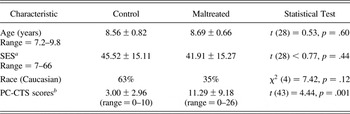
Fifty boys between the ages of 7.1 and 9.8 years were recruited by distributing flyers through the Madison, Wisconsin, Public Schools. Given sex differences in aggressive behavior and externalizing disorders (Cappadocia, Desrocher, Pepler, & Schroeder, Reference Cappadocia, Desrocher, Pepler and Schroeder2009; Cullerton-Sen et al., Reference Cullerton-Sen, Cassidy, Murray-Close, Cicchetti, Crick and Rogosch2008), we restricted our investigation to boys in order to eliminate heterogeneity across the sexes and maximize statistical power. This was particularly important given our interest in examining multivariate individual differences (Yarkoni, Reference Yarkoni2009). Parent consent, child assent, and university institutional review board approval were all obtained for this study. As in our prior studies (e.g., Shackman et al., Reference Shackman, Shackman and Pollak2007), control families were required to have scores below 10 on the PCCTS (Straus et al., Reference Straus, Hamby, Finkelhor, Moore and Runyan1998); families designated as maltreating had scores at least 20 on the physical abuse subscale of the PCCTS and/or had substantiated cases of physical abuse on record with the Dane County (WI) Department of Human Services. Based on these criteria, 33 control and 17 maltreated children were enrolled in and completed the study. All children had normal or corrected to normal vision. Six control children and 1 maltreated child were dropped from Session 1 analyses (n = 43) and 4 control children were dropped from Session 2 analyses (n = 46) because of missing data. Forty children had complete and usable data on all measures given, and were included in cross-session analyses. Maltreated and control children had similar demographic characteristics (Table 1).
Means ± standard errors of sociodemographic characteristics

a The Four Factor Index of Social Status (Hollingshed, 1975) reflects family socioeconomic status (SES) on the basis of parent education and occupational status.
b These scores are taken from the Physical Abuse Scale on the Parent–Child Conflict Tactics Scale (PC-CTS) and include items that reflect frequency and severity of corporal punishment techniques (Straus et al., Reference Straus, Hamby, Finkelhor, Moore and Runyan1998).
Procedures
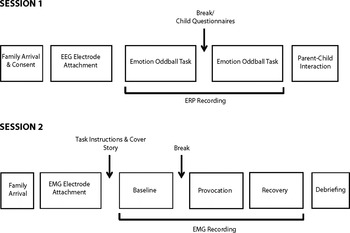
Families visited the laboratory on two separate occasions (Figure 1). During the first visit, children performed an emotional oddball task while ERPs were recorded. Parents and children also participated in a semistructured dyadic interaction at the end of Session 1. Families returned to the laboratory between 2 and 20 days after Session 1. During the second visit, children participated in a provocation task designed to elicit reactive aggression. Families were paid $50 for their participation in both sessions, and children were given an age-appropriate prize after each session. Families were debriefed at the conclusion of Session 2.
The overview and order of events for Sessions 1 and 2.

Self-report assessment of children's aggression
The Reactive–Proactive Aggression Questionnaire (Raine et al., Reference Raine, Dodge, Loeber, Gatzke-Kopp, Lynam and Reynolds2006) was administered to children to measure the occurrence of aggressive behavior. The questionnaire includes 23 items, with separate scales for reactive (α = 0.81) and proactive (α = 0.84) aggression.
Self-report assessment of parental hostility and maltreatment
The PCCTS (Straus et al., Reference Straus, Hamby, Finkelhor, Moore and Runyan1998) is a 20-item parent-report measure of the frequency with which a parent has carried out specific acts of physical aggression toward the child during the child's lifetime. Internal consistency reliability for the physical abuse subscale has been reported at 0.55, but this scale been shown to produce prevalence rates of physical abuse that are equal or greater to those reported by the most recent National Incidence Study at the time of publication (Straus et al., Reference Straus, Hamby, Finkelhor, Moore and Runyan1998). Parents also completed the State–Trait Anger Expression Inventory (Spielberger, Reference Spielberger1988), a 44-item self-report questionnaire. The temperamental trait anger subscale was used to assess parental trait anger expression and provide concurrent validity for the PCCTS and parent interaction tasks. Internal reliability has been reported at 0.86.
Observational assessment of parental hostility
Parent–child interaction
An assessment of child-directed parental hostility was obtained by having parent–child dyads participate in a 10-min semistructured interaction. This was performed primarily in order to examine the extent to which our parent-report measure of maltreatment exhibited external validity. Parents were asked to help their child complete a set of Tangram puzzles by providing only verbal coaching, and were instructed to refrain from touching the puzzle in any way. Parent–child dyads were initially provided with a set of eight difficult puzzles chosen on the basis of pilot work to be above the ability level of 7- to 9-year-old children. After 5 min, an experimenter returned to the room to explain to the family that they had accidentally been given the wrong set of puzzles, so that the burden of poor performance would not be placed on the child. Families were then given an easier, age-appropriate set of puzzles and asked to continue their work for the remaining 5 min. The interaction was designed to be mildly frustrating for parents, in that they were expected to guide their child through a puzzle that children were not able to solve. The interaction was digitally recorded for coding and monitored so that it could be stopped if necessary, although this was never necessary.
Coding
Videos of the parent–child interaction were rated by two coders unaware of families' maltreatment classifications. After coders were trained on a subset of 10 videos, they rated each video independently. Any discrepancies were discussed, and a final score was determined by consensus among the two coders and the first author. Parental behavior was coded on eight domains of interest: hostile vocal tone, negative content of speech, expressed negative affect (body gestures and facial expressions), neglect, positive support, warm vocal tone, positive content of speech, and expressed positive affect. Ratings were based globally on behaviors observed over the entire 10-min interaction, and reflected frequency, intensity, and duration of behaviors. Each domain was rated on a 5-point scale, where 1 indicated the absence of the behavior of interest and 5 indicated a high amount of the behavior of interest. Coders first watched the entire 10-min recording before beginning. The video was then viewed eight successive times, once for the coding of each domain. A “negative affect” (α = 0.73) composite score was computed by averaging scores on the four negative domains (hostile vocal tone, negative content of speech, expressed negative affect, and neglect). A “positive affect” (α = 0.87) composite score was computed by averaging scores on the four positive domains (positive support, warm vocal tone, positive content of speech, and expressed positive affect).
Oddball task
During Session 1, children performed an oddball emotion recognition task known to elicit a P3b response (cf., Pollak et al., Reference Pollak, Cicchetti, Klorman and Brumaghim1997). After placement of electroencephalography (EEG) electrodes, children viewed color photographs of adults posing angry, happy, and neutral facial expressions (Matsumoto & Ekman, Reference Matsumoto and Ekman1988). Children were instructed to press a button when they recognized a face expressing the target emotion (either angry or happy). Faces were presented on a 19-inch monitor for 500 ms, with an intertrial interval that varied between 1500 and 1900 ms.
The oddball task took the form of a 3 (emotion: angry, happy, neutral) × 2 (trial type: target, nontarget) incomplete repeated-measures design, because there were no neutral target trials. Following a 20-trial practice block with feedback, children performed four 100-trial blocks. In each block, angry and happy facial expressions were presented with probabilities of 25%, while neutral faces were presented with a probability of 50%. Angry faces were designated as targets during two consecutive blocks, and happy faces were designated as targets during the remaining two blocks. Neutral faces were always nontargets. Trial presentation was quasirandomized, and block order was counterbalanced between subjects.
Behavioral performance scoring
Performance on the emotional oddball task was indexed using mean reaction time (correct responses only) and accuracy for target trials (i.e., percentage correct). Both measures were computed separately for angry and happy target faces.
Data acquisition and reduction
Data acquisition and reduction were performed using SCAN 4.3.3 (http://www.neuro.com). EEG was acquired using a 128-channel nonstandard layout Quikcap (http://www.neuro.com) with Ag–AgCl electrodes, referenced to Cz (impedances < 5 kΩ). The vertical and horizontal electrooculogram were collected from bipolar sites lateral to supra- and infraorbital ridges and outer canthi, respectively. Data were filtered (0.01–100 Hz), amplified (Synamps II, http://www.neuro.com), and digitized (500 Hz). Data from correctly performed trials were re-referenced to average mastoids, segmented (–200 to 1200 ms), and filtered (30-Hz low pass). Ocular artifact correction employed a singular value decomposition routine. Segments contaminated by residual gross artifact (>75 μV) were rejected. EEG was baseline-corrected and averaged separately for each combination of emotion and trial type. Average P3b amplitude was computed using a 400–600 ms window following stimulus onset.
EMG was continuously acquired throughout the task using two surface mini Ag/AgCl electrodes attached over the Corrugator supercilii muscle, just above the left inner brow. Impedances were maintained below 10 kΩ. A mid-forehead electrode served as the ground. Data were amplified and digitized (2000 Hz). Data from all trials were then bandpass filtered (30–500 Hz), rectified, segmented (–500 to 3000 ms following onset of the numerical point cue), and low-pass filtered (10 Hz). EMG (μV) was baseline-corrected (–500 to 0), Z transformed within participant, and averaged separately for each combination of condition and trial type.
Aggression task
After attachment of electrodes for recording facial EMG (C. supercilli), children were told they would be playing a computer game with another child (matched for age and gender) who was seated in another testing room in the lab. In actuality, there was no other child. Children were given the opportunity to introduce themselves to the other child over an intercom before beginning the game and always heard an audio recording of another child introducing himself. Children were then asked to select a name out of a basket to determine which child would play the computer game and which child would watch; however, child participants were always assigned to watch the other child play the computer game. Next, children were shown a selection of age-appropriate prizes (e.g., Legos, Frisbees) and asked to select their favorite prize that they could “purchase” at the end of the session using points earned during the task.
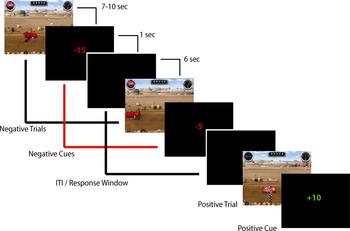
Children were told that they would watch the other child play a computer game. The game consisted of six different video segments (7–10 s) taken from the Disney/Pixar Cars computer game that had been altered for this experiment (Figure 2). Participants were told they would see all the moves the other child would make, and that their job was to provide feedback to the other child at specified time points to help him earn as many points as possible during the game. Children were then presented with a custom 10-button response pad, with 5 buttons arranged vertically on each side. One side contained red buttons to provide negative feedback, and the other side contained green buttons to provide positive feedback. The position (left vs. right) of positive and negative buttons was counterbalanced between participants by changing the color of the buttons. Children were told that pressing buttons would play a sound that would be audible only to their peer during the game. Buttons were labeled 1–5, where 1 indicated a low amount of positive or negative feedback and 5 indicated a high level of positive or negative feedback. Sounds corresponding to each button increased in intensity from 1 to 5 and were either positively (i.e., cheers and applause) or negatively (i.e., horns and buzzers) valenced. Children were encouraged to experiment with the buttons and listen to the sounds to ensure they understood how to use them.
(Color online) A depiction of the aggression task. Children watched brief video segments taken from the Disney/Pixar Cars video game (70 s) that contained either positive or negative events. They were followed by the presentation of positive or negative point cues, presented for 1000 ms, a 6-s response window, during which time the screen was blank.

Children were instructed to give whatever feedback they felt was appropriate on any given trial. Finally, children were told that the computer games were easy and that most children do very well on them, unless they are not working hard or not paying attention. This instruction was given to help encourage and maintain frustration directed at the other child. Children were provided with a visual cue to keep track of the number of points earned by the other child during the game. This occurred halfway through each experimental block as well as between experimental blocks, and displayed cumulative points earned. This took the form of a “point meter” that appeared green when the peer was gaining points and red when the other child was losing points. Children were instructed that the point meter needed to be above the halfway point at the end of the game in order to earn the prize they had selected earlier. The game was manipulated such that all children earned a sufficient number of points over the course of the game to earn the prize they had selected earlier.
The aggression task took the form of a 3 (condition: baseline, provocation, and recovery) × 2 (trial type: positive and negative) repeated measures design. Following a practice block of 5 trials with feedback, children performed six 30-trial experimental blocks (2 consecutive blocks/condition, 60 trials/condition). During the baseline condition, the other child's performance was good (66% positive point-earning trials). During the subsequent provocation condition, the other child's performance was poor (66% negative point-losing trials) in order to elicit negative affect and reactive aggression. During the recovery condition, the other child's performance was again good (66% point-earning trials), in order to assess children's ability to regulate their behavior and affect after the explicit provocation had ended. Average point values on given trials (range = 5–25 points) were equivalent across conditions. Condition order was not counterbalanced across participants because of our desire to examine the time course of children's affective and behavioral responses across contexts.
Trials consisted of a short video segment (range = 7–10 s) followed by a 500-ms blank screen and then a numerical point cue displayed on the screen for 1 s. Positive point cues were displayed in green and preceded by a plus sign. Negative point cues were displayed in red and preceded by a minus sign. Cue offset was followed by a 6-s response window (intertrial interval), during which time children were instructed to press only one button to indicate how well they thought the other child had performed on that trial.
Behavioral performance scoring
In order to measure behavior on both positive and negative events, a feedback intensity index was computed by separately averaging each combination of condition and trial type. Negative feedback was scored from –1 to –5 (with –5 being most intense) and positive feedback was scored from 1 to 5 (with 5 being most intense). Aggressive behavior was operationalized as the intensity of negative feedback during negative trials, with more aversive sounds delivered to a peer corresponding to more aggressive behavior. Feedback intensity scores were computed after removing trials with response latencies <100 ms.
Results
Validation of behavioral tasks and scales
We first verified that our behavioral task elicited frustration and reactive aggression. To establish that our behavioral provocation task elicited aggression, we performed an analysis of variance (ANOVA) with trial type (positive, negative) and condition (baseline, provocation, recovery) as predictors of children's behavior in the task. As predicted, a Condition × Trial Type interaction emerged, F (2, 88) = 24.88, p = .00. Children provided more negative feedback on negative trials during the provocation condition compared to baseline, t (45) = 9.23, p = .002, and recovery, t (45) = 7.41, p = .001. Across conditions, children provided increased negative feedback on negative trials and positive feedback on positive trials, F (1, 44) = 1557.54, p = .001.
In order to establish the validity of self-reported maltreatment, we used Pearson correlations to examine the relationship between the PCCTS and our behavioral observations of parental hostility in the laboratory. Parents who reported engaging in more abusive behaviors on the PCCTS showed more negative affect, r (48) = .48, p = .001, and less positive affect, r (48) = –.36, p = .014, while interacting with their children. In addition, parents who reported more trait anger on the State-Trait Anger Expression Inventory showed more negative affect while interacting with their children, r (48) = .33, p = .027.
Validity and replication of ERP measures
To minimize the number of comparisons and increase reliability, tests were a priori limited to a 27-sensor parietal–midline region of interest (a priori ROI), centered around Pz. We then created a functionally defined electrode cluster by identifying sensors within the a priori ROI that were sensitive to the oddball effect (target ERP > nontarget ERP, p < .05 collapsed across groups). Using the mean P3b amplitude across this cluster, we then conducted an ANOVA to examine group differences. Difference waves were then computed to eliminate nonspecific brain electrical activity by subtracting ERPs to happy faces from ERPs to angry faces, and focused t tests were used to examine group differences.
As expected, P3b was larger on target trials at Pz compared to Cz, t (42) = 2.09, p = .04, and Fz, t (42) = 7.04, p = .004. Collapsed across groups and expressions, five contiguous electrodes within our a priori P3b ROI showed a larger P3b in response to target faces compared to nontargets (ps < .05), and were averaged into a single functionally defined cluster over the parietal region (channels 65, 66, 75, 76, and 93).
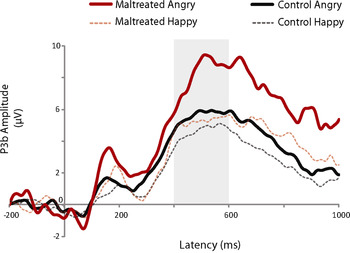
We then sought to confirm that maltreated children would show enhanced attentional allocation toward angry faces, indexed by the P3b component. Consistent with prediction, the Group × Emotion interaction for the functionally defined cluster was significant, F (1, 41) = 5.84, p = .02 (Figure 3). Maltreated children showed a larger P3b to angry target faces compared to control children, t (41) = 2.39, p = .03. This effect was quite specific: groups did not differ on happy target, t (41) = 0.34, p = .72, or neutral nontarget faces, t (41) = 0.45, p = .65. The groups showed similar levels of performance (reaction time and accuracy tests: all ps > .2).
(Color online) P3b in response to angry and happy target faces at the electrode cluster. The Group × Emotion interaction was significant, F (1, 41) = 5.84, p = .01. Maltreated children are depicted in red (online only) and control children are depicted in black (online only). P3b to angry faces is represented with a solid line, and P3b to happy faces is represented with a dotted line. The P3b was detected from 400 to 600 ms after face onset.

To eliminate effects attributable to nonspecific brain electrical activity, we created ERP difference scores by subtracting the P3b evoked by happy faces from that evoked by angry faces, separately for targets and nontargets. We selected happy faces as our baseline because there were no neutral target trials in the task. Consequently, positive scores indicate relatively larger amplitude for angry faces. Difference scores were created separately for each electrode and then averaged across the five electrodes comprising the functionally defined cluster. The resulting cluster difference wave was larger for maltreated compared to control children on target trials, t (41) = 2.24, p = .03, but not nontarget trials, t (41) = 0.83, p = .41. There was no main effect of race on children's P3b amplitude, nor did race interact with emotion or maltreatment group (ps > .26). This variable was not included in further analyses.
Hypothesis 1: Impact of physical maltreatment on aggressive behavior
Our first prediction was that maltreated children would show higher levels of aggressive behavior in response to provocation. We assessed whether the groups differed in their behavior during the peer-directed aggression task using a mixed-model ANOVA with maltreatment group, condition (baseline, provocation, or recovery), and trial type (positive or negative) as predictors of aggressive behavior. A Group × Condition × Trial Type interaction emerged, F (2, 88) = 4.34, p = .016. Children did not differ in the amount of positive feedback they delivered during any condition (ps > .3). As expected, children did not differ during baseline, t (44) = 1.58, p = .12, and all children showed similarly increased negative affect during provocation, t (44) = 0.92, p = .36. However, maltreated children exhibited higher levels of aggression during recovery, compared to control children, t (44) = 4.50, p = .001. Within groups, control children showed elevated aggression during provocation compared to baseline, t (28) = 8.36, p = .001, and decreased aggression during recovery compared to provocation, t (28) = 8.67, p = .001, that did not differ from baseline levels, t (28) = 0.47, p = .64. Maltreated children also showed elevated aggression during provocation compared to baseline, t (16) = 4.46, p = .001. In contrast, although their levels of aggression declined from provocation to recovery, t (16) = 2.33, p = .03, they remained elevated compared to baseline, t (16) = 2.38, p = .03. Finally, higher maltreatment levels on the PCCTS predicted greater aggression during recovery, r (44) = –.33, p =.03.
Hypothesis 2: Effects of physical maltreatment on negative affect
Our next prediction was that maltreated children would show enhanced levels on negative affect in response to provocation. We examined negative affect, indexed by corrugator EMG activity, elicited by our aggression task using a mixed-model ANOVA with maltreatment group, condition, and trial type as predictors of negative affect. Although the overall Group × Condition × Trial Type interaction did not reach significance, maltreated children showed more negative affect than did control children on negative trials during provocation, t (44) = 3.71, p = .001, and recovery, t (44) = 2.83, p = .007. The groups did not differ for any other combination of condition and trial type (ps > .10). Within groups, control children showed similar negative affect across all combinations of condition and trials type (ps > .08). In contrast, maltreated children showed elevated negative affect during both provocation, t (16) = 2.15, p = .047, and recovery, t (16) = 2.66, p = .017, relative to baseline. Moreover, their levels of negative affect did not differ between provocation and recovery, t (16) = 0.09, p = .93. Using Pearson correlation, higher levels of maltreatment reported on the PCCTS also predicted greater negative affect during both provocation, r (44) = 0.44, p = .003, and recovery, r (44) = 0.38, p = .008. Collapsed across groups, children showed more negative affect during negative compared to positive trials, F (1, 44) = 10.00, p = 0.003, suggesting that children experienced these trials as aversive.
Hypothesis 3: Relationship between negative affect and aggressive behavior
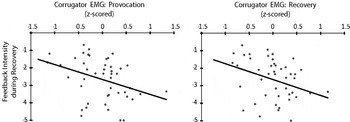
Our third prediction was that children with higher levels of negative affect would show more aggressive behavior. We tested this hypothesis using Pearson correlations between negative affect and children's aggressive behavior during both provocation and recovery. As shown in Figure 4, higher levels of aggressive behavior during recovery were predicted by higher levels of negative affect during both provocation, r (44) = –.33, p = .024, and recovery, r (44) = –.32, p = .033. Aggression during provocation was uncorrelated with either index of negative affect (ps > .45). This indicates that children who showed greater negative affect during provocation and who maintained this negative affect during recovery exhibited more aggressive behavior in the period following the provocation.
Pearson correlations depicting negative relationships between feedback intensity (aggression) during recovery and corrugator electromyography (EMG) during provocation, r (44) = –.33, p = .024, and recovery, r (44) = –.32, p = .033. In both cases, greater corrugator activity predicted more aggressive behavior during recovery.

Hypothesis 4: Attention to threat (P3b) mediates the impact of maltreatment on provocation-induced negative affect (corrugator EMG)
Finally, we predicted that the impact of parental hostility (PCCTS) on children's provocation-induced negative affect and aggression would be mediated by enhanced attention toward angry faces. To test this hypothesis, we adopted the multivariate framework of MacKinnon (MacKinnon, Fairchild, & Fritz, Reference MacKinnon, Fairchild and Fritz2007; MacKinnon, Lockwood, Hoffman, West, & Sheets, Reference MacKinnon, Lockwood, Hoffman, West and Sheets2002). This tested whether a significant portion of the variance in negative affect and behavioral aggression predicted by the degree of parental maltreatment was accounted for by variation in neural signals of attention allocation (P3b). Satisfying the criteria for mediation would provide more direct evidence than bivariate correlations that the impact of parental maltreatment on negative affect and aggression is due to alterations in attentional allocation. In addition, these three variables satisfy the temporal precedence criterion for mediation. Substantial evidence suggests that childhood maltreatment is associated with changes in attention allocation to anger (P3b). Moreover, our conceptualization of P3b as reflecting a traitlike individual difference further suggests that this should precede children's emotional reactions and behavior in the laboratory.
Mediation required four significant tests: (a) parental maltreatment (PCCTS) predicts provocation-induced negative affect and aggression, (b) parental maltreatment predicts attention allocation to anger, (c) attentional allocation predicts negative affect and behavioral aggression, and (d) removing the influence of attention allocation significantly reduces the impact (i.e., variance mediated) of parental hostility on negative affect and aggression. Following prior research (Shackman et al., Reference Shackman, Shackman and Pollak2007, Reference Shackman, Fox, Oler, Shelton, Davidson and Kalin2013), the last criterion was assessed using a directional Clogg test (Clogg, Petkova, & Shihadeh, Reference Clogg, Petkova and Shihadeh1992), which tests whether adjustment for the candidate mediator (i.e., intervening variable) reduces the association between the independent and dependent variables. Prior methodological work indicates that the Clogg test is characterized by accurate Type I error rates and enhanced statistical power to detect mediation effects (MacKinnon et al., Reference MacKinnon, Lockwood, Hoffman, West and Sheets2002).
For descriptive purposes, the proportion of variance mediated was computed as (r 2 – r′2/r 2) × 100%, where r is the correlation between PCCTS and negative affect or aggression and r′ is the partial correlation between PCCTS and negative affect or aggression, corrected for the influence of P3b. To test specificity, a Hotelling t test was used to assess between-condition differences in criteria (a) and (c).
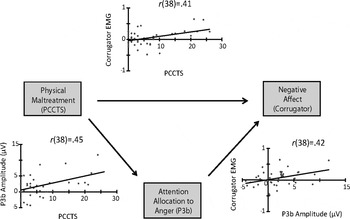
As shown in Figure 5, correlational analyses showed that children exposed to more physical maltreatment showed (a) more provocation-induced negative affect (corrugator EMG activity), r (38) = .42, p = .007, and (b) allocated more attention to threatening social information (P3b amplitude for angry targets), r (38) = .45, p = .004. Moreover, (c) children who allocated more attention to social threat showed increased provocation-induced negative affect, r (38) = .42, p = .007. Finally, (d) the deleterious impact of maltreatment on provocation-induced negative affect was significantly reduced after controlling for individual differences in attention to threat, t (37) = 1.83, p = .03, r (37) = .28, ns. Variation in attention accounted for 54% of the variance in provocation-induced negative affect. The overall mediation model was specific to negative trials during the provocation condition, evidenced by the identical model, which failed to reach significance for any other combination of condition and trial type (ps > .1).
A depiction of multivariate relations among maltreatment, P3b, and corrugator activity during provocation. Higher levels of physical maltreatment (Parent–Child Conflict Tactics Scale [PCCTS]) predicted greater attention allocation to anger (P3b) and higher levels of negative affect (corrugator). Attention allocation also predicted greater negative affect. Moreover, when controlling for individual differences in attention to anger, the impact of maltreatment on negative affect was reduced. Variation in attention allocation accounted for 56% of the impact of maltreatment on negative affect.

To assess the specificity of these findings, follow-up tests were performed. With respect to the first criterion, in addition to the provocation condition, maltreatment also predicted negative affect during recovery, r (39) = .45, p = .04, but not during baseline, r (39) = –.26, p = .10. This relationship was stronger for the provocation condition compared to baseline, t (37) = 2.66, p = .01, but did not differ from recovery, t (37) = –0.24, p = .81. Regarding the second criterion, attention to threat (P3b) was unrelated to negative affect during baseline, r (38) = .007, p = .96, or recovery, r (38) = .121, p = .46. As above, the relationship between attention to threat and negative affect was marginally stronger for the provocation condition compared to baseline, t (37) = 1.8, p = .07, but did not differ from recovery, t (37) = 1.5, p = .14.
Although we hypothesized that P3b would also mediate the association between parental maltreatment and aggression, this was not the case. P3b was unrelated to children's aggressive behavior during any portion of the task (ps > .1). Thus, we did not pursue more in-depth mediation analyses.
Discussion
The current study aimed to test the degree to which physical maltreatment increased negative affect and reactive aggression in response to social provocation. Maltreated children showed more negative affect and exhibited more aggression in the laboratory than did healthy controls. Further, higher levels of negative affect predicted more aggressive behavior. Consistent with our prior work, we also found that children exposed to higher levels of maltreatment allocated more attention, indexed by the P3b, to social threat, and children who allocated more attention to social threat in the oddball task also exhibited greater negative affect during the peer-directed aggression task. More than half of the impact of maltreatment on frustration-elicited negative affect was accounted for by variation in attention to social threat.
Implications for the study of maltreatment
Prior studies have linked a history of physical maltreatment to elevated reports of aggressive behavior, conduct problems (Jaffee et al., Reference Jaffee, Caspi, Moffitt, Dodge, Rutter and Taylor2005; Lansford et al., Reference Lansford, Miller-Johnson, Berlin, Dodge, Bates and Pettit2007), and poor emotion regulation (Maughan & Cicchetti, Reference Maughan and Cicchetti2002; Teisl & Cicchetti, Reference Teisl and Cicchetti2008). The present experiment extends this work using an online measurement of children's affect and behavior during a social provocation and affords us the opportunity to examine the factors that moderate expression of aggressive behavior. Moreover, by comparing baseline and recovery conditions, our paradigm allowed us to examine children's responses to similar cues in different emotional contexts. Thus our findings extend prior studies reporting elevated aggression in maltreated children (e.g., Cullerton-Sen et al., Reference Cullerton-Sen, Cassidy, Murray-Close, Cicchetti, Crick and Rogosch2008; Keil & Price, Reference Keil and Price2009), by demonstrating that the impact of maltreatment on aggressive behavior was only unmasked when it became contextually maladaptive for children to continue to behave aggressively. In other words, some amount of aggression may be a developmentally normative response to frustration, but maltreated children are unable to regulate this response when it is no longer appropriate to the situation.
One plausible explanation for why maltreated children continued to display aggressive behavior during recovery, whereas control children were able to update their behavior to reflect current contingencies, is that that they experienced elevated and lingering negative affect as a result of the provocation. Support for this possibility comes from our finding that, compared to control children, maltreated children experienced more negative affect during both provocation and recovery, which suggests they were experiencing higher levels of negative affect. Moreover, maltreated children did not exhibit a decrement in negative affect during recovery, suggesting difficulties with downregulating negative affect. Control children's negative affect did not differ among the three conditions; that is, they did not show an increase during provocation compared to baseline (no reactivity), and they did not show a decrease during recovery compared to provocation (no recovery). Higher levels of maltreatment also predicted greater negative affect during provocation and recovery. This finding is in keeping with prior research demonstrating that maltreated children exhibit difficulties with emotion regulation (Maughan & Cicchetti, Reference Maughan and Cicchetti2002), but it provides an important extension of this work by performing a more direct assessment of affect during multiple social contexts. Further support for the above explanation arises from our finding that children's negative affect predicted their aggressive behavior. Children who showed the greatest amount of negative affect during both provocation and recovery exhibited the most aggression during recovery. This suggests that both affective reactivity and a reduced ability to downregulate negative affect are predictive of poor behavioral regulation.
A possible explanation for poor regulation of aggression is that maltreated children were overattending to negative cues relative to positive cues during the task. Executive functioning has been shown to partially account for the relationship between aspects of difficult temperament (i.e., intense affective reactivity, irritability, and negative mood) and aggressive behavior (Giancola, Roth, & Parrott, Reference Giancola, Roth and Parrott2006), suggesting a potentially crucial role for attentional control in governing behavior. Negative cues increased in frequency during the provocation condition and therefore may have resulted in an attentional shift toward these cues that was maintained even after the relative frequency of negative cues decreased during recovery. Although we do not have direct evidence of attentional allocation during this task, prior research suggests that physically maltreated children do have difficulty disengaging their attention from threatening social cues (Pollak & Tolley-Schell, Reference Pollak and Tolley-Schell2003). Moreover, physically maltreated children in our study did allocate more attention toward processing angry faces, albeit during a task using more explicit social cues. Thus it is plausible that maltreated children may have been less able to refocus their attention on the more frequent positive cues, contributing to the maintenance of reactive aggression and unmaksing of group differences. However, this hypothesis requires further inquiry. The degree of physical maltreatment children had experienced was predictive of both heightened attention toward cues of anger and greater negative affect during provocation. Further, individual differences in attention allocation toward anger were found to partially account for the relationship between maltreatment levels and negative affect. These findings are in accord with prior research demonstrating that physically maltreated children show enhanced attention allocation toward angry faces (e.g., Pollak et al., Reference Pollak, Cicchetti, Klorman and Brumaghim1997), while also broadening our understanding of the mechanisms underlying the impact of maltreatment on affective responding.
It is important to note that individual differences in attentional allocation to anger were unrelated to children's aggressive behavior. There are two possibilities that may account for this null finding that warrant future study. First, the lack of association may have been a function of the fact that aggressive behavior is a complicated process involving many intervening variables and we did not measure the most relevant or proximal aspect of information processing. Dodge's social information processing model, proposed to account for aggressive behavior (Crick & Dodge, Reference Crick and Dodge1994), includes six stages of processing, and our measure of attention allocation relates only to the first and most distal stage (encoding of social cues). Previous studies investigating only a portion of this model have also found only modest relationships between cognitive processes and behavior in maltreated children (Teisl & Cicchetti, Reference Teisl and Cicchetti2008). Second, another possibility is that our aggression task did not contain any explicit social stimuli (e.g., faces or voices), despite the fact that it was designed to occur within the context of a mock social interaction. In contrast, the P3b was measured in response to discrete social cues. Thus, our provocation task may be a good analog for some, but not all, real-world situations, because there was no opportunity to use social cues to differentially regulate behavior.
Future challenges
Several limitations of the current study present opportunities for future research. First, we were not able to obtain a measure of children's cognitive processing of the numerical cue used to elicit negative affect and aggression during the provocation task. In the absence of this measure, we were unable to determine the extent to which children were attending to the negative versus positive cues and may have had difficulty reallocating their attention when experimental contingencies shifted. We also could not establish whether enhanced emotional reactivity and poor regulation of affect and aggression were driven by greater attention allocation toward the negative numerical cues. Although previous research indicates that maltreated children show differential patterns of attention allocation toward anger, studies have yet to explore the extent to which these difficulties extend to other negative or threatening types of stimuli (i.e., nonsocial cues that are associated with a social threat or provocation). However, this limitation suggests several avenues for future research. In particular, future studies should explore the extent to which children's attentional allocation to social stimuli moderate their affective responses to those stimuli, and vice versa.
Second, the design of our experiment made it difficult to cleanly separate the processes of emotional reactivity and regulation. Our measure of negative affect was collapsed across trials and averaged over a 20-min period for each condition. Our interpretation operated on the assumption that negative affect during baseline and provocation was most likely reflective of reactivity and negative affect during recovery was primarily reflective of regulation; however, these processes are closely linked and difficult to disentangle. Thus, it is possible that children who showed increased negative affect during provocation may have had both a stronger reaction to the social provocation and more difficulty regulating the negative affect they did experience. Future studies should attempt to better separate these processes.
Third, our study reported only on aggressive behavior in boys. Although gender differences in overt aggression have been recognized (Cummings, Iannotti, & Zahn-Waxler, Reference Cummings, Iannotti and Zahn-Waxler1989; Verona, Reed, Curtin, & Pole, Reference Verona, Reed, Curtin and Pole2007), it will be important to examine these processes in both sexes in order to determine whether maltreatment has differential effects on affect and aggression in boys and girls.
Conclusions
In sum, we propose that physical maltreatment exerts effects on attention to angry cues and negative affect in response to social provocation. Moreover, these two processes appear to be related via a common underlying mechanism. Maltreated children are also more likely to engage in aggressive behavior toward others and have more difficulty regulating that response, especially when they have a strong negative emotional reaction to a situation. This pattern of increased monitoring of the environment for anger or social threat may initially emerge as a contextually adaptive response to a stressful environment, in that it can give children the ability to avoid a potentially harmful situation. However, it may come at the expense of developing a lingering maladaptive tendency to misinterpret others' emotions and intentions and react aggressively toward others. Our findings also provide important clues for potential avenues of intervention. Clinicians might target the tendency to overattend to hostility in others, and might coach children on better emotion and behavior regulatory strategies to use when they are provoked.