Case report
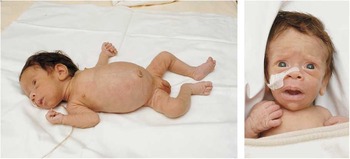
A 3-week-old boy was admitted because of poor weight gain. He was the first child of healthy non-consanguineous parents. He was born at 40 2/7 weeks of gestation, with birth weight of 1800 g (−6.8 SD), length of 42 cm (−5.4 SD), and head circumference of 33 cm (−3 SD). Physical examination revealed a very dysmature neonate with generalised hirsutism and reduced subcutaneous fat mass and muscle mass (Fig 1 left). He had a small face, prominent eyes, large ears, abundant dark scalp hair with a low frontal hairline, a turned-up nose with a depressed nasal bridge, and a large mouth with gingival hyperplasia (Fig 1 right). There was a grade II/VI systolic murmur and abdominal distention without hepatosplenomegaly. His penis was large, and both testes were descended. His blood glucose concentrations ranged from 1.6 mmol/L (29 mg/dl) before feeding to 18 mmol/L (324 mg/dl) after feeding. Insulin concentration was inappropriately high (>300 mIU/L) with a corresponding blood glucose level of 11.4 mmol/L (205 mg/dl).
Patient at 6 weeks of age. Left: note the loosely wrinkled skin, general lack of subcutaneous fat and muscle mass, prominent nipples, and abdominal distention. Right: note the abundant scalp hair, prominent eyes, large ears, large mouth with gingival hypertrophy, depressed nasal bridge, and the large hand.

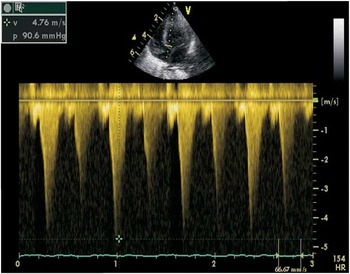
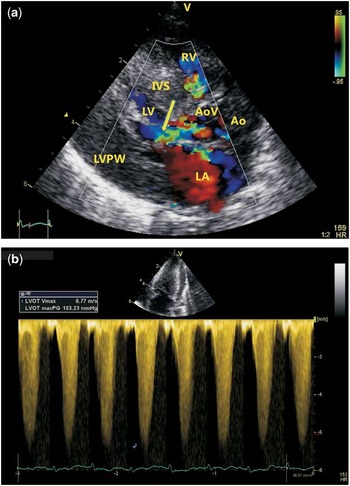
Initial echocardiography at 21 days of age showed mild cardiac hypertrophy of the interventricular septum. The interventricular septal thickness at diastole was 5.5 mm (z-score +2.1), and the left ventricular posterior wall thickness at diastole was 3.5 mm (z-score +1.5) (z-scores according to Pettersen et alReference Pettersen, Du, Skeens and Humes 1 ), without left ventricular outflow tract obstruction (left ventricular outflow tract Vmax 1.7 m/s) and a moderate mitral valve insufficiency with normal cardiac function. All the characteristics fitted to Donohue syndrome. Despite an intake of 150 kcal/kg, his growth was poor. Treatment with metoprolol was initiated. Echocardiography 15 days later at 36 days of age showed progressive hypertrophy (interventricular septal thickness at diastole 10.1 mm, z-score +4.9) with left ventricular outflow tract obstruction (left ventricular outflow tract Vmax 4.8 m/s (90 mmHg)) and systolic anterior movement of the mitral valve (Fig 2). Treatment with metformin was unsuccessful. Treatment with insulin-like growth factor-I was not given because of risk for further cardiac hypertrophy. There was a rapid progression of the left ventricular outflow tract obstruction with a Vmax of 6.8 m/s (183 mmHg) at 43 days of age and an interventricular septal thickness at diastole of 11.6 mm (z-score +5.75) (Fig 3). At 2.5 months of age, the boy died because of left heart failure. No autopsy was obtained. Insulin receptor gene analysis revealed a heterozygous nonsense mutation – c.2055G>A (p.Trp685X) – leading to a premature stop and a heterozygous missense mutation–c.172G>A (p.Gly58Arg)–previously reported as Gly31Arg and predicted to result in an abnormal insulin receptor protein.Reference Van der Vorm, van der Zon, Möller, Krans, Lindhout and Maassen 2 Both mutations were confirmed in the parents. During the next two pregnancies, prenatal diagnosis revealed that both fetuses were not affected by Donohue syndrome.
Continuous wave tracing of the left ventricular outflow tract at age 36 days clearly showing obstruction in the left ventricular outflow tract.

( a ) Parasternal long-axis view with colour showing severe concentric left ventricular hypertrophy (IVSd 11.6 mm (z-score +5.75), LVPWd 7.9 mm (z-score +5.7) and left ventricular outflow tract obstruction (arrow) at 43 days of age. ( b ) Continuous wave tracing of the left ventricular outflow tract. Ao=aorta; AoV=aortic valve; IVS=interventricular septum; LA=left atrium; LV=left ventricle; LVPW=left ventricular posterior wall; RV=right ventricle.

Discussion
Donohue syndrome or leprechaunism (Online Mendelian Inheritance of Man # 246200) is a rare, autosomal, recessively inherited disease with a prevalence of less than one in a million births. Clinical features are prenatal and postnatal growth retardation, elfin face, large and low-set ears, depressed nasal bridge, thick lips, large tongue, hypertrophic gingivae, hypertrichosis, acanthosis nigricans, and reduced subcutaneous fat mass and muscle tissue. The other symptoms often include large hands and feet, enlarged ovaries and external genitalia, and precocious puberty. Donohue syndrome is characterised by high circulating insulin levels, due to extreme insulin resistance. This is the result of mutations in the insulin receptor gene, resulting in a disabled or non-functional insulin receptor. Insulin is an anabolic hormone acting through the insulin receptor, which is widely distributed throughout the body, with its key targets being the liver, muscle, and fat tissue. In infants of diabetic mothers and infants with congenital hyperinsulinism, prenatal exposure to elevated insulin levels stimulates protein, lipid, and glycogen synthesis, resulting in large-for-gestational-age status of these infants. The myocardial hypertrophy reported in these infants is the result of the interaction of high insulin levels with the insulin receptor present in the heart.Reference Hawdon 3 , Reference DeBosch and Muslin 4
In contrast, patients with leprechaunism lack the anabolic effect of insulin because of the disabled insulin receptor, and therefore are small for gestational age; however, these patients have some features of increased tissue growth such as increased gonadal size and hypertrophic cardiomyopathy. The mechanism is unknown, but it is hypothesised that myocardial hypertrophy is the result of high insulin concentrations acting through the insulin-like growth factor-I receptor, which is also found in the heart.Reference DeBosch and Muslin 4
In fact, the insulin receptor and insulin-like growth factor-I receptor have considerable structural homology and both insulin and insulin-like growth factor-I act with each other’s receptors. In states of insulin resistance, clinical and experimental data suggest that the insulin-like growth factor-I receptor at least partially compensates for the absent insulin receptor function. Patients with Donohue syndrome due to a homozygous deletion of the insulin receptor never develop diabetic ketoacidosis, suggesting the persistence of some insulinomimetic effect.Reference Ogilvy-Stuart, Soos and Hands 5 Fibroblasts of Donohue syndrome patients show a clear effect of insulin at supraphysiological concentrations, which is blocked by pre-incubation with an anti insulin-like growth factor-I receptor antibody.Reference Geffner, Kaplan and Bersch 6
Hypertrophic cardiomyopathy is not often emphasised in leprechaunism and is not included in the Online Mendelian Inheritance of Man clinical synopsis of Donohue syndrome in 2015; however, it is already reported in Rosenberg et al’sReference Rosenberg, Haworth, Degroot, Trevanen and Rechler 7 review in 1980.
To estimate the prevalence of hypertrophic cardiomyopathy in Donohue syndrome, we searched the PubMed electronic database for case reports using the MeSH heading “Donohue syndrome or leprechaunism” from 1980 to 2014. As the starting year, 1980 was chosen as echocardiography was only introduced for clinical practice in the late 1970s of the past century.Reference Wells 8 We retrieved 81 case reports. Of these patients, 24 (29.6%) had hypertrophic cardiomyopathy. Diagnosis was based on echocardiographic or autopsy data. We speculate that this number is still an underestimate, as information about the cardiac examination was not available in 42/81 (52%) patients. Recently, the overlap between leprechaunism and type A insulin resistance syndrome has been emphasised. In the latter, mortality is low. Therefore, Musso et alReference Musso, Cochran and Moran 9 suggested limiting the term leprechaunism to children <2 years of age. Hypertrophic cardiomyopathy was present in 20/67 (29.9%) patients younger than 2 years of age at the time of publication and it was absent in 14/67 patients. In 33/67 (49.3%) patients, no cardiac evaluation was available, suggesting again that the correct prevalence of hypertrophic cardiomyopathy in patients younger than 2 years of age might be even higher. Of the patients with cardiomyopathy, 17/20 (85%) died of heart failure. In addition, possible consanguinity did not interfere. In fact, in the group of 67 patients younger than 2 years of age, consanguinity was present in 26, absent in 37, and unknown in four infants. Hypertrophic cardiomyopathy was present in 7/26 (26.9%) children of consanguineous parents and in 11/37 (29.7%) of unrelated parents.
In conclusion, hypertrophic cardiomyopathy is frequently observed in Donohue syndrome and has high mortality. We believe it is important to draw attention to its presence in Donohue syndrome and suggest that every patient with this syndrome should be screened for it.
Acknowledgements
The authors are grateful to Mrs Jeske van Harssel, MD, Department of Medical Genetics, for her assistance in writing the part concerning the insulin receptor gene analysis. The authors are also grateful to Prof. L. S. de Vries for her excellent clinical care and valuable assistance.
Financial Support
This research received no specific grant from any funding agency, commercial, or not-for-profit sectors.
Conflicts of Interest
None.
Ethical Standards
The authors assert that all procedures contributing to this work comply with the ethical standards of the relevant national guidelines on human experimentation and with the Helsinki Declaration of 1975, as revised in 2008, and has been approved by the institutional committees at University Medical Centre Utrecht.