In late May 1885 the letters page of The Times was a-buzz. On 20 May, “A British Matron” thundered:
Having waited in vain for any public remonstrance against the display of nudity at the two principal galleries of modern art in London … from the pen of any writer of high literary, artistic, or professional position, I ask you permit me in The Times to protest in the name of my sex—nay, in that of both sexes—against the indecent pictures that disgrace their exhibitions.Footnote 1
How could she give her offspring the appropriate polite education in art if such atrocities hung in the major galleries? In the days following this initial salvo, The Times carried a slew of responses. Some championed the erstwhile matron's cause. “Another British Matron,” responding the next day, was shocked by “the ease and apparent nonchalance with which young girls evidently of the higher classes of society, stood regarding the same side by side with men and boys.” Mixed-sex viewings of dangerous images represented, she warned, the “stealthy, steadfast advances of the cloven foot.”Footnote 2 Of the nineteen responses The Times chose to publish, only six sided with our matron, outnumbered two to one by those who found her “ignorant,” (“An Englishwoman,” 23 May), “intolerant” (“EJM,” 25 May), “morbid” (H. G. F. Taylor, 25 May), and wanting in culture (“Common Sense,” 21 May).
There has been considerable suspicion that this redoubtable relative of Mrs. Grundy was, in fact, the Royal Academy's own treasurer, John Callcott Horsley.Footnote 3 Today, Horsley's main claim to fame is as the man who gave us the first Christmas card in 1843.Footnote 4 In the mid-nineteenth century, however, he was perhaps best known for his vigorous opposition to nude painting and, especially, life models, a stance that earned him the memorable nickname of “Clothes Horsley.”
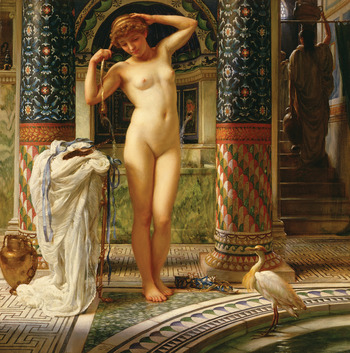
Diadumenè, c.1883 (oil on canvas), Sir Edward John Poynter (1836–1919), Royal Albert Memorial Museum, Exeter, Devon, UK/Bridgeman Art Library

The poet Robert Browning got in on the act too. A painting by his son, Pen, was rejected because of its nudity at much the same time. In his 1887 Parleying with Certain People of Importance in their Day, Browning defended nude art (and his son, if silently) through the mouthpiece of the seventeenth-century character Frances Furini (“Good priest, good man, good painter”), who on his deathbed begged his friends to destroy his work because he had painted not just nude men but “the naked female form.”Footnote 5 Browning's defense of the nude is, as Patricia O'Neill has pointed out, a conventional one that rested on the need for female purity, but his intervention is a reliable indicator of the waves made by this extraordinary week of correspondence, which The Times ended on May 28 with the stern admonition that “we cannot publish any more letters on this subject.”Footnote 6
The work of art that set off this firestorm was Diadumenè, by the neoclassical painter Edward Poynter. Poynter was very much an establishment figure. The first Slade Professor at University College London, he became principal of the National Art Training School in 1875 and then director of the National Gallery (the last practicing artist appointed to that position) in 1894. He succeeded John Millais as president of the Royal Academy in 1896 and was made a baronet in 1902. Poynter was not new to the genre of nude painting in the mid-1880s. His Andromeda had been exhibited at the Royal Academy in 1870.Footnote 7 In 1872, he produced his Paul and Apollos fresco, featuring two nude men, for a church in Dulwich.Footnote 8
Poynter's model for the controversial 1885 canvas was Lawrence Alma-Tadema's A Sculptor's Model (1877), which in turn was a recreation of the Venus Esquilina, a statue excavated in Rome in 1874.Footnote 9 The recovery and restoration of classical statuary was a recognized legitimate practice, and classical representations of female nudity had long been a staple of the world of high art.Footnote 10 Poynter's depiction of the naked form was by no means radical; it followed what John Smith and Chris Jenks have described as the “peculiar mix of nudity and history-painting” that typified art portrayals of naked women and men.Footnote 11 In his own justification for Diadumenè in The Times, Poynter distinguished his study in beauty from the perilous immorality of the French artists of the baigneuses.Footnote 12 Heaven forfend the British should be mistaken for the decadent and anarchic French. After all, the British establishment view of French art for a large part of the nineteenth century was that it was as dangerous as French politics, and thus unsuitable for British eyes or temperaments.Footnote 13
Still, Diadumenè languished without a buyer, and in 1893 Poynter added draperies to the unclothed figure, a compromise not unlike that made by his presidential predecessor at the Royal Academy, Millais, whose 1870 painting, The Knight Errant, also stirred debate. To effect a sale, Millais made considerable changes to the original work designed to render the woman modest.Footnote 14 In later attaching a section of this painting to his The Martyr of Solway, he also clothed the once-naked figure in the process.Footnote 15
Yet while “A British Matron” and others were publicly debating the morals, direction, and intent of Britain's painters and sculptors, there were myriad other representations of the naked form circulating in Britain, many of them regarded as highly respectable. In many cases their respectability was secured by the fact that they offered pictures not of naked Britons, but of naked colonial subjects. In particular, we might consider the increasing scientific enthusiasm for capturing the naked body in photographs designed to measure and classify human diversity. The rise of anthropometric techniques in anthropology, devoted to measuring individual bodies for comparative purposes, was linked to the rise of cheap, fast photography, and it was thus in 1869 that the well-established scientist Thomas Huxley famously asked the Colonial Office to provide him with photographs of naked natives to further his research. Huxley was precise about what he needed: “The person photographed should be in a condition of absolute nudity, or as near thereto as may be practicable.”Footnote 16 The Colonial Office was happy to oblige and quickly circulated a request to the governors of all Britain's colonies.
Huxley was only one among a substantial group of scholars for whom the unclothed body represented an opportunity to render scientific observations on humanity based on empirical data. The photographing of the naked native became something of a modern sport, with the camera a piece of standard equipment for explorers, scientists, game hunters, missionaries, field anthropologists, doctors, nurses, and just about anyone associated with the imperial project traveling in the colonies. The sketch, the painting, and the engraving did not disappear, but the camera became something of a badge of modern legitimacy and anthropological truth telling. This enthusiasm was, of course, part of a wider appreciation of photography as an increasingly integral part of science. From the 1860s, the anthropometric photograph was a staple of ethnological and biological texts, spilling over into the new eugenically inflected studies of the late nineteenth and early twentieth centuries.Footnote 17 Competing techniques and preferences proliferated, but proponents agreed that the photograph offered the prospect of a realistic likeness that was well suited to the medium of positivist science.Footnote 18 Like the artists who proclaimed the uprightness and purity of their interest in the representation of the unclothed human form, the scientific nude was invariably represented as a practical, value-free, and nonsexual emblem of the truth. The British matron, whoever she may actually have been, was for these constituencies wrongheaded and simple-minded in claiming a dangerous eroticism for such illustrations. This is not to suggest, of course, that images specifically constructed for sexual and erotic purposes did not exist. They did and in considerable quantity. But many of the naked pictures that circulated in this period were specifically promoted as images that rose above the grubby realm of titillation, devoted rather to truth or—sometimes and—beauty.
The gap between the positive response to Huxley's request from Lord Granville at the Colonial Office and the difficulties Millais and Poynter experienced in displaying and selling their pictures is worth our consideration. It was the racialized bodies of British colonial subjects that, beyond the realm of high art, featured most heavily in representations of the naked human form. The trope of the “naked native” exercised a great deal of power throughout the era of British imperialism, and its power derived as much from the debates about the dispassionate representation of naked bodies as from the unequal power relations inherent in colonial rule. Together, these offered a potent means by which nakedness, as distinct from the nudity inherited from the classical tradition, increasingly became emblematic of colonial primitiveness, savagery, and inferiority. Scientists excited by the prospect of uncovering truths quite literally elided undress and discovery, and nakedness as a means of documenting human “types” simultaneously became a lucrative avenue for photographers whose cartes-de-visite, postcards, and even studio portraits adopted the language of anthropology as a shrewd sales technique that allowed naked images to avoid the taint of pornography and the accusation of immorality.Footnote 19
As I have argued elsewhere, a lack of clothing among colonized peoples had long been associated with primitiveness and savagery.Footnote 20 Classical art, especially that of ancient Greece, was the reference point for all that was civilized in culture, and the nude male figure remained “the intellectual foundation of high art.”Footnote 21 The non-European nude, by contrast, specifically signified an absence of civilization. Lack of clothing and lack of culture and civilization belonged together. This linkage created an unparalleled set of opportunities for the scientist and the ethnographer, as well as the missionary and the travel writer, to speak of, write about, and display naked bodies without risking prosecution for obscenity, or even merely the wrath that had filled the pages of The Times in the spring of 1885. To put it simply, the furor that displays of white nakedness catalyzed was mostly muted when the bodies of the naked were those of colonial and nonwhite peoples. These were bodies that were available for display and study, were naturalized as naked, and in being thus cataloged and classified were confirmed in their inferior colonial status. What Patricia Hayes has elegantly termed “compulsory visibility” nicely sums up the experience of colonized peoples, constantly exposed to the cameras, pens, and analyses of colonizing observers.Footnote 22
This image of the “native” as definitionally naked was an extraordinarily tenacious one, appearing in a dazzling array of venues, from the geography textbook to the colonial exhibition, from the cheap postcard to the ethnographic photograph, from the missionary accounts of heathenism to the comic books aimed at British children, and from the pages of the journal of the Royal Anthropological Institute to the travel accounts so popular in the late nineteenth and early twentieth centuries. The prominence and predominance of science in this period, however, lent the ethnographic image a commanding presence. Science claimed that correctly read, the naked body would reveal truths about human characteristics and development. The body standardized by a precise uniform background, could be observed, measured, and classified. Techniques for achieving this were the subject of considerable debate toward the end of the nineteenth century. Everard im Thurn, governor of Fiji in the early 1900s, recommended accumulating large numbers of what he called “physiological photographs … taken in accordance with a fixed scale” and with accompanying measurements.Footnote 23 J. H. Lamprey favored a background grid, the visual impact of which, he claimed, facilitated “the study of all those peculiarities of contour which are so distinctly observable in each group” but which “no verbal description can convey.”Footnote 24 These were bodies that were stripped both literally and metaphorically. Unclothed, acutely aware of the camera, these photographic subjects were, in the language of the day, anthropological “types,” not individuals but representatives, their exposed bodies revealing and demonstrating racial characteristics. There is, in a remarkable number of these pictures, a far greater emphasis on body than on face; portraiture per se was uncommon, for it tended to emphasize singularity more than commonality and the exercise here was tilted toward populations rather than individuals.Footnote 25
The idea of the type was not new in the nineteenth century, nor was the use of the comparative view of individuals taken from front, three-quarter, and back perspectives. Eighteenth-century artists had developed this ethnographic convention, influenced by the taxonomic methods of science then rapidly gaining ground.Footnote 26 New in the mid-Victorian period were the techniques photography offered and the attractions of a more fully developed evolutionary theory. This potent combination, which promised a more exacting approach to understanding human development, allowed a focus on physical and visible characteristics to assume dominance. When the Quarterly Review declared photography “the child of science” in 1864, visual and anthropometric techniques were already in vogue and growing in popularity among both scientists and the new breed of commercial photographers.Footnote 27 In the words of Peter Hamilton and Roger Hargreaves, the nineteenth century demonstrated “a huge appetite … for taxonomy.”Footnote 28 The celebrated nineteenth-century anthropologist Edward Tylor advised that in such peoples as the “Caribs or Andamaners … uniformity contrasts instructively with the individualised faces of a party of Europeans.” It was, he advised, not difficult for the photographer to “select groups … which will fairly represent the type of a whole tribe or nation.”Footnote 29 Careful individualized measurement may have been the immediate goal in anthropometric photography, but its results and its ends pointed to a facelessness among those it calibrated. Their faces, their bodies, and their personalities (allegedly revealed by the all-seeing lens of the camera and of the scientist) merged together in a typological homogeneity. The fiction produced was, of course, that the native was, if not biddable, if not always predictable, nonetheless readable and knowable. It was a powerful pleasure in which anxious colonists could indulge.
The result was the generic quality so evident in these portrayals. Travelers' and explorers' accounts, anthropology texts, and even official documents rarely missed the opportunity to note an absence of clothing; it was part of the steady beat of colonial characterization, commonplace, ordinary, predictable even as its sexualized potential added a frisson of danger. By the late years of the nineteenth century, what Virginia-Lee Webb calls “generic field photographs” were the stock-in-trade of colonial photographic studios, suggesting just how embedded in popular culture the ethnological photograph had become.Footnote 30 One of the commercial photographers she has studied, who sold photos of New Guinea out of his Sydney studio, divided his work into three categories: general, missionary, and anthropological.Footnote 31 These anthropological images were mostly of naked savages posed in the familiar idiom of the anthropometric, a trope so routine by the turn of the century that Elizabeth Edwards sees a “continuum” between scientific photos and their commercial counterparts.Footnote 32 This stock representation was not, of course, an innovation induced by new photographic techniques. Illustrations in other formats, both earlier and contemporary, followed a similar pattern. Dominated by the official language of realism, the ethnographic photograph followed logically and triumphantly from allegedly descriptive art.
James Elkins has noted that jails and hospitals, alongside pornography, nude beaches, and life model classes, were sites where nakedness could most easily and obviously be observed.Footnote 33 In the nineteenth century it was mostly in coercive venues such as penal colonies that the Colonial Office's instructions and anthropometric methods, on behalf of Huxley, were fully realizable.Footnote 34 Port Blair was one such location, established as a remote outpost of the Indian government on the Andaman and Nicobar Islands in the Bay of Bengal. Edward Horace Man worked in the colony from 1869, retiring as deputy superintendent in 1901. A keen observer of his environment and an enthusiastic photographer, Man spent much of his time recording information about the indigenous peoples among whom he lived. His ethnological notes were published in two volumes in the early 1930s, one on the Andaman and one on the Nicobar Islands, shortly after his death. Both books contain detailed references to the scanty clothing of the islanders. The Andamanese, we learn, wore “no clothing, as we understand the word.” Footnote 35 Among the Nicobarese, the “advanced thinkers” affected “a curious assortment of foreign habiliments” (European articles preferred) “when they go to visit strangers.”Footnote 36 Man was sympathetic to those he observed and warned that “modesty and morality are not dependent on, or to be gauged by the amount of covering which is deemed requisite by either sex.”Footnote 37 Indeed, he regarded the islanders as possessed of a natural modesty.Footnote 38
Yet this apparently innate modesty was seldom on display in the photographs he took, many of which were included in the two posthumous volumes. Recall that the standard anthropometric photograph displayed a single body, stripped at the very least to the waist and preferably further, staged against some form of measuring device. The point was to allow comparison between photographs as well as exactitude derived from the measuring rod that was the most typical of the devices employed in this form of photography. But in this photograph (see fig. 2) from Man's book on the Andamans there are three figures, two of whom are seated, complicating any comparison.
“Great Andaman Types at Port Blair Home,” in E. H. Man, A. J. Ellis, and R. C. Temple, On the Aboriginal Inhabitants of the Andaman Islands (London, 1932), opp. xx

What appear to be tools are strewn in the lower foreground, perhaps a comment on indigenous technology. The photograph was taken at the Port Blair Home, part of the Andaman Homes settlement scheme established in 1863 in an attempt to reduce the number of Andamanese attacks on the penal settlement by offering shelter, food, and medicine. Man had become officer in charge of the project in 1875, so we might assume that he could command among that population almost as easily as among the largely Indian convicts confined in the penal settlement itself. But to pose subjects against a background of thatch and plain walls was certainly unorthodox in the world of anthropometric photography. Ethnographic picture taking, with its insistence on its scientific value, was built upon the requirement of a neutral setting, often a pale cloth which sometimes acted as a measuring grid that took the place of, or supplemented, a vertical measuring rod, which we do see here. Such photos declared their objectivity through the eschewing of decoration and embellishment and by the insistent presence of the measuring that was their rationale. Man borrows the basic technique, but this photograph is scientifically speaking illegible in its neglect of the basic tenets of the methodology. The same might be said of figure 3.
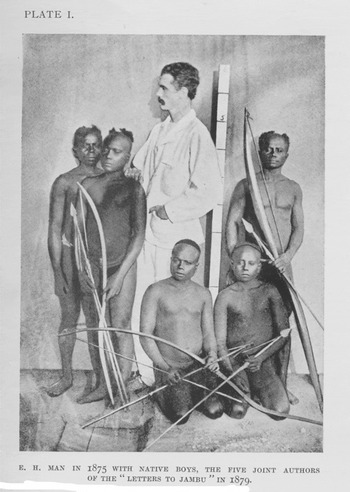
“E. H. Man in 1875 with Native Boys,” in Man, Ellis, and Temple, On the Aboriginal Inhabitants of the Andaman Islands, frontispiece.

Once again, the measuring stick is visually central, but here there are five Andamanese men (or “boys,” as the caption asserts), with Man himself at the very heart of the picture. Man, towering over the Andamanese, is himself almost the unit of measurement, the same length as the ruler to his left. The unclothed “native boys” (again, some seated) carry those archetypal signifiers of primitiveness, large and fearsome weapons, artfully arranged here to loom over their owners as does Man. These are photographs that straddle two worlds. They include the recognizably scientific apparatus of anthropometry, but their distance from the standard scientific conventions (their multiple figures, decoration, and Man's visual presence) align them with the more popular colonial photography of the period in which groups of “naked natives” displayed the badges of primitivism (spears, exotic headdresses, and so on).
Moreover, Man's words and his pictures told rather different stories. In his writings, as I have mentioned, he was at pains to underscore modesty, especially among those islanders he deemed “advanced.” Especially among strangers, according to Man, clothing was de rigueur, yet in these images we see none. Were these the less “advanced,” the more typical—and still savage—locals? The Andaman and Nicobar islanders, after all, along with Australia's Aboriginal populations and the Fuegians of Darwin's Beagle voyage, were regarded in the West as the most primitive societies on earth, living examples of Stone Age cultures. In Darwin's recollections, in treatises on Australian indigenes, and in literature on these islanders, nakedness is central to a deeply primitive lifestyle. Man, not surprisingly, then, read an interest in clothing among the islanders as a mark of progress, but his visual record offered images divested of these key attributes of civilization.
We know from a variety of accounts, and from the responses the Colonial Office received to its request on behalf of Huxley, that people did resist being photographed naked, sometimes successfully. Photography itself was sometimes viewed askance by colonial populations, which made it harder to acquire what the scientists wanted. Indeed, im Thurn came to the rather extraordinary conclusion in 1893 that the “bodies of primitive folk might … be more accurately measured and photographed for such purposes dead than alive, could they be conveniently obtained when in that state.”Footnote 39 Yet there are thousands upon thousands of these photographs—not exclusively British and by no means predominantly in the scientific idiom. Willing or not, indigenous peoples were photographed, alive, in naked and seminaked states, in groups and alone. Their images appeared in exhibitions, on postcards, on the printed page, and in an array of popular periodicals such as the Illustrated London News as well as journals aimed at the intelligentsia, and they were invariably trumpeted as authentic representatives of why colonialism mattered.
It was often the caption that separated the scientific from the commercial image. In keeping with the idea of sober data collection and empirical methods, anthropometrical photographs identified sex, race, date, and seldom much more. Subjects were sometimes though not often named. The postcard trade often followed suit, identifying images merely as types: tribal, racial, and so on, although there was an entire subgenre of “native beauties” that doubtless enjoyed a brisk trade. Studio photographers often used amusing or moralistic captions as a sales pitch, but it was sexuality that was always the ultimate and most successful sales tactic. Pictures of colonized women played heavily on the distinction between the clothed, sanctified, and largely unavailable body of the white woman and the allegedly easy sexuality of colonial women. For the most part, the women etched, sketched, photographed, and otherwise displayed as anthropological types from the far reaches of the empire looked steadily back at the viewer. This returned gaze was from its earliest appearance, as George Needham has shown, a pose typical in specifically pornographic photography.Footnote 40 Viewers of colonial images would not necessarily have been aware of their pornographic counterparts, of course, but the shared message of female brazenness nonetheless links these images. Women involved in pornography, African women, and women willing to share their bodies with an unknown viewer were all women, such pictures suggest, for whom shame was immaterial. In the case of colonized women, the parallel message that the naked state was routine and normal was a commentary not on rogue women who had gone astray (the life models and sex workers of urban Britain) but of entire societies. Here was primitivism displayed quite literally in the raw, in the flesh, in the moment.
While there are probably as many images and discussions of naked colonized men as there are of their female counterparts, the female breast was frequently central to visual and verbal conversations around colonial nakedness.Footnote 41 If I may be forgiven for stating the obvious, and if we might fleetingly think of the realism that is possible with a camera, to photograph an adult woman naked is, among other things, to photograph her breasts. The same logic applies to the genitalia of the naked man, yet sightings of that mostly off-limits and ever-sensitive organ of so very great a deal of power, the penis, are rare. But the breast was rarely covered up and in many photographs took center stage, as women were asked to clasp their hands above their heads or adopt particular postures designed to please the appreciative male viewer.
The female breast is everywhere in photographs, in drawings, and in written accounts of the naked native. The images range from the frankly erotic to the coy, from the ascetically scientific to the aesthetically exuberant. The “semiscientific” breast was a popular illustration: in figure 4, the anthropometric trope is maintained both by the profile view (a standard scientific convention) and by a vertical tree limb that conveniently echoes the measuring stick. The caption instructs us to pay closer attention to the head than the breasts, but the shaved head that is supposed to be at the center of our attention could just as easily have been displayed in a simple headshot. The body is not necessary, but its presence invites the eye to wander downward. This was a convention used by many photographers. In postcards, travel accounts, and many other texts, a caption or description assures the reader that the focus of the picture is some noteworthy and interesting anthropological characteristic (hair style, jewelry, or scarification), while the inevitable inclusion of the breasts suggests otherwise.
“Negrito Girls (Showing Shaved Head at Back),” in Wilfrid Walker, Wanderings among South Sea Savages and in Borneo and the Philippines (London, 1909), opp. 76

It was, though, not only the high pert breasts of young women that were presented to viewers and readers. Writers since at least the early modern period had remarked on the unattractiveness of the naked heavy breast and of the shamelessness of its owner. The pendulous, large, and sagging breast did a different kind of work. It was, on the one hand, a reminder of women's reproductive role (women were closer to nature than men, and none more so than those who lived savage, primitive lives), and, on the other hand, it exemplified the unattractiveness of the savage and the aesthetic indifference of uncivilized peoples seemingly unaffected by such ugliness or indeed by unchristian nakedness.Footnote 42 Sexual availability was a double-edged sword: the promise of the beautiful young body was shadowed by what it might subsequently become as a direct result of the sexuality it exposed.
While the breast took center stage more often than not, female genitalia were rarely displayed. Scientists and natural historians demonstrated a keen interest in viewing, measuring, and dissecting these organs after death, and early modern travelers had spread tales of unusual and interesting sexual organs among alien peoples. Closer to home, scientists speculated that prostitutes, as well as women of different races, might be genitally distinct from their respectable sisters.Footnote 43 Early in the twentieth century, Havelock Ellis strenuously argued that the necessary primitiveness of the sexual organs made them aesthetically unappealing to all but the most primitive of humans.Footnote 44 This was the same racialized aesthetic that differentiated between the breasts of nubile but childless women and those who had breast-fed children and were thus sexually experienced. Ugliness, the death of desire, followed sexual maturity; it was the promise of sexuality that these images of indigenous women hinted at most strongly, a reading of desire as an endlessly renewable resource supplied by bodies from Britain's ever-growing colonial territories that could be photographed, observed, and more.
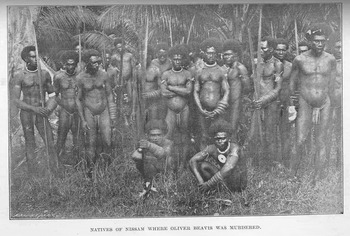
In displaying male bodies, the colonial imaginary often linked nakedness and physical danger. The caption in figure 5 explicitly equates violence and naked primitive masculinity. Naked male figures were commonly displayed with the trappings of war and sometimes (especially in the eighteenth century) the cannibalistic spoils of victory. Physical prowess rendered colonial men not manly but animalistic. The act of capturing colonial male nakedness, whether in an illustration or a treatise, was as much a form of symbolic taming as was the imposition of colonial power itself, so often logged as an emasculation of the conquered. Thus while the male Zulu or Maori could be lauded for prowess in war and for a manly body, the absence of clothing that connoted his distance from civilization rendered him, too, closer to nature, further from reason, and in material as well as figurative ways, impoverished and politically, if not physically, powerless.
“Natives of Nissam Where Oliver Beavis Was Murdered,” in H. Cayley-Webster, Through New Guinea and the Cannibal Countries (London, 1898), 337

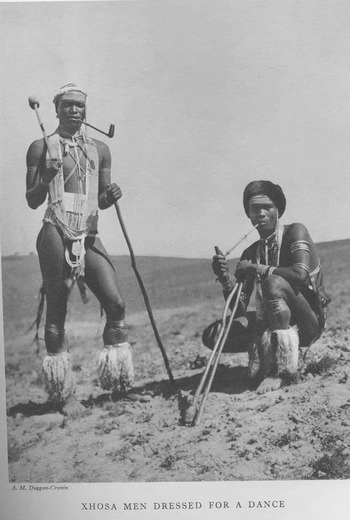
In the images of the Bantu peoples of South Africa in figures 6 and 7, shot by Alfred Duggan-Cronin between the First and Second World Wars, the men are in the process of dressing for a major event, yet to Western eyes even in their full finery they appear only partially clothed.Footnote 45 Even dressed, these Zulu men essentially remain examples of that representative figure, the naked native. The dress achieved here hardly conformed to Western notions of “proper” clothing. Images such as these often conveyed a notion of excessive native fussiness over bodily decoration and embellishment. The clothing indigenous peoples were described as donning was itself also closer to nature than were Western garments: typical in descriptions and images of Africans, Native Americans, Pacific islanders, and many others were animal skins, feathers, necklaces made from teeth and bone, and so on.Footnote 46 There was no necessary contradiction between depicting the naked native and exhibiting exotic and peculiar costume. These images existed on a continuum that not only emphasized the outlandishness of native dress but also, and crucially, did little to cover that which defined the native as in a state of nature: nakedness.
“Xhosa Initiates Dressing for the Dance,” in A. M. Duggan-Cronin, The Bantu Tribes of South Africa: Reproductions of Photographic Studies (Cambridge, 1939). Reproduced by kind permission of the Duggan-Cronin Collection, McGregor Museum, Kimberley, South Africa

“Xhosa Men Dressed for a Dance,” in Duggan-Cronin, The Bantu Tribes of South Africa. Reproduced by kind permission of the Duggan-Cronin Collection, McGregor Museum, Kimberley, South Africa

These portrayals were also time and again wildly inaccurate. Occasional and festive dress was represented as quotidian, and crucial elements of dress were omitted or assigned to the wrong group. Even among the images designated as scientific, ceremonial and everyday garments were confused with one another and their signification misunderstood.Footnote 47 Likewise, the claim that nakedness was a widespread and definitional aspect of primitiveness was, of course, a massive and frequently inaccurate generalization. The widely differing precepts and practices of different cultures as well as their attitudes toward the body and clothing were not reducible to a single standard. What constituted nakedness varied widely from culture to culture and could have profoundly different meanings; with the advent of colonialism, attitudes often shifted considerably. The claims of scientific precision and exactitude thus ring hollow.
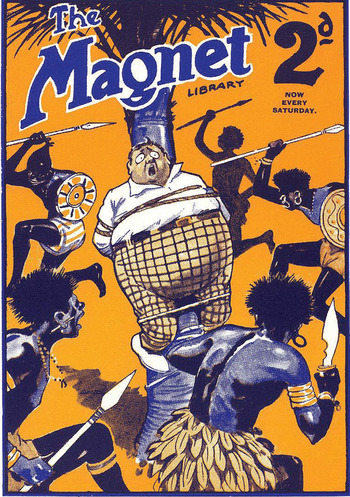
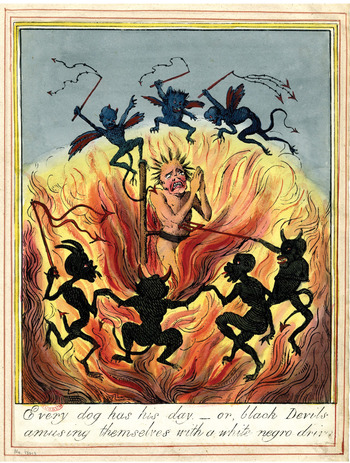
Another of the myriad subgenres of naked representation can be found in works aimed at children. Of the images of colonized peoples that crowd children's literature, comic books, and school textbooks, the most enduring is that of the grass-skirted or loin-clothed but otherwise naked black man as seen in figure 8. This is the timeless native, the veritable rationale for the colonial enterprise. Danger lurks here—Billy Bunter tied to the stake—but every British schoolboy knew that this could not and would not be the fat boy's demise.Footnote 48 Clever, brave schoolmates, teasing Bunter as they mercilessly did, would nonetheless outwit the lowly grinning savages. The empire would, in this version of events, always win. Images such as these, and they are legion, instruct as they classify, drawing on the long lineage associating nakedness and the primitive. There is no eroticism here, for sure, but it is striking how heavily this marvelously vivid image from 1927 leans on existing iconography depicting wild and morbidly gleeful black savages. The leaping demons of figure 9, explicitly identified in this satirical Cruikshank etching from 1818 as “black devils,” draw on the same visual and racial repertoire as J. H. Chapman's lively cartoons for boys more than a hundred years later.
Cover of The Magnet, 1 October 1927. Reproduced by kind permission of John Chapman

Every dog has his day; or, black devils amusing themselves with a white negro driver, 1818 (lithograph), George Cruikshank (1792–1878), © Trustees of the British Museum

The erotics of colonial power are, then, rather more complicated than they might seem at first glance. There is no simple power-driven equation between a domineering white masculinity and a hypersexualized but simultaneously feminized subject population, stripped of clothing as of authority. Both of these exist, without doubt, and beyond the obvious and unhelpful stereotype. The empire was a masculine space, and the language of penetration and conquest certainly carried a sexual charge. But there were other competing visions and versions of empire, and there was considerable pushback from the colonized. These alternatives tempered, interfered with, and sometimes even mocked imperial authority. There were erotic images and descriptions, and plenty of them, but they existed side by side with words and pictures that sought to portray the antithesis of desire. For every portrait of a comely bare-breasted maiden, there was her obverse. The group picture, a common portrayal, downplayed the erotics of the naked body, instead signifying its primitive strangeness precisely through its very mundaneness, its apparently quotidian presence. The message conveyed was that this was the native at home, in situ (for this was assuredly an archaeology), and if the scant dress of daily life suggested a constant of oversexualization, it was not one that sought to appeal to its British and Western audience. Above all, as I hope I have shown here, the portrayals claimed for and by science deployed a language, visually as well as textually, designed to create distance from the merely erotic. The language of neutrality—in images as well as in prose—aided the immensely wide circulation of images of colonial people without any clothes on. Whatever our contemporary skepticism regarding this claim to detached objectivity, the strategy worked at many levels and for a remarkably long time.
Let us fast-forward to 1937 when Charles Duguid founded the Ernabella Medical Mission in the northern reaches of South Australia. This Presbyterian mission was founded during the period now usually referred to as that of the “stolen generation,” during which Aboriginal children of mixed descent were removed from their natal families in a bizarre experiment at “breeding out the colour.”Footnote 49 The policy drew a critical distinction between, in the parlance of the day, the “half-caste” child, ripe for such a breeding experiment, and the “full-blood” Aboriginal increasingly removed to remote reservations. The authorities at Ernabella followed contemporary practice in making that distinction matter. Children attending the mission school were required to attend “in their natural state.”Footnote 50 The language clearly echoes an earlier anthropological and natural history vocabulary that distinguished modern from primitive through the lens of the “natural.” What was meant here by “natural state” was, of course, nakedness—but not for every pupil. It was only the children classified as full-bloods upon whom that requirement was imposed. Those mixed-race children not yet ensnared by the child-removal policies, by contrast, were required to don clothing at school; they were, after all, at least theoretically, on their way to modernity because of their biological makeup.
Oral histories suggest that the policy was not wildly popular with those at whom it was aimed.Footnote 51 Aboriginal peoples increasingly chose to wear clothes, partly as a sign of status but also because clothes helped them keep warm in the cold nighttime conditions in the desert.Footnote 52 Among women, clothing reduced their sense of sexual vulnerability, and Aboriginal women had experienced a great deal of vulnerability under colonial rule.Footnote 53
So here we are in 1940, the year the Ernabella School opened, in a former British colony where it is not indigenous time but European time that has stood still. Aboriginal peoples had made quite clear what they wanted (clothes), but their self-appointed helpers and guardians desperately wanted to see Aboriginal time as of and in the past. The naked, the natural, was a place, a belonging, that could continue to mark difference in stark and visible form even as twentieth-century anthropology began to move away from its nineteenth-century roots toward more culturalist and relativist perspectives. Nakedness was a natural state for natural peoples.
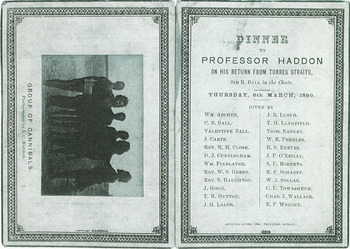
If, as Amanda Vickery has claimed, access to privacy was an index of power, then the capacity to enact the pictures I have discussed here, to request them from so august a body as the Colonial Office, or to insist on nakedness as a school uniform fully articulates the unequal power relations at the heart of colonial rule.Footnote 54 Much of the discourse around the naked native focused on the troubling refusal of the colonized to recognize the proper boundaries between public and private. Those who did not appreciate the regulatory importance of the division could be denied privacy with impunity. When Alfred Haddon, doyen of the new British field anthropology, returned home to Dublin from his first trip to the Torres Straits Islands in 1888, he brought with him a great number of photographs, examples of local artifacts, and much more. He returned to the islands in 1898 with an impressive multidisciplinary team, making early ethnographic films and sound recordings. A good deal of significant academic work came out of those two expeditions, and so did this rather astonishing invitation to dine with him in March 1890 (fig. 10).
Reproduced by permission of University of Cambridge Museum of Archaeology & Anthropology. Alfred Haddon took this photograph on 16–17 August 1888, in Western Division, then British New Guinea

The conventions of the formal dinner party played out the public and private divide night after night in the homes of the wealthy and influential. Formal seating arrangements designed with both politics and propriety in mind, the postprandial segregation of the sexes, and the studied invisibility of the servants all signified the particularities of public and private in a carefully choreographed realm where they could briefly and safely meet.
This invitation invites a veritable avalanche of discursive playfulness. The primitives, whose dining preference (human fare) and absence of clothing guaranteed their visibility and availability as entertainment and education, were served up as part of the evening's fare at a formal dinner where conformity to a dress code was a given. The absence of decorum on the part of natives—indexed visibly by their lack of clothing—conferred considerable license on their colonial masters. What better challenge to cannibalism than to make its display and dissection integral to a dinner party celebrating the work of a colonial anthropologist?
The invitation surely occupies the ground between the scientific and the commercial. It offers simultaneously the scientific photo and the posed group photo, and above all, the quintessential image of the naked savage. It does so under the imprimatur of unimpeachable respectability and in a context that mixed serious purpose and entertainment. Invitations such as these sat on the mantelpieces of male academics where they may well have been viewed by wives and children as well as students; they would certainly have been viewed by servants. What would our outraged British matron have thought about Haddon's invitation or the access to it that not just impressionable teenagers but those of the lower orders might have had? At one level, the matron, whoever she was, had already lost the battle in 1885, for the close association between nakedness and nativeness was already commonplace. Descriptions and images that propagated that association were available in books, postcards, and a plethora of other media, easily accessible to a wide variety of Britons, including the servants. The non-Western body, with its absence of shame and its apparent normalizing or incomprehension of nudity, remapped the violation of exhibiting white nakedness, creating a safe space for observing naked bodies belonging to nameless, oversexualized peoples to whom shame could not, allegedly, attach and displacing attention away from bodies closer to home. Just try to imagine Haddon's invitation with white bodies: the absolute impossibility, the absurdity of that proposition, is surely the naked truth of my title. In refusing to look away (as some would advise us to do), in confronting the reality of the images, verbal and visual, that crowd the literature and the iconography of colonialism, we can track the production of the idea of the naked native that lies squarely and insistently at the intersections of art, science, and pornography. Nakedness was never merely a description of the state of unclothedness, but a set of cultural artifacts, a set of cultural determinants, a set of describers, a condition of the social, that reined in, even as it produced desire, that became a telling of the colonial that offered the prospect of secular revelation revealed through the body stripped literally and metaphorically to its apparent and timeless essence.