Introduction
‘Supporting people to combine work and care has now become an economic as well as a social imperative’, a report from the Government in England stated in 2013 (Her Majesty's Government (HMG) and Employers for Carers, 2013: 8). Demographic changes, including the rise in the number of older people and the proportional decline of the working age population, mean that many people are trying to juggle work and unpaid care for family and friends. As a result, the reconciliation of employment and unpaid caring is becoming an important social issue, not just in England, but in many other countries (Fine, Reference Fine2012; Kröger and Yeandle, Reference Kröger, Yeandle, Kröger and Yeandle2013; Schneider et al., Reference Schneider, Trukeschitz, Mühlmann and Ponocny2013). The international literature shows that tensions between work and care can lead unpaid carers to leave employment, resulting in costs for individuals, employers and society (MetLife, 2006; Colombo et al., Reference Colombo, Llena-Nozal, Mercier and Tjadens2011; Schneider et al., Reference Schneider, Heinze and Hering2011; Social Protection Committee, 2014; Hoff, Reference Hoff2015).
In England, approximately 345,000 carers aged sixteen to sixty-four years have left employment because of caring and remain out of work (Pickard et al., Reference Pickard, King, Brimblecombe and Knapp2018a). The annual public expenditure costs of carers leaving employment are now estimated at £2.9 billion in England, based on lost tax revenues and social security spending on carers who have left employment because of caring (Pickard et al., Reference Pickard, King, Brimblecombe and Knapp2018a). This recent estimate, which relates to 2015–16, is considerably higher than a previous estimate, carried out in 2012, which found that the annual public expenditure costs of unpaid carers leaving work in England was £1.3 billion (Pickard et al., Reference Pickard, King, Knapp and Perkins2012). The more recent estimate is higher mainly because it includes key social security benefits that were not previously taken into account, including Income Support and Housing Benefit, as well as Carer's Allowance (Pickard et al., Reference Pickard, King, Brimblecombe and Knapp2018a). The estimate of the costs of carers leaving work is still not fully inclusive and would be even higher if it included, for example, the costs of carers who remain in employment but reduce their working hours due to caring (Pickard et al., Reference Pickard, King, Brimblecombe and Knapp2018a).
Government policy in England gives high priority to ‘enabling those with caring responsibilities to fulfil their. . . employment potential’ (HMG, 2014: 28). Policy around reconciling work and care by successive governments has primarily emphasised the role of employers in providing flexible working conditions (HMG, 1999, 2008). More recently, there has been an emphasis on ‘replacement care’, or paid services for the person cared for (HMG, 2008, 2010). In the Government's 2010 Carers Strategy, there is an emphasis on developing ‘social care markets’ to meet carers’ needs for ‘replacement care to enable them to continue to work’ (HMG, 2010: 16). The Care Act 2014 states that carers’ assessments must consider whether the carer wants to work and introduces a new duty on local authorities to provide support to meet carers’ needs, with Explanatory Notes making it clear that support for carers may be met by providing services to the person cared for, for example, by providing ‘replacement care’ (House of Commons, 2014: paragraph 152).
However, the high costs of carers leaving employment suggest that more needs to be done to support working carers in England. The recent emphasis on ‘replacement care’ in government policy represents a considerable change from previous government policies, which rejected any notion of replacing, or substituting, unpaid care with paid services (Pickard, Reference Pickard2001, Reference Pickard2012). In terms of the conceptualisation of carers in the service system, an emphasis on ‘replacement care’ is consistent with the ‘superseded carer’ model (Twigg, Reference Twigg1996). As such, it involves recognition of the ‘dual focus of caring’, acknowledging that caring takes place in a relationship and that policy should focus on both the disabled or older person and the carer. However, it is important to note that current government policy sees ‘replacement care’ as taking the form of services provided through ‘social care markets’ and is consistent with a neo-liberal approach to care provision (HMG, 2010, 2014). It is, however, likely that more publicly-funded ‘replacement care’ is also needed.
Consistent with the international evidence, recent research in England shows that paid services for the person cared for are effective in supporting working carers’ employment (Doty et al., Reference Doty, Jackson and Crown1998; Lundsgaard, Reference Lundsgaard2006; Lilly et al., Reference Lilly, Laporte and Coyte2007; Scharlach et al., Reference Scharlach, Gustavson and Dal Santo2007; Pickard et al., Reference Pickard, King, Brimblecombe and Knapp2015, Reference Pickard, Brimblecombe, King and Knapp2018b). In England, analysis using large-scale survey data, collected in 2009/10, shows that unpaid carers, providing care for ten or more hours a week, are more likely to be in employment if the person they care for receives paid services, including home care, help from a personal assistant, day care, meals-on-wheels or their equivalent and short-term breaks (Pickard et al., Reference Pickard, King, Brimblecombe and Knapp2015). A recent longitudinal study in England shows that unpaid carers, providing care for ten or more hours a week, who look after someone who does not receive paid services, are subsequently more likely to leave work to care than those looking after someone who receives services (Pickard et al., Reference Pickard, Brimblecombe, King and Knapp2018b).
However, although the evidence suggests that paid services for the person cared for are effective in helping carers to remain in employment, access to publicly funded care and support services in England by working carers is currently low (Yeandle et al., Reference Yeandle, Bennett, Buckner, Fry and Price2007; Arksey and Glendinning, Reference Arksey and Glendinning2008; Vickerstaff et al., Reference Vickerstaff, Loretto, Milne, Alden, Billings and White2009). Only approximately 36 per cent of employed carers or the people they care for have access to any social care services (Milne et al., Reference Milne, Brigden, Palmer and Konta2013). Most working carers look after people aged sixty-five and over (Brimblecombe et al., Reference Brimblecombe, Pickard, King and Knapp2017; Pickard et al., Reference Pickard, Brimblecombe, King and Knapp2018b), but access to local authority funded services by older people is restricted by strict eligibility criteria and means-testing. In 2015, annual public expenditure on social care services for older people in England was only £6.9 billion, while private expenditure, including user charges, was £9.3 billion (Wittenberg and Hu, Reference Wittenberg and Hu2015).
The aim of the present study is to make a national estimate of the public expenditure costs of providing ‘replacement care’ for working carers in England and to compare these costs with the public expenditure costs of carers leaving employment. The national estimate of the costs of providing ‘replacement care’ services for working carers draws on secondary analysis of a recent wave of the English Longitudinal Study of Ageing. The focus in this article is on carers whose employment is likely to be ‘at risk’ because they provide unpaid care for ten or more hours a week to someone who does not receive paid services (King and Pickard, Reference King and Pickard2013; Pickard et al., Reference Pickard, King, Brimblecombe and Knapp2015, Reference Pickard, Brimblecombe, King and Knapp2018b). The public expenditure costs of providing ‘replacement care’ services for working carers are compared with the public expenditure costs of carers leaving employment, to examine how far greater public investment in ‘replacement care’ to support working carers would represent good value for money for the Government.
Data and methods
Data: English Longitudinal Study of Ageing, Wave 6
The analysis uses the English Longitudinal Study of Ageing (ELSA), which is a longitudinal survey of people in private households in England. Data are recorded at two-yearly intervals and the present study uses Wave 6, which was collected in 2012–13 (Bridges et al., Reference Bridges, Hussey and Blake2015). The survey collects data on people aged fifty and over and includes information on their receipt of both paid and unpaid care. For reasons explained further below, the ELSA data are utilised here to provide information on the average amount of home care services used by older people aged sixty-five and over with unpaid care. Using the cross-sectional weight supplied with the dataset, the weighted sample size of older people aged sixty-five and over in Wave 6 of ELSA is 4,334.Footnote 1
Other data sources
The analysis also uses other relevant data. The analysis uses information on the number of carers who have left work because of caring and the public expenditure costs of carers leaving employment in England (Pickard et al., Reference Pickard, King, Brimblecombe and Knapp2018a). ‘Replacement care’ costs are compared with the costs of carers leaving employment, and the latter relate to the 2015–16 financial year, so the estimate of ‘replacement care’ costs also relates to 2015–16. The estimate of ‘replacement care’ costs uses data on the average hourly costs of home care in England in 2015–16 (Health and Social Care Information Centre (HSCIC), 2016).
Methods: key question and assumptions
The numbers of carers who have left work due to caring in England provide us with an estimate of the numbers of carers who are likely to need ‘replacement care’. Approximately 345,000 carers aged sixteen to sixty-four years in England have left work because of caring, with an estimated 225,000 leaving full-time, and 120,000 leaving part-time, employment (Pickard et al., Reference Pickard, King, Brimblecombe and Knapp2018a). The present article therefore asks: how much would it cost the Government to provide ‘replacement care’ for these approximately 345,000 carers?
It is assumed here that the aim of a policy of providing ‘replacement care’ would, however, be to support carers to remain in employment, and so the intention would be to provide these 345,000 carers with ‘replacement care’ services before they leave work. The policy would be focused on working carers aged sixteen to sixty-four whose employment is likely to be ‘at risk’ as a result of caring. The employment of carers is likely to be ‘at risk’ if they provide care for ten or more hours a week to someone who does not receive paid services. International research shows that unpaid care has a negative effect on employment when care is provided for ten or more hours a week (Arber and Ginn, Reference Arber and Ginn1995; Ettner, Reference Ettner1995; Carmichael and Charles, Reference Carmichael and Charles2003a, Reference Carmichael and Charles2003b; King and Pickard, Reference King and Pickard2013; Carr et al., Reference Carr, Murray, Zaninotto, Cadar, Head, Stansfeld and Stafford2016) and that carers are significantly more likely to be in employment if the person they care for receives paid services (Doty et al., Reference Doty, Jackson and Crown1998; Lundsgaard, Reference Lundsgaard2006; Lilly et al., Reference Lilly, Laporte and Coyte2007; Scharlach et al., Reference Scharlach, Gustavson and Dal Santo2007; Pickard et al., Reference Pickard, King, Brimblecombe and Knapp2015, Reference Pickard, Brimblecombe, King and Knapp2018b).
In making an estimate of the costs of ‘replacement care’, it is not assumed that every hour of unpaid care would be ‘replaced’ by an hour of paid care (cf. House of Commons Health Committee, 1996; Pickard, Reference Pickard2004). Instead, information is used on current levels of services received by care-recipients. It is assumed that a ‘replacement care’ policy would allocate services on a comparable basis to the services currently received by older people with unpaid care in England.
Methods: measuring the amount of ‘replacement care’ to be allocated
Secondary analysis of ELSA data is utilised to obtain information on the current amount of paid, or formal, services received by older people in England. The focus here is on the average number of home care hours received by older people. It is assumed that all those who receive services under the ‘replacement care’ policy would receive home care. Home care is the only service that previous research has shown to be effective in supporting the employment of both men and women carers when received on its own and not in collaboration with other services (Pickard et al., Reference Pickard, King, Brimblecombe and Knapp2015). The amount of home care received by older people aged sixty-five and over is used primarily because, as observed earlier, the majority of working carers look after older people.Footnote 2 In the ELSA data, home care is defined as help from a ‘home care worker, home help or personal assistant’. ‘Home care’ refers primarily to help with personal care; ‘home help’ refers to help with both personal care and domestic duties; while ‘personal assistants’ are people employed by individuals with care needs, often in receipt of personal budgets. ELSA provides information on the hours of home care received in the last week by each respondent from up to three home care workers, home helps and/or personal assistants.
The analysis of ELSA presented here examines the average amount of paid home care hours received by older people with unpaid care. The evidence shows that, where the care-recipient uses paid home care services, unpaid carers providing care for ten or more hours a week are very unlikely to leave employment (Pickard et al., Reference Pickard, Brimblecombe, King and Knapp2018b). The analysis therefore looks at the average amount of home care received by older people with ten or more hours a week of unpaid care and, under the ‘replacement care’ policy, this amount of home care is then allocated to carers ‘at risk’ of losing their employment. The ELSA dataset allows for the identification of unpaid care from a husband, wife or partner; daughter; son; grandchild; sister; brother; other relative; friend or neighbour. Apart from a spouse or partner, respondents are asked about help from up to three family members/friends of each type. The amount of unpaid care in the last week received from each family member and/or friend is recorded in bands. The analysis here looks at the average weekly home care hours received by older people, who are cared for by someone providing unpaid care to him/her for ten or more hours a week.
Methods: estimating the costs of a ‘replacement care’ policy for working carers
The estimation of ‘replacement care’ costs assumes that the unit cost of home care is the average cost of ‘externally provided’ home care in England, which was £14.28 in 2015–16 (HSCIC, 2016). Most home care services in England are ‘externally provided’: that is, they are contracted out to the independent sector, which is made up of voluntary and for-profit providers (House of Commons, 2016a). However, there are regional variations in the hourly cost of home care, ranging from £12.57 in the North West to £16.37 in the South West (HSCIC, 2016). Therefore, sensitivity analysis is conducted around the costs of ‘replacement care’ services, based on regional variations in the hourly costs of home care.
The cost estimates presented here make a number of assumptions. First, it is assumed that all those who receive services under the ‘replacement care’ policy would receive home care. However, what is in effect being allocated is a sum of money, which could take the form of a personal budget or direct payment and utilised to purchase other services, such as day care, meals or breaks (HMG, 2007). In addition, the cost estimates presented here are based on the assumption that all the costs of services are public expenditure costs. No attempt is made here to allow for means-testing of services,Footnote 3 because means-testing would reduce the numbers of working carers who would receive support. This assumption is discussed further at the end of the article.
Results
Amount of ‘replacement care’: mean hours of home care
As indicated above, the first stage of the analysis is to utilise ELSA (Wave 6) data to estimate the average amount of home care hours received by older people, who are cared for by someone providing unpaid care for ten or more hours a week.
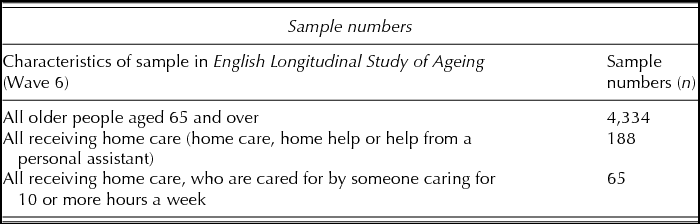
Table 1 shows that, of the 4,334 people aged sixty-five and over in Wave 6 of ELSA, 188 receive home care and, of these, sixty-five are looked after by someone providing unpaid care for ten or more hours a week. Therefore, only a small minority of older people in the survey (4.4 per cent) receive home care and, of these, only approximately a third are looked after by someone providing unpaid care for ten or more hours a week. These results are consistent with previous research, which shows that home care receipt by older people is low in England and that most older people who receive home care do not receive unpaid care (Comas-Herrera et al., Reference Comas-Herrera, Wittenberg and Pickard2010).
Number of older people receiving home care, who are cared for by someone providing unpaid care for 10 or more hours a week: derivation of sample, England, 2012–13.

Source: English Longitudinal Study of Ageing, Wave 6, 2012–13
Note: The sample is weighted using the cross-sectional weights supplied with the Wave 6 dataset.
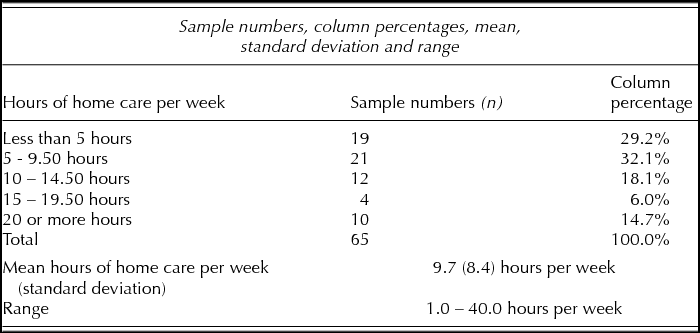
Table 2 shows the distribution of hours of home care and mean hours of home care received by older people who are looked after by someone providing unpaid care for ten or more hours a week. The table shows that approximately two-thirds of older people receive home care for five or more hours a week and approximately 40 per cent receive home care for ten or more hours a week. The mean hours of home care per week are 9.7 hours, with a standard deviation of 8.4 hours.
Distribution of hours of home care, and average home care hours, received by older people who are cared for by someone providing unpaid care for 10 or more hours a week, England, 2012–13.

Source: English Longitudinal Study of Ageing, Wave 6, 2012–13
Note: The sample is weighted using the cross-sectional weights supplied with the Wave 6 dataset.
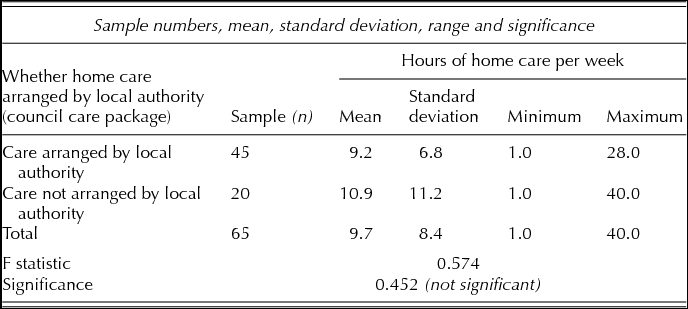
The estimate of ‘replacement care’ costs, presented here, relates to public expenditure costs and it might therefore be appropriate to focus only on care arranged by local authorities, or ‘council care packages’. Table 3 shows that most of the older people receiving home care in the dataset had had their care arranged by the local authority. The average weekly hours of home care received by someone who had had their care arranged by the local authority is 9.2 hours, compared to 10.9 hours received by someone who had arranged their care privately, but the difference is not significant (Table 3). Therefore, in order to maximise the sample size, it was decided to use the mean hours of care for all home care recipients in estimating the costs of ‘replacement care’, irrespective of whether or not they are in receipt of a council care package.
Average hours of home care received by older people who are cared for by someone providing unpaid care for 10 or more hours a week, by whether or not home care was arranged by the local authority, England, 2012–13.

Source: English Longitudinal Study of Ageing, Wave 6, 2012–13
Note: The sample is weighted using the cross-sectional weights supplied with the Wave 6 dataset.
Costs of ‘replacement care’ policy for working carers
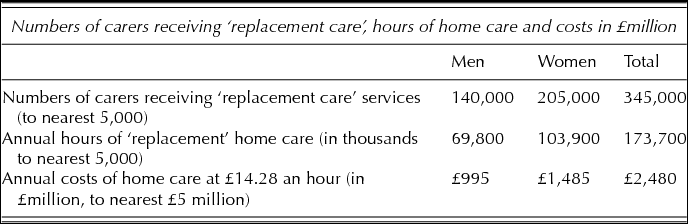
The costs of implementing a ‘replacement care’ policy are shown in Table 4. The numbers of working carers allocated ‘replacement care’ services are multiplied by the mean hours of home care received by older people who were looked after by someone providing unpaid care for ten or more hours a week (9.7 hours per week). The table shows that nearly 174 million (173,700,000) hours of home care a year would be needed to provide ‘replacement care’ to working carers providing care for ten or more hours a week. Assuming that the unit cost of home care is £14.28 an hour, the estimated costs of providing home care as part of a ‘replacement care’ policy would be approximately £2,480 million (£2.5 billion) a year (Table 4).
Estimated costs of ‘replacement care’ services for working carers, by carer's gender, England, 2015–16.

Sources: English Longitudinal Study of Ageing, Wave 6, 2012–13; Pickard et al., Reference Pickard, King, Brimblecombe and Knapp2018a; HSCIC, 2016
Notes: The annual hours of ‘replacement care’ are assumed to be 504 hours (9.7 hours a week). The hourly cost of home care is the average cost of externally provided home care services in England in 2015-16 (HSCIC, 2016).
Sensitivity analysis around costs of ‘replacement care’ policy for working carers
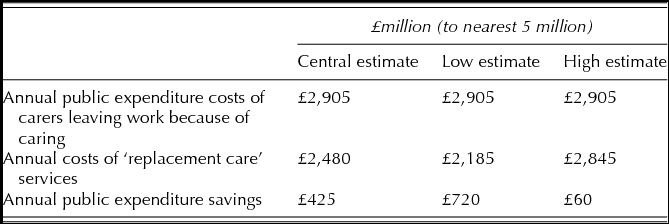
As indicated earlier, sensitivity analysis is conducted around the costs of ‘replacement care’ services, based on regional variations in the hourly costs of home care (Table 5). The lowest average regional cost of home care is in the North West of England, where a unit of home care costs £12.57 an hour. Assuming this lower rate of home care costs, the annual costs of providing home care as part of a ‘replacement care’ policy would be £2,185 million (£2.2 billion) (Table 5). The highest average regional cost of home care is in the South West of England, where a unit of home care costs £16.37 an hour. Assuming this higher rate of home care costs, the annual costs of providing home care as part of a ‘replacement care’ policy would be £2,845 million (£2.8 billion) (Table 5). Sensitivity analysis therefore shows that the costs of ‘replacement care’ on the assumptions used here would range from approximately £2.2 billion a year to approximately £2.8 billion a year, with a central estimate of approximately £2.5 billion a year.
Annual costs of ‘replacement care’ services and annual savings to public expenditure: sensitivity analysis around costs of ‘replacement care’ services, England, 2015–16.

Sources: English Longitudinal Study of Ageing, Wave 6, 2012-13; Pickard et al., Reference Pickard, King, Brimblecombe and Knapp2018a; HSCIC, 2016
Notes: The central estimate of the costs of ‘replacement care’ services assumes an hourly cost of home care of £14.28; the low estimate assumes an hourly cost of home care of £12.57; and the high estimate assumes an hourly costs of home care of £16.37 (HSCIC, 2016).
Comparison of costs of ‘replacement care’ with costs of carers leaving employment
As indicated earlier, the annual public expenditure costs of carers leaving employment are approximately £2,905 million (£2.9 billion) (Pickard et al., Reference Pickard, King, Brimblecombe and Knapp2018a). Assuming that all the costs of ‘replacement care’ services for working carers are publicly funded, the central estimate analysed here is that the public expenditure costs of ‘replacement care’ would be £2.5 billion a year and therefore the costs of ‘replacement care’ would be £425 million a year lower than the costs of carers leaving employment (Table 5). The savings in public expenditure would be even higher at the lower estimate of the costs of ‘replacement care’. The lower estimate is that the costs of ‘replacement care’ would be £2.2 billion a year and the costs of ‘replacement care’ would therefore be £720 million a year lower than the costs of carers leaving employment (Table 5). Even at the higher estimate, the costs of ‘replacement care’ would be less than the costs of carers leaving employment. The higher estimate is that the costs of ‘replacement care’ would be £2.8 billion a year and the costs of ‘replacement care’ would be approximately £60 million a year lower than the costs of carers leaving employment (Table 5).
Potential implementation of ‘replacement care’ policy over a five-year period
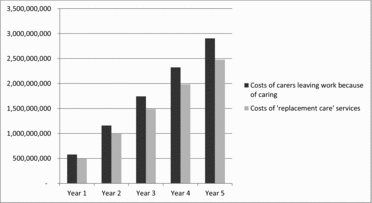
The costs of implementing a ‘replacement care’ policy would therefore be lower than the costs of carers leaving employment. Nevertheless, the costs of providing ‘replacement care’ would be high, requiring an investment of £2.5 billion a year by the Government. However, these costs could be expended incrementally. Figure 1 compares the costs of carers leaving work because of caring and the costs of ‘replacement care’ assuming a five-year implementation period. On this assumption, policy implementation would begin by providing ‘replacement care’ to one-fifth of the 345,000 working carers to be targeted, at a cost of approximately £495 million. If those carers did not then leave work due to caring, then the costs of carers leaving work would fall by one-fifth, or by approximately £580 million. The savings in the first year would therefore be approximately £85 million. In the second year, it is assumed that the numbers receiving ‘replacement care’ would be doubled and the savings in public expenditure would also double to £170 million. Therefore, as public investment in ‘replacement care’ increases, so too would the savings in public expenditure, culminating in savings of £425 million in the fifth year of the implementation period.
Costs of carers leaving work because of caring and costs of ‘replacement care’, assuming a five- year implementation period: central costs estimate, England, 2015-16.
Sources: English Longitudinal Study of Ageing, Wave 6, 2012-13; Pickard et al., Reference Pickard, King, Brimblecombe and Knapp2018a; HSCIC, 2016.
Notes: Assuming that the implementation of a ‘replacement care’ policy takes place over a five-year period, it is assumed that a fifth of both the costs of carers leaving employment and the costs of ‘replacement care’ are accrued in Year 1; two-fifths in Year 2; three-fifths in Year 3; four-fifths in Year 4; and the full costs in Year 5.

Cost-effectiveness of ‘replacement care’ for working carers
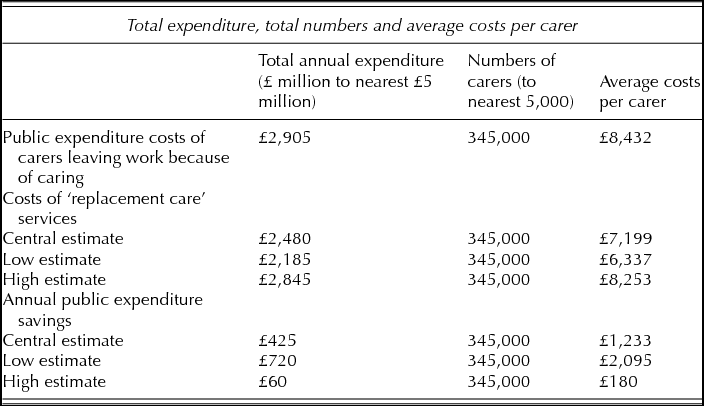
The finding that the costs of ‘replacement care’ for working carers are lower than the costs of carers leaving employment suggest that it would be cost-effective for the government to provide ‘replacement care’ services to working carers. Table 6 shows that, on average, it costs the Government £8,432 a year for a carer to leave employment due to caring. However, on the assumptions used here, the average costs of ‘replacement care’ services per carer would be lower than this. Using the central cost estimate, the cost of ‘replacement care’ services would be on average £7,199 a year per carer. The savings would therefore amount to £1,233 a year per carer. At the lower estimate, the costs of ‘replacement care’ per carer would be £6,337 a year, and the savings would be £2,095 a year per carer. Even at the higher estimate, the costs of ‘replacement care’ per carer would be £8,253 a year and the savings would be £180 a year per carer. It would therefore be cost-effective for the Government to provide ‘replacement care’ services because, for every carer that received services and did not leave employment, the Government would save on average £1,233 a year.
Average costs of ‘replacement care’ services and average costs of carers leaving employment: sensitivity analysis, England, 2015–16.

Sources: English Longitudinal Study of Ageing, Wave 6, 2012-13; Pickard et al., Reference Pickard, King, Brimblecombe and Knapp2018a; HSCIC, 2016
Notes: The central estimate of the costs of ‘replacement care’ services assumes an hourly cost of home care of £14.28; the low estimate assumes an hourly cost of home care of £12.57; and the high estimate assumes an hourly costs of home care of £16.37 (HSCIC, 2016).
Discussion
This article suggests that, in England, the costs of providing ‘replacement care’ services to people cared for by working carers are lower than the public expenditure costs of carers leaving employment. On the assumptions used here, the costs of providing ‘replacement care’ to working carers in England would be approximately £2.5 billion a year. The costs of implementing a ‘replacement care’ policy would be lower than the public expenditure costs of carers leaving employment, which amount to approximately £2.9 billion a year (Pickard et al., Reference Pickard, King, Brimblecombe and Knapp2018a). An investment of £2.5 billion in ‘replacement care’ to support working carers would therefore save approximately £425 million a year. These savings would represent a return on investment of approximately 17 per cent.Footnote 4
The costs of providing ‘replacement care’ are sensitive to the assumptions used about the unit costs of services. The costs of providing ‘replacement care’ for working carers, cited in the previous paragraph, use a central assumption regarding the unit cost of home care. Higher and lower assumptions about unit costs were also tested, based on regional variations in the average hourly costs of home care in England (HSCIC, 2016). The findings show that, even using the higher estimate, the costs of providing ‘replacement care’ to support working carers would be less than the public expenditure costs of carers leaving employment. Examining the average costs per carer per year, the findings show that it would be cost-effective for the Government to provide ‘replacement care’ services. For every carer that received services and did not leave employment, using the central estimate, the Government would save on average £1,233 a year.
It has been assumed in this article that all the investment in ‘replacement care’ services would be publicly-funded, and would not be funded by user charges. No attempt has been made to take into account the liability of care-recipients to pay charges under the means-test in England.3 If services were means-tested, then take-up of the ‘replacement care’ policy would likely be reduced and the numbers allocated publicly-funded services would also be reduced. The effectiveness of a ‘replacement care’ policy would therefore be compromised if services were means-tested, thereby exposing the limitations of means-testing in a situation where public provision of services is cost-effective. It might be argued that it would be unfair on other service users and their carers if the care-recipients of working carers received publicly-funded services when others were means-tested. However, in the 2014 Care Act, there is provision for the waiving of eligibility criteria, where the purpose is to support carers. The Care Act states that, where support for carers is met by providing services to the person cared for, ‘it does not matter that there may be no duty to meet that adult's needs in their own right’ (House of Commons, 2014: 22). This implies that the eligibility criteria relating to the needs or disability of the person cared for do not apply. By extension, it could also be argued that means-testing should not apply to the provision of services to the person cared for, where the purpose of providing these services is to support the carer's employment, particularly as the Care Act explicitly provides for support for carers who want to work.
A key assumption of this article is that carers looking after someone who receives paid ‘replacement care’ services do not tend to leave work because of caring. This assumption is based on the evidence, cited earlier, that paid services for the person cared for are effective in supporting working carers’ employment in England (Pickard et al., Reference Pickard, King, Brimblecombe and Knapp2015). Moreover, a recent longitudinal study shows that the probability of leaving work because of caring is very low where the care-recipient receives services (Pickard et al., Reference Pickard, Brimblecombe, King and Knapp2018b). The study found that only 1.8 per cent of carers looking after someone who received paid services had left work two years later because of caring and that the rate of carers leaving work to care was therefore less than 1 per cent a year where the care-recipient received services (Pickard et al., Reference Pickard, Brimblecombe, King and Knapp2018b).
The results presented here are likely to be sensitive to the assumptions used about the amount of ‘replacement care’ services allocated to care-recipients. For reasons explained earlier, the analysis has focused on the allocation of home care services to older people. Using secondary analysis of ELSA, the estimate of ‘replacement care’ costs allows for the allocation of 9.7 hours a week of home care to each care-recipient. This figure is comparable to that reported elsewhere. For example, the most recent edition of Unit Costs of Health and Social Care, an annual publication widely used for cost estimates in England, assumes an average weekly receipt of home care by older people of nine hours a week (Curtis and Burns, Reference Curtis and Burns2017). In the present article, if the lower estimate of the average hours of home care in ‘council care packages’ (9.2 hours a week) had been utilised in the cost estimations, then the costs of the ‘replacement care’ policy would have been lower and the savings to the Government would have been higher.
Although this article has examined a policy of ‘replacement care’ services for working carers, it has not been assumed that the care provided by working carers would be wholly replaced by paid services on an hour for hour basis. Previous research shows that working carers continue to provide care, even when paid services are provided to the person they look after (Pickard et al., Reference Pickard, King, Brimblecombe and Knapp2015). This suggests that paid services for the care-recipients are better described as ‘complementing’ or ‘supplementing’ the care provided by unpaid carers. Use of this latter terminology would be more consistent with the international literature on substitution between formal and informal care, which suggests that paid domiciliary services, provided to disabled and older people living in their own homes, do not tend to replace the care provided by unpaid carers (Motel-Klingebiel et al., Reference Motel-Klingebiel, Tesch-Roemer and von Kondratowitz2005). What this suggests is that a new term is needed for ‘replacement care’. In the meantime, it is advisable to use the term in inverted commas, as in this article.
If implemented, a policy of ‘replacement care’ would result in an expansion of paid home care work in England. However, this is a sector characterised by poor wages and conditions (Hussein at al., Reference Hussein, Stevens and Manthorpe2011; House of Commons, 2017) and, by implication, a ‘replacement care’ policy could lead to an expansion of poorly paid work. It could be argued that higher hourly rates for home care providers would be needed if these conditions are to be changed and this is certainly the argument of home care providers (United Kingdom Home Care Association (UKHCA), 2015). However, the average hourly rates for home care in 2015–16, utilised in this article, were compatible with the introduction of an ‘Ethical Care Charter’ by a number of councils in England at that time (House of Commons, 2017). The Ethical Care Charter was created in 2012 by UNISON, one of the largest trade unions in the UK, and includes the National Living Wage, payment for travel time, paid sick leave, no zero-hours contracts and provision for training (UNISON, 2012, 2013). The fact that the Charter had been implemented in a number of councils across the UK by 2015–16 suggests that these ‘sustainable’ working conditions are not incompatible with the hourly rates for 2015–16 utilised in this article and that an expansion of home care employment would not necessarily be on the basis of poor wages and conditions.
The study presented here has a number of limitations. First, the estimation of the costs of ‘replacement care’ uses information on the average hours of home care from ELSA (Wave 6), but this is based on the relatively small sample of older people receiving home care in the survey. Moreover, it would be preferable to use data on the amount of home care received by care-recipients irrespective of their age, since unpaid care may be provided to people of all ages. However, existing surveys in England currently limit this type of analysis for younger age groups (HSCIC, 2017). The implication for research is that we need improved large-scale survey data on the amounts of services and unpaid care received by people of all ages in England.
A further limitation of the study reported here is that it assumes the proactive identification of the target population of working carers at risk of leaving employment due to caring. It has been assumed here that, under a ‘replacement care’ policy, the approximately 345,000 people who have left work because of caring can be identified before they leave work and provided with ‘replacement care. This would represent a challenge to those carrying out assessments of carers’ needs. However, a great deal is now known about the characteristics of unpaid carers who leave work due to caring. Studies in the UK show that, as well as caring for people who lack services and caring for ten or more hours a week, the characteristics of carers who leave employment include being an older worker, caring for even longer hours (twenty or more hours a week) and caring for more than one person (Carmichael and Charles, Reference Carmichael and Charles2003b; Heitmueller, Reference Heitmueller2007; King and Pickard, Reference King and Pickard2013; Pickard et al., Reference Pickard, King, Brimblecombe and Knapp2015, Reference Pickard, Brimblecombe, King and Knapp2018b). Nevertheless, better information is desirable and the collection of improved large-scale longitudinal data on caring and employment is needed (cf. Pickard et al., Reference Pickard, Brimblecombe, King and Knapp2018b).
Conclusions
The findings presented here have important implications for policy in England. The overall conclusion of the article is that greater public investment in ‘replacement care’ to support carers in employment could lead to savings in public expenditure and would therefore represent good value for money for the Government. The Care Act 2014 potentially provides a vehicle for greater public investment in ‘replacement care’ to support working carers. However, the Government has provided only £186.6 million in 2016–17 to local authorities to implement carers’ rights under the Care Act, together with £138 million in 2016–17 to Clinical Commissioning Groups to support the implementation of the Care Act and other policies (House of Commons, 2016b). These amounts seem inadequate compared to the likely costs of ‘replacement care’ services, which are estimated here to be ultimately approximately £2.5 billion pounds a year for working carers alone.
The conclusion of this article is that there is a need for much greater public investment in services for older and disabled people who are cared for by working carers. Many working carers and the people they care for would welcome greater access to paid services. Previous research in England has found considerable unmet need for services by working carers and the people they care for (Phillips et al., Reference Phillips, Bernard and Chittenden2002; Yeandle et al., Reference Yeandle, Bennett, Buckner, Fry and Price2007; Brimblecombe et al., Reference Brimblecombe, Pickard, King and Knapp2017, Reference Brimblecombe, Pickard, King and Knapp2018). However, as observed earlier, access to publicly-funded social care in England is restricted by strict eligibility criteria and means-testing. Moreover, the availability of adult social care services is being reduced in England as part of Government austerity policies, despite increased demand (Burchardt et al., Reference Burchardt, Obolenskaya and Vizard2015; Edmiston et al., Reference Edmiston, Patrick and Garthwaite2017; House of Commons, 2017). Since the 2017 General Election, reforms to the funding system, introduced under the 2014 Care Act, have been in disarray (Timmins, Reference Timmins2017), although there are now plans for a Green Paper on social care by mid-2018 (Cabinet Office, 2017) and a Select Committee enquiry on social care funding is under way (House of Commons, 2018). The present article makes an economic case for public investment in social care services for older and disabled people cared for by working carers. Indeed, such investment might be considered to be an ‘economic imperative’ in the context of current demographic changes.
Our research also has international implications. Reconciliation of work and care is a global challenge (Fine, Reference Fine2012; Kröger and Yeandle, Reference Kröger, Yeandle, Kröger and Yeandle2013) but, as the United Nations (UN) stated recently, ‘there is little widespread study of the economic cost to societies of the overreliance on informal caregivers’ (UN, 2016: 4). There is some international recognition that formal services may be cost-effective, if the opportunity costs of unpaid care are taken into account (Social Protection Committee, 2014). There is also international evidence that public investment in childcare yields public expenditure savings (Brennan, Reference Brennan1994; Fine, Reference Fine1999; Ben-Galim, Reference Ben-Galim2011; OECD, 2012). However, with regard to care for disabled and older people, there do not seem to be any other national estimates of the public expenditure costs of either ‘replacement care’ or carers leaving employment. Although relevant social care, tax and benefits systems differ (Bouget et al., Reference Bouget, Spasova and Vanhercke2016), the public expenditure costs of carers leaving employment are likely to be high in many other countries and therefore ‘replacement care’ may also represent good value for money in other countries.
Acknowledgements
Material from the English Longitudinal Study of Ageing is Crown copyright and has been made available via the UK Data Archive. I would like to thank Professor Martin Knapp, Dr Derek King and Ms Nicola Brimblecombe of the Personal Social Services Research Unit at the London School of Economics and Political Science for their helpful comments on an earlier version of the manuscript. The views expressed are those of the author and responsibility for any errors lies with the author.