

A successful start to school is well known to have lasting consequences for children's educational attainment, health, and psychosocial development (e.g., Duncan et al., Reference Duncan, Dowsett, Claessens, Magnuson, Huston, Klebanov and Japel2007). As such, children's transition into school is a topic of interest to researchers from many different traditions, and a wide range of theories exist concerning what a successful start looks like and what roles are played by biological, psychological, social, and educational processes (Snow, Reference Snow2006). Unfortunately, professional silos have obscured our understanding of the common predictors of a successful start to school by producing fragmented and sometimes contradictory evidence. As a result, research is needed to unify and extend disparate existing theories if a cohesive body of knowledge is to be achieved regarding what a successful start to school looks like and how this can be facilitated for a greater number of children. In turn, this knowledge has the potential to prompt better evidence-based decision making by policymakers, educational psychologists, interventionists, teachers, and parents.
This article investigates one of the factors implicated in whether or not a child is likely to enjoy a successful start to school — their effortful control (as one aspect of self-regulation; Blair & Raver, Reference Blair and Raver2015) — and an attempt is made to link theories from two areas of research: educational psychology and child health psychology. Historically, both have postulated mechanisms by which children's effortful control and self-regulation can be affected by biological, psychological, and social processes, but unified evidence is rare. For example, we are aware of fairly few studies in the past 22 years that have investigated children's diurnal cortisol reactivity during their transition to school (see below). This paucity of research is particularly striking given the expansion of preschool education in many countries (e.g., Bassock, Fitzpatrick, & Loeb, Reference Bassock, Fitzpatrick and Loeb2014) and because preschool is arguably at the nexus of developmental science (Pianta, Barnett, Burchinal, & Thornburg, Reference Pianta, Barnett, Burchinal and Thornburg2009). We respond by studying children's exertion of effortful control during their transition to school, their diurnal cortisol slopes during this period, and the extent to which both may be associated with prior preschool attendance.
Previous research has established self-regulation as an important measure of school readiness (e.g., Sammons et al., Reference Sammons, Hall, Sylva, Melhuish, Siraj-Blatchford and Taggart2013; Winsper, Hall, Strauss, & Wolke, in press; Wolke, Winsper, & Hall, Reference Wolke, Winsper and Hall2012). As a latter-developing component of self-regulation, effortful control normatively emerges during the preschool period (Karreman, van Tuijl, van Aken, & Deković, Reference Karreman, van Tuijl, van Aken and Deković2006), which increases its importance towards a successful start to school. Effortful control is an aspect of temperament and is defined as ‘the efficiency of executive attention, including the ability to inhibit a dominant response, to activate a subdominant response, to plan, and to detect errors’ (Rothbart, Ellis, Rosario Rueda, & Posner, Reference Rothbart, Ellis, Posner, Baumeister and Vohs2004, p. 129). This has considerable overlap with, and in fact is often treated as a behavioural equivalent to, the more cognitively oriented concept of executive functioning (Zhou, Chen, & Main, Reference Zhou, Chen and Main2012). For example, research has been linked to neurological functioning in the same three areas of the brain that are associated with decision making: the prefrontal cortex, the anterior cingulate cortex, and the basal ganglia (Rothbart, Ellis, Rosario Rueda, & Posner, Reference Rothbart, Ellis, Rosario Rueda and Posner2003).
The preschool period (ages 3–5 years) is not only a critical time for children's development of effortful control and broader self-regulation, it is also a time during which a number of physiological systems develop that shape how children respond to situations perceived as challenging (Heim & Binder, Reference Heim and Binder2012). A common method of assessing these developing systems is to take samples of the glucocorticoid hormone cortisol. We examined diurnal cortisol slopes during transition to school because past research has consistently linked flattened slopes (less change over the day) to poorer psychosocial functioning, higher chronic stress, and lower perceived control (e.g., Saxbe, Reference Saxbe2008). However, since 1995, only a few studies have investigated children's cortisol levels during their transition to school (e.g., Boyce et al., Reference Boyce, Adams, Tschann, Cohen, Wara and Gunnar1995; Gutteling, de Weerth, & Buitellar, Reference Gutteling, de Weerth and Buitelaar2005; Decaro & Worthman, Reference Decaro and Worthman2008; Turner-Cobb, Rixon, & Jessop, Reference Turner-Cobb, Rixon and Jessop2008; Russ et al., Reference Russ, Herbert, Cooper, Gunnar, Goodyer, Croudance and Murray2012; Groeneveld et al., Reference Groeneveld, Vermeer, Linting, Noppe, Van Rossum and Van IJzendoorn2013; Yang, Lamb, Kappler, & Ahnert, Reference Yang, Lamb, Kappler and Ahnert2017). The result is a patchwork of findings that suggest children's cortisol levels might react systematically to the challenge of transitioning to school, but many questions remain concerning the nature of these reactions, salient antecedents (e.g., attending preschool), correlates (e.g., effortful control), and consequences (e.g., for educational attainment).
Coming equally from the United States, United Kingdom, and the Netherlands, the studies that have investigated children's cortisol levels as they transitioned to school over the past 20 years have considered sample sizes ranging from 28 (Decaro & Worthman, Reference Decaro and Worthman2008) to 115 children (Russ et al., Reference Russ, Herbert, Cooper, Gunnar, Goodyer, Croudance and Murray2012), with most assessing cortisol via salivary sampling techniques and far fewer sampling children's hair (e.g. Gutteling et al., Reference Gutteling, de Weerth and Buitelaar2005). Furthermore, between them, these studies have considered all four of the types of cortisol measures mentioned in Saxbe's (Reference Saxbe2008) ‘Field (researchers’) guide to cortisol’: morning awakening response, diurnal slope, area under the diurnal curve, and the association between cortisol levels and ‘momentary experiences’ (here, starting school). The focus of these studies has also varied. Several considered how children's cortisol levels may be influenced by a combination of starting school and child personality factors (fearfulness, extroversion, and social phobia; respectively by: Decaro, & Worthman, Reference Decaro and Worthman2008; Turner-Cobb et al., Reference Turner-Cobb, Rixon and Jessop2008; Russ et al., Reference Russ, Herbert, Cooper, Gunnar, Goodyer, Croudance and Murray2012), while others studied how children's cortisol levels may be influenced by a combination of starting school and maternal socioeconomic status (Boyce et al., Reference Boyce, Adams, Tschann, Cohen, Wara and Gunnar1995; Decaro & Worthman, Reference Decaro and Worthman2008), and one focused exclusively on fluctuations over time in children's cortisol production during the transition to, and first year of, primary school (Yang et al., Reference Yang, Lamb, Kappler and Ahnert2017).
Unfortunately, the associations that have been found between children's exertion of effortful control during their transition to school, their diurnal cortisol slopes, and the extent to which both may be associated with prior attendance at preschool are inconsistent (Groeneveld et al., Reference Groeneveld, Vermeer, van IJzendoorn and Linting2010). For example, the relationship between starting preschool and children's cortisol reactivity is not merely a function of the extent to which preschool is perceived as challenging. Instead, this relationship can vary by child temperament (Tarullo, Mliner, & Gunnar, Reference Tarullo, Mliner and Gunnar2011) in a manner similar to children's reactivity in response to starting school (e.g., Russ et al., Reference Russ, Herbert, Cooper, Gunnar, Goodyer, Croudance and Murray2012). Further, the educational consequences of greater cortisol reactivity to the challenges of preschool and school are ambiguous. Cortisol reactivity that suggests greater perceptions of challenge in response to attending preschool can actually prove beneficial (Turner-Cobb, Rixon, & Jessop, Reference Turner-Cobb, Rixon and Jessop2011) and may even aid children's school readiness (Gunnar, Frenn, Wewerka, & Van Ryzin, Reference Gunnar, Frenn, Wewerka and Van Ryzin2009).
This article responds to the gaps in knowledge that exist concerning a particular aspect of children's school readiness during their transition to school (exertion of effortful control), their diurnal cortisol slopes during this period, and the extent to which both may be associated with prior attendance at preschool. We adopted person-centred statistical methods, as these are best matched to a focus on investigating whether distinct trends exist and what features define the groups associated with these trends. More specifically, this article aims to determine whether distinct trends can exist in children's diurnal cortisol slopes as they transition to school, and the extent to which these trends relate to children's preschool attendance and/or exerted effortful control. We meet these aims by answering four research questions:
-
1. Do distinct trends exist in children's diurnal cortisol slopes as they transition to school?
-
2. To what extent are trends in children's diurnal cortisol slopes during the transition to school related to the duration that they spend in preschool?
-
3. Is children's exertion of effortful control during the transition to school related to the duration that they spend in preschool?
-
4. To what extent are trends in children's diurnal cortisol slopes during the transition to school related to their exertion of effortful control?
Method
Participants
This article reports on a secondary analysis of the anonymised data collected by the Transition to School Study, a project funded by the UK Economic and Social Research Council (ESRC) that used a prospective cohort design to study children's experiences during the transition to school. For details of the original study, including ethical approval, see the article by Turner-Cobb and colleagues (Reference Turner-Cobb, Rixon and Jessop2008). The anonymised data are publically available from the UK Data Service (Turner-Cobb, Reference Turner-Cobb2007). Participants in the Transition to School Study included 105 children (53 boys, 52 girls) and families (102 mother and 3 father respondents) who were recruited from preschools in South West England in 2004. The sampled children were 55 months old on average (4 years, 7 months) at entry to school (range: 49–61 months) and the highest level of educational attainment of their parents indicated that the sample had a higher-than-average SES compared to the UK overall at the time. More than 50% of the parents were educated to university level or higher, and this was over 30% higher than the equivalent UK overall percentage (Office for National Statistics, 2003). Comparisons to national figures also suggested that a non-representative sample was achieved in terms of ethnicity and marital status, with over-sampling of Caucasian families (here 97%) and families where parents were cohabiting (here 92%). As a result, direct inference about the general UK population of 2004/5 must be made cautiously, but results and findings may be treated as indicative of the associations that are possible. Further detailed information on demographic and other characteristics of the sample can be found in the article by Turner-Cobb et al. (Reference Turner-Cobb, Rixon and Jessop2008).
Procedure
A within-person design was used to investigate 105 families and children resident in South West England over a 12-month period between 2004 and 2005. Repeated measurements of diurnal cortisol slopes were taken at three time points at approximately equal intervals (4 months prior to school entry, school entry plus 2 weeks, school entry plus 6 months), and assessments of children's temperament and behaviour were collected at the second time point (school entry plus 2 weeks). Demographic information about both parents and children was collected at baseline, as was information about children's preschool attendance.
Measures
Diurnal cortisol slopes
At each of the three time points, children's diurnal cortisol slopes were measured over a 2-day period using salivary samples gathered by parents. This paper considers diurnal cortisol slopes rather than alternative cortisol measures (morning awakening, evening, area under the diurnal curve, or time-matched pre-post reactivity) because past research has consistently linked flattened diurnal slopes (i.e., less change over the day) to poorer psychosocial functioning, higher chronic stress, and lower perceived control (Saxbe, Reference Saxbe2008). A 2-day saliva protocol was used at each time point in order to increase the validity and reliability of the achieved measures. Each day, parents sampled salivary cortisol concentrations (SCC) from their children on awakening (mean time 7.10 am ± 70 mins; intended to be prior to breakfast and the brushing of teeth) and in the evening (mean time 5.40 pm ± 82 mins; intended to be post school, after postschool activity, and either prior to or at least one hour after eating). To do this, parents were issued day and time colour-coded plastic Salivette devices featuring a sterile cotton swab held inside a plastic tube (Sarstedt AG & Co, Germany). This protocol was used because it was found to produce a high level of compliance on the part of administering parents in a previous study of this age group of children (Chryssanthopoulou, Turner-Cobb, Lucas, & Jessop, Reference Chryssanthopoulou, Turner-Cobb, Lucas and Jessop2005). In the Transition to School Study, researchers contacted parents by telephone at regular intervals to check about the timing of SCC sampling in order to facilitate fidelity to the protocol (Turner-Cobb et al., Reference Turner-Cobb, Rixon and Jessop2008). The Transition to School Study investigators assayed the saliva samples for cortisol using in-house radioimmunoassay, again following prior published protocols (Jessop, Dallman, Fleming, & Lightman, Reference Jessop, Dallman, Fleming and Lightman2001; Turner-Cobb et al., Reference Turner-Cobb, Rixon and Jessop2008, Reference Turner-Cobb, Rixon and Jessop2011).
At each of the three time points, mean diurnal cortisol slopes were calculated from each pair of morning and each pair of evening measures (ng/mL; for correlations between pairs of scores see Turner-Cobb et al., Reference Turner-Cobb, Rixon and Jessop2008), and where values exceeded 40 ng/mL they were excluded as outliers (this applied to a small number of individuals: eight children at baseline, two at the second time point, and one at the third time point). This exclusion of outliers constitutes recommended practice in the preparation of cortisol data for statistical analysis (Nicolson, Reference Nicolson, Luecken and Gallo2008). Diurnal cortisol slopes were calculated by subtracting the mean awakening from the mean evening value. This method of measuring diurnal cortisol slopes was carried out following precedents established by previous studies of preschoolers (e.g., Watamura, Donzella, Alwin, & Gunnar, Reference Watamura, Donzella, Alwin and Gunnar2003).
With morning cortisol levels subtracted from evening and a daily decline treated as normative, two types of slope were deemed likely: either an individual's cortisol level would decline over the course of a day (a negative slope) or it would not. There were two ways for a lack of a daily decline in cortisol to occur: cortisol levels could either be consistently high or consistently low across the course of a day (hyper- and hypocortisolism, respectively). It is important to note two things here. First, absolute levels of cortisol are subject to normal variations in a population, and objectively, ‘high’ and ‘low’ values are to be expected only in cases of medical conditions such as Cushing's disease and Addison's disease (e.g., Savage et al., Reference Savage, Lienhardt, Lebrethon, Johnston, Huebner, Grossman and Besser2001). Second, the functional significance of diurnal slopes of salivary cortisol concentrations is not entirely coherent in the literature. For example, while flatter diurnal cortisol slopes have been linked to experiences triggering increased stress (Almeida, McGonagle, & King, Reference Almeida, McGonagle and King2009), Turner-Cobb and colleagues (Reference Turner-Cobb, Rixon and Jessop2011) found that steeper slopes after school transition were associated with more upper respiratory tract infections rather than fewer. On the whole, however, previous research suggests that ‘flatter’ (nearer to zero) slopes may be associated with poor psychosocial functioning, a high chronic stress burden, and a variety of adverse health conditions (Saxbe, Reference Saxbe2008). Thus, ‘steeper’ diurnal cortisol slopes are typically considered to reflect a more adaptive pattern in both adults and children.
Duration spent in preschool
Parental respondents gave information on three aspects of the duration that their children's spent in preschool: the period (in months), the average estimated hours per week (during this period), and the average estimated days per week (during this period). All three of these measures were analysed in this study, as past research has linked each to young children's physiological functioning, psychological development, and educational attainment (e.g., Quas, Murowchick, Bensadoun, & Boyce, Reference Quas, Murowchick, Bensadoun and Boyce2002).
Exerted effortful control at school entry
A child's exertion of effortful control at school entry (plus 2 weeks) was measured via the parent-completed Child Behavior Questionnaire (CBQ; Ahadi, Rothbart, & Ye, Reference Ahadi, Rothbart and Ye1993). Designed to measure the temperaments of children between the ages of 3–7 years, the questionnaire instrument operationalised exerted effortful control as a higher order factor comprised of four standardised and averaged lower order factors, each consisting of a number of 7-point Likert scale items: attentional focusing, inhibitory control, low intensity pleasure, and ‘smiling and laughing’. Details regarding the reliability and validity of the CBQ instrument, and of the factor analysis resulting in these four characteristics as subscales of effortful control, are reported by Rothbart, Ahadi, Hershey, and Fisher (Reference Rothbart, Ahadi, Hershey and Fisher2001).
Background demographics
Four demographic factors were assessed at baseline via parental questionnaire and are also considered in this article: child gender, parental living arrangements, responding parent's highest attained educational level, and responding parent's age. The association between each of these and children's effortful control was statistically controlled for due to previous studies showing each to be a salient factor for young children's exertion of effortful control (e.g., Hall et al., Reference Hall, Sylva, Melhuish, Sammons, Siraj-Blatchford and Taggart2009). Including these measures in all analyses concerning associations with effortful control was also in keeping with standard practice in prospective longitudinal studies (e.g., Sylva, Melhuish, Sammons, Siraj-Blatchford, & Taggart, Reference Sylva, Melhuish, Sammons, Siraj-Blatchford and Taggart2010).
Analytic Approach
Statistical analyses were conducted using SPSS Version 21 (IBM Corp., 2012) and Mplus Version 6.1 (Muthén & Muthén, Reference Muthén and Muthén2010). A single latent class growth analysis (LCGA) produced statistical estimates that answered research questions 1–4. The number of latent classes that were estimated within this LCGA was decided upon by following standard conventions in LCGA analyses (e.g., Jung & Wickrama, Reference Jung and Wickrama2008). The LCGA also produced statistical estimates that were robust to the effects of non-normal statistical distributions, and this analysis estimated missing data through use of the full information maximum likelihood (FIML) procedure. All variables other than those recording diurnal cortisol slopes were z-score standardised beforehand in order to facilitate the convergence of the LCGA models. Standardised statistical effect sizes were calculated for all inferential statistical tests.
Three estimates of association are reported from our LCGA model: (1) odds ratios (OR) for the association between a child's (diurnal) cortisol pattern and the duration a child attended preschool; (2) beta coefficients (B) for the association between children's effortful control and the duration that they attended preschool plus the four background measures; (3) mean differences for the association between a child's (diurnal) cortisol pattern and their effortful control and background measures.
Results
Sample Characteristics
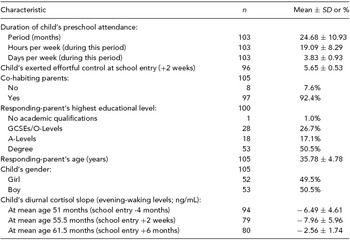
Table 1 describes the sample using characteristics relevant to the current analyses. An equal number of boys and girls were sampled, while the average child attended preschool for 2 years (25 months). During this period, the average child attended preschool for 4 days a week (19 hours a week). The parents of the average child were more likely to be cohabiting with their child's other parent, and the average questionnaire-responding parent was 36 years of age and qualified to degree level.
Characteristics of the Sample of 105 UK Children (and Their Families) as They Transitioned to School at Mean Age 55 Months (4 Years, 7 Months)

Note: SD = standard deviation.
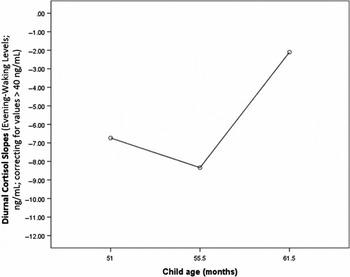
The sample characteristics shown in Table 1 also present the average child's diurnal cortisol slope during his/her transition to school at mean age 55 months (average evening level minus average waking level over a 2-day period) as measured at three time points. Diurnal cortisol slopes across these time points were then investigated for significant change over time via a repeated-measures ANOVA (see Figure 1). Results from this analysis of change revealed a statistically significant change in the average child's diurnal cortisol slopes during this period (F 2,126 = 33.92, p < .001; ηp 2 = 0.85). However, when examining for specific differences between time points using planned contrasts, children's diurnal cortisol slopes were significantly flatter (significantly closer to zero) only between the first and third measurement points, when children were of mean age 61.5 months, t(76) = 8.74, p < .001, d = 1.04. By contrast, there was no statistically significant difference in children's diurnal cortisol slopes between the first two time points (i.e., at 4 months prior to starting school and 2 weeks after starting school, t(72) = 1.71, p = .091, d = 0.17).
Repeated-measures ANOVA results: The mean diurnal cortisol slopes (evening-waking levels; ng/mL) of 105 UK children as they transitioned to school at mean age 55 months (4 years; 7 months).

Latent Class Growth Analysis (LCGA)
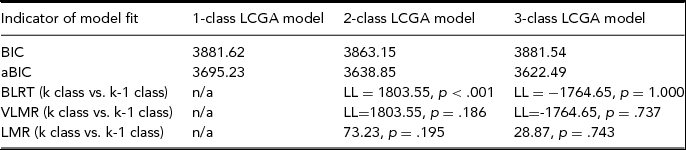
The estimation of the number of latent classes present within the longitudinal trend of diurnal cortisol slopes during children's transition to school (Figure 1) was carried out as the first step in the LCGA modelling. Following standard published guidelines (e.g., Jung & Wickrama, Reference Jung and Wickrama2008), an LCGA estimating a two-class solution was deemed to offer the best results. This decision was informed by comparing five different indices of model fit (see Table 2) for LCGA models that estimated one, two, and three latent classes, taking into consideration the parsimony of these models, their interpretability, and guidance offered by recent publications estimating the statistical power of these model fit indices (e.g., Nylund, Asparouhov, & Muthén, Reference Nylund, Asparouhov and Muthén2007). Two of the indices of model fit presented in Table 2 suggested that a one-class LCGA was preferable (VLMR and LMR), two of the indices suggested a two-class LCGA was preferable (BIC and BLRT), and one of the indices supported the three-class model (aBIC). Unfortunately, the simulation studies investigating the utility of these indices for determining the optimal number of classes within LCGA models has yet to consider sample sizes below n = 200 (e.g., Tekle, Gudicha, & Vermunt, Reference Tekle, Gudicha and Vermunt2016). It was this fact, coupled with the inconsistency of the suggestions from the model fit indices shown in Table 2 and the published guidelines warning against solely relying upon indices of model fit that led us to accept the LCGA model that estimated two distinct classes of children.
Statistical Comparison of Latent Class Growth Analysis Models With 1, 2, and 3 Latent Classes Estimated to Exist Within the Diurinal Cortisol Slopes of 105 UK Children as They Transitioned to School at Mean Age 55 Months

Note: BIC = Baysian Information Criterian; aBIC = adjusted BIC; BLRT = Bootstrap Likelihood Ratio Test; VLMR = Vuong, Lo, Mendell, & Rubin Likelihood Ratio Test; LMR = Lo, Mendell, & Rubin Likelihood Ratio Test; LL = log-likelihood; for further information on these statistical measures and their use in statistical mixture models, see Nylund, Asparouhov, and Muthén (Reference Nylund, Asparouhov and Muthén2007).
Do distinct trends exist in children's diurnal cortisol slopes as they transition to school?
While Figure 1 shows the changing diurnal cortisol slopes of 105 UK children as they transitioned to school, Figure 2 illustrates the results of the LCGA that suggested the existence of two distinct groups of children during this period. Forty children (39%; Class 1 in Figure 2) were found to exhibit a pattern of diurnal cortisol slopes that were flatter (slopes closer to zero) at two of the three points of measurement than those of the remaining 65 children (61%; Class 2 in Figure 2).
Latent class growth analysis (LCGA) results: Two distinct ‘classes’ evident within the mean diurnal cortisol slopes (evening-waking levels; ng/mL) of 105 UK children as they transitioned to school at mean age 55 months (4 years; 7 months).

To what extent are trends in children's diurnal cortisol slopes during the transition to school related to the duration that children spend in preschool?
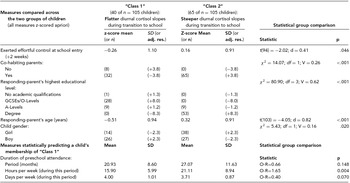
The likelihood that a child would demonstrate a pattern of diurnal cortisol slopes that was flatter over time (Class 1 in Figure 2) was found to be inconsistently related to the duration that s/he spent in preschool. A child's pattern of diurnal cortisol slopes during the transition to school (the child's likelihood of being within Class 1) was not associated with either the period (in months) that a child had attended preschool (OR = 0.66, p = .148) or the average days per week that s/he attended during this period (OR = 0.40, p =.070). However, the fewer the hours per week that children had spent in preschool, the more likely they were to show a pattern of diurnal cortisol slopes that was flatter over time (Class 1 in Figure 2) during their transition to school (OR = 1.65, p = .004).
Is children's exertion of effortful control during the transition to school related to the duration that children spend in preschool?
Children's exertion of effortful control 2 weeks after their transition to school was not associated with the duration for which they had attended preschool. Children's exertion of effortful control was unrelated to the months that they had spent in preschool (unstandardised beta [B] = −0.12 standard deviations, p = .251), the hours per week spent in preschool during this period (B = 0.10, p = .936), and the days per week spent in preschool during this period (B = 0.00, p = .981).
This pattern of null findings was consistent with the lack of associations between children's exertion of effortful control during the transition to school and the characteristics of their parents. Children's exertion of effortful control was unrelated to the cohabitation of their parents (B = −0.03, p = .829), the highest achieved level of education reported by the parent who responded to the background questionnaire (B = 0.07, p = .81), and this parent's age (B = 0.17, p = .176). By contrast, child gender was found to differentiate children's exertion of effortful control, where the average girl was found to exert significantly greater effortful control than the average boy two weeks after starting school (B = 0.23, p = .023).
Together, these seven measures relevant to preschool attendance and child and family characteristics accounted for only 8% (r 2 = .08, p = .113) of the differences between children in the extent to which they exerted effortful control 2 weeks after they transitioned to school. This percentage was a result of six out of the seven bivariate associations being statistically insignificant.
To what extent are trends in children's diurnal cortisol slopes during the transition to school related to their exertion of effortful control?
Table 3 shows the association between children's diurnal cortisol slopes during transition to school and their exertion of effortful control. Children who demonstrated a pattern of diurnal cortisol slopes that were ‘flatter’ (closer to zero) during the transition to school (Class 1 in Figure 2) were likely to exert significantly lower effortful control two weeks after starting school, t(94) = −2.02, p = .046, d = 0.41.
Statistical differences between the two groups of children that were distinct in their diurnal cortisol slopes during their transition to school at mean age 55 months (4 years; 7 months)

Notes: SD = Standard Deviation; ‘adj.res.’ = adjusted residual, values ±1.96 indicate p<0.05 differences; df = degrees of freedom; d = Cohen's d, an effect size for statistical t-tests; V = Cramer's V, an effect size for statistical Chi-Squared tests; O-R = Odds-Ratio
The results shown in Table 3 also reveal that all four background measures were significantly associated with children's patterns of diurnal cortisol slopes during their transition to school. Children who demonstrated a pattern of diurnal cortisol slopes that were ‘flatter’ (closer to zero) during the transition to school (Class 1 in Figure 2) were more likely to: be boys, χ2(1) = 5.43, p = .020, V = 0.16, have non-cohabiting parents, χ2(1) = 14.07, p = .001, V = 0.26, and have a responding-parent who was younger, t(103) = 4.05; p = .001, d = 0.82, and with a lower level of highest educational qualification, χ2(3) = 80.9, p = .001, V = 0.62.
Discussion
This article was written in response to that fact that although a successful start to school is well known to have lasting consequences for children's educational progress, health, and psychosocial development (e.g., Belsky & MacKinnon, Reference Belsky and MacKinnon1994), our understanding of the common predictors of a successful start to school is limited by fragmented and contradictory evidence. The prospective study reported here considered the extent to which there was an association between children's exertion of effortful control during their transition to school, their diurnal cortisol slopes during this period, and their prior attendance at preschool. This investigation of the relationships between effortful control, diurnal cortisol slopes, prior preschool attendance, and various background and family characteristics during children's transition to school constitutes a novel attempt to bridge between theory and measures from educational psychology and child health psychology. We formulated four research questions that are now discussed in turn.
First, our results illustrate that children can exhibit district trends in their diurnal cortisol slopes as they transition to school. Contextualised by a period of challenge (and cortisol reactivity) that is common for all children (especially 6 months after starting school; see Figures 1 and 2), 39% of the sampled UK children also exhibited a flatter diurnal cortisol slope both before transitioning to school and again after the first 2 weeks. This suggestion of two groups of children who are differentiated by diurnal cortisol slopes during their transition to school is in keeping with past research that has compared stress adaptations in children who attend preschool to those in home-based care (e.g., Watamura et al., Reference Watamura, Donzella, Alwin and Gunnar2003)
Second, the 39% of children who demonstrated a pattern of diurnal cortisol slopes that was consistently flatter over time were also likely to have attended preschool for significantly fewer hours per week. It is in keeping with the purpose of this paper that this finding confirms yet also challenges different areas of past research. On one hand, this finding is in keeping with theories suggesting that children's adaption to school can be facilitated by preschool attendance, as this may lessen the novelty of transitioning to school (Rimm-Kaufman & Pianta, Reference Rimm-Kaufman and Pianta2000). However, our finding also challenges other research narratives that present preschool attendance as less desirable than home-based care because it can be a more stressful daily experience (e.g., Watamura et al., Reference Watamura, Donzella, Alwin and Gunnar2003) with the potential for negative consequences (e.g., Belsky, Reference Belsky2001). Following the findings of Ques et al. (Reference Quas, Murowchick, Bensadoun and Boyce2002), we speculate that attending preschool more intensively (more hours per week) before transitioning to school may represent a continuity of experience that can lessen how challenging children find this transition, as reflected in steeper diurnal cortisol slopes. However, the ambiguity of the consequences of finding the transition to school challenging (e.g., Turner-Cobb et al., Reference Turner-Cobb, Rixon and Jessop2011) requires follow-up studies that are beyond the scope of this article.
Third, children's exertion of effortful control during the transition to school was found to be unrelated to the duration that they had spent in preschool. Extensive previous research has shown how the relationship between preschool attendance and children's psychological and educational outcomes varies as a function of preschool ‘quality’ (e.g., Belsky, Reference Belsky2001; Sylva et al., Reference Sylva, Sammons, Taggart, Siraj-Blatchford, Melhuish and Hall2006; Sylva et al., Reference Sylva, Melhuish, Sammons, Siraj-Blatchford and Taggart2010), suggesting a possible reason for this lack of association. That the Transition to School Study lacked measures of preschool quality suggests another area for future research, and this is expanded upon below.
Fourth, the 39% of children who demonstrated a pattern of diurnal cortisol slopes that were flatter during their transition to school were also likely to exert significantly lower effortful control 2 weeks after starting school. This finding closely ties in with the work of Gunnar and colleagues (Reference Gunnar, Sebanc, Tout, Donzella and van Dulman2003), who also reported a link between children's physiological responses to challenge and their exertion of effortful control.
However, the associated report by Gunnar, Sebanc, Tout, Donzella, and van Dulman (Reference Gunnar, Sebanc, Tout, Donzella and van Dulman2003) proposed a relationship that was opposite in directionality to that presented here. Instead of effortful control being influenced by trends in diurnal cortisol slopes, they proposed that it was (preschool) children's (lack of) exerted effortful control that led to (increased) cortisol reactivity as a response to (increased) perceptions of challenge caused by peer rejection. While this is certainly possible, we speculate that it is also plausible for reciprocal effects to exist between children's cortisol reactivity and exerted effortful control. There may be a psychoeducational ‘Matthew effect’ at work for preschool attendees: Children who enter preschool with less developed self-regulatory skills may fall further behind due to their preschool-period development of effortful control being hampered by peer rejection. In turn, the lack of these skills may then make the transition to school more challenging, which further impedes their ability to exert adequate effortful control. Empirical support for such a relationship is currently lacking in the existing research literature, however.
Strengths, Limitations, and Future Directions
This research makes a novel contribution to an under-researched, multidisciplinary area at the conjunction of educational psychology and child health psychology. Further, it does so via a secondary analysis of data from the second-largest study to have measured diurnal cortisol slopes in children and link this to pre-school in the past 22 years. However, our findings are also limited in ways that suggest several directions for future research.
First, the Transition to School Study sample was drawn from the United Kingdom in 2004 and 2005, which means that generalisations to other populations in 2017 must be made with caution. This limitation is partially mitigated by the fact that parental education and cohabitation were accounted for in the analyses reported here, but there may be differences between 2005 and 2017, or between the sample analysed here and a more representative sample of the overall UK population, in children's experiences of and responses to the transition to school. The findings of the study are therefore best described as exploratory in nature, with multiple areas in which the research questions, methods, and findings might be extended. For example, further research is needed featuring a more contemporaneous and representative sample (to facilitate generalisability and external validity), a larger sample size (to provide greater reliability and statistical power), and a design that is more robust towards subsequent claims of causality (i.e., an experimental design, ideally with an appropriate degree of nesting of children within preschools and primary schools). Such research would be a logical next step in attempts to contribute to the development and testing of theory concerning the association between preschool attendance, children's diurnal cortisol slopes and effortful control during the transition to school.
A second area where the findings of this study might be extended concerns adding additional measures, particularly alternative (or additional) measures of children's effortful control and of preschool quality. The reliance on solely one parent's report of his or her child's exerted effortful control negatively affects the accuracy of this measurement. Furthermore, future extensions of this work would strongly benefit from including a measure of preschool ‘quality’ (e.g., the Early Childhood Environment Rating Scale; Harms, Clifford, & Cryer, Reference Harms, Clifford and Cryer1998). Past research has shown that developmental and educational effects linked to the duration spent in preschool have interaction effects with preschool quality (Hall et al., Reference Hall, Sylva, Melhuish, Sammons, Siraj-Blatchford and Taggart2009), and that preschool quality alters the degree to which children perceive preschool as challenging (Vermeer, Van Ijzendoorn, Groeneveld, & Granger, Reference Vermeer, Van Ijzendoorn, Groeneveld and Granger2012).
A third area where this research may be built upon is through investigations that feature longer periods of study, punctuated by appropriate and regular measurement of key concepts. Although appropriate to its purpose, the period studied in this article is relatively short given that preschool effects have been found on child outcomes well beyond the first 6 months of primary school (Sylva et al., Reference Sylva, Melhuish, Sammons, Siraj-Blatchford and Taggart2010) and that there is a paucity of studies on the long-term impacts of cortisol reactivity to the challenge of starting school (Groeneveld, Vermeer, van IJzendoorn, & Linting, Reference Groeneveld, Vermeer, van IJzendoorn and Linting2010). Many of the effects postulated here are also likely to be indirect (i.e., mediated), including the possibility for reciprocal effects to exist between diurnal cortisol slopes and effortful control (cf. the possibility of ‘Matthew effects’).
A fourth area where this research could be extended is via a cognitive neuroscience follow-up. This is for two reasons. On one hand, effortful control has been found to have neurological associations with areas of the prefrontal cortex, anterior cingulate, and basal ganglia (Rothbart et al., Reference Rothbart, Ellis, Rosario Rueda and Posner2003). On the other hand, the prefrontal cortex has also been shown to be impacted by allostatic overload/chronic stress (Lupien, McEwen, Gunnar, & Heim, Reference Lupien, McEwen, Gunnar and Heim2009). This parallel reveals a potential neurological mechanism for preschool attendance to have the effects here observed upon diurnal cortisol slopes during the transition to school. However, the plausibility and specificity of this biopsychosocial mechanism would need to be both measured and investigated in a much larger study than that undertaken here, one that would bridge multiple disciplines including educational psychology, child health psychology, and the aforementioned cognitive neuroscience. Although calls for such research exist (e.g., Masten, Reference Masten2007), pragmatic difficulties remain that are linked to silo-thinking in research funding and the lack of appropriate multidisciplinary training.
Conclusions and Implications
Distinct trends can exist in children's diurnal cortisol slopes as they transition to school, and one such trend is characterised by persistently flatter diurnal cortisol slopes. Children who exhibit this trend are more likely to have attended preschool for fewer hours per week, and are likely to exert less effortful control 2 weeks after transitioning to school. These trends and associations clarify and extend our knowledge regarding what a successful start to school looks like and how we can make this more likely for a greater number of children, and they suggest the importance of continuity in children's daily routines in the transition to school. In turn, this knowledge has the potential to prompt better evidence-based decision making by policymakers, teachers, parents, educational psychologists, and interventionists. The existence of distinct patterns in cortisol slopes suggests that children may need different kinds or degrees of support (in the classroom and/or from educational psychologists) during their transition to school to facilitate their physiological and psychosocial adjustment, and the background factors associated with flatter diurnal cortisol slopes suggest some risk factors that practitioners might take into consideration when identifying children who may need additional support in this transition. Further, the finding that more hours of preschool attendance per week was associated with steeper diurnal cortisol slopes suggests that preschool attendance may mitigate the perceived challenge of transitioning to school, which should serve as a consideration for policymakers with regard to preschool provision and for parents with regard to decisions about their children's preschool attendance. For interventionists, findings from our analysis may help to identify appropriate measures to use in assessing the effectiveness of early interventions aimed at facilitating school readiness.
Acknowledgments
The authors wish to thank Professor Julie Turner-Cobb for comments on an earlier draft of this manuscript.
Financial Support
This research received no specific grant from any funding agency, commercial, or not-for-profit sectors.
Conflict of Interest
There are no conflicts of interest to declare.
Ethical Standards
The authors assert that all procedures contributing to this work comply with the ethical standards of the relevant national and institutional committees on human experimentation and with the Helsinki Declaration of 1975 as revised in 2008.