Introduction
The internalizing cluster is represented by syndromes of anxiety, depression and somatization (American Psychiatric Association, 2013). Lifetime prevalences of anxiety (28.8%) and mood (20.8%) disorders are high, making them the most common psychiatric conditions presented in primary care (Kessler et al., Reference Kessler, Berglund, Demler, Jin, Merikangas and Walters2005) and a source of substantial cumulative cost to society (McManus et al., Reference McManus, Bebbington, Jenkins and Brugha2014). Although the overlap among internalizing problems is well documented (Nemeroff, Reference Nemeroff2002; Costello et al., Reference Costello, Mustillo, Erkanli, Keeler and Angold2003; Kessler et al., Reference Kessler, Berglund, Demler, Jin, Merikangas and Walters2005), questions remain regarding temporal patterning (Simms et al., Reference Simms, Prisciandaro, Krueger and Goldberg2012; Ask et al., Reference Ask, Waaktaar, Seglem and Torgersen2016). As around half of all cases of mental health problems are diagnosable by age 14 (Kessler et al., Reference Kessler, Berglund, Demler, Jin, Merikangas and Walters2005), understanding how anxiety, depression and somatization develop across childhood and adolescence is critical for prevention and intervention.
An extensive amount of research has been undertaken on the comorbidity and natural course of anxiety and depression (see Jacobson and Newman, Reference Jacobson and Newman2017 for a review). Theories of their manifestation can be simplified into two conceptual models, the prodromal model and the bidirectional model. Prodromes are early signs or symptoms of disorder onset or relapse and are represented statistically by unidirectional associations. In a systematic review, Jackson et al. (Reference Jackson, Cavanagh and Scott2003) found that generalized anxiety was one of the most common prodromal symptoms to depression among adults. Generalized anxiety has likewise been identified as a prodrome to early-onset depression (i.e. depressive episode before age 26) in young adults (Parker et al., Reference Parker, Wilhelm and Asghari1997, Reference Parker, Wilhelm, Mitchell, Austin, Roussos and Gladstone1999). In contrast, the bidirectional model posits that anxiety and depression are risk factors for one another, which was the conclusion of a meta-analysis (Jacobson and Newman, Reference Jacobson and Newman2017). Despite evidence to support both theories among adults, fewer studies have focussed on adolescents. In the extant literature, researchers have found support for the prodromal model (Cohen et al., Reference Cohen, Andrews, Davis and Rudolph2018), the bidirectional model (McLaughlin and King, Reference McLaughlin and King2014; Long et al., Reference Long, Young and Hankin2018) and only homotypic pathways (e.g. depression predicts depression; Keenan et al., Reference Keenan, Feng, Hipwell and Klostermann2009). Temporal patterning thus remains elusive.
According to DSM nosology (American Psychiatric Association, 2013), somatization (medically unexplained pain, such as frequent headaches, stomach aches) is a core component of the internalizing cluster, yet has been overlooked in most prior research. Among the handful of studies that have prospectively examined anxiety, depression and somatization across adolescence, inconsistencies are common. Researchers have found that somatization in childhood predicts anxiety and depression in adulthood (Shanahan et al., Reference Shanahan, Zucker, Copeland, Bondy, Egger and Costello2015), anxiety predicts the onset and continuity of somatization (Lieb et al., Reference Lieb, Zimmermann, Friis, Höfler, Tholen and Wittchen2002), and somatic symptoms have bidirectional associations with anxiety and depression (Janssens et al., Reference Janssens, Rosmalen, Ormel, van Oort and Oldehinkel2010). Analytic factors may account for variability in temporal ordering, including the use of aggregated data with large time-lags between assessments or the focus on mean-level differences. A fine-grained examination of how symptoms unfold within individuals has therefore been impeded. Understanding the dynamic nature of intraindividual variability in internalizing symptoms is essential for clinicians and researchers.
When assessing the developmental course of anxiety, depression and somatization, other methodological factors need to be considered. First, should internalizing problems be measured using a dimensional (symptoms) or dichotomous (diagnostic) approach? Most prior research has focused on clinical samples, but as around half of all mental illnesses go undiagnosed and untreated, subclinical symptoms can be distressing and impairing, and traditional nosology is based on arbitrary boundaries, dimensional approaches have been called for (Demyttenaere et al., Reference Demyttenaere, Bruffaerts, Posada-Villa, Gasquet, Kovess, Lepine, Angermeyer, Bernert, de Girolamo, Morosini, Polidori, Kikkawa, Kawakami, Ono, Takeshima, Uda, Karam, Fayyad, Karam, Mneimneh, Medina-Mora, Borges, Lara, de Graaf, Ormel, Gureje, Shen, Huang, Zhang, Alonso, Haro, Vilagut, Bromet, Gluzman, Webb, Kessler, Merikangas, Anthony, Von Korff, Wang, Ustun, Heeringa, Chatterji, Aguilar-Gaxiola and Brugha2004; Copeland et al., Reference Copeland, Wolke, Shanahan and Costello2015; Kotov et al., Reference Kotov, Waszczuk, Krueger, Forbes, Watson, Clark, Achenbach, Althoff, Ivanova, Michael Bagby, Brown, Carpenter, Caspi, Moffitt, Eaton, Forbush, Goldberg, Hasin, Hyman, Lynam, Samuel, South, Markon, Miller, Morey, Mullins-Sweatt, Ormel, Patrick, Regier, Rescorla, Ruggero, Sellbom, Simms, Skodol, Slade, Tackett, Waldman, Widiger, Wright and Zimmerman2017; Holmes et al., Reference Holmes, Ghaderi, Harmer, Ramchandani, Cuijpers, Morrison, Roiser, Bockting, Connor, Shafran, Moulds and Craske2018). Second, who should be used as informants? Although parents can be astute in recognizing physical health problems among their children (Kröner-Herwig et al., Reference Kröner-Herwig, Morris, Heinrich, Gassmann and Vath2009), youth and parent reports of mental health problems can be highly discordant (Achenbach et al., Reference Achenbach, McConaughy and Howell1987). Using parent reports of anxiety and depression among preadolescent girls, Keenan et al. (Reference Keenan, Feng, Hipwell and Klostermann2009) found only homotypic continuity (depression→depression) and no evidence for the prodromal or bidirectional model. Notwithstanding this possibility, parents could have difficulty recognizing onset, stability and change in internalizing symptoms among their children, especially if they experience psychopathology themselves (Waters et al., Reference Waters, Doyle, Wolfe, Wright, Wake and Salmon2000; Youngstrom et al., Reference Youngstrom, Loeber and Stouthamer-Loeber2000). Youth and parent informants can therefore provide insights from multiple perspectives and potentially alternate avenues for intervention.
Environmental factors account for approximately 60–70% of the variability of internalizing symptoms (Hettema et al., Reference Hettema, Neale and Kendler2014; Ask et al., Reference Ask, Waaktaar, Seglem and Torgersen2016). Social inequalities, including education, income, ethnicity and biological sex, have been associated with the development of anxiety, depression and somatization, as have experiences of abuse, such as child maltreatment and bullying victimization (Rueter et al., Reference Rueter, Scaramella, Wallace and Conger1999; Lieb et al., Reference Lieb, Zimmermann, Friis, Höfler, Tholen and Wittchen2002; Costello et al., Reference Costello, Mustillo, Erkanli, Keeler and Angold2003; Kessler et al., Reference Kessler, Berglund, Demler, Jin, Merikangas and Walters2005; Marmot, Reference Marmot2005; Arseneault et al., Reference Arseneault, Milne, Taylor, Adams, Delgado, Caspi and Moffitt2008; Lereya et al., Reference Lereya, Copeland, Costello and Wolke2015; Shanahan et al., Reference Shanahan, Zucker, Copeland, Bondy, Egger and Costello2015). Meta-analyses suggest that there is a dose–response association among depression and socioeconomic status (Lorant et al., Reference Lorant, Deliège, Eaton, Robert, Philippot and Ansseau2003), the risk of anxiety and depression is 1–2.5 times higher among youth who have been physically or sexually maltreated (Lindert et al., Reference Lindert, Von Ehrenstein, Grashow, Gal, Braehler and Weisskopf2014), and there are moderate effects for the association between internalizing symptoms and being bullied (Reijntjes et al., Reference Reijntjes, Kamphuis, Prinzie and Telch2010). With finite resources allocated to health and social care and the opportunity costs of misplaced spending, we were interested in the unique contribution of these risk factors on symptom means and trajectories.
Traditionally, studies of stability and change relied upon autoregressive cross-lagged (ARCL) models, yet ARCL models are limited because they mix within-person effects (i.e. the degree to which deviations in an individual's score at one time point predict deviations from that individual's expected score at subsequent time points) and between-person effects (i.e. deviations from the overall mean and rate of change over time) into a single, uninterpretable estimate (Curran et al., Reference Curran, Howard, Bainter, Lane and McGinley2014; Berry and Willoughby, Reference Berry and Willoughby2017). Analytic advances, such as the development of autoregressive latent trajectory models with structured residuals (ALT-SR), allow the uncoupling of within- and between-person sources of variance to examine the developmental course of symptoms over time (Curran et al., Reference Curran, Howard, Bainter, Lane and McGinley2014; Berry and Willoughby, Reference Berry and Willoughby2017). Although a handful of studies have examined stability and change in depression and anxiety across adolescents parsing within- and between-person effects (McLaughlin and King, Reference McLaughlin and King2014; Long et al., Reference Long, Young and Hankin2019), none have simultaneously examined somatization or whether models replicate across youth and parent reporters.
The purpose of this study was to examine the temporal patterning of anxiety, depression and somatization in a community sample of adolescents. Our primary aim was to disaggregate between-person from within-person effects as reported by adolescents and parents to examine: (a) intraindividual stability and change in symptoms across time (within-person effects); and (b) the unique contribution of risk factors (sex, parent education, income, race/ethnicity, child maltreatment, bullying victimization) on symptom means and trajectories (between-person effects).
Method
Sample
We used data from the McMaster Teen Study, a cohort of Canadian children that has been followed since 2008. Children (N = 875) were recruited from a random sample of Grade 5 classrooms (M = 10.91, s.d. = 0.36) across 51 schools: 703 (80%) participated in the longitudinal arm of the study (see Vaillancourt et al., Reference Vaillancourt, Brittain, McDougall and Duku2013; Lee and Vaillancourt, Reference Lee and Vaillancourt2018 for details of recruitment). The present study used data across a 7-year interval when the sample was aged 11–17 years. Data were collected annually in the Spring of each year. Of the recruited children, 95% (n = 669) provided data at two or more time points and were selected as the core analytic sample (54% girls; 76% White).
Procedure
Each year, ethical approval was granted and parental consent and child assent were provided after they received a complete description of the study. Data were originally collected from children in their classroom using a paper/pencil survey (age 11). From age 12, a paper/pencil or electronic version of the questionnaire was completed at home. Parents (87% mothers) completed a phone interview with trainee clinicians supervised by the second author. Participation was compensated with a gift card that incrementally increased in value.
Measures
Anxiety, depression and somatization
Child reports
The Behavior Assessment System for Children-Second Edition (BASC-2) (Reynolds and Kamphaus, Reference Reynolds and Kamphaus2004) is a multidimensional measure of behaviour with subscales on depression (12 items), generalized anxiety (10 items) and somatization (seven items). Items were rated using a five-point scale (0 = never, 1 = seldom, 2 = occasionally, 3 = often, 4 = very often) or dichotomous response (0 = false, 2 = true). Measures of anxiety and depression were collected from age 11, while somatization was collected from age 13. The child version (age 11 and 12) had two additional items that were not part of the adolescent version (age 13 onward) on the depression (one item) and anxiety (one item) subscales. To make meaningful comparisons across time and handle multicollinearity, the additional items were dropped from the age 11 and 12 subscales. Subscale items were summed to create a composite, with higher scores indicating greater symptom severity. Subscale reliabilities were good for anxiety (α min–max = 0.86–0.91), depression (α min–max = 0.87–0.89) and somatization (α min–max = 0.68–0.74). The average measures intraclass correlation coefficients (ICC) for anxiety (ICC = 0.88, p < 0.001), depression (ICC = 0.83, p < 0.001) and somatization (ICC = 0.88, p < 0.001) indicated good reliability across time.
Parent reports
Depression and anxiety were assessed using the Brief Child and Family Phone Interview Version 3 (Cunningham et al., Reference Cunningham, Boyle, Hong, Pettingill and Bohaychuk2009). Each subscale contained six items rated on a three-point scale (0 = never, 1 = sometimes, 2 = often), which mapped onto DSM-IV diagnostic criteria. Subscale items were averaged to form a composite at each time point. Scale reliabilities were good for anxiety (α min–max = 0.81–0.88) and depression (α min–max = 0.83–0.91). Somatization was measured using the BASC-2 for parents (Reynolds and Kamphaus, Reference Reynolds and Kamphaus2004), which contained 11 items rated on a four-point scale (0 = never, 1 = sometimes, 2 = often, 3 = almost always). Scale reliability was good (α min–max = 0.73–0.91). The average measures ICC for anxiety (ICC = 0.92, p < 0.001), depression (ICC = 0.87, p < 0.001) and somatization (ICC = 0.88, p < 0.001) indicated good reliability across time.
Covariates
Chronic bullying victimization
Children completed an adapted version of the Olweus Bully/Victim questionnaire (Vaillancourt et al., Reference Vaillancourt, Trinh, McDougall, Duku, Cunningham, Cunningham, Hymel and Short2010) consisting of one general item ‘Since the start of the school year, how often have you been bullied at school?’ and four specific items (physical, verbal, social, cyber victimization). Responses were on a five-point scale (0 = not at all, 1 = only a few times, 2 = every month, 3 = every week, 4 = many times a week). Using previously established cut-offs (Solberg and Olweus, Reference Solberg and Olweus2003), participants who reported they were victimized at least every month were identified as targets, and those who were identified as targets at age 11 and 12 were classified as targets of chronic bullying victimization (0 = not a target, 1 = target).
Child maltreatment
Participants were contacted at age 19 and retrospectively reported on childhood physical and sexual abuse using the Childhood Experiences of Violence Questionnaire Short-Form (Walsh et al., Reference Walsh, MacMillan, Trocmé, Jamieson and Boyle2008). Participants were asked ‘How many times before the age of 16 did an adult…’ followed by three items pertaining to experiences of physical abuse (e.g. ‘kick, bite, punch…?’), responded to on a five-point scale (0 = never, 1 = 1–2 times, 2 = 3–5 times, 3 = 6–10 times, 4 = more than 10 times). Responses were recoded as no physical abuse = 0 or physical abuse = 1. The questionnaire contained one item on sexual abuse, which was a dichotomous item (no = 0, yes = 1).
Socioeconomic indicators
Biological sex was self-reported (boys = 0, girls = 1). Race/ethnicity was a combination of self- and parent reports and was recoded as White = 0 or non-White = 1 due to the low prevalence of most ethnic backgrounds (second highest prevalence was Black = 3.9%). Household income was reported by parents when children were aged 11, 13, 15 and 17 using an eight-point scale (1 ⩽ $20000, 2 = $20 000–$29 999…8 ⩾ $80 000). At age 11 and 17, parents reported their highest level of education using a five-point scale (1 = did not complete high school; 2 = high school; 3 = college diploma or trades certificate; 4 = undergraduate degree; 5 = graduate degree). Mean composites were computed for income and education due to high correlations across time (income rs ⩾ 0.74; education r = 0.82).
Analysis
Missing data patterns between youth included and excluded from the core analytic sample, as well as descriptive data, were examined using independent sample t tests, χ2 tests and Pearson's correlations in SPSS (IBM version 26).
ALT-SR models were built in Mplus version 8 and estimated using maximum likelihood robust with full information maximum likelihood to handle missing data (Muthén and Muthén, Reference Muthén and Muthén2017). We calculated the design effect (DEFF) to test whether we needed to account for the multilevel structure of the data (McNeish, Reference McNeish2014). As the DEFF value for household income was >0.2 (children with similar levels of household income were more likely to be clustered within the same school), we used the TYPE = COMPLEX option and clustered at the school level. The χ2 statistic, comparative fit index (CFI), root mean square error of approximation (RMSEA) and standardized root mean square residual (SRMR) were used to assess model fit, acknowledging that χ2 is sensitive to sample size and model complexity (Kline, Reference Kline2015). Commonly accepted values for a close fitting model are CFI >0.95, RMSEA <0.06 and SRMR <0.05 (Browne and Cudeck, Reference Browne and Cudeck1992; Hu et al., Reference Hu, Bentler and Kano1992).
We built the ALT-SR model using self-reports then repeated the analyses using parent reports. Following procedures outlined in detail elsewhere (Curran et al., Reference Curran, Howard, Bainter, Lane and McGinley2014; Berry and Willoughby, Reference Berry and Willoughby2017), we constrained the residual variance of each observed variable to zero and used this to estimate the latent structured residual. Between-person effects were examined by estimating intercepts (latent means) and slopes (trajectories). As somatic symptoms were not measured until age 13, slopes were centred at the mid-point of the study (age 14). Slopes were specified as linear functionsFootnote 1 and we examined slope (co)variances to determine whether these effects should be fixed (to zero) or free (random). Intercepts and slopes were correlated and non-significant correlations were subsequently trimmed. All models controlled for risk factors (parent education, household income, race/ethnicity, sex, chronic bullying victimization and child maltreatment) by adding paths from each covariate to each intercept and slope. Risk factors were free to covary (see online Supplementary material for an exemplar Mplus input file).
The remaining residual variance in the model was then conceptualized as within-person variability. The structured residuals were used to specify all 1-year autoregressive (e.g. age 11 anxiety→age 12 anxiety), covariance (e.g. age 11 anxiety with age 11 depression) and cross-lag (e.g. age 11 anxiety→age 12 depression) parameters. Autoregressive, covariance and cross-lag parameters were unconstrained (free to vary across time), then we used the Satorra–Bentler scaled χ2 difference test (Satorra and Bentler, Reference Satorra and Bentler2001) to explore whether constraining autoregressive, covariance or cross-lag parameters to be equal across time resulted in significant loss of model fit. Equality constraints were first added to all autoregressive parameters within the domain (e.g. age 11 anxiety→age 12 anxiety = age 12 anxiety→age 13 anxiety). Next, all within-time covariances were constrained (e.g. age 11 anxiety with age 11 depression = age 12 anxiety with age 12 depression). Last, we tested the equality of cross-lag parameters across waves (e.g. age 12 anxiety→age 13 somatization = age 13 anxiety→age 14 somatization). Multi-group analyses were explored to examine moderation by sex by (a) estimating an unconstrained model, (b) estimating a constrained model (all parameters held equal across girls and boys) and (c) probing differences in the constrained and unconstrained models using the Wald χ2 test. Because of the large number of parameters and tests, we applied the Benjamini–Hochberg false discovery rate correction for structural equation models (Cribbie, Reference Cribbie2013). Results reported below are for parameters that remained significant after the correction (all estimates are reported in the online Supplementary eTables). Data and syntax are available from the corresponding author on request.
Results
Missing and descriptive data
Across all cases in the analytic sample, variables had an average of 23.8% missing data (min = 8.5, max = 34.7). Little's test of Missing Completely at Random indicated that data were not missing completely at random, χ2(1099) = 1318.217, p = 0.001. There were no significant differences between children in the analytic sample and those who only reported data at age 11 on anxiety (t = 0.17), depression (t = 1.58), bullying victimization (χ2 = 0.81) or sex (χ2 = 0.58), but children in the analytic sample had higher household income (t = −5.58), parent education (t = 6.17) and were more likely to be White (χ2 = 21.11).
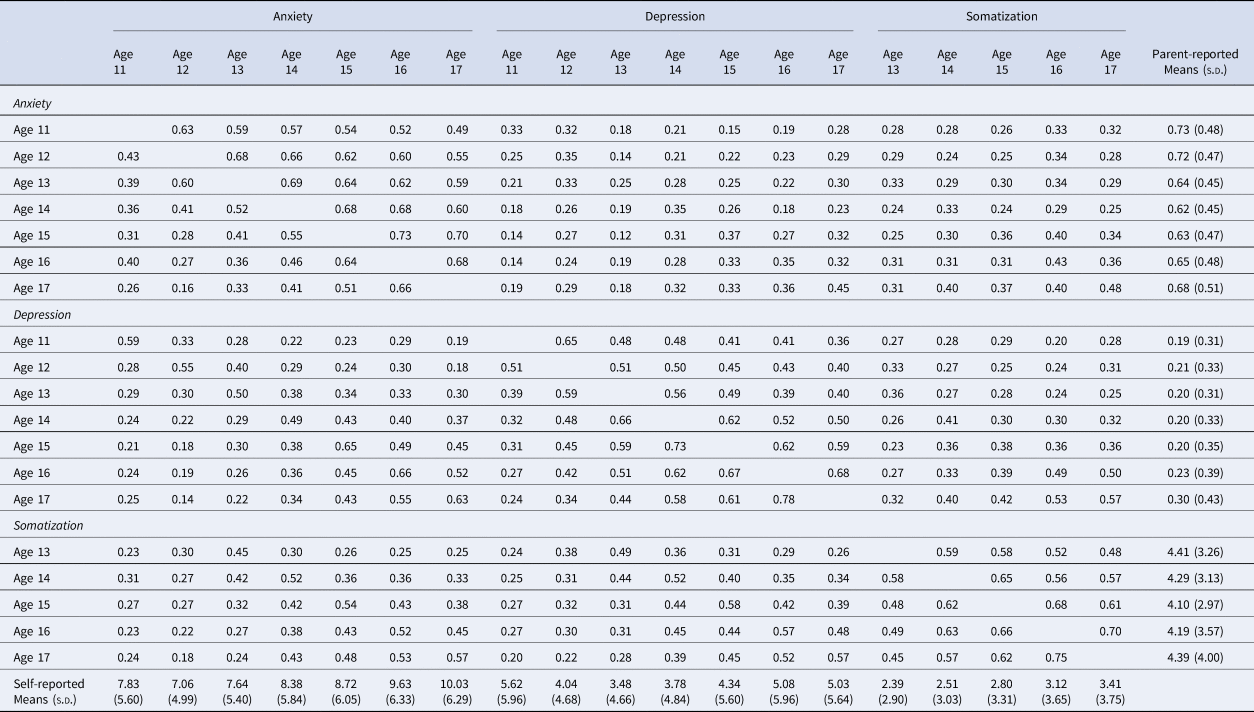
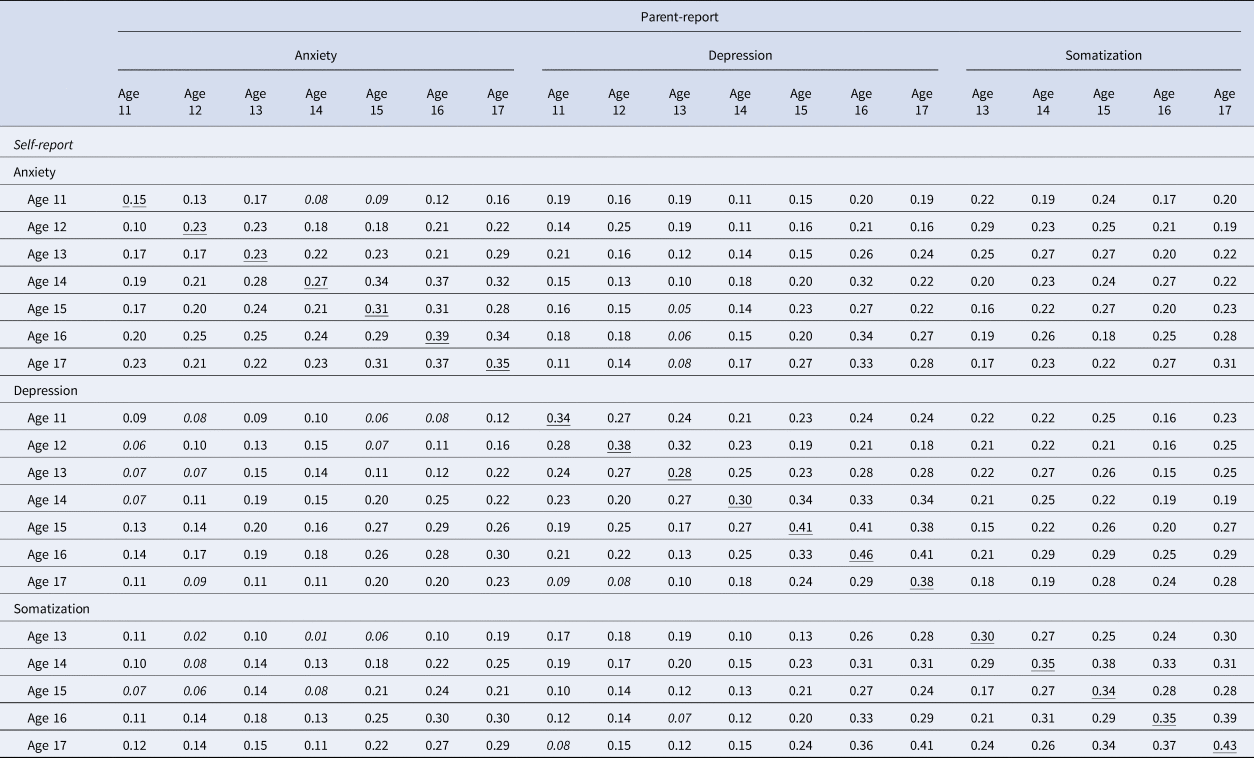
In the analytic sample, 16.1% (n = 106) were targets of chronic bullying victimization, 8.3% (n = 34) had been sexually abused and 16% (n = 64) had been physically abused. There were significant positive bivariate correlations among anxiety, depression and somatization at every time point according to self- and parent reports (Table 1 for correlations and descriptives). Cross-informant correlations (Table 2) were smallest for anxiety at age 11 (r = 0.15), largest for depression at age 16 (r = 0.46), and generally increased over time for anxiety (min–max rs = 0.15–0.39), depression (min–max rs = 0.28–0.46) and somatization (min–max rs = 0.30–0.43).
Self-reported and parent-reported bivariate correlations and descriptive statistics
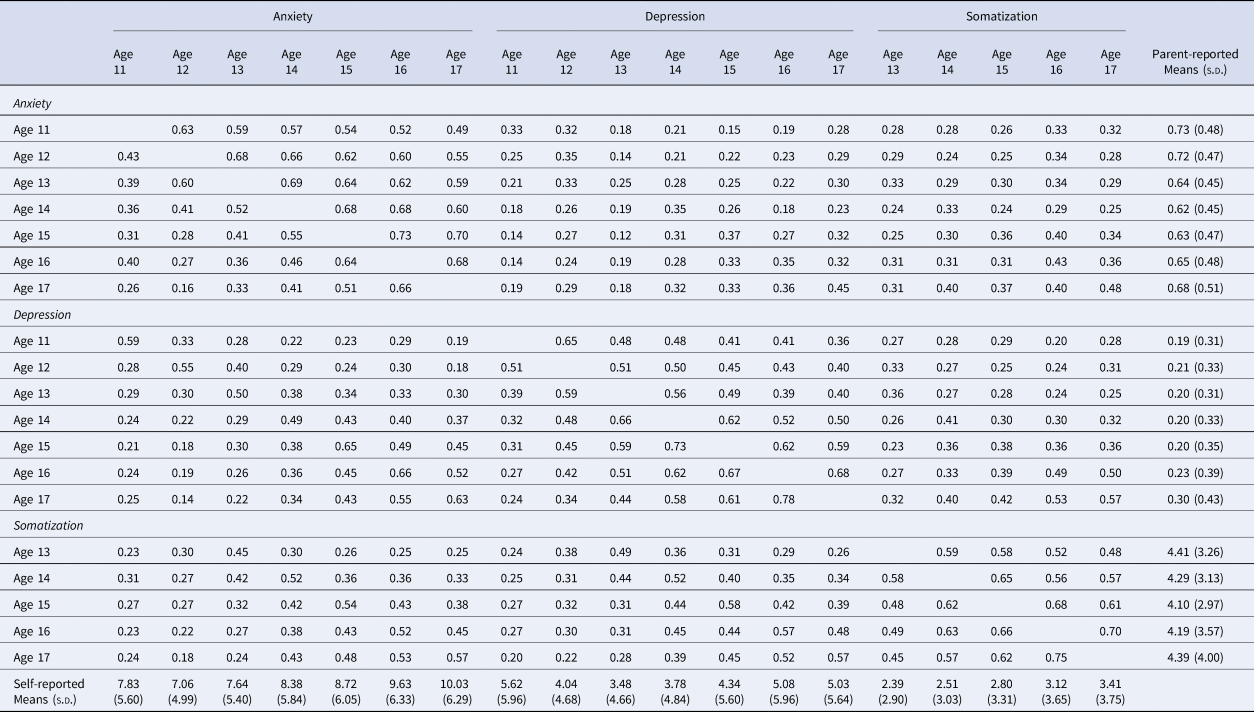
Note: Self-reports are below the diagonal; parent reports are above the diagonal. All correlations are significant at p < 0.05.
Cross-informant correlations
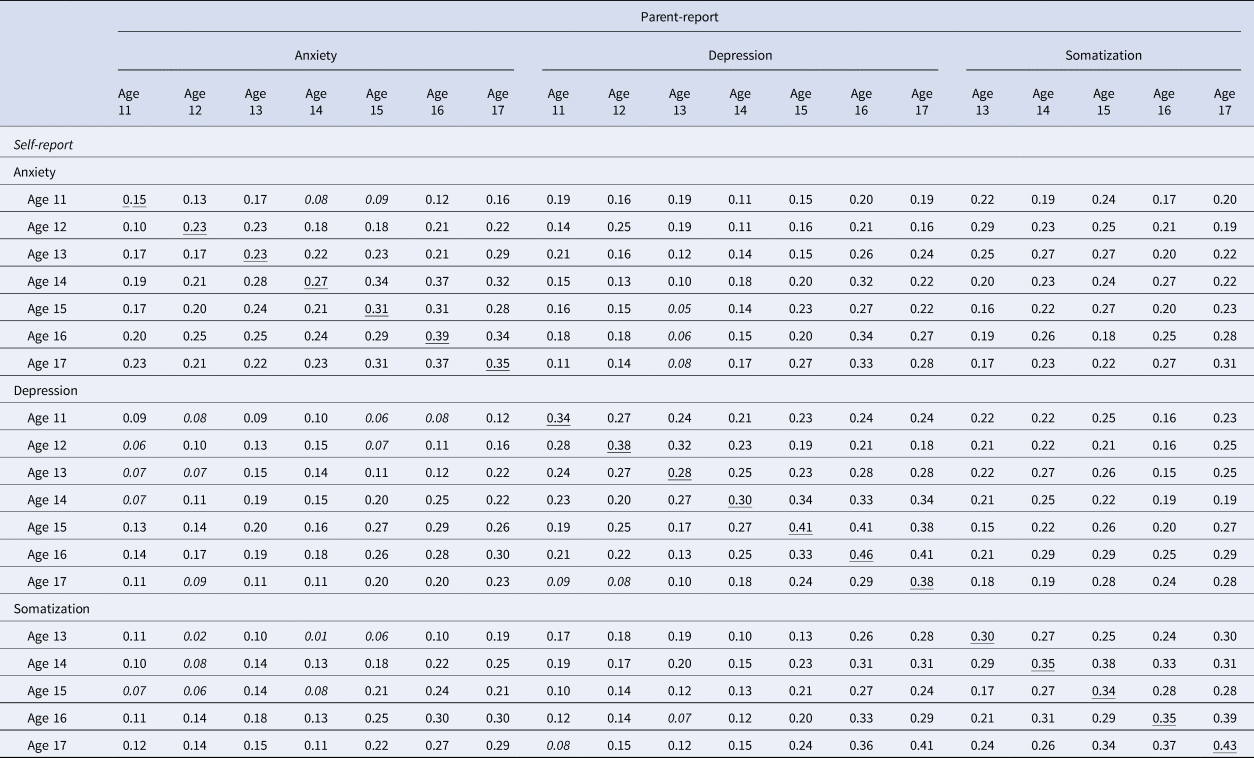
Note: Values underlined on the diagonal are the within-time, within-construct correlations between self- and parent reports. All correlations are significant at p < 0.05 except those italicized.
ALT-SR models
Self-reported internalizing symptoms
Model
Only anxiety had significant variation in the slope factor; as there was no significant variation in the (co)variances of the depression and somatization slopes, these parameters were fixed. The slope and intercept of anxiety were correlated,Footnote 2 while all other intercept and slope correlations were not statistically significant and were subsequently trimmed. This yielded a model that had good fit to the data, χ2(217) = 345.353, p < 0.001; CFI = 0.975; RMSEA = 0.030 (90% CI 0.024–0.036), p = 1.00; SRMR = 0.028, AIC = 59 633.379. Imposing equality constraints on the autoregressive (Δχ2 = 55.640, Δdf = 13, p < 0.001) and covariance (Δχ2 = 28.992, Δdf = 14, p = 0.011) parameters resulted in significant deterioration of model fit. We next constrained the cross-lagged parameters to be equal over time, which resulted in no difference in fit between the two nested models (Δχ2 = 30.470, Δdf = 24, p = 0.17). As this constrained model was parsimonious and a good fit to the data χ2(241) = 374.726, p < 0.001; CFI = 0.973; RMSEA = 0.029 (90% CI 0.023–0.034), p = 1.00; SRMR = 0.044, AIC = 59 626.822, it was chosen as the final model. Multigroup analyses exploring moderation by sex did not converge, so sex was included as a covariate.
Within-person effects
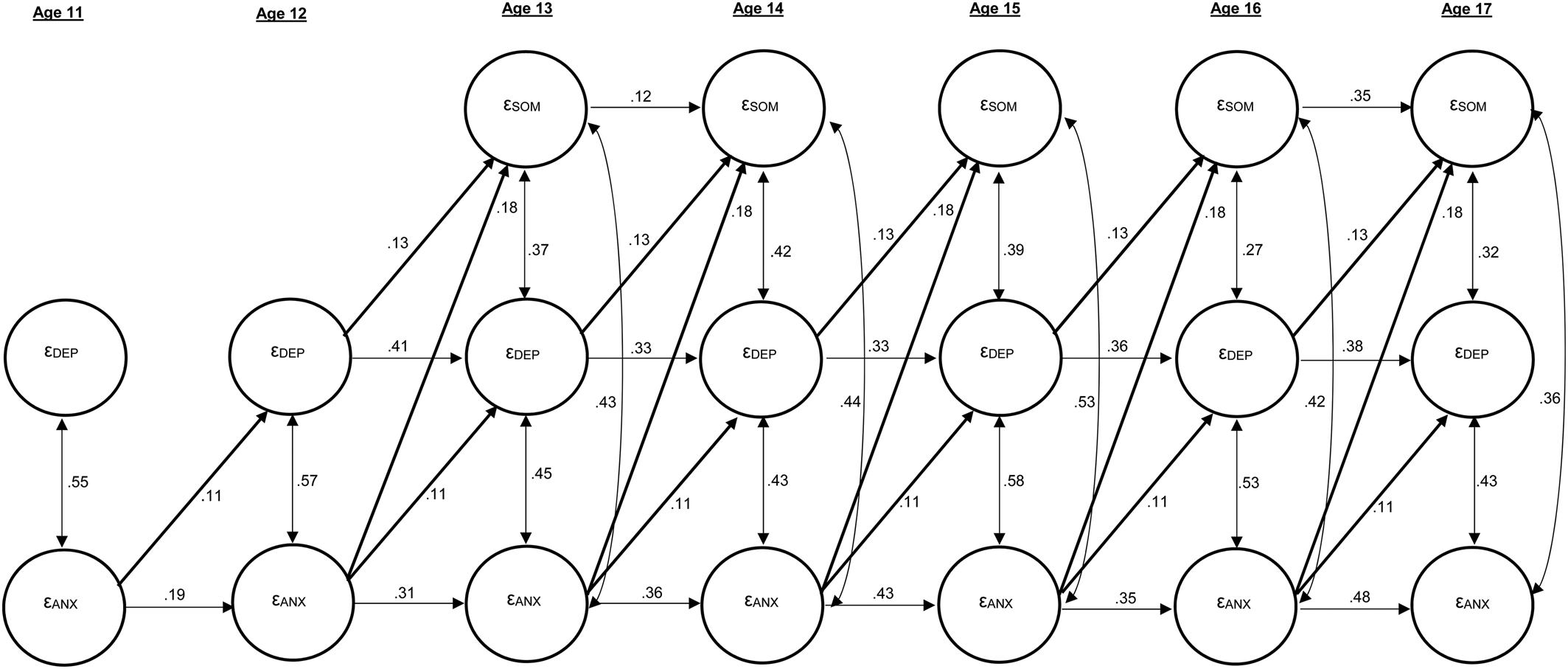
Autoregressive parameters for anxiety, depression and somatization were generally high, indicating stability in internalizing symptoms across time (Fig. 1; online Supplementary eTable 1 for all model estimates). Within-time, there were positive correlations among anxiety, depression and somatization every year of the study. The cross-lag pattern of effects revealed that deviations from an individual's average trajectory in anxiety symptoms at one time point predicted deviations from that individual's expected trajectory in depressive symptoms 1-year later, and likewise for the effects of anxiety and depression on somatic symptoms 1-year later. That is, anxiety consistently predicted depression, while anxiety and depression consistently predicted somatization.
Self-reported within-person effects of the final auto-regressive latent trajectory model with structured residuals (ALT-SR). Values are standardized coefficients and the parameters displayed are those that were statistically significant following the Benjamini–Hochberg p value correction. Non-significant parameters, between-person effects and the control variables are not shown in the figure for the ease of interpretation. Note: ɛ (epsilon), residual variance; SOM, somatization; DEP, depression; ANX, anxiety.
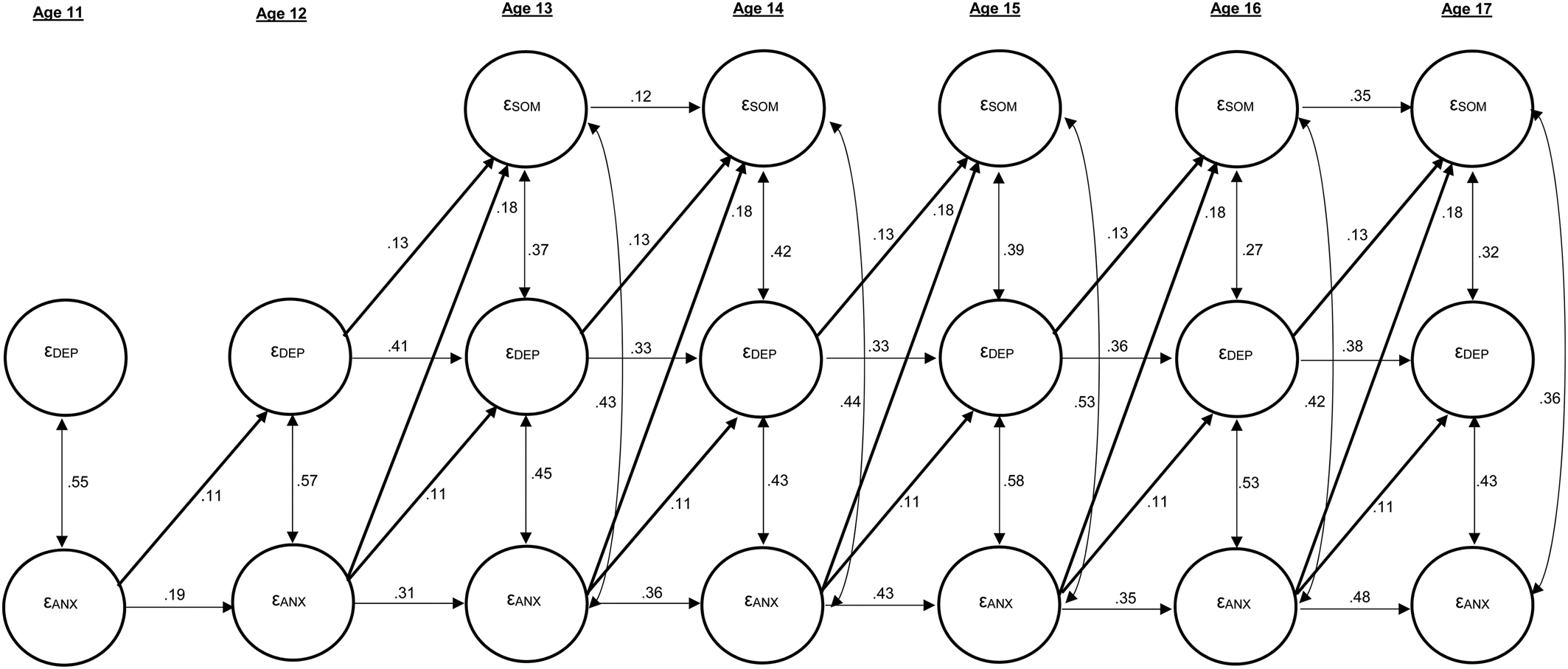
As there were pathways in the model that spanned three time points (anxiety→depression→somatization), we tested for indirect effects. Because anxiety→depression (a) and depression→somatization (b) were constrained across time, indirect effects were computed by specifying an interaction term (a × b) between the path parameters (Berry and Willoughby, Reference Berry and Willoughby2017) and calculating the total effect (a + b). Anxiety had direct effects on somatization (b = 0.100, s.e. = 0.025, p < 0.001) and indirect effects via depressive symptoms (b = 0.008, s.e. = 0.003, p = 0.006). The proportion of the total effect (b = 0.189, s.e. = 0.037, p < 0.001) that was explained by depression was 4.2%.
Between-person effects
There were significant positive correlations among the intercepts of anxiety, depression and somatization. Sex positively predicted every intercept and slope, such that girls had higher latent means of anxiety, depression and somatization compared to boys, and over time, girls' level of anxiety, depression and somatization increased. Chronic bullying victimization positively predicted the intercepts of anxiety, depression and somatization and negatively predicted the slopes of anxiety and depression (online Supplementary eFigs 1a and 1b). Physical abuse positively predicted the intercepts of anxiety, depression and somatization, while sexual abuse positively predicted the intercept of somatization and the slopes of anxiety and depression. Income negatively predicted the intercepts of anxiety and depression, while education negatively predicted the intercept of somatization.
Parent-reported internalizing symptoms
Model
Anxiety, depression and somatization had significant variation in the slope factor and were therefore retained as random effects. There was significant covariation between the slope of depression and the intercepts of anxiety, depression and somatization, while all other intercept and slope covariances were not statistically significant and were subsequently trimmed. This yielded a model that had good fit to the data, χ2(213) = 293.472, p < 0.001; CFI = 0.982; RMSEA = 0.024 (90% CI 0.017–0.030), p = 1.00; SRMR = 0.037, AIC = 22 583.070. Imposing equality constraints on the covariance (Δχ2 = 78.992, Δdf = 14, p = 0.017) and cross-lag (Δχ2 = 48.640, Δdf = 24, p = 0.002) parameters resulted in significant deterioration of model fit, while constraining the autoregressive parameters to be equal over time resulted in no difference in fit between the two nested models (Δχ2 = 15.347, Δdf = 13, p = 0.286). As the constrained model was parsimonious and a good fit to the data [χ2(226) = 307.083, p < 0.001; CFI = 0.982; RMSEA = 0.023 (90% CI 0.016–0.029), p = 1.00; SRMR = 0.038, AIC = 22 590.402], it was selected as the final model. Multigroup analyses exploring moderation by sex did not converge, so sex was included as a covariate.
Within-person effects
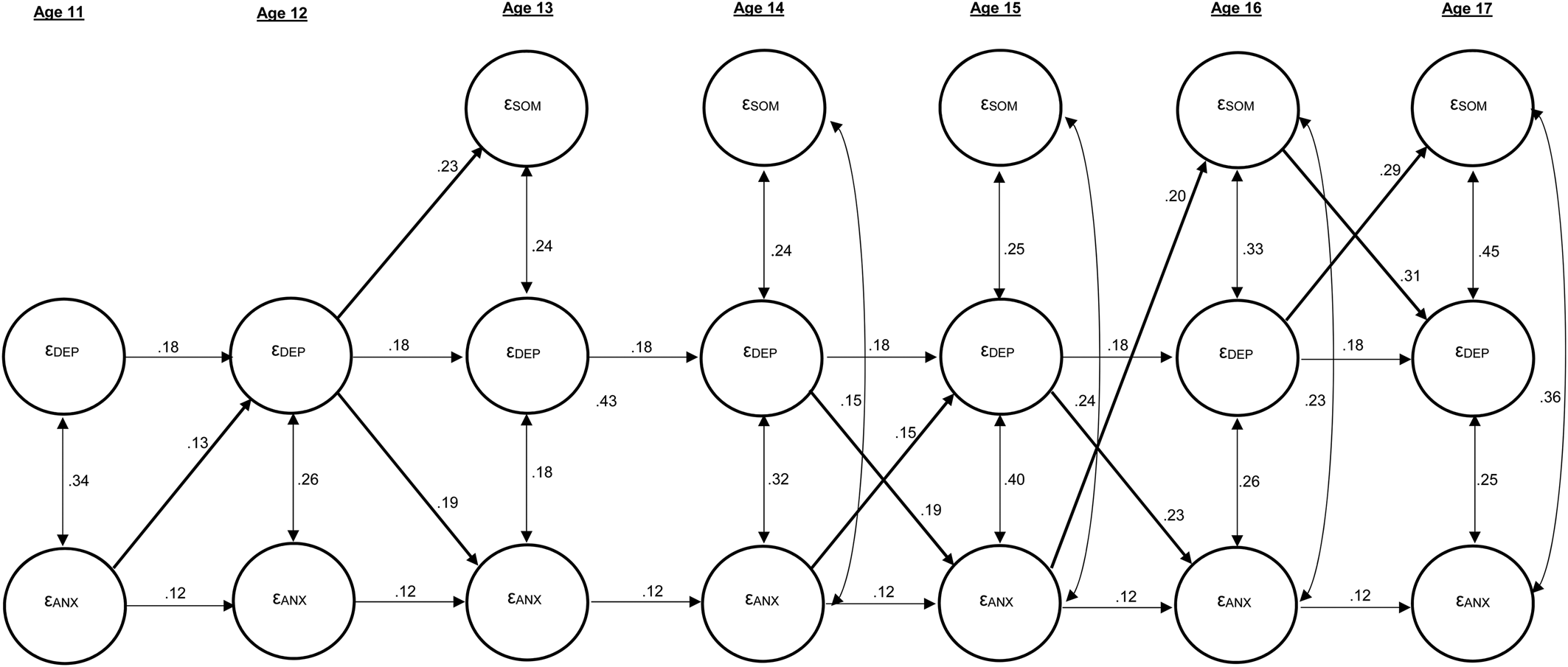
Autoregressive paths for anxiety and depression were stable, while there was no continuity in parent-reported somatic symptoms (Fig. 2; online Supplementary eTable 2 for all model estimates). At almost every time point, there were within-time associations among anxiety, depression and somatization (except between anxiety and somatization at age 13). The cross-lag pattern of effects revealed several bidirectional links between anxiety and depression. As a post-hoc test, we examined the magnitude of associations between anxiety and depression by applying equality constraints across all depression→anxiety and anxiety→depression pathways, then probing using the Wald χ2 statistic. The effect of depression→anxiety was significantly stronger in magnitude than the effect of anxiety→depression (χ2 = 9.575, df = 1, p = 0.002). There were three cross-lag links between depression and somatization: the effect of depression→somatization was significantly stronger in magnitude than the effect of somatization→depression (χ2 = 5.377, df = 1, p = 0.02).
Parent-reported within-person effects of the final auto-regressive latent trajectory model with structured residuals (ALT-SR). Values are standardized coefficients and the parameters displayed are those that were statistically significant following the Benjamini–Hochberg p value correction. Non-significant parameters, between-person effects and the control variables are not shown in the figure for the ease of interpretation. Note: ɛ (epsilon), residual variance; SOM, somatization; DEP, depression; ANX, anxiety.
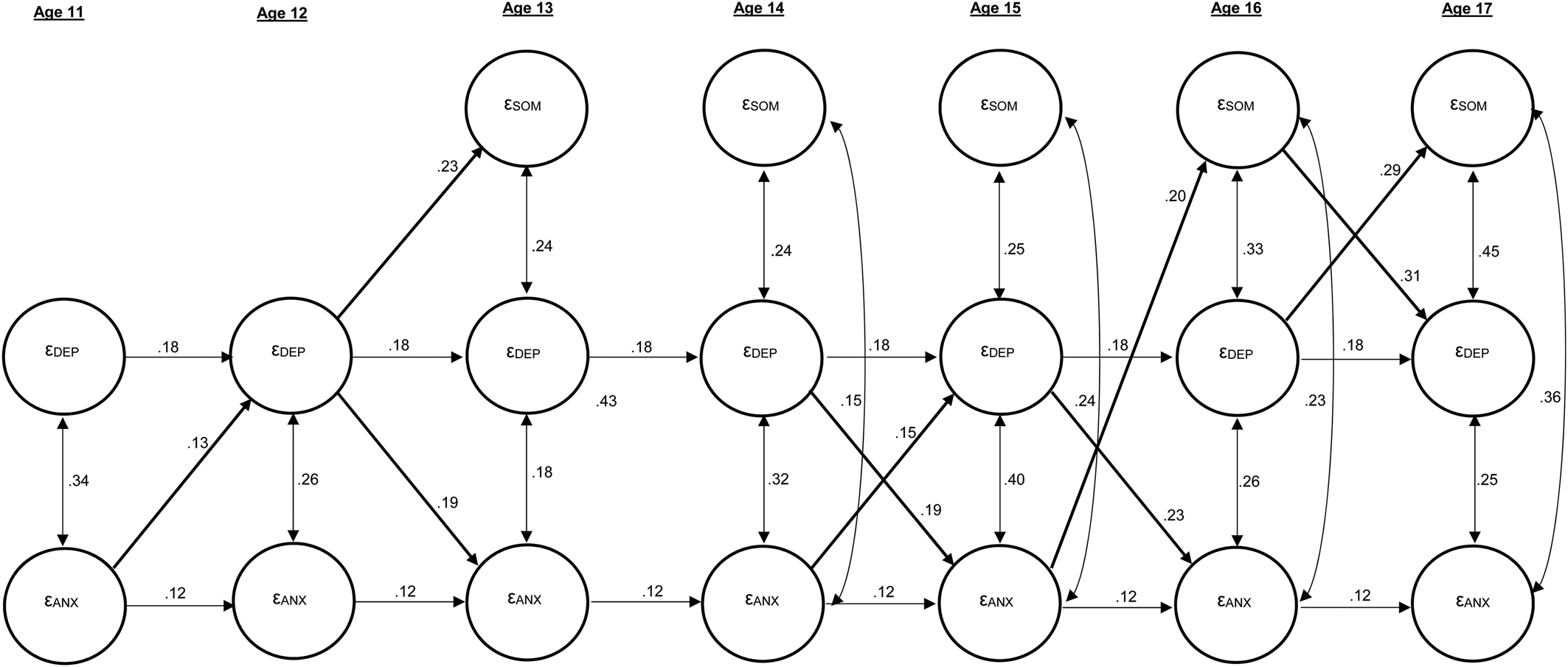
As there were pathways in the model that spanned three time points (age 11 anxiety→age 12 depression→age 13 somatization), we tested for indirect effects by re-running the final model, adding a constraint specifying an interaction term (a × b) between the path parameters. The test for indirect effects was non-significant (b = 0.207, s.e. = 0.129, p = 0.108).
Between-person effects
There were significant positive correlations among the intercepts of anxiety, depression and somatization. Sex positively predicted the intercepts of anxiety and somatic symptoms and all three symptom slopes. That is, parents reported higher latent means of anxious and somatic symptoms and increasing trajectories of all internalizing symptoms among daughters in comparison to sons. Chronic bullying victimization was positively associated with the intercepts of depression and somatization. Income negatively predicted the intercepts of anxiety, depression and somatization, while race/ethnicity negatively predicted the intercepts of anxiety and somatization; parents from White racial backgrounds and from households with higher levels of income reported lower levels of internalizing symptoms among their children.
Discussion
To our knowledge, this is the first study to delineate intraindividual stability and change in symptoms of anxiety, depression and somatization reported by a community sample of adolescents and parents. The main findings were: (a) the patterning of self-reported internalizing symptoms supported a prodromal model; (b) the patterning of parent-reported internalizing symptoms somewhat supported a bidirectional model; (c) experiences of abuse were consistent risk factors for self-reported internalizing symptoms; and (d) across informants, being a girl conferred a risk for higher means and rising trajectories of anxiety, depression and somatization.
As reported by adolescents, generalized anxiety manifest as a precursor to depression and somatization and exerted an indirect effect on somatization via depressive symptoms, supporting the idea that anxiety is a prodrome to depression, as previously reported among adults (Parker et al., Reference Parker, Wilhelm and Asghari1997; Jackson et al., Reference Jackson, Cavanagh and Scott2003; Fava and Tossani, Reference Fava and Tossani2007). Although the notion that generalized anxiety plays a key role in the development of depression is not new (Moffitt et al., Reference Moffitt, Harrington, Caspi, Kim-Cohen, Goldberg, Gregory and Poulton2007), the current findings offer a novel contribution to the debate by highlighting that intraindividual shifts in symptoms of anxiety consistently increase the risk of early depressive and somatic symptoms across a sensitive period of development. Clinically, early treatment for self-reported symptoms of childhood anxiety may inhibit the progression of homotypic (anxiety→anxiety) and heterotypic (anxiety→depression/somatization) symptom continuity. The indirect pathway from anxiety to somatization via depression was unexpected and our interpretation is that the effect of depression on somatization is being driven by prior anxiety. Further studies are needed to determine whether the prodromal and mediation pathways found in this study replicate across other samples.
The patterning of internalizing symptoms reported by parents was less consistent but provided some evidence in support of the bidirectional model. Bidirectional associations between anxiety and depression across childhood and adulthood (age range 5–61 years) were reported in a meta-analysis that included self- and parent reports (Jacobson and Newman, Reference Jacobson and Newman2017), meaning that informant may partially explain inconsistencies in temporal ordering reported across previous studies. Discrepancies between informants have implications for the assessment of internalizing problems and can have serious ramifications for youth; Makol et al. (Reference Makol, De Los Reyes, Ostrander and Reynolds2019) found that among adolescents in a psychiatric inpatient facility, divergent reports favouring parents (internalizing symptoms reported as high by parents and low by youth) resulted in youth receiving more locked door seclusion and antipsychotic medication. Discrepant reports have also been associated with poorer treatment outcomes (Goolsby et al., Reference Goolsby, Rich, Hinnant, Habayeb, Berghorst, De Los Reyes and Alvord2018). Less is known about how outcomes might differ for community-based youth with subclinical symptoms and this warrants further investigation. As the cross-informant correlations for childhood anxiety were small and the magnitude of cross-lag effects in the parent-reported model was strongest from depression to anxiety, parents may be unreliable at recognizing symptoms of anxiety and its cascading effects in their children. As parents are generally the gatekeepers to health services, failure to recognize symptoms of anxiety may be an opportunity lost for early intervention and the prevention of comorbidity. Self-reports of childhood anxiety may therefore need to be given precedence among clinicians and healthcare providers.
Experiences of abuse were consistent risk factors for self-reported internalizing symptoms. Bullying victimization was associated with positive intercepts and negative slopes for depression and anxiety. The positive intercepts corroborate prior research showing that being bullied is an environmental risk for internalizing problems, beyond genetic vulnerability (Arseneault et al., Reference Arseneault, Milne, Taylor, Adams, Delgado, Caspi and Moffitt2008). As the overall slope factor for anxiety was positive, the negative slope for anxiety among children who had been bullied meant that anxiety symptoms were elevated and remained stably high across the study period (online Supplementary eFig. 1a). The negative slope for depression meant that although depressive symptoms were initially elevated, the effect of chronic childhood bullying victimization on depression decreased over time (online Supplementary eFig. 1b), supporting prior evidence that the negative effects of being bullied can dissipate for some adolescents (Singham et al., Reference Singham, Viding, Schoeler, Arseneault, Ronald, Cecil, McCrory, Rijsdijk and Pingault2017). Although researchers have found that being bullied is more strongly associated with psychopathology than being maltreated by a caregiver (Lereya et al., Reference Lereya, Copeland, Costello and Wolke2015), the magnitude of effects for physical abuse and bullying victimization on internalizing symptoms in this study were similar. We found non-significant intercepts and significant slopes for sexual abuse, which could mean that the impact of sexual abuse on anxiety and depression had a delayed onset for youth who were abused in childhood, or that there was an increase in occurrences of sexual abuse and subsequent internalizing symptoms in mid-adolescence; our retrospective measure only allowed us to determine that the abuse occurred before age 16. As prospective and retrospective measures of childhood maltreatment are associated with differential pathways to psychopathology (Baldwin et al., Reference Baldwin, Reuben, Newbury and Danese2019), further investigations into the measurement of abuse and pathways to mental illness are needed. Presently, our results substantiate meta-analytic findings that childhood sexual and physical abuse is associated with depression and anxiety over the life course (Lindert et al., Reference Lindert, Von Ehrenstein, Grashow, Gal, Braehler and Weisskopf2014).
Consistent across informants and with prior research, comorbidity was the rule rather than the exception (within-person correlation 0.2–0.6; intercept correlations >0.4), and internalizing symptoms were strongest among girls (Lieb et al., Reference Lieb, Zimmermann, Friis, Höfler, Tholen and Wittchen2002; Nemeroff, Reference Nemeroff2002; Costello et al., Reference Costello, Mustillo, Erkanli, Keeler and Angold2003; Kessler et al., Reference Kessler, Berglund, Demler, Jin, Merikangas and Walters2005). In addition to the high comorbidity between anxiety and depression, anxiety had strong links with somatization, converging with research showing that psychiatric diagnoses are longitudinally associated with youth- and parent reports of somatic pain and that somatization can be a consequence of psychological and social stress (Lee and Vaillancourt, Reference Lee and Vaillancourt2019). The evolution of symptoms as reported by adolescents (anxiety→depression→somatization) may reflect a progression of symptom severity (Simms et al., Reference Simms, Prisciandaro, Krueger and Goldberg2012), with physical pain being the end point. Despite the strong evidence of unidirectional effects found in the self-report model, we expect that experiencing chronic pain will exert rebound effects on symptoms of anxiety and depression, leading to bidirectional associations in adulthood. Research is needed to delineate the precise neurobiological processes that lead to comorbidity, including the mechanisms that lead girls to be more adversely affected than boys.
There are several strengths and limitations to our study. The main limitations arise from the complexity of our models, as we were unable to model quadratic terms or test multi-group models. We attempted to examine model invariance across sex, but these models would not converge. Our cross-lag effects are larger than those found in similar studies (Truglio et al., Reference Truglio, Seroczynski, Peeke, Martin and Cole2005; Keenan et al., Reference Keenan, Feng, Hipwell and Klostermann2009; Long et al., Reference Long, Young and Hankin2019), representing moderate effect sizes (Bosco et al., Reference Bosco, Pierce, Field, Singh and Aguinis2014), and although these effects are clinically meaningful, we are cognizant that there are heterogeneous pathways to internalizing symptoms that are unaccounted for in our models. Our sample consisted primarily of White, middle-class children and parents, and despite being representative of the Canadian populace, limits our ability to extrapolate the findings. Further research is needed to determine whether our exploratory and data-driven models can be replicated across samples of similar and diverse backgrounds and age groups. With these caveats in mind, important strengths of the study include the rigorous methodology, including the randomly-selected sample, the use of validated, multi-item measures, multiple informants, the prospective design across seven consecutive years and notably, the novel modelling approach that allowed us to disentangle between- and within-person variability.
We found compelling evidence that generalized anxiety plays a key role in the emergence of early depressive and somatic symptoms across childhood and adolescence. As this is, to our knowledge, the first study of its kind, additional studies are needed to replicate and extend the models and further test whether childhood generalized anxiety is a unique prodrome for adolescent-onset as opposed to adult-onset depression and somatization. Priority areas of research should include investigations into whether community interventions targeting subclinical symptoms of childhood anxiety may prevent homotypic and heterotypic continuity and determine the long-term outcomes following self- or parent reports of all internalizing symptoms. Continued efforts are needed to implement policies and interventions that reduce child maltreatment and peer victimization.
Supplementary material
The supplementary material for this article can be found at https://doi.org/10.1017/S0033291719002484.
Acknowledgements
We express our gratitude to the parents and youth in the McMaster Teen Study for their continued participation and to Heather Brittain for her statistical advice.
Financial support
This research was supported by grants awarded to T.V. from the Social Sciences and Humanities Research Council of Canada (grant numbers 833-2004-1019, 435-2016-1251); the Canadian Institute of Health Research (grant numbers 201009MOP-232632-|CHI-CECA-136591, 201603PJT-365626- PJT-CECA-136591); and the Ontario Mental Health Foundation (grant number PA-13-303).
Conflict of interest
None.
Ethical standards
The authors assert that all procedures contributing to this work comply with the ethical standards of the relevant national and institutional committees on human experimentation and with the Helsinki Declaration of 1975, as revised in 2008.