INTRODUCTION
The Brazil nut (Bertholletia excelsa) is one of the main seeds commercially harvested in rainforest ecosystems (Peres et al. Reference Peres, Baider, Zuidema, Wadt, Kainer, Gomes-Silva, Salomão, Simões, Franciosi, Cornejo Valverde, Gribel, Shepard, Kanashiro, Coventry, Yu, Watkinson and Freckleton2003; Kainer et al. Reference Kainer, Wadt and Staudhammer2007), and as such plays an important role in the extractive economy of the Amazon. Its collection and processing are important sources of income for many rural communities and urban dwellers in Peru, Bolivia and Brazil (Mori & Prance Reference Mori, Prance, Prance and Ballack1990; Stoian Reference Stoian2005). The eastern Brazilian Amazon was the historical centre of production from the mid-1600s onward (Kainer et al. Reference Kainer, Wadt and Staudhammer2007), but, in recent decades, production has shifted toward the south-western Amazon, which, in contrast to the older frontier regions, still contains large tracts of forests. Currently, production is concentrated in a tri-national region known as the MAP region, which includes the Departments of Madre de Dios (M) in Peru and Pando (P) in Bolivia, and the State of Acre (A) in Brazil. Within this region, the Brazil nut is the most important commercially-extracted non-timber forest product (Peres et al. Reference Peres, Baider, Zuidema, Wadt, Kainer, Gomes-Silva, Salomão, Simões, Franciosi, Cornejo Valverde, Gribel, Shepard, Kanashiro, Coventry, Yu, Watkinson and Freckleton2003).
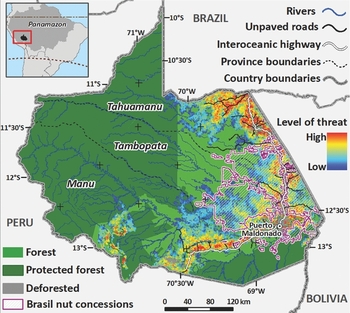
Here, we focus on the economics of Brazil nut production in the Department of Madre de Dios (Peru), where the Brazil nut industry, including collection, processing, transport and export, employs c. 30 000 people (Flores Reference Flores2002), and provides 67% of the annual income for these families (Campos Reference Campos2006). Collection occurs primarily within concessions, which occupy 12% of Madre de Dios, an area of approximately one million hectares. This area is divided into more than 800 concessions, which vary in size from 200 to 1200 ha and are concentrated in two provinces: Tahuamanu and Tambopata (Fig. 1).
Level of threat posed by deforestation in areas of Brazil nut concessions in Madre de Dios, Peru.

Although Brazil nut collection is both economically and culturally important for Madre de Dios, other activities, such as logging, agriculture and cattle ranching, play a relevant role in the income diversification of the region's small landholders and local producers (Escobal & Aldana Reference Escobal and Aldana2003). Recent investments in infrastructure in the region, particularly the paving of the Interoceánica Sur highway (IOS) and the planned Inambari hydroelectric power plant, which will become the largest dam in Peru (see http://www.dams-info.org/), will impact local and regional economies, including Brazil nut producers. The paving of the IOS may increase the production of nuts by 13%, as profitability increases due to reduced transportation costs (Bonifaz & Urrunaga Reference Bonifaz and Urrunaga2008). Conversely, these infrastructure investments will accelerate migration to the region, already catalysed by the gold rush (Swenson et al. Reference Swenson, Carter, Domec and Delgado2011), spurring invasion and land grabbing in a context of low governance (Yu et al. Reference Yu, Levi and Shepard2010). Thus, while infrastructure improvements may make Brazil nut collection more profitable, they will also increase competition for land and the profitability of other activities, such as ranching and agriculture (Nepstad et al. Reference Nepstad, Soares-Filho, Merry, Lima, Moutinho, Carter, Bowman, Cattaneo, Rodrigues, Schwartzman, McGrath, Stickler, Lubowski, Piris-Cabezas, Rivero, Alencar, Almeida and Stella2009), which contribute to deforestation of the ecosystems that Brazil nut production depends upon (Soares-Filho et al. Reference Soares-Filho, Nepstad, Curran, Cerqueira, Garcia, Ramos, Voll, McDonald, Lefebvre and Schlesinger2006; Killeen Reference Killeen2007; Kirkby et al. Reference Kirkby, Giudice, Day, Turner, Soares-Filho, Oliveira-Rodrigues and Yu2011). This suggests that it is important to look for viable strategies that reconcile forest conservation with development objectives in order to avoid deforestation and forest degradation.
There are many project-level initiatives underway that attempt to harness market mechanisms or implement payments for ecosystem services (PES) (Wunder Reference Wunder2008) in order to place economic value on standing forests with high levels of biodiversity, such as those of Madre de Dios. Perhaps the most important initiative being considered is Reducing Emissions from Deforestation and Forest Degradation in developing countries, and the role of conservation, sustainable management of forests and enhancement of forest carbon stocks (REDD+). In effect, REDD+ goes beyond PES projects, as it focuses on creating both an institutional framework and international financial mechanisms for developing countries to reduce CO2 emissions from deforestation and forest degradation.
The majority of studies of REDD+ have focused on estimating the opportunity costs associated with maintaining land in forest versus other prevailing land uses, such as ranching, agriculture and commercial forestry (see for example Sohngen & Sedjo Reference Sohngen and Sedjo2006; Kindermann et al. Reference Kindermann, Obersteiner, Sohngen, Sathaye, Andrasko, Rametsteiner, Schlamadinger, Wunder and Beach2008; Nepstad et al. Reference Nepstad, Soares-Filho, Merry, Lima, Moutinho, Carter, Bowman, Cattaneo, Rodrigues, Schwartzman, McGrath, Stickler, Lubowski, Piris-Cabezas, Rivero, Alencar, Almeida and Stella2009; Soares-Filho et al. Reference Soares-Filho, Moutinho, Nepstad, Anderson, Rodrigues, Garcia, Dietzsch, Merry, Bowman, Hissa, Silvestrini and Maretti2010a). Important issues have been raised, however, about the failure to account for other joint benefits of forest conservation that go above and beyond maintaining carbon stocks in forests (Stickler et al. Reference Stickler, Nepstad, Coe, McGrath, Rodrigues, Walker, Soares-Filho and Davidson2009). In the case of Brazil nut collection, these joint benefits include income generation for rural and non-rural populations that collect Brazil nuts (Stoian Reference Stoian2005), as well as biodiversity conservation and maintenance of ecosystem services in forests where nuts are collected (Zuidema & Boot Reference Zuidema and Boot2002). As such, financial resources from REDD+ projects could be used to improve the forest management practices in collection areas to ensure the health of the forest ecosystems where Brazil nut trees thrive (Viana et al. Reference Viana, Mello, Morales, de Mendes, Gascon and Moutinho1998; Peres et al. Reference Peres, Baider, Zuidema, Wadt, Kainer, Gomes-Silva, Salomão, Simões, Franciosi, Cornejo Valverde, Gribel, Shepard, Kanashiro, Coventry, Yu, Watkinson and Freckleton2003; Zuidema Reference Zuidema2003; Wadt et al. Reference Wadt, Kainer, Staudhammer and Serrano2008). In addition, REDD+ funds could be invested to improve the production chain and eliminate barriers to transport, certification and commercialization of the nut, thereby potentially increasing the added value of the product and profits to Brazil nut collectors. This would, in turn, increase the value of standing forests in the region.
A necessary step in arguing that funding from REDD+ can and should be channelled toward economic activities that provide joint benefits of income to forest-dependent people and improved forest management (Agrawal & Angelsen Reference Agrawal, Angelsen and Angelsen2009) consists of a careful estimation of profits generated by these activities, considering that REDD+ is likely to succeed only where the joint economic benefits are greater than the opportunity costs of forest stewardship, namely where the net present value (NPV) of sustainable forest management is greater than NPV of the best forgone land-use option (Wunder Reference Wunder2008). Non-timber forest products (NTFPs) have been envisaged as a means to match tropical forest conservation and development goals (Arnold & Perez Reference Arnold and Perez2001; Agrawal & Angelsen Reference Agrawal, Angelsen and Angelsen2009), but whether they are an economically-viable solution is still debated (Kusters et al. Reference Kusters, Achdiawan, Belcher and Ruiz2006). We developed a spatially-explicit model that estimates the potential annual rents (profits) to Brazil nut collectors in concessions of Madre de Dios and compared the rents with opportunity costs of other land uses in the region. According to the Malthusian definition, land rent is the portion of the value of the whole produce which remains to the owner of the land after all outgoings belonging to its cultivation, of whatever kind, have been paid, including the profits of the capital employed. In the case of Brazil nut rents, they are concessionary rents, because they are accruing to the concessionaire, who does not own the land, but profits from it. We also compiled data on investments needed to improve and certify the production chain and calculated the contribution of the Brazil nut concessions to reducing deforestation in Madre de Dios in the context of a REDD+ programme by simulating future deforestation. This research, therefore, estimates the potential reductions in deforestation associated with the sustainable management of Brazil nut concessions, as well as the costs to improve production and forest management within concessions. Both of these estimates are important components for designing programmes aimed at reducing deforestation and adding value to standing forests. As such, we see the Brazil nut concessions of Madre de Dios as an important case study for practical implementation of REDD+.
Brazil nut production in concessions of Madre de Dios
In 2002, the Peruvian government began to grant 40-year renewable Brazil nut concessions on state-owned land to local harvesters (castañeros) in Madre de Dios (Fig. 1). These concessionary arrangements guarantee the exclusive right of exploitation to the concessionaires, contingent upon (1) registration with the Regional Government of Madre de Dios, which assumed the duties of the former National Institute of Natural Resources (INRENA) in 2010, (2) completion and compliance with the General Forestry Management Plan (Plan General de Manejo Forestal [PGMF]) and the Annual Operational Plan (Plan Operativo Anual [POA]), (3) payment of all fees, and (4) compliance with forest law. Both PGMF and POA guide activities undertaken within the concession; POA develops an annual production budget using an inventory of Brazil nut trees within the concession (including data on location and productivity), conducted as part of PGMF (Appendix 1, see supplementary material at Journals.cambridge.org/enc).
Collection of Brazil nuts occurs once annually during part of the rainy season (December–April), and because the harvest is concentrated during these months, many concessionaires live in urban areas and are only on-site during the collection period. The concessionaires, their family and hired workers use a trail network within the concession to collect the mature Brazil nut fruit from the forest floor. The fruit, round woody capsules (pyxidium) of up to 2 kg, are then carried to and gathered at points along the main trail (varadero), where they are chopped to extract the nuts. Buckets (latas) of c. 10 kg are used to measure nut volume and fill the approximately 70 kg sacks (barricas) in which the nuts are carried to the final collection centre within the concession. There, the nuts can be processed (dried to remove the woody seed testa or shell) and then transported by motorcycle, truck or boat to intermediary processers or distribution centres (centros de acopio), or directly to export firms in Puerto Maldonado, where they are sold unshelled or shelled.
Previous research estimated the average annual revenue for one medium-sized concession (500–800 ha) at US$ 6410 yr−1 (US$ 8–10 ha−1 yr−1) (Campos Reference Campos2006); Wunder (Reference Wunder2001) estimated the annual profit from Brazil nut collection to be US$ 7 ha−1 and Kirkby et al. (Reference Kirkby, Giudice-Granados, Day, Turner, Velarde-Andrade, Dueñas-Dueñas, Lara-Rivas and Yu2010) provided a figure of US$ 6 ha−1 yr−1 for unshelled production. Rents can fluctuate dramatically on an annual basis due to variations in tree productivity, output prices, input prices and transportation costs, as well as by type of production. There are at least two types of improvements upon the basic model of selling unshelled (unprocessed) Brazil nuts that are currently underway in the region: (1) investments in processing infrastructure and (2) investment in production chain certification. While there is a price premium associated with the processed nut, many concessionaires lack the infrastructure and financial resources necessary to dry and shell the nut and must therefore sell the nuts unshelled. The certified nut also has a price premium associated with it (Flores Reference Flores2002), but requires upfront investments in the certification process. The three relevant types of certification for Brazil nut production are (1) sustainable management certification by the Forest Stewardship Council (FSC, see http://www.fsc.org); (2) organic certification by the Institute for Marketecology (IMO, see http://www.imo.ch) and (3) fair trade certification by Fairtrade Labelling Organizations (FLO-CERT, see http://www.flo-cert.net). While there are currently no FSC-certified concessions, there are three associations of castañeros, namely ASCART (Asociación de Castañeros de la Reserva Nacional Tambopata), RONAP (Asociación de Recolectores Orgánicos de la Nuez Amazónica Peruana) and those working with the exporting firm CANDELA (Comercio Alternativo de Productos No Tradicionales y Desarrollo en Latinoamerica), which together comprise approximately 257 castañeros in the region who are both IMO and FLO-CERT certified (Campos Reference Campos2006).
METHODS
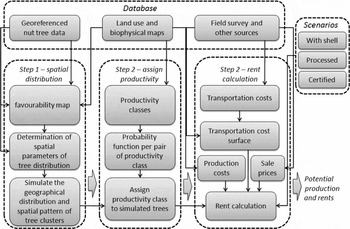
The model we developed assesses potential yields and rents in Brazil nut concessions of Madre de Dios under three scenarios of production and management (unshelled, shelled or shelled-certified). This model is unique in integrating the economic, geographic and environmental aspects of the collection, processing, transport and sale of Brazil nuts. The model was developed in three steps (Fig. 2). First, we modelled the spatial distribution of Brazil nut trees within the concessions. Then, we modelled the distribution of tree productivity. Finally, we combined the map of estimated productivity with output prices and estimates of costs of collection, processing and transport to estimate the annual rent per hectare for a specific forest parcel (a raster cell of 0.25 ha) within the concessions.
Model flowchart. Dashed lines encompass main model components, database and modelled scenarios of Brazil nut production.

All model components were designed and implemented using Dinamica EGO freeware (Soares-Filho et al. Reference Soares-Filho, Rodrigues and Costa2010b; see URL http://www.csr.ufmg.br/dinamica/index.html), which employs a series of spatial algorithms for the analysis and simulation of space-time phenomena.
Data
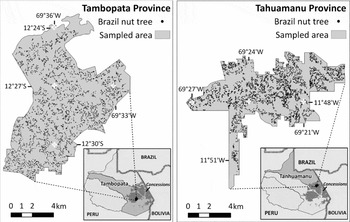
We compiled data from various sources to build our model (Appendix 1, Table S1, see supplementary material at Journals.cambridge.org/enc). We obtained PGMF and POA data for a set of Brazil nut and logging concessions from former INRENA, processing plant budgets from Bosques Amazonicos (see http://www.sfmbam.com), and in 2008/2009 conducted interviews and surveys with members of the Brazil nut production chain to obtain data on costs of production, processing coefficients, transport and sale prices, and estimates of costs of processing and certification. Our dataset includes a detailed georeferenced inventory of Brazil nut trees within the concessions with data on productivity and morphological attributes. From this inventory, we selected two subsets of continuous tree locations (Tahuamanu and Tambopata) in order to minimize bias from delimiting the samples around clusters of highly productive trees. The Tahuamanu subset contained 5500 inventoried trees within 6489 ha and the Tambopata subset contained 3787 trees within 9359 ha (Fig. 3) (Appendix 1, Figs. S1 and S2, see supplementary material at Journals.cambridge.org/enc).
Selected areas of the Tambopata and Tahuamanu provinces composed of contiguous Brazil nut concessions, indicating the spatial distribution of Brazil nut trees.

Simulating the geographic distribution and spatial pattern of Brazil nut trees
The first step in estimating the potential rent of Brazil nut collection was to simulate the geographic distribution of Brazil nut trees within the concessions. Using the tree inventory data, we applied the weights-of-evidence method (Soares-Filho et al. Reference Soares-Filho, Rodrigues and Costa2010b) to calculate the effect of spatial variables (such as distance to streams, geomorphology, elevation, slope, vegetation, temperature or precipitation) on the probability of occurrence of a Brazil nut tree in a given cell (Appendix 1, Table S2, see supplementary material at Journals.cambridge.org/enc). Weights of evidence (W+Bn) were calculated for each category (n) of a spatial variable B, and represent an estimate of the influence of the variable category on the probability of occurrence of Brazil nut trees in a specific cell according to the following equation:

where the larger the value of the coefficient of W+Bn, the stronger the association between the explanatory variable and the probability of occurrence of a Brazil nut tree within a cell (P{tree}). By the same logic, negative coefficients indicate an inhibitory effect, and values close to zero are consistent with no association (Soares-Filho et al. Reference Soares-Filho, Rodrigues and Costa2010b). Using this method, we find that Brazil nut trees occur more often in areas of low rolling hills at elevations of 200–400 m, away from flooded plains, and disassociated from bamboo forests and palm forests (Appendix 1, Fig. S3 and Tables S3 and S4, see supplementary material at Journals.cambridge.org/enc).
While the average density of Brazil nut trees in healthy forests is one adult tree per hectare, density is not uniform; trees are often found in clusters of 50 to 300 individuals in areas of 20–50 ha (Mori & Prance Reference Mori, Prance, Prance and Ballack1990), a spatial distribution characteristic of the species (Zuidema & Boot Reference Zuidema and Boot2002; Peres et al. Reference Peres, Baider, Zuidema, Wadt, Kainer, Gomes-Silva, Salomão, Simões, Franciosi, Cornejo Valverde, Gribel, Shepard, Kanashiro, Coventry, Yu, Watkinson and Freckleton2003; Wadt et al. Reference Wadt, Kainer and Gomes-Silva2005; Kainer et al. Reference Kainer, Wadt and Staudhammer2007), which may be due to interactions with man and other species (Peres et al. Reference Peres, Baider, Zuidema, Wadt, Kainer, Gomes-Silva, Salomão, Simões, Franciosi, Cornejo Valverde, Gribel, Shepard, Kanashiro, Coventry, Yu, Watkinson and Freckleton2003; Haugaasen et al. Reference Haugaasen, Haugaasen, Peres, Gribel and Wegge2010). Thus, as a next step, we sought to model the existence of more densely-populated ‘hotspots’. To do this, we analysed the spatial distribution of our samples by first testing the null hypothesis of a random distribution versus the alternate hypothesis of a non-random distribution with a chi-squared test; we rejected the null hypothesis of no spatial association between trees (p < 0.05). We then calculated K and G functions (Baddeley & Turner Reference Baddeley and Turner2005) by graphing the distance-to-the-nearest-neighbouring Brazil nut tree, and compared these functions to theoretical K and G distributions for random points (Appendix 1, Figs. S4 and S5, see supplementary material at Journals.cambridge.org/enc). Our findings were consistent with a clustered spatial distribution. We also calculated landscape-level descriptive statistics (average sample density and average distance to nearest neighbour), and average size and standard deviation of 1-tree, 2-tree and 3-tree groupings per 0.25 ha cell resolution (Appendix 1, Table S5, see supplementary material at Journals.cambridge.org/enc).
Using these analyses, we selected spatial distribution parameters for our simulation of tree locations. For buffer distances of 50 m and 100 m from cells with a previously-simulated tree, we estimated the probability of occurrence of another tree at 0.5 and 0.9, respectively (Appendix 1, Fig. S6, see supplementary material at Journals.cambridge.org/enc). These probabilities were transformed into corresponding weights of evidence and included as an additional variable in Eq. 1. Thus, this process modifies the probability map produced from the weights-of-evidence method to include the effect of clustering. The model stochastically and iteratively (10 iterations) simulates groupings of 1–3 trees, such that simulated groupings of trees influence the predicted location of others. For this step, we chose a saturation parameter of four trees per hectare, which corresponded to the observed maximum number of trees per hectare in more than 90% of our sampled area. In this way, the transition function of Dinamica EGO (Soares-Filho et al. Reference Soares-Filho, Rodrigues and Costa2010b) was calibrated so that the simulated spatial distribution reflected the average values for size, clustering, dispersion and density of groupings of 1, 2 and 3 trees obtained from the samples. Due to large differences in the statistics of sampled areas, we customized our model parameters for each province of Madre de Dios using data from the respective sampled areas.
Assigning productivity values to simulated Brazil nut trees
The seeds of the Brazil nut tree are extracted from the rigid pericarp of the fruit; each fruit holds approximately 15–25 nuts (Ortiz Reference Ortiz, Shanley, Pierce, Laird and Suillen2002). The tree fruits annually, and fruit production can vary greatly by tree and by year (Viana et al. Reference Viana, Mello, Morales, de Mendes, Gascon and Moutinho1998; Zuidema & Boot Reference Zuidema and Boot2002; Zuidema Reference Zuidema2003; Wadt et al. Reference Wadt, Kainer and Gomes-Silva2005, Reference Wadt, Kainer, Staudhammer and Serrano2008; Kainer et al. Reference Kainer, Wadt and Staudhammer2007). Viana et al. (Reference Viana, Mello, Morales, de Mendes, Gascon and Moutinho1998) observed an average annual production per tree of 24 kg of unshelled nuts (range1.5–105 kg); Wadt et al. (Reference Wadt, Kainer and Gomes-Silva2005) reported an annual average production of 10.28 kg of unshelled nuts per tree, and Kainer et al. (Reference Kainer, Wadt and Staudhammer2007) monitored 140 trees over five years and observed average annual production of 9.3 kg of unshelled nuts per tree (Appendix 1, Table S6, see supplementary material at Journals.cambridge.org/enc).
Kainer et al. (Reference Kainer, Wadt and Staudhammer2007) estimated via regression that DBH (diameter at breast height) explained more than 50% of variation in annual production. Although our sampled trees cover a wide range of DBH measures, a Spearman's rank correlation test of a subset of our sample with DBH ≥ 50 cm explained less of this variation (R2 = 0.34, n = 8948; Appendix 1, Figs. S1 and S2, see supplementary material at Journals.cambridge.org/enc). Hence, because our study focused on the effects of landscape attributes, we chose to model tree productivity as a function of observed spatial parameters rather than the tree characteristics, such as DBH.
To deal with the large variability in tree productivity, we modelled the spatial distribution of different productivity classes of trees using a process similar to the one we employed to predict tree location. We first divided the trees into three classes: non-productive (NP), low productivity (LP; 1–3 buckets) and very productive (VP; > 3 buckets) (Appendix 1, Fig. S7, see supplementary material at Journals.cambridge.org/enc). This classification system is similar to that used by Wadt et al. (Reference Wadt, Kainer and Gomes-Silva2005). The production data from sampled trees represent the volume of unshelled nuts available to the collector after collecting and opening the fruits, and ignore seeds that are lost or eaten by animals.
We estimated probability distribution functions (PDF) for each productivity class by graphing the distance from a tree of a particular class to trees of each other class (Appendix 1, Fig. S8, see supplementary material at Journals.cambridge.org/enc). Hence each one of these functions estimates the probability of finding a Brazil nut tree of a particular productivity class (NP, LP, VP) as a function of the radial distance in metres to the nearest Brazil nut tree of a productivity class. As a result, nine PDFs were derived based on the nearest neighbour distance distribution (Gcross; Baddeley & Turner Reference Baddeley and Turner2005), and used as input to a stochastic simulation of productivity classes (Appendix 1, Fig. S8, see supplementary material at Journals.cambridge.org/enc). The model then iteratively assigns productivity classes to previously simulated trees in 10 steps, such that in each step probability maps are recalculated as a function of buffer distances from already-realized assignations. In the first step, the model allocates a minimum quantity of the most frequently observed productivity class (LP) and follows by allocating each other productivity class. Due to great variation in productivity within a class (1–3 buckets for LP and 4–18 buckets for VP), the model stochastically draws values of production in kilograms for tree groupings with assigned productivity classes by using the PDF associated with each productivity class, as estimated from the samples. For the low productivity class, the PDF is a discrete distribution function composed of three values: p{x = 1} = 0.332; p{x = 2} = 0.3855; p{x = 3} = 0.2825, and for the very productive class, the PDF is a beta distribution (0.6, 0.25) truncated at 4 and 24, which most closely resembles the frequency distribution of this class. Both steps 1 and 2 (Fig. 2) were run 20 times in order to incorporate uncertainty bounds in the yield estimates.
Calculating rents
We combined the average yield map with data on costs of production and transport and sale prices from 2008 (Appendix 1, Tables S7, S8 and S9, see supplementary material at Journals.cambridge.org/enc) with maps of regional infrastructure and navigable rivers to calculate the average rent per hectare of Brazil nut collection in the concessions of Madre de Dios. We estimated the annual rent per hectare for three types of production: unshelled, shelled and shelled-certified Brazil nuts.
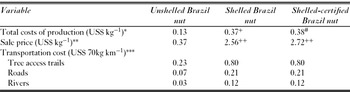
In the unprocessed scenario, we assume that the nuts are sold immediately after collection and opening of fruit (namely without drying and shelling). In this scenario, the nuts are extracted and stored in sheds until they are transported to the closest distribution centre or point of sale; this practice is most common in concessions that lack the required infrastructure to dry and shell the nut, as well as in cases where hiring labour for processing is difficult or unaffordable. In the processed scenario, we assumed that the concessionaire dried and shelled the nut at the concession location using mostly manual labour, as is predominantly the case in the region. Finally, for the certification scenario, we simulated the case where all production of Brazil nuts in the concessions was processed and certified (under the fair trade scheme), commanding a 6% price premium (Table 1).
Economic variables used to calculate rents for each of three scenarios. *1 kg of unshelled nuts yields 0.286 kg of shelled nuts. +Refers only to drying and shelling the nuts. ++Per kg of shelled nuts. **Average regional sale prices for 2008. ***Average costs for existing modes of transportation (motorcycles, trucks, tractors, boats). #Does not include upfront investments.

Potential rent per hectare, under each scenario, was calculated by multiplying the sale price by the simulated total production for a specific cell, and by subtracting the total costs of production and transportation to the closest distribution centre or point of sale, according to the following equation:

where Q xy, is the simulated production for a cell with geographic coordinates (x) and (y) in kg, Pn is the sale price and Cn the cost of production in US$ by type of product (n) (Table 1), and Txy,n,t is the transportation cost by type of product (n) and mode of transport (t) from location (x, y) to the nearest point of sale (Appendix 1, Table S9, see supplementary material at Journals.cambridge.org/enc). A processing coefficient of 28.6% is applied to convert Q of unshelled to shelled nuts.
We used a map of roads and navigable rivers to estimate transportation costs. First we calculated a cost friction surface, and then the accumulated cost in US$ per 70 kg of product (one sack), according to the type of road/waterway and mode of transport (boat, motorcycle or truck) as the product traverses the cells between the concession and the closest distribution centre or point of sale. Thus, the cost of transport was the least cost pathway following either an existing road and trail network or navigable rivers. In the case of roads and trails, the cost of transport was an average of the costs of each mode (Appendix 1, Table S9, see supplementary material at Journals.cambridge.org/enc).
Model validation
To validate the model we compared (1) our yield estimates with actual values of our sampled areas and (2) our predicted rent values with the rents from five Brazil nut concessions within our samples (as reported in the financial reports of their POAs for 2007–2008).
Estimating CO2 emission reductions from Brazil nut concessions
In order to estimate the potential contribution of Brazil nut concessions to reducing deforestation in the Department of Madre de Dios, first we assessed the historical effectiveness (1990–2005) of Brazil nut concessions and other land-use zones in Madre de Dios (Appendix 1, Fig. S9, see supplementary material at Journals.cambridge.org/enc) on locally deterring deforestation using the method devised by Soares-Filho et al. (Reference Soares-Filho, Moutinho, Nepstad, Anderson, Rodrigues, Garcia, Dietzsch, Merry, Bowman, Hissa, Silvestrini and Maretti2010a). This method compensates for differences in the probability of deforestation in areas of pairwise comparison, using 10-km buffers within and outside land-use zones. We ran the SimAmazonia deforestation model (Soares-Filho et al. Reference Soares-Filho, Nepstad, Curran, Cerqueira, Garcia, Ramos, Voll, McDonald, Lefebvre and Schlesinger2006) under three scenarios: business-as-usual (BAU), historical and REDD+. The BAU scenario assumes that the recent deforestation trend will accelerate due to road paving and other infrastructure investments that take place in the region within a context of low governance (Soares-Filho et al. Reference Soares-Filho, Nepstad, Curran, Cerqueira, Garcia, Ramos, Voll, McDonald, Lefebvre and Schlesinger2006). The historical scenario projects the 2000–2005 average deforestation rate of 6657 ha yr−1 for Madre de Dios derived from data from Killeen et al. (Reference Killeen, Guerra, Calzada, Correa, Calderon, Soria, Quezada and Steininger2008) and http://dge.stanford.edu. Finally, our REDD+ scenario assumes a 20% progressive reduction in deforestation per year from the 2000–2005 average annual deforestation rate for the entire Madre de Dios department (Appendix 1, Fig. S10, see supplementary material at Journals.cambridge.org/enc). In the BAU and historical scenario, the effects of land-use zoning on deforestation were removed from the set of spatial determinants that control the location of deforestation in the model, whereas in the REDD+ scenario, the historical effects of Brazil nut concessions and other land-use zones (Appendix 1, Table S10, see supplementary material at Journals.cambridge.org/enc) were maintained to assess the overall contribution of each land-use zone to reducing deforestation from the former scenarios to the REDD+.
We derived a ‘level of threat’ map for the region (Soares-Filho et al. Reference Soares-Filho, Moutinho, Nepstad, Anderson, Rodrigues, Garcia, Dietzsch, Merry, Bowman, Hissa, Silvestrini and Maretti2010a) by averaging the predicted deforestation within the BAU and historical scenarios. This index is time-dependent and thus identifies areas under imminent risk of deforestation (Fig. 1). In addition, we estimated potential CO2 emissions under each scenario by superimposing the annual simulated deforestation maps on a composite map of total carbon biomass derived from Saatchi et al. (Reference Saatchi, Houghton, Alvala, Soares and Yu2007) and Asner et al. (Reference Asner, Powell, Mascaro, Knapp, Clark, Jacobson, Kennedy-Bowdoin, Balaji, Paez-Acosta, Victoria, Secada, Valqui and Hughes2010), assuming that 85% of the forest carbon was released to the atmosphere with deforestation (Houghton et al. Reference Houghton, Skole, Nobre, Hackler, Lawrence and Chomentowski2000). Finally, reduced CO2 emissions under the REDD+ scenario were calculated using either the BAU or the historical scenario as a baseline (Appendix 1, Fig. S11, see supplementary material at Journals.cambridge.org/enc).
RESULTS
Yields and potential rents
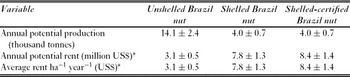
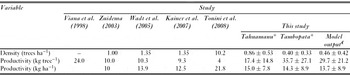
We estimated that a total of 14.1 ± 2.4 thousand tonnes of Brazil nuts (unshelled) were available for collection in the Brazil nut concessions of Madre de Dios annually; this is an area of c. 1 × 10⁶ ha (Table 2), where annual yield averages 13.7 ± 8.9 kg ha−1. This model result is similar to the observed average yields in sampled areas:15.0 ± 7.8 kg ha−1 for Tahuamanu and 14.3 ± 8.9 kg ha−1 for Tambopata (Table 3).
Model results for each scenario. *At 2008 average sale prices.

Mean values of Brazil nut tree density and productivity from previous studies compared with those from our samples in Tahuamanu and Tambopata and the model. Average values ± standard deviation; +samples, €as simulated by the model.

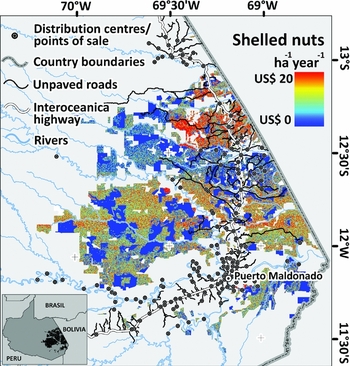
Using our three scenarios, we estimated the location-specific potential rents for unshelled, shelled and shelled-certified nuts (Fig. 4). There appeared to be three high-rent regions associated with a combination of natural hotspots and close proximity to main roads or sale points (reduced transportation costs) (Fig. 4). Because we used the same predicted yield maps for all three scenarios, variation in rents was attributed to varying costs of production and transport, and differences in the price of the final product. At 2008 regional sale prices, total modelled production amounted to an annual rents of US$ 3.1 ± 0.5 million, US$ 7.8 ± 1.3 million and US$ 8.4 ± 1.4 million, for unshelled, shelled and shelled-certified nuts, respectively. These values are equivalent to rents of US$ 3.1, 7.8, and 8.4 ha−1 yr−1, respectively. Our estimates for areas of five concessions in Tahuamanu and Tambopata are within the range of profits reported in their POAs (2007–2008), which are US$ 9.27–12.01 ha−1 yr−1 (shelled nuts).
Spatial distribution of potential annual rents per hectare for shelled Brazil nuts.

Investments needed to upgrade the production chain
Transportation costs take a toll on the profitability of Brazil nuts, especially for remote concessions at a distance from IOS. A previous study (Arana et al. Reference Arana, Sequeira and Torres2002) showed that the redesign of internal collection trails to follow the shortest route between trees could reduce transportation costs by 32.5%. This study also suggests that the use of an improved fruit collection technique that employs a locally woven basket and a stick with a split end to collect fruits could reduce harvesting time by 49.3%. We incorporated these improvements into our model to assess their overall effects on rents. These modifications reduced the overall cost of production of unshelled nuts by 38%, which corresponded to a profit increase of 23%.
We calculated the cost of implementing these improvements in harvesting and transportation, as well as the construction of nut storage barns within the concessions to be from US$ 5 to 7 million using figures derived from Arana et al. (Reference Arana, Sequeira and Torres2002) and from the Programa de Mejoramiento y Adecuación de la Producción de Castaña (unpublished data 2008). The time needed to pay back these investments was 7–10 years, assuming that all gains in rents from these improvements are saved.
In addition to the aforementioned investments, we estimated the investments necessary to establish five cooperative processing plants in the region. These plants would absorb potential production from the region and eliminate the need for shelling at the level of individual producers (Bosques Amazónicos, unpublished data 2010). We estimated that US$ 9–10 million would be required to establish these processing facilities, which would also reduce some of the costs associated with certification due to improved sanitary conditions (the proliferation of aflatoxin affects the quality and sale price of the nuts, and can be controlled in the processing plants). Thus, the new facilities would make the nuts eligible for IMO Organic certification as well.
Role of Brazil nut concessions in reducing deforestation in Madre de Dios
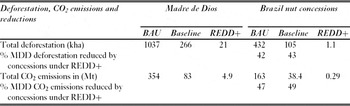
By measuring adjusted odds ratios of deforestation for land-use zones in Madre de Dios, we demonstrated that Brazil nut concessions, together with ecotourism, reforestation concessions and indigenous reserves, were the only areas that presented de jure (due to designation) inhibitory effects on deforestation, whereas other land-use zones, such as protected areas, only showed lower rates of deforestation due to their remoteness. Despite their inhibitory effect, Brazil nut concessions are under a high level of threat of deforestation due to their proximity to gold mining areas and IOS, which land grabbers use as a point of entry. We estimated that, if the Brazil nut concessions did not exit, 42% of deforestation that would occur under a BAU scenario in Madre de Dios by 2050 would take place within the concessions. Thus, these areas could contribute to a deforestation reduction of 42–43% (BAU and historical scenarios as baselines) for the region if a REDD+ programme was successful. We also found that reductions in CO2 emissions attributed to Brazil nut concessions under an annual 20% deforestation reduction achieved by a REDD+ programme could amount to 39–163 million tonnes by 2050, using the historical or BAU scenario as a baseline (Table 4).
Simulated deforestation and associated CO2 emissions in Madre de Dios (MDD) and in Brazil nut concessions 2011–2050.

DISCUSSION
We employed a unique combination of methods to estimate the potential production and rents to concessionaires of Brazil nut collection in Madre de Dios. Despite the complexity of integrating a wide variety of data into a model, our rent estimates were corroborated by the budgets of the POAs that we used for validation. Moreover, our estimate of mean yield of 13.7 ± 8.9 kg ha−1 for all concessions falls near the range of the sampled areas and is similar to estimates obtained by two previous studies (Wadt et al. Reference Wadt, Kainer and Gomes-Silva2005; Kainer et al. Reference Kainer, Wadt and Staudhammer2007). Our estimates of tree productivity, however, are higher than those in the existing literature. Conversely, our predicted density of trees is lower than estimates from previous studies (Table 3). Large differences in tree productivity and density were also observed between our sampled areas, which can be explained by the occurrence of extremely dense and highly productive groupings of trees (hotspots). This clustering, as suggested by our analyses, contributes to somewhat increased uncertainty in field measurements of tree productivity and density, demanding large and contiguous sampling areas. In this respect, our sampled areas were much larger than those of previous studies (Appendix 1, Table S6, see supplementary material at Journals.cambridge.org/enc); even so, they still characterize statistically distinct populations both with respect to tree density and productivity (Kruskal Wallis test, p < 0.01).
Our results indicate that Brazil nut collection is profitable in most concessions, particularly when the nut is processed and certified. However, overall costs of production of shelled nuts amounted to 42% of revenue. Moreover, transportation costs can comprise a significant portion of the total cost of production (up to 20%), particularly for concessions producing unprocessed nuts that are distant from roads, where high transportation costs can significantly reduce profits.
The differences in calculated rents for the three scenarios suggest the importance of processing activities for concessionaires, as the profit from selling processed nuts is approximately 2.5 times that of unshelled Brazil nuts. Nevertheless, certification only contributes to a 6% increase in rents beyond selling processed nuts. Hence the low price premium for certification, when combined with its upfront investments and costs, makes certification only marginally profitable for producers (Table 2).
Comparison of rents from improved certified-shelled Brazil nut production with opportunity costs of other agriculture land uses in Madre de Dios (Table 5) showed that this activity can compete economically with small landholder agriculture and even cattle ranching, especially if consociated with ecotourism and sustainable logging, both activities that are allowed within concessions (Appendix 1, Table S11, see supplementary material at Journals.cambridge.org/enc). Note that although revenues from logging obtained during land conversion can be added to agricultural land use rents, most of this revenue is spent in upfront investments, which are especially large for cattle ranching (Nepstad et al. Reference Nepstad, Soares-Filho, Merry, Lima, Moutinho, Carter, Bowman, Cattaneo, Rodrigues, Schwartzman, McGrath, Stickler, Lubowski, Piris-Cabezas, Rivero, Alencar, Almeida and Stella2009), and this fact was not considered in the study of Kirkby et al. (Reference Kirkby, Giudice-Granados, Day, Turner, Velarde-Andrade, Dueñas-Dueñas, Lara-Rivas and Yu2010). Moreover, the rents from Brazil nut collection can be obtained during five months only, whereas cattle ranching, for example, is a year-round activity. The degree to which Brazil nut rents will be competitive depends upon a policy to establish a market floor price, for example at the level of 2005 regional prices; variability in the ratio of sale prices and input costs between 2005 and 2009 caused annual profits to vary from –39% to +174% of our 2008 estimates (Appendix 1, Table S12, see supplementary material at Journals.cambridge.org/enc).
Rents of rural activities in Madre de Dios. NPV = net present value over 25 years; discount rate of 7.35%. Appendix 1 available at Journals.cambridge.org/enc.

We estimated the investment needed to improve and certify production for all concessions of Madre de Dios to be US$ 14–17 million; this could be distributed through a REDD+ programme. These investments represent a cost of US$ 0.09–0.10 (BAU) or US$ 0.37–0.42 (historical baseline) per tonne of reduced CO2 emissions attributable to Brazil nut concessions; this represents only a small fraction of the carbon price that would be levied through a REDD+ project for the region if a cap-and-trade system were established under a new climate protocol (c. US$ 16–21 per tonne of CO2; Piris & Keohane Reference Piris and Keohane2008). Nevertheless, our simulations are intended for comparison only, and must not be used to fix REDD+ payments, given that forward-looking baselines are questionable because deforestation trajectories can alter drastically in response to changes in a complex set of circumstances (Soares-Filho et al. Reference Soares-Filho, Moutinho, Nepstad, Anderson, Rodrigues, Garcia, Dietzsch, Merry, Bowman, Hissa, Silvestrini and Maretti2010a). Rather than on a project-by-project basis, REDD+ and associated payment schemes must be negotiated and implemented under a broader national-departmental framework if REDD+ is to succeed (Nepstad et al. Reference Nepstad, Soares-Filho, Merry, Lima, Moutinho, Carter, Bowman, Cattaneo, Rodrigues, Schwartzman, McGrath, Stickler, Lubowski, Piris-Cabezas, Rivero, Alencar, Almeida and Stella2009). Thus, the sustainable management of Brazil nut concessions must comprise part of a comprehensive rural planning strategy for Madre de Dios that also incorporates ecotourism, sustainable logging, protected area consolidation and support for other forest-friendly rural livelihoods.
With respect to the model itself, comparison of our results qualifies it for estimating potential yields and rents of Brazil nut collection in other regions of the Amazon, contingent upon data availability. Potential improvements in this model could include the effects of climate change on the productivity of Brazil nut trees, which would have important implications for the estimation of the economic sustainability of Brazil nut production and the financial risks of potential projects (for example productivity and profitability might decrease as a result of extreme climate events such as droughts and associated forest fires) (Kainer et al. 2005). However, the effects of climate change on Brazil nut productivity still requires further research.
CONCLUSIONS
Our results highlight the importance of Brazil nut concessions in developing a regional REDD+ strategy for Madre de Dios. Moreover, the Brazil nut industry in Madre de Dios presents a unique opportunity to couple conservation with sustainable development. If upgraded to certified-shelled production, the rents associated with Brazil nut collection combined with ecotourism and sustainable logging will compete with or outdo rents of traditional agriculture in Madre de Dios. Even so, the success of this industry depends on investments needed to expand processing, lower production costs, stabilize a market floor price and command a price premium for the environmental co-benefits from the sustainable management of the Brazil nut concessions, whose values are currently unattractive (Appendix 1, see supplementary material at Journals.cambridge.org/enc). REDD+ funds that go above and beyond the investments necessary to improve processing and gain certification could also represent an important means to help compensate Brazil nut collectors for the opportunity cost associated with higher-profit agriculture that will tend to expand into the region as a consequence of infrastructure projects.
While investment of REDD+ funds could bring economic benefits to local communities, it is crucial to harness these economic gains to promote sustainable forest management, not only in order to protect the forest in the face of other economic opportunities fuelled by capitalization from REDD+ (Agrawal & Angelsen Reference Agrawal, Angelsen and Angelsen2009), such as agriculture (Escobal & Aldana Reference Escobal and Aldana2003), but also to maintain the ecological integrity of the forest and its ecological cobenefits (Stickler et al. Reference Stickler, Nepstad, Coe, McGrath, Rodrigues, Walker, Soares-Filho and Davidson2009). This is particularly important for the collection of Brazil nuts, since survival of the species depends upon a healthy forest ecosystem (Mori & Prance Reference Mori, Prance, Prance and Ballack1990; Zuidema & Boot Reference Zuidema and Boot2002; Zuidema Reference Zuidema2003; Wadt et al. Reference Wadt, Kainer and Gomes-Silva2005). The degree to which Brazil nut extraction is sustainable and allows for natural regeneration of Brazil nut groves is debatable in the literature; while some authors believe that Brazil nut extraction is ecologically sustainable over the long term (Viana et al. Reference Viana, Mello, Morales, de Mendes, Gascon and Moutinho1998; Zuidema Reference Zuidema2003; Wadt et al. Reference Wadt, Kainer, Staudhammer and Serrano2008), others point out that intensive collection of Brazil nuts in some regions can compromise the forest ecosystem (Peres et al. Reference Peres, Baider, Zuidema, Wadt, Kainer, Gomes-Silva, Salomão, Simões, Franciosi, Cornejo Valverde, Gribel, Shepard, Kanashiro, Coventry, Yu, Watkinson and Freckleton2003). Thus, any investment in Brazil nut production or other forestry activities must include sustainable management certification criteria (Appendix 1, see supplementary material at Journals.cambridge.org/enc) in order to maintain and improve the health of the forest ecosystem.
Therefore, the synergy between REDD+ and Brazil nut collection in Madre de Dios will be an important force to encourage forest owners and users to adopt improved forest management, and to reduce deforestation. Our results strengthen the role of Brazil nut collection as an economically-sound option to help attain the conservation of the region's forests along with the improvement in the livelihoods of its forest-dependent people.
ACKNOWLEDGEMENTS
This work was supported by the Gordon and Betty Moore Foundation and CNPq (Conselho Nacional de Desenvolvimento Científico e Tecnológico). We also acknowledge Dr Lucia Wadt for comments, and Luz Marina Velarde, Jorge Torres, German Zumaeta, GOREMAD, former INRENA and ACCA for providing data.