During the 2014–2015 Ebola outbreak, ensuring healthcare worker (HCW) safety during delivery of patient care, particularly preventing the acquisition of a potentially lethal infection, emerged as a major challenge in US hospitals. Ebola virus disease (EVD) spreads directly, by contact with blood or body fluids of a person infected with the virus, and indirectly, through contact with contaminated objects (eg, surfaces, medical equipment).
Healthcare workers employ standard and transmission-based precautions that involve the use of personal protective equipment (PPE), including gloves and gowns. For patients with serious communicable diseases such as EVD, HCWs require more complex PPE such as coveralls, aprons, and hoods. Appropriate and consistent use of PPE is essential for reducing transmission of infectious diseases to HCWs. Doffing PPE is a high-risk activity because of potential self-contamination,Reference Casanova, Teal and Sickbert-Bennett 1 – Reference Dubost, Pasquier and Kearns 4 even when HCWs believe they have done everything correctly.Reference Doll, Feldman and Hartigan 5
While opportunities to improve PPE elementsReference Casanova, Alfano-Sobsey, Rutala, Weber and Sobsey 6 – Reference Tomas, Cadnum, Mana, Jencson and Donskey 8 and doffing protocol complianceReference Zellmer, Van Hoof and Safdar 9 – Reference Kang, O’Donnell, Colaianne, Bircher, Ren and Smith 11 have been assessed, a small but growing body of literature on the design of biocontainment units (BCUs) suggests the importance of a designated doffing space.Reference Hallihan, Baers and Wiley 12 – Reference Lenaghan and Schwedhelm 16 However, only 1 study has assessed environmental design strategies in depth.Reference Herlihey, Gelmi, Cafazzo and Hall 17 Our study was informed by and expanded on previously tested design strategies including doffing zone demarcation, balance aids, and visibility. Using data gathered from 4 US Ebola treatment centers, we developed a framework regarding how the design and layout of the doffing space may improve the safety of HCWs when doffing PPE after caring for patients with high-consequence pathogens.
METHODS
As part of a larger project including experts in human factors and microbiology, the built environment team analyzed a series of 10 simulations each in the BCUs of the 4 state-designated Ebola treatment centers in Georgia (sites A, B, C, and D) to identify ways HCWs interacted with the built environment. For 6 of the simulations, we built a geometrically accurate, high-fidelity mock-up of site D in the SimTigrate Design Lab at Georgia Institute of Technology because the BCU was being used for patient care. At site A, an additional simulation was performed because the microbiologic data from the first simulation attempt were not processed.
The HCWs in each simulation followed donning and doffing procedures and used PPE adopted by their BCU, including the use of a trained observer (TO) to monitor and guide the HCW while doffing. The participating HCWs (n = 41) and TOs (n = 15) had prior training for complex PPE as part of their readiness to care for a potential EVD patient. After donning, the PPE was contaminated with harmless bacteriophages mimicking Ebola (ϕ6) and other emerging viruses (MS2). The HCWs conducted a simulated patient care task on a mannequin before doffing the PPE. After doffing, the HCW’s PPE, hands, and face were sampled to assess whether cross contamination occurred; these results have been reported elsewhere.Reference Casanova, Erukunuakpor and Kraft 18
The simulations were recorded from different angles using 4 stationary cameras and 1 handheld camera to document the actions and dialogue of participants. The HCW behaviors were documented in real time and through video analysis. In addition, 2 human factors experts reviewed video recordings of the simulations to identify the unique ways that the doffing process can fail. For each major doffing step, as defined by the facility’s protocol, the human factors experts identified events with potentially adverse consequences, including events that spread contamination, delayed or disrupted the doffing process, or compromised PPE. These included behaviors such as reduced adherence to protocols (eg, abbreviated hand hygiene) and potential spread of contamination to the environment (eg, bumping into objects).Reference Mumma, Durso and Ferguson 19
We modified a list of “risky behaviors” based on the team’s findings, and we included other actions where the failure of the physical environment to support a safe process (eg, communication failures) could compromise HCW safety. The ‘risky behaviors’ highlighted in this paper do not include challenges with the PPE itself, nor have we attempted to link them to incidences of actual contamination, as has been reported elsewhere.Reference Casanova, Erukunuakpor and Kraft 18 – Reference Alhmidi, Koganti, Tomas, Cadnum, Jencson and Donskey 20
Characteristics of BCU layouts measured onsite and on architectural drawings included key environmental elements such as the size of the spaces, location of the TO and HCW during doffing, and distance to supplies and equipment from the doffing area, including the hand hygiene dispenser and trash bin. Additionally, we noted the height of mounted equipment, hand hygiene dispensers, and the type and size of trash bins and stabilization aids for balance such as stools and hand grips.
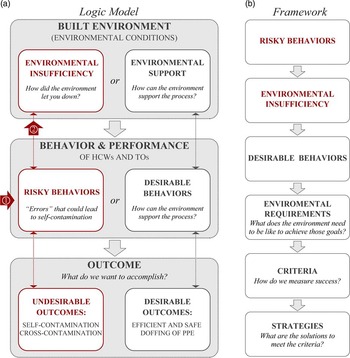
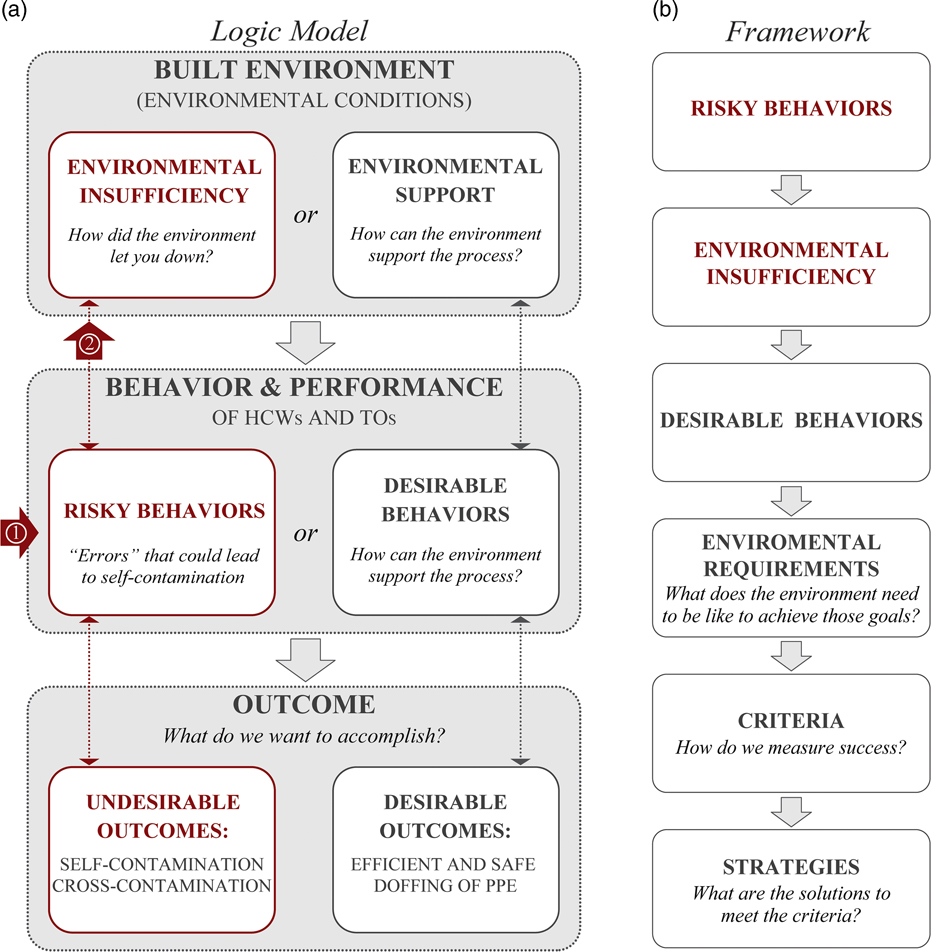
A preliminary analysis of the risky behaviors at each site and their environmental contributors was presented to representative HCWs and BCU leadership of the individual sites. Feedback from these discussion sessions was combined with our observations from simulations to develop a framework focusing on how environmental conditions (layout and design) encourage certain behaviors (Figure 1). This framework identified insufficiencies in the environment that allowed observed behaviors potentially leading to self- and cross contamination. Finally, we defined requirements the built environment must achieve to support more desirable, safe behaviors that improve HCW safety. We also developed a matrix proposing the design strategies that can be implemented to meet those requirements.
A framework using ‘risky behaviors’ observed during simulations to identify environmental strategies to support safe doffing of Ebola-level personal protective equipment.
RESULTS
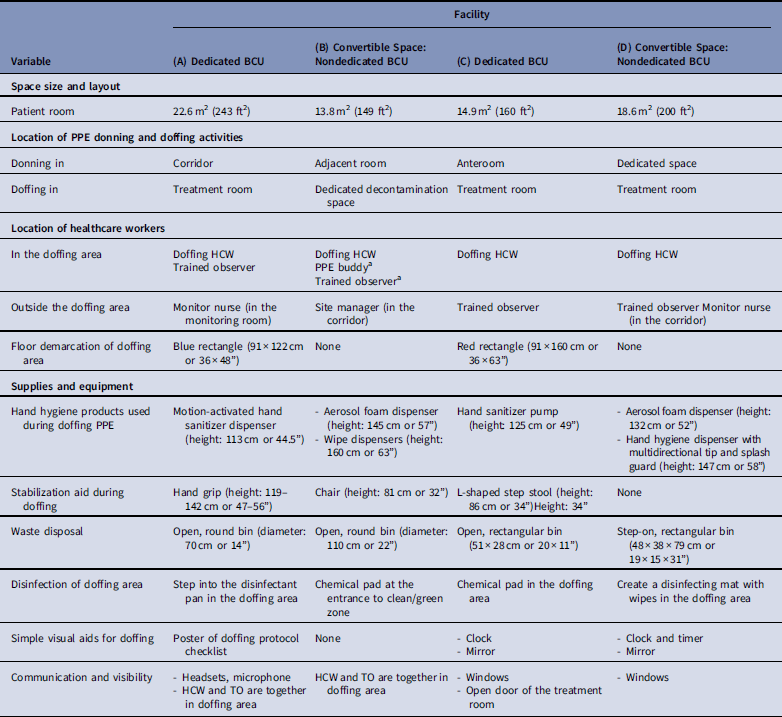
In all of the study settings, we observed the physical environment influencing risky behaviors by the HCW. We noted distinct design differences among the doffing spaces and equipment across all BCUs including the HCW’s relative location, the tools available for stabilization of balance, and accessibility of supplies (Table 1). Even within the same location, we observed variations in where the HCW stood and their relationship with the other critical elements, such as the trash bin and the hand sanitizer. During the simulations, HCWs reached, leaned, or even left the doffing zone after partially removing PPE to access supplies (eg, canisters of hand sanitizer) that were not in a standard location. Deviations from the standard location occurred both from being moved during the simulation and from being placed elsewhere prior to starting the doffing.
General Design Features Relevant to Doffing Personal Protective Equipment (PPE) in the Biocontainment Units (BCUs) in 4 State-Designated US Ebola Treatment Centers
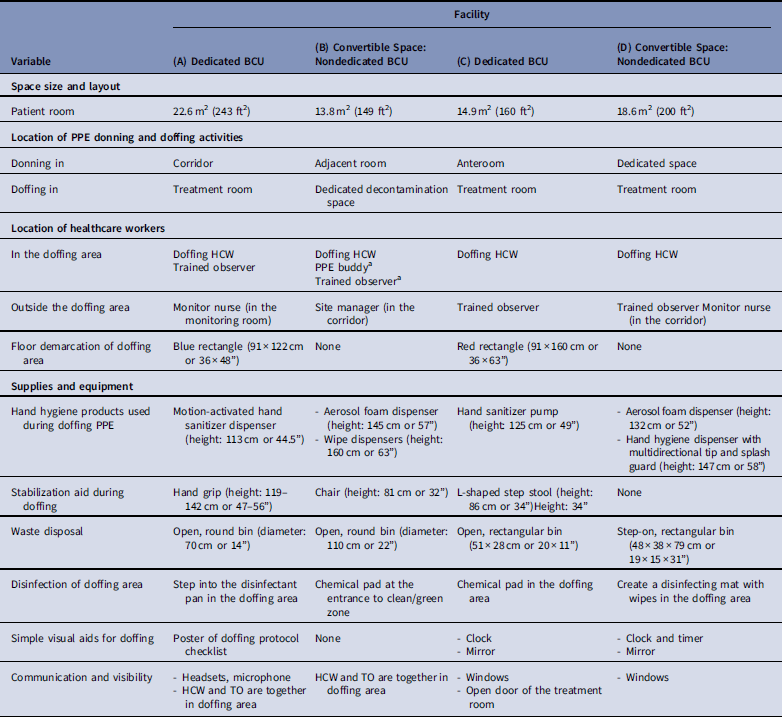
Note. HCW, healthcare worker; TO, trained observer.
a Doffing area is divided by plastic curtain.
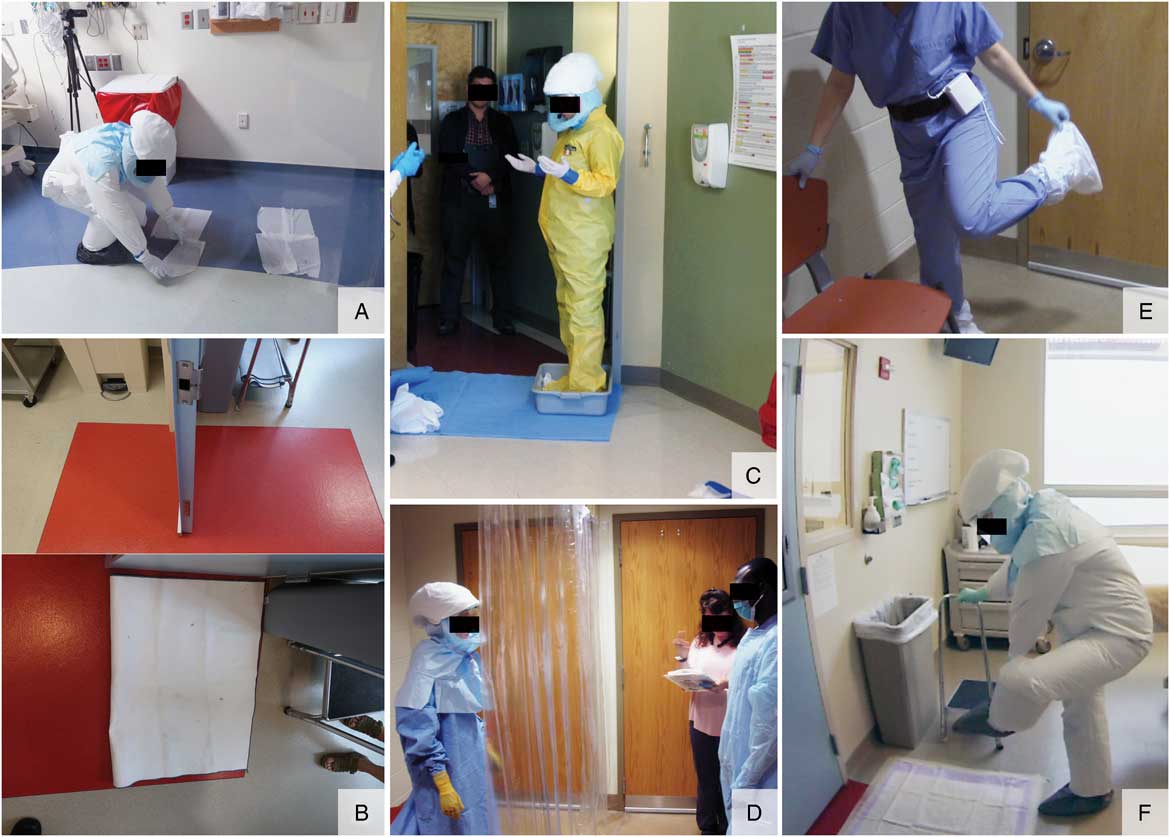
The most notable and pervasive challenge was communication between the HCW and TO. In sites C and D, where the HCW doffs inside the patient room and the TO stands behind a closed door, each reported difficulty hearing the other, and visual inspection was constrained by the limited size of windows or other obstructions. At site C, the TO frequently leaned over a counter to monitor the HCW through a side window because the door’s window had louvers. These communication challenges did not occur when the TO and HCW were in the same space, as in site A (Figure 2C) or in site B, where they were separated by a clear plastic curtain (Figure 2D). However, the HCW in site A turned their back on the TO during doffing when they used the hand grip.
Space layouts and common issues encountered during doffing of complex personal protective equipment (PPE) by healthcare workers (HCWs). (A) HCW creating a chemical mat by laying out 4 wipes on the floor. (B) Colored floor tiles for demarcation of the doffing zone. (C) HCW steps into disinfectant pan. (D) HCW doffing in an area separated by a clear plastic curtain. (E) HCW using chair. (F) Stool for stabilization while removing shoe covers.
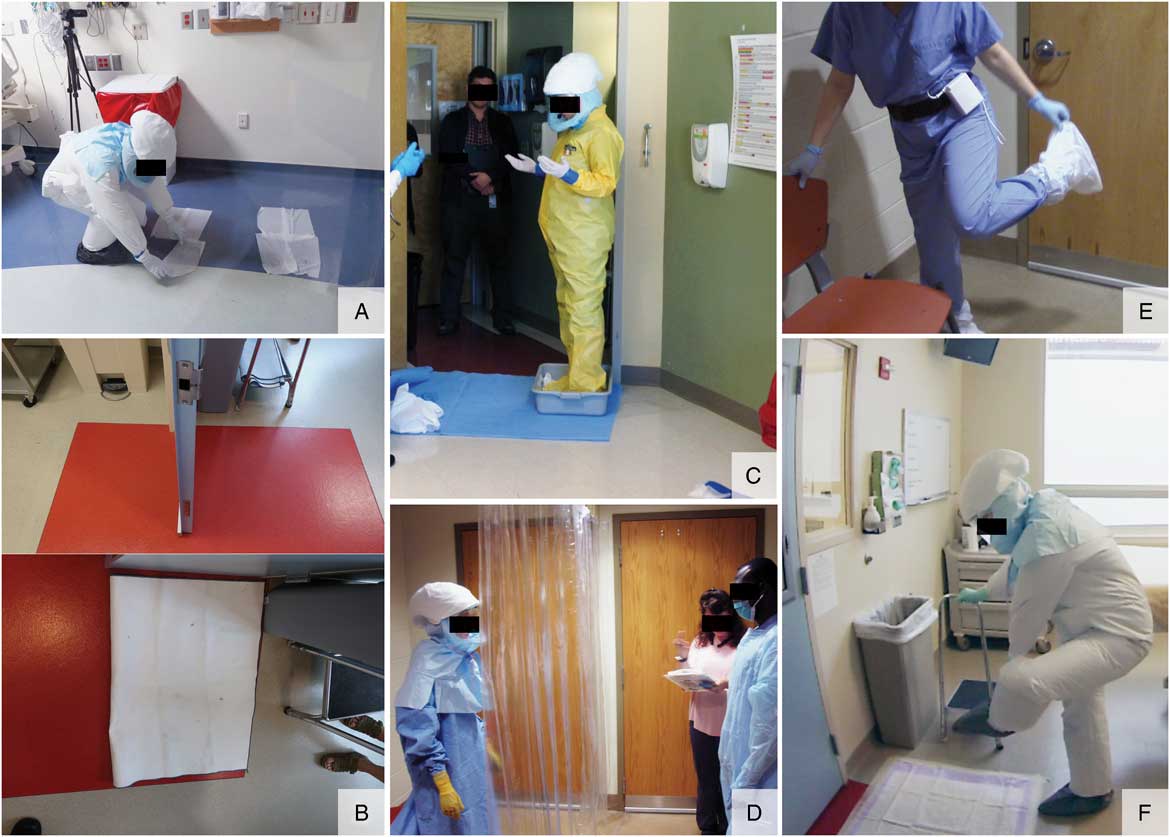
Another challenge observed during the simulations was maintaining balance. The HCWs were unsteady as they stood on 1 foot to remove their shoe covers (Figure 2F), resulting in a number of risky behaviors including HCWs crossing their legs or stumbling and losing balance, though no one fell or grasped objects other than those designated for stabilization. At site C, the HCW used an L-shaped step stool for stabilization and often crossed their legs while removing the shoe covers (Figure 2F), resulting in possible cross contamination. The step stool also wobbled during use; thus, the model used may not have provided sufficient stability. Of the 10 HCWs observed in site B where a chair was available, only 3 sat in the chair.
A third challenge was access to and disposal of needed equpipment and supplies. Often when these items were far apart, the HCW leaned over to reach them, which increased the risk of losing balance or touching a contaminated surface. During our simulations, we observed HCWs tossing their shoe covers or balled-up coveralls into a trash bin beyond their reach (a previously reported phenomenon), at times missing the trash bin entirely.Reference Kang, O’Donnell, Colaianne, Bircher, Ren and Smith 11 , Reference Herlihey, Gelmi and Flewwelling 13 Occasionally, HCWs bumped into potentially contaminated objects while doffing or touched items in the environment, potentially spreading contamination. At site B, several HCWs touched the disposable plastic curtain during doffing due to limited space. In site A, where the TO was in the room with the HCW and assisted with preparing the doffing zone, the TO and HCW crossed paths multiple times because both used the same wall-mounted hand sanitizer. At 2 different sites (A and D), HCWs moved outside their doffing zone to use a hand sanitizer even though a closer one was available.
Finally, some risky behaviors were the result of incompatibility between the physical environment and the adopted protocol. Some HCWs tried to read the instructions from the wall-mounted poster instead of listening to the TO’s instructions, which resulted in desynchronization of the HCW and TO during doffing. Similarly, at site D, the HCW was responsible for establishing a chemical mat by laying out 4–6 wipes on the floor (Figure 2A). Without guidance, the HCW occasionally created the mat too far from the hand sanitizer or trash bin to be easily reached.
DISCUSSION
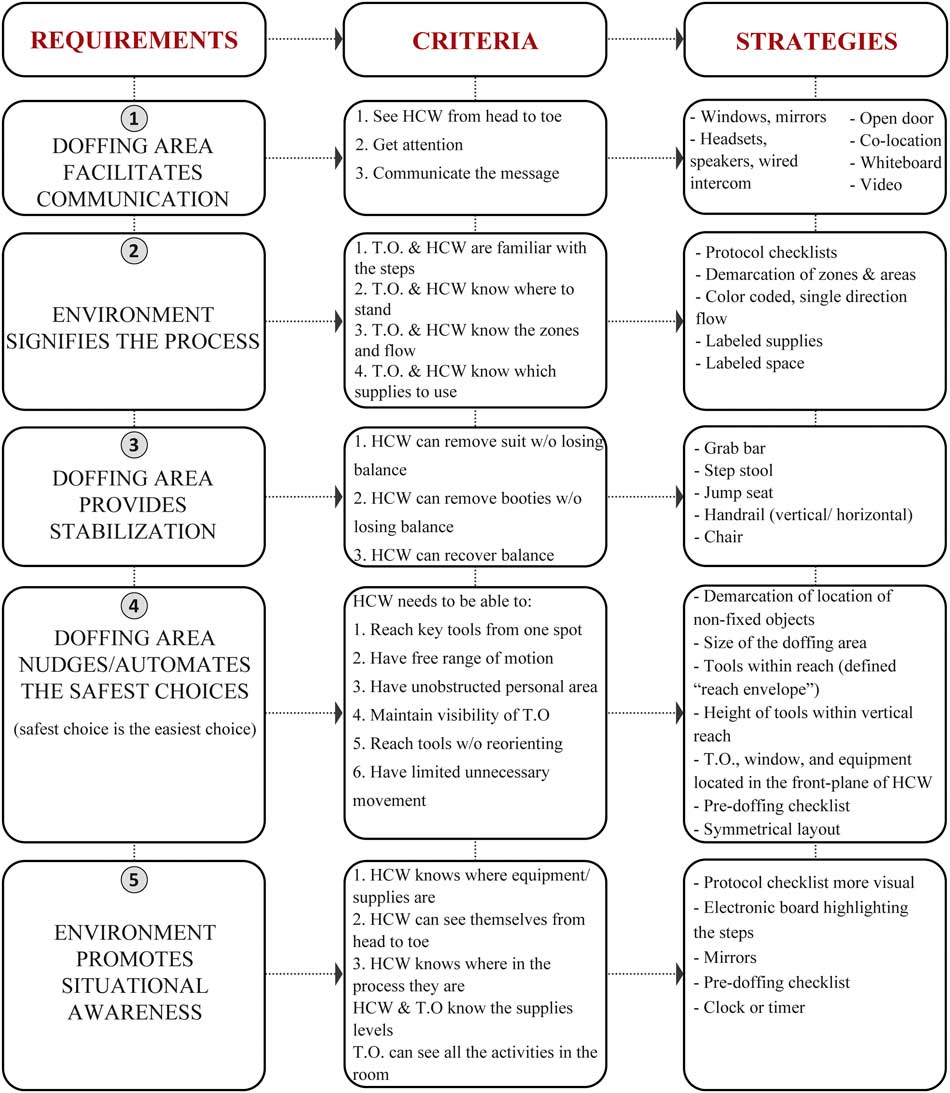
From a review of published literature on the risk of self-contamination while doffing PPE, observation of the simulations, feedback from study participants at all 4 sites, and analysis of the layouts of the Ebola treatment centers, we identified 5 requirements the doffing area should accomplish to increase process safety (Figure 3), as detailed below.
Built environment requirements, criteria, and design strategies matrix to improve healthcare worker safety during doffing of complex personal protective equipment.

Facilitate Communication Between HCWs and TOs
Communication challenges were associated with failure to clean some items and with either omitting steps or performing steps out of order. Because doffing requires precise attention to detail and occurs when the HCW is potentially fatigued and stressed, a TO supervises and reads out the steps of the doffing procedure.Reference Cummings, Choi and Esswein 21 The TO and doffing HCW need (1) to be able to see each other, (2) to be able to obtain each other’s attention easily, and (3) to be able to communicate complex instructions while the HCW is wearing complex PPE that usually includes a powered air purifying respirator (PAPR), which can limit both hearing and vision. The TO must also be able to see the HCW from head to toe to visualize any breaches in PPE or potential contamination.
Good communication can be facilitated by spatial designs that increase visual and auditory connections between the TO and HCW. The design of the physical space, such as the location and size of windows and doors, influences the ability of HCWs to communicate with TOs.Reference Herlihey, Gelmi and Flewwelling 13 Communication is easier if the TO and HCW are in the same space; collocation can also make it easier for the TO to see the HCW from head to toe. Good visibility between the TO and the HCW can be achieved even if the 2 are stationed in separate rooms through the thoughtful placement of the doffing area and positioning of the TO. Windows, without obstructions, need to be adequately sized, and the doffing area must be sufficiently distant from the window so that the TO can see the HCW’s feet.
Other communication improvement strategies include the use of headsets or intercoms. Headsets can be used inside the PPE to help overcome noise generated by the PAPR.Reference Herlihey, Gelmi and Flewwelling 13 Alternatively, audio speakers in the patient room can amplify the voice of the TO, but this approach may be disruptive to patients.Reference Haverkort, Minderhoud, Wind, Leenen, Hoepelman and Ellerbroek 22 Study participants stated that they used white boards to communicate messages during patient care and doffing, but this was not observed during the simulations. Regardless of the method used to optimize communication, technological solutions (eg, headsets) should have a simple backup method (eg, white boards) in case of technology failure.
Signify Steps in the PPE Doffing Process
To minimize the information a HCW needs to remember or consider during doffing, the built environment should intuitively guide the appropriate process and workflow. The complex process can be embedded in the physical space rather than solely relying on the memory of the TO and HCW using the following approaches:
Designate separate areas for donning and doffing and establish unidirectional flow
Distinct areas for donning and doffing prevents cross contamination and can be used to establish unidirectional flow. Current Centers for Disease Control and Prevention (CDC) guidance also recommends separation of the doffing area from the treatment room, but this may be difficult to accomplish given space constraints especially in adapted spaces. 23 Of 4 study sites, 3 had doffing areas inside the patient room near the door to facilitate communication with the TO and to enable the doffed HCW to step directly to the clean zone after doffing. Design can provide visual cues, such as dividing a space into zones using color to indicate 3 levels of potential contamination and different levels of risk (ie, green, yellow or orange, and red).Reference Dubost, Pasquier and Kearns 4 The Johns Hopkins BCU has effectively used this color-coding strategy with progressive limitations to enforce unidirectional flow.Reference Garibaldi, Kelen and Brower 14
Demarcation of zones and labeled supplies
Clear lines for the doffing zone reduce inappropriate crossing between clean and contaminated zones. Labeling supplies with color coding and marking can be a useful strategy.Reference Herlihey, Gelmi and Flewwelling 13 Once the HCW starts the doffing process, they are generally required to stay in the doffing area, and any critical equipment, including hand sanitizer, wipes, and trash bins should be within easy reach. Fixing the location of items, color-coding equipment, limiting the number of options, and using dedicated equipment are all recognized as effective strategies to avoid HCWs inadvertently moving back into hot zones after they begin doffing. Even though sites A and C have colored floor tiles to demarcate the doffing zone (Figure 2B), HCWs had great latitude in deciding where to stand within this area during doffing.
Protocol checklist with the procedure
Trained observers emphasized their role in reading the steps aloud and that the protocol should be placed where the TO could see it while simultaneously observing the HCW.Reference Herlihey, Gelmi and Flewwelling 13 Both TO and HCW need to be aware of where in the process they are and which step comes next. Although posters are helpful memory aids, adding a checklist for HCWs may not reduce doffing sequence errors.Reference Beam, Gibbs, Boulter, Beckerdite and Smith 7 Graphic checklists should be designed to visually communicate proper technique while minimizing opportunity for misinterpretation.
Provide Stabilization for the HCW During PPE Doffing
Loss of stability was most commonly associated with removing shoe covers.Reference Hallihan, Baers and Wiley 12 Removing shoe covers while standing on one foot is often challenging and can lead to potential errors such as grabbing contaminated surfaces,Reference Hallihan, Baers and Wiley 12 but even HCWs sitting in a chair reported discomfort.Reference Casalino, Astocondor, Sanchez, Díaz-Santana, Del Aguila and Carrillo 24 Possible options to minimize fall risk and improve stability include step stools, stools, hand grips, and chairs. Chairs present a challenge for cleaning due to a larger surface area, and sitting also presents more opportunities for self-contamination.Reference Kang, O’Donnell, Colaianne, Bircher, Ren and Smith 11 Although we rarely observed HCWs using chairs while doffing shoe covers, they reported a preference for having a chair available because of anticipated fatigue; this has also been noted in the literature.Reference Herlihey, Gelmi, Cafazzo and Hall 17
The placement of hand grips should be well thought out to ensure appropriate use and to prevent risky behavior. In one setting, the location of the hand grip resulted in a HCW stepping out of the doffing zone to remove their left shoe cover.Reference Herlihey, Gelmi, Cafazzo and Hall 17 Additionally, the placement of the hand grip should enable continuous eye contact between the HCW and the TO.
Nudge the Safest Choices
The environment itself can be configured in a way that makes certain behaviors easier, thereby ‘nudging’ people toward that behavior.Reference Thaler and Sunstein 25 Behavior nudge tactics can be used to improve and automate safe behavior while reducing cognitive burden for HCWs. The doffing space should be compact enough to present the HCW with all the needed items within easy reach, while not restricting movement or causing the HCW to bump into obstacles. Because the HCW is in a standing posture most of the time, the vertical work surface needs to be considered. At 3 sites at least one hand hygiene dispenser was mounted higher than the recommended height of 106–114 cm (42–45 inches), creating an unintended barrier to cleaning hands (Table 1).Reference Tilley 26
Promote Situational Awareness
Both the HCW and the TO need to have good situational awareness, a knowledge of the activities and tasks, familiarity with the environment, and mindfulness of each other’s locations and anticipated actions prior to and throughout the doffing process. Before doffing, a HCW needs to know where the supplies are located and whether the current levels are sufficient. The TO must be able to completely visualize the HCW during doffing, and the HCW should be able to see themselves from head to toe.
Sites C and D had mirrors in the doffing areas that provided increased visibility for the TO but also promoted self-awareness for the HCW, including assistance finding the zipper on PPE without touching any contaminated places.Reference Herlihey, Gelmi, Cafazzo and Hall 17 , 23 Mounting a timer within the HCW’s field of vision can increase temporal awareness, whereas providing one for the TO may discourage them from rushing the HCW while they perform hand hygiene.
Given the observed gaps in HCW safety and the 5 requirements listed above, we developed a matrix of recommended design strategies to create a space for safe doffing (Figure 3). These strategies are mostly low cost and relatively simple to implement in existing units, They should be considered when designing new BCUs. Infection preventionists and hospital epidemiologists working with BCUs should engage clinical leadership, facilities management, and architects to use this framework to improve HCW safety in BCUs.
In conclusion, doffing PPE is an inherently high-risk task that requires extreme vigilance from TOs and cognitively fatigued HCWs, but improved safety can be facilitated by the careful design of the environment. Through the simulation exercises observed in this study, we identified 5 ways in which the environment might be supportive: facilitating communication, signifying process, providing stabilization, nudging safest choices, and promoting situational awareness. Each of these environmental parameters can be buttressed with simple, low-cost interventions that can improve HCW safety in BCUs, and they should be considered for implementation in both current and future BCUs.
Acknowledgments
We thank Chelsey Kamson for her assistance in identifying relevant research articles and Gabrielle Campiglia for her editorial support. We also thank the participating hospitals and healthcare workers, as well as and their administrative teams, and the members of the Prevention Epicenter of Emory and Atlanta Consortium Hospitals (PEACH).
Financial support
This work was supported by the Centers for Disease Control and Prevention’s Prevention Epicenters Program (grant no. U54CK000164). Emory University Hospital’s participation was in part supported by the National Center for Advancing Translational Sciences of the National Institutes of Health (grant no. UL1TR000454 from the Atlanta Clinical and Translational Science Institute).
Potential conflicts of interest
All authors report no conflicts of interest relevant to this article.