Introduction
Patients with frontal disorders may show environmental dependency phenomena (ED; De Renzi, Cavalleri, & Facchini, Reference De Renzi, Cavalleri and Facchini1996; Lhermitte, Reference Lhermitte1983), such as utilization behavior (tendency to grasp and use an object) and imitation behavior (tendency to reproduce gestures performed by the examiner). ED has been often considered as a clinical sign associated to frontal-temporal dementia (FTD), and particularly to its behavioral variant (bvFTD; Ghosh, Dutt, Bhargava, & Snowden, Reference Ghosh, Dutt, Bhargava and Snowden2013). A recent comparative study, indeed, reported that utilization and imitation behaviors are significantly more frequent in bvFTD than in Alzheimer’s disease (AD; Ghosh et al., Reference Ghosh, Dutt, Bhargava and Snowden2013). However, the cognitive processes involved in the genesis of ED are still unclear; the few group studies exploring this issue reported contrasting results. According to some authors, utilization and imitation behaviors arise from a defective inhibition of visuo-motor action circuits driven by external environmental stimuli (Blakemore, Wolpert, & Frith, Reference Blakemore, Wolpert and Frith2002; Frith, Blakemore, & Wolpert, Reference Frith, Blakemore and Wolpert2000; Norman, & Shallice, Reference Norman and Shallice1986); this defect would be linked to high-level damage of frontal/executive control in patients with frontal defects (Shallice, Burgess, Schon, & Baxter, Reference Shallice, Burgess, Schon and Baxter1989; Sommerville, & Decety, Reference Sommerville and Decety2006). On the contrary, other authors (Besnard et al., Reference Besnard, Allain, Aubin, Chauviré, Etcharry-Bouyx and Le Gall2011) observed that the presence of dysexecutive syndrome was not correlated to occurrence of ED, since frontal patients with or without ED achieved similar scores on executive tasks. On these bases, Besnard et al. (Reference Besnard, Allain, Aubin, Chauviré, Etcharry-Bouyx and Le Gall2011) proposed that ED would be related to a defect of the social cognition, which prevents patient from understanding examiner’s instructions.
Frontal/executive defects can also be associated to closing-in (CI) in visuo-constructional copying tasks (Conson, Salzano, Manzo, Grossi, & Trojano, Reference Conson, Salzano, Manzo, Grossi and Trojano2009; De Lucia, Grossi, Fasanaro, Carpi, & Trojano, Reference De Lucia, Grossi, Fasanaro, Carpi and Trojano2013; De Lucia, Grossi, & Trojano, Reference De Lucia, Grossi and Trojano2014), where patients reproduce drawings near to or superimposed on the original model (Mayer-Gross, Reference Mayer-Gross1935). CI has been often reported in AD (De Lucia et al., Reference De Lucia, Grossi, Fasanaro, Carpi and Trojano2013, Reference De Lucia, Grossi and Trojano2014; Serra, Fadda, Perri, Caltagirone, & Carlesimo, Reference Serra, Fadda, Perri, Caltagirone and Carlesimo2010), but it occurs in patients affected by FTD too. Incidence of CI in copying drawings does not appear to differ in FTD and AD (Gasparini et al., Reference Gasparini, Masciarelli, Vanacore, Ottaviani, Salati, Talarico and Bruno2008) at any level of dementia severity (Ambron, Allaria, McIntosh, & Della Sala, Reference Ambron, Allaria, McIntosh and Della Sala2009), but it is worth mentioning that possible neuroanatomical correlates of CI have not been investigated. It has been proposed that CI in AD patients is related to visuo-constructional or visuo-spatial impairments (Lee et al., Reference Lee, Chin, Kang, Kim, Park and Na2004; Mayer-Gross, Reference Mayer-Gross1935), but a growing body of evidence suggests that CI can be interpreted as due to an attraction behavior released by frontal defects for which patients’ hands are pulled to act toward a salient visual stimulus (De Lucia et al., Reference De Lucia, Grossi, Fasanaro, Carpi and Trojano2013; Gainotti, Reference Gainotti1972). The same interpretative model has been proved able to explain CI in both AD and vascular dementia patients, suggesting that the frontal defects are accountable for CI regardless of clinical diagnosis (De Lucia et al., Reference De Lucia, Grossi and Trojano2014). At the moment, no studies attempted to investigate the cognitive mechanisms leading to CI in FTD patients.
From this brief overview, it would appear that, although several studies addressed ED and CI in FTD, some uncertainty still exists about their causative cognitive mechanisms, and, above all, that no study attempted to verify whether disruption of the same mechanisms can release different types of motor responses interfering with intentional behavior. At least two competing hypotheses can be put forward: according to the first, ED and CI are both expressions of an automatic tendency leading to imitate, use or approach toward available environmental stimuli; in other words, ED and CI might be considered as belonging to the same class of “disinhibition” phenomena related to a failure of the executive control system. According to an alternative hypothesis, ED and CI are to be considered as not related to a shared disruption of the frontal/executive control system, but as characterized by specific and distinctive cognitive bases.
The present study aimed to elucidate the cognitive mechanisms underlying ED and CI in bvFTD, and particularly to ascertain whether ED and CI are related to common cognitive defects. For these purposes, we investigated the possible association between neuropsychological performance and occurrence of ED and CI in a sample of bvFTD patients, and also searched for associations between occurrence of ED and CI in these patients. By applying logistic regression analysis, we could assess whether frontal/executive impairments can significantly predict occurrence of ED and CI. This were the case, the hypothesis of a common frontal/executive impairment in ED and CI would be supported. This hypothesis would be also confirmed by an association between ED and CI, and more specifically by the finding that presence of ED is significantly associated with occurrence of CI. To find, instead, that ED and CI are related to different cognitive profiles, and to observe opposite patterns of clinical manifestations (i.e., patients with ED and without clinical evidence of CI, and patients showing CI without ED phenomena), would be consistent with the idea that different mechanisms are involved in the genesis of such clinical manifestations.
Methods
Patients
Patients for this study were recruited from a continuous series of outpatients attending the Geriatric Centre “Frullone” in Naples. Inclusion criteria for this study were: clinical diagnosis of bvFTD according to the traditional criteria (Neary et al., Reference Neary, Snowden, Gustafson, Passant, Stuss, Black and Benson1998); formal education of at least two years; mild to moderate general cognitive impairment as assessed by the Mini Mental State Examination (MMSE, Italian version; age- and education-adjusted score higher than 13; Measso et al., Reference Measso, Cavarzeran, Zappalà, Lebowitz, Crook, Pirozzolo and Grigoletto1993); lack of concomitant neoplastic diseases or severe organ failures.
The clinical diagnosis of bvFTD was made independently from enrolment in the present study, and confirmed by repeated clinical observations. All patients showed structural (TC and/or MR) and functional (positron emission tomography imaging with F-18 fluorodeoxyglucose) neuroimaging findings of predominant bilateral frontal and/or anterior temporal abnormalities. The study sample included 31 patients (12 females and 19 males) with age ranging 41–83 years, education ranging 2–17, and adjusted MMSE score ranging 13–24.
All participants (and their legal guardians, if appropriate) gave their informed written consent to participate to the study, which was approved by the Local Ethics Committees. This study was conducted in compliance with the Ethical standards of Helsinki Declaration.
Assessment of Cognitive Abilities
All the tests used for the neuropsychological assessment were administered according to Italian standard procedures.
Visuo-constructional and visuo-spatial skills were evaluated by means of Clock drawing task (Mondini, Mapelli, Vestri, & Bisiacchi, Reference Mondini, Mapelli, Vestri and Bisiacchi2003), immediate reproduction of Rey Complex Figure (Caffarra, Vezzadini, Dieci, Zonato, & Venneri, Reference Caffarra, Vezzadini, Dieci, Zonato and Venneri2002), and Copying drawing test (Spinnler & Tognoni, Reference Spinnler and Tognoni1987).
Frontal/executive functions were assessed by means of the Frontal Assessment Battery (Dubois, Slachevsky, Litvan, & Pillon, Reference Dubois, Slachevsky, Litvan and Pillon2000; we used the Italian version standardized by Appollonio et al., Reference Appollonio, Leone, Isella, Piamarta, Consoli, Villa and Nichelli2005), complemented by an extended phonological verbal fluency task. The Frontal Assessment Battery includes six subtests assessing: abstract reasoning and conceptualization (to identify semantic categories to which sets of objects belong); mental flexibility (to produce words with a given initial phoneme); motor programming (to perform a “fist-edge-palm” sequential movement upon imitation); sensitivity to interference (to produce gestures opposite to those produced by the examiner); inhibitory control (two subtests requiring to withhold a motor response induced by concomitant visual or tactile stimulation). The phonological verbal fluency task (Carlesimo, Caltagirone, & Gainotti, Reference Carlesimo, Caltagirone and Gainotti1996) is a frontally loaded task that requires patients to produce in one minute as many words beginning with the letter “F”, “A”, and “S” as they can (score is the sum of words produced correctly).
Anterograde memory skills were assessed by the Rey 15-Word learning test (Carlesimo et al., Reference Carlesimo, Caltagirone and Gainotti1996), providing a measure of the immediate, and delayed recall of verbal material.
All selected tests are characterized by satisfactory reliability. Inter-rater reliability for the immediate reproduction of the Rey Complex Figure is .96 (Caffarra et al., Reference Caffarra, Vezzadini, Dieci, Zonato and Venneri2002); test–retest reliability is .37 for the Copying drawing test (Spinnler & Tognoni, Reference Spinnler and Tognoni1987); test–retest reliability is .85, and inter-rater reliability is .96 for the Frontal Assessment Battery (Appollonio et al., Reference Appollonio, Leone, Isella, Piamarta, Consoli, Villa and Nichelli2005). Reliability data for the Italian version of the remaining three tests are not available, but their psychometric features are well known. Reliability of both the phonemic fluency test and the Rey 15-Word learning test has been reported to be above .70 in several studies (see Lezak, Reference Lezak2012, for a review); moreover, inter-rater and intra-rater reliability of Clock drawing tests with administration procedures similar to those used here are reportedly high (both>.80), despite scoring criteria differed across studies (Tuokko, Hadjistavropoulos, Rae, O’Rourke, Reference Tuokko, Hadjistavropoulos, Rae and O’Rourke2000).
Assessment of Utilization Behavior
According to Shallice et al. (Reference Shallice, Burgess, Schon and Baxter1989), utilization behavior occurs when the patients grasp and use objects although they are not required to do so. Two forms of utilization behavior can be distinguished: the “induced” form appears when the examiner stimulates patient’s hands with an object (Lhermitte, Reference Lhermitte1983); the “incidental” form occurs while the patient is engaged in other activities and yet manipulates and uses available objects (Shallice et al., Reference Shallice, Burgess, Schon and Baxter1989).
On this basis, we assessed both “induced” and “incidental” utilization behavior (Shallice et al., Reference Shallice, Burgess, Schon and Baxter1989), adopting the traditional procedures (Lhermitte, Reference Lhermitte1983; Shallice et al., Reference Shallice, Burgess, Schon and Baxter1989). To assess “induced” utilization behavior, examiner and patient were seated at the opposite side of a desk, in a quiet room. The examiner stimulated patient’s hands with a common object (e.g., a glass) and quickly withdrawn it. The stimulation was consecutively repeated three times, while the examiner remained silent (Lhermitte, Reference Lhermitte1983; Shallice et al., Reference Shallice, Burgess, Schon and Baxter1989). Seven common objects (e.g., lighter, fork) were presented one at a time (Lhermitte, Reference Lhermitte1983, Reference Lhermitte1984). For each grasped and used object at least once across the three stimulations, 1 point of “induced” utilization behavior was scored (score range 0–7).
To assess “incidental” utilization behavior we adapted the procedure of Shallice et al. (Reference Shallice, Burgess, Schon and Baxter1989). The patient was engaged in a 15-min clinical interview about self-biography topics (e.g., daily living activities), while two sets of objects were present on the table. Each set of visual stimuli consisted of eight common objects (e.g., comb, key), each placed on a tray located at the right or left of the patient’s midline. During the interview, object use was never prompted explicitly or implicitly, and no environmental cue for object utilization was provided. If a patient handled and used one object the examiner admonished him/her by saying “Why did you use it? I did not tell you to” (De Renzi et al., Reference De Renzi, Cavalleri and Facchini1996). For each object handled or used, 1 point of “incidental” utilization behavior was assigned (score range 0–16). We also classified responses into one of three types (Shallice et al., Reference Shallice, Burgess, Schon and Baxter1989): (i) toying (not-purposeful manipulation of an object; for example, handling the comb without any purpose); (ii) complex toying (two objects used in an incomplete manner or not for the original purpose; for example, using the glass to put it on the top of the bottle); (iii) coherent activity (one or more objects used in a typical manner; for example, using the key to open up the catch). Finally, we estimated the effect of admonition, by scoring 1 point for each object the patient kept using or manipulating after admonition (score range 0–16).
Assessment of Imitation Behavior
Lhermitte (Reference Lhermitte1984) evaluated the imitation behavior showing several gestures to the patient without any instruction. Instead, De Renzi et al. (Reference De Renzi, Cavalleri and Facchini1996) assessed imitation behavior intermittently during clinical interviews and neuropsychological tasks, and explicitly warned patient not to reproduce examiner’s gestures when imitation behavior occurred (see also Besnard et al., Reference Besnard, Allain, Aubin, Chauviré, Etcharry-Bouyx and Le Gall2011; Ghosh et al., Reference Ghosh, Dutt, Bhargava and Snowden2013). In the present study, the examiner presented gestures for eliciting imitation behavior after each presentation of 15-word Rey’s word list for verbal learning, that is, while patients were recalling items of the list, and during delayed reproduction of the Rey complex figure. The examiner cumulatively performed 10 meaningful (e.g., sign of the cross) and 10 meaningless (e.g., scratch the forehead) gestures (De Renzi et al., Reference De Renzi, Cavalleri and Facchini1996) with his right hand. After De Renzi et al. (Reference De Renzi, Cavalleri and Facchini1996), if the patient imitated one gesture the examiner asked “Why did you imitate me?” and the admonition followed “I did not tell you to do like that”. Then, the same gesture was produced. As in von Gunten and Duc (Reference von Gunten and Duc2007), we scored separately gestures imitated before admonition (naïve imitation behavior: 1 point for each imitated gesture; score range 0–20) and after admonition (persistent imitation behavior: 1 point for each imitated gesture; score range 0–20).
Assessment of Closing-in
Occurrence of CI was assessed on the copying tasks (De Lucia et al., Reference De Lucia, Grossi, Fasanaro, Carpi and Trojano2013). The first task (Copying drawing test; Spinnler & Tognoni, Reference Spinnler and Tognoni1987) included seven black-and-white drawings (e.g., diamond, cube), centrally printed within the upper half of an A4 sheet, and patients had to reproduce each stimulus in the lower half of the same sheet. In case of a response identified as CI (see below), a reminder of task instruction was provided to the patient. The second task consisted in copying the Rey complex figure, centrally printed on an A4 sheet in landscape orientation; patients were required to copy the model in the centre of a separate sheet, placed 10 mm from the bottom edge of the model’s sheet.
Presence of CI, independently from drawing accuracy, was identified when any point of the copy was within 10 mm from the lower side of the model (near-CI) and when at least one element of the copy was superimposed on at least one element of the model (adherent-CI). For the Rey Figure, the same method was adopted, but in this case near-CI was classified not only when the copy was produced within the model’s page, but also when the figure was copied within 10 mm from the upper edge of the response sheet (De Lucia et al., Reference De Lucia, Grossi, Fasanaro, Carpi and Trojano2013).
Statistical Analyses
To identify cognitive abilities correlated to occurrence of ED (utilization behavior and imitation behavior) and CI we ran two separate logistic regression models (level of significance was set at p<.05). In the first model, we entered age, education, MMSE and neuropsychological scores as independent variables, and occurrence of two or more utilization or imitation behaviors (i.e., at least one phenomenon after having received a first admonition) as the dependent variable (absence of ED was coded as 0, and presence of ED was coded as 1). In the second model, we entered the same independent variables as above but we considered presence of at least two instances of CI (i.e., at least one phenomenon after having received a first reminder of task instructions) as the dependent variable (absence of CI was coded as 0, and presence of CI was coded as 1, as above). To run these statistical models, we calculated Z-values (based on the sample’s mean values) for demographic data, MMSE and neuropsychological scores, and then composite indices as average Z-values for frontal scores (including: frontal assessment battery and phonological verbal fluency scores), visuo-constructional scores (including: immediate reproduction of Rey complex figure, copying drawings test and Clock drawing task), and memory scores (including: immediate and delayed recall of the 15-Word learning test).
Last, we performed a third logistic regression analysis to evaluate if occurrence of ED phenomena was related to CI in our patients. In this model, we considered occurrence of ED phenomena (coded as 0 or 1 as above), and the frontal, visuo-constructional, and memory scores as independent variables, whereas occurrence of CI was entered as the dependent measure (coded as 0 or 1 as above).
For each model, we reported a measure of goodness-of-fit, expressed by chi square (Archer & Lemeshow, Reference Archer and Lemeshow2006), and an index of effect size, expressed by Cox & Snell R squared (Bewick, Cheek, & Ball, Reference Bewick, Cheek and Ball2005).
Results
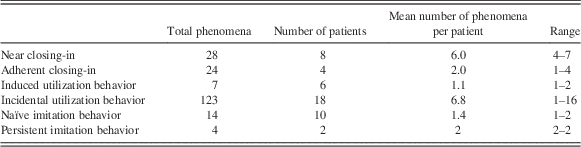
Two or more instances of utilization, imitation, or CI phenomena occurred in 18/31 (58%) bvFTD patients (see Table 1).
Total number of the environmental dependency and/or closing-in phenomena in bvFTD patients, number of patients showing each phenomenon, and mean number (and range) of phenomena per patient (only 18/31 patients showed one or more type of phenomena)

Induced utilization behavior was less frequent (19.3% patients of the total sample) than incidental utilization behavior (58%). All patients with induced utilization behavior also showed incidental utilization behavior. All patients with incidental utilization behavior produced toying, whereas one patient also showed complex toying and four patients showed coherent activity. After admonition, incidental utilization behavior persisted only in 9/18 bvFTD patients (toying in all of them, associated with complex toying in one patient and with coherent activity in three patients).
Imitation behavior was observed in 32.2% patients of the total sample, but only two of them persisted in reproducing gestures performed by the examiner after admonition (persistent imitation behavior).
Two or more CI errors were observed in 38.7% patients; adherent-CI was less frequent that near-CI, and was present only in patients showing near-CI too.
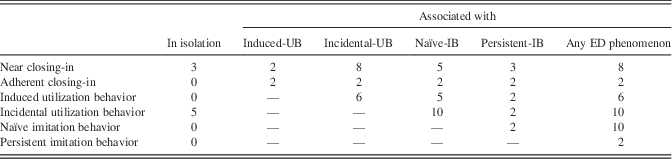
The observed pattern of co-occurrence between ED and CI is shown in Table 2. Most patients with CI also showed one or more ED, but it is important to underline that 3/12 patients presented CI in isolation. Most patients showing ED had two or more associated phenomena, but incidental UB occurred in isolation in 5 patients, who did not show CI either.
Number of bvFTD patients showing environmental dependency and/or closing-in phenomena is isolation or in association

Note. UB=Utilization behavior; IB=Imitation behavior; ED=Environmental dependency.
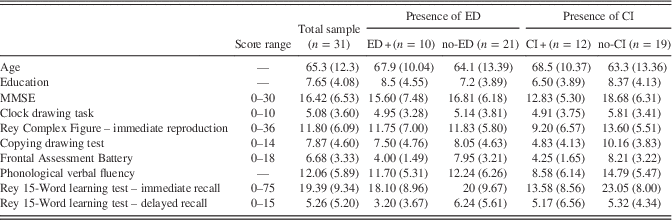
The neuropsychological scores of the whole sample, and of patients showing CI or ED are reported in Table 3.
Means (and standard deviations) of demographic data and raw scores on MMSE and on neuropsychological tests in the total bvFTD sample, and in subsamples of patients as a function of presence of either ED or CI

Note. ED+=bvFTD patients with ED; no-ED=bvFTD patients without ED; CI+=bvFTD patients with CI; no-CI=bvFTD patients without CI.
The first logistic regression model to explore the neuropsychological correlates of ED was statistically significant [χ 2 (6)=11.641; p<.05; Cox & Snell R2=.313], and showed that the frontal score was the only significant predictor of ED phenomena (odds ratio, OR: .009, confidence intervals; 95%CI: .000–.482; p=.02). Presence of ED was not significantly influenced by demographic data (age=OR: 2.132; 95%CI: .483–9.415; p=.31; education=OR: 1.615; 95%CI: .317–8.225; p=.56), MMSE score (OR: 1.563; 95%CI: .413–5.914; p=.51), visuo-constructional scores (OR: .753; 95%CI: .432–1.312; p=.31), or memory scores (OR: 1.128; 95%CI: .872–1.459; p=.35).
The second logistic regression model to explore the neuropsychological correlates of CI was significant too [χ 2 (6)=20.921; p<.002; Cox & Snell R2=.491], and demonstrated that only the frontal score influenced occurrence of CI (OR: .051; 95%CI: .004–.749; p=.03). No significant effect were found of demographic data (age=OR: 2.449; 95%CI: .681–8.801; p=.17; education=OR: 2.275; 95%CI: .546–9.475; p=.25), MMSE score (OR: 3.942; 95%CI: .790–19.664; p=.09), visuo-constructional scores (OR: 1.102; 95%CI: .779–1.558; p=.58), or memory scores (OR: 1.025; 95%CI: .816–1.287; p=.83).
The third regression analysis exploring the possible relationships between ED and CI was significant [χ 2 (4)=20.05; p<.001; Cox & Snell R2=.476]. CI was significantly predicted by the frontal score (OR: .027; 95%CI: .001–.814; p=.03), but not by occurrence of ED phenomena (OR: 2.81; 95%CI: .210–37.85; p=.43), visuo-constructional score (OR: .802; 95%CI: .520–1.23; p=.80) and memory (OR: 1.11; 95%CI: .863–1.431; p=.41) score.
Discussion
Clinical and experimental studies in patients with bvFTD reported utilization and imitation behavior in approximately 68% of patients (Ghosh et al., Reference Ghosh, Dutt, Bhargava and Snowden2013), whereas occurrence of CI was retrospectively observed in approximately 50% of FTD patients (Ambron et al., Reference Ambron, Allaria, McIntosh and Della Sala2009). In our study, frequency of ED and/or CI was in line with the above data, but we also observed that in most patients ED and CI co-occurred. Nonetheless, we could observe opposite clinical patterns (i.e., patients showing ED but not CI, and patients showing CI but not ED) in a non-negligible proportion of cases.
It has been often stated that utilization and imitation behavior arise from an impairment to inhibit the tendency to grasp and use, or to imitate available stimuli (Blakemore et al., Reference Blakemore, Wolpert and Frith2002; Frith et al., Reference Frith, Blakemore and Wolpert2000). In the same vein, it has been reported that CI in AD patients can result from a defect of the frontal ability to monitor the pathological attraction of motor acts and attention toward visual models (Conson et al., Reference Conson, Salzano, Manzo, Grossi and Trojano2009; De Lucia et al., Reference De Lucia, Grossi, Fasanaro, Carpi and Trojano2013). Our logistic regression models showed that the composite frontal score was the only independent predictor for both ED and CI. This observation would confirm that defects of frontal/executive functions are crucial for occurrence of both ED and CI, thus suggesting a parallelism in cognitive mechanisms giving rise to both kinds of phenomena in patients affected by bvFTD. A damage of a frontal high-level control system would release automatic activation of both perception-action and attention-action circuits, making patients highly sensitive to external visual stimuli.
Results from the third logistic regression analysis demonstrated, however, that presence of CI was not significantly related to occurrence of ED, whereas CI was significantly predicted by the composite frontal score only. These findings, together with the observation of patients with utilization behavior without CI and patients with CI without utilization behavior, could be compatible with the idea that distinctive frontal/executive dysfunctions (and probably distinctive neuro-anatomical regions) are related to utilization/imitation behavior and CI, although such impairments often co-occur.
It has been claimed that ED emerges from the inability to suppress the automatic activation of motor acts when an environmental stimulus occurs, and it has often been related to defect of the frontal monitoring processes (associated to orbitofrontal lesions; Cummings, & Miller, Reference Cummings and Miller2007). The correlation between ED and frontal dysfunctions has been agreed upon also by authors proposing alternative interpretations about the genesis of such phenomena (Besnard et al., Reference Besnard, Allain, Aubin, Chauviré, Etcharry-Bouyx and Le Gall2011). As regards CI, recent studies demonstrated that reduced attentional resources (in dual task paradigms) can release attraction of action toward relevant visual stimuli in both demented patients (De Lucia et al., Reference De Lucia, Grossi and Trojano2014) and healthy adults (Sagliano et al., Reference Sagliano, D’Olimpio, Conson, Cappuccio, Grossi and Trojano2013). Such data would suggest that a dysfunction of the cognitive mechanisms involved in divided attention can release the approach toward the model, that is, the appearance of the so-called near-type of CI (De Lucia et al., Reference De Lucia, Grossi and Trojano2014). Traditionally, defects of divided attention have been ascribed to dorsolateral prefrontal lesion (Stuss & Levine, Reference Stuss and Levine2002). Therefore, the non-significant predictive value of ED for occurrence of CI, and the observation that ED is not systematically associated to CI, might suggest that different frontal/executive dysfunctions are involved in these different clinical manifestations, but such a speculation would require conjoint cognitive and neurofunctional investigations.
In the present study, we observed that patients showing ED or CI in isolation only produced incidental utilization behavior or near-CI, respectively. It could be possible to hypothesize that these are the mildest form of the phenomena, and that they appear in isolation in patients with rather selective cognitive impairments, whereas the progressive derangement of frontal functions as the disease progresses could lead to appearance of other forms of ED or CI, and of associated ED and CI. An indirect support to this hypothesis might be found in the observation that in our study the more severe the cognitive impairment, the more frequent the co-occurrence of CI and ED phenomena. Indeed, patients with associated ED and CI had a more pervasive cognitive impairment (median MMSE raw score=8; median MMSE adjusted score=13), and a more pervasive frontal defect (median Frontal Assessment Battery score=4) than the few patients showing CI only (N=3; median MMSE raw score=13; median MMSE adjusted score=18.2; median Frontal Assessment Battery score=6), or utilization behavior only (N=5; median MMSE raw score: 22; median MMSE adjusted score=22.1; median Frontal Assessment Battery score: 8), and than patients without ED or CI. Thus, progressive derangement of frontal functions might give rise to appearance of utilization behavior (and imitation behavior) associated to CI, whereas at early disease stage dysfunction of specific mechanisms might trigger selective appearance of specific forms of CI or utilization behavior.
Some limitations of the present study should be acknowledged. First, the sample size was relatively small, with a few patients showing imitation behavior or ED not associated with CI, and this prevented a full appraisal of the cognitive correlates of such phenomena, limiting possible generalization of the present findings. Moreover, the relatively small sample size also precluded investigation of frequency and co-occurrence of ED and CI across different stages of the disease. Second, our findings allowed us to hypothesize that mild cognitive dysfunctions might trigger occurrence of specific forms of ED or CI; since we only assessed frontal functions on the FAB and phonological verbal fluency tests, however, we could not investigate whether selective frontal deficits can be associated with specific forms of ED or CI. Third, since we could not implement clinic-anatomical correlations, specific morphometric and tractographic analysis are necessary to test our speculation about the neural correlates of CI and ED.
Notwithstanding such limitations, our study contributed to investigate the genesis of ED and CI, and their relationships, in bvFTD patients. We found here that defects of frontal/executive functions are crucial for occurrence of both ED and CI, suggesting that a dysfunction of a frontal high-level control system would release automatic activation of both perception-action and attention-action circuits, making our patients sensitive to external stimuli. However, we also found patients with utilization behavior or CI in isolation, that could be compatible with the idea that distinctive frontal dysfunctions are related to the two kinds of phenomena. The investigation of specific cognitive and neural correlates of ED and CI warrant, however, further studies.
Acknowledgments
The authors have no conflict of interest to disclose. The study has not received any external financial support.