Introduction
Toxoplasma gondii is a zoonotic, obligate intracellular protozoan parasite in phylum Apicomplexa that can infect all warm-blooded animals (i.e. sheep, goats, pigs, horses and camelids, rodents and primates) including humans (Tenter et al., Reference Tenter, Heckeroth and Weiss2000). Although it causes clinical illness in diverse animal species the disease concerning aspect is its acute life-threatening syndrome in some species. Toxoplasma gondii parasite has a two-stage sexual and asexual cycle. The asexual cycle happens in warm-blooded creatures and the sexual cycle occurs in cats as definitive hosts (Studenicova et al., Reference Studenicova, Bencaiova and Holkova2006; Dubey, Reference Dubey2010).
Humans as warm-blooded species are also considered as intermediate hosts of T. gondii. It may be transmitted to humans through contaminated vegetables and water with oocyst from cat feces and by eating raw meat which contains tissue cysts (Pal et al., Reference Pal, Qayyum and Yaseen1995; Ghoneim et al., Reference Ghoneim, Shalaby, Hassanain, Zeedan, Soliman and Abdalhamed2009; Dubey, Reference Dubey2010; Bauerfeind et al., Reference Bauerfeind, Alexander, Peter, Hans, Tino, Werner, Horst, Bauerfeind, Alexander, Peter, Hans, Tino, Werner and Horst2019). Women that get infected during pregnancy can transmit it to their fetus (congenital infection) and the probability of transmission increases with gestational age, but the severity of consequences decreases with gestational age (Hajsoleimani et al., Reference Hajsoleimani, Ataeian, Nourian and Mazloomzadeh2012).
Other infectious pathways are blood transfusion and organs transplantation (Jones et al., Reference Jones, Kruszon-Moran, Sanders-Lewis and Wilson2007; Bodaghi et al., Reference Bodaghi, Touitou, Paris and Lehoang2012). Several precautions such as proper meat handling and cooking, washing hands with soap and water and use of gloves while working in the garden should be followed as precautionary measures to prevent possible infection of T. gondii (Dubey, Reference Dubey2010). The prevalence rate of T. gondii is lower in South Asian countries because properly cooked meat is consumed over there (Zuber and Jaquier, Reference Zuber and Jaquier1995).
Symptoms of apparent abnormalities are localized, which are mostly cervical or generalized lymphadenopathy, low fever, general weakness, headache and myalgia. Toxoplasmosis in immunocompromised adults includes symptoms as personality changes, apathy, confusion, aphasia, seizures, visual disorder, dyspnea and diarrhoea. Toxoplasma gondii encephalitis develops in up to 40% of patients with AIDS (Bauerfeind et al., Reference Bauerfeind, Alexander, Peter, Hans, Tino, Werner, Horst, Bauerfeind, Alexander, Peter, Hans, Tino, Werner and Horst2019).
Toxoplasmosis in pregnancy may induce abortion, stillbirth or preterm delivery. About 10–20% of infected newborns show clinical symptoms which are hydrocephalus, intracranial calcifications, chorioretinitis florid inflammation with lymphadenopathy, anaemia, jaundice, hepatosplenomegaly, seizures and fever (Bauerfeind et al., Reference Bauerfeind, Alexander, Peter, Hans, Tino, Werner, Horst, Bauerfeind, Alexander, Peter, Hans, Tino, Werner and Horst2019).
Prevalence of T. gondii infection was studied in general human population and animals in different regions of Pakistan including Multan, Islamabad, Muzaffargarh, Khyber Pakhtunkhwa, Bahawalnagar and Rajanpur (Sadaruddin et al., Reference Sadaruddin, Agha, Anwar and Ghafoor1991; Nazir et al., Reference Nazir, Akhtar, Maqbool, Waheed, Sajid, Ali, Oneeb, Alam, Ahmad, Nazir, Fatima and Lindsay2017). Only a little information is available about the occurrence of T. gondii infection in women in Pakistan. The present study is, therefore, planned to study occurrence and risk factors associated with T. gondii in women in different districts of Punjab Province, Pakistan.
Methods
Study Area and population
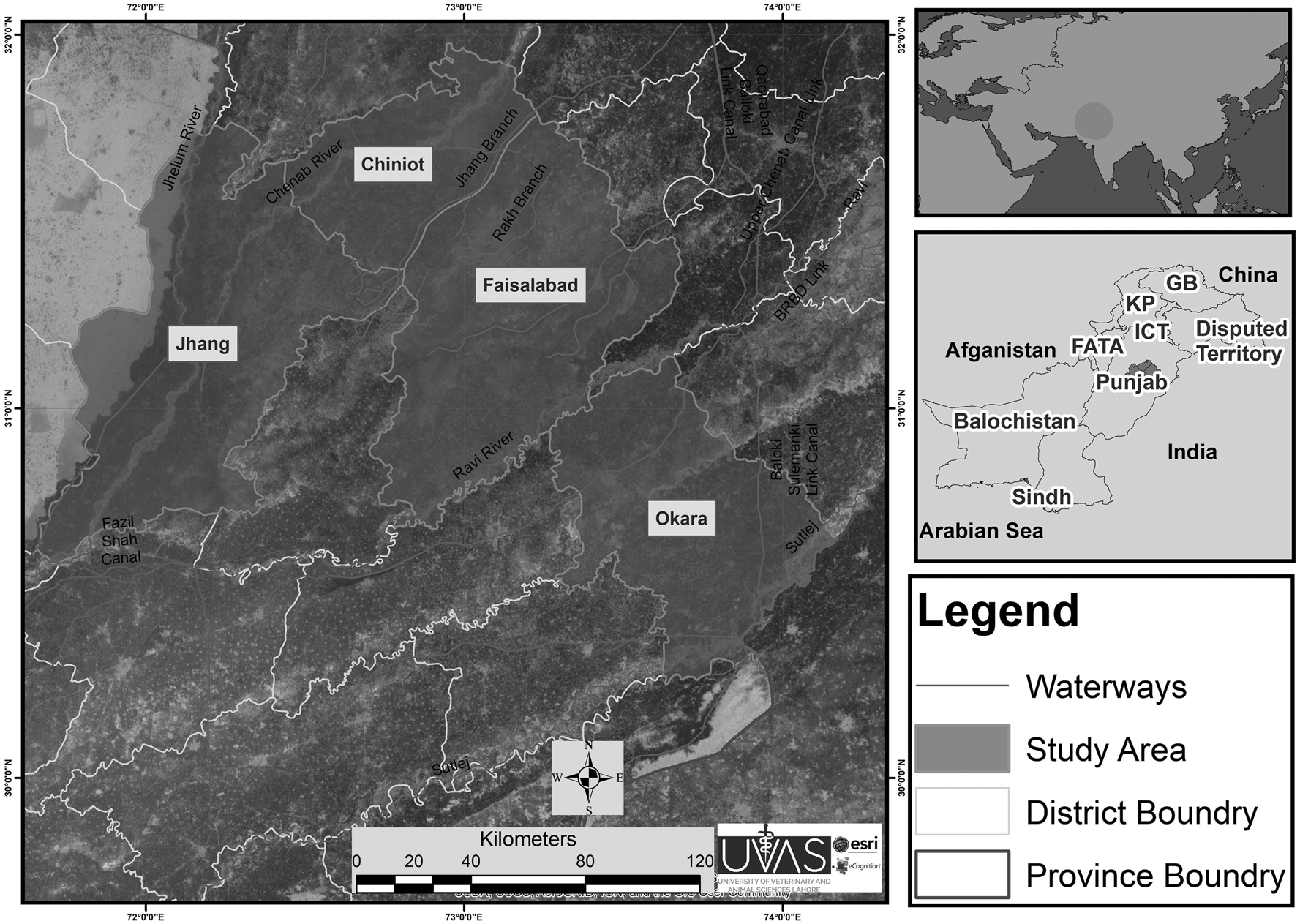
The study was conducted in four districts of Punjab Province (including Chiniot, Faisalabad, Jhang and Okara) of Pakistan (Fig. 1). The total area of Punjab, Pakistan is about 205 344 km2. The total population in the province is about 101.4 million. Chiniot (31°43′12″N 72°58′44″E) is a city of Pakistan which is located at the bank of River Chenab having its organizational headquarters in the state of Punjab. Faisalabad (31°25′45″N 73°4′44″E) is recognized as the third most crowded city in Punjab province occupying a central position in the district having connecting roads, rails, and air transportation. Faisalabad has developed to become the most important industrial and delivery centre. Jhang (31°16′05″N 72°19′05″E) is known as the capital city of Jhang District in the province of Punjab, Pakistan. It is placed on the east bank of the River Chenab. While Okara (30.8090°N, 73.4508°E) is also known as the capital city of Okara District in the province of Punjab, Pakistan. It is well-known for its cultivation based on cotton mills and the economy. People of the study area are mostly engaged in livestock raring which is an important source of income and food for them in the form of milk, meat, and butter. In rural areas of these districts, women are engaged specially in the management of livestock at the domestic level. Vegetables, cereals and rice are being predominantly used as food in the study area with less frequent use of mutton (i.e. sheep, goat), beef (i.e. cow, buffalo) and poultry (i.e. chicken) to fulfil protein demand (Saeed et al., Reference Saeed, Ali, Khan, El-Adawy, Melzer, Khan, Iftikhar and Neubauer2019).
Sampling sites for women consisting of four districts (including Chiniot, Faisalabad, Jhang and Okara) from Punjab Province, Pakistan

Data Collection
A questionnaire was developed to collect information from all the women to whom the blood was sampled (January 01 to December 31, 2017). The questionnaire was based on different relevant questions like occupation, age, location, urbanicity, socioeconomic status, contact with cat (act as definitive host) and other animals (act as intermediate hosts), consumption of unwashed fruits and vegetables, consumption of tap/unboiled water, pregnancy status, previous abortion history, trimester of pregnancy and previous child with congenital history. All these information were collected from women during the interview. No data were collected from those patients who were not willing to participate.
Blood Sampling
A total of 593 blood samples were randomly collected from pregnant (n = 293) and non-pregnant (n = 300) women through fortnightly visits of the district headquarter (DHQ) hospitals of Chiniot, Faisalabad, Jhang and Okara, Pakistan. Serum from the collected blood samples was separated out by centrifugation at 3500 rpm. The serum samples were stored in a refrigerator at −20°C till the process for analysis.
Serological Evaluation
Antibodies (IgG) against T. gondii were detected using a commercial Enzyme-Linked Immunosorbent Assay following manufacturer's instructions (BioCheck, Inc., California, USA). The sensitivity and specificity of the present Toxo IgG ELISA test was 98.3% and 99.2%, respectively. All serum samples were diluted 1:40 of test samples. After following manufacture's protocol ELISA plate was then read at 450 nm on ELISA played reader.
Statistical Analysis
A two-test approach was used to assess any association of seropositivity for anti-T. gondii antibodies with potential risk factors. For this purpose, initially, a univariant analysis was performed to determine the strength of the association between each risk factor and the outcome variable using the Chi-square test. However, in case if the cell count was less than 5 among 255 of the cell, Fischer Exact test was preferred. Finally, variables significant in the univariant analysis were subjected to binomial logistic regression to estimate the association between seropositive and explanatory variables. To determine the association between risk factors and the occurrence of toxoplasmosis odds ratio along with 95% CI were also calculated. P value ⩽0.05 was considered statistically significant for all analysis (Lemeshow and Hosmer, Reference Lemeshow and Hosmer1982). Statistical Package for social sciences (SPSS) version 21.0 software was used to perform the statistical analysis of all collected data.
Results
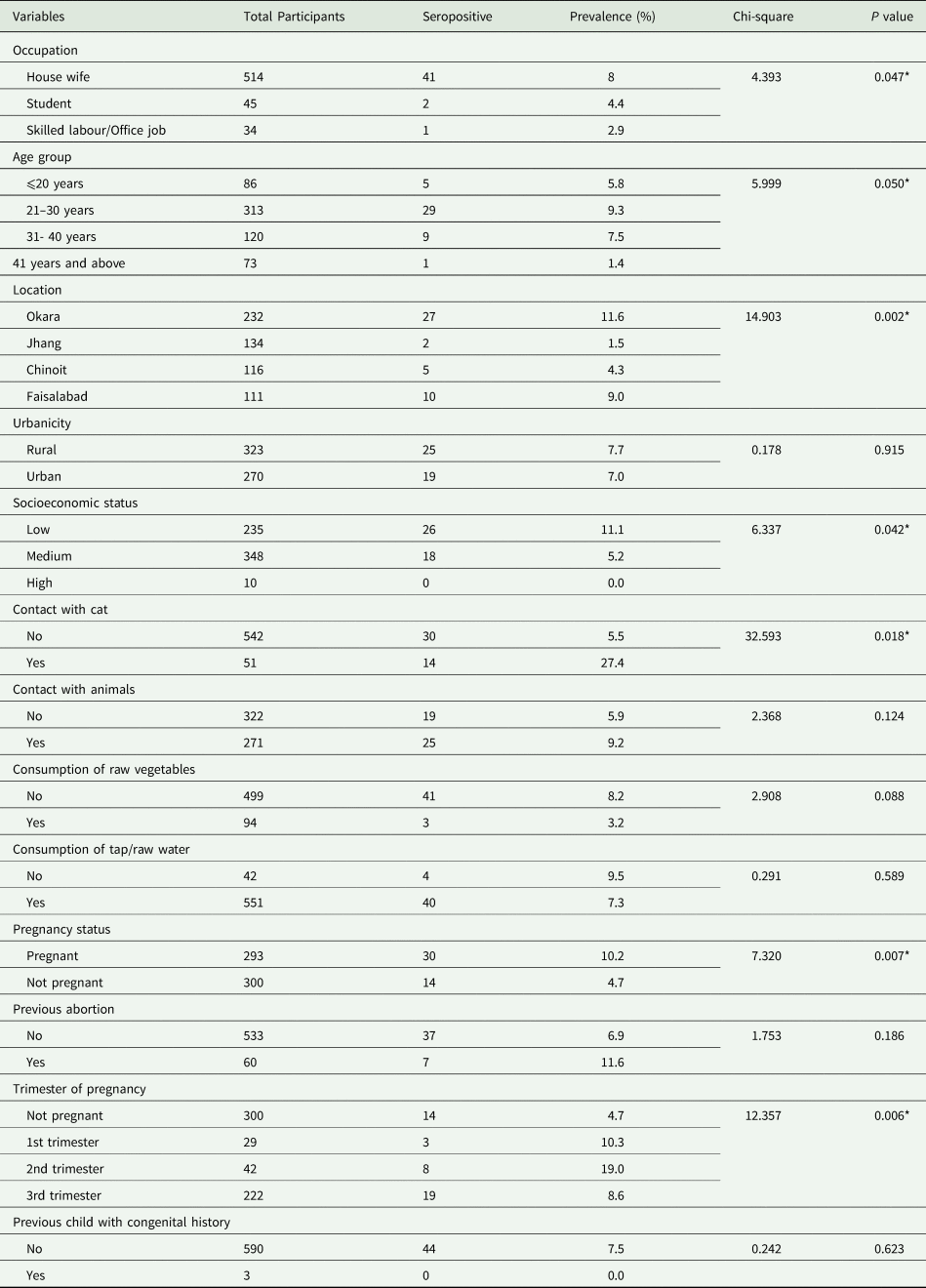
Out of 593 women's blood samples collected from DHQ hospitals of Punjab, Pakistan; 44 (7.42%) were positive for IgG anti-T. gondii antibodies tested by ELISA. The associations of demographic parameters with the presence/absence of seropositivity of women for T. gondii are described in Table 1.
Association of demographic and epidemiological variables for occurrence of anti-Toxoplasma gondii antibodies in the 593 tested women from Punjab Province, Pakistan based on Chi-square analysis (2017)

Chi-square test was applied, *P value less than 0.05 was considered statistically significant.
A high proportion (8%) of T. gondii antibodies were investigated from women living as housewives. However, any significant differences were found among the different professions (Table 1). The highest occurrence of 9.3% (29/313) was found in women with the age group of 21–30 years. The occurrence difference between different age groups was statistically significant (P > 0.05) (Table 1).
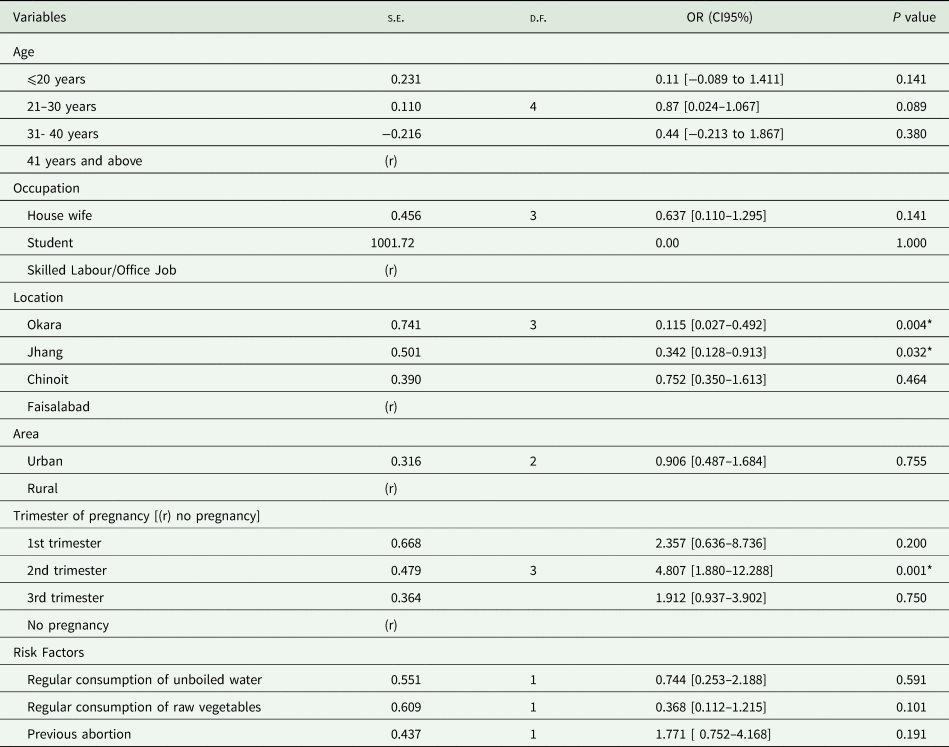
The occurrence of T. gondii was statistically significant (P < 0.05) among individuals of different locations but the residents of Okara district showed the highest occurrence i.e. 11.6% (Table 1). Women of rural areas were more often seropositive for the antibodies of T. gondii [7.7% (25/323)] than women of the urban area [7.0% (19/270)]. The occurrence by urbanicity was statistically non-significant i.e. P > 0.05 (Tables 1 and 2).
The occurrence of T. gondii was statistically significant (P < 0.05) on the basis of socioeconomic status. Individually, 26 (11.1%) out of 235 tested women with low economic status and 18 (5.2%) out of 348 with middle economic status were positive for T. gondii. Interestingly, all the 10 women with higher socioeconomic status showed negative results (Table 1).
Multiple epidemiological factors were associated with T. gondii and their brief summary is presented in Table 1. The occurrence of T. gondii with respect to contact with cat was statistically (P < 0.05) higher and lower in those which had no contact with cat. The infection was more [25 (9.2%)] in those women who had frequent contact with animals and lower [19 (5.9%)] in those which had no contact with animals.
There was non-significant (P = 0.088) association of T. gondii occurrence with the consumption of raw vegetables. The rate of seropositivity of T. gondii was high (9.5%) in those women who did not use boiled water and less (7.3%) in those who used tap water. A remarkable result from the data was that pregnant women had higher occurrence (10.2%) as compared to non-pregnant women (4.7%). This finding confirmed that there was a significant (P < 0.05) relation between T. gondii and pregnant women (Table 1).
Women which had previous abortion history were recorded with higher rate (11.6%) of T. gondii infection while those who had no previous abortion incident had less (6.9%) chances to get infected with T. gondii. The women in 1st trimester of pregnancy showed moderate (10.3%), in 2nd Trimester showed higher occurrence (19.0%) and in 3rd trimester showed lower (8.6%) seropositivity for T. gondii. A significant relation was observed among T. gondii infections with respect to various trimesters of pregnancy (P < 0.05) (Tables 1 and 2). A large number of participants (590/593) claimed that they did not have any child congenital history [occurrence of 44(7.5%)]. Remaining participants who claimed to have a congenital history of their child showed no occurrence of T. gondii antibodies.
Identification of risk factors for the occurrence of anti-Toxoplasma gondii antibodies in the 593 tested women from Punjab Province, Pakistan based on binary regression (2017)

(r), reference group; s.e., standard error; d.f., degree of freedom; CI, confidence interval.
Binary regression was applied using serology results for Toxoplasma gondii and demographics/risk factors as covariates.
Discussion
The present study examined the occurrence and risk factors associated with T. gondii in pregnant and non-pregnant women in selected districts (Chiniot, Faisalabad, Jhang and Okara) of Punjab province, Pakistan and found 7.42% seropositivity for T. gondii antibodies. This rate of occurrence was like older findings that showed 11.3% prevalence rate for T. gondii in human beings from the Lahore region, Pakistan (Ahmad et al., Reference Ahmad, Maqbool, Mahmood-ul-Hassan, Mushtaq-ul-Hassan and Anjum2012). This study somehow has not confirmed research findings on T. gondii infections in pregnant women of Northwest, Ethiopia which were revealing 16.7% seropositivity as compared to our seropositivity (Agmas et al., Reference Agmas, Tesfaye and Koye2015). However, 19.3% pregnant women from district Swabi of Khyber Pakhtunkhwa, Pakistan was found seropositive for T. gondii Antibodies using Toxo-latex test (Alvi et al., Reference Alvi, Khan, Waqar, Ahmad, Shah, Khan, Ali, Faisal, Saif, Ahmad and Javid2014). The highest prevalence rate of T. gondii antibodies (45.7%) was reported in women from Multan, Pakistan (Nazir et al., Reference Nazir, Akhtar, Maqbool, Waheed, Sajid, Ali, Oneeb, Alam, Ahmad, Nazir, Fatima and Lindsay2017).
Our study reflects that the housewives engaged in livestock farming were major victims of this infectious disease; we found a very high occurrence of T. gondii antibodies among those women who adopted livestock as their profession as compared to the women from other professions. Our results are in line with the findings of a previous study in which the high prevalence of T. gondii (15.1%) was reported in working women in Ranchi, Jharkhand, India (Pratap et al., Reference Pratap, Aslami, Manjushri and Sahu2016).
In the present study, we observed the highest occurrence in the age group of 21–30 years of women. However, with the age, the host occurrence of T. gondii also increased. In our age groups study, there was a small difference in occurrence and those were significant from each other. Our results of age groups were identical to other studies held in women in Pakistan (Alvi et al., Reference Alvi, Khan, Waqar, Ahmad, Shah, Khan, Ali, Faisal, Saif, Ahmad and Javid2014; Nazir et al., Reference Nazir, Akhtar, Maqbool, Waheed, Sajid, Ali, Oneeb, Alam, Ahmad, Nazir, Fatima and Lindsay2017).
In the present study, women whose economic status was low found more seropositive than economically medium and highly ranked women. Women having a low status of socioeconomics had less awareness and poor hygienic conditions, improper sanitary facilities, more exposure to animals, pets etc. Due to this condition risk of infection in pregnant women from low socioeconomic status increased. So, there is a dire need to instruct the women about this infectious disease. Our findings are matching with the previous findings of T. gondii infection in Women of Reproductive Age in a Northwestern Mexican City (Esquivel et al., Reference Esquivel, Corella-Madueno, Hernandez-Tinoco, Rascon-Careaga, Sanchez-Anguiano, Martinez-Robinson, Aldana-Madrid, Quizan-Plata, Canez-Carrasco and Perez-Martinez2018).
In the present study, the highest occurrence was found in those women who had contact with cats and the occurrence of T. gondii was found statistically significant (P < 0.05). Our results are consistent with previous results (Majid et al., Reference Majid, Khan, Jan, Taib, Adnan, Ali and Khan2016). They found a strong and significant relationship among the pregnant women in Khyber Pakhtunkhwa, Pakistan and the disease incidence (P < 0.05). However, we found comparatively low occurrence of T. gondii antibodies with respect to those presented in Northeast Iran, who found 37.9% prevalence among pregnant women who were having frequent contact with cats (Babaie et al., Reference Babaie, Amiri, Mostafavi, Hassan, Lotfi, Rastaghi and Golkar2013). Similarly, a significant association (P < 0.05) was identified based on meta-analysis between contact with cat and risk of infection of T. gondii in the general population, immunocompromised people as well as cat owners and people with special occupation (Wei et al., Reference Wei, He, Yang, Lindsay and Peng2016).
Our results are in good agreement with a study conducted in Nigeria in which the contact of pregnant women with the animal (dog) had no impact in disease incidence (P > 0.05) (Agboola et al., Reference Agboola, Busari, Osinupebi and Amoo2011). We found much lower value for those women who had contact with other animals including sheep, goat, cow, buffalo dog than a much higher prevalence of T. gondii (51.76%) in pregnant women from Egypt (Ibrahim et al., Reference Ibrahim, Mohamed, El-Sharaawy and El-Shqanqery2017). Although Lopes et al. (Reference Lopes, Mitsuka-Breganó, Gonçalves, Freire, Karigyo, Wedy, Matsuo, Reiche, Morimoto, Capobiango, Inoue, Garcia and Navarro2009) found a significant relation (P = 0.05) between Pregnant women of Brazil and their habit of consumption of raw vegetables. Our results do not support these observations as the relation among women eating raw vegetable and T. gondii infections were statistically insignificant (P > 0.05).
We found much lower value as compared to the values of T. gondii infections in women who are drinking raw/tap water in Cameroon (Njunda et al., Reference Njunda, Assob, Nsagha, Kamga, Nde and Yugah2011). Our findings support the results of the study conducted on prevalence and risk factors associated with T. gondii among various rural communities of Iran. They found the impact of raw water usage statistically insignificant (P > 0.05) like in our study (Rostami et al., Reference Rostami, Seyyedtabaei, Aghamolaie, Behniafar, Lasjerdi, Abdolrasouli, Mehravar and Esquivel2016).
The occurrence of T. gondii infection was high in pregnant women than in non-pregnant women in the present study. Our findings are in line with the results of previously reported higher T. gondii antibodies among pregnant women than in non-pregnant women in Multan, Pakistan (Nazir et al., Reference Nazir, Akhtar, Maqbool, Waheed, Sajid, Ali, Oneeb, Alam, Ahmad, Nazir, Fatima and Lindsay2017). One of the most prominent causes of T. gondii infections among pregnant women could be previous abortion history. Our results confirm the previous findings which concluded that there is no significant relation among disease and pregnant women of south western Saudi Arabia women which were having previous abortion history (P > 0.05) (Almushait et al., Reference Almushait, Dajem, Elsherbiny, Eskandar, Al Azraqi and Makhlouf2014). From previous findings, the highest prevalence reported was 45.7% with a history of abortion from Multan, Pakistan (Nazir et al., Reference Nazir, Akhtar, Maqbool, Waheed, Sajid, Ali, Oneeb, Alam, Ahmad, Nazir, Fatima and Lindsay2017).
The current study does not support the previous research who found various percentages [i.e. 14.4% for 1st trimester, 51.7% for second and 33.8% for 3rd trimester] in women of Jima town, Ethiopia (Zemene et al., Reference Zemene, Yewhalaw, Abera, Belay, Samuel and Zeynudin2012). Our results are also in contrast with the previous findings of a researcher from Golestan Province, Iran who studied the risk of disease among women of different trimesters of pregnancy and noted that relationship between disease incidence and pregnant women was statistically insignificant (P > 0.05) (Sharbatkhori et al., Reference Sharbatkhori, Moghaddam, Pagheh, Mohammadi, Mofidi and Shojaee2014). A large number of participants (590/593) claimed that they did not have any child congenital history. Remaining participants who claimed to have a congenital history of their child showed no occurrence of T. gondii antibodies in the present study. However, in a large-scale study in Norway, 10.9% of women were infected with T. gondii before the onset of pregnancy. Congenital infection was detected in their 11 infants, giving a transmission rate of 23% overall: 13%, 29% and 50% in the first, second and third trimesters, respectively (Jenum et al., Reference Jenum, Stray-Pedersen, Melby, Whitelaw and Eng1998).
It is a worth thing that there is sparseness in data. This leads to very low or high frequencies across some subcategories. In future studies, the samples size from each category should be realistic to obtain more precise estimates.
Concluding remarks
Toxoplasmosis, the commonest zoonotic disease all around the world is a potential hazard for public health. The women should be screened for toxoplasmosis to prevent any complications and for timely initiation of treatment. This study confirmed that Toxoplasma gondii is a serious threat for women of District Chiniot, Jhang, Faisalabad and Okara of Punjab province, Pakistan. Conclusively, an effective preventive and control strategy against toxoplasmosis of the human population is greatly needed.
Data
Raw data cannot be made publicly available due to ethical restrictions imposed by the Institutional Ethical Committee on human rights related to research. However, data can be provided on request.
Author contributions
SA, TMK, AM, HA performed the statistical analyses, evaluated the results and drafted the paper. SA, ZA, AI and IK participated in the conception and design of the study. ZA, SA and IK contributed to the enrolment of the patients and follow up. SA, TMK analysed data. All authors have read and approved the final manuscript.
Financial support
This research was partially supported by Higher Education Commission, Islamabad, Pakistan research grant number: 21-237/SRGP/R&D/HEC/2014.
Conflict of interest
The authors declare that they have no conflict of interest.
Ethical standards
All procedures performed in studies involving human participants were in accordance with the ethical standards of the Institutional Review Committee for Biomedical Research, University of Veterinary and Animal Sciences, Lahore, Pakistan (No. 048/IRC/BMR) and with the 1964 Helsinki declaration and its later amendments or comparable ethical standards.
Consent to publication
All the patients agreed to publish any data pertaining to them, including their demographic characteristics and experimental data, without their names disclosed. Informed consent was obtained from all the study participants.