Autism is a neurodevelopmental disorder characterized by qualitative impairments in social communication accompanied by unusual repetitive and stereotypical behaviors. A deficit in the development of joint visual attention, defined as the capacity to share attention with social partners in a coordinated way (Scaife & Bruner, Reference Scaife and Bruner1975) is one of the earliest behavioral manifestations of autism, and it is thought to compromise opportunities for social learning and subsequent social and communication development (Baron-Cohen et al., Reference Baron-Cohen, Cox, Baird, Swettenham, Nightingale and Morgan1996; Mundy, Reference Mundy1995; Mundy & Burnette, Reference Mundy, Burnette, Volkmar, Paul, Klin and Cohen2005). The aim of this review is to focus in detail on one of the earliest emerging aspects of joint visual attention, namely, sensitivity to the direction of another person's eye gaze. Although it is well established that people with autism have difficulty following gaze in naturalistic and seminaturalistic situations, this evidence is hard to reconcile with recent reports showing, or appearing to show, intact orienting to eye gaze cues in laboratory experiments. We review this evidence to establish the circumstances under which people with autism may show reduced sensitivity to eye gaze information, and assess whether this impairment is specific to social stimuli.
We begin our review by considering briefly the importance of gaze following behavior in triadic communication, defined as the ability to trace a line of sight to discern the object/target of the eyes' fixation and, most likely, their owner's attention. This is an extremely useful and adaptive behavior. At a basic level, it provides highly relevant information about interests and dangers in the environment. At a more sophisticated level, it can provide information about the mental states of others. What a person is seeing and attending to has implications for their knowledge, beliefs, desires, thoughts, and emotional state. Thus, detecting and interpreting the direction of another person's gaze is an important component of social interaction (Argyle & Cook, Reference Argyle and Cook1976; Emery, Reference Emery2000; Kleinke, Reference Kleinke1986; Langton, Watt & Bruce, Reference Langton, Watt and Bruce2000).
Spontaneous Gaze Following in Typical Development and Autism
In typical development, spontaneous gaze-following behavior develops during infancy. Interest in faces emerges very early (Morton & Johnson, Reference Morton and Johnson1991): neonates prefer to look at faces with eyes open rather than eyes closed (Batki, Baron-Cohen, Wheelwright, Connellan, & Ahluwalia, Reference Batki, Baron-Cohen, Wheelwright, Connellan and Ahluwalia2000), and they look for longer at faces displaying direct gaze rather than averted gaze (Farroni, Csibra, Simion, & Johnson, Reference Farroni, Csibra, Simion and Johnson2002). From approximately 2 month of age, infants begin to scan the eye region of the face preferentially (e.g., Hainline, Reference Hainline1978; Maurer & Salapatek, Reference Maurer and Salapatek1976); by about 4 months of age, infants can discriminate gaze direction (Caron, Caron, Robert, & Brooks, Reference Caron, Caron, Roberts and Brooks1997; Hains & Muir, Reference Hains and Muir1996; Lansky & Klein, Reference Lansky and Klein1979; Vecera & Johnson, Reference Vecera and Johnson1995), and recent evidence suggests that infants use gaze information to learn about objects (Reid & Striano, Reference Reid and Striano2005) and faces (Farroni, Massaccesi, Menon, & Johnson, in press). By 6 months, they readily orient attention to an object being looked at by another person, providing it is in their visual field (Morales, Mundy, & Rojas, Reference Morales, Mundy and Rojas1998). By 9–10 months, infants follow head-turn and gaze shifts spontaneously, and they can search for a looked-at object on the basis of head cues only, even if the object is not in their immediate visual field (Butterworth & Jarrett, Reference Butterworth and Jarrett1991; Corkum & Moore, Reference Corkum and Moore1998; Scaife & Bruner, Reference Scaife and Bruner1975). Brooks and Meltzoff (Reference Brooks and Meltzoff2005) found that by 10 months of age, infants were more likely to follow a protagonist's head turn when its eyes were open compared to the same head turn when its eyes were shut. Moreover, individual differences in this ability were related to subsequent language scores at 18 months. Finally, by 18 months, infants can follow eye gaze precisely, regardless of distance and location of the target (Butterworth & Jarrett, Reference Butterworth and Jarrett1991; Morissette, Ricard, & Gouin-Decarie, Reference Morissette, Ricard and Decarie1995).
Because autism is rarely diagnosed before 24 months of age, experimental investigations of face-processing and gaze-following behaviors during early infancy are lacking. However, experiments with older individuals with autism reveal striking impairments. Many behavioral and electrophysiological studies have demonstrated deficits in face discrimination and recognition in individuals with autism (e.g., Dawson, Webb, & McPartland, Reference Dawson, Webb and McPartland2005; Klin, Sparrow, de Bildt, Cicchetti, Cohen, & Volkmar, Reference Klin, Sparrow, de Bildt, Cicchetti, Cohen and Volkmar1999; Weekes & Hobson, Reference Weeks and Hobson1987). People with autism also show less interest in looking at faces, and in particular, they tend to look less at the eye region of the face (Dalton et al., Reference Dalton, Nacewicz, Johnstone, Schaefer, Gernsbacher and Goldsmith2005; Klin, Jones, Schultz, Volkmar, & Cohen, Reference Klin, Jones, Schultz, Volkmar and Cohen2002). A retrospective study by Osterling and Dawson (Reference Osterling and Dawson1994) analyzed first birthday home videos and found that children later diagnosed as autistic spent less time looking at faces, suggesting that an early manifestation of autism may be a reduced tendency to orient toward faces.
In addition to differences in face processing, children with autism also engage in less mutual gaze (e.g., Sigman, Mundy, Sherman, & Ungerer, Reference Sigman, Mundy, Sherman and Ungerer1986; Volkmar & Mayes, Reference Volkmar and Mayes1990) and show deficits in gaze-following behavior (e.g., Leekam et al., Reference Leekam, Baron-Cohen, Perrett, Milders and Brown1997; Leekam, Hunnisett, & Moore, Reference Leekam, Hunnisett and Moore1998; Leekam, López, & Moore, 2000). Before considering this evidence in detail, it is first necessary to address whether children with autism are able to compute the direction and target of eye gaze. Although these skills do not necessarily require any kind of social understanding, they are a necessary basis for gaze-following behavior as clearly, if a child was unable to discern where another person was looking, it would not be surprising if they failed to follow that person's gaze to a mutual location.
Leekam et al. (Reference Leekam, Baron-Cohen, Perrett, Milders and Brown1997) provided clear evidence that children with autism can discern where other people are looking. They tested the ability of school-aged children with autism to follow a line of sight based on fine changes in the direction and angle of the eyes. Participants viewed a photograph of a head and had to identify which of three rods, separated by varying degrees, it was looking at. Head orientation was either matched or mismatched with eye direction so that neither head direction nor the position of the iris within the visible sclera could be relied upon as the sole cue for task solution. Children with autism performed as well as control children, suggesting that they were able to compute accurately what another person sees. However, the children with autism were very poor at monitoring gaze and tended not to follow a change in another person's head and eye direction, suggesting that they fail to spontaneously orient their attention to the target of another person's gaze.
In a follow-up study, Leekam et al. (Reference Leekam, Hunnisett and Moore1998) reported evidence to suggest that spontaneous gaze-following behavior in autism is developmentally delayed. Three different methods were used: parent interview, direct observation, and an experiment. In the interview parents were asked about how their child responded to various attention-directing cues and at what age these responses had begun. In the direct observation, an experimenter gave two types of attention-directing cue to a toy out of the child's reach: a head turn alone and a head turn combined with a pointing gesture and the verbalization “look.” The experiment (following Corkum & Moore, Reference Corkum and Moore1998) measured existing spontaneous gaze-following skills and attempted to teach this behavior. It comprised three phases: (a) a baseline period, where an experimenter would turn to look at a target 90º to either side, similar to the gaze-monitoring task used by Leekam et al. (Reference Leekam, Baron-Cohen, Perrett, Milders and Brown1997); (b) a shaping phase, which attempted to teach the child the contingency between the experimenter's head and gaze turn and an interesting target over four trials; and (c) a test phase, where the target was only activated if the child turned their head toward it in response to the experimenter's cue. As a group, children with autism were impaired across all three methods. However, and in contrast to Leekam et al.'s (1997) findings, a surprisingly high proportion of children with autism did follow gaze spontaneously (50% in the observation and 59% in the baseline phase of the experiment). Nevertheless, only 1 parent out of 17 reported that their child would follow a head-turn cue alone compared to 8 out of 13 parents of children in the control group.
An important finding from this study was that for the children with autism, mental age (both verbal and nonverbal) was a significant predictor of performance at baseline in the experiment; it also correlated significantly with number of correct trials in the observation. Furthermore, the ability to follow eye gaze and head turn was ubiquitous within and largely confined to those children with autism who had a mental age above 4 years. This suggests that rather than a long-term absence or impairment of gaze-following behavior, children with autism are delayed in development of this behavior, and this delay seems to be associated with mental age (see Leekam et al., Reference Leekam, Lopez and Moore2000, for similar findings).
In summary, the picture emerging from studies of gaze following in children with autism is that the development of spontaneous gaze-following behavior is delayed and linked to mental age. A similar relationship has been proposed between developmental level and joint attention behavior more generally (Landry & Loveland, Reference Landry and Loveland1988; Mundy, Sigman, & Kasari, Reference Mundy, Sigman and Kasari1994) and success on theory of mind tasks (Eisenmajer & Prior, Reference Eisenmajer and Prior1991; Happé, Reference Happe1995). In addition, although Leekam et al. (Reference Leekam, Hunnisett and Moore1998) found that a mental age of 4 years was sufficient for all their participants with autism to display gaze following in the laboratory, it is important to keep in mind that typically developing infants follow gaze from 10 to 11 months of age (Butterworth & Jarrett, Reference Butterworth and Jarrett1991; Corkum & Moore, Reference Corkum and Moore1998; Scaife & Bruner, Reference Scaife and Bruner1975). It seems that many more years and a much higher level of verbal ability are needed for children with autism to follow gaze spontaneously. Leekam et al. (Reference Leekam, Hunnisett and Moore1998) speculated that for children with autism, both chronological age and mental age are critical factors for the development of gaze following, whereas for nonautistic children with developmental delay, gaze-following behaviors emerge in line with age, regardless of developmental level (Leekam et al., Reference Leekam, Hunnisett and Moore1998). Furthermore, as suggested by parent testimonies (Leekam et al., Reference Leekam, Hunnisett and Moore1998), a mental age in excess of 4 years may not be sufficient for children with autism to show gaze-following behavior in real life when the environment is rather more complex than captured by a laboratory task.
What Underlies Delays in Spontaneous Gaze Following in Children With Autism?
A number of reasons have been offered as possible explanations for the delay in the development of spontaneous gaze- and head turn-following behavior in autism. One account evokes a cognitive explanation, claiming children with autism fail to interpret gaze or head movement as an index of the other person's state of attention to or interest in a particular location (Baron-Cohen, Reference Baron-Cohen1995). This fits well with the finding that children with autism can compute the direction of eye gaze in nonmentalistic contexts, but are severely developmentally delayed in mentalistic situations (Leekam et al., Reference Leekam, Baron-Cohen, Perrett, Milders and Brown1997, Reference Leekam, Hunnisett and Moore1998) and more generally with the view that deficits in theory of mind are at the core of autism.
It is important to note, however, that gaze following does not necessarily require a representation of the other person's mental state (Gomez, Reference Gomez, Russon, Bard and Taylor Parker1996; Moore & Corkum, Reference Moore and Corkum1994; Perner, Reference Perner1991). Gaze-following behavior develops in macaque monkeys (Ferrari, Kohler, Fogassi, & Gallese, Reference Ferrari, Kohler, Fogassi and Gallese2000), and although chimpanzees follow eye gaze, they do not have a representation of the mental state of the person doing the gazing (e.g., Povinelli & Eddy, Reference Povinelli and Eddy1996, Reference Povinelli and Eddy1997). Nevertheless, although mentalizing ability is not necessary for gaze-following behavior, a representation of the other person's mental state is an important motivation behind gaze following: we look where someone else is looking because we want to see what has captured their interest or attention, or we want to establish shared reference as a basis for communication (Tomasello, Reference Tomasello2003). Therefore, a lack of appreciation that a head or gaze cue is an index of a person's interest or attention might well be expected to contribute to a reduction or delay in the use of gaze-following behavior. However, it cannot be the whole story: given that the ability to represent other people's mental states is not necessary for gaze following, why is it that children with autism do not engage in gaze following behavior, given its strong adaptive value?
An alternative to the theory of mind account is to propose that gaze-following behavior is learned from the experience of repeated exposure to the pairing of a gaze or head-turn cue and a rewarding target in the location indicated (classical conditioning) and/or a contingency between following another person's head turn and a rewarding event (operant conditioning). Corkum and Moore (Reference Corkum and Moore1998) argued that these learning mechanisms could be at work in typical development. Using a conditioned head turn procedure, they found that a significant proportion of their sample of 8- to 9-month-old infants were able to acquire gaze-following behavior. Moreover, using this same procedure, Leekam et al. (Reference Langton, Watt and Bruce1998) found that 44% of children with autism who did not demonstrate gaze following at baseline improved after training, although the sustainability of this improvement was questioned.
Of course, just because this method can help establish gaze following in the short term in a laboratory setting, one cannot necessarily conclude that these mechanisms are actually important in the typical development of this behavior in a natural environment in which the detection of contingencies is likely to be much more complex. However, if they are important, the question then becomes why is it that children with autism are so poor at learning to pair cues (where a person is looking) and targets (the location being looked at). We return to discuss this issue later in this paper.
A rather different explanation for gaze-following deficits seen in children with autism is to propose that difficulty following gaze is related to problems orienting attention in response to a directional cue (e.g., direction of eye gaze) toward the location indicated. This may relate to more general problems with disengaging attention from one stimulus and shifting it to another location, as described by the executive dysfunction account of autism (e.g., Hill, Reference Hill2004; Ozonoff, Pennington, & Rogers, Reference Ozonoff, Pennington and Rogers1991). There are studies showing problems with shifting attention both between modalities (Courchesne et al., Reference Courchesne, Townsend, Akshoomoff, Saitoh, Yeung-Courchesne and Lincoln1994) and within modalities (Casey, Gordon, Mannheim, & Rumsey, Reference Casey, Gordon, Mannheim and Rumsey1993; Pascualvaca, Fantie, Papageorgion, & Mirsky, Reference Pascualvaca, Fantie, Papageorgiou and Mirsky1998; Townsend et al., Reference Townsend, Courchesne, Covington, Westerfield, Harris and Lyden1999; Townsend, Courchesne, & Egaas, Reference Townsend, Courchesne and Egaas1996; Wainwright & Bryson, Reference Bryson, Landry, Wainwright, Burack and Enns1996; Wainwright-Sharp & Bryson, Reference Wainwright-Sharp and Bryson1993) in individuals with autism, although not all studies have found an impairment (for review, see Burack, Enns, Stauder, Mottron, & Randolph, Reference Burack, Enns, Stauder, Mottron, Randolph, Cohen and Volkmar1997). Clearly, however, if children with autism have difficulty shifting their attention from a directional cue such as gaze or head direction toward the target indicated, this could account for their reduced spontaneous gaze-following behavior. We turn now to consider evidence addressing this possibility in detail.
Reflexive Attentional Cueing: Methods and Typical Development
Human individuals are very sensitive to eye gaze direction, and there seems to be a fundamental tendency for an individual to look in the same direction as someone else is looking. This is demonstrated nicely in experimental studies using a Posner-style spatial cueing paradigm. If adults are presented with a picture of a face with gaze averted to the left or right, they are faster to detect, localize, or identify a target stimulus that subsequently appears at the location that the face was looking (the valid location) rather than the nongazed-at location (the nonvalid location). This is described as the validity effect. Even when the cue is uninformative and nonpredictive in that it validly cues the target location for only 50% of trials, participants continue to show a validity effect (Friesen & Kingstone, Reference Friesen and Kingstone1998). The validity effect occurs when the interval between the onset of the gaze cue and the onset of the target is short (when stimulus onset asynchrony [SOA] is as short as 105 ms, and persists until SOA is approximately 1000 ms). This, along with the fact that facilitation occurs even though the cue is nonpredictive, suggests that the tendency to move attention to the location of another person's eye gaze is reflexive and not dependent on the recruitment of voluntary attention.
Several studies have shown that eye gaze cues contained in a static image of a face (photographs or schematic drawings) elicit a reflexive orienting response in nonautistic adult viewers (e.g., Driver et al., Reference Driver, Davis, Ricciardelli, Kidd, Maxwell and Baron-Cohen1999; Friesen & Kingstone, Reference Friesen and Kingstone1998; Friesen, Ristic, & Kingstone, Reference Friesen, Ristic and Kingstone2004; Hietanen, Reference Hietanen1999; Langton & Bruce, Reference Langton and Bruce1999). A similar effect has been reported in 3- and 4-year-old children (Ristic, Friesen, & Kingstone, Reference Ristic, Friesen and Kingstone2002), and in infants as young as 4 months old a validity effect (as measured by saccades to targets cued by dynamic gaze shifts) has been observed (Farroni, Johnson, Brockbank, & Simion, Reference Farroni, Johnson, Brockbank and Simion2000; Hood, Willen, & Driver, Reference Hood, Willen and Driver1998). Thus, it seems likely that eye gaze serves to cue reflexive attentional orienting from an early age (Baron-Cohen, Reference Baron-Cohen1994; Hood et al., Reference Hood, Willen and Driver1998). As nonsocial cues such as arrows do not orient attention (Jonides, Reference Jonides, Long and Baddeley1981; Vuilleumier, Reference Vuilleumier2002), this sensitivity seems specific to biologically relevant cues such as eye and head gaze, leading to the view that “eyes are special” (Friesen & Kingstone, Reference Friesen and Kingstone1998; Langton et al., Reference Langton, Watt and Bruce2000), although later in this paper, counterevidence is discussed).
Clearly, the Posner attentional cueing paradigm is far more artificial than the methods used to test spontaneous gaze following in naturalistic situations. However, it allows for a detailed investigation of people's sensitivity to eye gaze cues by measuring the efficiency of reflexive orienting under highly controlled conditions. In nonautistic individuals, reflexive orienting to eye-gaze cues suggests that sensitivity to this social stimulus represents a special form of attention (Langton et al., Reference Langton, Watt and Bruce2000). We now turn to the question of whether people with autism show reflexive orienting to eye gaze cues.Footnote 1
Is Reflexive Orienting to Eye Gaze Intact in Autism?
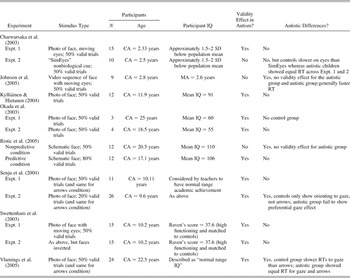
The majority of published reports find no evidence for deficits in attentional orienting to social stimuli in children and young people with autism (see Table 1). For example, Swettenham, Condi, Campbell Milne, and Coleman (2003) found that children with autism showed a validity effect when responding to a target cued by moving eye gaze. This effect was comparable to the effect shown by a group of typically developing control children.
Summary of experiments investigating attentional orienting from gaze cues in people with autism

Note: CA, chronological age; MA, mental age; RT, response time.
Kylliäinen and Hietanen (2004) tested high-functioning children with autism (age range = 7 years, 4 months to 14 years, 1 month) as well as a tightly matched control group, individually matched for age and mental age. The uninformative cue comprised a photograph of a forward-facing head with the eyes statically gazing left or right. This study was perhaps better controlled than Swettenham et al.'s study, as the children's heads were restrained during testing and more care was taken to ensure that they were fixating the centre of the screen at the beginning of each trial. Mirroring Swettenham et al.'s (2003) results, however, no group differences were found, and both groups showed a validity effect.
Senju, Tojo, Dairoku, and Hasegawa (Reference Ristic, Friesen and Kingstone2004) also found a validity effect in response to a full-face, static eye direction cue in their sample of high-functioning children with autism, despite strong emphasis that the cue was irrelevant and should be disregarded. They manipulated task demands such that rather than being merely uninformative (50% valid cues, 50% invalid), the cue was counterinformative in that it was invalid for 80% trials and valid for only 20% of trials. Participants were explicitly informed of this and instructed to attend to the opposite side to that cued. Previous experiments with nonautistic adults demonstrate that despite this manipulation, reflexive cueing of static eye gaze persists (Driver et al., Reference Driver, Davis, Ricciardelli, Kidd, Maxwell and Baron-Cohen1999). In line with these findings, Senju et al. (Reference Ristic, Friesen and Kingstone2004) found that the reflexive cueing effect persisted in both children with autism and control children (SOA ≥ 100 ms). This is, therefore, strong evidence for an intact and automatic reflexive orienting response to eye gaze in children with autism.
Unfortunately, however, the studies thus far discussed are of only limited relevance to the question of whether impairments with attentional orienting underlie impairments in spontaneous gaze-following behavior in autism. This is because the participants in the studies described above were generally in midchildhood or older, and from the higher functioning end of the autism spectrum. In addition, none of the studies established whether participants had deficits in spontaneous gaze following. Given that older and more able children with autism do not always show deficits in spontaneous gaze following (Leekam et al., Reference Leekam, Hunnisett and Moore1998), failure to find deficits in attentional orienting in this group does not negate the possibility that deficits did exist earlier in development. Potentially, early deficits in automatic orienting to eye-gaze cues may contribute to abnormalities in the development of joint visual attention, even if by school age, orienting deficits are no longer observed.
Relevant to this issue are data presented by Chawarska, Klin, and Volkmar (Reference Casey, Gordon, Mannheim and Rumsey2003). They tested 15 2-year-old children with autism along with a group of typically developing control children. First, the children were observed in a semistructured interaction (the Autism Diagnostic Observation Scale; Lord, Rutter, DiLavore, & Risi, Reference Lord, Rutter, DiLavore and Risi1999). Although children with autism attended to a toy when it was activated or placed directly in front of them, they did not attend to it when attention was directed via the tester's head and eye gaze, or point. This evidence that all of the children with autism failed to follow gaze spontaneously provides an appropriate backdrop against which to explore the children's orienting of attention using a Posner-style gaze-cueing paradigm.
The cue used by Chawarska et al. (Reference Casey, Gordon, Mannheim and Rumsey2003, experiment 1) was a dynamic display of a color photographic image of a face that looked forward, blinked, looked forward again, and then shifted its eyes laterally to the left or right. Rather than a simple shape or asterisk, targets were color photographs of toys and characters from children's books. The dependent measure used was reaction time (RT) to initiate a saccade to the target following either valid or invalid cueing. Despite their young age and spontaneous gaze-following deficits, the children with autism, along with the typically developing children, displayed a validity effect. It is interesting to note that the children with autism were significantly faster at orienting attention to the target, a finding replicated by Johnson et al. (Reference Hutt and Ounsted2005). We return to this observation later, but in the meantime, the fact that children with autism showed an equivalent validity effect suggests that abnormalities with reflexive attentional orienting to eye gaze and head direction cues do not underlie deficits in spontaneous gaze following.
Okada, Sato, Murai, Kubota, and Toichi (Reference Mosconi, Mack, McCarthy and Pelphrey2003, experiment 1) also examined whether individuals with autism who failed to show spontaneous gaze following behavior nevertheless showed a validity effect. Although this study needs to be interpreted very cautiously as only three participants were tested, and there was no control group, their findings are very similar to those reported by Chawarska et al. (Reference Casey, Gordon, Mannheim and Rumsey2003): despite poor spontaneous gaze following behavior, participants showed a validity effect.
Thus far, this review of the relevant literature using a Posner-style paradigm leads to the conclusion that eye-gaze and head-direction cues induce reflexive shifts of attention in individuals with autism, just as they do in control children. Only two studies have examined attentional orienting in participants known to be unable to follow gaze spontaneously (Chawarska et al., Reference Chawarska, Klin and Volkmar2003; Okada et al., Reference Okada, Sato, Murai, Kubota and Toichi2003), and of these, Okada et al.'s findings are difficult to interpret for methodological reasons. However, the results of Chawarska et al.'s experiment clearly demonstrated no impairments in attentional cueing from face stimuli in 2-year-old children with autism, despite the children showing marked deficits is spontaneous gaze following. This finding suggests that despite impairments in developing joint visual attention and spontaneous gaze following, infants with autism nevertheless show reflexive orienting to eye gaze. Before accepting this conclusion, however, it is necessary to address the issue of whether or not the reflexive orienting produced by eye gaze in Posner-style cueing experiments genuinely reflects sensitivity to the social salience of eye gaze.
Are Eyes Special? Reflexive Orienting to Social and Nonsocial Cues
The view that “eyes are special” was challenged by Tipples (Reference Tipples2002), who found that arrow cues produced the same reflexive orienting effect as eye gaze cues in nonautistic adults. Thus, participants showed a validity effect in that they attended to the arrow-cued location, even when cue direction was uninformative. This suggests that eye-gaze direction-orienting effects are not governed by underlying cognitive or neural mechanisms dedicated to the processing of social information (cf. Langton et al., Reference Langton, Watt and Bruce2000). With this view, the finding that people with autism show normal patterns of social orienting to eye gaze cues is perhaps not surprising, if performance on the task is mediated by nonsocial mechanisms. But is this really the case?
Ristic et al. (Reference Plunkett, Karmiloff-Smith, Bates, Elman and Johnson2002) compared reflexive orienting to eye gaze direction and to arrows, using a within-subject design. They found an identical pattern of results for both types of cue (in both adults and children, all nonautistic) suggesting that eyes are not special but serve as a simple spatial cue, just as the direction of an arrowhead does. However, data from a split-brain patient argues against this conclusion (Ristic et al., Reference Ristic, Friesen and Kingstone2002, experiment 3). When presented with eye gaze cues, the split-brain patient showed reflexive orienting only when stimuli were presented to the right hemisphere, the hemisphere associated with face processing. In contrast, arrow cues elicited reflexive orienting regardless of which hemisphere stimuli were presented to. These data are compatible with the view that “eyes are special,” as they suggest that qualitatively different mechanisms subserve the processing of biological or social stimuli compared with nonbiological or nonsocial stimuli.
These findings are important, because they offer a possible explanation for why people with autism show normal reflexive orienting to eye-gaze cues despite lack of sensitivity to eye-gaze cues in more naturalistic or spontaneous situations. Potentially, in Posner-style tasks people with autism may process eye gaze using nonsocial mechanisms as if they were arrow stimuli. According to this view, they are attending to basic movement or directional properties of stimuli, rather than properties that are salient because of their social function. In contrast, nonautistic people may utilize different mechanisms for processing social and nonsocial stimuli.
Some studies have compared sensitivity to social and nonsocial stimuli in children with autism (see Table 1). As reviewed above, Chawarska et al. (Reference Casey, Gordon, Mannheim and Rumsey2003, experiment 1) found that 2-year-old infants with autism showed equal sensitivity to eye-gaze cues to control infants. A second experiment (with a different group of children) examined sensitivity to a nonsocial cue called “SimEyes.” This stimulus was constructed to be similar to the eye-gaze cue used in the first experiment. For example, it was dynamic, shifting from central fixation to left or right, analogous to the shift in eye gaze used to signal direction in the eye gaze stimulus. It is important, however, that it was not perceived as representing a face or eyes, and therefore, it was considered a nonbiological cue. Neither infants with autism nor control infants displayed a reflexive orienting response to this cue. Nevertheless, Chawarska et al. (Reference Casey, Gordon, Mannheim and Rumsey2003) did find some evidence to suggest that the social cue (moving eye gaze) had a special significance relative to the nonsocial cue (SimEyes) for control infants who were significantly slower to initiate a saccade to a target following the eye gaze cue, relative to the SimEyes cue. This is consistent with standard findings demonstrating that (nonautistic) adults are slower to respond to eye-gaze cues than arrow cues (Ristic et al., Reference Ristic, Friesen and Kingstone2002). In contrast, infants with autism did not show this effect: saccadic responses were equivalent across social and nonsocial conditions. Furthermore, and as noted earlier, Charwaska et al. (2003) found that infants with autism were faster than control children in the eye-gaze condition. Johnson et al. (Reference Hutt and Ounsted2005) replicated this effect, and speculated that faster RTs in infants with autism may be a consequence of them not processing the central face as deeply as the typically developing infants; this may result in additional resources being available to allocate to peripheral target stimuli leading to faster RTs. A final observation from Charawaska et al.'s (2003) study is that in the control group only, significantly more SimEyes trials than face trials had to be discarded from analyses because of lack of sufficient attention to the cue. This suggests that although the face cue held attention, the SimEyes cue did not. Although these findings need to be interpreted cautiously as different children participated in the social and nonsocial experiments, taken together, they are consistent with the view that control infants respond preferentially to social cues relative to nonsocial cues, but infants with autism do not.
Senju et al. (Reference Ristic, Friesen and Kingstone2004) used a nonsocial arrow cue and also found evidence that children with autism do not show preferential sensitivity to a social cue. They first established that both groups of children (autism and controls) displayed a validity effect in response to both uninformative gaze and arrow cues. Then, they went on to show that when arrow and gaze cues were counterinformative (achieved by decreasing the proportion of trials correctly cued from 50 to only 20%, thus meaning that for 80% of trials, the cue was counterinformative), both eyes and arrows still yielded a validity effect for children with autism, whereas for control children, only the reflexive attentional orienting properties of the gaze cue survived this manipulation. Thus, eye-gaze cues triggered reflexive orienting more effectively than arrow cues in control children, whereas this was not the case in children with autism. These findings of lack of preferential sensitivity to social cues in infants and children with autism provide evidence for the idea that in autism, social stimuli do not possess the normal pattern of increased salience, relative to nonsocial stimuli (see Vlamings, Stauder, van Son, & Mottron, Reference Vlamings, Stauder, van Son and Mottron2005, for similar conclusions).
Ristic, Mottron, Friesen, Iarocci, Burack, and Kingstone (Reference Povinelli and Eddy2005) also questioned the extent to which children with autism are sensitive to eye gaze cues as social stimuli. They noted that previous work demonstrating reflexive orienting to eye gaze in autism used stimuli containing cues that are often confounded with eye gaze such as stimulus motion or abrupt transitions, as in photographs (see Table 1). For example, Swettenham et al. (Reference Senju, Tojo, Yaguchi and Hasegawa2003) and Chawarska et al. (Reference Casey, Gordon, Mannheim and Rumsey2003) used stimuli containing motion (i.e., eyes moved from a central fixation to look to the left or the right) while Senju et al. (Reference Ristic, Friesen and Kingstone2004) and Kylliäinen and Hietanen (2004) used full-face photographs of a human face. Ristic et al. (Reference Povinelli and Eddy2005) asked whether children with autism showed reflexive orienting of attention to eye-direction cues that were static and simple (comprising a left- or right-deviated gaze on a schematic face, rather than a photograph of a human face). When the cue was spatially uninformative (50% trials cued correctly, 50% incorrectly), control children showed a clear validity effect. The children with autism, however, did not: responses were identical to validly cued as invalidly cued targets. In a second condition, the task was modified such that the cue was predictive more frequently: on 80% of trials, direction of eye gaze correctly cued the location of the target. In these circumstances, children with autism showed a validity effect equivalent to that shown by the control children. This suggests that children with autism are sensitive to the statistical co-occurrence between cue and target; however, when this statistical contingency is not available (i.e., in the 50% condition where the cue is uninformative), children with autism do not show sensitivity to eye gaze, unlike control children who are unable to resist the force of the cue, even when it is uninformative.
These findings led Ristic et al. (Reference Povinelli and Eddy2005) to conclude that children with autism are not sensitive to eye direction as a social stimulus. This conclusion is clearly at odds with findings reported earlier demonstrating that infants and children with autism do show a normal validity effect, even when the eye gaze cue is uninformative (Chawarska et al., Reference Chawarska, Klin and Volkmar2003; Kylliäinen & Hietanen, 2004; Senju et al., Reference Senju, Tojo, Dairoku and Hasegawa2004; Swettenham et al., Reference Swettenham, Condie, Campbell, Milne and Coleman2003). It may be that attentional orienting in these studies is underpinned by sensitivity to aspects of the stimulus such as motion, rather than sensitivity brought about by the special significance of social stimuli. However, this is only a speculation that remains to be tested by comparing reflexive orienting to eye gaze that is static versus dynamic, schematic versus complex under varying conditions of cue–target contingency in people with autism and control participants.
Leekam et al. (Reference Lansky and Klein2000, experiment 2) supported the notion that people with autism rely more on statistical co-occurrence between cue and target. They examined whether a nonsocial cue, in this case, a toy train turning to a point either to the left or right, could orient attention. Following exposure to the contingency between train turning and the appearance of the target, children with autism acquired a cue-following response. In contrast, the developmentally delayed control children did not. These findings led Leekam et al. (Reference Lansky and Klein2000) to suggest that children with autism may rely to a greater extent than nonautistic children on repeated observations of cue–target pairings to learn about the significance of eye gaze and head turns. As human signals vary with context, learning in this way would be laborious, especially as children with autism show difficulties with generalization (Plaisted, Reference Plaisted, Baron-Cohen, Tager-Flusberg and Chen2000).
In summary, evidence that people with autism can reflexively orient their attention in response to eye gaze cues is contradictory. Although some studies have demonstrated apparently normal effects of social cueing (e.g., Swettenham et al., Reference Swettenham, Condie, Campbell, Milne and Coleman2003), the results of other experiments suggest that people with autism respond to social cues such as eye gaze in much the same way as they do to nonsocial cues such as arrows, whereas in nonautistic people, a greater salience to social cues has been reported (Chawarska et al., Reference Chawarska, Klin and Volkmar2003; Ristic et al., Reference Ristic, Mottron, Friesen, Iarocci, Burack and Kingstone2005; Senju et al., Reference Senju, Tojo, Dairoku and Hasegawa2004). It may also be the case that whereas nonautistic people are alert to the social features of eye gaze stimuli, and respond via mechanisms developed to deal with social stimuli (Ristic et al., Reference Ristic, Friesen and Kingstone2002), people with autism respond to physical features of the stimuli (e.g., motion) such that when these features are removed, reflexive attentional cueing via eye gaze is no longer observed (Ristic et al., Reference Ristic, Mottron, Friesen, Iarocci, Burack and Kingstone2005).
Sensitivity to Mutual Gaze in People With Autism
Although it is known that children with autism engage in less mutual gaze than control children (e.g., Sigman et al., Reference Sigman, Mundy, Sherman and Ungerer1986; Volkmar & Mayes, Reference Volkmar and Mayes1990) and that for some children, direct mutual gaze is aversive (e.g., Hutt & Ounsted, Reference Hutt and Ounsted1966), these observations have received relatively little research attention, certainly in comparison to the body of work concerned with attentional cueing, gaze following behavior, and their relation to jont visual attention and the development of social cognition. However, recent studies by Senju and colleagues highlight the need to investigate this aspect of gaze processing in more detail.
Senju, Yaguchi, Tojo, and Hasegawa (Reference Senju, Yaguchi, Tojo and Haseawa2003) used an oddball procedure in which children were asked to detect a rare stimulus presented occasionally within the context of a frequently reoccurring stimulus. The rare stimulus was either a face with gaze averted laterally to the left or to the right, or a face with direct gaze (i.e., mutual gaze shared with the participant); the frequent stimulus showed a face with eyes glancing downward. Thirteen children with autism (mean age 12 years) were compared with 15 typically developing children of the same age. The control children showed a gaze facilitation effect in that they were better able to detect faces with direct gaze than averted gaze. In contrast, although the children with autism were able to detect averted faces as effectively as control children, they were less skilled at detecting faces with direct gaze, and they also failed to show facilitation for direct versus averted faces. This is an important finding in that it demonstrates an impairment in mutual gaze detection against a backdrop of apparently intact processing of averted gaze (see Senju, Hasegawa, & Tojo, Reference Senju, Hasegawa and Tojo2005, for similar findings in a visual search paradigm).
In a companion paper, Senju, Tojo, Yaguchi, and Hasegawa (Reference Ristic, Mottron, Friesen, Iarocci, Burack and Kingstone2005) present event-related potential data collected during the visual oddball experiment described above. Focusing on the N2 component (an occipitotemporal negative component), it was notable that in control children, N2 responses were (a) lateralized to the right hemisphere and (b) greater in amplitude when detecting a direct gaze versus averted gaze. In contrast, children with autism showed bilateral activation of the N2 response and no differences in amplitude when detecting a direct versus averted gaze. In addition, as with the behavioral data summarized above, the difference between the two groups of children emerged not with the processing of averted gaze but with the processing of direct (i.e., mutual) gaze. These findings suggest that mutual gaze processing may be served by atypical neural substrates in people with autism. One important note of caution concerns the observation that people with autism tend not to fixate on eyes (e.g., Dalton et al., Reference Dalton, Nacewicz, Johnstone, Schaefer, Gernsbacher and Goldsmith2005). Potentially, therefore, behavioral and electrophysiological differences in the direct (mutual) gaze condition may simply reflect a lack of fixation on the direct gaze stimulus. Eye movements could be monitored to check this possibility. Note, however, that even if it is found that Senju et al.'s findings were a consequence of children with autism showing reduced looking to faces with direct gaze, two important questions would remain: namely, why do people with autism engage less with mutual gaze, and what are the consequences of this for social communication.
The Need for a Developmental Perspective
What have we learned so far? Children with autism are able to compute subtle directional information from eye gaze. In addition, under some circumstances, reflexive orienting to eye direction is observed. Despite this, however, difficulties with mutual gaze, following gaze spontaneously, and in naturalistic settings are not uncommon, and there is some evidence to suggest that reflexive orienting of attention to eye gaze cues is atypical.
With the notable exception of studies such as those described by Chawarska et al. (Reference Casey, Gordon, Mannheim and Rumsey2003), the majority of experimental investigations of sensitivity to eye gaze in autism have been conducted with children and young people rather than infants. This is understandable, given that autism is rarely identified before 24 months and many children do not receive a diagnosis until they are considerably older (Coonrod & Stone, Reference Coonrod, Stone, Volkmar, Paul, Klin and Cohen2005). However, autism is a developmental disorder, and therefore, it is vital to view its manifestations from a developmental perspective.
Dawson and colleagues (1998) coined the term social orienting impairment to describe very early deficits in orienting to social stimuli in autism. Thus, if attentional orienting to social cues is disturbed from early in development, this could underpin, at least in part, disturbances in the development of joint visual attention and social communication. Thus, early differences in the behavior or response of infants with autism limit exposure to social stimuli, and over time, this reduces the relative salience of stimuli such as eye gaze. In contrast, these stimuli become increasingly salient to nonautistic infants because of the their social relevance. If this account is correct, one would expect evidence pointing to atypical social orienting in autism early in infancy. Despite the lack of direct experimental evidence, family home videos of older children with autism recorded when they were younger reveal difficulties in orienting to social stimuli, responding to their name, looking at people, and making eye contact during the first 12 months of life (e.g., Baranek, Reference Baranek1999; Dawson, Osterling, Meltzoff, & Kuhl, Reference Dawson, Osterling, Meltzoff and Kuhl2000; Maestro et al., 2002; Osterling, Dawson, & Munson, Reference Osterling, Dawson and Munson2002; Werner, Dawson, Osterling, & Dinno, Reference Werner, Dawson, Osterling and Dinno2000). Prospective methods provide complementary evidence. For example, 10 20-month-old infants participating in Swettenham et al.'s (Reference Swettenham, Baron-Cohen, Charman, Cox, Baird and Drew1998) experiment were considered to be at risk of autism, based on earlier observations and checklist ratings made by health professionals at 18 months (as part of a large (N = 16,000) epidemiological study; Baron-Cohen et al., Reference Baron-Cohen, Cox, Baird, Swettenham, Nightingale and Morgan1996). Later assessments at 42 months confirmed a diagnosis of autism in all 10 children. At 20 months, these children were observed to spend less time overall looking at people, to look more briefly at people and to look for longer durations at objects, compared to infants not considered to be at risk for autism.
These retrospective and prospective studies provide support for the view that autism is characterized by atypicalities in attending to people early in life. As yet, however, important evidence is missing because we do not know why infants with autism show these early impairments in joint attention, nor whether they are underpinned by lack of reflexive orienting to specifically social stimuli. Corkum and Moore (Reference Coonrod, Stone, Volkmar, Paul, Klin and Cohen1998) review evidence pointing to the following developmental process operating in typically developing infants. By 4 months of age, an early emerging reflexive response to eye gaze is considered important for the detection of the pairings between another person's eye or head movement and a rewarding event at the signalled location, leading to an appreciation of the social significance of the cue and therefore to the development of spontaneous gaze-following behavior. There seems to be a reciprocal relationship between interest in faces and eyes and the realization that head and eye gaze serve as useful cues such that initially, the former plays a part in the development of the latter, but over time, both go on to strengthen each other. Children with autism may miss out on this developmental process: if they are delayed in acquiring a reflexive orienting response to eye-gaze cues, difficulty with learning the social significance of the eyes is likely, and following this, a delay in the development of spontaneous gaze following is to be expected. Together, this results in a circle of behavior such that knowledge about social meaning is not acquired and opportunities to use gaze information to learn about words, faces, and objects are lost (cf. typical development; Brooks & Meltzoff, Reference Brooks and Meltzoff2005; Farroni et al., in press; Reid & Striano, Reference Reid and Striano2005).
These speculations are appealing, but exactly why infants with autism fail to appreciate the contingency between cues (where a person is looking) and targets (the location being looked at) is far from clear. At least three different perspectives can be gleaned from the literature. The first is that autism is primarily an affective disorder. According to this view, infants with autism fail to engage with stimuli that have social relevance because of a deficit either in social–emotional response (e.g., Mundy, Reference Mundy1995) or in intersubjective relatedness (e.g., Hobson, Reference Hobson1993, Reference Hobson2002). The notion that infants with autism are less sensitive to the reward value of social stimuli also fits well with the broader view that offers an affective explanation for why infants with autism engage in less social experience, which in turn, leads to difficulty with joint attention. According to this account (for a recent review, see Mundy & Sigman, Reference Mundy, Sigman, Cicchetti and Cohen2006), social stimuli have inherent positive reward value to humans. This results in strong associations being formed between social processing and a positive reward early in infancy, leading to the development of a motivational system that “serves to organize early behavior and to prioritize social orienting, social interactions and social processing” (Mundy & Sigman, Reference Mundy, Sigman, Cicchetti and Cohen2006, p. 314). It is proposed that in autism, disruption to the neural systems relating to the functioning of this motivational system cause social stimuli to be inherently less rewarding, which in turn reduces opportunities for learning via social experience. An important focus of current and future work is to specify further the nature of the neural mechanisms underpinning the early development of “the social brain” (for recent reviews, see Johnson et al., Reference Johnson, Griffin, Csibra, Halit, Farroni and De Haan2005; Mundy & Burnette, Reference Mundy, Burnette, Volkmar, Paul, Klin and Cohen2005).
An alternative perspective is to propose that differences in saliency of social stimuli are themselves a consequence of a primary deficit that is nonsocial. For example, a difference in sensitivity to dynamically changing information would have dramatic consequences for the perception of socially relevant cues such as eye-gaze direction early in development, leading to the circle of events described above. Plaisted and Davies (Reference Plaisted and Davis2005), while reflecting on the observation that older children with autism show deficits on visual tasks engaging magnocellular function, offer a plausible developmental perspective. They note that the magnocellular system—crucial for the perception of motion and low spatial frequency stimuli—develops rapidly during early infancy, before the onset of the parvocellular system (Hammarrenger et al., Reference Hammarrenger, Lepore, Lippe, Labrosse, Guillemot and Roy2003). Potentially, therefore, during typical development early visual experience is primarily acquired via the magnocellular system. This experience serves to orient babies to faces, thus laying a foundation for the development of social orienting and joint attention. In babies with autism, neurodevelopmental abnormalities in magnocellular cells lead to magnocellular deficits that in turn disrupt this developmental sequence. This hypothesis is particularly intriguing given the importance of the magnocellular pathway for transmitting low spatial frequency to the amygdala, and therefore its importance for processing emotional expression in faces (Vuilleumier, Armony, Driver, & Dolan, Reference Vuilleumier, Armony, Driver and Dolan2003).
Other researchers have suggested that nonsocial impairments in attention may underpin the failure of infants with autism to develop social orienting. As social stimuli (faces, voices, gestures) are dynamic and complex, they are demanding of attention, and executive control mechanisms are required to shift attention from one stimulus to another. If, as suggested by Bryson, Landry, and Wainwright (Reference Brooks and Meltzoff1996), infants with autism are poor at disengaging attention, deficits in social orienting will follow from this more general impairment. It is important to note, however, that some studies have made a direct comparison between social versus nonsocial orienting in infants with autism and generally, findings that are consistent with a greater deficit emerging in social tasks (e.g., Dawson, Meltzoff, Osterling, & Brown, Reference Dawson, Meltzoff, Osterling and Brown1998; Dawson et al., Reference Dawson, Toth, Abbott, Osterling, Munson and Estes2004). Therefore, any hypothesis attributing these deficits to impairments in disengaging attention needs to be able to account for why deficits are especially marked for social stimuli.
All of these hypotheses have in common the idea that infants with autism show behaviors that reduce their opportunity to learn from social experiences that in time contribute to the development of other manifestations of autism. However, without developmental data from very young infants with autism, it is impossible to assess the validity of these hypotheses, or to address whether they are indeed separate. For example, one could construct a developmental account that sees impairments in magnocellular function underpinning impairments in disengaging attention. Large-scale sibling at-risk studies (e.g., Volkmar, Chawarska, & Klin, Reference Volkmar, Chawarska and Klin2005) provide an exciting opportunity to examine the course of development in very young infants. For example, preliminary data reported by Zwaigenbaum et al. (2995) suggests that by 12 months (but not at 6 months), infants who go on to develop autism when they are older show slower latency to disengage attention to nonsocial stimuli than control infants.
Computational modeling also holds great potential for informing our understanding the nature and developmental course of gaze processing in autism. By varying model parameters and then monitoring how these changes influence development, such models provide powerful tools to test hypotheses and reveal mechanisms of developmental change (e.g., Plunkett, Karmiloff-Smith, Bates, Elman, & Johnson, Reference Plunkett, Karmiloff-Smith, Bates, Elman and Johnson1997). Triesch, Teuscher, Deák, and Carlson (Reference Tomasello2006) simulated gaze following in typical development using a model architecture that comprised a basic set of parameters (e.g., perceptual skills and preferences, a structured social environment) and a reward-driven learning algorithm. Drawing on evidence that people with autism show less interest in faces, they then asked how the development of gaze following would differ in a model trained under learning conditions that simulated reduced interest in or reward from faces. Learning was severely disrupted such that “reduced reward for looking at the caregiver's face or aversiveness of the caregiver is sufficient to explain delays or complete failure in the emergence of gaze following” (p. 137). This resonates well with Mundy's social reward ideas discussed earlier, and demonstrates how a change in learning parameters may lead to a quite different developmental trajectory. More generally, Triesch et al.'s (Reference Triesch, Teuscher, Deák and Carlson2006) findings illustrate how computational models provide an opportunity to address hypotheses in specific, explicit, and testable ways.
The importance of taking a developmental perspective is also highlighted when one pauses to consider the possible complexities involved when trying to interpret data collected from older children, adolescents, and adults with autism. Over time, individuals may develop compensatory strategies allowing then to “hack out” solutions to laboratory tasks. Although this may result in a task being “passed,” it would be premature to infer normality because it could be that atypical strategies or mechanisms were used (e.g., Carpenter, Pennington, & Rogers, Reference Carpenter, Pennington and Rogers2002; Frith & Happé, Reference Frith and Happe1998; Karmiloff-Smith, Reference Karmiloff-Smith1998). Moreover, although use of alternative and perhaps nonperfect strategies may allow participants to achieve normal levels of performance in a laboratory cueing task, they may not guarantee success in real-life social situations where interactions are complex, dynamic, and less predictable, and features in the environment other than the cue are competing for attention. Earlier, we reviewed work showing that although social and nonsocial cues elicit reflexive orienting of attention, responses to the two types of cue may depend on different neural and cognitive mechanisms (Ristic et al., Reference Ristic, Friesen and Kingstone2002). This finding brings with it the hypothesis that people with autism respond to social stimuli using the same processes and mechanisms as for nonsocial stimuli. Evidence suggesting that people with autism might respond identically to social and nonsocial stimuli (cf. nonautistic people) is certainly consistent with this view, although direct evidence is currently lacking.
Advances in cognitive neuroscience may provide a means of testing this hypothesis. As an example, consider the results of an imaging study reported by Kingstone, Tipper, Ristic, and Ngan (Reference Kingstone, Tipper, Ristic and Ngan2004). They used functional magnetic resonance imaging (fMRI) while (nonautistic) adult participants performed a Posner-style task with ambiguous cues that, based on instruction, could be perceived either as social (eyes) or nonsocial (headlights of a car). Although both cues produced equivalent shifts in reflexive attention, the neural systems subserving the two forms of orienting were not equivalent. The superior temporal sulcus (STS) was engaged only when the cue was perceived as eyes, not headlights. Consistent with previous work, these findings suggest that the STS region is implicated specifically in aspects of social perception such as eye gaze (Allison, Puce, & McCarthy, Reference Allison, Puce and McCarthy2000; Puce, Allison, Bentin, Gore, & McCarthy, Reference Puce, Allison, Bentin, Gore and McCarthy1998).
There is some evidence that that activity in the STS region differs in adults with autism. Using fMRI, Pelphrey, Morris, and McCarthy (Reference Pelphrey, Morris and McCarthy2005) scanned participants as they viewed an animated character who shifted her gaze toward a target stimulus (congruent trials) or toward empty space away from the target (incongruent trials). This task is considered to tap sensitivity to goal-directed intentions, that is, the expectation that the character would look toward the target stimulus. Like control participants, adults with autism showed activity in the STS region during both congruent and incongruent trials. Unlike control participants, however, adults with autism failed to show differential activation for congruent versus incongruent trials. Pelphrey et al. (Reference Pelphrey, Morris and McCarthy2005) suggested that these findings provide “direct evidence for a neural basis of a specific gaze processing deficit in autism—reading intentions conveyed by shifts in eye gaze” (p. 1046). In a follow-up study, Mosconi, Mack, McCarthy, and Pelphrey (Reference Moore and Corkum2005) found that 7- to 10-year-old typically developing children showed exactly the same pattern of results as the control adults tested by Pelphrey et al. (Reference Pelphrey, Morris and McCarthy2005). It seems likely that children with autism will, like adults with autism, fail to show differential activation for congruent versus incongruent trials, but to date, this finding has not been reported. It also remains to be seen whether differences in STS activity in people with autism are seen when reflexive attention is oriented by different types of cues (cf. Kingstone et al., Reference Kingstone, Tipper, Ristic and Ngan2004). Such data could provide crucial evidence regarding the question of whether the mechanisms underlying reflexive cueing to social and nonsocial stimuli differ in any way from nonautistic individuals.
Is It Normal? Is It Automatic? Is It Social?
We began by posing three questions concerning sensitivity to eye gaze in autism, namely, is it normal, is it automatic, and is it social? Our review demonstrates that clear and conclusive answers to these questions are not yet possible. The most straightforward question to deal with concerns whether sensitivity to eye gaze in autism is normal. Impairments in the ability to spontaneously follow another person's eye gaze to share attention are one of the hallmarks of autism, thus demonstrating that sensitivity to eye gaze is not normal. However, it is equally clear that at least older and more able children with autism do not have difficulty understanding what a person is looking at (e.g., Baron-Cohen, Campbell, Karmiloff-Smith, Grant, & Walker, Reference Baron-Cohen, Campbell, Karmiloff-Smith, Grant and Walker1995; Leekam et al., Reference Leekam, Baron-Cohen, Perrett, Milders and Brown1997). This suggests a dissociation between deficits in understanding the mentalistic or social intentions of shared gaze alongside an intact nonsocial appreciation of eye gaze direction. However, given that an understanding of mental states is not required to follow another person's eye gaze, this begs the question of why children with autism are severely delayed in developing this behavior. A plausible answer to this question may be that the perception of eyes fails to cue automatic shifts in attention in people with autism. Is there any evidence to suggest that sensitivity to eye gaze is not automatic in autism? The evidence here is contradictory with some studies finding impairments in attentional cueing from eye-gaze direction and other studies not. The picture is complicated even more by the proposal that in autism, apparently normal responses to eye gaze cues may be achieved via qualitatively different nonsocial processing mechanisms to those used by typically developing individuals, leading to the third question: is it social? There is tantalizing evidence to suggest not (e.g., Ristic et al., Reference Ristic, Mottron, Friesen, Iarocci, Burack and Kingstone2005), although more data are needed comparing social versus nonsocial cueing to different types of stimuli under varying task demands known to influence performance (such as cue–target contingency) before conclusions can be drawn.
Finally, and arguably most important, a greater understanding of developmental processes is needed. A challenge for future work is to understand why individuals with autism show deficits in responding to eye-gaze cues. There is mounting evidence suggesting that atypical processes may be in operation from early in development, and that these may reduce opportunities for social learning and thus lead to delays in the development of joint visual attention and subsequent difficulties with communication and social cognition. However, the nature and origin of these early impairments, whether they are specifically social or whether they stem from more general impairments in perception or attention that in turn have severe knock-on effects for social development, is far from clear. Data from young infants at risk of autism have the potential to address the issue of why infants with autism show deficits in social orienting early in life, and whether this leads to a developmental course whereby social stimuli are dealt with no differently to nonsocial stimuli in people with autism.