INTRODUCTION
The family Epimeriidae Boeck, 1871 is distributed worldwide and is particularly well represented in the Antarctic. Species belonging to this family inhabit the continental shelf and slope, in trenches and seamounts, in soft bottoms between 48 m and 3710 m depth (Lörz & Brandt, Reference Lörz and Brandt2004). Very recently, Lörz (Reference Lörz2008, Reference Lörz2009) reported a total of 27 described species in the family Epimeriidae from the Southern Hemisphere. However, since then the number of known species has increased dramatically to a total of 60 marine species in five genera. The most speciose genus, Epimeria Costa, 1851, contains 50 species of which about half (25) are from the Antarctic, 11 from the Pacific, 11 from the Atlantic, and one from the Indian Ocean, and another from Austrialian waters (Coleman & Barnard, Reference Coleman and Barnard1991; Lörz, Reference Lörz2008, Reference Lörz2011, Reference Lörz2012; Lörz et al., Reference Lörz, Maas, Linse, Coleman and Bruce2009).
Members of the family Epimeriidae are characterized by a laterally-compressed body, a well developed rostrum, long antennae, strong mandibular rakers, and a long mandibular molar process. Many species are blind or feature reduced eyes (Coleman & Barnard, Reference Coleman and Barnard1991; Lörz & Brandt, Reference Lörz and Brandt2004).
During exploration expeditions along the western coast of Mexico, several lots of peracarids were obtained from bottom sediment samples or with a benthic sledge. Among this material, a series of 12 amphipods of the family Epimeriidae were recognized and represent an undescribed species in the genus Epimeria. This new species is described herein and morphologically compared to other species; very similar species (E. norfanzi Lörz, Reference Lörz2011 and E. cora J.L. Barnard, Reference Barnard1971) are presented.
MATERIALS AND METHODS
The material examined herein was collected during the TALUD X expedition (central Gulf of California; February 2007) aboard the RV ‘El Puma’ of the Universidad Nacional Autonóma de México (UNAM). Positional coordinates for the sampling stations were plotted using a GPS navigation system. Depth was measured with a digital recorder. Epibenthic water temperature and salinity were measured with a Seabird conductivity–temperature–depth (CTD) probe, and dissolved oxygen content was estimated with the Winkler method and with a probe attached to the CTD. Organic matter content in sediments was estimated by direct oxidation and titulation. During this expedition, samples were obtained from depths of 465 to 1865 m using a benthic sledge (2.5 m width, 0.9 m high) equipped with a modified shrimp net (~5.5 cm stretched mesh size) with ~2.0 cm (3/4″) internal lining net. Although smaller than the mesh aperture, amphipods were retained due to the presence of many other organisms that clogged part of the net.
Specimens of Epimeria were examined, dissected and illustrated using a dissecting microscope MOTIC SMZ-168 equipped with a camera lucida. Bucal parts and small appendages were illustrated using a MOTIC BA-210 compound-microscope also equipped with a camera lucida. Illustrations were completed using the Corel Draw V.12 program. Terminology and taxonomic classification were taken from Coleman & Barnard (Reference Coleman and Barnard1991) and Lörz (Reference Lörz2009, Reference Lörz2011). All specimens have been deposited in carcinological collections in Mexico: the Regional Marine Invertebrate Collection (EMU), at the Instituto de Ciencias del Mar y Limnología, UNAM, in Mazatlán, and the National Collection of Crustacea (CNCR), at the Instituto de Biología, UNAM, in Mexico DF. Abbreviations: TL, total length; St., sampling station.
RESULTS
SYSTEMATICS
Order AMPHIPODA Latreille, 1816
Suborder GAMMARIDEA Latreille, 1802
Family EPIMERIIDAE Boeck, 1871
Genus Epimeria Costa, 1851
Epimeria morronei sp. nov.
(Figures 1–4)
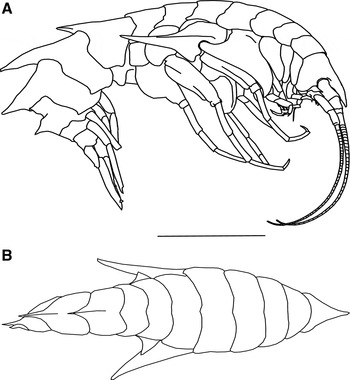
Epimeria morronei sp. nov., holotype: adult female 23 mm, EMU-9507. (A) Lateral view; (B) dorsal view. Scale bar: A, B, 5.0 mm.

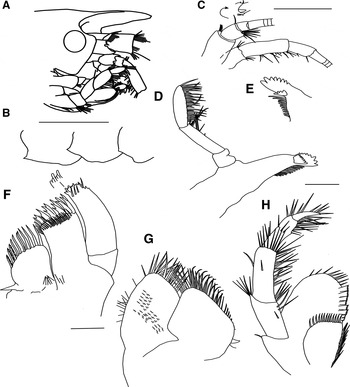
Epimeria morronei sp. nov., holotype: adult female 23 mm, EMU-9507. (A) Head, lateral view; (B) epimera 1–3, lateral view; (C) antenna 1, lateral view; (D) left mandible; (E) right mandible; (F) maxilla 1; (G) maxilla 2; (H) maxilliped. Scale bars: A, B, 2.5 mm; C, 3.0 mm; D, H, 0.6 mm; F, G, 0.4 mm. Arrow indicates the accessory flagellum.

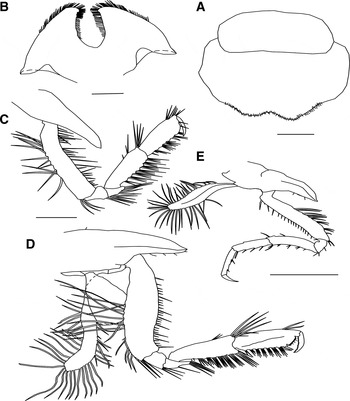
Epimeria morronei sp. nov., holotype: adult female 23 mm, EMU-9507. (A) Upper lip; (B) lower lip; (C) gnathopod 1; (D) gnathopod 2; (E) pereopod 3. Scale bars: A, 0.2 mm; B, 0.4 mm; C, D, 1.2 mm; E, 2.5 mm.

Epimeria morronei sp. nov., holotype: adult female 23 mm, EMU-9507. (A) Pereopod 4; (B) pereopod 5, coxa ommited; (C) pereopod 6; (D) uropod 1; (E) uropod 2; (F) uropod 3; (G) telson, dorsal view. Scale bars: A, 3.0 mm; B–F, 2.5 mm; G, 1.6 mm. Arrows indicate the tiny setae on margins.

TYPE MATERIAL
Holotype: female, 23 mm TL, TALUD X expedition, St. 18, central Gulf of California (coordinates: 27°09′06″N 111°46′54″W), 1526 m depth, benthic sledge, RV ‘El Puma’ (EMU–9507); coll. M. Hendrickx, 12 February 2007.
Paratypes: TALUD X expedition, St. 22, central Gulf of California (coordinates: 27°02′46″N 111°52′57″W), 1575–1586 m depth, benthic sledge, RV ‘El Puma; coll. M. Hendrickx, 13 February 2007; one female, 16 mm TL (EMU-9508), one female, 19 mm TL (EMU-9509), three females, 19–28 mm TL (EMU-9510), three females, 16–18 mm TL (EMU-9519), one female, 19 mm (CNCR–26576), one female, 21 mm (CNCR-26577), and one female, 17 mm (CNCR-26578).
ETYMOLOGY
This new species is named to honour Dr Juan José Morrone Lupi (Facultad de Ciencias, Universidad Nacional Autónoma de México), for his valuable contribution to the study of systematics in Mexico. It is derived from the noun morrone in the genitive case.
DIAGNOSIS
Rostrum long; eyes vestigial; accessory flagellum scale-like; mandible with vestigial molar; lower lip without internal lobules; maxilliped palp 4-articulated, outer plate with inner margin finely serrated, 15 submarginal large tooth-like setae; gnathopods 1–2 subequal, chelated; pereonites without lateral process, pleonites each with long dorsal process; coxa 4 well developed, scythe-shaped, anterior margin sinuous, posterior margin expanding in a subtriangular process fitting into coxa 5; coxa 5 posteriorly produced into a spine-like process, tip reaching to first third of epimeral plate 1; posterior margin of telson serrate, with a medial cleft.
DESCRIPTION
Holotype: adult female 23 mm (EMU-9507). Anterior cephalic region (Figures 1A, B & 2A) sinuous, anterior cephalic lobule developed, rounded, little produced; rostrum as long as head, reaching distal margin of peduncle article 2 of antenna 1; eyes vestigial, contour barely visible, small (less than 1/4 head height), unpigmented and without ommatidies.
Pereonite 1 (Figure 1A, B) slightly shorter than head (measured without rostrum); pereonite 2 subigual to pereonite 1; pereonites 1–6 lacking mid-dorsal or dorsolateral processes; pereonite 6 with 2 midlateral carinae, one on each side; pereonite 7 with a dorsal small tooth on posterior margin.
Pleonites 1–3 (Figure 1A, B) each with acute mid-dorsal tooth slightly curving posteriorly to overhang following somite.
Epimeron 1 (Figures 1A & 2B) anteroventral and posteroventral angles slightly rounded, anteroventral more pronounced; epimera 2 and 3 anteroventral angle rounded, posteroventral produced.
Urosomite 1 (Figure 1A) with mid-dorsal process; urosomites 2–3 without mid-dorsal processes.
Antenna 1 (Figure 2C) article 1 of peduncle with short distal setae, length subequal to articles 2 and 3 combined; accessory flagellum scale-like; primary flagellum with 40 articles.
Antenna 2 (Figure 2C) article 1 with three small distal processes; article 2 with two processes; article 3 the longest, with marginal ventral setae; primary flagellum with 53 articles.
Mandible (Figure 2D, E) with incisor and lacinia mobilis strongly dentate; molar vestigial; left incisor and lacinia mobilis with eight teeth each, right with eight and four teeth respectively, distal margin with 12 rakers; palp 3-articulated; article 2 with seven single setae; article 3 internal margin densely setose, with 32–33 single setae.
Maxilla 1 (Figure 2F) inner plate ovoid, distal margin with three stout plumose setae and eight stout single setae, inner margin with a spine-like basal process; outer plate distal margin with nine bifid, robust setae, 21–22 simple submarginal setae, and seven simple, subdistal setae; palp barely exceeding outer plate, article 1 short, article 2 curved and long, with four robust and two smaller submarginal setae, distal margin crenulated.
Maxilla 2 (Figure 2G) plates subtriangular, both with long, plumose, distal setae; inner plate with short, simple marginal setae; outer plate with marginal setae and patches of minute lateral and facial setae.
Maxilliped (Figure 2H) inner plate reaching half length of outer plate, with eight robust and long marginal setae, and 13 robust distal setae; outer plate broadly rounded distally, nine robust distal setae, internal margin finely serrate, 15 tooth-like submarginal setae; palp medial margin strongly setose, tufts of setae on external margin of article 1, on distal margin of article 2, and on article 3.
Epistome wider than high (Figure 3A). Upper lip (Figure 3A) with distal margin slightly bilobulate, with short simple setae. Lower lip (Figure 3B) with fused internal lobes, external lobes subtriangular, mandibular processes subtriangular, margins with short simple setae.
Gnathopod 1 (Figure 3C) coxa long and slender, ventrally subacute; basis linear, slender, ventral margin irregular in middle, margins with numerous long, robust setae; ischium short, subtriangular, two distal setae on posterior margin; merus slightly shorter than ischium, with long, robust setae on posterior margin; carpus as long as propodus, posterior margin irregular, with tufts of setae; propodus slightly expanded distally, posterior margin with tufts of setae, subdistal and proximal tufts of setae, two isolated setae on distal margin; dactylus slender, slightly curved, smooth, overreaching palm angle.
Gnathopod 2 (Figure 3D) coxa much wider than coxa 1, ventrally bluntly triangular; basis, ischium, merus, carpus and propodus similar in shape to gnathopod 1, except for length, number and position of some setae; a pair of subdistal robust setae on posterior margin of propodus, near the tip of dactylus; palm and inner margin of dactylus finely serrate.
Pereopod 3 (Figure 3E) coxa slightly longer than coxa 2; basis linear, slender, proximal 2/3 of anterior margin with long and posterior margin with short, regularly spaced setae; merus slightly longer than carpus, with sparse setae on anterior margin; propodus slightly shorter than carpus, slender, two pairs of short marginal setae; dactylus slender, curved, 1/2 length of propodus.
Pereopod 4 (Figures 1A & 4A) coxa much longer than coxa 3, wider than combined width of coxae 1–3, anterior margin sinuous, ventrally curving backward; posterior margin divided into a deep, proximal, V-shaped indentation, followed by a posteroventral, subacute process inserted into a subcircular opening in anterior margin of coxa 5, and a distal, slightly curving cusp, a ridge parallel to distal portion of posterior margin; basis thick, wider distally; ischium short, naked; merus long and slender, four pairs of short, robust setae on posterior margin and a robust seta on distal margin; carpus shorter than merus, two pairs of short, robust setae on posterior margin and one robust seta, distally; propodus as long as carpus, slightly curved, three pairs of short, robust setae on posterior margin and one distal robust seta; dactylus slender, slightly curved, naked.
Pereopod 5 (Figures 1A & 4B) coxa subtriangular, similar in size to coxa 4, posterodistal angle strongly produced, spine-shaped, tip reaching to first third of epimeral plate 1; basis to dactylus similar to pereopod 4.
Pereopod 6 (Figures 1A & 4C) coxa subquadrate, smaller than coxa 5; basis expanded mid-posteriorly; ischium short, naked; merus and carpus similar in length, each with 3 short, robust setae on anterior margin, merus thicker; carpus with a distal pair of robust setae; propodus slender, 1 1/2 times as long as carpus, a single, short medial seta on posterior margin; dactylus slender, slightly curved.
Pereopod 7 (Figure 1A) coxa similar in size to coxa 6; basis posteriorly expanded; ischium to dactylus similar to pereopod 6.
Uropod 1 (Figure 4D) peduncle shorter than rami, wider distally; inner ramus about 1/5 shorter than outer ramus; rami with very short, robust setae on inner margin.
Uropod 2 (Figure 4E) peduncle slightly longer than rami; inner ramus about 1/5 shorter than outer ramus; rami with very short, robust setae on inner margin.
Uropod 3 (Figure 4F) peduncle short, two simple, short marginal setae, a medial process on distal margin; rami similar in length and thickness, a subdistal robust seta on outer margin.
Telson (Figure 4G) twice as long as wide, distal margin serrate, with median V-shaped cleft.
COLOUR
Freshly collected specimens whitish.
DISTRIBUTION AND ECOLOGY
Only known from the type locality and a nearby locality (27°09′06″N 111°46′54″W and 27°02′46″N 111°52′57″W), in the central Gulf of California, Mexico. From 1526 to 1586 m depth. Bottom water temperature and dissolved oxygen concentration: 2.7–3.2°C and 0.51–0.88 ml O2/l, respectively. Muddy substrate, with 3.04–3.35% of organic matter content.
REMARKS
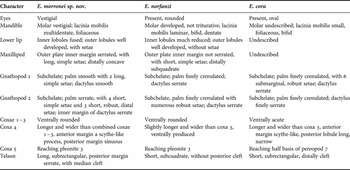
Epimeria morronei sp. nov., is morphologically similar to E. norfanzi Lörz, Reference Lörz2011 (New Zealand, 1268 m depth) and E. cora J.L. Barnard, Reference Barnard1971 (off Oregon, USA, 2086 m depth). All three species share a well developed rostrum, a reduced accessory flagellum, and they all have processes or carina on pereonites 1–7 and processes on pleonites 1–3. Epimeria morronei sp. nov., however, differs from these two species by a combination of several of the following characters: the size and structure of the eyes (vestigial in the former); the shape of the mandibular molar and lacinia mobilis, of the lower lip and of the external plate of the maxilliped; the setae arrangement in palm and dactylus of gnathopods 1–2; the shape and relative size of coxae 1–5; and the shape of the telson. Major differences are summarized in Table 1.
The more significant morphological characters used to compare females of Epimeria morronei sp. nov., to the two closely related species E. norfanzi Lörz, Reference Lörz2011 and E. cora J.L. Barnard, Reference Barnard1971.

DISCUSSION
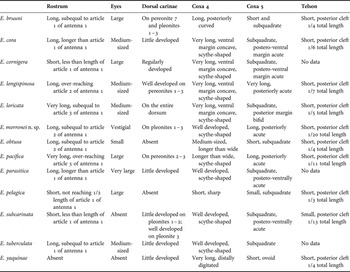
Including the new species described herein, there are 61 species belonging to the Epimeriidae: Epimeria (50 species), Paramphithoe (8), Actinacanthus, Metepimeria and Uschakoviella (one species each). About half Epimeria species are restricted to the Antarctic, while the rest occur in the Atlantic, Pacific or Indian Oceans (Lörz et al., Reference Lörz, Maas, Linse, Coleman and Bruce2009; Lowry et al., Reference Lowry, De Broyer, Costello, Bellan-Santini and Lowry2010; Lörz, Reference Lörz2011, Reference Lörz2012). Of the 60 previously described species, only three (less than 10%) are known to the East Pacific of a total of 10 species reported for the entire Pacific Ocean, between 970 and 3710 m depth. These 10 species are (last two restricted to the East Pacific): Epimeria horsti Lörz, Reference Lörz2008; E. norfanzi Lörz, Reference Lörz2011; E. pacifica Gurjanova, Reference Gurjanova1955; E. pelagica Birstein & Vinogradov, Reference Birstein and Vinogradov1958; E. subcarinata Nagata, Reference Nagata1963; E. victoria (Hurley, Reference Hurley1957); E. bruuni Barnard, Reference Barnard1961; E. glaucosa Barnard, Reference Barnard1961; E. cora J.L. Barnard, Reference Barnard1971; and E. yaquinae McCain, Reference McCain1971 (Lörz, Reference Lörz2011). The discovery of a third species, E. morronei sp. nov., in the East Pacific is therefore considered significant. With the addition of E. morronei sp. nov. a total of 13 species of Epimeria are known to occur in the Northern Hemisphere, 12 benthic and one pelagic. These species can be separated using the characters provided in Table 2.
Major external morphological differences among species of Epimeria known to occur in the Northern Hemisphere.

ACKNOWLEDGEMENTS
The authors thank all colleagues, students and crew members for their help in sampling activities aboard the RV ‘El Puma’ during the TALUD X expedition, and Mercedes Cordero for the final edition of the manuscript. We also thank Samuel Gómez for providing the organic matter content data. Shiptime aboard RV, ‘El Puma’ was granted by CTIC, Universidad Nacional Autónoma de México.