

Introduction
Resources for nature conservation are limited, so it is essential to target them effectively. The dynamic nature of many species’ populations means that their numbers can change rapidly over relatively short periods. Regular reassessments of species’ population status, using the latest data to identify current priorities, are therefore essential, both for measuring the effectiveness of conservation efforts and ensuring that species in most need receive adequate attention promptly. If assessments are repeated consistently over time, they can also measure progress towards conservation targets, like those in the European Union (EU) Biodiversity Strategy for 2030 (EC 2020) and the Kunming–Montreal Global Biodiversity Framework (CBD 2022).
In 1994, BirdLife International published Birds in Europe (BiE1), the first assessment of the population status of all naturally occurring wild bird species in Europe (Tucker and Heath Reference Tucker and Heath1994). National population size estimates and semi-quantitative trend data were collated for all native species, and assessed using a set of criteria that assigned each species to one of five categories. Those classified in the top three categories were termed Species of European Conservation Concern (SPECs), depending on whether they were of global concern (SPEC 1), concentrated in Europe and of regional concern (SPEC 2), or not concentrated in Europe but of regional concern (SPEC 3). Overall, 195 species (38% of the European avifauna) were listed as SPECs, mostly due to population declines. Nearly 60% of all SPECs were associated with farmland habitats, and further analysis identified agricultural intensification as the main threat (Donald et al. Reference Donald, Green and Heath2001).
Since then, a regular reassessment process for identifying priority species for conservation in Europe has been established. The second assessment (BiE2) was published in 2004 (BirdLife International 2004) and the third (BiE3) in 2017 (BirdLife International 2017). Each assessment has underlined the ongoing plight of farmland birds (Donald et al. Reference Donald, Sanderson, Burfield and Van Bommel2006), while also identifying other emerging conservation issues at continental level. BiE2 highlighted worrying declines in many long-distance Afro-Palearctic migrants (Sanderson et al. Reference Sanderson, Donald, Pain, Burfield and Van Bommel2006), raptors and steppe species, while BiE3 further emphasised the problems facing migrants and revealed declines in many of Europe’s globally important seabird populations.
Although SPECs have no formal legal status, their classification has strongly influenced bird conservation in Europe and beyond. By informing the identification of Important Bird Areas (IBAs), hundreds of key sites for SPECs have been designated as protected areas under the EU Birds Directive, Bern Convention on the Conservation of European Wildlife and Natural Habitats, Ramsar Convention on Wetlands, and other policy instruments (Waliczky et al. Reference Waliczky, Fishpool, Butchart, Thomas, Heath, Hazin and Donald2019). SPECs were used to identify the most important habitats for birds in Europe and the conservation measures required to maintain or restore their populations in the wider environment (Tucker and Evans Reference Tucker and Evans1997), influencing the reform of various sectoral policies (Tucker Reference Tucker2023). Many SPECs have been prioritised within Species Action Plans (e.g. Heredia et al. Reference Heredia, Rose and Painter1996), benefit from a higher EU co-funding rate for LIFE Programme projects (EC 2023), and/or are priorities in the Memorandum of Understanding on the Conservation of Migratory Birds of Prey in Africa and Eurasia (Raptors MoU) (CMS 2015).
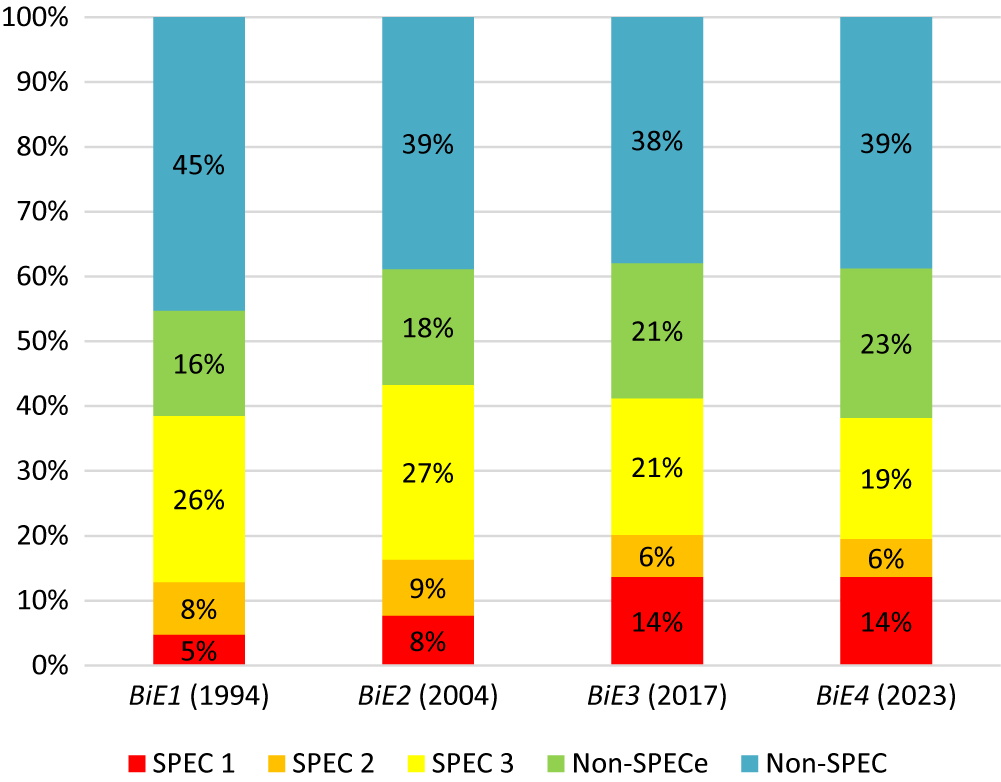
All three previous assessments took the same approach, although there were small changes in the methodology to reflect growing experience and improvements in data availability. This consistency over time means that the results of the different assessments are broadly comparable, both at individual species level and overall, which is important for tracking progress towards conservation goals. The overall proportion of SPECs remained similar across the first three assessments (38–43%), but the number and proportion of SPEC 1 species trebled, from 24 (5%) in 1994 to 40 (8%) in 2004, and 74 (14%) in 2017, as a growing number of European species became of global conservation concern, including iconic birds like Atlantic Puffin Fratercula arctica and European Turtle-dove Streptopelia turtur.
The quantity and quality of data underpinning these assessments have increased over time, and the data compilation process has evolved too. In 1994, national population size and trend data (1970–1990) were collated through a combined network of national data compilers and contributors, in a close collaboration between BirdLife International’s European Partnership and the European Bird Census Council (EBCC), with the same data also used in the first European breeding bird atlas (EBBA1) (Hagemeijer and Blair Reference Hagemeijer and Blair1997). A similar protocol operated in 2004, but using the more precise trend data (1990–2000) for some common and widespread species from the subset of countries contributing to the growing Pan-European Common Bird Monitoring Scheme (PECBMS: https://pecbms.info/) (Brlík et al. Reference Brlík, Šilarová, Škorpilová, Alonso, Anton, Aunins and Benkö2021). For midwinter population figures, BirdLife mobilised data from the annual International Waterbird Census (IWC) coordinated by Wetlands International (https://www.wetlands.org/knowledge-base/international-waterbird-census/).
A step change occurred in 2011, when EU Member States adopted a new system for reporting to the European Commission (EC) under Article 12 of the Birds Directive (2009/147/EC). Every six years, Member States must report on the implementation and impact of measures they have taken to conserve birds, including information on species’ population sizes and trends. This means governments are legally obliged to report on the size and trend of the national population and range of every regularly occurring wild bird species breeding in their country, and a subset of wintering and passage species. Hence, the national data previously collated by BirdLife are now mobilised via an official data flow under state responsibility. In practice, national BirdLife Partners, EBCC delegates, IWC coordinators and others are integral to the process in most countries, as they organise most of the relevant monitoring schemes, surveys and atlas projects.
In 2013, when the first round of Article 12 reporting took place, the EC commissioned BirdLife to collate the data provided by Member States and use them to assess the population status of birds at EU level (EEA 2015) to help measure progress towards targets in the EU Biodiversity Strategy to 2020 (EC 2011). Recognising the value of pan-European status reviews and regional Red List assessments, the EC supported BirdLife to collate equivalent data from other (non-EU) countries, combine them with the EU Article 12 data and apply the International Union for Conservation of Nature (IUCN) Red List criteria and guidelines (IUCN 2012a, b) to produce the first European Red List of Birds (ERLoB) (BirdLife International 2015). This allowed the global Red List to be updated and facilitated the production of BiE3 (BirdLife International 2017). The same process operated after the second round of Article 12 reporting in 2019, with the EC commissioning BirdLife to assess the EU population status of birds (EEA 2020) and collate non-EU data to update ERLoB (BirdLife International 2021). This review (BiE4) represents the final stage in the update cycle, applying the SPEC criteria to identify current species of European conservation concern.
Methods
Data collation and processing
The geographical scope of this exercise is the same as in previous SPEC assessments and in both editions of ERLoB (BirdLife International 2015, 2021). It is continent-wide, extending from Greenland in the north-west to the Russian Urals in the north-east, and including the Atlantic archipelagos of the Azores, Madeira and the Canary Islands (Macaronesia), as well as Turkey, Cyprus and the Caucasus region.
National data on population sizes and trends were those collated for the latest edition of ERLoB (BirdLife International 2021), and are available online, along with information on data quality and sources (http://datazone.birdlife.org/info/euroredlist2021; select a species from the table, and when the IUCN factsheet opens, click “Download” and select “Supplementary Information”). They comprise official data reported by EU Member States to the EC in 2019 under Article 12 of the Birds Directive (EEA 2020), and equivalent data from non-EU countries provided by national experts through the BirdLife Partnership and the EBCC network, validated by BirdLife International. In both cases, the data derive from fieldwork conducted by thousands of skilled ornithologists, including many volunteers, over several decades.
For each regularly and naturally occurring wild bird species, national data were gathered on breeding population size (in c.2018, or as a mean over 2013–2018) and trends over two periods: short-term (c.2007–2018, i.e. two Article 12 reporting periods) and long-term (c.1980–2018), 1980 being a policy-relevant baseline, approximating to when the Birds Directive was adopted (1979) and entered into force (1981), rather than an ecological baseline. Where available, the equivalent midwinter population data were also collated, mainly for waterbirds covered by the IWC, and especially when required by the EC. Although some data on passage birds were reported under Article 12, they were not used because most species are not well monitored during migration, and it is difficult to avoid the risk of double-counting birds when combining such data.
Most population size estimates were supplied as minimum–maximum ranges, although best single values were used when reported. All countries were requested to use the same population unit per species. In most cases, the units were breeding pairs (except for a few taxa with unusual or complex breeding biology, or with cryptic behaviour, for which other units were used, e.g. calling/lekking males) and wintering individuals. National population size data from all countries were summed to produce minimum and maximum estimates of the overall European population size.
The direction and magnitude of most national population trend estimates were reported as either precise percentage changes over the relevant time periods (e.g. from national monitoring schemes contributing to PECBMS), or as banded minimum–maximum ranges (e.g. +30–40%). To produce European trends for each species, national trend data from all countries were combined, weighting each country’s contribution by its national population size relative to the total European population (for details, see BirdLife International 2021). This is analogous to how PECBMS combines data from 30 countries to produce trends for 170 common bird species (Brlík et al. Reference Brlík, Šilarová, Škorpilová, Alonso, Anton, Aunins and Benkö2021). Trends were calculated using a dedicated tool (developed for the IUCN Red List) to estimate overall trends as a weighted mean using heterogeneous data from multiple (e.g. national) populations (IUCN 2018).
Previous SPEC assessments were unable to consider changes in species’ range size, as comparable data on their spatial distribution were not available from across the continent. The publication of the second European breeding bird atlas (EBBA2) (Keller et al. Reference Keller, Herrando, Voříšek, Franch, Kipson, Milanesi and Martí2020) made this possible, by comparing the number of 50-km squares occupied (mainly during the 1980s) in the first atlas (EBBA1) (Hagemeijer and Blair Reference Hagemeijer and Blair1997) with those occupied during 2013–2017 in the second atlas (a period similar in length to the long-term population trend period), excluding squares poorly covered in either atlas. The overall magnitude of range change per species was calculated thus (for details, see Keller et al. Reference Keller, Herrando, Voříšek, Franch, Kipson, Milanesi and Martí2020):
 $$ \mathrm{Range}\ \mathrm{change}\ \mathrm{index}=100\hskip0.2em \ast \hskip0.2em \left(N2\hbox{--} N1\right)/\left(N2+N1\right) $$
where N1 and N2 are the number of occupied 50-km squares per species in EBBA1 and EBBA2, respectively. Positive and negative values indicate the extent to which a species’ range size increased or decreased between the atlases: 0 indicates no change, -100 extinction, and +100 colonisation (although index values should not be interpreted as percentage range changes). In general, range changes were calculated only for the area covered reasonably well in both atlases. As European Russia, the Caucasus region, Turkey and Cyprus were poorly surveyed or not covered by EBBA1, index values are not reliable for species concentrated in eastern Europe. However, a qualitative analysis of range changes in a subset of species in European Russia found high consistency with range changes in the rest of Europe (Kalyakin et al. Reference Kalyakin, Voltzit, Voříšek, Herrando and Keller2022). For most species, therefore, the index provides a valuable metric of the overall direction and magnitude of range change over c.30 years, albeit approximate given differences in survey effort and methods between the two atlases.
Status assessment
Assessments were conducted at species level, following the taxonomy and nomenclature of the BirdLife Checklist (HBW and BirdLife International 2022), whose adoption by the EU for Article 12 reporting and by the EBCC greatly facilitated data harmonisation. As in previous iterations, most assessments were based solely on breeding data, but some waterbirds were assessed using both breeding and wintering data, and a few species that occur in Europe only in winter (e.g. Red-breasted Goose Branta ruficollis) were assessed in that season. Many migratory waterbirds are much more abundant in Europe in winter, when their populations congregate and are better monitored than when they are dispersed during the breeding season, sometimes in remote areas outside Europe. Following standard practice (e.g. Wetlands International 2022), population estimates based on wintering counts were multiplied by 0.67 to convert them from individuals (including immature birds) to mature individuals, as required when applying the IUCN Red List criteria (IUCN 2012a).
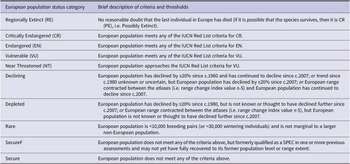
To determine its European population status, each species was first assessed against the IUCN Red List criteria at European level, following the regional application guidelines (IUCN 2012b), to identify regionally Threatened (i.e. Critically Endangered, Endangered or Vulnerable) and Near Threatened species (for details, see BirdLife International 2021). Each species classified in this first step as Least Concern in Europe was then assessed against the additional criteria developed and refined in subsequent SPEC assessments to identify other species of regional conservation concern considered to be Declining, Depleted or Rare (for definitions, see Table 1).
Summary of the criteria and thresholds used to allocate species to European population status categories in BiE4. For more details, see IUCN (2012a, b) and BirdLife International (2021). SPEC = Species of European Conservation Concern.

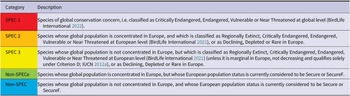
Finally, each species was assigned to one of five SPEC categories (Table 2), depending on its global extinction risk on the IUCN Red List (BirdLife International 2022), its European population status, and the proportion of its global population or range in Europe (Figure 1). Species are defined as concentrated in Europe when more than 50% of their global population or range occurs in Europe, according either to the latest global species assessments and range maps (BirdLife International 2022), or to more recent global population estimates where available (e.g. Wetlands International 2022). In a few cases, marginal species classified as Threatened or Near Threatened in Europe owing solely to their small European population (BirdLife International 2021), but which are not known or thought to be decreasing in Europe, were treated as Secure (see Table 1) for the purposes of this exercise, for consistency with earlier SPEC assessments.
Summary of the categories of SPECs and Non-SPECs. SPEC = Species of European Conservation Concern.

Flowchart showing the procedure for assessing and classifying species as SPECs or Non-SPECs. CR = Critically Endangered; EN = Endangered; IUCN = International Union for Conservation of Nature; NT = Near Threatened; RE = Regionally Extinct; SPEC = Species of European Conservation Concern; VU= Vulnerable.

The first three categories together represent SPECs: species that are either of global conservation concern (SPEC 1) or of European conservation concern, whether concentrated in Europe (SPEC 2) or not (SPEC 3). All other species assessed but not currently qualifying as SPECs are deemed Non-SPECs, which are also divided according to whether they are concentrated in Europe (Non-SPECe) or not (Non-SPEC). Europe has a particularly high responsibility for Non-SPECe species, which could rapidly become species of global conservation concern if their European populations decline.
One refinement in this assessment is incorporating changes in European breeding range size using the index of range change between EBBA1 and EBBA2 (see Appendix 2 of Keller et al. Reference Keller, Herrando, Voříšek, Franch, Kipson, Milanesi and Martí2020; only index values calculated with certainty were included, i.e. uncertain values in square brackets were excluded). Knowledge of range changes is important for deriving sound conservation warnings, especially when linked to the environmental pressures driving them. A simple sensitivity analysis suggested that a range change index value of ≤-5 was useful for identifying a suite of additional Declining or Depleted species whose breeding range had contracted between the atlases but which would not qualify as SPECs using population data alone (see Table 1 for definitions).
Another refinement is distinguishing between species that have always been Secure and those that have formerly qualified as SPECs in one or more earlier assessments (SecureF). All these species are presently Non-SPECs, but they are also extremely diverse, ranging from abundant and widespread birds with increasing European populations and expanding ranges, to some that are relatively scarce, localised or decreasing and close to qualifying as SPECs, but not currently meeting the criteria. Applying any threshold-based criteria system inevitably means that some species fall just on one side and some on the other. Distinguishing “former SPECs” (SecureF) from “never SPECs” (Secure) highlights some species whose status may have improved sufficiently to no longer qualify as SPECs using these criteria, but which may still rely on conservation action to maintain or restore their populations and/or ranges to levels required by various policies.
Results
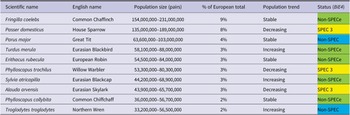
Of the 546 species assessed, 533 are considered native breeding birds in Europe (the other 13 being native non-breeders), with a total breeding population of 3.4–5.4 billion individuals (Table S1 in online supplementary materials). The EU (including the UK, which was a Member State when the data were gathered) supports 60% of these: 2.1–3.2 billion individuals of 445 breeding species. The most abundant breeding species in Europe is the Common Chaffinch Fringilla coelebs, representing one in every 11 birds. The 10 most abundant breeding species are all widespread passerines, whose combined populations comprise 39% of the European total (Table 3). By contrast, the populations of the least abundant 325 species together comprise just 1% of the European total. However, abundance does not guarantee security: three of the 10 most abundant species have decreasing populations and are SPECs.
The 10 most abundant breeding bird species in Europe, in descending order of population size. For each species, the percentage of the European total was calculated by dividing the geomean of its European population estimate (minimum–maximum) by the geomean of the total European population estimate for all breeding species. SPEC = Species of European Conservation Concern.

Numbers of SPECs and changes over time
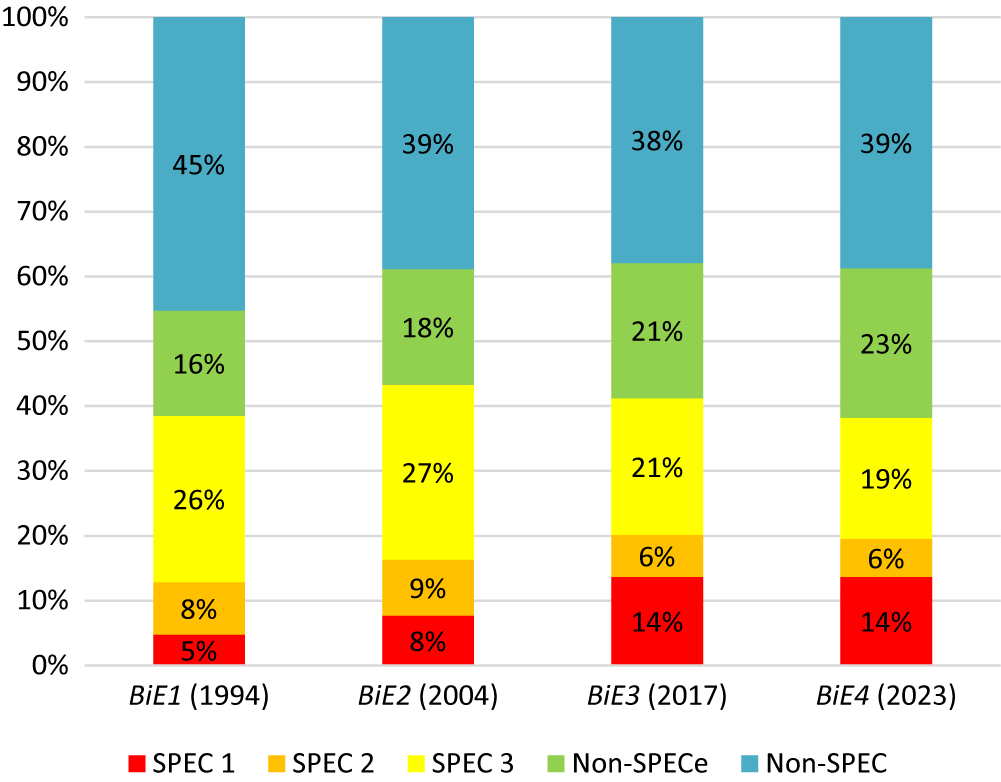
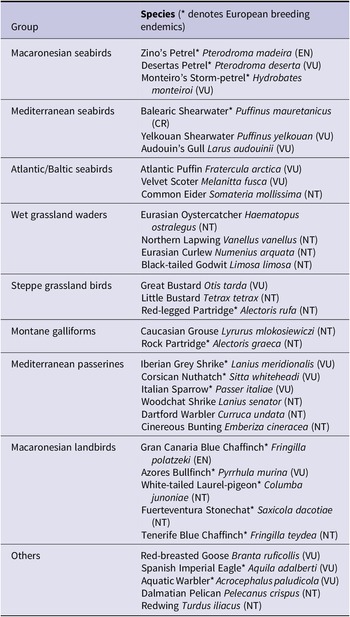
Of the 546 species assessed, 207 (38%) qualify as SPECs (Figure 2, Table S1): 74 (14%) of global concern (SPEC 1); 32 (6%) of European concern and concentrated in Europe (SPEC 2); and 101 (18%) of European concern but not concentrated in Europe (SPEC 3). The overall proportion of SPECs has remained similar across all four assessments, at 38–43%, but the number and proportion of SPEC 1 species of global concern has trebled, from 24 (5%) in 1994 to 74 (14%) here. Of particular concern are those SPEC 1 species that are endemic to Europe or whose global population or range is concentrated (≥50%) in Europe. Considering their biogeographical distribution and habitat use, most of these species fall into a few specific groups, highlighting several priorities for conservation action (Table 4).
Percentage of European bird species classified in each SPEC and non-SPEC category over time. SPEC = Species of European Conservation Concern.
SPEC 1 species of global conservation concern with populations concentrated in Europe (n = 34), clustered in biogeographical and habitat groups, in decreasing order of global extinction risk per group. CR = Critically Endangered; EN = Endangered; NT = Near Threatened; SPEC = Species of European Conservation Concern; VU= Vulnerable.

The number and proportion of SPEC 2 species is slightly lower than in previous assessments, largely because several species that are concentrated in Europe have deteriorated in status to the extent that they are now SPEC 1 (e.g. Woodchat Shrike Lanius senator, Red-legged Partridge Alectoris rufa).
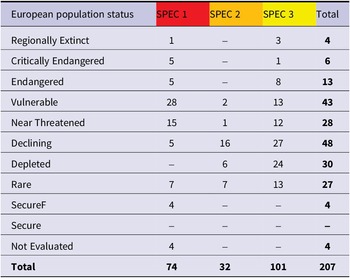
Considering the criteria by which species qualify as SPECs, Table 5 summarises the European population status of all 207 SPECs. While 45% of species qualify as SPECs due to their European status being assessed as Regionally Extinct, Threatened or Near Threatened in ERLoB (BirdLife International 2021), 38% qualify owing to ongoing (Declining) or historical (Depleted) population declines and/or range contractions, 13% because their European population is small and non-marginal (Rare), and 4% because they are globally Threatened or Near Threatened (BirdLife International 2022). This highlights the value of using both the IUCN Red List criteria and additional criteria to identify species of conservation concern, and of applying them consistently over time to maximise confidence that most resulting changes are genuine.
The European population status of all 207 SPECs. Four SecureF species qualify as SPEC 1 because they are globally Near Threatened (Ferruginous Duck Aythya nyroca, Bar-tailed Godwit Limosa lapponica, Red Knot Calidris canutus, Curlew Sandpiper Calidris ferruginea). Four species were Not Evaluated, as they either occur in Europe only on passage or have an uncertain marginal status but qualify as SPEC 1 because they are globally Threatened (Siberian Crane Leucogeranus leucogeranus, Asian Houbara Chlamydotis macqueenii, Rüppell’s Vulture Gyps rueppelli) or Near Threatened (Sooty Shearwater Ardenna grisea). SPEC = Species of European Conservation Concern.

Overall, 44 species assessed as Non-SPECs in 2017 (BiE3) now qualify as SPECs, although 12 of them had previously been SPECs in earlier assessments (Table S3 in online supplementary materials). They include many species that breed in Europe’s alpine, arctic and boreal regions, embracing various waders (e.g. Eurasian Dotterel Eudromias morinellus, Ruddy Turnstone Arenaria interpres, Red-necked Phalarope Phalaropus lobatus), predators (e.g. Arctic Jaeger Stercorarius parasiticus, Rough-legged Buzzard Buteo lagopus, Merlin Falco columbarius) and passerines (e.g. Water Pipit Anthus spinoletta, Twite Linaria flavirostris, Lapland Longspur Calcarius lapponicus). Another group of species (re)qualifying as SPECs includes several declining Afro-Palearctic migrant passerines (e.g. Wood Warbler Phylloscopus sibilatrix, Black-eared Wheatear Oenanthe hispanica).
Conversely, 62 species listed as SPECs in 2017 (BiE3) are now assessed as Non-SPECs (Table S4 in online supplementary materials). Of these, 42 (68%) were SPECs in all three previous assessments, but 29 (47%) were assessed as Depleted in 2017, indicating that their earlier population declines had already abated. This is borne out here, with only 16 (26%) of these species having a decreasing population trend and just 12 (19%) of them experiencing any range contraction between the atlases (including three with uncertain range trends). Indeed, 23 (37%) of these species have undergone significant range expansions since the 1980s, including multiple species of herons and raptors. However, many such species experienced considerable reductions in population and/or range well before the 1980s, which stimulated the development of the Birds Directive, Bern Convention and other policies, and the publication of BiE1; hence why 1980 is considered a policy baseline, rather than an ecological one. Determining whether species have indeed recovered sufficiently involves intensive work to establish species-specific baselines or reference levels (e.g. Bijlsma et al. Reference Bijlsma, Agrillo, Attorre, Boitani, Brunner, Evans and Foppen2019, Grace et al. Reference Grace, Akçakaya, Bennett, Brooks, Heath, Hedges and Hilton‐Taylor2021). In the meantime, it is useful to classify such species as SecureF (former SPECs) rather than Secure (never SPECs).
It is also important to emphasise what has not changed. Many of the patterns identified previously remain evident, with 100 species (18% of the European avifauna) classified as SPECs in all four assessments, of which 47 are now SPEC 1 and 11 are SPEC 2. These 100 include high numbers of raptors (18), waders (15), ducks (10), quail/partridges/grouse (7), petrels/shearwaters (6), larks (6), pigeons/doves (4), gulls/terns/auks (4), bustards (3), shrikes (3) and sandgrouse (2). Conversely, 211 species (39%) have been classified as Non-SPECs in all four assessments, including various geese, egrets, gulls, owls, woodpeckers, corvids, tits, warblers, thrushes, chats, pipits, wagtails, finches and buntings. However, 30% of these have unknown population trends and 10% are currently decreasing (albeit slowly). Better monitoring or accelerated declines may mean that some of them qualify as SPECs in the future.
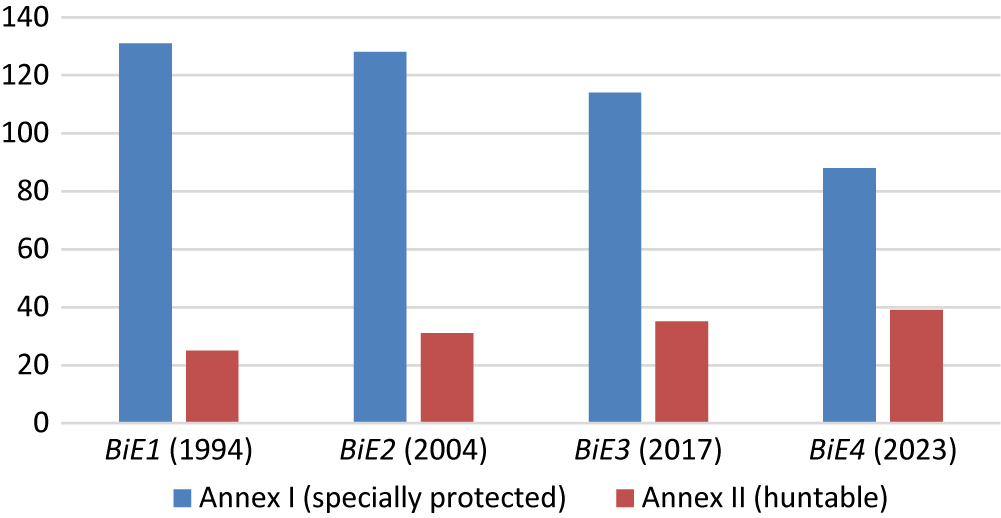
In relation to the EU Birds Directive, 88 SPECs (43%) are listed on Annex I (specially protected) and 39 (19%) on Annex II (huntable). Overall, 45% of all 194 Annex I species and 48% of all 81 Annex II species are SPECs. Since 1994 (BiE1), the number of Annex I species classified as SPECs has fallen by 33%, while the number of Annex II species qualifying as SPECs has risen by 56% (Figure 3). Many of the Annex I species that qualified as SPECs in 1994 but no longer do so are large waterbirds and raptors, whereas most of the Annex II species that have become SPECs since 1994 are grouse, ducks and waders.
Number of species on Annexes I and II of the EU Birds Directive assessed as SPECs over time. SPEC = Species of European Conservation Concern.

Spatial distribution of SPECs
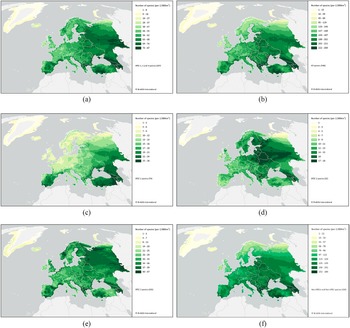
SPECs are distributed throughout Europe, but several regions hold particularly high numbers of species, including parts of Iberia, Turkey, the Caucasus and European Russia (Figure 4a). Many coastal areas, including parts of the Mediterranean, Black, Baltic and North Seas, are also prominent. This pattern largely reflects the distribution of all European birds (Figure 4b), but it still indicates “hotspots” for bird conservation. Many of these areas are the same as in previous assessments, but the high concentration of SPECs in parts of north and north-east Europe is a recent phenomenon, driven principally by SPEC 2 and 3 species, rather than SPEC 1 species (Figure 4cde).
Distribution and number of SPECs, Non-SPECs, and all species. Maps were produced by overlaying BirdLife’s global range maps for relevant species, counting the number of unique species per cell in an icosahedral Snyder equal-area tessellated grid (2,580 km2 resolution) and categorising them using Jenks natural breaks classification, within ArcGIS. (a) SPEC 1, 2, and 3 species (207); (b) all species (546); (c) SPEC 1 species (74); (d) SPEC 2 species (32); (e) SPEC 3 species (101); (f) Non-SPECe and Non-SPEC species (339). SPEC = Species of European Conservation Concern.

All European countries hold SPECs, and therefore all have some responsibility for conserving them (Table S2 in online supplementary materials). European Russia holds the highest absolute numbers of breeding SPECs (147), followed by seven other large countries: Turkey, France, Sweden, Finland, Spain, Norway and Ukraine (all with 87–95). Considering the number of SPECs as a proportion of all breeding species, however, the top-ranked country is Iceland (46%), followed by the Faroe Islands, Svalbard, Greenland, Finland, Norway, European Russia and Sweden (all with 35–46%). The Macaronesian islands also rank more highly on this latter metric, reflecting their importance for the conservation of various endemics.
For SPEC 1 species, the top 10 countries comprise the same eight large ones mentioned above, plus Italy and Greece (Figure 4c). European Russia again tops the list, with 44 breeding SPEC 1 species (59% of the total). However, a different pattern emerges for SPEC 2 species (Figure 4d): European Russia, France, Ukraine, Finland and Sweden again rank highest, but only just above Romania, Poland, Germany, Belarus and Lithuania. The distribution of SPEC 3 species (Figure 4e) is similar to that for all SPECs (Figure 4a), with European Russia heading the list, but followed by Sweden, Finland and Norway.
Discussion
Despite much change in the status of individual species, the total percentage of birds classified as SPECs has remained remarkably similar over the past three decades and four European assessments, at 38–43%. This does not mean that Europe’s bird populations are in some sense stable and faring relatively well. For example, the population of a short-lived species that has repeatedly been assessed as Vulnerable under Criterion A2 of the IUCN Red List must have continued to decline at a rate exceeding 30% every 10 years. Over the past 30 years, its population may have decreased by more than two-thirds overall, and still be declining; but unless or until it crosses the threshold to qualify in a different category or under a different criterion, it remains Vulnerable. This is not a hypothetical concern: 100 species have been classified as SPECs in every assessment, and the fact that the number of European species of global concern (SPEC 1) has trebled since 1994 is alarming and signifies that threats have increased and intensified.
Efforts to halt biodiversity loss in Europe have clearly not been sufficient to stop the decline of many bird species, as the broad patterns identified in previous assessments remain evident in this review. Populations of numerous farmland and steppe birds, seabirds, raptors, waders, long-distance migrants and Macaronesian endemics are either heavily depleted or continue to decline or contract in range. A separate analysis for 378 species in the EU, using a subset of the same data and PECBMS trends, revealed an overall decline of 17–19% in breeding bird abundance since 1980, representing a net loss of 560–620 million individual birds, with the greatest declines affecting common and abundant species associated with agricultural habitats (Burns et al. Reference Burns, Eaton, Burfield, Klvaňová, Šilarová, Staneva and Gregory2021).
European Russia’s tally of 71% of all breeding SPECs reflects its vast area (35% of Europe), diverse habitats, wide latitudinal range, and borders with Siberia and Central Asia. The disproportionately high number of breeding SPECs in northern Europe reveals its increasing importance for bird conservation, which was already significant but emerges even more highly here. The deteriorating status of species that breed in Europe’s alpine, arctic and boreal regions, including waders, raptors and passerines, may indicate the increasing impacts of climate change (e.g. Lehikoinen et al. Reference Lehikoinen, Brotons, Calladine, Campedelli, Escandell, Flousek and Grueneberg2019, Lindström et al. Reference Lindström, Green, Husby, Kålås, Lehikoinen and Stjernman2019), although many factors may drive changes in mountain bird populations (Alba et al. Reference Alba, Kasoar, Chamberlain, Buchanan, Thompson and Pearce‐Higgins2022). Some of these birds, especially several waders (e.g. Broad-billed Sandpiper Calidris falcinellus, Ruff C. pugnax) are now classified as SPEC 2 species, and may soon be of global concern if current trends continue and declines are also occurring beyond Europe.
Priorities for monitoring
Monitoring the status and trends of bird populations, and reporting them to the EC (Article 12) or the secretariats of other relevant conventions and agreements, is the responsibility of national governments.
The legal obligation of Article 12 reporting means that the data for many EU Member States are better than ever, but they are not perfect. Maintaining, improving and expanding European bird monitoring remains crucial. Many countries still lack formal national monitoring schemes, especially in parts of south-east and eastern Europe, despite ongoing efforts by the EBCC and PECBMS (Voříšek et al. Reference Voříšek, Gregory, Keller, Herrando, Lindström, Nagy and Burfield2018). Consequently, some former SPECs now classified as Non-SPECs may in fact be of higher concern (hence the rationale for denoting them as SecureF), while some Non-SPECs with unknown trends may actually be declining.
The quantity and quality of data from bird population monitoring schemes and atlas projects in Europe have continued to increase, as exemplified by the second EBCC atlas (Keller et al. Reference Keller, Herrando, Voříšek, Franch, Kipson, Milanesi and Martí2020), and the growing spatial and species coverage of PECBMS (Brlík et al. Reference Brlík, Šilarová, Škorpilová, Alonso, Anton, Aunins and Benkö2021). Fennoscandia has excellent monitoring (e.g. Lindström et al. Reference Lindström, Green, Husby, Kålås, Lehikoinen and Stjernman2019), but population trends in many other alpine and arctic regions of Europe are poorly known (e.g. Alba et al. Reference Alba, Kasoar, Chamberlain, Buchanan, Thompson and Pearce‐Higgins2022), due to the remote and inaccessible nature of these environments. Hence, evidence of range contractions between the two atlases provides a valuable new metric of conservation concern, helping to identify the deteriorating status of various species in these regions. There is also untapped potential in combining older semi-quantitative data from published sources with newer quantitative data to derive and report long-term trends (e.g. Stroud et al. Reference Stroud, Francis and Stroud2012, Kalyakin et al. Reference Kalyakin, Voltzit, Voříšek, Herrando and Keller2022).
It is also imperative to improve the monitoring and evaluation of conservation efforts, to understand their effectiveness, and to ensure that there is adequate funding and political commitment to continue and expand the implementation of effective measures. There is strong evidence that measures taken for species’ conservation have a significant positive impact on population and range size, especially for those listed on Annex I of the Birds Directive (Donald et al. Reference Donald, Sanderson, Burfield, Bierman, Gregory and Waliczky2007, Sanderson et al. Reference Sanderson, Pople, Ieronymidou, Burfield, Gregory, Willis and Howard2016) and Annex I to Resolution 6 of the Bern Convention (Keller et al. Reference Keller, Herrando, Voříšek, Franch, Kipson, Milanesi and Martí2020). The results of this exercise provide further evidence by showing that the number of Annex I species qualifying as SPECs has fallen with each assessment, as declines have abated and populations have recovered (e.g. Ledger et al. Reference Ledger, Rutherford, Benham, Burfield, Deinet, Eaton and Freeman2022). Conversely, the number of huntable (Annex II) species qualifying as SPECs has increased with every assessment.
Priorities for conservation
Various policy and legal instruments, including the EU Birds Directive, Bern Convention, Ramsar Convention, Convention on Migratory Species (CMS), African-Eurasian Migratory Waterbird Agreement (AEWA) and others, provide general protection to all European bird species and their habitats, and special protection to specific subsets of species of higher conservation concern (as listed on their annexes or appendices). National governments are responsible for implementing relevant conservation measures. SPEC classifications should be used to define conservation priorities as part of national strategies and to guide efforts by governmental and non-governmental actors. Although the population status of some species differs at EU (EEA 2020) and European scales, often due to different policies and drivers operating inside and outside the EU, it is identical for most species, highlighting the continental response needed.
To conserve species, it is essential to protect their remaining populations and habitats, so it is not surprising that one focus of governments’ implementation in recent decades has been the protection of key sites for species, including designating many IBAs as Natura 2000 and Emerald Network sites under the Birds Directive and Bern Convention respectively (Waliczky et al. Reference Waliczky, Fishpool, Butchart, Thomas, Heath, Hazin and Donald2019). Such site protection has been successful (e.g. Pavón-Jordán et al. Reference Pavón-Jordán, Abdou, Azafzaf, Balaž, Bino, Borg and Božič2020) and must continue, with increased enforcement and implementation of site management plans (e.g. Le Saout et al. Reference Le Saout, Hoffmann, Shi, Hughes, Bernard, Brooks and Bertzky2013). However, to achieve the targets of the EU Biodiversity Strategy (EC 2020) and the Kunming–Montreal Global Biodiversity Framework (CBD 2022), this must be accompanied by greater efforts to restore nature beyond protected areas too.
Many of Europe’s most threatened birds (as identified by SPEC assessments) have benefited from the development and implementation of targeted species action plans (e.g. Heredia et al. Reference Heredia, Rose and Painter1996, Schäffer and Gallo-Orsi Reference Schäffer and Gallo-Orsi2001). Some of these have proven so successful that the species are no longer considered of global concern (e.g. White-tailed Eagle Haliaeetus albicilla, Pygmy Cormorant Microcarbo pygmaeus, Red Kite Milvus milvus). There are many inspiring examples of species recovery and wildlife comeback in Europe (e.g. Ledger et al. Reference Ledger, Rutherford, Benham, Burfield, Deinet, Eaton and Freeman2022), and more will follow if the EC’s proposal for a strong EU Nature Restoration Law succeeds and LIFE Programme funding expands. The increasing number of SPEC 1 birds emphasises the ongoing need for species-specific interventions to avert extinctions (Bolam et al. Reference Bolam, Ahumada, Akçakaya, Brooks, Elliott, Hoban and Mair2022), including better implementation of existing plans, like the multi-species action plan for wet grassland breeding waders (Leyrer et al. Reference Leyrer, Brown, Gerritsen, Hötker and Ottvall2018).
Despite the importance of both approaches, neither protected areas nor targeted measures are adequate to reverse the declines of dispersed species, including many of the Declining and Depleted SPECs identified here. Conserving such species requires tackling the systemic drivers of biodiversity loss, by mainstreaming biodiversity into relevant sectoral policies, especially those relating to agriculture, forestry, fisheries, energy and trade, on land and at sea (CBD 2022). Beneficial measures include incorporating safeguards to reduce mortality and prevent damage to key habitats, removing subsidies that harm biodiversity, and encouraging management practices that enhance it. Proven solutions exist, including well-designed agri-environment schemes that can reverse farmland biodiversity declines while still producing food sustainably (e.g. Leclère et al. Reference Leclère, Obersteiner, Barrett, Butchart, Chaudhary, De Palma and DeClerck2020). Such schemes must now be implemented at scale and pace, alongside extensive landscape-scale restoration projects (e.g. Pavlacky et al. Reference Pavlacky, Green, George, Iovanna, Bartuszevige, Correll and Panjabi2022, Lengyel et al. Reference Lengyel, Nagy, Tóth, Mészáros, Nagy, Mizsei and Szabolcs2023). Such action is essential to halt and reverse the ongoing loss of Europe’s birds and meet regional and global restoration targets.
Supplementary material
The supplementary material for this article can be found at http://doi.org/10.1017/S0959270923000187.
Acknowledgements
The data underpinning this review are based on a huge amount of fieldwork carried out by thousands of skilled ornithologists throughout Europe over recent decades, including many volunteers, all of whom deserve enormous gratitude. Thanks also to the national compilers and contributors who collated and synthesised the data, and their organisations, all of whom were acknowledged more fully in ERLoB (BirdLife International 2021). Financial support was generously provided by BirdLife Partners in Italy (LIPU), Montenegro (CZIP), Slovakia (SOS/BirdLife Slovakia), Spain (SEO/BirdLife) and the UK (RSPB). Sergi Herrando (EBCC) shared data from EBBA2, Tom Langendoen (Wetlands International) provided the latest global waterbird population estimates, and Ashley Simkins (BirdLife International) helped to recalculate Europe’s global responsibility for species. This review was improved by valuable comments from Ariel Brunner (Stichting BirdLife Europe), Richard Gregory (RSPB), Marco Gustin (LIPU), Octavio Infante (SEO/BirdLife) and two anonymous reviewers. The presentation of material in this publication, and the geographical designations employed, do not imply the expression of any opinion whatsoever on the part of BirdLife International concerning the legal status of any country, territory or area, or concerning the delimitation of its frontiers or boundaries.