Historically, Aboriginal and Torres Strait Islander people were strong, healthy, hunter gatherers estimated to have been living in Australia for over 50,000 years (Jackson & Ward, Reference Jackson and Ward1999). However, since the colonisation of Australia, the disparity in health between Aboriginal and Torres Strait Islander Australians and non-Indigenous Australians is well recognised, with Aboriginal and Torres Strait Islander people currently experiencing a burden of disease that is two and a half the times that experienced by other Australians (Vos, Barker, Stanley, & Lopez, Reference Vos, Barker, Stanley and Lopez2007). Past and continued acts of political and socioeconomic marginalisation have contributed to this disparity, including a lower life expectancy, higher mortality and greater sickness (Eckermann et al., Reference Eckermann, Dowd, Chong, Nixon, Gray and Johnson2006; Vos et al., Reference Vos, Barker, Stanley and Lopez2007). Non-communicable diseases, including cardiovascular disease and diabetes, explain 70% of the difference in the burden of disease between Aboriginal and non-Aboriginal people (Vos et al., Reference Vos, Barker, Stanley and Lopez2007).
There is much written about ways to address these disparities; for example, programs to address diabetes (Lee, Bonson, Yarmirr, O'Dea, & Mathews, Reference Lee, Bonson, Yarmirr, O'Dea and Mathews1995; O'Dea et al., Reference O'Dea, Cunningham, Maple-Brown, Weeramanthri, Shaw, Dunbar and Zimmet2008; Rowley et al., Reference Rowley, Daniel, Skinner, Skinner, White and O'Dea2000), and a return to a traditional diet (O'Dea, Reference O'Dea1984). However, the majority of these approaches focus on change in Aboriginal people, or change in an environment that Aboriginal people are exposed to, such as the cost of the food supply (Brimblecombe, Ferguson, Liberato, & O'Dea, Reference Brimblecombe, Ferguson, Liberato and O'Dea2013). Despite this, there is emerging evidence that health professionals who work with Aboriginal people to address health disparities also have a role to play.
It has been identified that a well-trained workforce is important for improving the health of Indigenous peoples (Anderson, Reference Anderson2009). There is a mandate from the Australian government to include Indigenous health in the training of health professionals at university level (Standing Committee on Family and Community Affairs, 2000), and work has been performed by Indigenous scholars about ways in which higher education can equip health professional students to work in Indigenous health (Behrendt, Larkin, Griew, & Kelly, Reference Behrendt, Larkin, Griew and Kelly2012). However, there is still evidence that health professionals face challenges when working in Indigenous health; for example, organisational barriers that can constrain and influence the scope of practice (Allan, Reference Allan2010; Lloyd, Wise, & Weeramanthri, Reference Lloyd, Wise and Weeramanthri2008), and organisational capacity that has been shown to affect the delivery of health-related programs to Aboriginal people (Panaretto, Coutts, Leon, & Hayman, Reference Panaretto, Coutts, Leon and Hayman2010). Furthermore, barriers at the individual level also exist, because working in Indigenous health can raise issues that lead to discomfort and anxiety for the non-Indigenous health care provider (McDermott, Reference McDermott2012). If health professionals do not have strategies to address these feelings, this can result in resistant behaviour (Wear & Aultman, Reference Wear and Aultman2005).
Cultural safety as an approach recognises the power imbalance that exists between health professional and client and puts the focus back on the health professional as the agent for change. Cultural safety emerged from the work of Maori nurse Irihapeti Ramsden (Reference Ramsden2002) and reorients the idea of effective practice from something that a health professional is in control of to something that the Aboriginal or Torres Strait Islander person they are working with defines. It is about delivering high quality and culturally appropriate care to those who need it most (Bond & Brady, Reference Bond and Brady2013). In Australia, there is a body of work by Aboriginal and Torres Strait Islander scholars about cultural safety within and outside the area of Indigenous health. For example, Bin-Sallik (Reference Bin-Sallik2003) argues that cultural safety has been practised in Indigenous higher education for over 30 years, with the incorporation of Indigenous knowledge systems into academic programs. Other work (Bond & Brady, Reference Bond and Brady2013; Bond, Sporling, & Askew, Reference Bond, Sporling and Askew2014) describes how the Inala Indigenous Health Service became culturally safe through the work of Indigenous leaders. In 1994, the Inala Indigenous Health Service was not being accessed by Indigenous people, but after adopting strategies such as the employment of and collaboration with Indigenous people, the service has been very successful (Bond et al., Reference Bond, Sporling and Askew2014). Cultural safety requires health professionals to assess their own attitudes and values and consider how this affects the healthcare encounter. By assessing their own attitudes and values and engaging with a culturally safe approach, health professionals are able to work effectively with all people and address the power imbalance that is inherent in the health care interaction.
Reflexivity is a tool that has been used in the literature to gain a greater understanding of the self/other positionalities and the experience of the research. For example, Pellatt (Reference Pellatt2003) considered the effect she had on her research (based in a spinal cord rehabilitation unit), the effect it had on her, and the resulting implications. Bolak (Reference Bolak and Hertz1997) used reflexivity to assess the impact of her status as both an insider (Indigenous cultural status) and outsider (middle-class status) on her research with Indigenous people in working-class areas of the Middle East. Despite these examples, there is little evidence about the best ways to use reflexivity and address discomfort in the area of Aboriginal and Torres Strait Islander health.
In Australia, Aboriginal and Torres Strait Islander scholars have written about the importance of identifying one's position and reflecting on individual attitudes and values. For example, Fredericks (Reference Fredericks2006) reports that non-Indigenous people need to focus more on addressing their own positioning and experiences of White privilege. Similarly, Moreton-Robinson (Reference Moreton-Robinson2000) writes that acknowledging one's standpoint is vital because otherwise there is an assumption that all people have similar experiences and can therefore speak on behalf of each other. In the published literature, some authors have shared their stories about working in Aboriginal and Torres Strait Islander health and their identification of their attitudes and their values. For example, Mackinlay (Reference Mackinlay2012) used autoethnography to reflect on processes of decolonisation in Indigenous Australian studies classrooms, including a search for pedagogy that enables recognition of and discussion about key issues including race and Whiteness. Gair (Reference Gair2007) described the actions she took to rectify gaps in her knowledge as a non-Indigenous person, in conjunction with Indigenous teachers, using autoethnography to frame and give meaning to her reflections. Minniecon, Franks, and Heffernan (Reference Minniecon, Franks and Heffernan2007) examined the development of their research with Aboriginal and Torres Strait Islander communities from the perspectives of the Indigenous and non-Indigenous people involved. Despite this body of work, there is a lack of published literature about personal accounts of working in Aboriginal and Torres Strait Islander health that use reflexivity as a model and that comments on experiences of race, Whiteness and White privilege. In particular, there is a lack of personal accounts that draw out the relevance for a wider audience and provide a framework for how a similar process may be undertaken by others.
The purpose of this article is to share the process of reflexivity I undertook while completing a PhD in Aboriginal health. I drew on the challenges I experienced, which enabled me to draw out my assumptions, attitudes and values on which I was basing my practice and I describe how my practice changed. This article aims to:
• present an example of the use of reflexivity to critically examine one's own attitudes, values and biases with a view of engaging in culturally safe practice; and
• provide a framework for how others might use reflexivity to become a culturally safe health professional.
Note on Terminology
In this article, the use of the term ‘Aboriginal’ reflects the preference of the people and communities I worked with, whereas when citing literature I mirror the terms ‘Aboriginal and Torres Strait Islander’ people and ‘Indigenous’ as used by the original authors. I use the term ‘White’ in line with the definition provided by Kowal whereby referring to a person as:
‘White’ does not intimate that they all had White skin or identified as White.. . . Rather it implies that they willingly and unwillingly, knowingly and unknowingly, participate in the racialized societal structure that positions them as ‘White’ and accordingly grants them the privileges associated with the dominant Australian culture. (Kowal, Reference Kowal2008)
In line with the use of the term ‘White’ in other literature, I capitalise it.
Where This Journey Began
This journey began when I was a new graduate dietitian working in rural and remote South Australia in 2007 and 2008. Willing and interested to work in the area of Aboriginal health, as a new graduate I lacked the confidence to do so. I struggled to work with Aboriginal clients and communities in ways that simultaneously met their needs and the expectations of the health services around me. This, as well as the many discussions I had with Aboriginal people who lived and worked in those communities during that one year, inspired me to do a PhD about how mainstream services and Aboriginal communities may work together in a way that better suits the needs of the Aboriginal people and ultimately lead to better outcomes in their health and nutrition. I also wanted to encourage conversations between dietitians about the challenges of working in Aboriginal health and to normalise these challenges, rather than having dietitians think that they were something to be ashamed of, as I did.
For the three and a half years of my PhD, I immersed myself in Aboriginal health. I worked in partnership with Aboriginal colleagues and community members. I learnt about Aboriginal culture and history by spending time with Aboriginal people. I learnt the power of listening, and I listened to many stories. I stepped out of my comfort zone and learnt what it feels like to be in the minority. I identified my privileged position as a young White woman and learnt how to incorporate an awareness of this position into my practice as a dietitian. I asked many questions, for which I did not always find answers. I considered alternative approaches to research and engaged in a paradigm shift in order to conduct more appropriate and meaningful research. In doing so, I have reoriented many of my initial ideas and expectations about working in Aboriginal health. These are just some of the elements of my journey, a journey that I document and share in this article.
The PhD Project
The PhD on which I reflect in this article investigated the role of White health professionals in addressing Aboriginal health in South Australia. Set within the discipline of nutrition and dietetics and the area of obesity prevention, it explored the practice of White health professionals from the point of view of Aboriginal and White people working in these areas.
The setting for this research was a community-based, childhood obesity prevention program in South Australia. Located in one rural and one urban community, I sought to explore how this program was delivered to the Aboriginal communities within the larger rural and urban communities. Throughout the course of the research, I broadened the focus to include dietitians across South Australia, in order to assess the wider context in which White health professionals work in Aboriginal health in the area of nutrition and dietetics.
In order to conduct ethical research, I worked closely with Aboriginal community members and workers in the rural and the urban community, through building and maintaining relationships and activities of reciprocity, over a period of 3 years.
Approach to My Learning
Reflexivity has been used as a research tool across a number of disciplines and research paradigms, including psychology, counselling, post-structuralist feminism, education and anthropology. Etherington, a counsellor and occupational therapist informed by feminist principles, describes reflexivity as a process by which researchers notice their responses to people, events and the world around them and use that knowledge to inform their actions, communications and understandings (Etherington, Reference Etherington2004, Reference Etherington2007). Being reflexive encourages awareness of personal, social and cultural contexts in which we live and work and how those factors influence our interpretation of the world (Etherington, Reference Etherington2004, Reference Etherington2007). It also makes the researcher vulnerable (Etherington, Reference Etherington2007), and Etherington demonstrates this by providing examples of how she uses reflexivity in her own research (Etherington, Reference Etherington2005; Etherington & Bridges, Reference Etherington and Bridges2011).
Reflexivity from a feminist standpoint recognises the power differentials that exist in research (Mauthner & Doucet, Reference Mauthner, Doucet, Denzin and Lincoln2003), and through reflexivity, researchers can explore personal subjectivities, including attitudes, values and beliefs that then affect the research (Dowling, Reference Dowling2006). If this is not done, then biases are inevitably brought into research (Naples, Reference Naples2003). Pillow, who has written in the area of post-structuralist feminism, gender, race and sexuality studies and psychology, has called for examples of reflexivity that are ‘messy’ and present the ‘uncomfortable realities of doing engaged qualitative research’ (2003, p. 193). Termed by Pillow (Reference Pillow2003) as ‘uncomfortable reflexivity’, such investigations create discomfort for the researcher, who seeks to know while at the same time situating knowing as tenuous; and they enable exploration of representations of ourselves as researchers
Similar concepts of reflexivity are used in anthropology: Behar (Reference Behar1996, p. 273) states that reflexivity also has parallels with critical reflection (see also Brookfield, Reference Brookfield1998; Reference Brookfield2009). Similar to reflexivity from a feminist standpoint, critical reflection questions power relationships (Brookfield, Reference Brookfield2009). It goes beyond the ‘nuts and bolts’ of the process of reflective practice and asks about the power dynamics, wider structures and assumptions that frame a field of practice (Brookfield, Reference Brookfield2009) and how a practitioner works (Brookfield, Reference Brookfield1998). In this research, I draw on reflexivity from all of these disciplines and paradigms in order to explore my own subjectivities, assumptions, reactions and experiences. In particular, I aim to respond to Behar's (Reference Behar1996) question and Pillow's (Reference Pillow2003) call for examples of ‘messy’ and ‘uncomfortable realities’ by examining and sharing my own ideology. In particular, I use reflexivity to ask myself where I fit as a White person doing research in Aboriginal health, and how I can do research that engages meaningfully with Aboriginal people and seeks to address power imbalances in partnership. I use critical reflection to acknowledge that Whiteness not only shapes wider societal relations, it also shapes my research and therefore must be considered here.
Reflexive Journal
I kept a reflexive journal during my PhD studies (2008–2011). This journal enabled me to keep detailed documentation about what I was doing: to reflect on and debrief from some of the challenges and difficult situations I experienced; to develop a general awareness about the importance of self-reflection and how this can be used to alter practice; and to assess my own beliefs and biases and how they might influence the research. I started the journal after I began to feel discomfort in many of the situations I was exposed to during my research. The reflexive journal became a tool through which I could note and work through this discomfort.
I wrote in this journal every time there was something I wanted to reflect on; for example, after I met with a colleague or attended a community event. The journal reflected my needs as a researcher, which changed over time. Initially, I structured my reflexive journal using headings: ‘Observation notes’ (what I saw, heard and felt), ‘Methodological notes’ (how to collect data), ‘Theoretical notes’ (critiques of what I was doing, seeing and thinking) and ‘Personal notes’ (feeling statements, including doubts, anxieties and achievements) (Silverman, Reference Silverman2005). However, as I became more familiar and comfortable with making reflections, the journal became less structured and there was a greater focus on how I might change my practice, based on my reflections.
Thematic analysis (Braun & Clarke, Reference Braun and Clarke2006) and NVivo 8.0 (QSR International, Doncaster, Victoria, 2008) were used to analyse data. When including excerpts from my reflexive journal in this article, I have referred to the date of the reflection and the page number of the journal it appeared on. When my reflections refer to direct quotes from a conversation I had with another person, I have checked with the person that my understanding of the conversation matched their understanding, and have sought permission to use the reflection. I have also sought permission to use all instances of personal communication in this article.
Addressing Uncomfortable Issues Through Reflexivity
In the next part of the article, I describe the four-step process through which I was able to address issues that made me uncomfortable. The four-step process included identifying challenges, learning from these experiences, reaching new levels of understanding, and changing my practice.
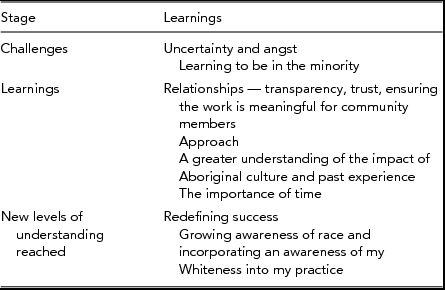
Initially, I experienced challenges; however, through making a conscious decision to persist, I experienced a number of learnings that ultimately enabled me to overcome the challenges and reach a new level of understanding in my thinking that I could act on and apply to my practice. In the next section I describe these challenges, learnings, and new levels of understanding reached. The changes I experienced to my practice are discussed in each section (summarised in Table 1).
Summary of Challenges, Learnings and New Levels of Understanding Reached
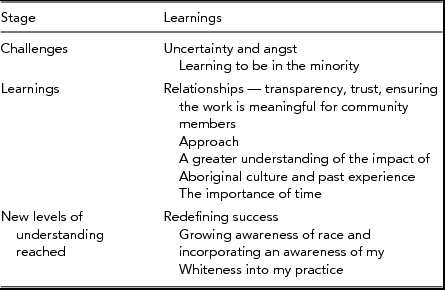
Challenges
Uncertainty and Angst
I began this journey with many feelings of uncertainty. I felt that other White health professionals were unsure of my intentions in doing the PhD, and I was concerned about how the results of this research would reflect on them, who, despite good intentions of working with Aboriginal communities, did not always achieve positive outcomes due to a vast array of barriers (Reflexive Journal, March 26, 2009, p. 37). I was worried about what Aboriginal people would think of the fact that I, a White person, had chosen to investigate this topic. I was uncomfortable referring to myself as a White person, mainly because I was concerned about what reactions it would evoke from both Aboriginal and White people. While I had travelled overseas and grown up with people from different cultural backgrounds, and had an interest in learning about other cultures, I had never explored my own Whiteness. I was aware that I was somewhat privileged, but held a philosophy that everyone should be equal and treated the same. I now recognise that while this intention was sound, it is rarely so simply. Individual differences, stories and experiences have a great impact on how people are placed in society. A trip to India at the end of 2008 was an important step in acknowledging my White privilege.
Learning to Be in the Minority
In the first year of working closely with Aboriginal people, I learnt what it feels like to be in the minority, with high levels of self-awareness, anxiety and discomfort. I was concerned about being perceived as ‘a typical White researcher’ who comes into a community and takes a lot but does not give much back. I steered away from topics related to race and did not confidently acknowledge my position as a White person:
I felt totally in the minority and I was always worried, thinking: ‘What are they thinking about me?’ ‘Will they think I’m silly for being here?’ ‘Will they say something mean?’ ‘Will they single me out as the only White person?’ Particularly when they were saying things about Whitefellas and what they think of Aboriginal people. I just wanted to say ‘we don't all think like that’ or ‘yes I know we have done terrible things to you, but I want to help make it right’. (Reflexive Journal, March 18, 2009, pp. 30–31)
Overcoming these daily experiences of feeling in the minority was challenging yet important in my attempts to build relationships with the Aboriginal communities in my research. Having experienced what it felt like to be in the minority meant that I was better able to relate to Aboriginal people who may experience this feeling regularly.
Initially, when I was attending community events, I felt uncomfortable and awkward. However, over time, as I got to know people and developed confidence, I felt more comfortable at events (Reflexive Journal, February 3, 2010, p. 144; Reflexive Journal, February 16, 2010, p. 146). With my increasing comfort levels came less anxiety and a much better reception from people.
Learnings
Relationships
Building relationships with Aboriginal colleagues and community members was vital because it allowed me to undertake the research in a way that was respectful, inclusive and of use to the Aboriginal communities I was working with. The importance of these relationships was the biggest learning for me. These relationships developed in a number of ways, but primarily through attending local community events, speaking to people, and offering to be part of local cooking groups (reciprocity). A number of strategies stood out as important when forming and maintaining relationships, and these included trust, transparency and ensuring that the work is meaningful for community members.
Reciprocity
I learnt early in this research that in order to gain something as a researcher, I needed to give something back to the community. My awareness of the importance of reciprocity developed through conversations with project mentors in early 2009, and the more I got to know members of the Aboriginal community, the more value I placed on it. One Aboriginal person (health worker) advised:
You need to show that you exercise reciprocity — that you are giving something back to the community and that they are benefiting from it, that is, what are the benefits to the community of using the data and how will the health and wellbeing of the community benefit? (Reflexive Journal, February 23, 2009, p. 13)
I used a three-step process when working with Aboriginal workers and community members through reciprocity. First, I focused on building a relationship; second, I asked if there was anything I could do for that person/group; and finally, I invited their input into my research. By using reciprocity, I was able to make the needs of the community I was working with the priority. Some examples of activities of reciprocity I was involved in included cooking sessions, women's groups and health fair days.
Transparency
I was aware of the importance of transparency about my true intentions in my interactions with Aboriginal workers and community members right from the start of the project. One Aboriginal worker made this clear to me from the start when she highlighted the need to disclose that I was doing research to any community groups that I engaged with (Reflexive Journal, April 1, 2009, p. 44).
This learning led me to say at future interactions with people about my research: ‘This is what I am doing and this is why I am doing it, what do you think you could add? Would you like to be involved? What do you have to say?’ Being transparent in my practice meant I gave potential research participants all of the facts and then allowed them to make up their minds whether they wished to be involved and how they might contribute, rather than telling them what I was doing and what I wanted their involvement to be. This allowed me to avoid being paternalistic and gave people the opportunity to develop their own interpretation of what I was doing. Being transparent was about sharing my agenda. By being transparent, I provided an opportunity for agendas to be discussed, negotiated and ultimately shared.
Trust
Trust was, and remains, a crucial factor in building and maintaining relationships. Developing trust occurred through my actions, such as spending time in the community, through developing personal connections with people, and through the introductions of well-known and respected key people: ‘Being associated with [key worker] gives me credibility. If [key workers] trust me then that is a good sign to the community members’ (Reflexive Journal, September 9, 2008, p. 5).
Initially, the signs that indicated that trust had been built were not always obvious to me. It took time to recognise the significance of being invited to a meeting in a worker's home, and repeated invitations to join the women's groups to events, including the movies and a trip to the zoo.
Trust building is a complicated business that works both ways. I came to understand that if an Aboriginal person trusts me and vouches for me and I go and do something wrong, then that not only makes me look bad but it makes the person who vouched for me also look bad (Reflexive Journal, September 9, 2008, p. 5). Initially, this situation made me somewhat nervous because I felt as though I had a responsibility to maintain my end of the relationship and I was concerned that I would do something wrong. This fear began to dissipate as my confidence in my ability to uphold my side of the relationship grew.
It is interesting to note that trust was more prominent in certain places or certain situations. For example, I was only ever asked to do things by Aboriginal workers or community members when I was in their space. I was invited to women's group events through attending the community lunch. Another worker asked for my advice about a nutritional supplement when I dropped into her building, and first brought up her idea for a cooking program after a meeting with members of the Aboriginal health team. This demonstrates the importance of having a presence in community and the importance of incidental contact. I changed my practice by making time to attend these events and spend time in the spaces where my Aboriginal colleagues felt most comfortable, and this contributed to the trust and relationships I developed.
Ensuring the Work is Meaningful for Community Members
The more I worked with community groups and Aboriginal health workers, the more I appreciated the importance of making my work relevant, meaningful and understandable to local Aboriginal people. For example, when I was undertaking community consultation and describing my research project, people were most interested when I described it as a program to prevent diabetes and obesity. The community members I spoke to were very aware of these issues and passionate about making it better for their children and/or grandchildren (Reflexive Journal, April 28, 2009, p. 48). One of the women paraphrased what I had said by saying ‘so by helping you, we’re really helping ourselves?’ (Reflexive Journal, April 28, 2009, p. 49). After this learning, I sought to make my work relevant for the specific group I was working with rather than describing it in the way that made most sense to me.
Approach
My approach to working with Aboriginal people and community groups changed over time. Initially, I brought a set agenda to each group session, but as my confidence and comfort level grew, I began to ‘go with the flow’ and responded to the particular needs of participants at each session. This led to a more successful and less stressful encounter for both participants and myself:
If you go in with a set agenda then you will just get frustrated if you don't cover it, which often seems to happen, because other things are more important to discuss. And because you get hung up on this, you don't appreciate the fantastic spontaneity that can occur if you just let the conversation wander. I have found that if I go in with a general idea of what to talk about — for example, today I know that we needed to cover the questions — but not too specific (e.g., a ‘tick list’ like I may have in the past) then I am a lot less stressed and consequently am much happier to just let the conversation flow. I think that you need to be in this state of mind to allow innovative, spontaneous ideas to come out. (Reflexive Journal, July 31, 2009, p. 85)
In this example, my growing ability to identify my position as a White researcher and the need to modify my actions to acknowledge this power imbalance, while centralising the needs of the communities I was working with, became apparent.
I found it important to not push my agenda straight away. I reflected on how I facilitated a cooking group with Aboriginal women — spending time talking to community members first, then weaving a few questions into conversations, and then ending with a general discussion:
Approach at a group — it's like a sandwich. You go in, warm up (which will often involve doing something like chopping vegies to cook or whatever), talk about whatever, then kind of comes the opportunity to ask the questions, and then you kind of lead that back to general chatting. So this is partly why it takes the time — you can't just launch in and get straight to business. (Reflexive Journal, March 30, 2010, p. 128)
As my approach developed, I began to move away from the idea of being an ‘expert’ to a position of appreciating that I had just as much to learn from Aboriginal people, if not more, than they had to learn from me:
I think that making it clear that you are willing to learn is crucial and not making out like you know it all. (Reflexive Journal, November 24, 2009, p. 99)
When working with Aboriginal health workers, I came to see that my role was to facilitate and advise, but not to make all the decisions. For example, when working with an Aboriginal health worker to plan a cooking program, I used an approach where I sat back, advised, and was available to answer questions and discuss issues (Reflexive Journal December 10, 2009, p. 105).
This approach led to better trust and rapport, a better relationship and a cooking program that was more extensively based on local community needs.
A Greater Understanding of the Impact of Aboriginal Culture and Past Experience
It became clear through my work with Aboriginal people that culture and past experiences have a significant impact on how Aboriginal people live their lives and relate to the present. This was not obvious to me at first, but over time I became more aware of it and began to pick up on cues. For example, when working with Aboriginal health workers, I recognised some of the barriers they faced in practice, such as working with certain organisations, were due to bad experiences in the past (Reflexive Journal, 31 July, 2009, p. 84). The structural location of Aboriginal health workers within institutional spaces was also evident, with their roles being critical for quality, but not always recognised within institutional spaces. This was also evident when I attended community group meetings with guest speakers from government organisations, and Aboriginal community members related what the guest speakers said with their own personal experiences or experiences of their family, many of which were negative and consequently tarnished their present experience (Reflexive Journal, May 5, 2009, p. 53).
Over time, I began to learn about the connection of Aboriginal people to the land. For example, I attended a Sorry Day lunch in 2009 where a DVD was screened about the importance of water to an Aboriginal group, and about the impact of lower water levels. I had underestimated the effect of reduced water levels on Aboriginal people; for example, the DVD included comments such as ‘when the water goes our spirit dies’ and ‘there is so little left now compared to when our grandparents are young’. I was not aware of this, and hearing Aboriginal people talk about this connection and the effect of the water levels was confronting: it highlighted to me that there were a whole lot of cultural factors affecting the lives of Aboriginal people that I was not aware of and did not necessarily understand (Reflexive Journal, May 26, 2009, p. 61).
Cultural hierarchies also became more obvious as I sat back and observed at events. For example, in women's groups, Elder women were listened to by all of the younger women; at a meeting, the most senior Aboriginal worker was listened to by all of the others, and at a community lunch Elders were always served first (Reflexive Journal, May 12, 2009, p. 55; Reflexive Journal, February 4, 2010, p. 145).
The Importance of Time
I learnt that it takes time to work successfully with Aboriginal communities. For example, building relationships took time because I needed to identify key people to talk to and the appropriate ways in which to contact them. I also needed to identify the best way to relate to people so that there was something in it for them (reciprocity), as well as for me. However, later I came to realise that allowing adequate time during the initial stage of my research, and building trust and relationships, made recruitment for the research easier later on.
The most important step for me in acknowledging the role and importance of time was learning to readjust my own timelines to those that fitted with the community. It was also important to not be too hard on myself when I had not achieved something that I thought I should have by that point in time. I dealt with this by looking instead at what I had achieved, and valuing things that I may not have placed so much importance on before; for example; having lunch with a community women's group and then being invited back to another session (Reflexive Journal, February 16, 2010, p. 146). Using a reflexive journal to document these achievements was crucial to recognising them and not feeling pressured by time.
Reaching a New Level of Understanding
Redefining Success
Another important step in working well with Aboriginal communities involved learning to redefine what I considered to be ‘success’. I came to see that major changes in nutrition habits would not occur by running one-off sessions about healthy eating. Rather, by getting to know the community, and gaining their trust over time, people started to ask me for advice about nutrition in relation to areas they were interested in. Therefore, my interactions with people were framed primarily around their needs rather than mine as a researcher. This learning was based on what I learnt from the Aboriginal people I was working with. I began to appreciate that gaining people's trust was a major achievement that led to information exchange. Some examples of when I identified my success are presented:
I think that you know you are doing a good job when people start coming to you — for example, when [worker] did today and when [another worker] asked for my details. (Reflexive Journal, May 6, 2009, p. 54)
Redefining my notion of ‘success’ was an important step in redefining what I sought to do and achieve in my PhD. I changed my practice by changing the focus of my PhD. While initially I aimed to find a specific ‘way’ to work in Aboriginal health, I realised that this ‘right way’ would differ, based on the situation, people and communities; hence, I changed the focus of my PhD to explore the context and present some possibilities, rather than to present one ‘right way’.
Growing Awareness of Race and Incorporating an Awareness of my Whiteness Into my Practice
As I entered the second year of my PhD I started to become more familiar with the discourse of race by reading widely in the area and developing deeper relationships that provided a space to discuss Aboriginal and non-Aboriginal peoples’ experiences and understandings of race. As I developed a deeper consciousness of race and related concepts, I was able to reflect on my initial feelings of discomfort. I reflected that my previous discomfort was not a result of my poor practice or something I had failed to do, but rather was reflective of wider issues, both at a health system level, and at a societal level, around Aboriginal and non-Aboriginal people working together. Therefore, in gaining a greater understanding of race, I gained more confidence in my practice.
Attending a course about race and Whiteness (‘Race, Culture, Indigeneity and the Politics of Public Health’ at the University of Melbourne in June 2009, run by Emma Kowal and Yin Paradies) was also an opportunity to explore the concept of race further. This course enabled me to start a dialogue about being a White researcher in Aboriginal communities and the realities, barriers and possibilities of this work. I began to explore my own Whiteness and White privilege and to talk about White guilt and effective strategies for addressing it. Naming these concepts helped to clarify my thinking and provided a wider framework through which I could consider my experiences. After this course I was much more willing to discuss my experiences and concerns in this area, and in opening up, I discovered that some of my colleagues were facing similar issues.
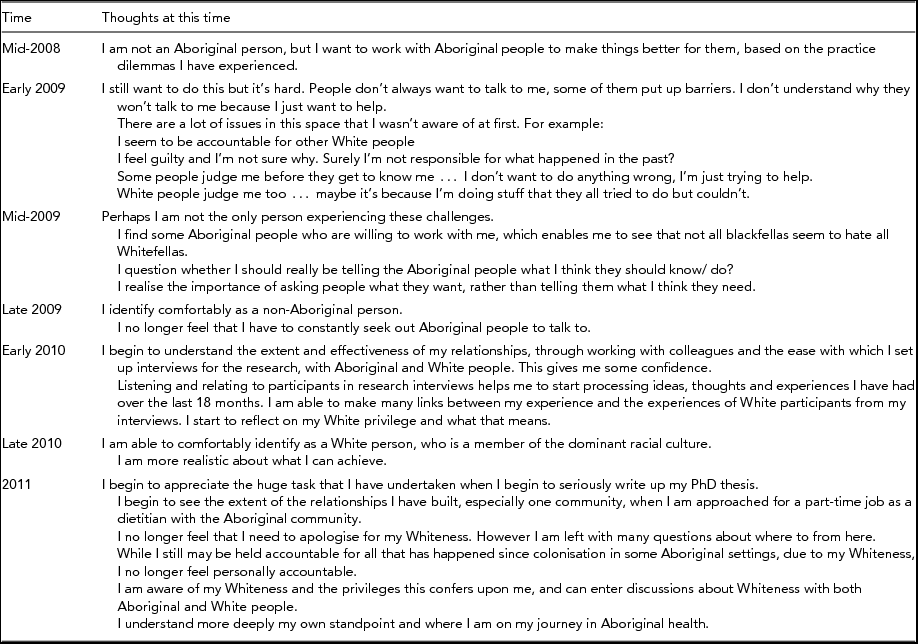
To highlight the significant changes in my thinking, and how I have come to new understandings about race and Whiteness, I have included some of the key thoughts and experiences I have had throughout this research that are related to race and Whiteness (Table 2).
Summary of My Key Thoughts and Experiences About Race and My Whiteness While Doing a PhD in the Area of Aboriginal Health

Discussion
There is a lack of writing about how health professionals can use reflexivity as a tool to develop culturally safe behavior. This includes acknowledging that ‘good’ care is defined by the patient, and being flexible and not imposing your attitudes and values on those you work with. This article makes a contribution to filling that gap by presenting my journey as a White researcher who used reflexivity to develop culturally safe practice and present a process others can use to do so. It encourages culturally safe behavior by encouraging an individual to reflect on their own attitudes and values and change their practice, based on these reflections (reflexivity).
In this article I draw on reflexivity from a number of positions and paradigms, including uncomfortable reflexivity (Pillow, Reference Pillow2003), critical reflection (Brookfield, Reference Brookfield1998), and reflexivity from a feminist standpoint (Mauthner & Doucet, Reference Mauthner, Doucet, Denzin and Lincoln2003; Naples, Reference Naples2003; Dowling, Reference Dowling2006). This is notable in my open and descriptive discussions of my discomfort and the challenges faced during my research, my reflection on how my approaches to practice (such as my concept of time) affected my relationships with Aboriginal people and my exploration of my Whiteness. Race and Whiteness is an issue that permeates not only this research, but also wider society. It has been described by Frankenberg (Reference Frankenberg1993) as: (a) a location of structural advantage and race privilege; (b) a standpoint from which White people look at themselves, others and society; and (c) a set of cultural practices that are usually unmarked and unnamed. As it is a set of cultural practices that are usually unmarked and unnamed (Frankenberg, Reference Frankenberg1993), it can be easy to ignore. By acknowledging and discussing my Whiteness, I have named Whiteness and therefore have not reproduced this common practice of wider culture, a characteristic of critical reflection (Brookfield, Reference Brookfield1998). Documenting my journey was an uncomfortable process. Reflexivity enabled me to address some of the issues and subjectivities that were making me feel uncomfortable, such as the power differential between myself as a researcher and the Aboriginal community members I was working with (Dowling, Reference Dowling2006). By persisting with uncomfortable reflexivity (Pillow, Reference Pillow2003), I changed my practice; for example, seeking to build meaningful, two-way relationships prior to doing research that reconfigured the power differential and alleviated this discomfort.
It is recognised that working in Indigenous health is a challenging space; however, people's reflections about why it is challenging and what is learnt when that challenging space is explored and persisted with is rarely explored. I hope that by reading about my journey, others in similar situations will recognise the shared nature of such experiences. As I appreciated when I engaged with reflexivity and critical reflection, sharing our stories with each other enables realisation that challenges are usually collectively experienced (Brookfield, Reference Brookfield1998). In addition, readers of this article may draw guidance about ways of reaching new levels of understanding through critically examining their own attitudes and values as they work towards practising in a culturally safe way. Reaching new levels of understanding and acting on this is an important part of the process; it has previously been reported that gaining an understanding of one's attitudes and values is only the first step and ‘futile unless followed by improvements in attitudes and actions that effectively chance otherwise predictable practices and outcomes’ (Durey, Thompson, & Wood, Reference Durey, Thompson and Wood2011, p. 21).
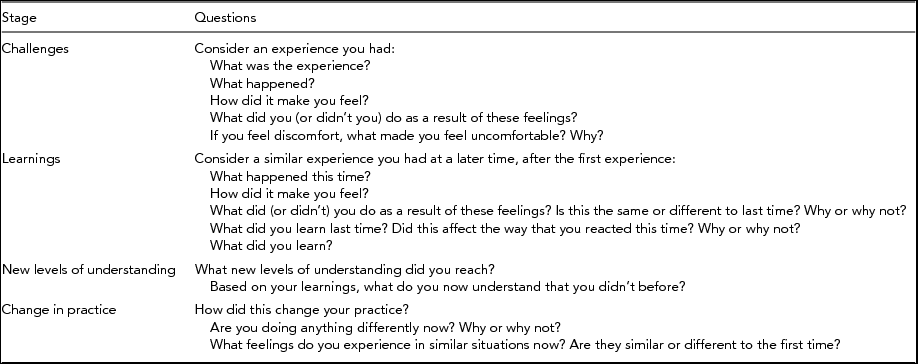
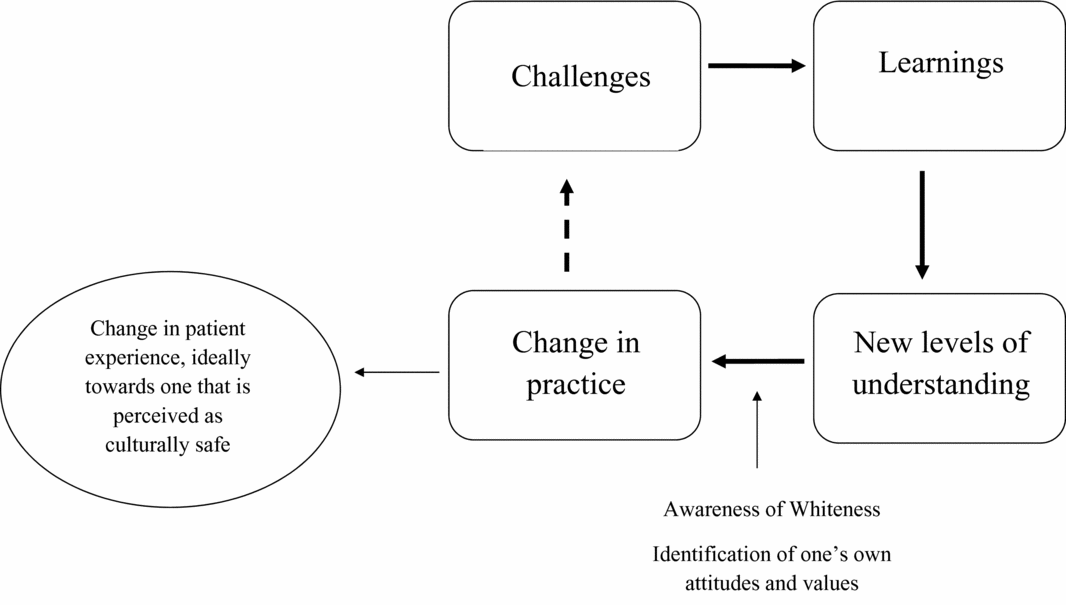
Figure 1 demonstrates a process that health professionals, researchers and others can use to be reflexive in their practice in Indigenous health. Table 3 outlines some questions that individuals can use at each of these stages to be reflexive. It is based on the four-stage process discussed earlier in this article, that is, identification of challenges, learnings, reaching new levels of understandings, and changes in practice, which can alter the experience of those receiving the care. It is envisaged that it will take an individual some time to work through these stages, and reaching new levels of understanding is unlikely to be immediate. As indicated in Figure 1, it is a cyclical process rather than a linear one, and even when new levels of understanding are reached, different challenges may still be experienced.
Suggested Questions to Assist Health Professionals, Researchers and Others to be Reflexive in Their Practice in Aboriginal and Torres Strait Islander Health When Experiencing Challenges, Learnings, New Levels of Understanding and Changes in Practice
Suggested process for reflexivity for health professionals, researchers and others working in Aboriginal and Torres Strait Islander health
The experience presented in this article has similar themes to other research presented in the literature. As outlined, this research led me to experience discomfort as I identified my attitudes and values. Such discomfort has been noted by other authors. For example, Minniecon et al. (Reference Minniecon, Franks and Heffernan2007, p. 28) highlighted the ‘myriad of personal and institutional dilemmas’ arising for non-Indigenous researchers engaging in Indigenous health. Durey et al. (Reference Durey, Wynaden, Thompson, Davidson, Bessarab and Katzenellenbogen2012) highlighted that reflecting on one's own values, beliefs and attitudes and how they have been shaped can be confronting. This may be because the process involves challenging one's individual worldviews, which can lead to discomfort and anxiety, and enables health professionals to think about whether their own beliefs and practices promote or compromise the health of Aboriginal people (Durey et al., Reference Durey, Wynaden, Thompson, Davidson, Bessarab and Katzenellenbogen2012). The reporting of this discomfort in other literature suggests it is a vital part in becoming a culturally safe health professional (Bond et al., Reference Bond, Sporling and Askew2014). Despite these challenges and discomfort, I persisted with reflexivity and reached a new level of understanding. This is in line with cultural safety literature, which acknowledges that identifying and unpacking one's values and beliefs can be an uncomfortable experience, but that this discomfort should not prevent action (Bond et al., Reference Bond, Sporling and Askew2014). However, while this article may be useful in particular for other White health professionals working in Aboriginal health, the role of Aboriginal and Torres Strait Islander people in providing culturally safe care and environments must not be diminished. Indigenous people need to feel comfortable about accessing health services if Indigenous health is to improve, and evidence has demonstrated that employment of Indigenous staff and Indigenous leadership within a health service increases the access of the health service to Indigenous people (Hayman, White, & Spurling, Reference Hayman, White and Spurling2009). Reflexivity is a key attribute to be able to engage in culturally safe behaviours, and therefore reflexivity is important for cultural safety. For example, developing critical consciousness, or reflexivity, enables individuals to identify their own biases and assumptions, which means they are less likely to impose their values and beliefs onto their patients (Pitner & Sakamoto, Reference Pitner and Sakamoto2005) and are therefore more likely to provide care that is culturally safe. Furthermore, reflexivity provides a stronger basis for individuals to develop a culturally safe approach, which provides a stronger base to address the needs of Aboriginal people in a way that is useful and meaningful to those people. In the case of this article, the importance of using research as a vehicle to support and centralise Aboriginal community needs is highlighted. Additionally, critical reflection, which has parallels to reflexivity, involves identifying power relationships in the settings in which we work (Brookfield, Reference Brookfield1998, Reference Brookfield2009). A principal of cultural safety is the ability to recognise and address power differentials through practice (Taylor & Guerin, Reference Taylor and Guerin2010), and therefore critical reflection is likely to facilitate culturally safe practice.
Despite the importance of individual reflexivity, it is acknowledged that organisational change is also required. This includes organisational reflection on the ways in which White privilege and racism affect service provision, staffing and organisational structure (Fredericks, Reference Fredericks2006). However, interpersonal reflection has been cited as a lever for organisational change (Durey et al., Reference Durey, Wynaden, Thompson, Davidson, Bessarab and Katzenellenbogen2012); for example, ‘Encouraging health care providers to reflect on how normative, White privilege can reproduce inequities in Indigenous health care is an important step to changing the discourse that places Indigenous people at the centre of the problem in Australia along with the failed service approaches that exist’ (Durey & Thompson, Reference Durey and Thompson2012, p. 9). Clearly, lack of reflexivity and lack of acknowledgment of one's Whiteness has been documented to interfere with good service provision, and consequently engaging in reflexivity is crucial in order to deliver culturally safe practice, not just at an individual level but also at an organisational level.
White racial identity (WRI) can be used to describe how White people see themselves in relation to people of other races. Specifically, WRI is a stage theory or step process by which White people come to develop a racial consciousness, acknowledge and accept their Whiteness and what it means to be a White person in a society where White is the dominant race (Helms, Reference Helms1984, Reference Helms, Ponterotto, Casas, Suzuki and Alexander1995). This is important, because too often Whiteness remains invisible, unmarked and unnamed, which avoids acknowledging the effect of race on people's lives (Frankenberg, Reference Frankenberg1993) and the benefits bestowed by unearned White privilege (McIntosh, Reference McIntosh1986). My growing awareness of race and incorporation of an awareness of my Whiteness into my practice (Table 2) can be explored using WRI theory (Helms, Reference Helms1984, Reference Helms, Ponterotto, Casas, Suzuki and Alexander1995).
From my own journey in this research, I can clearly see the development of my WRI. When I immersed myself in Aboriginal communities, I was forced to acknowledge my Whiteness, and this was associated with significant guilt for me (disintegration stage — mid-2008 and early 2009) and the idea that I had to ‘make up’ for something, and over time I felt anger about this (reintegration stage — mid-2009). I actively sought contact with Aboriginal people because of this. Disintegration is characterised by disorientation and confusion and is the stage when individuals are forced to identify that they are White, which is usually accompanied by feelings of guilt and depression (Table 2), while reintegration is characterised by fear, anger, and a tendency to stereotype (Helms, Reference Helms1984, Reference Helms, Ponterotto, Casas, Suzuki and Alexander1995). Over time, and through ongoing contact with Aboriginal people, I gradually lost this feeling of guilt and that I had something to make up for. I still spent time with Aboriginal people but it just tended to happen: I did not have to try too hard, nor did I actively seek these people out (pseudo independent stage — late 2009). I entered the immersion/emersion stage when I began to search for an internally defined positive racial identity as a White person and started to reflect on my White privilege and the benefits associated with it (early 2010; Helms, Reference Helms1984, Reference Helms, Ponterotto, Casas, Suzuki and Alexander1995). Towards the end of my research, I became much more secure in my racial identity and entered the autonomous stage (late 2010 and 2011) where I was able to work with Aboriginal people as individual people and be aware of racial difference, but not feel that I had something to make up for. I was also able to comfortably acknowledge my Whiteness, a characteristic of the autonomous stage. Being comfortable with using the term ‘White’ is a necessary step in developing a WRI (Helms, Reference Helms, Ponterotto, Casas, Suzuki and Alexander1995). Other features of an autonomous racial identity include valuing cultural diversity and accepting racial difference, acceptance of members of different racial groups as individuals, and the capacity to relinquish the privileges of racism (Helms, Reference Helms1984, Reference Helms, Ponterotto, Casas, Suzuki and Alexander1995).
Applying WRI theory to my experience provided a framework that enabled me to derive meaning. It demonstrates that the process I went through is not unique to me, which suggests that others in similar situations to myself are likely to experience it too. Furthermore, linking my experiences to WRI helped to ‘normalise’ my experiences, in that I saw that I was not the one who was strange and different. If these experiences are written about in a theory, then surely others experience them too. This gave me more confidence and determination to push through and learn from the experience.
Conclusion
Reflexivity is a vital tool for researchers and others working in Aboriginal and Torres Strait Islander health. It can be used to identify and work through challenges and ultimately reach a place of greater understanding that facilitates culturally safe practice and the centralisation of the needs of Aboriginal people that health professionals and researchers work with. This article presents my journey as an example of a reflexive process, including challenges, learnings, new understandings reached and changes in practice, as well as a suggested process for reflexivity that others can draw on. In doing so, it aims to start dialogue about the challenges and learnings experienced in working in Aboriginal and Torres Strait Islander health, and encourage others to engage in reflexivity and ultimately become more culturally safe practitioners.
Acknowledgements
I would like to acknowledge the Aboriginal people and communities who were part of my research, spent the time talking to me and contributed greatly to my learnings in this area. This includes a significant number of community members and Aboriginal workers in the two communities in which this research was based. I would like to formally acknowledge the input of Aboriginal mentors into this research. I am grateful for the mentoring of Luita Casey, Mark Thompson, Kim O'Donnell, Sandy Wilson, Sharon Perkins, Darryl Cameron, Theresa Francis and Ngala Cox, who have had a significant impact on this research and my understandings. Without these individuals and communities, this journey would not have been possible.
I would also like to acknowledge Associate Professor Anthea Magarey, Dr Michelle Jones and Dr Janet Kelly who were supervisors for this research as well as Dr Tamara Mackean who provided advice and support during the writing of this paper, including commenting on drafts. I was supported by a scholarship from SA Health (2008) and an Australian Postgraduate Award and top-up scholarship from SA Health (2009–2011).
About the Author
Annabelle Wilson is a Research Fellow in the Poche Centre for Indigenous Health and Well-Being and the Discipline of Public Health at Flinders University. She received her PhD in 2012. She is also an Accredited Practising Dietitian and has worked with Aboriginal communities across Australia in rural, remote and urban settings. She has a strong commitment to ethical practice and working in partnership with Aboriginal people and communities.