Conceptual models of child development and adaptive functioning have often approached the understanding of early competency by examining within-domain predictors of developmental phenomena or have focused on stability of early emerging skills (Rubin, Bukowski, & Parker, Reference Rubin, Bukowski, Parker, Eisenberg, Damon and Lerner2006; Tremblay, Reference Tremblay, Lahey, Moffitt and Caspi2003). However, the significance of cross-domain influences (Calkins & Bell, Reference Calkins, Bell, Calkins and Bell2010) and bidirectional processes (Masten et al., Reference Masten, Roisman, Long, Burt, Obradović and Riley2005) has recently garnered attention, particularly within the field of developmental psychopathology, because of the promise that such approaches offer an understanding of how early developmental phenomena influence and are influenced by separate, but perhaps related, processes. This approach is particularly useful in trying to understand complex developmental phenomena, like social competence, psychological functioning, and academic achievement outcomes that are clearly the product of numerous skills and abilities that likely emerge over time and may operate bidirectionally (Burt, Obradovic, Long, & Masten, Reference Burt, Obradović, Long and Masten2008; Howse, Calkins, Anastopolous, Keane, & Shelton, Reference Howse, Calkins, Anastopoulos, Keane and Shelton2003). A developmental psychopathology perspective, advocating an organizational view of development in which multiple factors, or levels of a given factor, are considered in the context of one another, rather than in isolation (Cicchetti & Dawson, Reference Cicchetti and Dawson2002; Cicchetti & Rogosch, Reference Cicchetti and Rogosch1996; Cicchetti & Schneider-Rosen, Reference Cicchetti, Schneider-Rosen, Rutter, Izard and Read1986) is consistent with such “cascade” models of early development. Cascade models of early development also have the potential to meet one of the fundamental tenets of developmental psychopathology, which is to understand pathways to both typical and atypical outcomes.
Early social competence and successful peer relationships have long been considered a hallmark of adaptive functioning in early childhood. For example, numerous negative outcomes have been associated with peer rejection, including early conduct problems, later adolescent disorders, school truancy, suspension, and leaving school early (Coie, Lochman, Terry, & Hyman, Reference Coie, Lochman, Terry and Hyman1992; Miller-Johnson, Coie, Maumary-Geremaud, Bierman, & Conduct Problems Research Group, Reference Miller-Johnson, Coie, Maumary-Gremaud and Bierman2002; Woodward & Fergusson, Reference Woodward and Fergusson2000). Similarly, withdrawal from the peer group and peer victimization are associated with many maladaptive outcomes, including depression, loneliness, and anxiety (Hodges, Boivin, Vitaro, & Bukowksi, Reference Hodges, Boivin, Vitaro and Bukowski1999; Hodges & Perry, Reference Hodges and Perry1999), as well as with externalizing behaviors, school avoidance, and academic failure (Hanish & Guerra, Reference Hanish and Guerra2002; Kochenderfer & Ladd, Reference Kochenderfer and Ladd1996). Although many of these associations are assessed via cross-sectional designs, preliminary evidence indicates that peer difficulties predict changes in symptomology, and that these effects can linger into adulthood (Kochenderfer-Ladd & Wardrop, Reference Kochenderfer-Ladd and Wardop2001; Olweus, Reference Olweus, Albee, Bond and Monsey1992). The investigation of factors contributing to success or failure within the peer milieu have long been considered important, although such studies have been challenged to establish a clear direction of effects (Rubin et al., Reference Rubin, Bukowski, Parker, Eisenberg, Damon and Lerner2006).
Although early work on the predictors of peer relationships focused on how children were processing social cues and generating responses to specific peer behaviors (Dodge, Pettit, McClaskey, & Brown, 1986), more recent work has focused on the emotion-relevant behavior children exhibit in peer environments and how it may predict their response to the behavior of others. Much of this work has focused on how children manage these emotion-relevant behaviors, with the assumption that failure to regulate emotions is a proximal cause of peer relationship difficulties (Denham et al., Reference Denham, Blair, DeMulder, Levitas, Sawyer and Auerbach-Major2003; Eisenberg, Fabes, Bernzweig, & Karbon, Reference Eisenberg, Fabes, Bernzweig and Karbon1993; Halberstadt, Denham, & Dunsmore, Reference Halberstadt, Denham and Dunsmore2001). From a developmental perspective, success or failure at important developmental tasks, such as the acquisition of emotion regulation skills during toddlerhood and preschool, likely plays some role in the trajectory of more serious problem behavior as children enter peer and school contexts (Hill, Degnan, Calkins, & Keane, Reference Hill, Degnan, Calkins and Keane2006; Keane & Calkins, Reference Keane and Calkins2004). Moreover, from this standpoint, early childhood behavior problems are considered a risk factor for later antisocial behavior and suggest that the mechanism(s) responsible for ongoing behavioral difficulties are to be found in the interactions between very early child functioning, particularly with respect to the regulation of arousal, and the contexts in which the development of regulation is occurring: namely family and peer relationships.
Considerable work has examined the development of emotion regulation, from both normative and atypical perspectives (Blandon, Calkins, Keane, & O'Brien, Reference Blandon, Calkins, Keane and O'Brien2008; Calkins & Howse, Reference Calkins, Howse, Philippot and Feldman2004; Keenan, Reference Keenan2000). Emotion regulation is defined as those behaviors, whether automatic or effortful, conscious or unconscious, elicited during an affectively arousing situation (Buss & Goldsmith, Reference Buss and Goldsmith1998; Calkins & Hill, Reference Calkins, Hill and Gross2007). Emotion regulation helps individuals modulate their arousal and facilitates positive social interaction and effective social problem solving (Eisenberg et al., Reference Eisenberg, Fabes, Murphy, Maszk, Smith and Karbon1995; Eisenberg, Fabes, Guthrie, & Murphy, Reference Eisenberg, Fabes, Guthrie and Murphy1996; Howse, Calkins, Anastopoulos, Keane, & Shelton, Reference Howse, Calkins, Anastopoulos, Keane and Shelton2003). Early behavioral difficulties, those characterized by high negativity and oppositional behavior, challenge the child to acquire appropriate emotion regulation skills (Calkins & Dedmon, Reference Calkins and Dedmon2000).
The ability to regulate one's emotions is a critical achievement attained during childhood, with considerable support and feedback from caregivers (Calkins & Hill, Reference Calkins, Hill and Gross2007; Thompson & Meyer, Reference Thompson, Meyer and Gross2007) and has implications for many dimensions of later development, including behavioral adjustment, social relationships, and school achievement (Calkins & Howse, Reference Calkins, Howse, Philippot and Feldman2004; Degnan, Calkins, Keane, & Hill-Soderkind, Reference Degnan, Calkins, Keane and Hill-Soderlund2008). By school age, the pattern of emotion regulation may be entrenched and difficult to alter. For example, among older children, inhibition and suppression of negative emotion has been associated with greater internalizing problems (Suveg & Zeman, Reference Suveg and Zeman2004), whereas undercontrolled negative emotion has been linked to greater externalizing problems (Eisenberg et al., Reference Eisenberg, Cumberland, Spinrad, Fabes, Shepard and Reiser2001).
Although there has been less focus on peers and the development of emotion regulation, it is clear that by the time children enter school, peers, like parents, help with the development of self-regulatory skills. Peers serve as sources of emotional support during times of stress (Hartup, Reference Hartup1996) but also provide feedback about the appropriateness of emotional displays. Anger expression, bossiness, aggression, and impulsivity are all negatively related to peer status (Eisenberg et al., Reference Eisenberg, Fabes, Bernzweig and Karbon1993; Keane & Calkins, Reference Keane and Calkins2004); rejected children are also more effusive in their displays of emotion (i.e., happiness) to positive events (Hubbard, Reference Hubbard2001). Taken together, these studies suggest that both positive and negative high-intensity emotional behavior play a role in determining concurrent peer status. The peer group may also attempt to socialize children's emotion regulation through specific negative treatment, such as peer victimization or exclusion (Salisch, Reference Salisch2001).
Given that emotion regulation patterns are established early and can lead to a range of difficulties, examining its emergence and the way it influences other skills and abilities is especially important. Entrance to school, therefore, marks a significant and appropriate period to study the relation between emotion regulation and social competence, as these early relationships and concomitant peer status may be difficult to alter (Kochenderfer & Ladd, Reference Kochenderfer and Ladd1996). However, it is important to consider how emotion regulation becomes an element of peer relationships, how it influences behavior directed toward peers that becomes a part of the child's social repertoire, and influences social status, reputation, and peer success. Most of the research examining the role of emotion regulation and social status, for example, has focused on direct relations or on indices of behavior problems as a proxy for peer relationships.
Early work on the relations between problem behavior and peer relationships, however, provides insight into the mechanisms through which emotion regulation becomes a predictor of peer success during the transition to school. For example, Ladd, Kochenderfer, and Coleman (Reference Ladd, Kochenderfer and Coleman1996) found that children who transitioned to school with a familiar peer had better academic and social adjustment than chidden who did not. Ladd, Price, and Hart (Reference Ladd, Price and Hart1988) further demonstrated that cooperative play on the playground predicted increases in peer acceptance across the preschool year. Conversely, noncompliant behavior and arguing with peers were related to increases in peer rejection at both midyear and end of year assessments.
The predictive relations between early negative and poorly regulated behavior and peer relations may be a function of several different behavioral processes. Young children may simply be engaging in the same behaviors in the classroom as they do at home (aggression, negativity, and oppositional behavior) and become disliked by peers for engaging in these behaviors toward classmates. Young children may engage in other sorts of behavior that elicit negative attention from the teacher (noncompliant or uncontrolled behavior) and the negative attention causes their peers to like them less. Children may also fail to engage in positive peer-directed behavior (e.g., sharing), which can lead to peer dislike (Keane & Calkins, Reference Keane and Calkins2004). A small number of studies have examined the specific behaviors exhibited by young children and success with peers. For example, in one study, preschoolers who engaged in prosocial behaviors and were adept at understanding emotional situations were well liked by their peers (Denham, McKinley, Couchoud, & Holt, Reference Denham, McKinley, Couchoud and Holt1990).
Given the salience of peer-directed behaviors for young children and children's abilities to identify peers with better versus poorer social skills, which are a strong predictor of rejection and liking at a young age (Keane & Calkins, Reference Keane and Calkins2004), it is possible that the pathway from challenging toddler behavior and poor emotion regulation to compromised peer relationships in the early years of school is through social skills acquired during the transition from preschool to kindergarten. Children who can manage their negative and positive emotions may have more success at learning appropriate behaviors in the peer environment of the classroom and more likely to use them in subsequent social interactions. Successful use of these behaviors is noted by peers, who, in turn, develop preferences for some children over others, a process that initiates children's social standing in the school environment as early as kindergarten.
There are clear challenges to identifying the direction of effects when studying relations among indices of emotional and social competency and peer relationships. However, it is clear from prior work that an attempt to understand these pathways and cascades must begin by assessing these constructs very early in development, prior to the time children have much exposure to peers. Moreover, it is necessary to measure early behaviors and skills across the period of early childhood in order to observe the bidirectional relations that are likely occurring. Finally, in order to understand the possible mechanisms by which early challenging behavior and emotion regulation affects peer relationships, it is important to sample the kinds of skills that are observable in preschool and kindergarten when children are first challenged to negotiate these relationships. These were the primary aims of the present study, a longitudinal investigation of the relations among early indices of emotional functioning, social competence, and peer relationships.
Research Aims
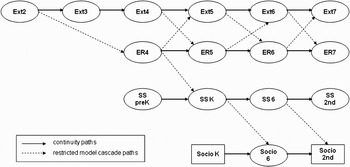
Figure 1 depicts a model that captures the influence of both early behavioral difficulties (externalizing problems) and emotion regulation on emerging social skills and peer acceptance in the early school years. This model focuses on the effects of child-driven processes and highlights the emerging emotion regulation skills that continue to influence and be influenced by a child's level of behavior problems over the course of early childhood (Degnan et al., Reference Degnan, Calkins, Keane and Hill-Soderlund2008; Hill et al., Reference Hill, Degnan, Calkins and Keane2006). To investigate this model, we use longitudinal data from a study of children at different levels of risk for externalizing behavior problems. We measured externalizing behavior problems from ages 2 through 7, and emotion regulation, social skills, and peer relationships as emerging competencies at ages 4 and 5. Peer acceptance was measured during kindergarten and second grade.
Conceptual model of hypothesized restricted cascade model. Numbers and grades denote year of data collection. Latent variables labeled 3 and 6 are placeholders to accommodate differential spacing of measurement. All models include within-time correlations (not shown) and paths from the prior model. Ext, externalizing; ER, emotion regulation; SS, social skills; preK, preschool assessment; K, kindergarten assessment; Socio, sociometric ratings; 2nd, second-grade assessment.

The first aim was to examine the stability of children's emotional and social functioning from 2 to 7 years of age. We expected significant stability across the time points for all of the constructs, with externalizing behavior showing the highest levels of stability over time. Our second aim was to examine a restricted cascade model across early development focused on the key paths outlined in Figure 1. First, externalizing behavior and children's emotion regulation were expected to show bidirectional effects over time. In addition, we expect children's early externalizing behavior will have a significant effect on their later emotion regulation skills, which would then impact their social skills, and finally their peer acceptance in second grade.
Because of the potential complex nature of multiple reciprocal processes linking emotional and social competence to peer acceptance across early childhood, our final aim is exploratory, and examines a full model including all possible cross-lag (cascade) paths. Given the exploratory nature of this model, no specific hypotheses are proposed.
Method
Recruitment and attrition
The current sample utilized data from three cohorts of children who are part of a larger ongoing longitudinal study. The goal for recruitment was to obtain a sample of children who were at risk for developing future externalizing behavior problems that was representative of the surrounding community in terms of race and socioeconomic status (SES). All cohorts were recruited through child day care centers, the County Health Department, and the local Women, Infants, and Children program. Potential participants for Cohorts 1 and 2 were recruited at 2 years of age (Cohort 1, 1994–1996; Cohort 2, 2000–2001) and screened using the Child Behavior Checklist (CBCL; Achenbach, Reference Achenbach1992) completed by the mother in order to oversample for externalizing behavior problems. Children were identified as being at risk for future externalizing behaviors if they received an externalizing T score of 60 or above. Efforts were made to obtain approximately equal numbers of males and females. A total of 307 children were selected. Cohort 3 was initially recruited when infants were 6 months of age (in 1998) for their level of frustration based on laboratory observation and parent report and followed through the toddler period (for more information, see Calkins, Dedmon, Gill, Lomax, & Johnson, Reference Calkins, Dedmon, Gill, Lomax and Johnson2002). From Cohort 3, children whose mothers' completed the CBCL at 2 years of age were included in the current study (n = 140). Of the entire sample (N = 447), 37% of the children were identified as being at risk for future externalizing problems. There were no significant demographic differences between cohorts with regard to gender, χ2 (2, N = 447) = 0.63, p = .73, race, χ2 (2, N = 447) = 1.13, p = .57, or 2-year SES, F (2, 444) = 0.53, p = .59. Cohort 3 had a significantly lower average 2-year externalizing T score (M = 50.36) compared to cohorts 1 and 2 (M = 54.49), t (445) = −4.32, p < .01.
Of the 447 original screened participants, six were dropped because they did not participate in any 2-year data collection. At 4 years of age, 399 families participated. Families lost to attrition included those who could not be located, moved out of the area, declined participation, and did not respond to phone and letter requests to participate. There were no significant differences between families who did and did not participate in terms of gender, χ2 (1, N = 447) = 3.27, p = .07, race, χ2 (1, N = 447) = 0.70, p = .40, 2-year SES, t (424) = 0.81, p = .42, or 2-year externalizing T score, t (445) = −0.36, p = .72. At 5 years of age 365 families participated including four that did not participate in the 4-year assessment. Again, there were no significant differences between families who did and did not participate in terms of gender, χ2 (1, N = 447) = 0.76, p = .38, race, χ2 (1, N = 447) = 0.17, p = .68, 2-year SES, t (424) = 1.93, p = .06), and 2-year externalizing T score, t (445) = −1.73, p = .09. At 7 years of age 350 families participated including 19 that did not participate in the 5-year assessment. Again, there were no significant differences between families who did and did not participate in terms of gender, χ2 (1, N = 447) = 2.12, p = .15, race, χ2 (3, N = 447) = 0.60, p = .90, and 2-year externalizing T score, t (445) = −1.30, p = .19. Families with lower 2-year SES, t (432) = 2.61, p > .01, were less likely to continue participation at the 7-year assessment.
Participants
The current sample included 440 children (212 male, 228 female). Children were an average of 31 months (SD = 3.67 months), 54 months (SD = 3.74 months), 68 months (SD = 3.25 months), and 92 months (SD = 4.31 months) at the 2-, 4-, 5-, and 7-year assessments, respectively. At the 2-year assessment, 67% were European American, 27% were African American, 4% were biracial, and 2% were Hispanic. At the 2-year assessment, the children were primarily from intact families (80%; single = 16%, divorced/separated = 4%) and families were economically diverse based on Hollingshead SES scores (M = 39.54, SD = 11.15; 1975). The 4-, 5-, and 7-year SES scores were on average 42.43 (SD = 10.64), 43.00 (SD = 10.44), and 44.78 (SD = 11.77), respectively. Hollingshead scores that range from 40 to 54 reflect minor professional and technical occupations considered to be representative of middle class.
Procedures
Children and their mothers participated in an ongoing longitudinal study when the children were 2, 4, 5, and 7 years of age. During the laboratory assessments, children and their mothers engaged in a series of tasks designed to elicit emotional and behavioral responding and mother–child interaction. At each laboratory assessment, mothers completed questionnaires assessing family demographics, their own functioning, and their child's behavior. School assessments were also conducted when children were in preschool, kindergarten, and second grade. Current analyses included maternal-reported questionnaire data from the laboratory assessments, teacher-reported questionnaire, and sociometric data from the school assessments.
Preschool assessment
Consent from the families was obtained to complete an assessment in the child's preschool classroom. Preschool teachers completed questionnaires that measured children's behavior problems, emotionality and regulation, child classroom social behavior, and children's social skills.
Kindergarten and second-grade assessment
Consent from the families was obtained to complete an assessment in the child's kindergarten classroom. This assessment did not take place until the children had at least 8 weeks in the classroom to become acclimated to their peers. Classroom sociometric ratings were conducted by trained graduate and undergraduate students who individually interviewed each child. The sociometric procedures used were a modified version of the Coie, Dodge, and Coppotelli (Reference Coie, Dodge and Coppotelli1982) procedure. Instead of asking children to nominate three peers they “liked most” and “liked least,” children were asked to give unlimited nominations for each category. This method allows for more reliable results and a reduction in measurement error (Terry, Reference Terry2000). Furthermore, this increased precision can be achieved with fewer classmates than are needed for the limited-choice nominations (Terry, Reference Terry2000). The mean rate of participation across classrooms was 84% (range = 68%–94%, number of reporters = 8–22), which is well within the acceptable range (Keane & Calkins, Reference Keane and Calkins2004). Sociometric data were collected in 158 classrooms for the current sample. The average number of students in a class was 20 (range = 10–27). Cross-gender nominations were permitted to increase the stability of measurement for the nominations to determine peer status. To ensure children had a good understanding of the questions, they were asked to go through several sample questions until they understood the task, and pictures of all of the participating children were provided as visual prompts. Interviewers were trained to provide further information and more examples if the child did not seem to grasp the questions. Teachers also completed questionnaires to assess the target child's social, emotional, and behavioral functioning in the school setting.
Measures
Externalizing behavior problems
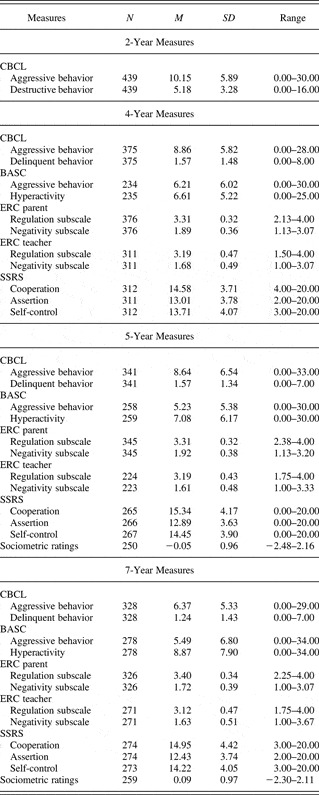
The CBCL was used to assess both externalizing and internalizing behaviors (Achenbach & Edelbrock, Reference Achenbach and Edelbrock1983). Mothers completed the CBCL for 2- to 3-year-olds when the children were 2 years of age (Achenbach, Reference Achenbach1992) and the CBCL for 4- to 18-year-olds when the children were 4, 5, and 7 years of age (Achenbach, Reference Achenbach1991). These scales have been found to be a reliable index of externalizing and internalizing behavior problems across childhood (Achenbach, Reference Achenbach1992; Achenbach, Edelbrock, & Howell, Reference Achenbach, Edelbrock and Howell1987). The measures for the current analysis included, at 2 years of age, the minor subscales of aggression and destructive behavior. At 4, 5, and 7 years of age, the minor subscales of aggression and delinquency were utilized (Table 1).
Descriptive statistics for study variables

Note: Descriptive statistics are reported for the original variables prior to rescaling for structural equation modeling analysis. CBCL, Child Behavior Checklist/2–3 (Achenbach, Reference Achenbach1992); BASC, Behavior Assessment System for Children (Reynolds & Kamphaus, Reference Reynolds and Kamphaus1992); ERC, Emotion Regulation Checklist (Shields & Cicchetti, Reference Shields and Cicchetti1997, Reference Shields and Cicchetti2001); SSRS, Social Skills Rating System (Gresham & Elliot, Reference Gresham and Elliott1990).
Teachers completed the elementary school version of the Behavior Assessment System for Children (BASC; Reynolds & Kamphaus, Reference Reynolds and Kamphaus1992). The BASC is a widely used behavior checklist that taps emotional and behavioral domains of children's functioning. The teacher elementary school version for children ages 2.5–5 contains 109 items, whereas the version for children ages 6–11 contains 148 items. Because some of the children in our sample turned 6 during the kindergarten year, it was necessary to give them the ages 6–11 version of the BASC. Each item on the BASC is rated on a 4-point scale with respect to the frequency of occurrence (never, sometimes, often, and almost always). The measure yields scores on broad internalizing, externalizing, and behavior symptom domains as well as nine specific content scales. The BASC has well-established internal consistency, reliability, and validity (Doyle, Ostrander, Skare, Crosby, & August, Reference Doyle, Ostrander, Skare, Crosby and August1997; Reynolds & Kamphaus, Reference Reynolds and Kamphaus1992). For the purpose of the present study, the raw specific content scales of aggression and hyperactivity were included.
Emotion regulation
Mothers and teachers completed the Emotion Regulation Checklist (Shields & Cicchetti, Reference Shields and Cicchetti1997, Reference Shields and Cicchetti2001), which assesses the reporter's perception of the child's emotionality and regulation. This measure includes 23 items rated on a 4-point Likert scale indicating how frequently the behaviors occur (1 = almost always to 4 = never). The emotion regulation subscale includes 8 items that assess aspects of emotion understanding and empathy and contains items such as “displays appropriate negative affect in response to hostile, aggressive or intrusive play” and “is a cheerful child.” The negativity subscale includes 15 items that assess aspects such as angry reactivity, emotional intensity, and dysregulated positive emotions and contains items such as “exhibits wide mood swings” and “is easily frustrated.” Validity has been established using correlations with observers' ratings of children's regulatory abilities and the proportion of expressed positive and negative affect (Shields & Cicchetti, Reference Shields and Cicchetti1997).
Social skills
The Social Skills Rating System (SSRS; Gresham & Elliot, Reference Gresham and Elliott1990) was completed by the child's teacher at each school assessment. Preschool teachers completed the preschool version that contains 30 items to assess social behavior. Kindergarten and second-grade teachers completed the elementary school version of the SSRS designed to assess children in kindergarten through sixth grade. The elementary school version is a 57-item behavior rating system that measures children's social behavior in the classroom including social skills, academic competence, and problem behavior. On each version, teachers report on the frequency in which children engage in a variety of social behaviors (0 = never, 1 = sometimes, 2 = very often) and how important each of these behaviors is for the child's development (0 = not important, 1 = important, 2 = critical). The SSRS has well-established internal consistency (α = 0.78–0.95), reliability, and criterion-related validity with the CBCL (−0.64). The current study utilized the raw scores of cooperation, assertion, and self-control. Higher scores indicate better social skills.
Sociometric nominations
Children's likability was assessed based on peer sociometric ratings during kindergarten and second grade. A social preference score was obtained from the sociometric procedures. The total number of nominations for “like most” and “like least” were standardized to obtain two separate z scores, which were subsequently subtracted to compose a social preference score (z “like most” –z “like least” = social preference; Coie et al., Reference Coie, Dodge and Coppotelli1982). Social preference was then standardized within classrooms after computing the difference score. Lower scores represented less likeability, whereas higher scores represented greater likeability. This is a widely used technique for assessing a child's overall likeability or peer acceptance within the classroom (Jiang & Cillessen, Reference Jiang and Cillessen2005). The descriptive statistics for all study variables are presented in Table 1.
Analysis plan
Longitudinal measurement models
Several longitudinal factors were fit in an attempt to adequately account for the covariances among the observed scores over time because there were several indicators of the major constructs. For example, externalizing behaviors were measured by parent ratings of aggression and destructive and teacher reports of hyperactivity and aggression at ages 4, 5, and 7. As recommended by Kline (Reference Kline2005), indicators of latent variables were rescaled so that the difference in variance between each of the indicators was not more than 10, which facilitates model convergence (maternal-reported aggressive behavior 0.2 and destructive/delinquency 2; teacher reported hyperactivity and destructive behavior 0.2; maternal and teacher reported emotion regulation and negativity 5). We first fitted two longitudinal factor models that differed in the number and types of factors. Once the factor structure was determined, we examined the invariance of the factor loadings (Meredith, Reference Meredith1964a, Reference Meredith1964b, Reference Meredith1993) across age.
In the first model, trait model, there were externalizing factors at ages 2, 4, 5, and 7 as well as emotion regulation and social skills factors at ages 4, 5, and 7. All common factors were allowed to covary, and unique covariances between the same measurement instruments across time were estimated (e.g., mother rated aggression at ages 2, 4, 5, and 7). In the second model, trait plus informant model, we examined the need for four informant factors as the data were collected from mother and teacher reports. Thus, the data represent a modified longitudinal multitrait–multimethod (Campbell & Fiske, Reference Campbell and Fiske1959; Widaman, Reference Widaman1985) design where multiple traits were crossed with multiple methods across time (Grimm, Pianta, & Konold, Reference Grimm, Pianta and Konold2009). Informant factors may be necessary because behavior rating scales often show considerable informant variance (e.g., Konold & Pianta, Reference Konold and Pianta2007). The four informant factors were a global mother factor and three teacher factors (one at ages 4, 5, and 7) when teacher reports were available. Teacher factors were indicated by all of the ratings made by the child's teacher at that age. The mother factor was indicated by all of the ratings made by the child's mother, regardless of age. Informant factors were assumed to be uncorrelated with trait factors for identification purposes. Once the factor structure was determined, we examined longitudinal measurement invariance by constraining the factor loadings of the same observed score to be the invariant across age. This was done for trait and informant factors.
Autoregressive cross-lag models
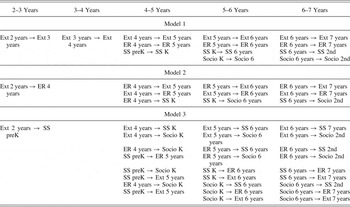
Once the factor structure was determined, we examined the longitudinal associations by fitting a series of models for the trait factors (Table 2). In these models, sociometric nomination data (at ages 5 and 7) were also included. The first model (continuity model) allowed for all autoregressive paths, where each factor was predicted by itself at the previous time. The second model, a restricted model based on Burt et al. (Reference Burt, Obradović, Long and Masten2008), allowed for all autoregressive paths, where each factor was predicted by itself at the previous time, and a specific series of cross-lag paths (i.e., cascade effects). The cross-lag paths included longitudinal associations between externalizing and emotion regulation from 2 to 7 years of age, as well as emotion regulation at age 4 to social skills at age 5, and social skills at age 5 to sociometric nominations at age 7. The third (full model), more exploratory autoregressive cross-lag model, included all possible cross-lag effects between externalizing, emotion regulation, social skills, and sociometric nominations. In both models, autoregressive coefficients were forced to be equal across time and the differential spacing of measurements was accommodated with the addition of latent variable placeholders (see McArdle, Reference McArdle, Cudeck, du Toit and Sorbom2001). All models were fit using Mplus v. 5.0 and full information maximum likelihood estimation was used to handle incomplete data.
Results
Longitudinal measurement model
Fit statistics and parameter estimates from the trait model, χ2 (476) = 2351, root mean square error of approximation (RMSEA) = 0.094, comparative fit index (CFI) = 0.758, Tucker–Lewis index (TLI) = 0.698, suggested the model was unable to adequately capture the covariation structure of the data as several correlations among the common factors were greater than |1|. The fit of the trait plus informant model, χ2 (435) = 847, RMSEA = 0.046, CFI = 0.947, TLI = 0.927, was statistically better than the fit of the trait model, Δχ2 = 1504, Δdf = 41, and the global fit indices were in the adequate to good range. Behavior ratings tended to show a considerable amount of informant variance; thus, it was important to account for this variability. However, some convergence issues remained. These issues were with unique covariances, which were unstable because unique variances tended to be small. Measurement invariance was then examined with the trait plus informant model. The invariance model fit statistically worse, Δχ2 = 97, Δdf = 31, p < .01; however, global fit indices were still good (CFI = 0.938, TLI = 0.921, RMSEA = 0.048), indicating the invariance model was an adequate representation of the data. Factor correlations from the measurement model are included in Appendix A.
Longitudinal autoregressive models
The first longitudinal model, which assessed the stability in constructs over time, fit the data well, χ2 (565) = 1155, CFI = 0.925, TLI = 0.911, RMSEA = 0.048. All autoregressive paths were positive and significantly different from zero, suggesting that the child's behavior (e.g., externalizing) at any age was related to his/her behavior at the previous occasion.
Longitudinal cross-lag models
The first longitudinal cross-lag model, based on Burt et al. (Reference Burt, Obradović, Long and Masten2008), fit the data well, χ2 (562) = 1149, CFI = 0.925, TLI = 0.911, RMSEA = 0.048 (Table 3). The restricted model fit statistically marginally better than the autoregressive model, Δχ2 = 6.61, Δdf = 3, p < .10. All autoregressive paths were positive and significantly different from zero, suggesting that the child's behavior (e.g., externalizing) at any age was related to his/her behavior at the previous occasion. In terms of cross-lag paths, only the path from social skills to sociometric nominations was significantly different from zero. The cross-lag coefficient was positive, suggesting that a child's social skills at a given occasion were positively related to the child's subsequent sociometric nominations controlling for previous levels of sociometric nomination. Thus, children with higher levels of social skills showed greater increases in subsequent popularity. Within-time correlations between constructs, after taking into account their autoregressive and cross-lag effects, ranged from .03 to .93. Notably, emotion regulation and social skills were strongly positively related (r = .85 to .93); externalizing behaviors and social skills were negatively related (r = −.07 to −.18), and emotion regulation was negatively correlated with externalizing behaviors (r = −.23 to −.36). Sociometric nominations were not strongly correlated with emotion regulation (r = .03 to .11), externalizing behavior (r = −.04 to −.05), or social skills (r = −.08 to −.13).
The second longitudinal cross-lag model, which was a complete exploratory cross-lag model, also fit the data well, χ2 (554) = 1123, CFI = 0.928, TLI = 0.913, RMSEA = 0.048, and fit statistically better than the restricted cross-lag model, Δχ2 = 25.40, Δdf = 8, p < .01. This model led to a different representation of cascade effects. In this model, autoregressive coefficients for externalizing behaviors and sociometric nominations were significantly different from zero. In terms of cascade effects, social skills was found to have an effect on subsequent levels of externalizing behaviors controlling for previous levels of externalizing behavior, emotion regulation, and sociometric nominations when available. The coefficient was negative, suggesting that children with greater social skills showed greater decreases in externalizing behavior at the next occasion. In addition, the cross-lag paths from emotion regulation to externalizing behavior were significant. The coefficient was negative suggesting that higher levels of emotion regulation showed greater decreases in subsequent levels of externalizing behavior problems, controlling for earlier levels of externalizing behavior. No other cross-lag effects were significantly different from zero.
Discussion
The present study examined a cascade model of children's early emotional and social competence and children's peer acceptance. A cascade analysis allows for an understanding of how complex developmental phenomena emerge across early childhood as well as being able to identify bidirectional influences over time among these phenomena. Research that simultaneously examines multiple domains of behavior over time fits within a developmental psychopathology perspective that promotes a view of development in which multiple factors, or levels of a given factor, are considered in context of one another rather than in isolation (Cicchetti & Dawson, Reference Cicchetti and Dawson2002; Cicchetti & Rogosch, Reference Cicchetti and Rogosch1996). The present investigation examined a series of longitudinal structural equation models utilizing a multimethod multitrait approach that specifically controlled for shared rater variance, which is a common limitation when informant's ratings are used to assess children's behavioral functioning (Konold & Pianta, Reference Konold and Pianta2007). Given that several studies have found associations among early emotional and social functioning such as disruptive behavior and children's regulatory abilities with children's classroom experiences, we were particularly interested in the indirect effects of externalizing behavior and emotion regulation on later social skills and children's peer acceptance. Specifically, we examined cascade effects from 2-year externalizing behavior to 4-year emotion regulation, which was then hypothesized to predict kindergarten social skills to levels of children's peer acceptance in second grade. Overall, the results provide some evidence for the role of cascade effects in early development, although the cascade effects found were not always consistent with our specific hypothesis. These results underscore the importance of utilizing complex models for identifying bidirectional and cross-domain effects across early childhood.
The first aim was to examine the stability of children's externalizing behavior, emotion regulation, social skills, and peer acceptance across early childhood. The models tested controlled for shared rater variance, which is a common problem in longitudinal studies that rely on parent and teacher ratings of children's behavioral functioning, thereby providing a more stringent test of stability among each construct over time. The continuity model, which tested the autoregressive paths among each construct, indicated that that there was stability in all of the behaviors assessed (externalizing behavior, emotion regulation, social skills, and peer acceptance) across early childhood. Specifically, a child's behavior at the earlier assessment was predictive of their behavior at the later assessment.
A different picture emerged, however, when the cascade paths (i.e., cross-lag paths) were included in the model. The full exploratory model, that included all cascade paths, indicated that only children's externalizing behavior from 2 to 7 years of age and peer acceptance from kindergarten to second grade exhibited stability, suggesting that children's ability to regulate their emotions and the social skills they utilize in the classroom are not stable across the period examined. Previous research with the same sample found that children's emotion regulation generally increases over time from 4 to 7 years of age (Blandon et al., Reference Blandon, Calkins, Keane and O'Brien2008). Developments in brain regions associated with regulatory functioning, such as the maturation of the prefrontal cortex and anterior cingulated cortex are potential mechanisms underlying these improvements (Ochsner, Bunge, Gross, & Gabrieli, Reference Ochsner, Bunge, Gross and Gabrieli2002; Ochsner & Gross, Reference Ochsner and Gross2005). During this time children develop the capacity to utilize more complex strategies, such as reappraising negative events or planning to avoid distressing or difficult situations (Larsen & Prizmic, Reference Larsen, Prizmic, Baumeister and Vohs2004); it may be the case that although they are using more strategies that they may not always prove effective, which may influence their stability over time.
Another potential explanation that emerges from a transactional perspective, and may be particularly relevant for the social skills that children are able to utilize in the classroom, is that the environmental changes that are occurring across early childhood may impact the development of children's competencies. Across this period there are changes in classroom management practices that may account for differences in children's ability to behave appropriately within the classroom, including increasing expectations for socially appropriate behavior and increasingly structured events (La Paro, Rimm-Kaufman, & Pianta, Reference La Paro, Rimm-Kaufman and Pianta2006). Given that children also have different teachers every year, and that classroom management strategies are likely to differ across different classroom, it is not necessarily surprising that children's social skills in the classroom across early childhood are not stable.
The second aim was to examine whether the longitudinal cascade paths between externalizing behavior and emotion regulation and whether early externalizing behavior indirectly influences later peer acceptance through developments in earlier emotion regulation and social skills (Figure 1). The picture that emerged was somewhat different based on the restricted model that only tested these specific cascade paths (Figure 1) and the full model that examined all possible cascade paths (Table 2). Contrary to our expectations, the results from the restricted model indicated that there was not a bidirectional relation over time between children's externalizing behavior and their emotion regulation. There was, however, some evidence of cascade effects based on the full model indicating that children's ability to regulate their emotions influenced their later levels of externalizing behavior. Specifically, it appears that children with higher levels of emotion regulation evidence decreases in their subsequent externalizing behavior. This is consistent with a considerable body of research that has found that when children are unable to manage or modulate their emotions, particularly in frustrating and difficult situations, that they are at risk for increased levels of aggressive and disruptive behavior problems, difficulties with peers, and later psychopathology (Calkins, Gill, Johnson, & Smith, Reference Calkins, Gill, Johnson and Smith1999; Eisenberg et al., Reference Eisenberg, Cumberland, Spinrad, Fabes, Shepard and Reiser2001; Keenan, Reference Keenan2000; Shipman, Schneider, & Brown, Reference Shipman, Schneider, Brown and Beauregard2004).
Longitudinal structural equation modeling models tested in the cascade analysis

Note: The numbers denote the year of data collection. Years 3 and 6 are latent variable placeholders to accommodate differential spacing of measurement. Model 1 is the continuity model in which autoregressive paths are included in all subsequent models; Model 2 is the restricted model, which is included in subsequent models; and Model 3 is the full exploratory model. Ext, externalizing; ER, emotion regulation; SS, social skills; preK, preschool assessment; K, kindergarten assessment; 2nd, second-grade assessment; Socio, sociometric ratings.
Standardized path coefficients for all cascade paths from the restricted and full exploratory models
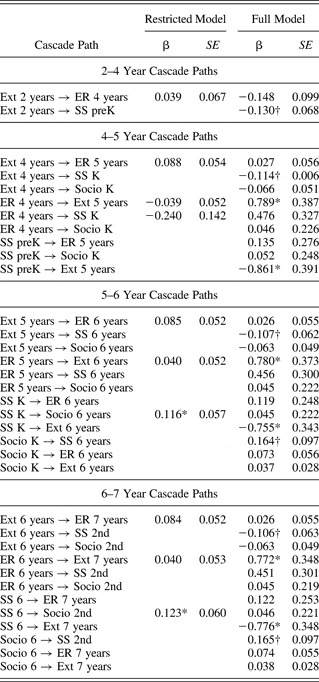
Note: The numbers denote the year of data collection, with three and six latent variable placeholders to accommodate differential spacing of measurement. Ext, externalizing; ER, emotion regulation; SS, social skills; preK, preschool assessment; K, kindergarten assessment; Socio, sociometric ratings; 2nd, second-grade assessment.
†p < .10. *p < .05.
Other avenues of research point toward reciprocal interactions between early externalizing behavior problems and children's early emotion regulation skills across early childhood (Calkins & Keane, Reference Calkins and Keane2009). For instance, when children exhibit early high levels of externalizing behavior problems they may be more limited in their opportunities in which they are exposed to situations that may offer opportunities to learn strategies to manage their emotions. This may be partly attributable to parents' reluctance to take difficult children to certain places or limit their peer interactions. It is also important to note that children's emotion regulation is just one component process of a set of self-regulatory behaviors that develop during childhood. Self-regulation has been identified as a set of processes, including physiological, attentional, emotional, and cognitive control (Calkins, Reference Calkins, Olson and Sameroff2009; Calkins & Keane, Reference Calkins and Keane2009). These self-regulatory processes are hypothesized to be hierarchically organized and linked over time such that earlier regulatory developments such as children's capacity for physiological regulation and attentional control support the development of later abilities (Calkins, Reference Calkins, Olson and Sameroff2009). In the current investigation we focused specifically on children's capacity for regulating their emotions, which could account for the lack of bidirectional effects. Given that children's physiological and attentional self-regulatory processes are theorized to emerge earlier in development, they may be more likely to exhibit bidirectional relations with children's externalizing behavior particularly during the toddler and preschool years.
In addition to longitudinal associations among children's externalizing behavior problems and emotion regulation, the other cascade paths tested in the restricted model included children's emotion regulation at age 4, predicting children's social skills in the classroom during kindergarten, which was expected to predict classroom peers reports of child acceptance in second grade. Contrary to our expectations, only the cascade path from children's social skills within the classroom to sociometric nominations was significant, suggesting children with higher levels of social skills in the classroom show greater increases in subsequent popularity. Cascade effects, therefore, were evident but not until children entered school. It appears that the domain of social competence that is most important for children's peer acceptance in school is how they are able to behave in school. There is some research to suggest that when children are able to engage in more prosocial interactions with peers, such as sharing, they have higher levels of peer acceptance (Erhardt & Hinshaw, Reference Erhardt and Hinshaw1994; Ladd et al., Reference Ladd, Price and Hart1988).
The final goal was more exploratory, given that we expected there to be complex interactions among the multiple developmental phenomena from 2 to 7 years of age. We examined all possible cascade paths to fully explore potential cross-domain and reciprocal associations that within the cascade model context may be relevant for understanding children's early social and emotional development. In terms of cascade effects, social skills was found to have an effect on subsequent levels of externalizing behaviors controlling for previous levels of externalizing behavior, emotion regulation, and sociometric nominations when available. Specifically, children with greater social skills in the classroom showed greater decreases in externalizing behavior at the next occasion. Children's social skills, such as the ability to cooperate and exhibit self-control in the classroom, may reflect some aspect of children's ability for behavioral regulation. Indeed, children's ability to comply with adult directives and mange impulsive responses are key aspects of children's behavioral regulation (Kopp, Reference Kopp1982; Kuczynski & Kochanksa, Reference Kuczynski and Kochanska1995), which are thought to be important for their transition into the school environment. It is also possible that aspects of the school environment may support children's capacity to regulate their behavior. Indeed, the increased structure that occurs from preschool through second grade may facilitate the development of children's behavioral regulation, which then may reduce their disruptive behavior overall, not just in the classroom. In addition, the peer group may also attempt to socialize children's emotion regulation through specific types of negative treatment, such as peer victimization or exclusion (Salisch, Reference Salisch2001), that over the course of the school year influences children's level of disruptive behaviors. No other significant cross-lag effects were found.
The study has some limitations that must be noted. First, the sample was overselected for externalizing behavior problems, and thus may not be representative of community samples. Although there was still a normal range of behavior problems exhibited within the sample. It may actually be the case that a more extreme group approach may be more conducive to testing the model that externalizing behavior is a leading indicator in a cascade of effects across early development that influence later peer acceptance. Second, it has been proposed that the strongest argument for cascade models can be established when the study is longitudinal, there are at least three assessment points, and each construct is measured at each time point (Masten et al., Reference Masten, Roisman, Long, Burt, Obradović and Riley2005). In the current study, emotion regulation was not assessed at age 2, which limits some of the conclusions that can be made; given the current results, it may be the key factor in understanding the cascade of emotional and social development across early childhood.
This study extends the literature on the role that emotional and social competence plays in early peer relationships in a number of directions. First, although there are a number of studies that address the predictors of peer acceptance, few studies have explored multiple domains of children's early social and emotional competence across early childhood, utilizing a cascade model that accounts for shared rater variance, within-time correlations and continuity within constructs over the period examined. This research clearly indicates that understanding the reciprocal relations of multiple developmental phenomena over time is necessary for developing a more clear understanding of the pathways to both typical and atypical social outcomes. Further research needs to address how these developmental processes interact across early childhood with a focus on the role of both child and contextual factors. This will allow for developing a more precise understanding of the cascade of effects over time.
Appendix A
Factor correlations from the measurement model

Note: The numbers denote the year of data collection. Ext, externalizing; ER, emotion regulation; SS, social skills; preK, preschool assessment; K, kindergarten assessment; 2nd, second-grade assessment.
*p < .05. **p < .01. ***p < .001.