I. INTRODUCTION
Syndiotactic polystyrene (sPS) has received a great deal of interest because of its high melting temperature, high crystallization rate, low dielectric constant, good chemical resistance, and good irradiation resistance. The structure, quantity, and form of crystalline materials in an sPS material are complex and vary greatly depending on the thermal history and solvent treatment.Reference Evans, Kellar, Knowles, Galiotis, Carriere and Andrews1–Reference Lu, Zhao, Chen, Xiong, Zhang, Mai and Wu16 Both α- and β-crystalline forms are obtained by cooling from the melt,Reference Evans, Kellar, Knowles, Galiotis, Carriere and Andrews1 whereas γ and δ are induced by a solvent.Reference Guerra, Vitaglian, Rosa, Petraccone and Corradini2 α and β crystals exist mainly between limit disordered (α′ and β′) and limit ordered (α″ and β″). The α form has a hexagonal structure,Reference Rosa3,Reference Cartier, Okihara and Lotzs4 whereas the β form possesses an orthorhombic shape.Reference Guerra, Vitaglian, Rosa, Petraccone and Corradini2,Reference Ho, Lin, Tsai and Woo6 Guerra et al.Reference Guerra, Vitaglian, Rosa, Petraccone and Corradini2 observed that the crystalline structure of sPS that is produced by cooling from the melting point consists of both α″ and β′ forms.
The multiple endothermic peak phenomenon frequently observed for sPS cooling from the melt has also been investigated. Woo et al.,Reference Woo, Sun and Lee7 Lin and Woo,Reference Lin and Woo8 and Hong et al.Reference Hong, Jo, Lee and Kim9 identified the high, intermediate, and low melting peak temperatures correspond to β′, α, and β forms, respectively. Wang et al.Reference Wang, Hsu and Lo10 agreed the low and intermediate melting peaks correspond to β and α forms, respectively, but they believed that the high melting peak is a mixture of α and β. For isothermal crystallization of sPS, Zhou et al.Reference Zhou, Lu and Mai11 and Rosa et al.Reference Rosa, de Ballesteros, Gennaro and Auriemma12 found that the crystallization temperature and annealing time increase with increasing amount of β and decreasing amount of α. Adding to this morphological complexity of sPS is the transformation from one crystalline form to another during crystallization under different conditions. For example, Ho et al.Reference Ho, Lin, Hseih and Chung13 reported a phase transformation from α″ to β′ in sPS crystallized at 245 °C for different times. Recently, Lu et al.Reference Lu, Zhao, Chen, Xiong, Zhang, Mai and Wu16 found that the lower nucleation energy is beneficial for the formation of the α form in melt-crystallized sPS.
sPS is being used as a scintillator material in high-energy radiation, and much research has focused on the effects of gamma ray radiation on its mechanical and optical properties.Reference Pruit17–Reference Lin, Ming and Lee19 Our previous study on crystallization behaviors from the melt of gamma-irradiated sPS in oxygen and vacuum revealed that the irradiation conditions have a strong effect on the chemical properties and microstructure of this polymer.Reference Liu, Nguyen, Yang and Lee15 In addition to causing extensive oxidation and chain scission, gamma radiation treatment also increased the crystallinity and decreased the melting peak temperatures of sPS. By using Gaussian function to resolve the multiple overlapping peaks in the heat flow thermograms, we showed quantitatively that gamma irradiation at a high dose strongly accelerates the formation of the β′-crystalline form in sPS materials. The primary objective of the present study was to investigate the isothermal melt-crystallization kinetics of sPS that had been irradiated in air with gamma radiation at different doses. In addition, the effects of crystallization time on the melting enthalpies and amounts of different crystalline forms generated during the isothermal crystallization of gamma-irradiated sPS were also examined. Differential scanning calorimetry (DSC) technique was used to provide isothermal crystallization kinetics of sPS irradiated with gamma rays in air.
II. EXPERIMENTAL PROCEDURES
A. Materials and gamma ray irradiation
sPS pellets were obtained from Dow Chemical Company (Midland, MI). This material had a number average molecular mass of 3.5 × 10⁵ g/mol, a DSC glass transition temperature (T g) of 99.6 °C, and contained unknown additives having a concentration of approximately 0.1–0.5 ppm. The sample preparation was the same as given in Ref. Reference Liu, Nguyen, Yang and Lee15. Briefly, sPS sheets were fabricated by molding dry sPS pellets in a press at 300 °C, followed by quenching in 0 °C water to produce transparent samples. After grounding and polishing, sPS sheets were annealed at 90 °C for 24 h to remove residual stresses.
Samples having a dimension of 5 × 5 × 1 mm (about 8 mg) were then placed in air-filled glass tubes having outer and inner radii of 15 and 2.5 mm, respectively, for gamma radiation treatment. They were irradiated at 24 °C at different doses from 200 to 800 kGy at a rate of 30 kGy/h using a Co-60 gamma source at Radiation Application Technology Center in Institute of Nuclear Energy Research (Tauyuan, Taiwan).
B. Measurements of isothermal crystallization behaviors
Isothermal crystallization behaviors of sPS irradiated with gamma rays in air were followed using a Netzsch DSC 200F3 differential scanning calorimeter (Netzsch, Germany). Except for the crystallization time, this study used the same special heating/cooling/holding/heating procedure described previously.Reference Liu, Nguyen, Yang and Lee15 Briefly, after heating to the melt temperature at 310 °C, the samples were cooled down to a prespecified crystallization temperature (T c) in the 220–260 °C range, held at that specified T c for a fixed crystallization time, then heated up again. DSC thermograms during this isothermal crystallization cycle were recorded. We found that this scheme can provide DSC thermograms containing resolvable melting endothermic peaks that are tenable for analyzing the crystallization behaviors of gamma-irradiated sPS. The heat flow characteristics and the thermal history for the samples used in this study were the same with those presented in Fig. 1 of Ref. Reference Liu, Nguyen, Yang and Lee15. The main thermal history difference between the present study and the previous workReference Liu, Nguyen, Yang and Lee15 was the duration at each crystallization temperature. The previous study used a fixed 10-min crystallization time, whereas the present study varied the crystallization time. Another difference was the material: the previous investigation irradiated sPS samples in vacuum and oxygen, whereas this study irradiated sPS samples in air.
In addition to DSC, Fourier transform infrared (FTIR) spectroscopy and x-ray diffraction (XRD) studies were also conducted to characterize chemical and microstructural changes of irradiated sPS. FTIR measurement was carried out using a Nicolet AVATAR 320 FTIR spectrometer in the attenuation total reflection (ATR) mode (Thermo Electron Corp., Madison, WI), and XRD used a Rigaku D/MAX-IIB diffractometer (Shibuya-Ku, Tokyo, Japan). More complete details of all three measurements were given in Ref. Reference Liu, Nguyen, Yang and Lee15.
III. RESULTS AND DISCUSSION
A. Melting enthalpies and crystallinity as a function of crystallization time for different crystalline forms in sPS irradiated with gamma rays in air
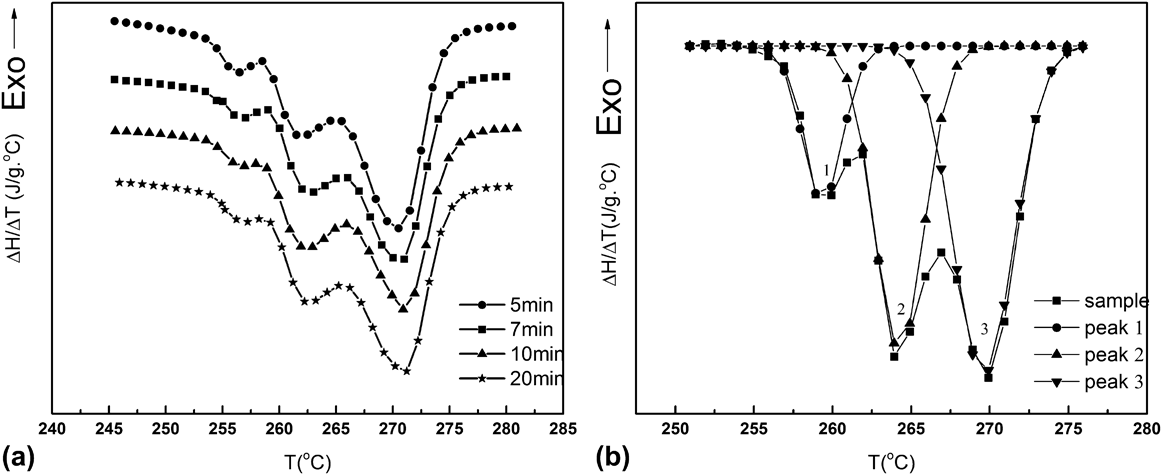
sPS is known to crystallize rapidly from the melt and tends to crystallize before the crystallization temperature (T c) is reached. Further, depending on crystallization conditions, crystalline materials in an sPS material may change from one form to another during crystallization. Therefore, the heat flow curve of sPS crystallization is very complex, comprising of multiple overlapping peaks representing various crystalline forms. This intricate behavior often complicates the analysis of sPS crystallization data. When sPS is irradiated with gamma rays, its chemical and morphological properties are greatly changed, and its melting behaviors are markedly altered.Reference Liu, Nguyen, Yang and Lee15 Such a strong radiation effect on the microstructure and phase changes makes the study of crystallization kinetics of gamma-irradiated sPS even more challenging. As indicated in the experimental section, to effectively study the crystallization characteristics of gamma-irradiated sPS, we have used a particular heating/cooling/holding scheme to generate resolvable endothermic peaks in the heat flow curves. Figure 1(a) representatively displays such curves in the 250–285 °C range for sPS irradiated with gamma rays in air (air gamma-irradiated sPS). These are the DSC thermograms at four different crystallization times (t) for an sPS sample irradiated at a 400 kGy dose followed by isothermally crystallizing at T c = 230 °C. It is noted here that because numerous experimental irradiation and crystallization variables were included in this study, unless specified, only representative graphical results are presented in this paper to show the effects of some key variables. Figure 1(a) shows that the DSC curves of air gamma-irradiated sPS material crystallized at 230 °C composed of three endothermic peaks. Similar three melting peak curves were also observed for other T c values in the 220 °C ≤ T c ≤ 242 °C range. However, only two melting peaks were detected for DSC curves at T c = 250 °C and only one peak for T c = 260 °C. In general, crystallization time, crystallization temperature, and gamma radiation dose had a strong influence on the endothermic peak areas (proportional to crystalline fractions and heats of melting) and crystallization kinetic parameters but imparted only a small effect on the melting peak temperatures of air gamma-irradiated sPS (see Tables I–V).
(a) Typical DSC thermograms in the 245–280 °C range for different crystallization times of sPS irradiated in air with gamma rays at, as an example, 400 kGy and isothermally crystallized at 230 °C, showing overlapping melting endothermic peaks, and (b) typical deconvoluted Gaussian functions for sPS irradiated in air with gamma rays at, as an example 800 kGy, and isothermally crystallized at 240 °C for 15 min.

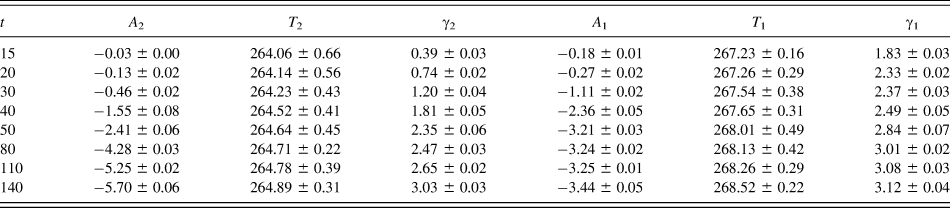
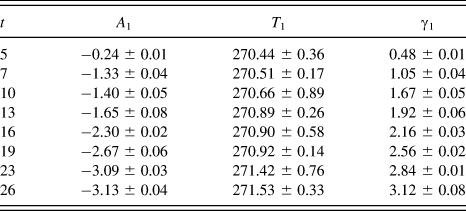
Effect of crystallization time t (min) on A i (J/g, °C), T i (°C), and γi (°C) for sPS irradiated in air at 800 kGy and crystallized at 240 °C; i = 1, 2, and 3.
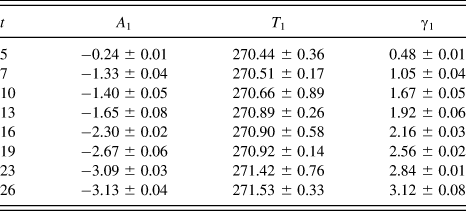
Effect of crystallization time t (min) on A i (J/g, °C), T i (°C), and γi (°C) for sPS irradiated at 800 kGy and crystallized at 250 °C; i = 1 and 2.
Effect of crystallization time t (min) on A i (J/g, °C) and γi (°C) for sPS irradiated at 800 kGy and crystallized at 260 °C; i = 1.
Glass transition temperature of sPS, T g, as a function of Φ.

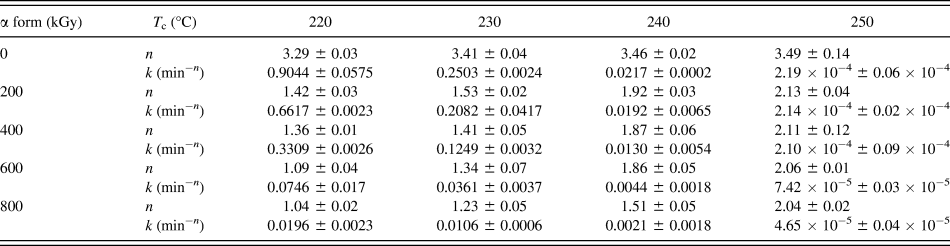
Dependence of exponent n and crystallization rate k on T c and radiation dose for crystalline α in air-irradiated sPS.
As seen in Fig. 1(a), the multiple endothermic peaks corresponding to the melting behavior of various crystalline forms in air gamma-irradiated sPS overlapped with each other. To provide quantitative data for accurately assessing the effects of crystallization and irradiation conditions on the melting enthalpy and the amount of each crystalline form in the gamma-irradiated sPS material, these endothermic peaks were resolved through the use of Eq. (1). The melting enthalpy change with temperature of the endothermic envelop composing of multiple Gaussian distributions is written as:
 $${{\Delta H} \over {\Delta T}} = \mathop\sum\limits_{i = 1}^n {{A_i}\exp \left[ { - {{\left( {{{T - {T_i}} \over {{{\rm{\gamma }}_i}}}} \right)}^2}} \right]} + B\quad ,$$
where ΔH, A i, T i, and γi denote the melting enthalpy fraction corresponding to temperature change from T to T + ΔT, peak amplitude, melting peak temperature, and the Gaussian radius, respectively; B is a constant. Integer n can be 1, 2, or 3, and subscript i corresponds to the ith peak of the endotherm. When n = 3, the endothermic peaks 1, 2, and 3 are designated as P1, P2, and P3 corresponding to the crystalline forms β, α, and β′, respectively.Reference Liu, Nguyen, Yang and Lee15
Figure 1(b) provides an illustration of using Eq. (1) to fit the experimental data for, as an example, an sPS sample gamma-irradiated at 800 kGy and isothermally crystallized at 240 °C for 15 min. Values of the parameters used to fit the experimental data corresponding to this T c are given in Table I, which also include values for other crystallization periods. Note that at this T c, three endothermic peaks corresponding to the three crystalline forms are present. All A i and γi values increased with an increase in t, and each melting peak temperature, T i, raised about 1 °C when t was increased from 5 to 50 min. Tables II and III provide values of parameters A i, T i, and γi for sPS samples irradiated at the same dose but crystallized at 250 and 260 °C, respectively. For these two high T c values, the changes of both A i and γi with t followed the same trend with those for T c at 240 °C but essentially had no effect on T i. In summary, sPS samples irradiated with gamma rays in air at doses from 0 to 1000 kGy composed three crystalline forms, β, α, and β′ when they are crystallized in the 220–242 °C range. They contained two crystalline forms, α and β, when T c = 250 °C and had only the β form when T c = 260 °C.
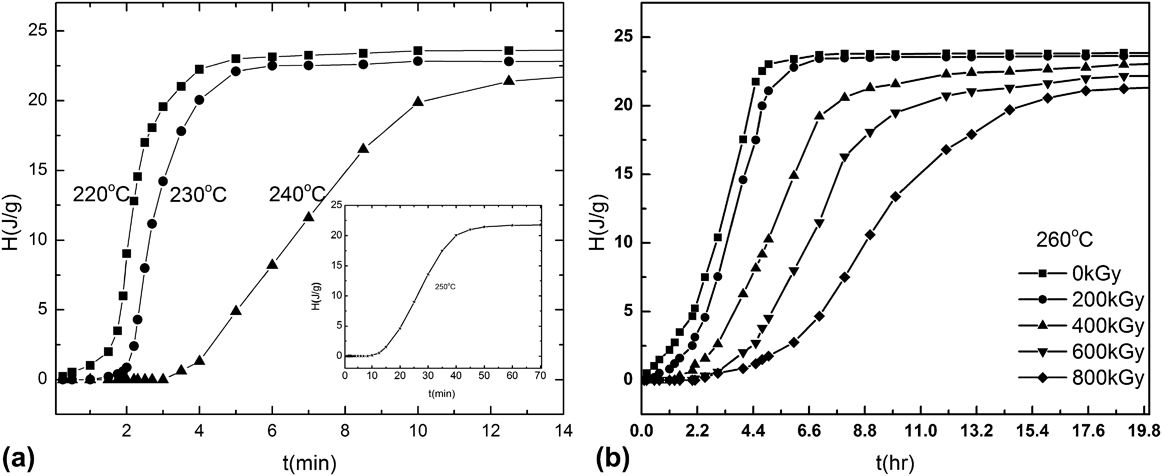
Using the Gaussian function deconvolution procedure described above, the effects of gamma radiation dose and crystallization conditions (t and T c) on melting enthalpy, amount of each crystalline form, and crystallization kinetics of air gamma-irradiated sPS were quantitatively investigated. Figure 2 depicts the total melting enthalpy (H) (i.e., sum of all three peaks and is proportional to crystallinity of the sample) with crystallization time for four T c values. Note that the 250 °C results are displayed in the inset because the crystallization time scale for this T c is considerably greater than that for T c at 220, 230, or 240 °C. If data of all four crystallization temperatures were presented in the same graph, the differences between the H versus t curves for the three lower T c values cannot be readily seen.
Plots of total melting enthalpy versus t for sPS irradiated in air with gamma rays: (a) at 400 kGy and isothermally crystallized at different T c values and (b) at different doses and isothermally crystallized at 260 °C.
Figure 2(a) shows a general S shape curve, similar to that observed for nonirradiated sPS.Reference Cimmino, Di Pace, Martuscelli and Silvestre20 However, the induction time (defining here as the time between 0 and the steep rise of the melting enthalpy), the rate of H change with crystallization time, and the time required to reach a constant H value changed greatly with T c for air gamma-irradiated sPS. The induction period rose, the rate of H change with t decreased, and the time required to complete the crystallization markedly increased with increasing T c. As revealed in Fig. 2(a), the crystallization started almost immediately at T c = 220 °C, but it needed an induction period of more than 10 min for this phase change to begin at 250 °C. Similarly, the crystallization time to attain a saturated amount of crystalline material increased with increasing T c. For example, it took approximately 5 min to complete the crystallization at T c = 220 or 230 °C but needed nearly 1 and 11 h for all crystalline materials to form in the air gamma-irradiated sPS crystallized at T c = 250 and 260 °C, respectively. Obviously, the crystallization was faster, and the enthalpy change rate was higher when the difference between the melting temperature and the crystallization temperature was greater.
The effect of gamma radiation dose on melting properties is demonstrated in Fig. 2(b), where the dependence of H on t at different doses is plotted for the highest T c used in this study (260 °C). The 0 kGy results represent the nonirradiated sPS material. It is interesting to observe from Fig. 2(b) that although the degree of influence is different, an increase in the gamma radiation dose had a similar effect on the H versus t behaviors as an increase in T c. That is, the induction period and the time required to attain full crystallinity in the sample increased, whereas the rate of H change with t decreased with an increase of the radiation dose. Further, for a given t, the total melting enthalpy increased with decreasing dose. Similar effects have also been observed for other T c values used in this study (220 °C ≤ T c ≤ 260 °C).
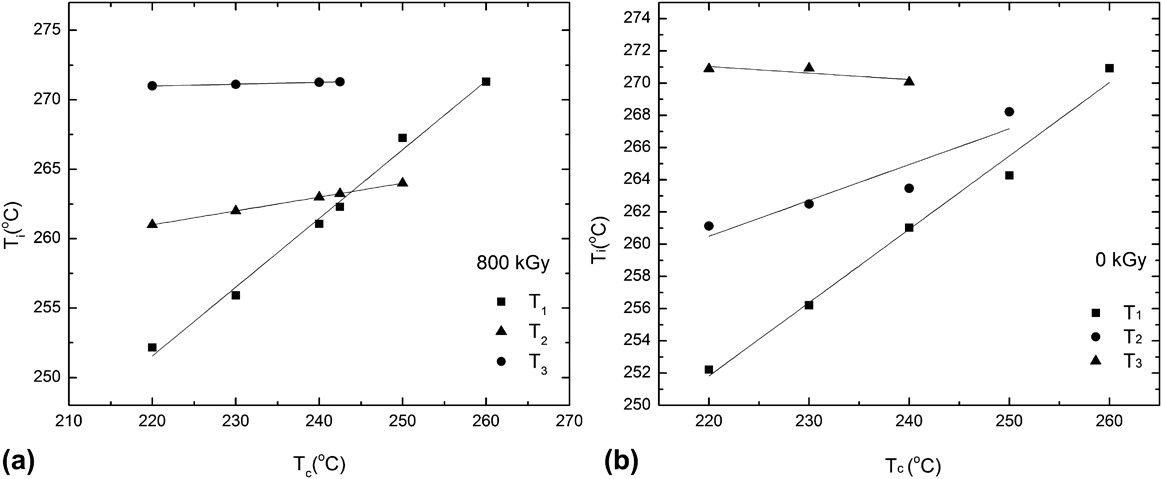
Figure 3(a) depicts the dependence of the melting peak temperatures, T i, on T c for sPS gamma irradiated in air at, as an example, 800 kGy. The results for nonirradiated sPS are presented in Fig. 3(b) for comparison. For both irradiated and nonirradiated sPS materials, T 1 and T 2 increased linearly with T c, but T 3 was essentially unaffected by T c. Further, the rate of increase for T 1 was greater than that for T 2. For irradiated sPS [Fig. 3(a)], the T 1 line intercepted with the T 2 line at approximately 242 °C. The interception between the two melting peak temperatures suggests that the crystalline forms corresponding to T 1 and T 2, i.e., β and α, respectively, coexist in an air gamma-irradiated sPS material when it is crystallized at this temperature. This result is different from that for the nonirradiated sPS material, which showed that the T 2 line was always above the T 1 line [Fig. 3(b)], similar to that observed by Woo and Wu.Reference Woo and Wu21 Experimental data obtained at other T c values also revealed that the highest melting peak (P3) of an air gamma-irradiated sPS was vanished when T c > 242 °C, and this result is indicated in Fig. 3(a). The disappearance of P3 suggests that the crystalline form corresponding to this melting peak, i.e., β′, does not exist in the air gamma-irradiated sPS material when it is crystallized above this temperature.
Relationship between melting temperatures, T i, and T c for (a) sPS irradiated in air with gamma rays and (b) nonirradiated sPS.
The relative amount of crystalline material, X it, in %, in each of the three melting peaks (P1, P2, and P3) at a crystallization time t was obtained from the area of the ith Gaussian distribution as:
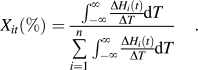 $${X_{it}}\left( \% \right) = {{\int_{ - \infty }^\infty {{\textstyle{{\Delta {H_i}(t)} \over {\Delta T}}}{\rm{d}}T} } \over {\mathop\sum\limits_{i = 1}^n {\int_{ - \infty }^\infty {{\textstyle{{\Delta {H_i}(t)} \over {\Delta T}}}{\rm{d}}T} } }}\quad. $$
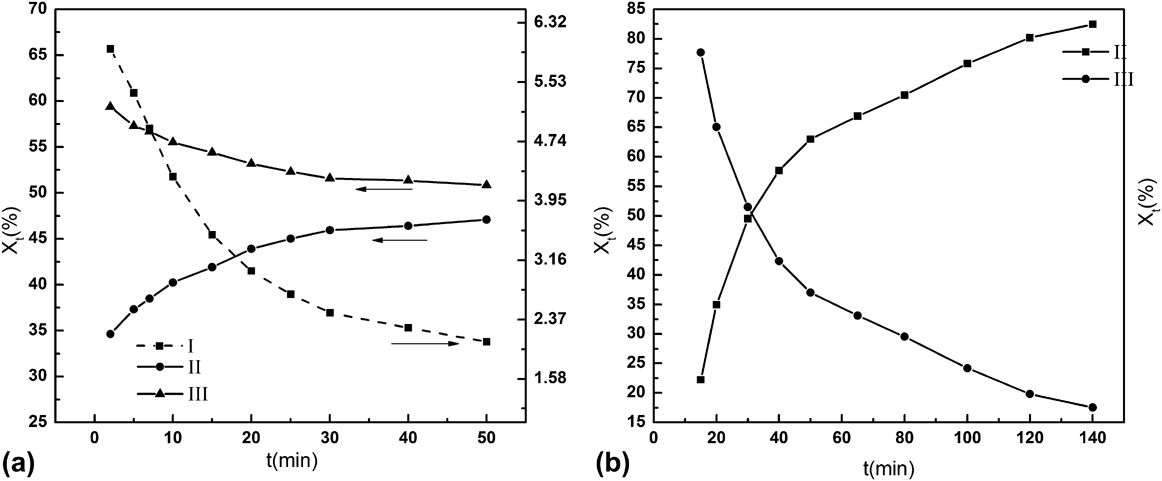
The relationship between X it and t for sPS irradiated with gamma ray in air is representatively displayed in Fig. 4 for two T c values and at 200 kGy. For T c at 220 °C [Fig. 4(a)], X 1t values (i.e., crystalline fraction of P1) were small compared with those for X 2t and X 3t at all crystallization times. At this crystallization temperature, both X 1t and X 3t values decreased, and X 2t increased with t. Further, the rates of these changes were greater at shorter crystallization times (<25 min) than at longer ones. Figure 4(a) also showed that, among the three fractions, the relative decrease for X 1t was greatest: it lost nearly 75% of its value after 50 min of crystallization. Similar X it versus t plots were obtained for other T c values between 230 and 242 °C and at other gamma doses. The results showed that for all irradiation doses and T c between 220 and 242 °C, X 1t and X 3t decreased, and X 2t increased, with increasing t. In summary, the amounts of all three crystalline forms in an air gamma-irradiated sPS sample crystallized between 220 and 242 °C varied greatly with t. Further, in this T c range and for all crystallization times, the fractions of X 3t and X 1t were highest and lowest, respectively, with X 2t fraction was in between. Recalling that X 1t, X 2t, and X 3t are the crystalline contents of the β, α, and β′ forms, respectively, in an sPS material. Thus, an air gamma-irradiated sPS material crystallized for any duration in the 220–242 °C range contains the largest amount of β′ and the smallest amount of β, with the quantity of α falls in between.
Variation of crystalline fractions of P1, P2, and P3 with t for sPS irradiated in air with gamma rays at, as an example, 200 kGy and isothermally crystallized at (a) 220 °C and (b) 250 °C (note that only the P1and P2 fractions are shown in Fig. 4(b) because P3 is vanished at 250 °C).
The variations of X 1t and X 2t with t up to 140 min for an sPS sample irradiated at 200 kGy and crystallized at 250 °C is illustrated in Fig. 4(b). Note that at this T c, which is closer to the 270 °C melting temperature, the X 3t curve disappears regardless of the radiation dose. At this T c, X 1t decreased and X 2t increased rapidly between 15 and 40 min but slowed down afterward. At low t values (15 and 20 min), X 1t was the largest fraction in an air-gamma irradiated sPS (∼78% after 15 min) but became a minor component at high t values (∼18% after 140 min). However, the quantity of X 2t changed in the opposite direction with crystallization time, from approximately 22% after 15 min to almost 82% after 140 min. As also seen in Fig. 4(b), the X 1t curve intercepted with the X 2t curve (at the 31 min, 50% point). Because the summation of X 1t and X 2t is unity, the X 2t curve can be estimated from the X 1t curve and vice versa. Further, the intercepted time of the X 2t and X 1t curves increased with increasing dose. Other curves of X 1t and X 2t versus t of sPS samples irradiated at other doses and then crystallized at T c = 250 °C (not shown) displayed similar trends to those of Fig. 4(b).
The effects of radiation dose on X it at a fixed T c or t were not well defined. In general, at a fixed t and in the T c range between 220 and 240 °C, X 1t values at high doses (600 and 800 kGy) tended to be higher than X 1t values for nonirradiated sPS or sPS irradiated at low dose (200 kGy). The opposite was true for X 2t where its values at low doses were higher than those at high doses. The effect of dose on X 3t followed a similar trend to that of X 1t for T c = 220 and 230 °C. However, gamma radiation dose had a negligible effect on X 3t at T c =240 °C. For more detailed results on the effects of gamma radiation dose on X it at various T c and t values, see supporting Tables I–III.
The glass transition temperatures, T g, of air gamma-irradiated sPS was also observed to increase slightly with an increase of radiation dose from 99 °C for nonirradiated sPS to 101.8 °C for 800 kGy (supporting Table IV). Although the effect of radiation dose on T g was small, but the trend was obvious. A rise in T g with increasing dose suggests a decrease of chain mobility in the irradiated sPS, which was likely a result of an increase in the crosslinking of the sample as the amount of radiation was increased. This relationship between crosslinking and radiation dose may explain the decrease of H with increasing gamma radiation dose observed in Fig. 2(b). Higher crosslinked polymer chains tend to be more difficult to crystallize than lower crosslinked ones. In our previous work,Reference Liu, Nguyen, Yang and Lee15 the T g of sPS irradiated with gamma rays in both vacuum and oxygen was found to decrease with increasing radiation dose, and this was explained as due to an increase of chain scission at higher doses. The contradiction on T g between this and our previous studyReference Liu, Nguyen, Yang and Lee15 probably arose from the dose rate. The dose rate for the previous work was 9.57 kGy/h and that for this study was 30 kGy/h. Janik and RosiakReference Janik and Rosiak22 and Adem et al.Reference Adem, Richards, Burillo and Avalos-Borja23 also have reported similar observation for sPS and suggested that, at high dose rates, polymer chains set in motion and move about before cleavage. But at low dose rates, they are essentially stationary until broken. Therefore, high dose rates tend to cause entanglement of the polymer chains and low dose rates result in chain scissions.
B. Morphological and chemical changes of crystallized air gamma-irradiated sPS
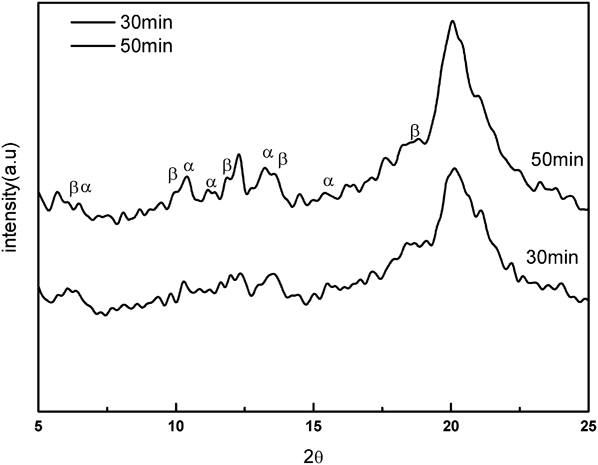
XRD technique was used to follow relative changes of the α and β forms as function of crystallization time for sPS irradiated under different environments and doses. Figure 5 displays the XRD patterns for two different t values for sPS irradiated in air followed by isothermal crystallization at, as an example, 250 °C. The diffraction angles, diffraction planes, and the assignments of the peaks have been given previously.Reference Liu, Nguyen, Yang and Lee15 Clearly, under the crystallization conditions used in this experiment, a mixture of α- and β-crystalline forms existed in the gamma-irradiated sPS, consistent with the DSC enthalpy data shown above. For irradiation in air (Fig. 5), the α diffraction peaks at 2θ = 6.7, 11.6, and 13.2° increased and those of the β diffraction peaks at 2θ = 12.3 and 13.6° decreased with increasing t. These results indicated that the crystallinity fractions of the α form increased and those of the β form decreased with increasing t for sPS irradiated in air. These results were consistent with those obtained by DSC as seen in Fig. 4(a).
XRD patterns of sPS irradiated in air at 600 kGy and crystallized at 250 °C for two different times.
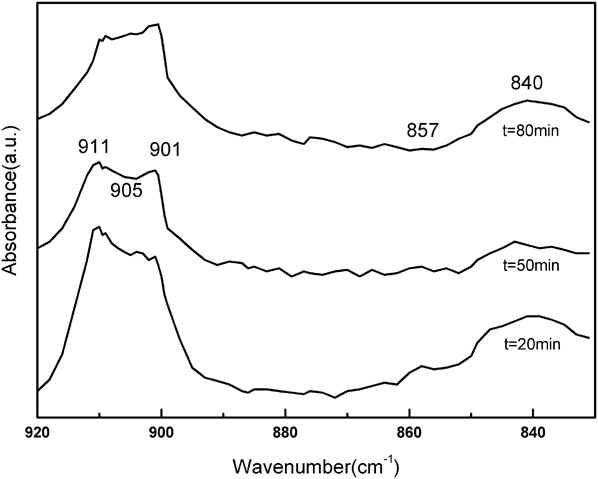
We have shown previously that FTIR is useful for studies of crystallization behaviors of gamma-irradiated sPS.Reference Liu, Nguyen, Yang and Lee15 It can not only characterize the chemical changes caused by the gamma radiation but also effectively follow the evolution of various materials formed during crystallization of the irradiated samples, such as the amorphous material and the α- and β-crystalline forms. Figure 6 presents the FTIR-ATR spectra in the 800–920 cm−1 region for several t values of sPS irradiated in air at, as an example, 800 kGy and then crystallized at 250 °C. This region was selected for analysis because it is sensitive to polymer chain packing and phase changes in sPS.Reference Woo and Wu21,Reference Musto, Tavone, Guerra and De Rosa24 The bands at 840 and 905 cm−1 have been assigned to the amorphous material, those at 857 and 911 cm−1 are associated with the β form, and the 901 cm−1 band is attributed to the α form.Reference Ho, Lin, Hseih and Chung13,Reference Woo and Wu21 For irradiation in air, the band at 901 cm−1 was more pronounced when t was increased from 20 to 80 min, but the band at 911 cm−1 had the opposite trend. These results indicated that the crystallinity fraction of the β form decreased and that of the α increased with t for air-irradiated sPS. Qualitatively, FTIR results were consistent with XRD and DSC data.
FTIR spectra at different crystallization times of sPS irradiated in air at 800 kGy.
C. Crystallization kinetics of sPS irradiated with gamma rays in air
The isothermal crystallization kinetics of sPS irradiated with gamma rays under different environments and doses have been investigated using the Avrami model [Eq. (3)]Reference Avrami25–Reference Avrami27:
 $$1 - {X_{it}} = {\rm{exp}}\left( { - {k_i}{t^{{n_i}}}} \right)\quad ,$$
where X it is the crystalline fraction at time t, k i is the crystallization rate, and n i is the exponent related to the growth mode and nucleation mode. Subscript i denotes the melting peak corresponding to the crystalline form in the polymers as stated previously. Although this model was developed for single-phase transformation from one to another, it has successfully been applied for studying the crystallization kinetics of polymorphic nonirradiated sPS.Reference Cimmino, Di Pace, Martuscelli and Silvestre20,Reference Wessen28–Reference Wu, Hsu, Chen and Wu30 Equation (3) is valid only for crystal growth. As shown in Fig. 4(a), the amount of X 2t (i.e., crystalline fraction of the α form) increased, but those of the X 1t and X 3t (β and β′ forms) in the 220 °C < T c < 242 °C range decreased with t. Therefore, Eq. (3) is applied here to study crystallization kinetics of the α form existed in sPS materials irradiated with gamma rays in air. Table V gives n and k values for the α form, as a function of radiation dose and T c. The exponent n increased with increasing T c but decreased with increasing radiation dose. This is different from that for nonirradiated sPS, where n was reported to be constant in the T c ranges of 122–132 °C and 244–252 °C,Reference Wang, Huang, Cheng, Cheng and Shong31 and for n is equal to 3 for all T c values.Reference Wessen28 However, the crystallization rate k decreased with an increase of both T c and radiation dose. Wang et al.Reference Wang, Huang, Cheng, Cheng and Shong31 also reported a decrease of crystallization rate with increasing gamma radiation dose. These results suggest that gamma irradiation in air at high dose tends to retard the crystallization of the α form in sPS.
The crystallization half time τ at each temperature was determined using the relation:
 $${\rm{\tau }}(T) = {\left[ {\ln 2/k(T)} \right]^{{1 \over n}}}\quad ,$$
and the activation energy of isothermal crystallization of air gamma-irradiated sPS was determined using a modified Arrhenius equation:
 $${1 \over {{\rm{\tau }}(T)}} = {1 \over {{{\rm{\tau }}_0}}}{\rm{exp}}\left( { - {U \over {R\left( {T - {T_\infty }} \right)}}} \right){\rm{exp}}\left( { - {A \over {T\left( {{T_{\rm{m}}} - T} \right)}}} \right)\quad ,$$
where τ(T) is the crystallization half time at crystallization temperature T, τ0 is the preexponent factor, U is the activation energy, R is gas constant, A is the thermodynamic driving force, T m is the melting temperature, and T ∞ is the temperature in which polymeric chains stop segmental motion. Note that T ∞ is usually taken as T g − 30 K,Reference St. Lawrence and Shinozaki32,Reference Yoshioka and Tashiro33 where T g is the glass transition temperature. Equation (5) can be rearranged as
 $$Z = - {\rm{ln[\tau (T)]}} + {A \mathord{\left/ {\vphantom {A {T(T_{\rm{m}} - T)}}} \right. \kern-\nulldelimiterspace} {T(T_{\rm{m}} - T)}} = \,- {\rm{ln\tau }}_0 \,- {U \mathord{\left/ {\vphantom {U {R(T - T_\infty )}}} \right. \kern-\nulldelimiterspace} {R(T - T_\infty )}}\quad .$$
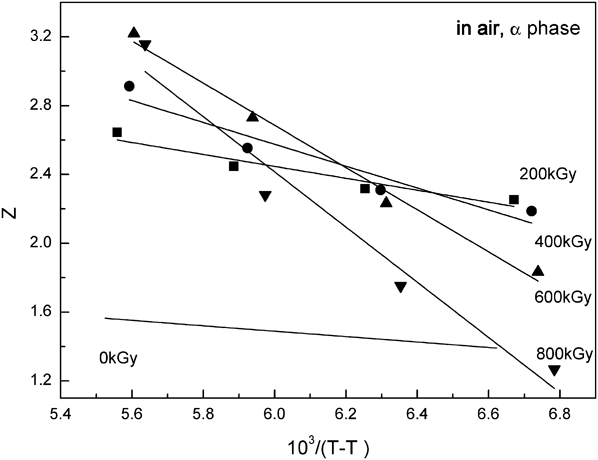
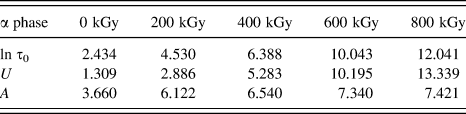
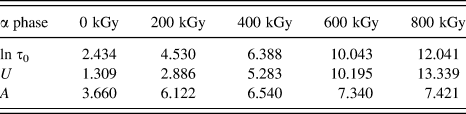
Figure 7 displays plots of Z versus  ${1 \mathord{\left/ {\vphantom {1 {\left( {T - T_\infty } \right)}}} \right. \kern-\nulldelimiterspace} {\left( {T - T_\infty } \right)}}$ for the α-crystalline form in sPS irradiated in air at different radiation doses. U and τ0 were obtained from the intercept and slope, respectively, of Fig. 7, and A was determined using the least square method described in Ref. Reference St. Lawrence and Shinozaki32. Values of U, τ0, and A for the α-crystalline form is presented in Table VI. The preexponent factor k 0, A, and the activation energy U of crystallized air gamma-irradiated sPS increased with increasing dose. The results of U suggested that a higher energy is required to crystallize an sPS material irradiated at a higher dose than a material irradiated at a lower dose. That is, both the rate of crystallization and the crystalline fraction are lower for sPS irradiated with gamma irradiation at higher dose than those exposed to the same radiation at a lower dose, consistent with the results shown in Fig. 2(b). Furthermore, as seen from Table VI, the thermodynamic driving force increases with increasing dose. This is also implied that thermodynamic driving force is required to crystallize an sPS materials irradiated with a higher dose than with a lower dose. Note that if n is constant, Eq. (5) has an alternative form,
 $$k(T) = {k_0}\exp \left[ {{{ - U} \over {R(T - {T_\infty })}} - {A \over {T({T_{\rm{m}}}^0 - T)}}} \right]\quad .$$
Plots of Z versus 1/(T–T ∞) for α-crystalline form of sPS irradiated in air with gamma rays at different doses.
The values of crystallization half time τ0 (min−1), thermodynamic driving force A (104 × K 2), and activation energy U (kJ) of α form, samples of which are irradiated in air.
Equation (7) was used by WessonReference Wessen28 and St. Lawrence and ShinozakiReference St. Lawrence and Shinozaki32 for studying crystallization kinetics of sPS.
IV. CONCLUSIONS
The isothermal crystallization kinetics of gamma-irradiated sPS has been investigated. sPS samples were irradiated with gamma ray in air at different doses from 0 to 800 kGy at a rate of 30 kGy/h. They were melted at 310 °C, quenched to crystallization temperatures (T c) between 220 and 260 °C, and maintained for various periods of time. DSC was used to study the crystallization kinetics. The melting envelop of crystallized irradiated samples recorded by the DSC method was decomposed into Gaussian distributions corresponding to different crystalline forms. Significant results are given below:
(1) Crystallization time (t) and radiation dose have a strong effect on the melting enthalpies of air gamma-irradiated sPS. At the same T c, the melting enthalpy increases with increasing t, and the time to reach a saturated amount of crystalline material increases with increasing radiation dose. At the same radiation dose and a given t, crystallinity of air gamma-irradiated sPS decreases with increasing T c.
(2) The α-crystalline fraction in air gamma-irradiated sPS increases with increasing t, but those of the β and β′ forms have an opposite trend.
(3) The isothermal crystallization rate of air gamma-irradiated sPS decreases with increasing radiation dose and T c.
(4) The activation energy and thermodynamic driving force of crystallization increase with increasing gamma radiation dose.
(5) Glass transition temperature of air gamma-irradiated sPS increases with radiation dose at 30 kGy/h dose rate, implying that this type of high energy radiation induces chain crosslink in this polymer.
ACKNOWLEDGMENT
This work was supported by the National Science Council, Taiwan.