Worldwide, injury is the leading cause of death. Every year more than a million persons die from road traffic injuries. Ninety percent of these fatalities are seen in low- and middle-income countries (LMICs). 1 Strengthening trauma and emergency care can prevent many deaths and long-term disabilities. 2 Most postinjury fatalities occur before arrival to a hospital; moreover, 50% of these were preventable if early first aid interventions had been administered at the scene or during transport to hospitals. Reference Sauaia, Moore and Moore3 Therefore, a well-organized emergency medical system with adequate prehospital care and short transport time to definitive care can save lives.
The World Health Organization (WHO) Reference Sasser, Varghese and Kellermann4 set out to determine the essential elements for designing and establishing a cost-effective prehospital emergency system for trauma care. In 2005, the WHO published guidelines to assist health-system planners in the implementation of highly economical and effective hospital and prehospital care systems in countries with limited resources. Reference Sasser, Varghese and Kellermann4
Before establishing and strengthening any given prehospital emergency system, it is essential to understand the available resources, capability, and challenges facing the development of this system. Unfortunately, in Yemen, no such data about the prehospital care system are available. Therefore, the aim of this study was to assess the current status of prehospital care or emergency medical services (EMS) in Yemen.
Methods
A qualitative, cross-sectional study was conducted in Yemen from January to February 2019 involving a self-reporting questionnaire and an interview. The questionnaire was derived from the Prehospital Trauma Care System Guideline created by WHO for the developing countries. Reference Sasser, Varghese and Kellermann4 Additionally, other relevant key contents were extrapolated from a literature review of the EMS systems of 48 LMICs. Reference Suryanto and Boyle5 The study questionnaire consisted of 36 questions designed into 7 sections: (1) background of respondents, (2) organization, (3) prehospital care and transport, (4) training of prehospital care providers, (5) funding, (6) quality and regulations, and (7) barriers to implement or develop the service. We followed a qualitative research approach and implemented a purposeful sampling technique to capture the range of approaches to prehospital care in the country. The sampling targeted the key representatives of the respective agencies that may oversee or run the service. These agencies were the Ministry of Public Health and Population (MoPHP), Civil Defense/Police departments (MOI), and the Yemeni Red Crescent Association (YRCA). We realized that access to data from governmental authorities would not be easily feasible. Therefore, we also interviewed providers from these agencies. This type of sampling is appropriate when developing an understanding of general approaches to a problem. Reference Patton6
Unfortunately, during the data-gathering phase of this study, the country was still suffering from the ongoing war; consequently, some provinces were inaccessible, and others were non-functioning. Moreover, most of the related resources were allocated to the then-current needs. Therefore, we collected data with the use of both on-site interviews and electronic means (ie, telephone, email). The data were analyzed qualitatively on 2 premises: on a day-to-day basis and in times of emergencies. Military, private resources, and other non-governmental organizations (NGOs) were excluded from this study.
Results
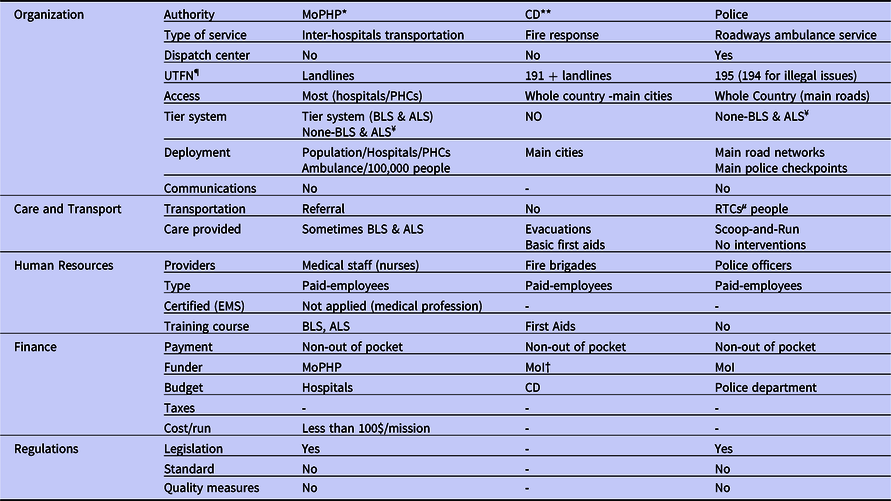
Table 1 summarizes the key components of prehospital care in Yemen on a day-to-day basis.
The available resources related to the prehospital care, on day-to-day bases

*Ministry of public health and population. **Civil defense. ¶Universal toll free number. ¥Ambulances with stretchers +/− oxygen only. µ Road traffic collisions. †Ministry of Interior
Respondents’ Background
The data were obtained from the prehospital care representatives in the headquarters of MoPHP, MOI, and YRCA located in Sana’a and Aden ranging from clinicians and technicians to fire brigades and law enforcement.
Organization
There are several formal prehospital services in the country; however, these services are still underdeveloped—insufficient to cover an entire country and run by unqualified providers. Roadways Ambulance Service (RAS) is an ambulance service to transport critically injured victims of traffic collisions. The MoPHP provided none-equipped ambulances at select rescue points throughout some highways of the country to be operated by traffic police officers. This service had a dispatch center with a toll-free number (195) for emergency calls; however, this dispatch center was nonfunctioning.
Transport and Care
Most patients were self-driven to hospitals or by commercial vehicles. There was no specific tier system followed by the MoPHP in providing prehospital care; thus, the majority of ambulances were not equipped with life support supplies. Most providers used the scoop-and-run approach—patient transportation without applying any rescue interventions such as airway management, positioning, bleeding control, or immobilization. It was found that only 45% of them could provide first aid, basic life support (BLS), and/or advanced life support (ALS) care.
Human Resources and Training
A total of 190 providers were recruited by the MoPHP to carry out ambulance services across the country. The vast majority of the staff rendering ambulance services were non-EMS/EMT certified; they were either general nurses or nontrained nonmedical professionals (eg, police officers, drivers). There were in-service training programs in emergency medicine, but no specialty degree or fellowship programs in EMS and disaster medicine. There were no formal courses in first aid, Prehospital Trauma Life Support (PHTLS), or Advanced Trauma Life Support (ATLS) being provided in Yemen.
Regulation, Quality, and Funding
Data showed that some resolutions and decrees were enacted regarding prehospital service; however, these legislations were insufficient and inactive, with a need for more supportive laws that can help in advocacy for the development of this service, especially with regard to financial support. There were no national standard or quality development measures used to regulate the improvement of service. RAS provided services free-of-charge and was funded by the government from the MoPHP budget; inter-hospital transportation was an indirectly paid-service, added to the cost-sharing payments fees of service delivery and drugs supplement to the customers.
Obstacles
A major obstacle to the provision of the prehospital care or EMS development in Yemen was the scarcity of governmental, political, and financial support. Other obstacles are technological and geographical factors, such as the large surface area of the country, road infrastructure and designs, traffic congestion, and lack of telecommunication and Internet to large areas of country.
Disaster
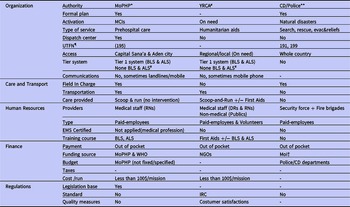
Table 2 summarizes the key components of prehospital care in Yemen in emergencies and disasters.
The available resources related to the prehospital care, on emergencies and disasters

*Ministry of public health and population. µ Yemen Red Crescent Association. **Civil defense. ¶Universal toll free number. ¥Ambulances with stretchers +/− oxygen only. †Ministry of Interior.
Discussion
The present study assessed the status of prehospital care in Yemen with a focus on the overall service organization. The overall data showed that some formal prehospital services are being delivered; however, they are uncoordinated, fragmented, and insufficient. The areas lacking most considerably are in legislation, regulation, and funding support.
We found that communication suffered significant shortcomings in the status of prehospital care: although a toll-free number existed for emergency calls, the dispatch center was non-functioning, resulting in no means of communication between rescue points, ambulances, and hospitals. A systematic review of barriers in prehospital care in LMICs found that 39% had a centralized emergency number, which allows for more efficient activation of the EMS system; however, coordination of care between various service providers still poses a great challenge. Reference Kironji, Hodkinson and De Ramirez7 Better coordination between providers can improve patient outcomes and allow for less reliance on technology as in the more costly models seen in high-income countries. Reference Kironji, Hodkinson and De Ramirez7
Unfortunately, due to the extreme difficulty of the situation in Yemen, we were not able to gather information on EMS documentation and incident records. Such administrative elements allow not only for sustainable and effective allocation of resources, but for insights into the location and types of community hazards. Reference Sasser, Varghese and Kellermann4 Consequently, the systematic collection of such data can inform the development of prevention programs that target high-risk settings, products, behaviors, and groups. Reference Sasser, Varghese and Kellermann4 Furthermore, documentation of information such as distribution of coverage or response times can guide future development of interventions and policy.
We found that most patients were self-driven to the hospital or in commercial vehicles. A study conducted in Sana’a reported similar results: 71% of casualties were transported to hospitals by a taxi, compared with the 13% transported by ambulance. Reference Alfalahi, Assabri and Khader8 This may be due to lack of accessibility to ambulances. Our study also found that the majority of ambulances in Yemen were not equipped with supplies to provide first aid, BLS, and/or ALS care, resulting in widespread use of the scoop-and-run approach. This is a common barrier in LMICs: a study conducted in Mexico found that many patients in respiratory distress were not able to receive the necessary care due to lack of equipment. Reference Arreola-Risa, Mock and Lojero-Wheatly9 By contrast, Ukraine is an example of a LMIC that operates well-equipped ambulances. Reference Suryanto and Boyle5 In all, lack of equipment precludes the delivery of appropriate care to patients. This is a disservice to patients as most deaths within the initial hours following injury are a consequence of uncontrolled bleeding, airway compromise, or respiratory failure—all of which can be addressed with the appropriate interventions. Reference Sasser, Varghese and Kellermann4 Moreover, the number of delayed deaths and the likelihood of complications can also be reduced through interventions such as oxygenation and blood pressure support or fracture immobilization. Reference Sasser, Varghese and Kellermann4 However, successful implementation of such interventions requires that ambulances not only be equipped with the necessary supplies, but also with adequately trained personnel.
The majority of providers recruited to provide ambulance services were non-EMS/EMT certified. Multiple studies have shown improved outcomes after health-care providers and bystanders alike had been provided training in the fundamental components of trauma care. Reference Sasser, Varghese and Kellermann4,Reference Suryanto and Boyle5 Furthermore, no formal courses in first aid, PHTS, or ATLS were offered in Yemen. However, a case study in Ghana demonstrated that first-aid training need not be formal to be effective; training can be tailored to be provided at an appropriate educational level with an increased emphasis on active learning, demonstrations, and practice sessions. Reference Tiska, Adu-Ampofo and Boakye10
In terms of regulation, there currently exists no national standard or quality development measures. With regard to funding allocated to prehospital care in Yemen, we were unable to obtain exact numbers due to the sensitive nature of this information. For years, Yemen has been dealing with economic decline; coupled with the recent pooling of financial resources toward the COVID-19 response, it is unlikely that there is adequate funding dedicated to the development of the prehospital care system. In all, the areas of regulation, funding, and legislation appear to be most considerably lacking in our assessment of the status of prehospital care in Yemen. This is consistent with a prior systematic review that identified inadequate funding and legislation setting standards as the most commonly cited barriers to EMS development in LMICs. Reference Suryanto and Boyle5 Per WHO Reference Sasser, Varghese and Kellermann4 recommendations, legislation enactment may be necessary to ensure the success of a prehospital care system; despite this, the lack of legislation remains one of the most frequently cited barriers to EMS development. Reference Suryanto and Boyle5 EMS legislation has been demonstrated to improve the care received by victims of medical emergencies in 2 promising case studies in Columbia and Romania. Reference Suryanto and Boyle5 Furthermore, many of the aforementioned issues related to communications, equipment, regulation, and funding can be addressed by EMS and prehospital care legislation. Reference Kironji, Hodkinson and De Ramirez7
Limitations
One limitation of the present study may stem from our small sample size. This was in part due to the detailed and sensitive nature of the information necessitated by this study. Coupled with the ongoing conflict and humanitarian crisis, our sampling was limited to respondents located in Sana’a and Aden. As the largest 2 cities in Yemen, the status of prehospital care systems assessed from our sampling may not be representative of Yemen as a whole, especially given the differences in infrastructure and local expertise between urban and rural settings. Furthermore, the selection of these 2 locations—Sana’a and Aden—represent the health-care systems at the national and regional levels, respectively. As such, this means of sampling is appropriate given the roles and involvement of both levels of government in the establishment of a prehospital care system.
Conclusions
Overall, despite the availability of some formal services, the prehospital care system in Yemen is uncoordinated, fragmented, and insufficient. The areas most lacking are in regulation, legislation, and funding support. Future policies and strategies should strive to improve communication and coordination between existing prehospital care providers, to establish a lead agency, and to increase accessibility to training. Combined with appropriate legislation and allocation of resources, the existing prehospital care system in Yemen can be rendered more effective and sustainable.
Author Contributions
W.N. is the first author proposed the project, contributed to the conception, formulation and drafting of the article. M.A. is the corresponding author contributed to the drafting of the paper and supervised the elaboration at every step of the paper writing process and was responsible for coordination of the study and communication with all coauthors. W.S., R.Y., and H.B. contributed equally to the conception, drafting and reviewing of the paper. W.N. and M.A. revises the whole manuscript. All authors read and approved the final manuscript.
Funding
None to disclose.
Ethical standards
A written consent to conduct the study was obtained from the Research and Ethical Committee of the Faculty of Medicine and Health Sciences, Aden University.