


1. JFK and Nixon
At the conclusion of Oliver Stone's Nixon (1995), the title character (Anthony Hopkins) stands alone in a White House hallway.Footnote 1 His resignation imminent, Richard Nixon turns to Aaron Shikler's posthumous portrait of John Fitzgerald Kennedy and confronts the specter of his predecessor. The image of JFK that stares down on him is not the inspirational hero who penned Profiles in Courage, but a haunted and remote figure, arms folded and face downcast.Footnote 2 As Nixon's gaze meets this ghostly representation, the music swells on a dissonant pentachord—a gradually stacked column (A♭–B♭–C♭–C–D) buttressed on either end by a high D and a low C pedal (Example 1). That C forms the stable base for the rest of the sequence. It is an effective root for the cluster-chord, sonically grounding what will become the film's most significant moment of anagnorisis—the kind of revelation that fundamentally changes a character's (and audience's) understanding of their dramatic situation. The sonority quickly subsides, leaving open a hollow and vacant soundscape. French horn and piano trade melodic fragments from some never-realized theme, while synthesized choir traces a solemn diatonic progression, the vestige of a lost minor chorale. The tone is brooding and eerie, with music lending an almost religioso aura to the late-film revelation.Footnote 3
Anthony Hopkins as US President Richard Nixon confronting JFK in Nixon (1995, Cinergi Pictures Entertainment, Inc.), directed by Oliver Stone and produced by Dan Halsted, Eric Hamburg, Richard Rutowski, Oliver Stone, Clayton Townsend, and Andrew G. Vajna.

Music for Nixon's confrontation with JFK from Nixon (1995, Cinergi Pictures Entertainment, Inc.), directed by Oliver Stone and produced by Dan Halsted, Eric Hamburg, Richard Rutowski, Oliver Stone, Clayton Townsend, and Andrew G. Vajna. Musical score by John Williams. Transcription by author.
It is over this aural canvas that Nixon utters the film's most incisive line of dialogue: “When they look at you, they see what they want to be,” he concedes. “When they look at me, they see who they are.”Footnote 4 With his political career hours from ending, it is a figurative deathbed realization.Footnote 5 Nixon expresses something that has hovered as subtext over the whole of his movie: Kennedy is a cipher, an imaginative projection, while he himself is the concrete, unflattering embodiment of the actual American character.Footnote 6
This scene plays out an encounter between an inaccessible thirty-fifth president and a physically and psychologically far too close thirty-seventh. It is one of several thematic hinges between Stone's two controversial commander-in-chief films from the 1990s: JFK (1991) and Nixon (1995), both scored by film composer John Williams. The understatedly ominous cue deepens the connections latent between the two movies and is one instance among many where the soundtrack enlists musical topics and associations—tragedy, Americana, religion, obsession—to evoke and construct a mythicized version of U.S. history.
Both JFK and Nixon are aggressively stylized and, for mainstream cinema in the 1990s, unconventional exercises in political filmmaking. The former is not a biographical film as its title suggests, but a three-hour erection of what Oliver Stone called a “counter-myth” to the Warren commission's findings on the Kennedy assassination. JFK may well be the summit of what might be called the paranoid style in American cinema.Footnote 7 David Cook, echoing many critics, positions it within a “paranoid conspiracy” genre, which first blossomed in the 1960s and ’70s with assassination-centered films like Executive Action (1973) and The Parallax View (1974).Footnote 8JFK outdoes its models, jerking rapidly between historical footage, re-enactments, newsreels, models, still photographs, and courtroom scenes. This striking editorial vocabulary was well appreciated for its novelty and persuasive (if not necessarily sound) argumentative power.Footnote 9 The film courted a firestorm of critique and condemnation, though only rarely was music mentioned in critical reactions.Footnote 10JFK’s arsenal of special effects, sonic and otherwise, are hung on a single narrative frame, the prosecution of alleged (and ultimately acquitted) conspirator Claw Shaw (Tommy Lee Jones) by New Orleans District Attorney Jim Garrison (Kevin Costner). The result is an eclectic, seductive, and frequently tendentious argument for a massive conspiracy perpetrating and covering up the president's death.Footnote 11
Nixon uses many of the same editorial techniques and paints a similarly paranoiac picture of the upheavals of the 1960s. However, compared to the generically fluid JFK, Nixon is a more traditional, if non-linearly structured, biopic. Scenes from Richard Nixon's youth are inserted at calculated moments within a biographical arc that traces the thirty-seventh president's rise and eventual fall from power. Although less of a cultural event than JFK at its release, Nixon too received a tempestuous reception, with volleys of criticism hailing from both right- and left-leaning commentators.Footnote 12 Spared critical opprobrium was the universally praised Hopkins, who occupies the center of virtually every scene. No white knight such as Jim Garrison serves to champion the telling of truth to power. Unlike JFK, Stone's Nixon plays like a modern-day classical tragedy, with all its focus centered squarely on its ill-fated central character. An expressionistic visual vocabulary and a few outright allusions make a case for interpreting the film as a revisionist Citizen Kane (1941).Footnote 13 One might go so far as to imagine Anthony Hopkins as a different take on Charles Foster Kane, had he happened to make it all the way to the White House.Footnote 14
Serving the director's mythical and polemical ends are the film's musical scores, each penned by three-time Stone collaborator John Williams.Footnote 15 Williams's initial association with Stone came through scoring Born on the Fourth of July (1989), a biopic on the life of Ronald Kovic, a Vietnam veteran turned anti-war activist. The sweeping orchestral soundtrack for July anticipates some of the stylistic features of JFK and Nixon: solo trumpet as lone voice of dignity, consonant strings and winds for the warmth of domestic American life, dissonant synthesizers underscoring the questionable activities of the United States during the 1960s and 70s. In some ways, JFK is a much closer cousin of its predecessor July than it is to Nixon.Footnote 16 Their narratives follow traditional redemptive heroic arcs: a male protagonist is gradually disillusioned by socio-political horrors of the 1960s, risks severed ties with family members, but is ultimately vindicated by his devotion to Truth. Nixon, by contrast, forcefully denies its central character a righteous ending, and the truth he stumbles upon on the eve of his downfall is of a purely personal, not socially transformative sort. This specific contrast strongly affects the musical scores, as will be discussed shortly. In any case, Williams brought a well-developed personal lexicon of musical codes—“Williamsisms,” one might say—to JFK and Nixon. The resultant creative consistency is one obvious means by which the two films come to form a linked politico-aesthetic unit, both invested in manufacturing the sonic component to Stone's historical metanarratives.Footnote 17 And because the collaboration between Stone and Williams is so circumscribed (only three films of the director's twenty-three), it is difficult not to hear JFK and Nixon as a significant musical pairing.
In this study, I explore the colors with which Williams paints the portraits of these significant figures and how music serves Stone's larger goals of mythologizing the recent past and musicalizing national political trauma. I begin by putting Stone's political aesthetics in context. That leads to a discussion of musical style as it informs the (counter)myth-making behind JFK and Nixon. I follow with an examination of the scores’ construction of political villains (“The Beast”) and heroes (JFK, Jim Garrison). I conclude with a close reading of Richard Nixon's thematic material and the accompaniment of his speeches; Williams's characterization of Nixon, I claim, positions him as simultaneously occupying the mythic roles of hero and villain.
Throughout, I illustrate how Williams's underscore immerses the filmgoer thoroughly within the treacherous currents of Stone's version of history.Footnote 18 Sometimes in conflict with the immersive aim, however, Williams's music also enables reflection on past presidencies at a critical distance. Williams thereby falls within a legacy of executive portraiture whose musical artists include several of his stylistic models, such as Ives, Copland, Harris, and Adams.Footnote 19 As will become evident, JFK and Nixon are the two most political of Williams's soundtracks, thereby offering a study in the reconciliation of presidential reality and myth, history-as-fact and history-as-metanarrative.Footnote 20
2. Stone's Political Aesthetics
Before delving fully into the musical mythopoetics of these two films, it will be useful to have a sense of Oliver Stone's political and cinematic philosophies, and how they influenced his collaboration with Williams. Throughout his directorial career, Stone has returned compulsively to subjects of post-war American history, leading some to label him a “cinematic historian.”Footnote 21 Informed by his disillusioning experiences as an infantryman in Vietnam and propelled by a flair for radical politics, Stone wields the elements of filmmaking as tools to jostle audiences into a more alert, critical engagement with their past. As Marita Sturken puts it,
Stone has, perhaps more than any other producer of popular culture, attempted to interpret, narrativize, and make meaning of late twentieth-century American history. As a consequence of his ideological stance, his position as a popular historian, and his particularly dogmatic style of filmmaking, he has been a figure upon whom tremendous hostility and anxiety have been projected.Footnote 22
No two films elicited more hostility (or, in equal measure, appreciation and fascination) from critics, historians, and politicians than JFK and Nixon.Footnote 23 The director saw the movies as a linked and coherent statement on the politics of the 1960s and their aftermath. With Kennedy as “prologue” and Nixon “epilogue,” together these presidencies would act as framing devices to “understand our country in those turbulent years.”Footnote 24
An overview of Stone's filmography and written and spoken statements reveals that the director's political aesthetics are both complex and frustrating, the product of multiple, sometimes seemingly contradictory attitudes toward history and narrative. Stone has a radical skepticism toward the possibility of completely accurate or impartial accounting of the past. In interviews, he has consistently and aggressively rejected what could be termed history-as-fact.Footnote 25 Yet despite his contempt for objective historiography, he also has an archivist's zeal for extensive research and voluminous citation of data and opinion.Footnote 26 Stone's entire filmography betrays a polemicist's urge for countering prevailing and official accounts of the past. At the same time, he holds a mythologist's commitment to the existence of grand narratives and the truths that lie behind things. Many of his films in fact embrace a totalizing style of history-as-metanarrative, a stance that runs counter to postmodernist intellectual currents of the late twentieth century.Footnote 27 Together, these last two factors—the instinct for contrariety and the mythmaking—contribute to the central theme of “countermyth,” which we shall explore in more detail at the end of the next section.
Stone's movies ultimately strive to offer emotional catharsis and intellectual clarity. He achieves them through the act of selecting and converting historical data into simplified, moralizing narratives. This is this sense to which his films are so frequently referred to—by critics and the director himself—as mythic in structure and purpose.Footnote 28 They make no claim to the chimerical goal of neutral recounting of fact, and instead employ cinematic devices to rhetorical ends.Footnote 29 Chronology may be manipulated, characters conflated, facts massaged, altered, or even invented, so long as they contribute to a more clear picture of the storyteller's core narrative. “Filmmakers make myths,” Stone avers. “They take the true meanings of events and shape them.”Footnote 30
Ultimately, Oliver Stone's presidential films are concerted attempts to construct and refine a myth of the American 1960s. In JFK, Stone argues that the innocence and heroic promise Kennedy represented are destroyed from without by the malevolent force of the military-industrial complex, a foe challenged bravely but ineffectually by devotees of the “Truth.” This intangible antagonist is referred to in Nixon in abstract (and eschatological) terms as “the Beast.” There, it also brings about the downfall of the title character, albeit as a corrupting force internalized in the president, both hero and antagonist within his own narrative. Stone's Nixon provides a dark inversion of the myth of the American dream. Merit and struggle are not sufficient to place him at the top: concessions to “the Beast” are required at every turn, ultimately leading to his moral and political collapse.
3. Williams's Mythic Americana
John Williams is no stranger to “scoring presidencies,” nor indeed American politics at large. Given his Academy Award-nominated score to Born on the Fourth of July and stature as the U.S.’s most prominent symphonic film composer, he was an obvious choice for Stone's presidential dramas.Footnote 31 However, with respect to musical style and political sensibility, Williams is an unusual match for the director. The most Oscar-nominated living person is by no means a political composer, in fact being conspicuously and consistently reticent in interviews to speak on matters of policy, ideology, or social controversy. He is certainly not political in the same sense as some of his predecessors such as Hanns Eisler and Aaron Copland—composers who, like Williams, composed for both concert stage and screen.Footnote 32 In the few places where the musicological literature has waded into the issue of Williams's musical politics, it has focused chiefly on strains of nostalgia and/or stylistic conservatism evident in Williams's trend-setting orchestral scores for genre pictures of the 1970s, seen by many commentators as explicit throwbacks to classical Hollywood practice.Footnote 33 Yet it is in soundtracks like JFK and Nixon that we can find expressions of a more deliberate and perhaps even incisive political attitude, as milestones in the composer's larger pattern of engagement with the office of commander in chief.
Like a musical Aaron Shikler, Williams has been producing a gallery of presidential portraits for decades. The cinematic depictions include, notably, many partnerships with Steven Spielberg: take, for example, the music attached to John Quincy Adams in Amistad (1997); Abraham Lincoln, in Lincoln (2012); and Lincoln again (by proxy) in Saving Private Ryan (1998). Living politicians, Democrats in particular, have also used Williams's prominence in American culture.Footnote 34 Williams wrote occasional pieces for Michael Dukakis (Fanfare for Michael Dukakis, performed at the 1988 Democratic National Convention), and Barack Obama (Air and Simple Gifts, performed at the 2008 inauguration; A Timeless Call for Spielberg's short film at the same year's party convention; and “For The President's Own” in 2013).Footnote 35 And though not by the composer's devising, an arrangement of main theme for the film The Patriot (2000) was played during Obama's speech in Chicago on the night of his 2008 victory.Footnote 36
A common thread in these compositions and others that project national pride is their sparking orchestration and consonant melodiousness—with allowances for the occasional non-disruptive dissonance.Footnote 37 The model for much of this “Americana style” and the musical topics that infuse it is undoubtedly Copland.Footnote 38 The Coplandesque “pastoral trope,” as Neil Lerner identifies it, has been a resilient constant in Hollywood film scoring since the 1940s. Many of the topics Lerner attributes to this style can be located throughout Williams's Americana works, even when they are concealed by the composer's more chromatic and leitmotivic personal style.Footnote 39 Tonic pedals undergird the slow diatonic chorale in the Omaha Beach segment from Saving Private Ryan. Wide intervals and equally wide orchestral voicings suggest the fertile expanses of the West in The Cowboys (1972) and Superman (1978). Brass discant full of perfect fourths and fifths straight out of Fanfare for the Common Man lends politicians the appropriate gravitas in Lincoln and Amistad. Aside from Copland, the broad appeal of this music recalls nothing so much as the art of Norman Rockwell.
Oliver Stone's political radicalism and technical experimentation might thus seem in conflict with Williams's generally accessible and non-experimental musical temperament, as epitomized in his Copland-referring Americana style.Footnote 40 Nevertheless, their working relationship was by all accounts a smooth, productive, and mutually admiring one.Footnote 41 One immediate upshot of the collaboration is an exploitation of Williams's facility with modernist idioms. As we will see, the more modern compositional techniques that occur in JFK and Nixon tend to entail a selective pressuring (although not rejection) of the nostalgic tendencies in Williams's symphonic style. The scores’ tonal and timbral idioms do nod on occasion to the pastoral dialect that one suspects is the composer's default symbolic modus. But just as often, they delve into dissonant and aloof sound-worlds, resistant to long lyrical lines, willing to dabble with Coplandesque nobility but heavily skeptical of the comforts of (pan)diatonicism.
Unlike his optimistic compositions for other presidents, Williams's JFK and Nixon eschew brassy, extroverted pomp. Musical codes associated with distress or conflict (dissonance, dense polyphony, electronics) are given consistently higher prominence. The Americana music that does appear—which includes some musical topics less indebted to Copland, such as military drum rhythms—often exists in order to be disrupted or dismantled. Consonance is only rarely left uncontested by the more dystopic elements of the soundtrack.Footnote 42 The two scores do not establish this dichotomy in an entirely equivalent fashion. JFK shares with July a strategy of positioning consonance and melody as a kind of musical originary state, lost or corrupted in most of the score, but ultimately recovered through righteous sacrifice. (JFK even allows its musical Americana to surge splendiferously during its final scene, shorn of irony or ambiguity). By contrast, it is the darkness that Nixon’s score always returns to, making those few moments where melody and tonal stability assert themselves sound suspect.
Although the musical idiom Williams employs in JFK and Nixon may not recall the musical Rockwellianism of his other Americanist projects, one crucial aspect does place them firmly within the composer's accustomed area of expertise: myth-making. Williams's best-known scores (and many lesser-known ones) evince a mythologizing impulse widely noted in both critical and musicological discourse.Footnote 43 To a certain extent, the composer's inclination towards larger-than-life symphonic scoring may just be an especially aggressive manifestation of reality-heightening tendencies always active in mainstream film. But in Williams's intentionally mythic scores, the orchestra magnifies mundane events into epochal turning points and turns actors working from scripts into walking Jungian archetypes. His music smoothes over narratival inconsistencies and frames scattered scenes into absorbing—and often simple, highly familiar—narratives.
Williams's talent for musical mythmaking would thus be a great asset to Stone, whose own interest lay in formulating myths rather than neutral accounts of history. The American cultural mythology that Stone endeavors to construct in JFK and Nixon is motivated by two storytelling urges: the first a need to process national trauma, the second a desire to offer a response to prevailing narratives. The rehearsal of trauma through filmic reconstruction and repetition helps cement the perpetual “nowness” of Stone's version of the past, solidifying a sense of urgency—and inescapability—of elements of American identity he chooses to dramatize. John Hellmann points to Stone's obsessive reiteration of a few horrible frames from the Zapruder film in JFK as part of a kind of Holy Communion:
The authority of the Zapruder film is that of an undeniable fact transfigured into collective rite. We suffered the loss of Kennedy in history, but it has become a religious experience through the collective pain we continue to experience in it. Stone's repetitive use of the home movie makes it a ritual. As we return to the moment of assassination many times in the course of JFK, our re-viewings join us with Garrison/Costner as our surrogates in this suffering.Footnote 44
Like Kennedy's portrait louring over Anthony Hopkins, Stone's history becomes an indicting ghost, demanding more than mere remembrance or neutral retelling. Williams's reliance on well-established style topics, as well as other techniques we will soon explore such as repetition and monumentalization, makes these films all the more portentous and direct in their messages. If Williams's sometimes-elegiac accompaniment provides a counterpoint to Stone's raw outrage, it nevertheless does so according to the same drive to relive tragedy and ritualize trauma.Footnote 45
The moral shadings of Williams's music—hyperexplicit in JFK and strategically ambiguous in Nixon—also aid Stone's desire to reveal “untold” aspects of history. The director's sense that the American public had not accepted or satisfactorily scrutinized the Warren commission accounts for his insistence that JFK is a “counter-myth.”Footnote 46 This insistence on the mythical status of his film is not merely an escape clause for the numerous, sometimes flagrant liberties taken with historical fact. For JFK, Stone offered the following rationale:
In the end, the importance of a historical episode is not just its factual content but its emotional and ethical significance as well. Why did it happen? What does it mean? . . . This process of evaluation, when undertaken by a whole society, eventually leads to the creation of a cultural myth. . . . [M]yths have always expressed the true inner meaning of human events. Myths are dynamic. They reinterpret history in order to create lasting, universal truths. . . . With JFK, we are attempting to film the true inner meaning of the Dallas labyrinth—the mythical and spiritual dimension of Kennedy's murder—to help us understand why the shots in Dealey Plaza still continue to reverberate in our nightmares.Footnote 47
Stone does not imagine himself as radical revisionist historian, but rather an almost atavistically reinterpretive historian. John Hellmann reads Stone's appeal to myth as a way of impressing “upon Americans that the interpretation of the facts carrying the authority of the establishment—the government and national media—is not necessarily definitive.”Footnote 48 By converting an assassination and a resignation into narratives of Manichean dimensions, Stone believed he could make these events more broadly intelligible, while at the same time dispelling decades of institutional deception, inveigling, and obfuscation. As Norman Mailer claims with regard to JFK, “tragedies of this dimension [of Kennedy's death] could only be approached as myths.”Footnote 49 With Americana tropes arrayed and ready for dismantling and reconstitution, Williams's music establishes the clean lines of Stone's overall mythic metanarratives. At their foundation, these scores are about providing a degree of emotional clarity—indeed comfort—even as the events that they paint horrify us still.
4. The Beast
Myths require antagonists. Williams frequently reserves his most insinuatingly memorable music for the enemy—Darth Vader, Captain Hook, Voldemort, Nazi henchmen, and so on. Yet without a concrete villain embodied within a single character in JFK or Nixon, Williams was compelled to take a more abstract approach than the usual catchy villain leitmotif. Instead, he stitched together Stone's presidential pictures with a set of recurrent timbres and techniques, consistent in their sound but stopping short of a coalesced “thematic portrait” for Stone's pervasive historical evils. There is no “Theme for the Military-Industrial Complex,” nor could there be, given the screenplays’ thesis of a centerless, elusive malignancy in American politics.
Set against the formless antagonist is an equally incorporeal protagonist: the image of John F. Kennedy. Despite bearing his name, the film JFK never features Kennedy as a character, only showing him speaking at the beginning of the film, his words culled from chopped-up newsreel footage. As Mark Feeney explains, Kennedy's “image is so potent that just invoking the name conjures up his presence.”Footnote 50 Kennedy the man and JFK the film haunt Stone's unofficial sequel as well. Anthony Hopkins's Nixon sees his predecessor as a real and, following his assassination, idealized political opponent—a constant point of comparison against Nixon's own embittered ego. Kennedy serves as a betrayed revenant who hangs over his successor's conscience.Footnote 51 At times Stone's screenplay even suggests that Nixon was unwittingly and remotely involved in JFK's assassination. This contributes to a vague guilt towards what Anthony Hopkins, as Stone's mouthpiece, calls “The Beast”—an uncontrollable adversary that emerges organically from the amalgamation of military, capitalist, and criminal interests. Hopkins's Nixon comes to see himself as just another pawn of this un-bridleable “Beast,” powerless to stop the domestic and international tragedies of his administration. “Neither Marxist construct nor small cabal,” explains Iwan W. Morgan, Stone's formulation of this mythic foe is “the representation of Darwinian forces in Cold War America.”Footnote 52
Stone pulls no punches when it comes to the Beast's blood lust: “They [the CIA, urged on by then–Vice President Nixon] went after Castro, and in some crazy way it got turned on Kennedy,” the film's version of H. R. Haldeman conjectures to John Ehrlichman. “I don't think the old man knows what happened. He's afraid to find out, I can tell you that. He's shitting peach pits every time he thinks about it” (2:35:00). Williams scores this conversation with a pair of nervous clusters (G#–A–B♭, and C#–D–E♭), set against a series of deep—nearly subaudible—bass drum strikes. In both JFK and Nixon, allusions to or manifestations of this “Beast” receive similar music to this scene. Recurrent colors include rumbling ostinati undergirded by synths, distorted fanfares, masked consonant melodies, and tight clusters. Especially characteristic is use of percussion in repetitive loops and low reverberations, both acoustic and electronic.Footnote 53
The significatory power of these sounds relies on their ability to unsettle musical topics normally coded “noble” or “pure.” In an interview on his scoring of Nixon, Williams explains the disturbance of diatonic music as a way of playing up the contrasts and paradoxes of Nixon's career, installing an almost antiphonal vacillation between heroic and tortured moods: “This side of the orchestra's playing along in a sort of consonant sort of way, where you have this kind of Shaker/Quaker American roots solidity. And suddenly something else happens on the other side of the orchestra which diffuses that, a dissonant element that comes in.”Footnote 54 Williams's manipulations and disruptions of upstanding and “solid” Americana music helps expose the sickness that underlies Stone's view of American polity, a rot “at the heart of the American dream,” as expressed by Kevin Costner at the end of JFK (3:08:20).
Snare drum lines and bass drum rumbles are particularly characteristic of “Beastly” percussion. Drum rhythms are used throughout JFK to invoke two topics: funeral processions and military marches. The former alludes to the drum corps at Kennedy's funeral, and the latter, more sinisterly, to the hypothesized military agenda behind the shooting.Footnote 55 In Nixon, the American armed services’ implied complicity with the tragedies of the 1960s is sublimated into nearly subaudible rumbles and crashes. Williams describes the unusual sounds in Nixon in almost apocalyptic terms:
You have orchestral music that accompanies that very sinister atmosphere in the music. But electronically, you also produce some explosions that are kind of low-end booms. This kind of thing where you almost don't hear it but you feel it. Which is like a kind of napalm recollection of something in Cambodia that perhaps hadn't even happened yet. It's a kind of a pre-lap [a type of transition in film editing, also called a ‘sound advance’] into the future and I think it can be very suggestive.Footnote 56
As Nixon’s sonic telltale heart, this muted musical metaphor quite literally “covers up” violence, leaving the carnage of war resonating faintly at the margins of the soundtrack. Rarely emerging to the aural foreground, Williams's beastly musical techniques generate an undercurrent of wordless unease that courses beneath both films. In JFK the musical manifestation of the Beast suggests undiscovered depths of a conspiracy. In Nixon it intimates distant violence and buried presidential culpability.
The consistency of Beast timbres is emblematic of the abstract and figurative relationship between these two soundtracks, more so than any specific thematic recurrences, which are almost completely absent. Williams makes but one outright connection between the scores: a tracked statement of a snare drum rhythm (henceforth “The Drummer's Salute”), motivic in JFK, played during a mere ten-second span in Nixon (0:52:40, see example 2). Tiny though it is, this bit of recall is nevertheless highly pregnant. The Salute occurs within the scene where (an unseen) Kennedy lands at the Love Field airport in Dallas, a location from which, hours before, Nixon had departed. Immediately following this thematic reference, Anthony Hopkins learns news of the assassination. The fleeting motivic reminiscence thus stands in for the entire earlier score—and the lost president that the rhythmic gesture characterizes—while the moment of national trauma is experienced from Nixon's perspective.
The Drummer's Salute. From Nixon (1995, Cinergi Pictures Entertainment, Inc.), directed by Oliver Stone and produced by Dan Halsted, Eric Hamburg, Richard Rutowski, Oliver Stone, Clayton Townsend, and Andrew G. Vajna. Musical score by John Williams. Transcription by author.
5. Devotion and Desecration in JFK
The lack of thematic allusions between JFK and Nixon stems in part from the differing authorial process behind their soundtracks. Williams's music for JFK is unusual in having been composed prior to the completion of filming. It is a rare score engendered largely by personal reflection rather than spotting sessions or synchronization notes. The soundtrack for Nixon, by contrast, resulted from a more traditional (and protracted) approach to dramatic underscoring, which is apparent in the preponderance of synchronization points and the meticulous scoring of scene-to-scene transitions, among other things.Footnote 57 This poietic difference yielded one score all about historical idealization and romanticized absence, and another that comes across as an effortful, “warts and all,” sort of musical experience.
For JFK, Stone invited Williams to visit some of the historical locations where principal shooting on the film was just under way. Williams spent two weeks with Stone as the director shot in New Orleans and Dallas, including Dealey Plaza, the site of Kennedy's assassination.Footnote 58 Drawing this geographical encounter together with his recollection of the day JFK died, Williams produced five large-scale, through-composed character pieces.Footnote 59 Their subjects include “Arlington,” “Garrison's Obsession,” “Kennedy Theme,” “The Conspirators,” and “The Motorcade.”Footnote 60 Given the amount of music composed before shooting had concluded, Stone could claim that Williams “essentially had written the score before the film was finished.”Footnote 61 This assertion is something of an exaggeration; these character pieces all together only account for twenty minutes of the hour of music in the movie (including numerous atmospheric diegetic cues). Along with subsequently written additional music, some based on the themes, these concert-performable works were edited, “cut up in a documentary fashion,” and occasionally reused ad libitum in the film proper.Footnote 62 Stone remarked that with the partially pre-editorial scoring style, Williams had “written a requiem in his head already.”Footnote 63JFK’s score was created through broad strokes by a composer with a personal stake in the represented subject, yielding a soundtrack infused with memory and imagination. Williams would later explain that his impressionistic approach was done to facilitate Stone's “documentary” film style of editing, but the result is anything but documentary-style authorial distance and effacement.Footnote 64 The single-topic character pieces allow the complexities of history to fall away in favor of preordained musical narratives of American innocence, fallen heroes, and implacable and elusive enemies. In this sense JFK is the most mythic of all Williams's scores.
Melodic themes play a vital role in the characterization of both films’ presidents. Nixon and JFK both garner flexible leitmotifs, although in the latter the various themes are functionally the same as the half-dozen “pre-cues” represented in example 3. JFK’s recurrent melodic materials may be demarcated into two categories, consonantly tonal music for the heroic and domestic aspects of the film and “Beast” music. In the tonal category, “Garrison's Family Theme” (Example 3a) features a sentimental English horn melody; the choice of a double-reed instrument appears a consistent signifier in Williams's scores, connoting domesticity and parenthood in films ranging in genre from Stepmom (1998), Angela’s Ashes (1999), and Star Wars: Episode I (1999) not to mention Born on the Fourth of July (1989).Footnote 65 Functioning as an elegy, “Arlington” (Example 3b) is scored for string ensemble, instantly and opportunistically drawing from the deep associative well of its model, Barber's “Adagio for Strings,” a work already closely linked in the American imagination with Kennedy's death.Footnote 66 Through its connection with the film's visual motif of the Eternal Flame, Williams's musical devotional further cements its precursor's cultural association with public mourning and presidential loss.Footnote 67
Heroic Materials—“Garrison Family Theme.” From JFK (1991, Le studio canal and Regency Pictures), directed by Oliver Stone and produced by Oliver Stone, Arnon Milchan, and A. Kitman Ho. Musical score by John Williams. Transcription by author.
Heroic Materials—“Arlington.” From JFK (1991, Le studio canal and Regency Pictures), directed by Oliver Stone and produced by Oliver Stone, Arnon Milchan, and A. Kitman Ho. Musical score by John Williams. Transcription by author.

The most prominent piece in the consonant category is the “Prologue,” alternatively the “Theme from JFK.” The piece acts as an ostensible motto for the film, even though its quiet dignity hardly seems to fit with the subject matter of political corruption and historical fatalism. More than a “theme from,” the piece serves as a “theme for”; that is, it is Williams's—and by extension Stone's—memorialization of Kennedy himself. Musical monument-making of this kind serves Stone's project of portraying an idealized Kennedy, a promise rather than a person, whose personal identity may be smoothly filtered into a generic and inclusive American symphonic style. Williams's musical cenotaph is constructed from a veritable shopping list of codes for “Americana.” The principal part of the theme (Example 3c) is supported by a stately diatonic accompaniment, while the melody above is full of wide-open intervals and a few, carefully calculated appoggiaturas and other expressive devices. Over the course of the film, the theme is variously intoned by strings, piano, and solo trumpet.Footnote 68 Mixolydian-hued subtonic cadences and a lilting, metrically mixed middle section full of Lydian touches lend it a passing modal quality.Footnote 69 These harmonic and rhythmic traits are devised to evoke what Williams claims is a “reference to [Kennedy's] Irish ancestry.”Footnote 70 It is worth noting that Kennedy's Irish roots have virtually no relevance within Stone's screenplay. But far from constituting filmic excess, the vaguely Celtic musical details simply activate an alternative set of codes that still play into the overall myth-making project. Instead of characterizing JFK's Arthurian nobility, the passing suggestion of folk musical elements helps tell a prototypical “immigrant story,” the struggle to integrate into American society while retaining one's ethnic heritage.Footnote 71
Heroic Materials—“Prologue”/“Theme from JFK” (conflated from several variants). From JFK (1991, Le studio canal and Regency Pictures), directed by Oliver Stone and produced by Oliver Stone, Arnon Milchan, and A. Kitman Ho. Musical score by John Williams. Transcription by author.
Williams has noted that “President Kennedy's life has always been imbued with a mythical dimension, no less powerful today than when he died.”Footnote 72 This dimension is, of course, stronger after death. Posthumous mythification has been a steady refrain surrounding the thirty-fifth president, ranging in form the Greek tragedian's “family curse” myth to the Shakespearean “murdered rightful ruler” myth (the latter explicitly invoked by Stone).Footnote 73 Most powerful of all is the Camelot myth, in which the perfect heroic leader is made flesh for one brief moment.Footnote 74 More than any other background narrative, it is this heroic narrative that Williams's “Theme for JFK” theme dutifully rehearses.
The fashion in which this melody accrues meaning over the course of the film is instructive as to Williams's larger mythic designs. The theme is first heard during JFK’s prefatory montage, where a solo trumpet rendition accompanies footage of Eisenhower's farewell address. During this speech, the outgoing president famously warns against the growth of the military-industrial complex, immediately establishing the meta-antagonist of Stone's presidential films. However, the melody's “initial baptism”—what Justin London, borrowing from philosopher Saul Kripke, dubs the moment when a motif attaches to its signified—occurs only with the next phrase, when it becomes clear JFK is himself is the symbolic target of the theme.Footnote 75 At the very moment Kennedy is first shown (0:1:29), Williams's music swells: an effusive tutti version of the theme rings out as the narrator (Martin Sheen) extols the promise of Kennedy's new presidency, particularly his vision of global demilitarization. Stone's narrative hinges on the idea that JFK would have extricated the United States from Vietnam, and Williams's stirringly manipulative music leaves no doubt as to the honesty of such a promise—or, at the very least, the film's position that Kennedy held a genuine commitment to peace.Footnote 76 At the end of the film, the same theme lends a triumphal air to Garrison's courtroom proceedings. It was a quest that ended in failure in legal terms, but within Stone's more important mythic coordinates, it is a resounding victory for having openly exposed “the truth.” With the musical transference of the film's main theme from Eisenhower to Kennedy to Garrison, Kevin Costner's character assumes a special knowledge of the “Beast's” form and even absorbs a glint of the slain president's mythic glow. Garrison becomes all the more noble for suffering such an uncompromising defeat and is thus allowed to enter into a heroic historical space along with the fallen president.Footnote 77
Set against these heroic musical markers, the other set of JFK associative material takes the form of aggressive and heavily repetitive music. Stone was especially pleased with these elements of the score and suggested that “Bernard Herrmann would be proud” of Williams's minimalistic suspense music.Footnote 78 But although a certain Herrmannesque modularity is evident in JFK, William's style here owes at least as much to the influence of 1970s thriller scores from composers such as Jerry Goldsmith and Michael Small, who relied on angular piano lines, distorted Americana topics, and expressionistic use of electronics.
More than external compositional influences, however, Williams's manifestations of the Beast rely on world-music sounds to suggest villainy and perversion. The character piece “The Conspirators” (Example 3d), and subsequent cues that draw from it, conspicuously make use of Afro-Caribbean percussion.Footnote 79 During scenes of plotting, both recounted and shown, claves and maracas lay down repetitive rhythms on top of which dissonant ostinatos and chordal oscillations assert themselves. The music for JFK’s phantom antagonists thus relies, in part, on the projection of ethnic Otherness. This negative association is especially active for the radical ex-Cuban militants who, on Stone's account, were primary agents behind Kennedy's downfall; there are no “good” Cubans in JFK or “good” Cuban music.Footnote 80
Beast Materials—“The Conspirators” particles. From JFK (1991, Le studio canal and Regency Pictures), directed by Oliver Stone and produced by Oliver Stone, Arnon Milchan, and A. Kitman Ho. Musical score by John Williams. Transcriptions by author.
Beast Materials—“The Motorcade.” From JFK (1991, Le studio canal and Regency Pictures), directed by Oliver Stone and produced by Oliver Stone, Arnon Milchan, and A. Kitman Ho. Musical score by John Williams. Transcription by author.
Beast Materials—“Garrison’s Obsession.” From JFK (1991, Le studio canal and Regency Pictures), directed by Oliver Stone and produced by Oliver Stone, Arnon Milchan, and A. Kitman Ho. Musical score by John Williams. Transcription by author.
Compounding the cultural problematics of Williams's conspiracy music, this already stereotyped “exotic” cue also fastens onto Stone's portrayal of a gay New Orleans subculture, in which Stone posits the assassination plot was initially fomented.Footnote 81 Although not narratively unmotivated like the Irish elements of the JFK theme, the negatively valenced conspiracy music is part of a larger game of rigid moral and sexual contrasts in Stone's film, in which the all-American purity of the Kennedy/Garrison household is pitted against pretty much everything else. In Hellmann's interpretation of Stone's homophobic subtext, Kennedy, “the perfect man, the embodiment of the traditional ideals of masculinity” is destroyed by the “perverters of democracy,” who “use a cabal of homosexuals to perform the violation of Kennedy's body with the assassin's bullets.”Footnote 82
Violation of body and ideal is mirrored by violation of musical material. Throughout JFK, Williams's theme for the president is cut up and subjected to a variety of splices, truncations, and maskings. While many of these forms of sonic desecration are the product of the editing process, others are built directly into the score. The first ten minutes of the film witness a steady and inexorable dismantling of the president's associated material. The trajectory of musical violence is represented in table 1 below. Williams and Stone first present the unvarnished “Prologue” without manipulation but progressively interrupt and destabilize it with spliced cues and menacing pedal points. As the moment of assassination nears, dissonant sound-design completely overwhelms the last vestiges of JFK's melody. A final whimper of the theme (at 9:05) is foregrounded on the soundtrack as Walter Cronkite announces the president's death, but it is thoroughly unsettled by a set of gratingly dissonant pedals in both higher and lower registers.
Musical structure of JFK, first ten minutes.
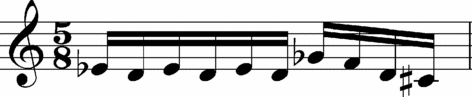
In line with Stone's aesthetic of reliving trauma, the dramatization of Kennedy's assassination is repeated on several occasions from several dramatic angles in JFK. The climactic instance, which also features the most hostile attack on “JFK's theme” by the “Beast,” takes place during the film's final courthouse scene. During Garrison's magic-bullet prosecutorial centerpiece, a long stretch of the character piece “The Motorcade” is heard (beginning at 2:52:35). Much like Stone's own montage style, the cue is based on a frenzied juxtaposition and near overwhelming barrage of acoustic stimuli. One hears disconnected fragments of the “JFK theme” in horns, “Drummer's Salute”–derived rhythmic ostinati, wailing bagpipes (another Irish connection), and wall after wall of clusters and polychords. Supporting it all is a pair of deep pedal points on the dyad A♭ and B♭. These dissonant drones are drawn, perversely, from the melodic major-second alternation present in the main JFK theme itself, where it takes place between scale degrees < tex − math/ > 4 and 5. < tex − math/ > “The Motorcade” is thus a composite of differentiated and conflicting orchestral layers, a music of “interlocking rhythmic disciplines” to use Williams's own phrase.Footnote 83 The sequence that results is indeed highly disciplined, every filmic component engineered to argue almost irresistibly for Garrison's multiple-gunman theory—down to the repetition of the Zapruder footage and Costner's litanization of the phrase “back-and-to-the-left.”
The remorselessly manipulative scene is the summit of what Stephen Lavington calls Stone's “sledgehammer aesthetic.”Footnote 84 Through its bludgeoning together of music, imagery, and dialogue, the motorcade sequence cannily blends conventions of horror film scoring with processional music, producing something part parade, part funeral cortege, and part simple aural assault. Kennedy's theme is defiled and then buried, figuratively and literally, under layers of musical pandemonium, denied full expression by musical ideas associated with conflicting ideologies and lifestyles. And yet it is ironically in this purposefully obscured state that Williams's theme is at its most mythically honest. The meaning of the “Theme from JFK” depends on the impossibility of unambiguous concrete representation through musical devices. No matter how evocative the style topics, no matter how stirring the Americana codes, at best music can only imaginatively reconstruct, not resurrect, a lost public figure. The theme's significatory power is thus at its highest when filmic context draws attention to its own absence, fragility, or ephemerality. John Hellmann states, “The popular hero known as John F. Kennedy was a product, an image designed to both express and elicit desire. This object was constructed through a series of hero tales that, told and retold, produced a politician as the hero of an unfolding mythology. . . . This modern American hero tale, the life and career of John F. Kennedy, is perhaps even the major American mythology of our time.”Footnote 85 Williams's attested aim to “portray something of the young President's character” notwithstanding, the thirty-fifth president, as rendered by Williams and Stone, amounts to a public recollection rather than an actual human being with interiority. This JFK is an image—romanticized, selective, and tragic—the mythical fallen King, always already lost.
6. Reprobation and Rehabilitation in Nixon
The balance of grim reality and hopeful idealization is reversed in Stone's Nixon. During its even longer running time (221 minutes), the film achieves a feeling of buzzing overrepresentation for the title character, who hardly ever leaves the screen. Nixon’s score is far longer, more sustained in its musical arguments, and subject to more insightful motivic development. In tandem with Hopkins's raw performance, music helps lay bare the thirty-seventh president's personal demons and traumatic past. Yet the surfeit of characterization alludes to a lack deliberately structured into the very fabric of the film —a musical “hole” comparable to the one in JFK, but approached from the other direction, as surplus presence rather than absence. Overflow of personality contributes to the story's tragic dimensions, the sense that the character is too big for the stage he is placed on. At the same time, it helps manufacture a broader narrative about the nature of historical representation. As Gavin Smith argues, “Ultimately Stone is giving us not just an imploded, psychodramatized Nixon but also a represented and displaced Nixon, endlessly fabricated and disassembled by history-making cameras and microphones in the era of mass media and of his own paranoia. His images and speech are insatiably captured, framed, fragmented, and reconstituted into a delirium of visual styles and formal devices. . . .[Stone's film] is a historical drama about the constructing and recording of history.”Footnote 86 Williams's musical characterization of Nixon is in line with this combination of psychodramatic excess and refractive deconstruction. A glimpse at the inventory of recurrent musical materials of the score (Example 4) reveals a strikingly different pattern than for JFK. The president of this film garners no one single motto, but a spiraling collection of motifs and submotifs; his thematic identity is located at once everywhere and nowhere in the score.
Themes and motifs in Nixon (1995, Cinergi Pictures Entertainment, Inc.), directed by Oliver Stone and produced by Dan Halsted, Eric Hamburg, Richard Rutowski, Oliver Stone, Clayton Townsend, and Andrew G. Vajna. Musical score by John Williams. Transcriptions by author.
Much material originates from the thematic fount of the film's trailer, which includes a specially composed overture that Williams later titled “1960s: The Turbulent Years” for the soundtrack album. With a large-scale ternary structure, “The Turbulent Years” inverts the film's tripartite narrative structure. The film's dramatic arc details Nixon's struggles and failures in Acts I and III, and his rise to power in Act II.Footnote 87 By contrast, the overture sandwiches its most tumultuous music between bookends of ambivalent aspiration. From “The Turbulent Years,” one may discern the gestation of the aforementioned “napalm recollections” (Example 4A), along with a half dozen other motifs that range from cataclysmic (Example 4F and G) to growling but noble (Example 4B, C, E) to almost bucolic (Example 4D and J). In the film these particles attach to and develop alongside various details of Nixon's career. Motif G, used sparingly but usually in an aggressive guise, is clearly coded as “villainous” and resembles Williams's themes for antagonists in the Star Wars series. Those motifs associated with “striving” (Example 4B, D, E, and H) are subjected to particularly elaborate development, their exaggerated rise/fall contours often set against ungainly chromatic harmonies. Yet, as with the “Prologue” from JFK, these musical ideas are not simply “themes for Nixon.” The fact that the source of the motifs refers to time period rather than the man himself illustrates the extent to which history, rather than just personality, is at stake in Williams's score.
The composer's role in constructing history is at its most active in his scoring of Nixon's speeches.Footnote 88 Especially acute in these scenes is the clash of Williams's penchant for monumentalization with Stone's kinetic and fragmentary aesthetic. Musical accompaniment varies from wounded (the 1962 “Last” Press Conference, 0:37:00) to “Beastly” (the 1973 Watergate address 2:43:20 and the “I am not a crook” address, 3:06:40) to blandly patriotic (the “Checkers” speech, 0:41:46). The rendering of Nixon's farewell address upon his resignation (3:22:23, immediately following the “deathbed realization” scene) is illustrative of these competing aesthetics. The speech plays over the end credits, placed there because of its superfluity to the film's core drama, with the narrative proper having reached its logical conclusion with Nixon's moment of cathartic self-realization and subsequent abdication.Footnote 89 Treating the speech as excess allows a problematic aspect of the scene to be side-stepped. The recreation of the farewell address appears not only to let Nixon off the hook, but gives him a warm and dignified glow after hours of portraying him as a hopelessly compromised antihero. Stone himself admits many critics read the scene as “hagiography,” while he himself thought of it as generally “neutral,” and at most “ironic.”Footnote 90
Williams is complicit in this side-stepping strategy. Elements in the music suggest that the final cue operates as an extra-narratival bookend, thus garnering a formal “escape clause” from its responsibility to color the main, more tragic action. In line with his usual approach, the composer grants the end-credits sequence a sustained reworking of his themes, fuller and longer breathed than heard previously. In the farewell address, Williams strings together several motifs (Example 4B, C, D, E, and M) into a bittersweet valediction redolent of the more dignified Coplandiana from JFK, leaning on the pastoralist codes he elsewhere dutifully eschews.Footnote 91 Despite the summational quality, however, the sequence still functions as underscore for dialogue. And as such, it is not a neutral witness but an active participant in producing the tone of the cinematically restaged historical event. Significantly, the motifs do not entirely shed their gnarled qualities. In fact, being clothed in sentimental harmonies and dignified orchestration only seems to highlight the motif's gnarled, melodically awkward, and diatonically inassimilable qualities. The disconnect between outward appearance and intrinsic brokenness subtly works against a too-straightforwardly sympathetic identification with Nixon. Stone himself subverts the implicitly critical tone of Williams's music when he substitutes the belligerent concluding pages of the underscore cue with a military band performance of “The Star Spangled Banner” and a choral rendition of the folksong “Shenandoah.” Rehabilitation of a sort certainly does take place on the soundtrack, but as incorporated into the musical texture, Williams's chosen motifs resist ennobling thematic transformation. His music is not “neutral,” as Stone naively views the whole scene, but nor is it uncomplicatedly on the side of Nixon's oratory.
The varied and sometimes contradictory approaches to historical representation in Nixon lead to a constant tug between identification and distanciation, between viewing events unfold at a critical remove and being immersed within the tumult of history as if it were directly taking place. The dichotomy of political representation is at play most urgently with the structural centerpiece of the film and score: the 1968 Republican National Convention (1:18:37–1:24:06). Nixon's acceptance address in the film is a composite of several speeches with some invented and adapted components.Footnote 92 An already-collage-like oration overlays a complex montage of Hopkins speaking, historical and staged footage of the “silent majority,” and widespread civil unrest. Table 2 provides a formal analysis of the speech, aligning the various stages of Nixon's oratory with each of the musical cue's thirteen sections. Also indicated are the montage images that sometimes align, but more frequently clash in tone with Nixon's exhortations: the audio-visual disjunctions are either direct (as when Hopkins promises “full prosperity in peacetime” while brutal police suppression is shown) or ironic (as when the image of Martin Luther King is seen while the duplicitous candidate extols the “truth”).
Musical structure of Nixon, “Miami Convention, 1968.”
Transcriptions by author.
The swing of Stone's editorial sledgehammer is answered with forcefully foregrounded scoring. Music amplifies the rhetorical punch of every line Hopkins delivers, and through its symphonic bombast it suggests that the convention was not only a turning point in Nixon's career, but in the history of the United States as well. Nevertheless, despite its manipulative aggression, the music once again pushes a scene into surprisingly ambivalent territory. The cue “Miami Convention, 1968” alternates statements of various motifs against a cyclone of briefly visited keys, twelve large-scale modulations in all. Craning higher in an ever-intensifying series of climaxes, the piece builds to a delirious, dissonant climax after Hopkins bellows, “We must have a complete reform of the big, bloated federal government!” as massive waves of D♭ major crash against the rocks of an A♮ pedal (Example 5).
Climax of “Miami Convention, 1968.” From Nixon (1995, Cinergi Pictures Entertainment, Inc.), directed by Oliver Stone and produced by Dan Halsted, Eric Hamburg, Richard Rutowski, Oliver Stone, Clayton Townsend, and Andrew G. Vajna. Musical score by John Williams. Transcription by author.
In conjunction with the rapid succession of incendiary images, Williams throttles the listener with roiling ostinatos and sinister fanfares. While closely synchronized at the speech's beginning such that applause lines signal new formal sections, the music becomes progressively less tethered to the beats of Hopkins's speech. This decoupling enables moments of striking counterpoint. Such is the case when Nixon calls for “new responsibility” while images flash of urban carnage and a positively Darth Vader–esque statement of motif G snarls. Proper realignment occurs at the conclusion of the address with a series of discordant hexatonic juxtapositions (C against E- and A♭-minor). It is a fittingly grotesque harmonic gambit for a transition in which fireworks and cheering give way to bombs over Laos and angry chants from the Chicago riots.
There is something more than a little dangerous in the way that Williams uses music to monumentalize Nixon's acceptance address. The score seems to support two equivocal, mutually exclusive interpretations, one critical, the other sympathetic. According to the first hearing, every negatively valenced musical topic underlines the divisiveness and hypocrisy of the orator and his “Southern strategy” of garnering support by playing on a feeling of reactionary alienation. The brass perorations that are so prominent in the cue—martial, inflated, never quite shorn of the element of disruptive dissonance—rightly belong to a tyrant re-ascendant.Footnote 93 “Miami Convention, 1968” on this hearing is music for a pseudo-fascist spectacle.
The second, more dangerous hearing is for filmgoers to be swept along, moved by the ferocity of Hopkins's delivery, perhaps enticed by the progressive tone of his later promises. Rather than construe the minor-mode fanfares as aspersions on Nixon's character, one might hear those musical elements as characterizations of his foes, the very “shouters” of social unrest that his “great silent majority” struggles to be heard over. On this reading, Williams's music is akin to a heroic tone poem, and Nixon its implied protagonist, complete with the victorious tolling of C major when he closes by promising a “New American Revolution!” With the churning orchestra supporting his rhetoric, Nixon battles away the forces of disorder and unrest, meaning what he says, and earning his thematic apotheosis, Black Panthers and Chicago rioters be damned.
Choosing between readings would seem to oblige us to impose a certain ideological lens on both the composer and the filmgoer. Is Williams so reactionary a composer that he would allow such a lionization of a disgraced president? Are we so easily enamored with representations of power that we instinctively hear negative musical topics as belonging to a narratively declared enemy, rather than a historically disastrous presidency? Or, alternatively, is Williams so repulsed by Nixon that he offers him the same musical treatment he would for a Dark Lord of the Sith in some fictional Manichean universe? And are we suitably prejudiced to read it in those terms as well? As usual, the hermeneutics of such contrapuntal-or-parallel (or critical-or-sympathetic) are grossly facile and reductive. The fact that the scene leaves these starkly opposed interpretations open speaks to a deeper, more productive ambivalence contained in the film's soundtrack. The actual effect of music in Nixon's acceptance speech is purposely bivalent and discomfiting, both condemnation of “The Beast” and an invitation to participate in a bit of musical authoritarianism, if just for three minutes.
7. Music as History
In his essay “Oliver Stone as Historian,” Robert Rosenstone claims that the director's filmography is “history” in a strong, albeit postmodern, sense: history as argument, metaphor, and symbol imposed upon traces of the past.Footnote 94 In Stone's hands, cinema, the “most literal of media never delivers a literal representation of the past. It speaks about the past, it comments on it, it raises the issues of the past and tells us what those issues (can) mean. But it cannot show the past to us.”Footnote 95 Oliver Stone's movies, Rosenstone argues, strive to make meaning of the past, selectively envisioning significant episodes, contesting conventional and institutional narratives, and revising those narratives to instruct and rouse audiences. The movies “engage the discourse of history and add something to that discourse.”
Whether one agrees with Rosenstone that Stone's paranoid and outraged films constitute history in the same way the work of academic historians does, it is apparent that John Williams's music is bound up with the same postmodern sort of authorship of historical meaning. As I have demonstrated, Williams's scores for JFK and Nixon assume much of the responsibility for creating of Stone's cinematically constructed metanarratives. The character traits Williams chooses to highlight through musical codes; the manner in which his themes symbolize ideas and eras rather than personages; the way music solidifies film-spanning metanarratives about power—these acts of compositional interpretation are part of a historical discourse as potent as any screenplay. Williams's music goes beyond neutral underscoring, and, indeed, beyond ideologically colored musings on history, whether nostalgic or condemnatory (or both). The scores are, in Rosenstone's sense, acts of writing history in their own right. Williams's presidential portraits do not pretend to “show the past to us.” But at every juncture they tell us what the issues of the past (can) mean.



