


Introduction
Before the early 2000s, research on local politics was one of the ‘growth industries’ in Thai studies. A steadily increasing number of studies were published during this period that analysed the domination of rural-based politicians (notably the ‘godfather’ phenomenon), the changing nature of electoral contests, and other related issues (e.g., Anderson Reference Anderson1990; Arghiros Reference Arghiros2001; Askew Reference Askew2008; Bowie Reference Bowie2008; McVey Reference McVey2000; Nelson Reference Nelson1998; Nishizaki Reference Nishizaki2011a; Ockey Reference Ockey1992; Somrudee Reference Nicro1993; Viengrat Reference Viengrat, Phongpaichit and Baker2008; Walker Reference Walker2012). These studies represented a wholesome trend, departing from the previous Bangkok-centric scholarship on Thai politics.
During the last decade or so, however, the lion's share of scholars’ attention seems to have shifted to more sensational issues in Bangkok, such as violent street protests, military and judicial interventions, Prayut Chan-ocha's repressive military or quasi-democratic regime, the monarchy and growing anti-monarchical discourse, and so on. Studies examining local Thai politics have appeared only intermittently (e.g., Chaiyon and Chainarong Reference Chaiyon, Chainarong, Phongpaichit and Baker2016; Keyes Reference Keyes2014; Pattana Reference Pattana and Montesano2012; Prajak Reference Prajak2016; Saowanee Reference Saowanee2021). The recent scholarly trend makes it seem as if provincial Thai politics did not matter as much as it once did or research on it had been exhausted.
Actually, it remains critically important to study provincial Thailand, and a lot more research needs to be done to uncover the structure of local power relations or the types and backgrounds of provincial politicians, about which we still know precious little. Some scholars have analysed these issues in relatively large provinces or the provinces where nationally famous godfathers have wielded power (see the works cited above), but smaller and lesser-known provinces have received scant scholarly attention.
This study makes a modest attempt to fill these lacunas in research and redirect scholarly attention to provincial Thai politics. It does so by unravelling one distinctive yet previously understudied general electoral trend in provincial Thailand. Specifically, this paper shows that in the majority of Thai provinces, the Provincial Administrative Organisation (PAO), an electoral institution that has received unprecedented amounts of state funding in the post-1997 era of decentralisation, has been controlled by influential political families that have produced members of Parliament (MP). Although some previous studies have highlighted the close nexus between the PAO and political families, many of them are rather outdated. Their findings are also limited to one or two particular provinces or elections, and they tell us little about whether the pattern identified in a particular province or election can be observed in other provinces and elections (e.g., Achakorn Reference Achakorn2007; Arghiros Reference Arghiros and McCargo2002; Montesano Reference Montesano2020; Nelson Reference Nelson2004; Punchada Reference Punchada2021). By contrast, this paper presents systematic data on all PAO presidents elected in all 76 Thai provinces (except Bangkok) up to the present and on their family relationships to former or incumbent MPs. These data highlight one deeply ironic outcome of the Thai government's much-touted decentralisation policy: As political and economic power has been devolved to the provinces outside Bangkok, a limited number of well-entrenched oligarchic elites have centralised it in their hands. What was a well-intended policy has turned the PAO into a new institutional territory for these elites.
My findings are based primarily on the Assets and Liabilities Declaration Files (บัญชีแสดงรายการทรัพย์สินและหนี้สิน), available at the National Anti-Corruption Commission of Thailand. These files, of which there are more than 2000, contain invaluable data on the personal, familial and economic backgrounds of all MPs and PAO presidents elected since 2007. In this paper, these files are abbreviated as NACC, followed by the names of MPs or PAO presidents. I supplement these documents with various other primary and secondary sources.
I emphasise that this paper concerns the effects of introducing the elected PAO presidency on the broad structure or distribution of political power in provincial Thailand. This is not a micro-level study of how specific PAO presidents have achieved electoral success and have performed in office, or how they are viewed by voters. Their election campaigns and performance in office do not directly impinge on my argument. My argument is not that the political families in question are detrimental to Thailand's sound democratic governance because they have used illegal means (e.g., vote-buying) to win the PAO presidency or that they have misused their public office and have failed to meet their constituents’ needs. As will be shown below, some of these families had their reputations damaged with allegations of wrongdoings before winning the PAO presidency. My point here is only that the well-intentioned decentralisation policy has enabled even these families to maintain and expand their power and that their electoral success has contributed to the entrenchment of the already influential political elites. I take a critical view of these and other elite families because I believe that their dominance over the PAO presidency is antithetical to pluralist democracy. Collectively, they have raised and constitute formidable structural barriers to entry into the most important elected local office for those who do not have powerful family connections.
Note also that this paper is limited to one local-level institution: the PAO. This is not a comprehensive study of how political families dominate all other local electoral institutions, such as municipal governments and the Sub-district Administrative Organisations (SAOs).Footnote 1 My specific focus is justifiable because the PAO, situated above municipal governments and SAOs and controlling a much larger amount of funds, is the most powerful electoral institution in provincial Thailand at present. An analysis of how various political families have controlled this institution offers a good insight into the unbalanced structure of power in provincial Thailand.
The PAO Politicised: Background and Rationale
Originally called the Provincial Council (sapha jangwat) in the 1933 Municipality Act, the PAO was created by the 1955 Provincial Administrative Act. Under this law, provincial governors, appointed by the Interior Ministry in Bangkok, served as ex-officio PAO presidents. The PAO constituted one means by which the central government effectively oversaw, controlled, and subordinated local administration. As such, the PAO had minimal autonomy to undertake its main duty: infrastructure development. In addition, funds for performing this function came from meagre central government subsidies. The PAO did not have sufficient economic resources to initiate development projects. It remained a low-key, nondescript, provincial-level institution in the centralised bureaucratic state (Bowie Reference Bowie2008: 487–488; PAO Chachoengsao Reference PAO2021).
What has transformed the PAO into the highly visible and powerful cash-awash institution it is at present is the promulgation of the so-called ‘People's Constitution’ in 1997. Drafted by prominent liberal royalists, such as Prawes Wasi and Anand Panyarachun, and other reformists, this constitution (section 284) sought to decentralise political and economic power from Bangkok, albeit not entirely (Supasawad Reference Chardchawarn2010: 11-12). In the post-Cold War global neoliberal regime that worships efficiency, transparency, accountability and rationality, the de jure devolution of power has become a fashionable slogan driving political reforms in many countries, including Thailand (Hadiz Reference Hadiz2011: 11-12, 18-19). Before the late 1990s, excessive political and economic power had been vested in the central government and bureaucracy in Bangkok, often resulting in opaque, arbitrary and inefficient decision-making—a legacy of the absolute monarchy that had reigned supreme before 1932 and the so-called ‘bureaucratic polity’ that appeared after 1932.Footnote 2 As Prawes lamented in 1995, this ‘monopolisation of politics by a minority’ was one of the shortcomings of Thai politics (McCargo Reference McCargo2015: 332). Rectifying this imbalance, sometimes referred to as ‘internal colonialism,’ was one of the primary motivations behind the 1997 constitution (Connors Reference Connors1999; McCargo Reference McCargo and McCargo2002). The constitution “sought to establish a broader political system than the one that had long been monopolised by traditional politicians and bureaucrats” (Naruemon Reference McCargo2002: 195).
The growing prominence of allegedly unscrupulous MPs gave an added impetus to the decentralisation drive. Tainted by allegations of malfeasance, electoral fraud, violence, unprincipled party-switching, links to the underworld or other misdeeds, these people or their family members were successful in winning parliamentary seats in various provinces. Once elected to Parliament, they allegedly funnelled massive state funds into their respective constituencies, skimmed profits off those funds and amassed even more wealth. Their expanding wealth helped make their already large clientelistic networks even larger and cement their local bases of electoral support (McVey Reference McCoy2000; Pasuk and Sungsidh Reference Pasuk and Sungsidh1996). As electoral politics took deeper root before the late 1990s, political and economic power became increasingly concentrated among these local elites, representing the worst excesses of Thailand's electoral democracy.
Deeply alarmed about these developments, neoliberal elites, with support from King Bhumibol, launched a noble movement to reform electoral politics in the early 1990s. Implemented as one integral component of this reformist project, the decentralisation project allocated state funds directly to the PAOs, bypassing the powerful local barons-cum-MPs who otherwise would have been the dispensers of those funds. The neoliberal reformists hoped that this policy would reduce the dependence of local governments and voters on such MPs for state funding and wrest political and economic power from them. This goal also received support from the advocates of ‘localism’ (e.g., grassroots nongovernmental organisations), who argued for empowering rural communities and people. Although these localists’ wariness of globalisation diverged from neoliberal pundits’ sanguine views, the two camps “shared a common opposition to the strong, overpowerful state” (Pasuk and Baker 2004: 21).
Based on these rationales, the central government has channelled unprecedented amounts of funds since 1997—at least 25 per cent of national revenues—to various units of local administration, including PAOs. In 2016, for example, the government allocated more than 28 per cent of its revenues to local administration—an exponential increase from 8 per cent in 2000, when the decentralisation programme was not yet fully enforced (Ockey Reference Ockey2017: 270; cf. Viengrat Reference Viengrat, Montesano, Chong and Shu Xun2019: 227). Some provinces have been allocated annual budgets exceeding one billion baht and nearing two billion baht (Peerasit Reference Peerasit2015). The PAO has been one major beneficiary of this new fiscal policy; it has become an institutional conduit through which abundant economic resources flow regularly from Bangkok.
Furthermore, the 1997 PAO Act, enacted with the 1997 Constitution (section 285), dictated that PAO presidents (and councillors) be elected directly by voters to four-year terms. Before the 2014 coup, three PAO elections were held—in 2004, 2008, and 2012 (except in provinces where PAO presidents won by-elections held in intervening years). The PAO presidents in office at the time of the 2014 coup had their terms extended until the most recent PAO elections in 2020.Footnote 3 There are currently 76 PAO presidents, one for each province except Bangkok.Footnote 4 Elected by direct popular vote, these PAO presidents have gained the authority, subject to PAO councils’ approval, to use enormous state funds in various districts, sub-districts and villages within their jurisdiction.
In a way, the decentralisation strategy has been successful. The PAO has now emerged as an institution considerably (if not completely) independent from the Interior Ministry.Footnote 5 Every PAO has implemented numerous development projects on its own initiative. Countless local residents have benefited from such projects.
PAOs and Family Rule: Unintended Outcomes
In some other ways, the decentralisation plan has failed to achieve its intended results. As is well known, the majority of PAO presidents and councillors are local capitalists, especially contractors, eager to profit from the vast financial opportunities created by the infusion of state funds. The PAO council has been dubbed the ‘contractors’ council’ (Arghiros Reference Arghiros and McCargo2002: 233, 237–238). Unsurprisingly, when the idea of abolishing the PAO was proposed in 2001 and 2013, PAO presidents (and councillors) throughout Thailand voiced vehement objections (Peerasit Reference Peerasit2015).
The elected PAO presidents have used their newfound political and economic resources to construct a large, province-wide patronage pyramid (Arghiros Reference Arghiros and McCargo2002: 233, 235–236). Lower-level local administrators (e.g., sub-district heads) find it expedient to curry favour with PAO presidents. A patron-client network consisting of these individuals has enabled many incumbent PAO presidents to win re-election.Footnote 6 Of all 181 PAO presidents elected nationwide since 2004,Footnote 7 nineteen have served an uninterrupted four terms. That is, they have monopolised the PAO post, having won all four elections held thus far (author's research; see appendix).
Some other PAO presidents have successfully groomed their family members as their successors and have achieved a dynastic transfer of public office. In 29 (38 per cent) of Thailand's 76 provinces, all four PAO presidential elections held in the 2000s have been won by members of the same family or kinship group. In another sixteen provinces (21 per cent), a particular family or its kinship group has held a semi-monopolistic grip on the PAO, having won three of the four PAO presidential elections in the 2000s (appendix). The introduction of the elected PAO presidency has facilitated concentration of power among these elite families.
Another noteworthy feature is the ambiguous boundary between PAO presidents and MPs. Of all 181 PAO presidents elected up to the present, 48 (26.5 per cent) had served as MPs prior to winning the PAO presidency.Footnote 8 Given the recent volatility of Thailand's national-level parliamentary politics,Footnote 9 these former MPs now prefer controlling the more stable and lucrative local-level PAO office to avoid the risk of being in opposition in Parliament or being subordinated to prime minister (Hadiz Reference Hadiz2011: 110). Another seventeen (9 per cent) of the 181 PAO presidents represent an opposite pattern, having become MPs after their terms as PAO presidents ended (appendix), while simultaneously bequeathing the PAO presidency to their relatives. For these latter MPs, the PAO presidency has been a steppingstone to the national Parliament.
In addition, of all 181 PAO presidents elected so far, 107 (59 per cent) are related, by blood or marriage, to at least one former or incumbent MP. Of these 107 PAO presidents, 79 come from families that have produced more than two MPs (appendix). In a typical pattern, one or more former or incumbent MPs from a particular family, including those previously accused of multiple misdeeds,Footnote 10 help their relatives win the PAO presidency in their respective provinces. The PAO presidency then enables the already influential MPs to consolidate their power and enhance their chances of re-election as MPs (although re-election is not guaranteed). In a reverse pattern, former or incumbent PAO presidents use their influence to secure their relatives’ electoral success as new MPs. In both patterns, the PAO presidency has become an institutional vehicle for dynastic power sharing and transfer among local elites.
Female PAO presidents have constituted one small yet important part of this phenomenon. Of all 181 former and incumbent PAO presidents elected to date, only 25 (14 per cent) are women, reflecting the male-dominant nature of Thai politics (Nishizaki Reference Nishizaki2018). It would be erroneous to view these 25 female PAO presidents as representing a new emerging type of provincial political leadership. Virtually all (n = 21) of the 25 female PAO presidents have come from families that have produced at least one male MP. These women possess superior electoral resources (e.g., money, patronage networks) that their male relatives have acquired as MPs.
Given the rationales underlying the post-1997 decentralisation policies, these outcomes are nothing short of ironic. The elected PAO presidency has allowed many former MPs and their families to acquire even more political and economic resources. Far from emasculating these families, the new institution has unintentionally empowered them and has contributed to expanding family rule in Thai politics, extending from the national level to the provincial level (see Nishizaki Reference Nishizaki2018; Ockey Reference Ockey2015; Stithorn and Wichuda Reference Stithorn and Wichuda2016 for data on family rule). This is a nationwide phenomenon, not specific to a few provinces or regions. In short, the decentralisation initiative has backfired, at least as far as the PAO presidency is concerned. In its very effort to redress centralisation of power, this initiative has inadvertently perpetuated and exacerbated it. Political and economic power has not become diffuse; its scope has become narrower because of the decentralisation policy.
The process through which this unintended outcome has transpired has not been always seamless, however. Given the extremely high stakes involved, the PAO presidency has become a much-coveted political post, and PAO presidents have attempted to eliminate threats to their positions by using every means possible. Likewise, their rivals have resorted to various tactics, including illegal and violent ones, to win the PAO presidency. As one testament to these vicious rivalries, five PAO presidents have been assassinated in office (appendix). Although such murders are relatively rare, PAO presidential elections in many provinces have generated intense competition, pitting various political families against each other. In the 2020 PAO election, the winning candidates in 46 (61 per cent) of the 76 provinces competed against former MPs or candidates whose relatives had previously served as MPs (author's research).
In the next section, I shed light on the political families that have controlled the PAO presidency in twelve provinces. These provinces represent all four regions of Thailand and differ greatly in physical and population size, as well as in their levels of economic development and urbanisation (Table 1). None of these geographic, demographic or socioeconomic factors have significantly affected political families’ ability to win the PAO presidency.

Nakhon Ratchasima
One such family is the Suwanchawees in Nakhon Ratchasima Province of the northeast. Mrs Ranongrak Suwanchawee, former PAO president (2012-2020), has married into this family. Her father, Lert Hongpakdee, had served as a constituency MP for Nakhon Ratchasima (1983-1988), after which his son-in-law (Ranongrak's husband), Pairote Suwanchawee, served five terms in the same role (1992–1996, 2001–2006). Ranongrak followed suit by representing Nakhon Ratchasima as a senator (2006) and as a constituency MP (2008–2011), before launching a successful bid for the PAO presidency in 2012. Pairote and Ranongrak were succeeded by their son (Lert's grandson) Polapee as a Nakhon Ratchasima constituency MP (2008–2014) (CREM Lert Hongpakdee 1993: 23–24; CREM Pairote Suwanchawee 2012: 12; NACC Ranongrak Suwanchawee 2008).Footnote 11
In 2011, the Suwanchawees were debilitated by Pairot's death from cancer at age 61. In 2019, Polapee lost his re-election bid to Thasanapon Ketmetheekarun, a female Palang Pracharat-backed candidate related to the Ratanasets, a rival political family.Footnote 12 With no family member elected to Parliament in 2019 and her political fortunes waning, Ranongrak did not run for re-election in the 2020 PAO race, nor did any of her relatives.
Another prominent political family, the Wangsupakitkosols (Figure 1), has now gained control of the Nakhon Ratchasima PAO presidency. The new PAO president, Mrs Yolada (formerly Wichuda) Jitrapitaklert, is married to Weerasak Wangsupakitkosol, who was elected a Bhumjai Thai party-list MP in 2019 and served Prime Minister General Prayut as deputy commerce minister until March 2021.Footnote 13 Weerasak is currently deputy transportation minister in Prayut's cabinet (NACC Yolada Wangsupakitkosol 2021; NACC Weerasak Wangsupakitkosol 2019).
Politicians from the Wangsupakitkosols and Jitrapitaklerts.

Prior to Weerasak's electoral success, Yolada's elder brother Wichai Jitrapitaklert had served as a Nakhon Ratchasima constituency MP for the Chart Thai (CT) Party from 1986 to 1988. Yolada's younger sister Jitrawan also served as a representative of Phuea Phaendin Party from 2008 to 2011. Jitrawan has married Weerasak's younger brother Somsak Wangsupakitkosol, a Nakhon Ratchasima senator elected in 2006. Yolada and Jitrawan, who are full-sisters, have married into the same family, and their husbands have been elected to Parliament, besides Jitrawan and Wichai (NACC Jitrawan Wangsupakitkosol 2008) (Figure 1).
Bound by intricate marital ties, these two families have produced four MPs since the 1980s, and their local power base has become even stronger, with Yolada currently serving as PAO president. This political base has a strong economic base. The two families have extensive joint investments in starch production (DBD/MC 1993a; DBD/MC 2000; DBD/MC 2004), transportation (DBD/MC 2001) and gas (DBD/MC 2007) in Nakhon Ratchasima and its surrounding provinces.
Sisaket
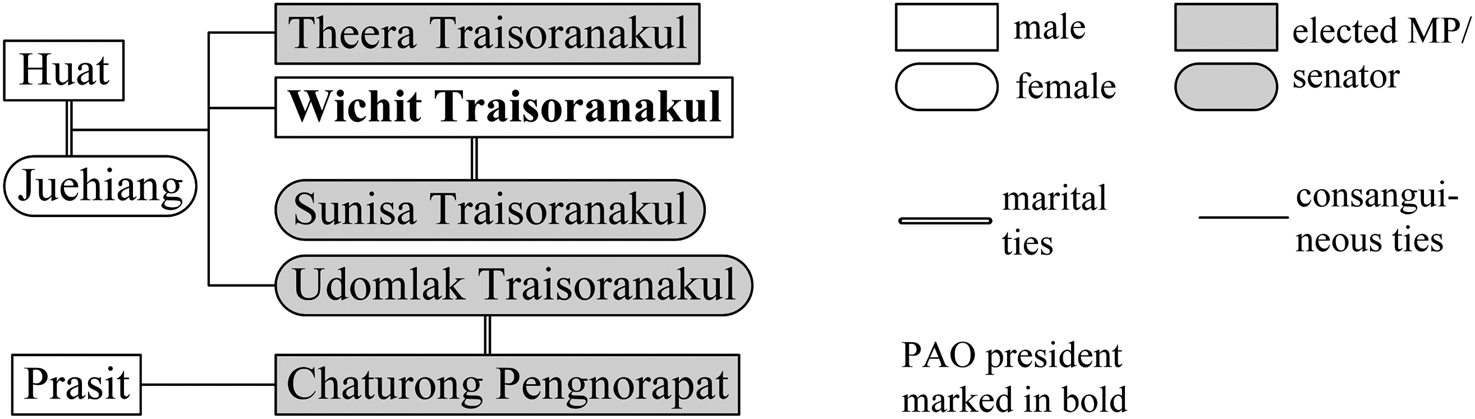
The PAO presidency in another northeastern province, Sisaket, has been monopolised by the Traisoranakuls. One member of this family, Wichit, has served four consecutive terms as PAO president since 2004 (Figure 2). In 2006, two years after Wichit became PAO president, his wife, Sunisa, was elected to the Senate representing Sisaket. Wichit's elder brother Theera Traisoranakul also entered electoral politics, winning a seat as a Sisaket constituency MP in 2007 and 2011 under the banners of pro-Thaksin parties (People's Power and Phuea Thai, respectively). Re-elected on the Phuea Thai ticket in 2019, Theera is an incumbent Sisaket MP. In 2007 and 2011, Wichit and Theera's youngest sister, Udomlak (Traisoranakul) Pengnorapat, was also elected a Sisaket constituency MP on the tickets of the Matchima and Bhumjai Parties, respectively (NACC Theera Traisoranakul 2019).
Politicians from the Traisoranakuls and Pengnorapats.

These MPs followed in the footsteps of Udomlak's husband, Chaturong Pengnorapat, who had served four straight terms as a Sisaket constituency MP from 1995 until the 2006 coup, long before Wichit first won the PAO presidency in 2004. In the 2007 Constitutional Court ruling, Chaturong, a high-ranking member of Thaksin's Thai Rak Thai (TRT) Party,Footnote 14 was banned from holding political office for five years. He was re-elected a Sisaket MP for the Phuea Thai Party, a reincarnation of TRT, in 2019. As of 2022, Chaturong still holds this post, along with Theera Traisoranakul, while Wichit serves as PAO president (NACC Chaturong Pengnorapat 2019).
Lopburi
The PAO presidency in Lopburi Province of the central region has also been dominated by one family, the Jiraphanwanits, who run two successful construction companies (DBD/MC 1992; DBD/MC 2005). The patriarch of this family, Kamol, now 89 years old, served seven times as a Lopburi constituency MP for the CT Party from 1983 to 2005. He solidified his control over provincial politics in 2004, when he succeeded in having his eldest son, Suban, elected as PAO president. Suban was re-elected PAO president in 2008. While Suban was still PAO president, Kamol was re-elected as a Lopburi MP under the CT banner in 2007. Once Kamol received a five-year political ban in the 2008 Constitutional Court ruling (for being a CT executive), his daughter (Suban's younger sister) and PAO councillor Manlika assumed control as a new Lopburi MP following the January 2009 by-election (NACC Manlika Jiraphanwanit 2009).
The Jiraphanwanits were given a jolt in June 2011, when the two-time PAO president Suban was murdered due to political conflicts stemming from his role as vote canvasser (Prajak 2013: 168). Nevertheless, this murder did not weaken the Jiraphanwanits politically. Following a by-election held in August 2011, Suban's widow, Oraphin, former PAO councillor, became new PAO president. Re-elected in 2012 and 2020, she currently holds the office of PAO president. For her part, Manlika won re-election as a Lopburi constituency MP in 2011 and 2019, while her father, Kamol, has retired from electoral politics. Manlika is an MP for Lopburi as of 2022.
Chainat
The PAO presidency in Chainat, another province in the central region, has been controlled, in succession, by two political families: the Songprachas and Nakhasais. The Songprachas, a capitalist family with far-reaching interests in construction (DBD/MC 1977), real estate (DBD/MC 1990a; DBD/MC 2016a), auto parts (DBD/MC 2011) and fruit sales (DBD/MC 2018), produced Chainat's first elected PAO president, a woman named Jirada, in 2004. She served in office until 2008. Before this, her father, Bunthong Songpracha, had served as a Chainat constituency MP for CT five times from 1983 to 1996. In the 1996 general election, Bunthong's son (Jirada's younger brother) Monthien took over as a new Chainat MP for CT. Monthien retained his parliamentary seat on the CT ticket in 2001, although he lost his re-election bid in 2005 and received a five-year ban in 2008 for being a CT executive. A year after this ban ended, he was elected as Chainat senator in 2014. Although his senatorial term was short due to a coup launched a month later, Monthien has now achieved a comeback as a Chainat constituency MP after winning the 2019 election under the banner of Prayut's Palang Pracharat Party (NACC Monthien Songpracha 2019).
Meanwhile, Monthien's younger sister Nanthana Songpracha served a term as a Chainat senator from 2000 to 2006, before winning a seat as a Chainat constituency MP for Bhumjai Thai Party in 2011. Re-elected in 2019 (alongside Monthien), she is now a party-list MP for the newly founded People Progressive (Pracha Piwat) Party. In addition, Jirada, former PAO president and Nanthana's elder sister, has been appointed to the Senate by Prayut (NACC Jirada Songpracha 2019; NACC Nanthana Songpracha 2019). Three Songprachas currently serve in Parliament.
Since Jirada's term as PAO president ended in 2008, Anuson Nakhasai has served in this role, having won three successive elections. Anuson's elder brother Anucha had served twice as a Chainat constituency MP for TRT (2001–2006). Anucha wields considerable economic clout, having owned Chainat FC in the lucrative Thai Premier League since 2009 (Wasan et al. Reference Panyakaew, Sa-nguansak and Jutipon2014: 115, 132). Receiving a five-year political ban in 2007 for being a TRT executive, Anucha remained politically dormant until 2019, when he was re-elected as a Chainat constituency MP, this time on the anti-Thaksin Palang Pracharat Party's ticket (alongside Monthien Songpracha). An unprincipled political opportunist, Anucha has defected from the Thaksin camp to the anti-Thaksin camp led by Prayut (NACC Anucha Nakhasai 2019). Anucha is one of the 32 former pro-Thaksin MPs whom Prayut has recruited into his party, given their track record of electoral success (author's research).
During Anucha's initial term as Chainat MP, his (now divorced) wife, Ponthiwa, was elected to the Senate to represent Chainat in April 2006.Footnote 15 Although the couple's terms were terminated by a coup five months later, and Anucha subsequently faced political suspension until 2012, Ponthiwa became a new Chainat constituency MP on his behalf by winning the January 2008 by-election on the Matchimatipatai Party ticket.Footnote 16 She was re-elected in 2011 on the Bhumjai Thai party's ticket. Meanwhile, Anucha Nakasai's elder sister (Ponthiwa's sister-in-law) Jitthana Yingthaweelapa served as senator for Chainat from 2008 to 2014 (NACC Jitthana Yingthaweelapa 2008). Thus, three Nakhasais have become MPs since before Anuson's term as PAO president started in 2008.
Rayong
The PAO presidency in Rayong Province, situated east of Bangkok, was initially held by two individuals from non-political families. Panajueapet Kritsanarat was elected PAO president in 2004. In early 2006, he resigned to run in the senatorial election scheduled in April that year, which he won. In a subsequent by-election, Sin Kumpa, a six-time former MP and a businessman,Footnote 17 became the new PAO president by defeating his rival, Piya Pitutecha. The Election Commission, however, raised a yellow flag for Sin's victory and held another by-election in July 2007. This time, Sin lost to Piya Pitutecha. Piya has been PAO president since then, having won three successive elections.
The Pitutechas are a wealthy Sino-Thai capitalist family in Rayong. The former patriarch of this family, Sakhon, accumulated wealth in the 1950s–1970s by growing sugar, cassava and rubber on several thousand rai of illegally occupied land (1 rai = 1600 square km). He even served as president of the Rayong Association of Sugarcane Planters. The Eastern Seaboard project, launched by the Thai government in the 1980s to promote industrialisation in Rayong and its vicinity, boosted the Pitutechas’ economic fortunes. Capitalizing on the state-funded infrastructure projects and land price hikes, the family founded eight companies with massive investments in construction (DBD/MC 1989; DBD/MC 1991; DBD/MC 1994; DBD/MC 2002), real estate (DBD/MC 2003a; DBD/MC 2015), canned fruits (DBD/MC 2003b) and combustibles (DBD/MC 2016b). Additionally, the Pitutechas have owned Rayong United, a Thai Division I football club, since 2012 (Wasan et al. Reference Panyakaew, Sa-nguansak and Jutipon2014: 117, 135). By 1997, they operated the largest construction business in Rayong. During this time, the family developed close ties with Kamnan Po, Thailand's most notorious godfather, based in the neighbouring Chonburi Province. Several people who threatened the Pitutechas’ economic interests were found shot dead (Chaiyon and Olarn Reference Chaiyon, Olarn, Phongpaichit and Baker2008: 198–200).
These economic resources have made the Pitutechas the most famous political family in Rayong. Four Pitutechas have become MPs thus far. Prior to becoming PAO president, Piya had served as a Ranong constituency MP three times from 1995 until 2005.Footnote 18 In 2001, Piya's younger brother Sathit was also elected a Rayong constituency MP on the Democrat Party ticket, while Piya was elected on the CT ticket. At that time, Sathit's father-in-law, Somkiat Nopaket, was PAO president.Footnote 19 Running as a Democrat Party candidate, Sathit lost his re-election bid in 2005, but he gained new political capital in 2007, when Piya assumed the PAO presidency. Since then, Sathit has been re-elected as a Rayong constituency MP in 2007, 2011, and 2019, each time on the Democrat ticket (NACC Sathit Pitutecha 2019).
Another Pitutecha, Thara, became a Rayong constituency MP under the TRT banner in 2005. Since defecting to the Democrat Party in 2007, Thara has won re-election three consecutive times, along with Sathit (NACC Thara Pitutecha 2019). Thara and Sathit are two of the four incumbent Rayong constituency MPs as of 2022. Meanwhile, Thara's elder brother Surachai was elected to represent Rayong as a senator in 2014 (NACC Surachai Pitutecha 2014).
Phrae and Lamphun
In Phrae Province of northern Thailand, the Wongwans have established effective monopoly over the PAO presidency. They did not control the PAO presidency from the beginning, however. The first Phrae PAO president elected in 2004 was Charnchai Silapauaychai, a medical doctor unrelated to the Wongwans. Charnchai served in office until October 2007, when he was shot dead while jogging in a public park. The Supasiri family, into which one of the PAO councillors, Pongsawat, was born, was suspected of having masterminded the murder. Pongsawat had reportedly clashed with Charnchai over the use of PAO funds.Footnote 20
Following Charnchai's murder, a by-election was held in December 2007 to choose new PAO president. Anuwat Wongwan, a former Phrae constituency MP for TRT (2005–2006), won this by-election. Anuwat's father, Narong, a logging and tobacco tycoon and a suspected drug lord on the United States government's blacklist, had served as a Phrae constituency MP for six straight terms from 1979 to 1995 (see Nishizaki Reference Nishizaki2011a: 216 for details). Since 2007, Anuwat has won three consecutive PAO presidential elections, including in 2020. Allegedly receiving electoral support from the Phuea Thai Party in 2020, Anuwat defeated Suphawat Supasiri, relative of Pongsawat Supasiri.Footnote 21 Anuwat remains Phrae's PAO president at present.
Two other Wongwans, Sangwal (Narong's younger brother) and Anuson (Narong's eldest son), have been elected MPs in Phrae's neighbouring province, Lamphun (NACC Anuson Wongwan 2008).Footnote 22 Elected in 2020 after receiving the Phuea Thai Party's endorsement, Anuson is the incumbent PAO president of Lamphun. Thus, two sons of the alleged drug trafficker Narong currently control the PAO presidency in two provinces. An economic base of Anuson's electoral success is his ownership (since 2011) of the Lamphun Warriors, a Thai Division II football club (Wasan et al. Reference Panyakaew, Sa-nguansak and Jutipon2014: 137).
The Wongwans are related to the Mutamara family, which has produced Chatawas (formerly Weeraphol), a four-time MP for another northern province of Chiang Rai, elected in 1986, 1988, 1995 and 1996. Anuwat Wongwan's wife, Sirinnuk, hails from the Mutamara family (NACC Anuwat Wongwan 2021).
Sukhothai
Somsak Thepsuthin, one of the crucial powerbrokers in contemporary Thai politics, operates huge cattle farms (DBD/MC 1990b) and a Thai Division II football club (Wasan et al. Reference Panyakaew, Sa-nguansak and Jutipon2014: 137) in Phrae's neighbouring province, Sukhothai. From 1983 to 2001, he recorded seven consecutive victories as a Sukhothai constituency MP, all on the Social Action Party ticket. No other politician had served as a Sukhothai MP longer than he did. In 2001, Somsak was elected as a TRT party-list MP and held six cabinet posts under Thaksin. During the same period (2001–2005), Somsak's wife, Anongwan, served as a Sukhothai constituency MP for TRT. Since 2004, Somsak has turned the PAO presidency of Sukhothai into his fief, expanding his already enormous political influence. He has done so by having his two relatives serve alternately as PAO president (Figure 3).
Politicians from the Thepsuthins and Pukpraserts.

First, Somsak's brother-in-law (Anongwan's elder brother) Manu Pukprasert won two successive terms as PAO president in 2004 and 2008. Meanwhile, Anongwan was re-elected as a Sukhothai constituency MP on the TRT ticket in 2005, a year after Manu Pukprasert won the PAO presidency. During his second term as PAO president, Manu resigned in May 2011 to run for MP in the July 2011 general election. He won the election and became a Sukhothai constituency MP for the Bhumjai Thai Party. The vacant PAO presidential post was filled by Somsak's younger sister Pansiri Kulanatsiri in a by-election of June 2011. Pansiri served as PAO president until 2019, when she resigned to run for MP. In the 2019 general election, she made her successful political debut as a Palang Pracharat MP for Sukhothai. She is an incumbent MP as of 2022. Manu then succeeded her as PAO president in 2020, a position he still holds today (NACC Manu Pukprasert 2011; NACC Pansiri Kulanatsiri 2019; NACC Somsak Thepsuthin 2019).
As for Somsak, although the Constitutional Court gave him a five-year political ban in 2007, he has returned as a Palang Pracharat party-list MP and justice minister by defecting from the Thaksin camp in the 2019 election. He is another of the 32 former Thaksinite MPs wooed by Prayut, given his copious electoral resources and electability.
Mae Hong Son and Chiang Rai
Akaradet Wanchaithanawong, whose family operates three construction firms (DBD/MC 1968; DBD/MC 1993b; DBD/MC 1995b), has dominated the PAO presidency in another northern province, Mae Hong Son, since 2006, when his predecessor, Surasit Treethong, was disqualified by the Election Commission.Footnote 23 Akaradet has won three consecutive PAO presidential elections since then. In 2020, his elder sister Athitathon (formerly Athiti) Wanchaithanawong was also elected PAO president in the neighbouring Chiang Rai Province (Figure 4). Athitathon has become the fourth female PAO president of Chiang Rai,Footnote 24 defeating another female candidate from a political family—Wisaradee Techatheerawat, former Chiang Rai constituency MP (2008–2014).Footnote 25 The Wanchaithanawongs, like the Wongwans, now control the PAO presidency in two northern provinces.
Politicians from the Wanchaithanawongs.

The Wanchaithanawongs have produced multiple MPs in Mae Hong Son and Chiang Rai. Before Akaradet became Mae Hong Son's PAO president in 2006, his father, Somboon, had served five terms as a Chiang Rai constituency MP. Somboon was re-elected in Chiang Rai under the TRT banner in 2005 and won another term as a party-list MP for the People's Power Party (PPP), a reincarnation of TRT, in 2007. In addition, Somboon's nephew (Akaradet's cousin) Adul was elected to represent Mae Hong Son as a senator (2001–2006) and as a constituency MP for PPP (2008–2011). Adul was replaced as Mae Hong Son senator by his younger brother Anan in 2006. Another of Somboon's nephews, Rangsan, served as a Chiang Rai constituency MP twice from 2008 to 2014, before winning his re-election bid in 2019 on the Phuea Thai ticket. Rangsan remains a Chiang Rai MP as of 2022. Rangsan's brother-in-law (a younger brother of Rangsan's wife, Duangkhae) Samart Piriyapanyapon served as a Democrat constituency MP (2008–2011) for Ratchaburi Province in the central region (NACC Adul Wanchaithanawong 2008; NACC Rangsan Wanchaithanawong 2008; NACC Samart Piriyapanyapon 2008; NACC Somboon Wanchaithanawong 2008).
Chumphon
The PAO in Chumphon Province of southern Thailand, the Democrat Party's traditional stronghold, has fallen into the hands of the Julasais, successful operators of a bird's nest business, since 2012, when Suphol Julasai was elected president.
Prior to this electoral victory, Suphol had served as president of the SAO from 2010 until 2012. Suphol's younger brother Chumphol had served as an anti-Thaksin Democrat MP for Chumphon twice from 2008 until 2014, when he lost his seat in a military coup. Re-elected on the Democrat ticket in 2019, he is now one of the three MPs representing Chumphon.
Another of the incumbent Chumphon MPs is Suphol himself, who had resigned as PAO president in 2018 to run in the 2019 general election. He was elected under the banner of the intensely anti-Thaksin Action Coalition for Thailand Party. The office of PAO president in Chumphon has then been taken over by Noppapon Usit, whose wife, Sujitra, is Suphol's younger sister and Chumphol's elder sister (NACC Chumphol Julasai 2019; NACC Noppapon Usit 2020; NACC Suphol Julasai 2019).
Noppapon won the PAO office by defeating Sirisak Onlamai, a former Chumphon constituency MP elected six times under the Democrat banner between 1992 and 2006. After 2006, Sirisak's son Sarawut became a Chumphon constituency MP three times in 2007, 2011, and 2019. Having successfully groomed his son as a political heir apparent, Sirisak tried to seize the PAO presidency from the Julasais in 2020. Thus, two political families in Chumphon vied for the PAO post in 2020. Having won this contest, the Julasai family remains in virtual control of the PAO presidency.
Petchaburi
Chaiya Angkinan has maintained a stranglehold on the PAO presidency in another southern province, Petchaburi, winning four straight elections since 2004. His family, one of the oldest bureaucratic families in Petchaburi, traces its origin to a (Hokkien) Chinese immigrant named Angki, who became a tax collector in Bangkok in the nineteenth century. Angki's grandson Narot, who held a khun title as prosecutor in Satul of Monthon Phuket,Footnote 26 was conferred the Angkinan family name by King Vajiravudh (Rama VI) in 1915 (Provincial Archives of Petchaburi 2009; Thep Reference Thep2013: 272, 285).
Since the absolute monarchy was abolished in 1932, six Angkinans have been elected to Parliament as representatives of Petchaburi over three generations. Thongpoon Angkinan, elder half-brother of Chaiya's grandfather Part (Figure 5), was elected in 1938. Part followed suit in 1957. In the 1970s–1990s, Thongpoon's son Pimuk and Part's two sons, Piya (Chaiya's father) and Yuth, became Petchaburi MPs multiple times.Footnote 27 In 1983 and 1988, Pimuk, Piya and Yuth monopolised all three parliamentary seats contested in Petchaburi. In 2011, Yuth's son Yutthapol, who had served as deputy mayor of the Petchaburi Muang municipality (2006–2008), was elected as a Chart Thai Patthana party-list MP (NACC Yutthapol Angkinan 2011). The Angkinans’ operation of two firms—one in ice production (DBD/MC, 1996) and the other in construction (DBD/MC 2009)—has facilitated their expansion into electoral politics. They have developed a reputation as a family of violent godfathers, tarnishing Petchaburi's image as a crime-ridden province with “the highest concentration of guns for hire” in Thailand (Pasuk and Sungsidh Reference Pasuk and Sungsidh1996: 76).
Politicians from the Angkinans and their kinship group.

The Angkinans are kin to four other prominent families. First are the Aksonnans (Figure 5), whose family name King Vajiravudh bestowed on Uab, former assistant governor of Rayong Province, in 1916 (Thep Reference Thep2013: 411, 412). One of Uab's descendants, Anthee, served as a Petchaburi constituency MP (1986–1988). Anthee's second daughter, Thiwalrat, has married Chaiya Angkinan, Petchaburi's PAO president since 2004 (Natchanuk Reference Natchanuk2011: 219, 227).
Second, the Angkinans have forged marital ties with a famous military family outside Petchaburi. Benjamat Angkinan, daughter of Narot (recipient of the Angkinan family name), married the Suphanburi-born Admiral Sa-ngat Chalo-yu, leader of the 1976 and 1977 coups (Figure 5). Sa-ngat's nephew, General Sarawut Chalo-yu,Footnote 28 is one of the 250 incumbent senators appointed by Prayut (CREM Prayoon Angkinan 1996: 28; CREM Sa-ngat Chalo-yu 1981: n.p.; NACC Sarawut Chalo-yu 2019).
The Polabutrs, a third family related to the Angkinans, received their family name from King Vajiravudh in 1917 (Thep Reference Thep2013: 506, 509). Since the 1990s, two Polabutrs—Alongkon and his younger brother Attapon—have served alternately as Democrat constituency MPs for Petchaburi and as Democrat party-list MPs.Footnote 29 Alongkon's wife, Khomkhai, served as a constituency MP for another province, Chanthaburi, three times from 1995 to 2005. Alongkon and Attapon trace their lineage to the Angkinan family founder: Their paternal grandmother, Pueam, was a younger sister of Thongpoon, the first Angkinan to become an MP (Natchanuk Reference Natchanuk2011: 362) (Figure 5).
Lastly, the Supapaengs have produced two MPs. Kampol Supapaeng, whose youngest daughter, Paritta, has married former party-list MP Yutthapol Angkinan (Figure 5), represented Petchaburi twice as a constituency MP under the Democrat banner (2008–2014). Kampol's younger brother Apichart also won four successive elections in the 2000s as Petchaburi MP on the Democrat ticket (NACC Kampol Supapaeng 2008).
These families have not been unified politically, sometimes competing against each other for elected offices in Petchaburi.Footnote 30 These rivalries have somewhat weakened the Angkinans politically, judging from their failure to produce any MP in the 2000s despite their solid control over the PAO. Thus, the Petchaburi case is illuminating in two respects. On one hand, it shows that as in many other provinces, a well-known political family that had produced multiple MPs has taken control of the PAO presidency since 2004. On the other hand, it shows that a family controlling the PAO presidency does not always win a parliamentary seat.Footnote 31
Patrimonial Culture and Historical Sequence: Thailand in Theoretical and Comparative Perspective
The empirical findings presented in this paper highlight the irony of making the PAO presidency an elected office. Contrary to what the protagonists of this institutional initiative intended, decentralisation of power from Bangkok has led to centralisation of power in the hands of the already powerful provincial elites.
This phenomenon is not a historical aberration; instead, it should be viewed as one typical manifestation or product of Thailand's enduring patrimonial culture, in which there is a blurred division between public and private, and public office continues to be regarded as shareable, inheritable and transferrable familial property, such as a house (Weber Reference Weber, Roth and Wittich1978: 1028–1029, 1041).Footnote 32 Embedded in this pre-existing political culture, electoral institutions in Thailand have been dominated by influential elites and their kin from the outset. Since the 1932 coup replaced the absolute monarchy with constitutional democracy, Parliament—an institutional symbol of Thailand's democratic state—has been controlled by a steadily growing number of political families. From 1988 to 2014, more than 52 per cent of the parliamentary seats contested went to political families (Nishizaki Reference Nishizaki2018: 381). In particular, the elected Senate and the party-list system, both implemented under the 1997 constitution, have been penetrated by political families (Nishizaki Reference Nishizaki2022: 147–150). The PAO presidency, made an elected office by the 1997 Constitution, is another office dominated by political families. Electoral institutions are shaped by a broader political culture in which they are embedded. Consequently, well-intentioned policies do not always produce the desired results.
This argument is theoretically supported by the historical institutionalist literature, of which the Nobel laureate Douglass North is a major proponent. North argues that the cross-national variation in the character of legal and electoral institutions can be attributed in part to the variation in political culture—the sum of historically transmitted values, knowledge, codes of conduct and norms of behaviour, which he subsumes under the concept of ‘informal constraints’ (North Reference North1990: 36–37). Plainly, North views a political culture as constituting a broad context that shapes or constrains the nature of formal institutions. This is essentially what Putnam (Reference Putnam1993) and Banfield (Reference Banfield1958) argue about southern Italy in their classic books: Southern Italy has been trapped in a longstanding patrimonial political culture, in which stocks of ‘social capital’ are low, and ‘amoral familism’ is the norm. Putnam supports his argument by drawing on North's theory.
A crucial element of the historical institutionalist argument is “the sequence by which modern [electoral] institutions are introduced and, in particular, the stage at which the democratic franchise is first opened” (Fukuyama Reference Fukuyama2015: 201). As Francis Fukuyama (Reference Fukuyama2015: 203) argues, such institutions were transplanted into a pre-existing patrimonial culture in most late-developing countries. In this sequence, oligarchic family rule—the antithesis of democratic pluralism—tends to emerge as ‘a default mode’ of governance, given human beings’ natural proclivities for favouring their relatives over strangers (Fukuyama Reference Fukuyama2015: 199, 208; see also Fukuyama Reference Fukuyama2011: 450, 453).
Thailand is no exception to this pattern. Thanks to the century-long absolute monarchy, patrimonialism had become deeply entrenched decades before electoral institutions were introduced from the top down in 1932 (Jacobs Reference Jacobs1971: 27). In particular, King Chulalongkorn, eulogised in Thailand's official royalist historiography as a far-sighted ‘modernising’ king, epitomised and perpetuated this culture. He appointed his numerous male relatives and nobles tied to him by marriage or concubinage, often despite their lack of experience and expertise, to the proliferating bureaucratic positions spawned by his administrative reforms. As he extended his sovereign reach by delegating some of his authority to these people, a patrimonial culture spread nationwide, permeating the lowest level of the bureaucracy in both Bangkok and outer provinces.
This culture has endured to date, having undergone little fundamental change, despite all the twists and turns in Thailand's political history. The 1932 coup, dubbed a ‘revolution’ in Thai, amounted to little more than a change in formal rules of the political game. It only supplanted the absolute monarchy with a form of Western representative democracy hoisted from above onto the politically apathetic and illiterate populace. Thus, the new rules of parliamentary governance introduced in 1932 were ‘an alien set of rules’ incongruent with the pre-existing patrimonial culture (North Reference North1990: 103). Introduced into this institutional context, Parliament was captured by the elites who treated their seats as an extension of their personal or familial property. These elites followed the examples set by the kings and their bureaucratic minions before 1932. Their patterns of behaviour in turn influenced how successive generations of elites viewed their political office.
The long spell of authoritarian rule in the 1950s–1970s exacerbated the patrimonial culture by vividly demonstrating the close relationship among family ties, unregulated political power and extravagant wealth. The corruption of Field Marshal Thanom Kittikachon (prime minister, 1963–1973), Colonel Narong (Thanom's son) and Field Marshal Prapas Charusathien (Narong's father-in-law) is almost proverbial. The 1973 student-led uprising against Thanom's military regime, also called a ‘revolution’ in Thai, only resurrected electoral politics without breaking the shell of patrimonial political culture, within which family rule had been incubated.
In this historical context, the decentralisation strategy was enforced in 1997 with fanfare. As symbolised by the elected PAO, political and economic power has been diffused from Bangkok to the provinces. In Thailand's patrimonial culture inherited from the past, this decentralised power has been appropriated by deeply entrenched local elites and their kin in many provinces. In some provinces, such as Nakhon Ratchasima and Chainat, these elites have been challenged and replaced by other political families. Such changes only mean that the PAO presidency has passed from one elite family to another. In the grander scheme of things, the nature of oligarchic rule has changed little. Paul Hutchcroft (Reference Hutchcroft2001: 27, 31) theorises that in a country where ‘strong and autonomous local patrimonial powers’—akin to family-based elites in provincial Thailand—already wield much influence, decentralisation efforts are likely to fail because these elites’ “informal networks of power…will undercut the formal…structures of authority.” No government, Hutchcroft warned prophetically in 2001, should make a hasty attempt at decentralisation without paying careful attention to pre-existing political conditions. The already influential elites and their family members in provincial Thailand have carved up the power devolved to the PAOs. They constitute one small yet integral part of Thailand's oligarchic patrimonial polity, along with numerous dynastic politicians in the national Parliament (Nishizaki Reference Nishizaki2022).
Thailand has noteworthy similarities with the Philippines. Long before the Americans introduced democratic institutions in the Philippines in 1907, a patrimonial culture had taken deep root, as decried by William Taft, governor-general of the Philippines (Karnow Reference Karnow1990: 198, 230, 231). Consequently, electoral institutions in the Philippines were dominated and even hijacked by provincial landowning elites (called caciques) and their relatives from the beginning (Hutchcroft Reference Hutchcroft2000; McCoy Reference McCoy1993). Benedict Anderson (Reference Anderson1988) famously called this polity ‘cacique democracy.’
The Philippines’ patrimonial political culture survived into the postcolonial period. It reached new heights after President Ferdinand Marcos, initially elected in 1965, emerged as an autocrat in 1972 (Hutchcroft Reference Hutchcroft1991). The 1986 People Power Revolution that toppled Marcos did not change this culture. It did little more than restore ‘cacique democracy’ that had flourished before the Marcos era. In the post-Marcos period, the proportion of dynastic representatives steadily increased from 62 per cent in the eighth Congress (1987–1992) to 72 per cent in the thirteenth Congress (2003–2006) (Tusalem and Pe-Aguirre Reference Tusalem and Jeffrey2013: 363). As recently as 2013, 74 per cent of the House members came from political families scattered over 81 provinces. The extent of dynastic control is even higher at the local level, with 85 per cent of provincial governors and 84 per cent of mayors belonging to political families (Tadem and Tadem Reference Tadem and Eduardo2016: 329).
Indonesia provides an equally intriguing comparison. The country initiated efforts to decentralise political power after President Suharto's decades-long authoritarian rule was toppled in 1998, around the same time that Thailand's decentralisation scheme got under way. Indonesia's broad institutional context resembles the one in Thailand (and the Philippines). The patrimonial nature of the state perpetuated during Suharto's rule (Crouch Reference Crouch1979) has endured into the nominally or procedurally democratic post-Suharto period. As this ‘patrimonial democratic’ state (Webber Reference Webber2006) has delegated power to various provinces of the vast Indonesian archipelago, “those who [had] inhabited the lower layers of the system of patronage on which the New Order [a system maintained by Suharto] was premised have [become] the greatest beneficiaries of the opening of the political space” (Hadiz Reference Hadiz2011: 90). Hadiz's argument, based on the cases of North Sumatra and East Java, captures the political dynamics in many other parts of Indonesia (Aspinall and Fealy Reference Aspinall and Fealy2003; Choi Reference Choi2004, Reference Choi2007, Reference Choi2009). The already entrenched local elites, as well as new emerging elites not linked to Suharto, have now wrested a considerable amount of political and economic power from the previously centralised state.
Most of these elites, like their counterparts in Thailand, come from political families. Michael Buehler (Reference Buehler2007, Reference Buehler2013) describes two such families: the Limpos and Atuts in South Sulawesi and Banten, respectively. The latter family secured top posts in four of the eight districts in Banten within a decade after direct local elections were introduced in 2005. Banten has also seen the rise of another political family, the Sochibs (Hamid Reference Hamid2014). In Pekalongan of Java, the Djunaids are rising to political prominence. In 2015, Arslan, a third-generation member of this family, was elected mayor of Pekalongan (Savirani Reference Savirani2016). Another study shows that, of the 34 female candidates who ran for local political posts (i.e., mayor and regent) in Java between 2010 and 2015, 23 were related by birth or marriage to powerful men who had previously held those and other posts. There was a scramble for power among these local elites. Of the 23 dynastic female candidates, 11 were elected. Most of the winning candidates replaced their husbands or fathers as mayor or regent (Dewi Reference Dewi2015: 187–192). Local political office has been passed down from one family member to another as if it were an heirloom. Dewi (Reference Dewi2015: 193) concludes that these patterns of dynastic political succession attest to “a concentration of local political power in the hands of a small group of the political elite, which hinders democratisation in local politics.” Another study shows that the local elites have gained even more power: Of all 120 women elected to national Parliament in 2019, 53 (44 per cent)—a considerable increase from 34 per cent in 2014—came from political families; many of these women are the wives, daughters, sisters and other relatives of former governors, deputy governors and mayors (Wardani and Subekti Reference Wardani and Subekti2021, 33–34).
Enforced in a deeply ingrained patrimonial culture, Thailand's elected PAO presidency initiative has produced similar outcomes. The liberal pundits who devised the 1997 Constitution had good intentions, but they were oblivious to the historical institutionalists’ message about the effects of political culture on electoral institutions. Revising a constitution and changing electoral laws alone have proved fruitless and counterproductive, because the “informal constraints that are culturally derived will not change immediately in reaction to changes in the formal rules” (North Reference North1990: 45). Old habits die hard. Quite arguably, it is a foregone conclusion that the elected PAO presidency, a cornerstone of Thailand's decentralisation initiative, has produced results that are at odds with what was intended.
Appendix. List of elected PAO presidents, 2004–2021