Introduction
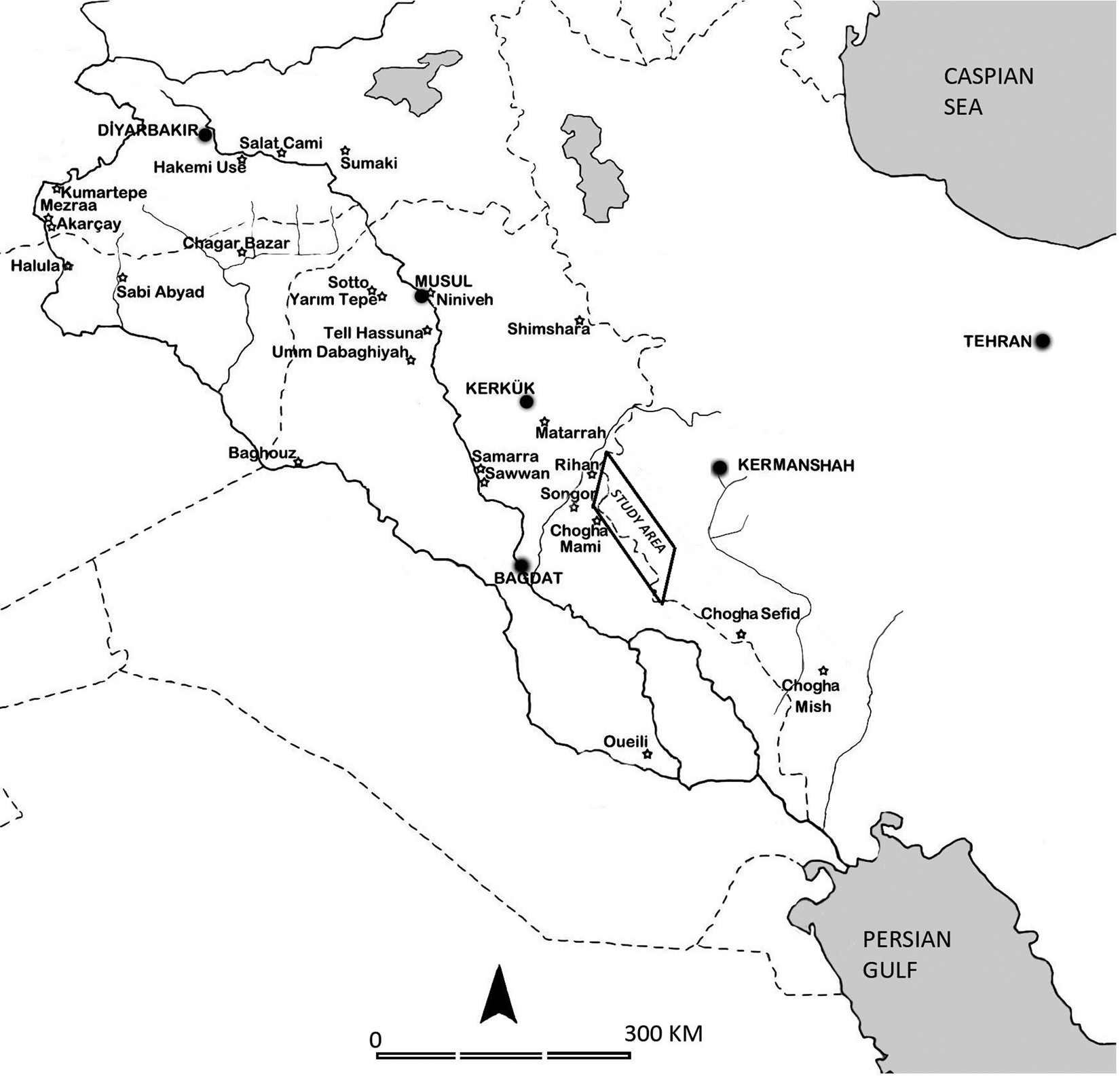
As a result of the excavations aiming at the exposure of medieval buildings at Samarra, the capital of the Abbasid Caliphs, a new type of black-on-buff ware with animated naturalistic decorative motifs and geometric patterns, thereafter called Samarran, was recovered in 1911 (Herzfeld Reference Herzfeld1930). Since this ware was recovered from badly preserved graves below the Islamic levels, its stratigraphic and chronological context was not clarified until several decades later when Tell Hassuna was excavated in the early 1940s. However, subsequent excavations at the nearby type-site of Tell es-Sawwan (Abu al-Soof Reference Abu al-Soof1968, Reference Abu al-Soof1971) provided robust evidence that the Samarran elements originated from central Mesopotamia. Samarran wares have so far been recognized from a notable number of sites inside and outside the border of Iraq (Fig. 1). In addition to Tell Hassuna (Lloyd and Safar Reference Lloyd and Safar1945), other northern Mesopotamian sites including Matarrah (Braidwood et al. Reference Braidwood, Braidwood, Smith and Leslie1952), Nineveh (ibid.), Shimshara (Mortensen Reference Mortensen1970) and Yarim Tepe I (Merpert and Munchaev Reference Merpert and Munchaev1969) contained Samarran ware in association with the preceding Hassuna entity. Also, evidence was found at Chogha Mami (Oates Reference Oates1968, Reference Oates1969), Oueili (Huot Reference Huot1971) and other sites such as Songor A (Matsumoto Reference Matsumoto and Huot1987), Rihan I (Gibson Reference Gibson1979) and probably Abada (Jasim Reference Jasim1981) in the Hamrin region, attesting to an expansion of the Samarran phenomenonFootnote 1 to the eastern and southern fringes of Mesopotamia. Moreover, the evidence gained from Baghouz (Braidwood et al. Reference Braidwood, Braidwood, Tulane and Perkins1944; Nieuwenhuyse Reference Nieuwenhuyse1999) and Sabi Abyad in Syria (Akkermans Reference Akkermans1989), as well as Hakemi Use in southeastern Turkey (Tekin Reference Tekin2005, Reference Tekin, Nieuwenhuyse, Bernbeck, Akkermans and Rogasch2012), indicates the presence of Samarran ware beyond the Iraqi borders. These sites point to its distribution in areas far away from the heartland, undermining previous ideas that assumed Samarran evidence was geographically restricted to the modern country of Iraq.
Map showing location of prominent Samarran sites and the study area along the Iranian frontiers (modified from Tekin Reference Tekin2015: fig. 1)

Unlike in Syria and Turkey, however, the nature of Samarran presence has not yet been well investigated inside the Iranian frontier. With the exception of work by Perkins (Reference Perkins1949), Braidwood et al. (Reference Braidwood, Braidwood, Smith and Leslie1952), Oates (Reference Oates1960, Reference Oates and Huot1987) and especially Hole (Reference Hole1977, Reference Hole1987), the eastward distribution of Samarran elements has not systematically been given further attention. In this respect, the main discussion comes from the results of excavations at Chogha Sefid, Deh Luran Plain, where a substantial change in subsistence strategies and settlement pattern was attributed to the movement of people from Mandali during the Chogha Mami Transitional (hereafter CMT) phase (c. 5400–5100 B.C.) in the local sequence (Hole Reference Hole1977, Reference Hole1987). It should be noted that the chronological position of the phase and even its nature in the past are controversial issues. J. Oates, who coined the term CMT after her excavations at Chogha Mami (Oates Reference Oates1969, Reference Oates and Huot1987), believes that late Samarran and Ubaid 0 are closely related to CMT (Oates Reference Oates, Carter and Philip2010: 47). Due to the continuity within the Samarran tradition and lack of significant disruption from Samarran to CMT levels at Chogha Mami, she allows that CMT is an awkward and ambiguous term (Oates Reference Oates and Huot1987: 168). More recently, however, she has suggested that CMT is equivalent to late Samarran, indicating a transition from Samarran to Ubaid 0 (Oates Reference Oates, Nieuwenhuyse, Bernbeck, Akkermans and Rogasch2013: 411). Thus, owing to the fact that ceramics of these two periods are stylistically rather indistinguishable, their chronological position is still ambiguous (Blackham Reference Blackham1996; Lebeau Reference Lebeau1985; also see discussion below). Nevertheless, we may divide the Samarran phenomenon into two sub-phases: early/classic and late/CMT phases. Judging from current evidence, the early phase is usually seen in central Mesopotamia where ceramics were mostly decorated with representational or a combination of geometric and representational motifs. The late phase may be seen as an entity that not only continues many early Samarran features, but also has close connections with the material culture of southern Mesopotamia in what has come to be referred to as Ubaid 0 at sites such as Chogha Mami and Songor A (Oates Reference Oates, Nieuwenhuyse, Bernbeck, Akkermans and Rogasch2013: 411).
The presence of (late) Samarran ware within Iran, however, had only been reported from the Deh Luran and, at a small scale, Susa plains, while its distribution into other adjacent areas was unclear. This was the situation until surveys were recently carried out along the border giving new insights into the eastward spread of the Samarran phenomenon. Although ongoing fieldwork makes definition of boundaries of the phenomenon difficult, the new findings from the Zagros piedmont are currently regarded as its eastward limit. In light of these finds, particularly fine painted pottery, this article discusses the nature of the eastward development of the Samarran phenomenon in the Near East and that how this might have been happened during the sixth millennium B.C.
New evidence from the Zagros piedmont
Previous investigations in the Mesopotamian heartland and its adjacent regions have generally characterized the typical Samarran ware as high quality, tempered with fine grit and painted with black to brown motifs on buff or greenish buff paste. Regarding decorative elements, a wide range of motifs, mostly including geometric ones like cross-hatching, chevrons, zigzags, steps and horizontal close lines or bands, are predominant. In addition, elements such as women with flowing hair, scorpions, goats, kingfishers and fish were painted in the interior of open bowls at the classic Mesopotamian sites (Matthews Reference Matthews2000: 76; for an analytical discussion of motifs see Bernbeck Reference Bernbeck, Córdoba, Molist, Pérez, Rubio and Martínez2008: 721–723; and for a technological analysis see Nieuwenhuyse et al. Reference Nieuwenhuyse, Jacobs, Van As, Broekmans and Adriaens2001). However, the occurrence of motifs varies at the regional level. Classic sites yielded both representational and geometric motifs, while sites in eastern areas of Mesopotamia such as Mandali and Hamrin show that geometric motifs are more common. In this regard, in terms of decorative elements, what is the position of newly found Iranian sites along the Zagros piedmont? And to what extent do they show similarities with previously known sites in the nearby Mesopotamian lowlands?
As noted above, despite earlier speculations the presence of Samarran material in Iranian areas had not been systematically addressed until 1968, when the site of Chogha Sefid on the Deh Luran Plain was excavated under direction of F. Hole. In fact, Hole was the main figure who tackled the eastward influence of Samarran phenomenon into the Iranian borderlands. In his opinion, in the mid-sixth millennium B.C., the Deh Luran plain witnessed new elements in ceramic styles and subsistence strategies that had not been present earlier (Hole Reference Hole1977: 12; also see below). At this time, the so-called ‘Susiana black-on-buff’ ceramics with designs similar to those of the CMT phase at Chogha Mami were introduced to the Deh Luran sequence; these ceramics had no background in the local traditions. Based on the presence of such ceramics at other sites like Chogha MishFootnote 2, the spread of the CMT tradition along the steppe lands of southwestern Iran was hypothesized (Hole Reference Hole1977: 15). Assessment of this hypothesis is beyond the scope of this article. Upon this foundation, however, I present new finds in connection with the eastward influence of the Samarran phenomenon into the Zagros piedmont.
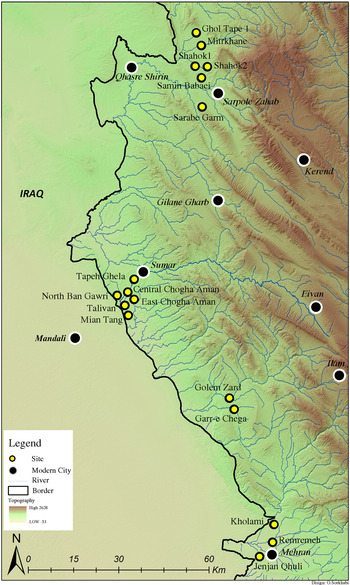
In recent years, Iranian archaeologists, including the author, have directed surveys along the Iran–Iraq border. This borderland constitutes an important transitional zone between the Mesopotamian lowlands and Zagros highlands. However, due to political instabilities and explosive remains of the war in the 1980s, archaeologists have generally overlooked it. Prior to the political instabilities, however, nearby Iraqi frontier zones, such as the Mandali region, were investigated, providing a large amount of evidence indicating Samarran elements there (Oates Reference Oates1969, Reference Oates and Huot1987). Thus, the presence of similar finds was expected along the Iranian frontier in the Zagros piedmont, although this area was inaccessible until recent times. In this regard, general reconnaissance surveys aiming to locate archaeological sites in Deh Luran, Mehran, Meimak, Soumar, Qasr-e ShirinFootnote 3 and Sarpol-e Zahab provided a wide range of artifacts dated to Paleolithic through late Islamic periods. As seen from a number of sites, the earliest Mesopotamian elements seem to have appeared in association with the late Samarran phenomenon across these border plains. As a transitional zone, they are bounded by the Zagros Mountains to the east and the hilly anticline of Hamrin to the west and southwest (Fig. 2).
Map showing location of newly discovered late Samarran sites in the Zagros piedmont along the Iran-Iraq border (map by O. Sorkhabi)

The Mehran plain, which is geographically located between Mandali and Deh Luran, was initially visited by Hole in 1973. He was looking for evidence associated with his hypothesis on the issue of CMT migration (Hole, pers. Comm. Reference Hole2011). Due to political instabilities of the time, however, he was unable to carry out any fieldwork there. The plain was later briefly surveyed by an Iranian team in the 1990s (Nokandeh Reference Nokandeh, Matthiae, Pinnock, Nigro and Marchetti2010). Nevertheless, most of the prehistoric data originated from a survey directed by the author in 2010 aiming to study the human–environment interaction of its inhabitants during Paleolithic through protoliterate periods (Darabi et al. Reference Darabi, Javanmardzadeh, Beshkani and Jami-Alahmadi2012). In this survey, three sites were found to have Samarran/CMT sherds on the surface (Javanmardzadeh et al. Reference Javanmardzadeh, Fazeli Nashli and Darabi2013).
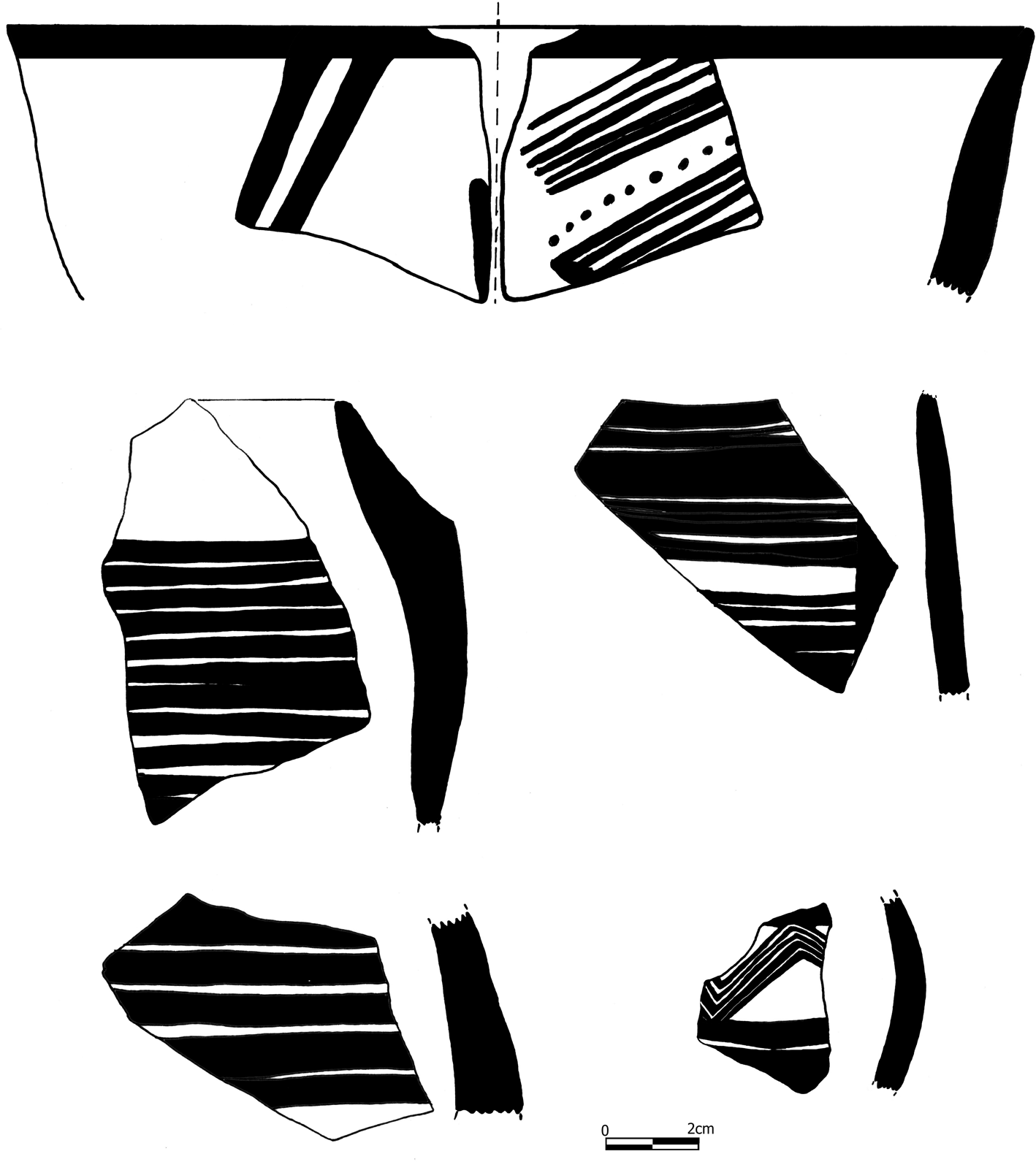
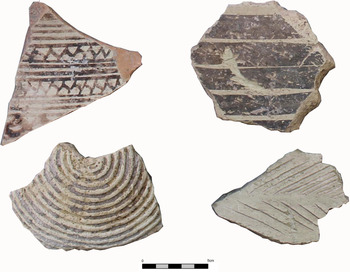
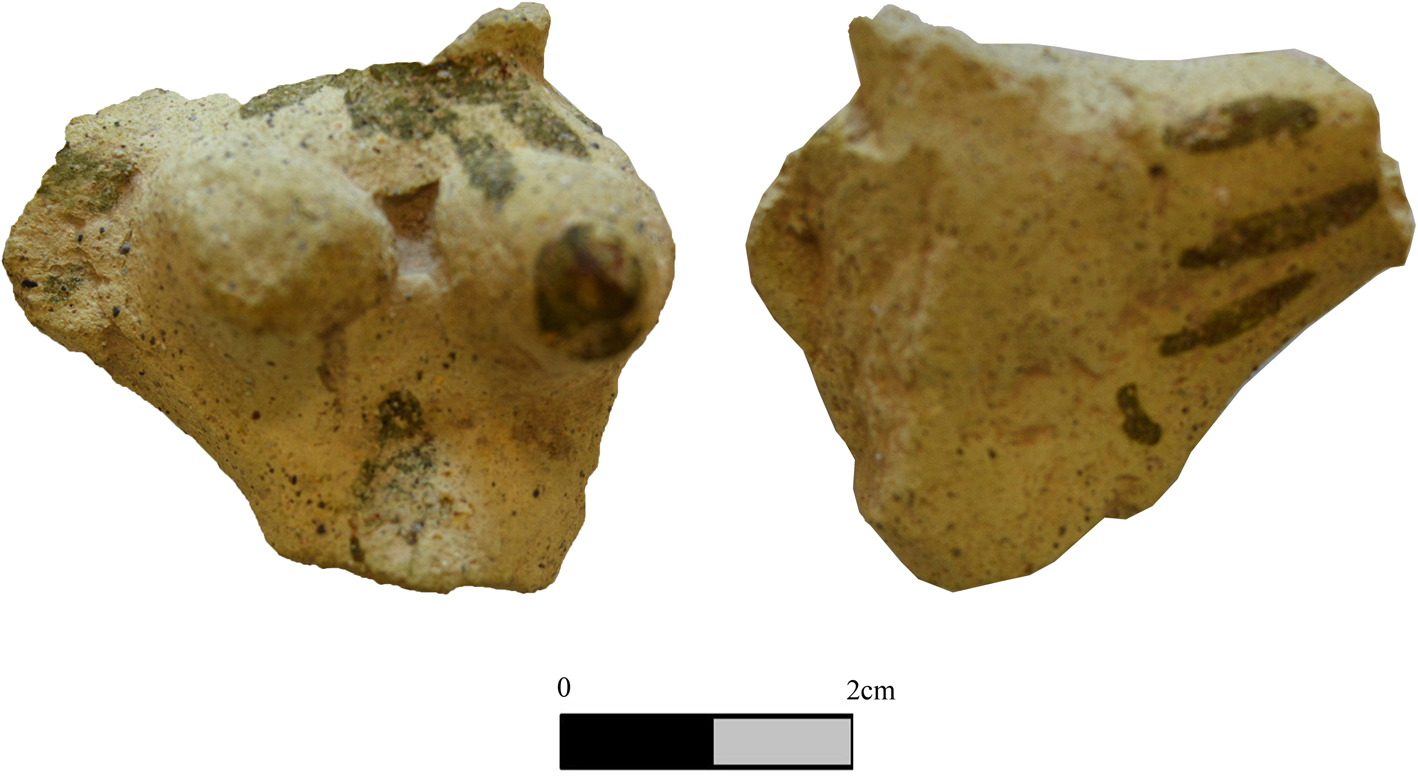
The main diagnostic finds come from the site of Remremeh, which is located on the edge of an alluvial fan and, nowadays, is surrounded by fertile agricultural fields. The site bears a notable amount of pottery sherds decorated with diagonal and horizontal bands or triangles on both interior and exterior (Fig. 3). They show close similarity with ceramics reported from late Samarra/CMT and Ubaid 0 phases, as well as with close-line ware of Archaic Susiana, on the Susa plain. Additionally, one of the most interesting surface finds is a fragment of terracotta female figurine that is stylistically reminiscent of those previously recovered from Samarran levels at Chogha Mami (Oates Reference Oates1969: 128, pls. XXVIII and XXIX) and Songor A (Oates Reference Oates, Nieuwenhuyse, Bernbeck, Akkermans and Rogasch2013: 411, fig. 37.9). The figurine seems to have been standing. It is headless and decorated with a painted necklace and horizontal bands as well as dot-like elements (Fig. 4). Apart from the ceramics, the presence of such a typical figurine strengthens the proposal of close interaction between Mandali and Mehran in the sixth millennium B.C.
Samarran/CMT potsherds from Remremeh, Mehran Plain (drawing by H. Darabi)

Fragment of a painted female figurine from Remremeh, Mehran Plain (photo by H. Darabi)
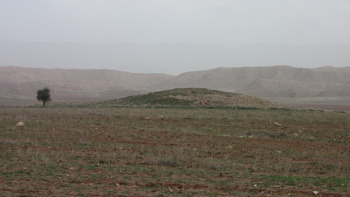
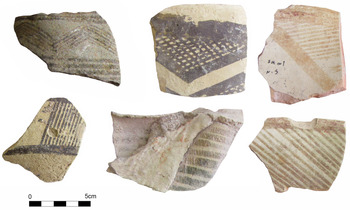
The nearby area of Meimak was initially surveyed by the author in 2010 (Darabi and Javanmardzadeh Reference Darabi and Javanmardzadeh2015). The survey showed the presence of Samarran/CMT ceramics at two sites: Garr-e Chega and Golem Zard. Both sites are located in an area where fertile lands and water supplies are available. Surface sherds vary in fabric, paste and decoration and suggest a long period of occupation. However, the occurrence of examples decorated with a cluster of geometric motifs, such as horizontal and diagonal bands, chevrons and hatched triangles, indicates Samarran/CMT evidence at the sites (Fig. 5). It is noteworthy that the mounded site of Garr-e Chega appears to have been occupied from the late Neolithic (late Samarra/Ubaid 0) onwards, suggesting it is a suitable location to investigate the diachronic development of interaction between highland Zagros and lowland Mesopotamia (Fig. 6).
Examples of Samarran wares from Meimak (photo by H. Darabi)

General view of Garr-e Chega, looking south (after Darabi and Javanmardzadeh Reference Darabi and Javanmardzadeh2015: fig. 8)

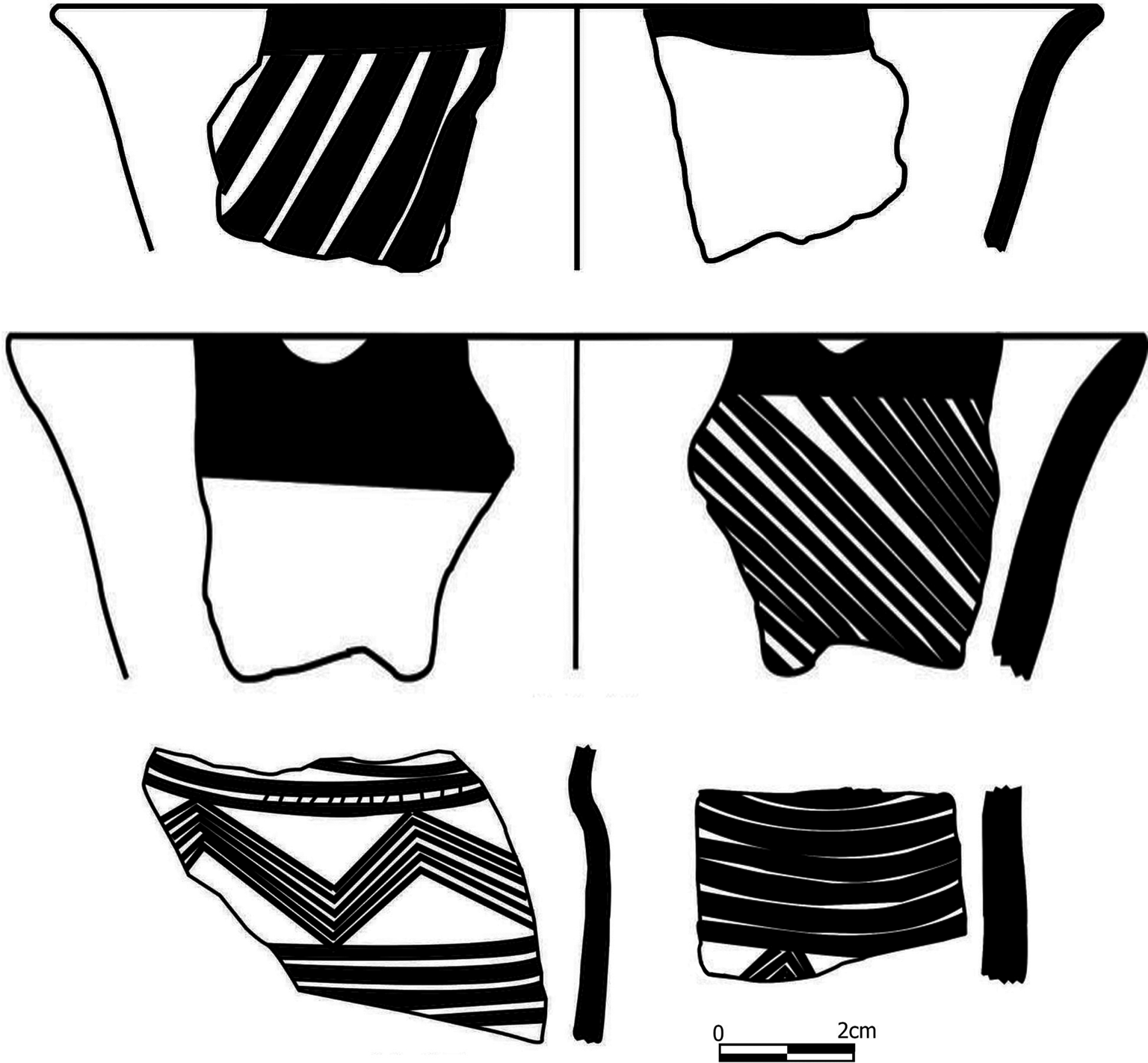
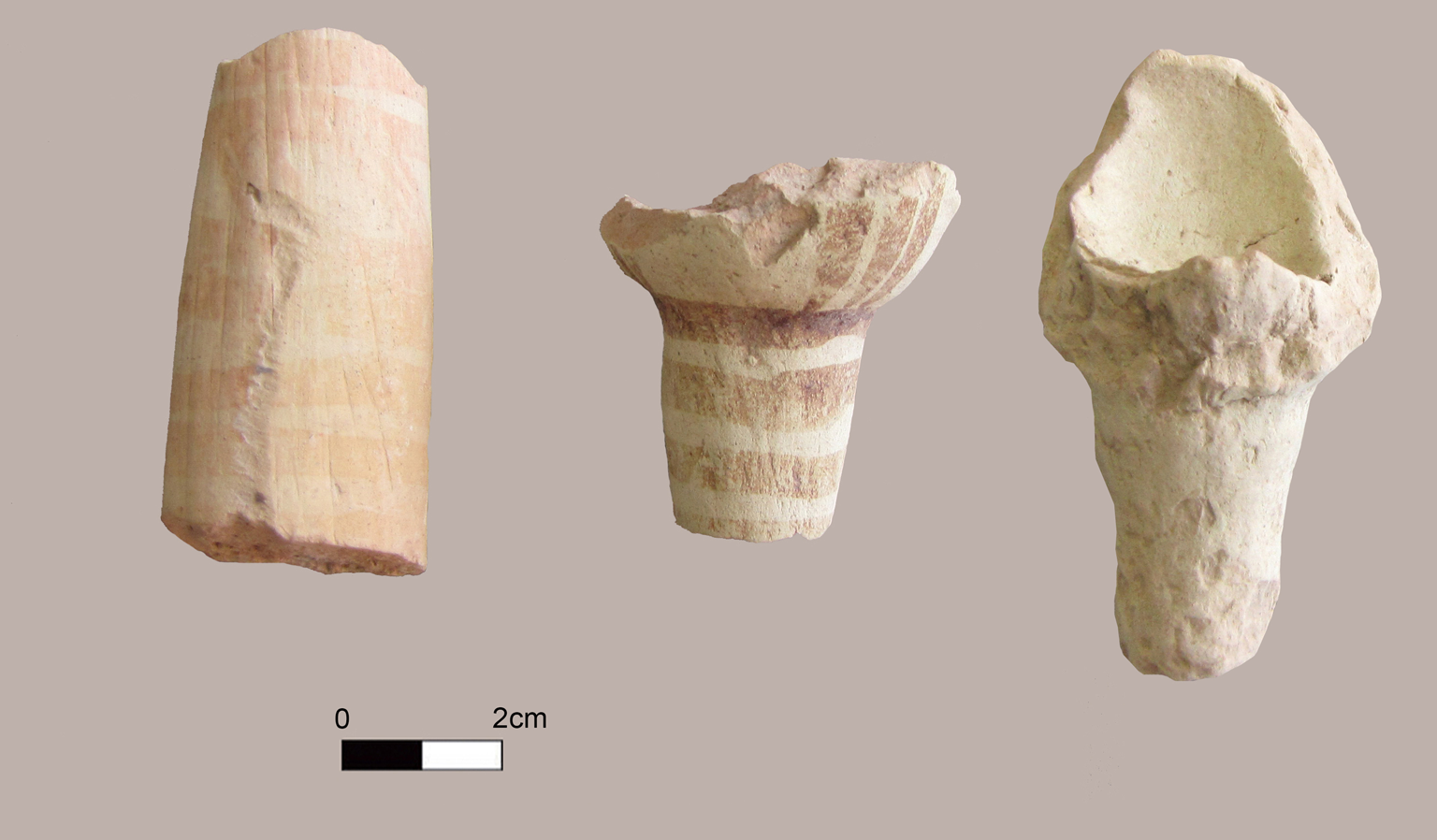
Samarran ceramics are strongly present in the adjacent small flood plain of Soumar, c. 2 km to the north of Mandali. This plain is geomorphologically composed of fine-grained alluvial and fluvial deposits that have mostly been formed by the Gangir River. As part of a rescue archaeological project along the border, Soumar was surveyed under the direction of the author in early 2015Footnote 4. Among the identified archaeological remains of various periods, six sites including Mian Tang, East Chogha Aman, Central Chogha Aman, Talivan, Tapeh Ghela and presumably North Ban Gawri contain late Samarran/CMT evidence. All these sites are located along the Gangir River where fertile lands are easily available. The late Samarran/CMT ceramics of Soumar are characterized by black or brown geometric designs on buff paste. Due to over-firing both paint and paste have turned greenish in color. Horizontal or oblique bands, zigzags and hatched, cross-hatched or solid triangles are mostly seen on exterior surface of the vessels (Figs. 7, 8). The interior surfaces of open bowls are painted with oblique narrow bands. A single band also often decorates the rim interior. In some cases, deformed sherds (wasters) were found. At Central Chogha Aman sherds decorated with incised lines were also recovered. In addition to the diagnostic sherds, three fragments of the so-called “Samarran ladle” were found at Mian Tang and Talivan (Fig. 9). These are sometimes painted with encircling bands. At the nearby site of Chogha Mami, painted ladles of pottery have been reported from Samarran levels and continued into the CMT phase (Oates Reference Oates1969: 136). It is noteworthy that the Soumar plain is connected southward to Mandali via a narrow valley in which the Gangir River flows. This geographic situation is mirrored in their archaeological evidence showing high similarities between the two regions.
Diagnostic late Samarram pottery from Soumar (photo by H. Darabi)

Examples of late Samarran ware from Soumar (drawing by V. Torabinezhad)

Fragments of Samarran ladles from Soumar (photo by H. Darabi)

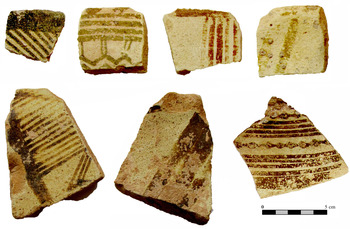
After previous sporadic investigations, Sarpol-e Zahab was first intensively surveyed by S. Alibaigi, who recorded a large number of archaeological sites in 2015 (Alibaigi Reference Alibaigi2015). The presence of Samarran ware, however, is seemingly more complicated here, and its differentiation from preceding or succeeding materials is difficult. Nevertheless, painted, incised or incised-painted samples were reported from six sites registered as Sarab-e Garm, Shahook 1, Shahook 2, Samin Babaei, Ghol Tapeh 1 and Mitrkhaneh (Fig. 10). These sites are all located within agricultural fields close to perennial water supplies. Interestingly, they appear to have been established in new areas on virgin soil. In addition to painted sherds, incised fragments with motifs such as circles or zigzags were found at some of these sites. They are comparable to Samarran examples previously found at Chogha Mami and Matarrah. Likewise, incised sherds also share some similarities with examples from Tell Abada (Jasim Reference Jasim1985: part ii, fig. 214), suggesting a later date. However, it is difficult to define the differences between Hassuna and Samarran ceramics, especially if they are from surface collection and their stratigraphic relationship is not known. Perhaps the paucity of Samarran ceramics in Sarpol-e Zahab results from their stylistic complexity and their similarity with succeeding styles. This issue is consistent with evidence gained from a recent survey in the nearby area of the Diyala (Sirwan) River Basin in Iraqi frontier, where no Samarran pottery was reported although Hassuna remains are seen (Casana and Glatz Reference Casana and Glatz2017: 8). Generally speaking, this may underline Oates’ idea that these two archaeological assemblages had a common origin, the so-called ‘Proto-Hassuna’ (Oates Reference Oates, Nieuwenhuyse, Bernbeck, Akkermans and Rogasch2013).
Samarran sherds from Sarpol-e Zahab (photo courtesy S. Alibaigi)

Discussion
Concerning the Samarra phenomenon and especially its eastward spread, the newly found Iranian sites add to our previous knowledge. As has been discussed for the mechanism of movement of Samarran ware to Hakemi Use in southeast Turkey (Tekin Reference Tekin, Nieuwenhuyse, Bernbeck, Akkermans and Rogasch2012: 500), the easiest way by which inhabitants of the Zagros highlands could have connected to those of the Mesopotamian lowlands were via the river valleys of the transitional zone. In other words, the Mesopotamian plain joins the Zagros through a transitional zone known as the piedmont, where much of the cultural interaction took place (Hole Reference Hole2011: 9). This transitional zone bridges the two main landscapes of the Eastern Fertile Crescent: Mesopotamian lowlands and Zagros highlands. The main features of the zone are river valleys that also formed ancient highways or trading routes along the foothills of Zagros. Due to their specific geographical position, therefore, it would be reasonable to anticipate a mixture of archaeological entities there, characteristic of both the Iranian highlands and Mesopotamian lowlands. On current evidence, however, Mesopotamian elements like Samarran ware are more common.
The origin and development of the Samarra phenomenon has been debated over the past decades. Following the excavations at Tell Hassuna, it was believed that Samarran painted ware was imported to northern Mesopotamia (Lloyd and Safar Reference Lloyd and Safar1945). In Braidwood's view, a group of travelling craftsmen might have reached northern Mesopotamia and introduced the Samarran style of painting there (Braidwood Reference Braidwood, Lloyd and Safar1945: 258). However, later investigations suggested that it was locally produced in the region (Bernbeck Reference Bernbeck1994: 129–141; Reference Bernbeck1995: 12–13). On the other hand, excavations at Matarrah (Braidwood et al. Reference Braidwood, Braidwood, Smith and Leslie1952) suggested the idea that Samarran pottery was simply the painted version of Hassuna wares. Oates (Reference Oates1960), who observed strong similarities between Ubaid 1 (Eridu) and Samarran elements, first suggested that early occupations of southern Mesopotamia should have originated in the Samarra period. More recently, she highlighted such a similarity between contemporaneous phases of CMT and Ubaid 0 (Oueili). Based on evidence from basal Tell es-Sawwan, she also suggests that classic Samarra directly derived from Proto-Hassuna and then developed as a distinct entity although sharing similarities with adjacent cultures (Oates Reference Oates, Nieuwenhuyse, Bernbeck, Akkermans and Rogasch2013). This idea is in agreement with an analysis of fabric and paint compositions of sherds from Oueili, which shows that Samarran and Ubaid 0 wares were similar and that they might have been stylistic variants of a common ceramic tradition although both locally produced (Blackham Reference Blackham1996: 13)Footnote 5. Moreover, at Chogha Mami similarities among fabrics and paints of the Samarran, CMT, and Ubaid wares suggest a single locale for their production (Oates Reference Oates, Young, Smith and Mortensen1984).
In the Susa plain, continuation of CMT ceramics to the succeeding phase is seen at Chogha Mish, where some decorative elements of the closed line type of Archaic Susiana III were still in use during early Susiana (Kantor et al. Reference Kantor, Delougaz and Alizadeh1996). In fabric, temper, shape, and decoration this ware apparently differs from other Archaic Susiana wares and it is known as a tradition that has no local rootsFootnote 6. This is also evident in the Deh Luran sequence where some of the CMT ceramic designs were found in the succeeding phase of Sabz (Hole Reference Hole1977). Therefore, we may speak of more similarities between ceramics of Ubaid 1, Sabz and early Susiana. This could show their common antecedent, however, the material culture of each region was more varied in the succeeding periods. These aspects indicate a strong continuation among different pottery styles and their close affinities, making detailed classification of surface assemblages difficult. In northern Mesopotamia, evidence from the sites of Hassuna, Shimshara, Matarrah, and Yarim Tepe I showed that classic Samarran ware was preceded by the Hassuna tradition. This is also observed at the key site of Tell es-Sawwan in central Mesopotamia. In contrast, the emergence of Samarran settlements in the east is different. The sites appear to have been established in new areas on the virgin soil or Samarran materials were imported into the local cultures in lowlands such as Deh Luran and Susa. Amongst the newly identified sites presented here, Remremeh and Garre-Chega have soft red or buff Neolithic ware as a local tradition preceding late Samarran pottery. It has previously been believed that the Samarran tradition arrived at the Mandali area somewhat later than at Tell es-Sawwan itself, and arrived still later in Deh Luran, in the form of Chogha Mami Transitional (Hole Reference Hole1977: 16). Eastern sites, therefore, mostly contain the later phase of Samarran that is represented by wares chiefly painted with geometric elements. In the Hamrin region, for example, late Samarran evidence was reported from several sites such as Songor A and Rihan I (Matthews Reference Matthews2000: 78). Judging from evidence gained from these two sites and from Chogha Mami, we may see CMT as a later variation of Samarran that is represented by the ubiquity of pottery painted in limited elements, mostly geometric designs rather than representational motifs.
Previous discussions on the eastward expansion of late Samarra/CMT have so far been dominated by the idea of ‘people movement’, particularly from Mandali to Deh Luran and Khuzestan (Hole Reference Hole1977, Reference Hole1987; Oates Reference Oates, Young, Smith and Mortensen1984, Reference Oates and Huot1987, Reference Oates, Nieuwenhuyse, Bernbeck, Akkermans and Rogasch2013). From the Iranian survey data presented here, an increase in the number of sites bearing Samarran elements can be observed. Although one may simply assume this was also a result of such movement, the issue seems to be more complicated. As noted above, the eastward spread of the late Samarra phenomenon is tied to the natural landscape, i.e., river valleys. Likewise, we should also give attention to the role of nomadic people who seasonally inhabited the transitional zone. As their adaptive subsistence strategy, nomadic herders constantly move between higher and lower pastures. As evidenced by excavations at some sites such as Tulai (Hole Reference Hole1987), these nomadic communities could be traced back to the Neolithic in the Zagros piedmont. Nowadays, nomadic groups are also frequently seen in the transitional zone and even had close relationships with their Iraqi neighbors until the late 1970s. Owing to the very long presence of nomadic herders and their roles in interconnecting societies through time, it would be reasonable to assume that they may have played an important role in introducing Samarran features, including painted pottery, to local inhabitants of the higher areas in the piedmont zone. At the same time, we should not overlook an increase in numbers of sites bearing Samarran features along the Iranian frontier. In Deh Luran (Hole Reference Hole1977, Reference Hole1987), the CMT phase coincided with an increase in settlement numbers. This kind of change in settlement pattern is partly seen in other areas such as Sarpol-e Zahab or Soumar in the transitional zone. This could indicate that these areas were occupied by newcomers who migrated from the nearby Mesopotamian lowlands. If so, previous ideas insisting on the movement of people should be adjusted (Hole Reference Hole1977; Oates Reference Oates, Nieuwenhuyse, Bernbeck, Akkermans and Rogasch2013).
Furthermore, Oates (Reference Oates, Nieuwenhuyse, Bernbeck, Akkermans and Rogasch2013: 414) connects the appearance of Samarran pottery, and other substantial cultural changes at c. 6200 B.C., to the evidence for abrupt climate change at this time (8.2 kya climate event). But how this event might have impacted the eastward spread of Samarran features is still unknown. In this respect, however, we may hypothesize that such severe climate forced people to move toward lowland areas where Samarran peoples had just settled. This may have caused population pressure there. Then as the climate became more favorable at the turn of the seventh–sixth millennia B.C., they started to expand or even returned to the highlands. Another important, but briefly outlined, proposal raises the possible conflict between Samarran and newly developed Halafian societies over access to raw materials in northern Mesopotamia. According to this proposal, as a result, Samarran society oriented to the east to gain better access to raw materials (Matthews Reference Matthews2000: 82). This assumption does not fit well with the results gained from sourcing analyses made on bituminous objects, such as a spindle whorl, mat, basket and sherds from Oueili. Molecular and isotopic analyses have confirmed that materials dated to Ubaid 0–2 were produced in or fixed by bitumen that had been imported from sources located in Luristan and Khuzistan (Connan Reference Connan1999: 41). This suggests that the peoples of Mesopotamia and the Zagros piedmont had close relationships since at least the early sixth millennium B.C. onwards, a time that predates the emergence of early Halaf. Therefore, late Samarran/CMT elements may have also been distributed via trade or exchange routes. On current evidence, however, the location of the sites under discussion shows a close dependence on river valleys that provided people with the means of easy interaction and the exchange of goods or ideas over a vast region.
As Hole notes (Reference Hole2011: 3), “the geography of the piedmont zone is not only ideal for transhumance but also for the development of simple irrigation techniques”. Here the small streams can be easily diverted to provide supplementary irrigation when needed. The landscapes surrounding the sites also indirectly show viability based on primitive irrigation. In this regard, the Gangir River may have played an important role in attracting the Samarran people into Mandali and Soumar, so that a notable number of settlements, including Chogha Mami, Serik Kabir, Mian Tang, Tali Van, Chogha Aman and Tapeh Ghela, are aligned with its course and the associated fertile lands. This brings to mind the possibility of an early irrigation system as has already been reported from Chogha Mami (Oates Reference Oates1969: 122–123). The Samarran agriculturalists appear to have moved into suitable plains where there were seasonal flood regimes permitting easy irrigation. Dependence on simple irrigation may have made the subsistence strategies of Samarran societies different to their contemporaneous neighbors (for a comparison between Samarra and Hassuna see Bernbeck Reference Bernbeck1995). If so, the predominance of newly established settlements with Samarran elements makes sense along the Zagros piedmont, although the significance of exporting raw materials to Mesopotamia should not be ignored.
Concluding remarks
In 1967 when the region of Mandali was surveyed by Oates, she correctly reported this region as the eastern end of a band of Samarra settlements and stated that no contemporaneous sites were yet known from the nearby Iranian frontier (Oates Reference Oates1968: 11). Although the later discovery of some evidence in Deh Luran paved the way for subsequent debates, the new finds presented here contribute to a better understanding of the eastward spread of late Samarra to the Zagros piedmont. Generally speaking, consideration of this development is based on a combination of natural and cultural landscapes. River valleys were the main routes for connecting highland Zagros to lowland Mesopotamia. The locations of the newly-discovered late Samarran settlements along streams indicates that these environmental niches, with available fresh water and fertile land, were prioritized for occupation. Such locations may strengthen the possible presence of an early irrigation system, an issue that was also previously proposed for the classic Samarran sites of Chogha Mami and Tell es-Sawwan in central Mesopotamia. It appears that rivers flowing from the Zagros Mountains were not deeply incised into the border plains, making simple irrigation possible. Hole (Reference Hole2011: 5) believes that, along with irrigation, newcomers to the Deh Luran brought new pottery styles and techniques and founded the black on buff ceramic tradition–derived from the Samarran–that was to dominate this region until the end of the fifth millennium B.C. In the newly occupied areas, however, local production of late Samarran ware is shown by the presence of overfired ceramic samplesFootnote 7.
Chronologically and comparatively, we are still not sure that Samarran expansion into Iranian areas was later than its expansion in other directions, i.e., north and northwest of Mesopotamia, where relationships between Samarra and Hassuna have been debated (Bernbeck Reference Bernbeck1995, Reference Bernbeck, Córdoba, Molist, Pérez, Rubio and Martínez2008; Mortensen Reference Mortensen1970; Nieuwenhuyse Reference Nieuwenhuyse1999; Oates Reference Oates, Nieuwenhuyse, Bernbeck, Akkermans and Rogasch2013). Stylistically, Iranian sites contain pottery decorated with geometric designs such as horizontal/oblique bands or crosshatching, indicating a time span later than the sites in the heartland. It is noteworthy that the crosshatching motif is also common at non-classic sites such as Baghouz and Sabi Abyad on the Euphrates (Nieuwenhuyse Reference Nieuwenhuyse1999: 17). These decorative designs, however, are more common at eastern sites of Chogha Mami, Songor A, Rihan I and perhaps Abada in the nearby regions of Mandali and Hamrin. Assuming the transitional phase as a variation of late Samarra bearing elements of both Samarran and Ubaid traditions, we may attribute the newly-found evidence to this time span, i.e., early sixth millennium B.C. If so, we will have to revisit the chronological time span previously assigned to the CMT phase in the Deh Luran Plain. To date, no site with early Samarran evidence has been found in the eastern fringe of Mesopotamia and the Zagros piedmont. Some of the Iranian sites such as Remremeh and Garr-e Chega, however, have soft red or buff ware characteristic of Neolithic highland Zagros. This shows the significance of investigating the chronological position of this highland element and the Samarran. Further investigation on the nature of the introduction of late Samarran wares to the Iranian highlands should be tied with sourcing analyses to verify whether they were locally produced or imported. However, as shown by previous analyses on samples from Chogha Mami, Tell es-Sawwan and Oueili, it seems likely that Samarran wares were locally produced although they shared some stylistic elements via networks of interaction. In the eastern areas such as Mandali, Soumar, Meimak and Mehran, Samarran evidence was found at basal levels of the sites or, like Deh Luran or Susa plains, was imported into local cultures. Owing to the presence of very typical finds on the Mehran Plain and due to its geographical location, this plain seems to have been the main route for the eastward spread of late Samarra/CMT to Deh Luran and then Susa. Further eastward, new investigation has shown the presence of late Samarran ware in the Behbahan plain, close to the head of the Persian Gulf (Moghaddam Reference Moghaddam2014). As one goes eastward into inner areas of the Zagros, however, regional variations of late Samarran pottery are more common. By contrast, areas closer to the Mesopotamian lowlands such as SoumarFootnote 8, Meimak and Mehran appear to have hosted societies more oriented to the Samarran heartland.
Although previous evidence from the Deh Luran Plain suggested migrant people as the trigger for the spread of late Samarran elements, it is unclear whether such people were wholly responsible for occupation of the transitional zone or whether nomadic herders played a role as well. Moreover, the possible impact of the cold, dry climatic event of 8.2 kya should not be overlooked. From our current knowledge, we may tentatively assume nomadic herders, climatic change, migrant people and exchange networks were all factors responsible for the eastward spread of Samarran elements. Whatever the main trigger was, however, they indicate the significant role of an intensive interaction in the early sixth millennium B.C., when people communicated or exchanged goods or ideas through networks across the Near East. This seems to have triggered stylistic-technological similarities between contemporaneous entities such as late Samarra/CMT and Ubaid 0. This time, spanning from the early to middle sixth millennium B.C., marks an era of socio-economic development, with early evidence of irrigation, cattle domestication, settlement increase, and exchange of goods and ideas. In this regard, the movement of bitumen from the Zagros piedmont in western/southwestern Iran to central/southern Mesopotamia merits special attention, as it may have intensified the relationships between inhabitants of the two regions during the sixth–fifth millennia B.C. These developments are more or less mirrored by the evidence for Mesopotamian features distributed over a vast region along the Zagros piedmont in western and southwestern Iran. However, to clarify this we need further evidence from excavations at suitable sites bearing cultural features from both Zagros piedmont and Mesopotamian lowlands.
Acknowledgments
I would like to thank Dr. Sajjad Alibaigi who kindly made available his unpublished data on Sarpol-e Zahab. I am also grateful to Dr. Abbas Moghaddam, Dr. Ali Sardari and Prof. Frank Hole as well as the anonymous reviewer(s) of the journal for making insightful comments on the article. Additionally, I should thank Prof. Reinhard Bernbeck who shared with me some of his helpful articles. Lastly, I would thank Mrs. Vahideh Torabinezahd and Mr. Obaid Sorkhabi for drawing the sherds from Soumar and making the distribution map of the sites, respectively.