1 Introduction
A commonly held position among linguists of different persuasions is that degree is either a grammatical notion that is expressed through adverbs and quantifiers and/or that degree is a notion related to the comparability of adjectives and adverbs, but there are also scholars who maintain that manifestations of degree are, in fact, also associated with verbs and nouns (Sapir Reference Sapir and Mandelbaum1949; Bolinger Reference Bolinger1972; Kennedy & McNally Reference Kennedy and McNally2005). This article discusses the nature of the relation between the notion of degree and expressions of degree in language. It takes issue with the grammatical class approach because an analysis of degree in language calls primarily for a semantic explanation that can account for the flexibility with which it is used and the apparent ease with which it is invoked in new contexts.
My claim is that degree is first and foremost a configurational meaning structure that combines with knowledge structures pertaining to things, events and states. The upshot of this is that degree is neither a property of grammatical classes nor a property of individual words. On the contrary, degree may be associated with most meanings of words and expressions. The final profiling of lexical meaning is definitely fixed when words and phrases are used in human communication. Degree is a configuration that is available in mappings between lexical items and their meanings, e.g. a very good book, disgusting, totally agree, what a car, thoroughly enjoy, very British, a very key strategic question, pretty crap and it is so not true. A recent car advertisement in Sweden says How WE are you? The new V70. Very WE, where the personal pronoun we is used as something you can be more or less of. Degree is thus not confined to the meanings of certain words but is part of the use potential of a wide range of lexical items.
Furthermore, there is a continuum between linguistic items that are primarily expressions of degree and linguistic items whose content has an underlying degree configuration. The notion of degree may be foregrounded and construed as the most salient component of a meaning structure, or it may be construed as a backgrounded meaning structure. In other words, degree modifiers such as very, a bit, totally, much, little, not foreground degree. By contrast, linguistic expressions such as good, excellent, alive, adore, need, hate, beauty and idiot foreground content structures such as ‘merit’, ‘existence’, ‘mental state’, ‘appearance’, while degree resides in the background. Even linguistic expressions that at first sight do not appear to be associated with grading, such as man or book, may on many occurrences of use highlight properties that are gradable. For instance, the profiling of a handsome man involves the evaluation of a property of man along a gradable dimension of ‘beauty’. Similarly, the profiling of a marvellous book involves a gradable dimension of book as being ‘a good or a bad read’ or ‘a beautiful or an ugly artefact’. The backgrounded degree structures of such meanings provide the necessary condition for combination with degree modifiers, either directly as in very nice, absolutely excellent, quite a man, badly needed or as in a very good book through a gradable property of a book (thing) bridged by ‘merit’, as here specified by good.
The purpose of this article is to synthesize my own empirical and theoretical work on gradable meanings over the past decade (Paradis Reference Paradis1997, Reference Paradis and Kirk2000a, Reference Paradis, Bermúdez-Otero, Denison, Hogg and McCully2000b, Reference Paradis2001, Reference Paradis, Facchinetti, Palmer and Krug2003a; Paradis & Willners Reference Paradis and Willners2006a, Reference Paradis and Willners2006b) with my more recent theoretical development of a general model of lexical meaning (Paradis Reference Paradis2003b, Reference Paradis2004, Reference Paradis2005), broadly within the framework of Cognitive Semantics (Langacker Reference Langacker1987a; Croft & Cruse Reference Croft and Cruse2004). The results of my empirical research using both corpus and experimental methods are explainable through the model of Lexical Meaning as Ontologies and Construals (Paradis Reference Paradis2005), henceforth LOC. With respect to meaning change, I take Traugott's (1999) Invited Inferencing Theory of Semantic Change (IITSC) as my pragmatic point of departure and thereby hope to add a semiological perspective to her more interactive approach to semantic change. The focus of this article is on modifiers of degree, since they express degree in its purest form. However, modifiers of degree cannot be treated in isolation, since they in turn have to be profiled against gradable meaning structures that are more complex, such as things, events and states, in order to make sense. I argue that (i) degree is a boundedness configuration in conceptual space; (ii) degree modifiers operate on the degree structure of the meanings they apply to through a construal of contextually motivated zone activation within conventionalized senses; (iii) nonconventionalized degree readings of form–meaning pairings are invoked through implication by means of construals of metonymization between senses (Traugott Reference Traugott and Verscheuren1999; Panther & Thornburg Reference Panther and Thornburg2003; Paradis Reference Paradis2004); and (iv) this process of metonymization is the mechanism through which change may or may not take place. Conventionalization of mappings between lexical expressions and meanings is a result of entrenchment through cognitive routines.
The structure of the article is as follows. Section 2 gives a short presentation of the basic assumptions and theoretical foundation of Cognitive Semantics and of LOC. Sections 3 and 4 report on corpus-based explorations of the use of degree modifiers and the types of meaning structures they modify. The corpus studies lead up to the formulation of the boundedness hypothesis, which is presented in section 5. That section reports on experiments that are designed to test the boundedness hypothesis. Section 6 gives a more detailed description of LOC and accommodates the results of the corpus investigations and the experiments in the model. Particular emphasis is given to LOC as a dynamic model of meaning that can account for mechanisms and motivations for meaning variants and change. Finally, section 7 synthesizes and concludes the arguments and the empirical findings.
2 Lexical meaning and the cognitive semantics framework
The core idea in Cognitive Linguistics is that meanings are mental entities in conceptual space. Meanings are in people's minds. They are not independent entities in the external world, as is the case in objectivist models. The external world is only indirectly relevant in that meanings are constrained by how human beings perceive the world (Gärdenfors Reference Gärdenfors2000). Lexical items activate concepts, and lexical meaning is the relation between lexical items and the part of the use potential that is profiled on the occurrence of use. Lexical meaning is constrained by encyclopaedic knowledge, conventionalized mappings between lexical items and concepts, conventional modes of thought in different contexts and situational frames (Cruse Reference Cruse2002; Paradis Reference Paradis2003b, Reference Paradis2005). It is important to note that meanings are not inherent in the lexical items as such but evoked by lexical items. On this view, meanings of words are always negotiated and get their definite readings in the specific context where they are used. Some form–meaning pairings, which we might call lexical concepts, are routinized and well entrenched, whereas novel uses of words and expressions are always ad hoc construals. These basic assumptions are crucial for the dynamic usage-based model of meaning as ontologies and construals, where lexical meaning is the link between concepts and lexical items and where some connections are well entrenched and potentially represented in long-term memory, while others are totally ad hoc construals, which may or may not be laid down as conventionalized pairings through diachronic change. Multiple readings of words and expressions are natural and expected in a dynamic usage-based model.
Lexical meaning is situated in conceptual space and cognitive processes operate on conceptual structure and make different meaning construals possible. LOC analyses lexical meaning in terms of ontologies and construals. It argues that concepts form the ontological basis of lexical knowledge, and conceptual space is structured relative to two types of knowledge structures: content structures and configurational structures (Cruse & Togia Reference Cruse and Togia1996; Paradis Reference Paradis1997, Reference Paradis and Kirk2001). Content structures involve meaning structures pertaining to things, events and states, and configurations are structures that combine with content structures, such as boundaries and scales. Both these ontological types are conceptual in nature and mirror our perception of the world. In addition to the conceptual realm, there is an operating system consisting of different types of construals which are imposed on the domains by speakers and addressees on the occasion of use. They are not themselves conceptual, but ways of structuring conceptual domains, reflecting some broad basic cognitive abilities, such as the choice of Gestalt, the focusing of attention, categorization and the selection of speaker perspective (Croft & Wood Reference Croft, Wood and Albertazzi2000; Paradis Reference Paradis2004, Reference Paradis2005). It is through the operations of construals on the ontological material that meanings of lexical expressions arise. Meanings of lexical items are dynamic and sensitive to contextual demands, rather than fixed and stable. It is important to note that lexical items evoke meanings rather than have meanings (Cruse Reference Cruse2002; Paradis Reference Paradis2003b, Reference Paradis2005; Ekberg Reference Ekberg and Thomsen2006).Footnote 2
The couplings between lexical items and meanings are partly conventionalized and routinized and partly constantly negotiated by speakers and addressees at the time of use. Interpretations of linguistic items are synchronically flexible. New uses of linguistic expressions may become conventionalized and undergo diachronic change, or they may not become conventionalized. Different readings in different contexts emerge from the motivations that activate the expression or the wish to interpret the expression in a relevant way in order to obtain socially viable mappings between words and concepts. In other words, cognitive processes (construals) operate on the conceptual structures on all occasions of use. These operations are the source of all readings, conventional as well as ad hoc construals, and possible lexical change takes place through new links between linguistic expressions and conceptual structures that become routinized and conventionalized.
Language has two fundamental functions: (i) the semiological function by which meanings are symbolized in speech, writing and gestures; and (ii) the interactive function which concerns language as a means of communication, expressiveness, manipulation and social behaviour (Langacker Reference Langacker and Tomasello1998: 1). Traugott's (Reference Langacker1999) treatment of flexibility and change embraces both aspects, but her approach, the IITSC, has interactive function as its main focus of interest. I take her approach as my point of departure and add to it a model with a semiological focus and semiological explanations of flexibility and change.
3 Exploring the use of degree modifiers in corpora
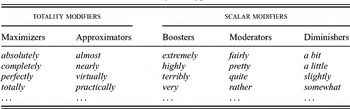
In my initial studies of degree, I explored the use of degree modifiers and the contexts in which they occur. The aim of that work was not only to provide adequate descriptions of degree modifiers in English, but also to develop a model for the analysis of degree in order to generate hypotheses about how degree is mentally represented and used in discourse. The first step was to make a survey of the meanings and uses of degree modifiers as lexical items and the lexico-semantic contexts in which they appear. Paradis (Reference Paradis1997) is a study of semantic and intonational aspects of a set of degree modifiers and the types of adjectival meanings they modify using the London–Lund Corpus (LLC) of spoken British English.Footnote 3 The focus of the study was on degree modifiers of adjectives in spoken language since the majority of them were most frequently used with adjectival meanings as compared to other contexts and were more frequently used in spoken language (LLC) than in written language (the Lancaster–Oslo/Bergen Corpus, LOB).Footnote 4 Some occurred exclusively or almost exclusively in the spoken data, e.g. awfully, a bit, jolly, frightfully, terribly and absolutely. Only four of the modifiers in the data set were more frequent in the written data, i.e. highly, almost, somewhat and most. The figures for these comparisons and the test set are given in Paradis (Reference Paradis1997: 33–40). This work resulted in a typology of the grading functions of degree modifiers, as shown in table 1.
The paradigms of modifiers of degree and examples of lexical items of each type

As table 1 shows, two main types of degree modifiers were identified: totality modifiers and scalar modifiers.Footnote 5 Totality modifiers are associated with a definite boundary and scalar modifiers are unbounded, indicating a range of a scale. Moreover, there are two types of totality modifiers both of which relate to totality although in different ways. There are maximizers that highlight the perfect match with a maximum or a boundary, e.g. absolutely brilliant and completely full, and approximators that indicate that a gradable property falls short of that maximum or that boundary, as in almost full and virtually unknown. In addition to the two types of totality modifiers, there are three types of scalar modifiers. These are boosters, which have a reinforcing effect on the modified property, e.g. extremely nice, moderators, which approximate the pivotal middle range, e.g. fairly nice, and diminishers, which attenuate the properties they apply to, e.g. a bit odd.
Paradis (Reference Paradis and Kirk2000a) replicates Paradis (Reference Paradis1997) using more recent data from the spoken part of the British National Corpus (BNC) in order to compare the use of the same set of modifiers some twenty years later.Footnote 6 Special attention in this study was paid to how teenagers use degree modifiers as represented in the Bergen Corpus of London Teenage Language (COLT), which forms part of the spoken part of the BNC.Footnote 7 As can be expected, some modifiers were not used at all, e.g. frightfully, awfully, dead (as a maximizer: dead right), while new modifiers had come into use, such as well, enough and dead (as a booster) as in well weird, enough funny and dead easy.Footnote 8 In addition to these contemporary studies, Paradis (Reference Paradis, Bermúdez-Otero, Denison, Hogg and McCully2000b) examines the use and diachronic development of modifiers of degree in combination with nominal meaning structures, e.g. absolute bliss, utter disaster and terrible bore. This development is discussed in more detail in section 7.1. Finally, Paradis (Reference Paradis, Facchinetti, Palmer and Krug2003a) investigates the use of really in the LLC and COLT, examining the semantic and intonational constraints on really as a modifier of degree, e.g. really nice, in contrast to really as a truth attester as in Really, they are quite strange and as a truth emphasizer as in I do actually really like singing. The use of really as a degree modifier is restricted to modification of adjectival states with an underlying scale structure in assertive contexts. For instance, in This film is really good, really is a modifier of degree, while in Is this film really good?, really expresses epistemic stance.
In summary, on the basis of the above investigations of degree using degree modifiers as the point of departure, a clear pattern of two main types of degree modifiers emerged: totality modifiers, which have the function of indicating either an absolute maximum or an approximation of that absolute maximum; and scalar modifiers, which have the function of indicating the mid-range of a scale, reinforcing the scalar properties or attenuating the scalar properties. It also emerged that the meaning structures that the degree modifiers operate on have to be gradable and configured in either a bounded or an unbounded way.
4 Degree, oppositeness and boundedness
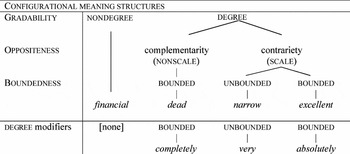
In addition to the typology of degree modifiers, the corpus investigations described in section 3 showed the pattern of the more complex semantic structures of degree that the modifiers operate on (Paradis Reference Paradis1997, Reference Paradis and Kirk2000a, Reference Paradis, Bermúdez-Otero, Denison, Hogg and McCully2000b). Those structures are more clearly stated in Paradis (Reference Paradis2001). In essence, the semantic structures that may be modified by degree modifiers, or indeed associated with comparison, foreground things, events and states and are configured on the basis of boundedness and scale (figure 1).
The non-degree/degree dichotomy, the type of oppositeness based on scalarity, boundedness and the interaction between scale and boundedness

As figure 1 shows, the first distinction is between nondegree structures and degree structures. The definition of nondegree structures is negatively formulated: nondegree structures are not compatible with degree modifiers. The lexical example given is financial, which is a lexical item that does not normally combine with degree modifiers. However, it is not difficult to conceive of a context in which financial could be used in combination with both totality modifiers, e.g. This is a totally financial journal, and with scalar modifiers, e.g. This journal is very financial. These more ad hoc uses of financial are formed in the same way as conventional combinations, i.e. the modified element maps onto a degree structure. This state of affairs demonstrates that degree is not associated with particular word forms or particular word classes but occurs more or less naturally with different types of meanings.
Furthermore, degree structures are divided into two types of oppositeness – complementarity that is nonscale and contrariety that is associated with a scale configuration – and two modes of boundedness – bounded and unbounded configurations. nonscale, first, is always bounded and such meanings combine with bounded degree modifiers such as completely and almost. For instance, opposites such as dead and alive may most often be used as complementaries in the sense that they divide some conceptual domain into two distinct parts.Footnote 9The cat is dead entails that The cat is not alive and The cat is alive entails that The cat is not dead. Because of this absolute divide, the expression It is neither dead nor alive comes across as paradoxical. However, similar to the flexibility of application of financial discussed above, it is possible to construe meanings that we might think of as bounded in the first place on a scale, either on a bounded scale, such as almost empty and almost full, or according to an unbounded configuration, as in very empty and very full. It is a general feature of most bounded adjectives that they can for more or less ad hoc purposes be laid out on a scale (Paradis Reference Paradis1997: 48–66; Paradis & Willners Reference Paradis and Willners2006a, Reference Paradis and Willners2006b; see also section 5 below).
As a pair of opposite meanings, ‘empty’ and ‘full’ are construed on the basis of a bounded scale. In like manner, meanings such as ‘terrific’ and ‘disgusting’ are profiled against the boundaries of a scale, e.g. (absolutely) terrific, (totally) disgusting. They differ from ‘empty’ and ‘full’ in that they are subjective and evaluative, while ‘empty’ and ‘full’ are calibratable and may often be used in an objective way. Subjective-evaluative bounded scale meanings differ from calibratable meanings in that people are likely to agree on their meanings but may very well disagree on their application (Warren Reference Warren1992: 19). In other words, a terrific meal for one speaker might very well be a disgusting experience for somebody else.Footnote 10 In the case of empty and full, language users are more likely to agree on both their meaning and their application. These two types of meaning representations also differ with respect to what kind of degree modifiers they combine with. While all of them happily combine with totally and completely, the subjective-evaluative meanings do not felicitously combine with almost and nearly. Unlike calibratable meanings, the extreme bounded scale meanings instead combine with most as in most disgusting. Most is infelicitous in combination with calibratable meanings such as most empty (Simon-Vandenbergen Reference Simon-Vandenbergen2007). The explanation for this difference between subjective-evaluative extreme meanings such as ‘terrific’ and ‘disgusting’ on the one hand, and more neutral bounded meaning such as ‘empty’ and ‘full’ on the other, may be that the scale is the more prominent configuration for the former meanings, while boundedness is the more prominent one for the latter type of meaning structures (Paradis Reference Paradis1997: 56).
Next, scalar opposites such as narrow and wide occupy opposite poles of a scale, and hence they are in possession of more or less of the conceptual content of the given dimension, and they go with scalar degree modifiers. In the case of narrow and wide, the scale is one of ‘width’. Such meaning structures exhibit all typical features of contrariety as defined by Cruse (Reference Cruse1986), Paradis (Reference Paradis1997) and Murphy (Reference Murphy2003). The members of such pairs denote some variable property such as ‘length’, ‘speed’, ‘weight’, ‘merit’, ‘personality’, etc. They can be described as implicit comparatives, since when we think of ‘a narrow path’ the notion of ‘wide’ is evoked at the same time (Cruse Reference Cruse1986: 216). Scalar opposites are counter-directional, which means that when intensified they move away from one another in opposite directions of the scale. Extreme values of ‘narrow’ and ‘wide’ only tend towards the extreme, never actually reaching an end-point. This characteristic of being construed according to an unbounded scale is highlighted by the fact that completely narrow and completely wide are most likely regarded as infelicitous pairings by most native speakers when asked. However, the occurrence of expressions such as completely good or completely nice proves that this is a possibility. The flexibility of degree in linguistic expressions of different kinds is evidence in favour of a modelling of degree as a free structure that is not tied down to individual words but combinable with a wide range of words and meanings. The different types of combinations of bounded, unbounded, scale and nonscale may fit more or less well with most meaning structures representing things, events and states in natural language use.Footnote 11
While the corpus studies reported on in the previous sections clearly indicate that there are configurational preferences between degree modifiers and the meanings that they modify in terms of boundedness, those results only allow us to account for what is in the corpora. At the time of use, monosemous degree modifiers demand either a bounded or an unbounded reading. Hence it is not possible to say anything about various different interpretational possibilities and constraints of expressions of degree. In the case of degree modifiers and their combinatorial patterns as evidenced by the corpus data, we are faced with the strong version of the general scientific problem of having positive evidence only, i.e. we only retrieve examples of linguistic expressions where the degree modifier is already part of the expression. For a more complete picture, we have to draw conclusions about the constraints not only on the basis of what is in the corpus but also what is not in the corpus, and what is possible and not possible. Most degree modifiers are used mainly as either scalar or totality modifiers, e.g. pretty and absolutely respectively. Once they are used in combination with the element they modify, they determine the reading of the whole. However, the exact degree reading may be unclear in cases where there is no degree modifier or when the degree modifier is capable of modifying both scales and boundaries. For that reason results from the corpus investigations should ideally be complemented with experimental methods, in which case probabilistic corpus results can be used to formulate testable hypotheses (Paradis & Willners Reference Paradis and Willners2006a). In other words, if we want to find out whether a certain combination is felicitous or not, we have to turn to introspection and experimental methods to ask informants about the felicity of certain combinations of lexical items and their meanings, such as? totally long and? very identical, the scaling force of near synonymous degree modifiers such as fairly, pretty, rather, quite (Paradis Reference Paradis1997: 147–57), or the readiness of certain degree modifiers to modify scales or boundaries (Paradis & Willners Reference Paradis and Willners2006a).
As already mentioned, there are a number of degree modifiers that combine with both bounded and unbounded meanings. For instance, in quite right and dead right a boundary is involved and quite and dead are both totality modifiers, while the configuration of easy in quite easy and dead easy is unbounded and the modifiers indicate a range on a scale. This is also the case with totally (Aijmer Reference Aijmer2007), all (Buchstaller & Traugott Reference Buchstaller and Traugott2006), the Swedish equivalent helt and sån (Ekberg in press) and so (Tagliamonte & Roberts Reference Tagliamonte and Roberts2005). Completely in completely good has the effect of coercing the reading of good into a boundary reading and thereby closing a ring around ‘goodness’ to the effect of ‘in all respects’. The negator not is another case in point. It may be a totality modifier, expressing the absolute opposite as in Bill is not alive = Bill is dead, or it may be an attenuator as in The water is not hot said about water that may be warm, lukewarm or cool (Bolinger Reference Bolinger1972; Horn Reference Horn1989; Israel Reference Israel2001; Giora, Balaban, Fein & Alkabets Reference Giora, Balaban, Fein, Alkabets, Colston and Katz2005; Giora Reference Giora2006; Paradis & Willners Reference Paradis and Willners2006a). The negator is therefore a particularly interesting modifier to investigate, since it may be used both as a totality modifier pointing to the absolute boundary, or a scalar modifier indicating a range on a scale. The next section presents the boundedness hypothesis and the results of experiments testing this hypothesis.
5 Testing the boundedness hypothesis experimentally
The boundedness hypothesis states that when a degree modifier combines with bounded meanings, its function is that of indicating an absolute boundary. When, on the other hand, a degree modifier combines with unbounded meanings, its function is to indicate a range of the scalar property of the expression it applies to. The boundedness hypothesis thus predicts configurational harmony between degree modifiers and the meaning structures they modify.
The boundedness hypothesis was tested in a series of psycholinguistic experiments that investigated the grading potential of the negator ‘not’ in combination with pairs of opposite adjectivals (Paradis & Willners Reference Paradis and Willners2006a).Footnote 12 The negator was used as a test item because it is compatible with both scales and boundaries. Applied to the interpretation of ‘not’ in combination with gradable adjectivals, the boundedness hypothesis predicts that ‘not’ is interpreted as a scalar modifier in combination with unbounded meaning structures, in which case its function is to modify a scale structure of the element it applies to, while ‘not’ is interpreted as a totality modifier in combination with bounded meaning structures. In other words, ‘not narrow’ (not x) would not be the same as ‘wide’ (y) on a scale of ‘width’. In combination with bounded meanings, on the other hand, ‘not’ is interpreted in the same way as a totality modifier, i.e. ‘not alive’ would be the same as ‘dead’, i.e. not x = y.
The results of the experiments showed that the boundedness hypothesis correctly predicted that when ‘not’ combines with unbounded meanings, such as ‘narrow’ or ‘wide’, its function is to attenuate the meanings of the modified adjectivals rather than to express the absolute opposite. Participants did not interpret ‘narrow’ as synonymous with ‘not wide’ nor did they interpret ‘wide’ as synonymous with ‘not narrow’. All unbounded meanings such as ‘narrow’ and ‘wide’ differed significantly from ‘not wide’ and ‘not narrow’ respectively.Footnote 13 This shows that ‘not’ has the function of toning down the meaning to which it applies rather than expressing strict counterfactuality. ‘Not narrow’ was judged by the experiment participants to be synonymous with ‘fairly wide’ and ‘not wide’ with ‘fairly narrow’. The results were very robust and consistent across all the unbounded test items.
Contrary to expectations, however, the boundedness hypothesis did not correctly predict the interpretations for all the members of the bounded set, i.e. when ‘not’ combines with bounded antonymic meanings, its role is to express the absolute opposite meaning, but instead four subtypes emerged.
(i) ‘dead’ = ‘not alive’ and ‘alive’ = ‘not dead’
(ii) ‘wrong’ = ‘not right’ but ‘right’ ≠ ‘not wrong’
(iii) ‘bound’ ≠ ‘not free’ but ‘free’ = ‘not bound’
(iv) ‘empty’ ≠ ‘not full’ and ‘full’ ≠ ‘not empty’
Of the pairs studied, both ‘dead’ and ‘alive’ behaved in the way predicted for bounded antonym pairs. This means that ‘dead’ and ‘not alive’ were judged by the participants to have the same interpretation and so were ‘alive’ and ‘not dead’.Footnote 14 The next two types of antonyms were not symmetrical. ‘Wrong’ and ‘not right’ were not judged to be significantly different, while ‘right’ and ‘not wrong’ were. For instance, ‘he was wrong’ was interpreted in the same way as ‘he was not right’ but ‘he was right’ was not judged to be synonymous with ‘he was not wrong’. Furthermore, ‘bound’ differed significantly from ‘not free’ but ‘free’ was not judged to differ from ‘not bound’. Thus, ‘the horse was bound’ was not judged to be synonymous with ‘the horse was not free’, while ‘the horse was free’ was interpreted as similar to ‘the horse was not bound’. Finally, in contrast to the other test items, ‘empty’ was judged to differ significantly from ‘not full’ and ‘full’ from ‘not empty’. On the surface it looks as if ‘empty’ and ‘not full’ behaved in the same way as the unbounded adjectives did, but that is not the case, since neither ‘not empty’ nor ‘not full’ were located on the opposite side of the scale by the participants and that was the case for the judgements for all the unbounded meaning structures. ‘Not narrow’, for instance, was considered to be synonymous with ‘fairly wide’ and ‘not wide’ synonymous with ‘fairly narrow’, while ‘almost empty’ was judged to be close to ‘empty’ rather than close to ‘full’.Footnote 15
The experiments clearly showed that there are very few strongly biased bounded meanings; the exceptions were ‘dead’ and ‘empty’, for which all of the participants were in total agreement that neither ‘dead’ nor ‘empty’ could be laid out on a scale. All the other bounded test items, however, were judged by many of the participants to be adaptable to partial configurations. It is almost always possible to coerce a bounded reading into an unbounded reading, i.e. laying it out on a scale. The reverse operation, that of turning typically unbounded meanings into bounded ones is in principle also possible, e.g. ‘not bad’ as synonymous with ‘good’, but the participants showed no willingness to interpret the negated variants of unbounded test items as bounded.
In summary, these experimental findings show that the role of configurations such as boundedness and scale is of significant importance in human communication. The experiments also showed that given the opportunity, people tend to invoke scalar interpretations. In some cases the shifts in boundedness are not just contextualized shifts but may eventually lead to proper change from nonscalar into scalar meanings. This is discussed in section 7, but before we launch into the matter of change, it is necessary to introduce some theoretical issues in order to be able to provide an explanation for expressions of degree in language and the mechanisms of change. Section 6 is a brief description of LOC in the context of degree, its theoretical assumptions and explanatory value.
6 Lexical Meaning as Ontologies and Construals
As mentioned in section 2, conceptual structures are of two kinds: content ontologies and configurational ontologies. Ontologies are not set lexical meanings but meaning structures (or ‘purport’ to use Cruse's term, Croft & Cruse Reference Croft and Cruse2004: 100–1). These ontologies are evoked by lexical items in different ways in different contexts in human communication. It is the cognitive processes – the construals – that finally fix the mappings between the ontologies and the lexical items on the occurrence of use.
The left-most column of table 2 gives the three most general content ontologies (i) concrete phenomena, (ii) events, processes and states and (iii) completely abstract phenomena. These top ontologies, in turn, subcategorize into more fine-grained ontologies, such as concrete entities, e.g. dog, woman, tulip, event entities, e.g. run, die, happy, and abstract entities, e.g. idea, problem, technology (for more details on the model, see Paradis Reference Paradis2005). Content ontologies are peripheral to the focus of this article and are therefore given very little attention here.
Ontologies and cognitive processes in meaning construction, adapted from Paradis (Reference Paradis2005)

The middle column shows various examples of configurational ontologies. As noted above, configurations are free ontologies that are applicable to many different content structures, not in a one-to-one fashion but in a one-to-many fashion. The configurations in table 2 are not listed in any particular order, i.e. I make no general claims about whether or not the configurational ontologies are hierarchically organized. What is clear, however, is that degree encompasses both boundedness and scale. Degree, boundedness and scale may be associated with all three types of content ontologies, e.g. much petrol, a lot of running around, absolutely impossible. The matching of configurational structures to content structures is motivated by how we perceive the world in a given situation.Footnote 16 Predominantly configurational (structural) meanings in language, such as those of degree modifiers, take precedence over the interpretation of the contentful meanings they modify and determine the final conceptual structure of the whole – not the other way round. For instance, the most common interpretation of male is nongradable. However, in combination with very, our understanding of male will shift to a scalar reading. It is not the case that male will force a nongradable reading onto very.
As pointed out above, construals are the cognitive processes that operate on the ontological representations in conceptual space. This dynamic component of the model is important for our interpretation of different readings of all kinds of linguistic expressions.Footnote 17 Croft & Wood (Reference Croft, Wood and Albertazzi2000: 55–6) match the construals presented in the cognitive linguistics literature with the cognitive processes from psychology and phenomenology, thereby creating a more comprehensive and coherent picture of this aspect of language and cognition. They suggest that the full range of construal operations should be presented in a more systematic way, and propose a classification of construals. They suggest that the construal operations discussed in the linguistics literature are special cases of four general cognitive processes, namely (i) Gestalt (constitution), (ii) salience (focus of attention), (iii) comparison (judgement) and (iv) perspective (situatedness).Footnote 18 Those classes represent four distinct processes in different realms of experience, which in turn subsume different construal operations as exemplified in table 2. The four processes are not mutually exclusive, but co-occurring and co-active.
The first process of relevance to this article is the construal of a Gestalt, which involves the matching of configurational structures with contentful structures. In this framework this means that configurative ontologies are put to use. For instance, thing or relation configurations are the representations implemented in part-of-speech Gestalt construals. The Gestalt of a noun is construed as atomic and conceived as static and holistic and all aspects of a certain nominal concept are available at the same time. Verb meanings, on the other hand, are conceptually relational processes. They are relational and sequentially scanned over time. The Gestalt of adjectival meanings is similar to both nouns and verbs. They are relational like verbs, but they differ from verbs in being atemporal rather than temporal. They are summarily scanned like nouns rather than being sequentially scanned like verbs. A thing is a complex autonomous Gestalt located in conceptual space. relations differ from things in that they require the concomitant activation of autonomous concepts, things, for their location in conceptual space (Gärdenfors Reference Gärdenfors2000: 101–22). The upshot of all this is that members of what are traditionally regarded as different parts-of-speech can be based on the same types of content structures, but they are differently construed in all cases and that is why they are categorized as different parts-of-speech in languages that make such distinctions. In other words, the difference between the meanings of die, dead and death, or bore and boring, is a matter of different Gestalt construals, different configurations but the same content structures (Paradis Reference Paradis2005).
The activation of boundedness representations also plays an important role in Gestalt construals and may manifest itself differently in combination with different ontological amalgamations. As has been shown in the previous sections, boundedness is strongly tied to gradability in language, but it forms the basis for countability in relation to nouns (things) and continuous/noncontinuous aspectuality and telicity for verbs (temporal relations). It is hardly surprising that crosscategorial correspondences have been recognized between count and noncount structures in nouns (car, mistake vs milk, information), and continuous and noncontinuous structures in verbs (know, hate, play vs arrive, die, cough) (Declerck Reference Declerck1979; Dahl Reference Dahl, Tedeshi and Zaenen1981; Langacker Reference Langacker1987b; Talmy Reference Talmy and Rudzka-Ostyn1988; Jackendoff Reference Jackendoff1991; Frawley Reference Frawley1992; Verkuyl Reference Verkuyl1993; Depraetere Reference Depraetere1995; Brinton Reference Brinton1998) and adjectives (good, long vs dead, identical) (Paradis Reference Paradis1997, Reference Paradis and Kirk2001). Count nouns, noncontinuous verbs and nonscale adjectives are bounded, while noncount nouns, continuous verbs and scale adjectives are unbounded. These correspondences are all effects of matchings of configurations and contentful structures resulting in Gestalt construals where the commonalities are obvious and the differences fall from other co-occurring ontological combinations in the construals.
The second type of construal important to the argument of this article concerns selection of attentional focus, which makes certain aspects of meanings salient. Salience refers to the degree of activation of certain conceptual structures in the cognitive network.Footnote 19 Every time we use a lexical item in context only a portion of its use potential is made salient. Metonymization, generalization and profiling are all special cases of construals of salience, or focus of attention, as motivated by the situational context. This article argues that metonymization is the pragmatically motivated mechanism that precedes change. This definition of metonymization takes its point of departure in a straightforward example of metonymy as a nonconventionalized part–whole construal of a nominal meaning; see example (1). Ample examples that involve degree are provided in section 7.
(1) Three red shirts converge on him and the red shirts win out.
The metonymical expression red shirts in (1) denotes red shirts, which refers to a concrete entity that is linked to the intended referents in their capacity of being people (‘football players’ here). The functional role of ‘people as players’ is made salient through their shirts. Metonymization is a conventional way of manipulating readings in context. In metonymization, one of the concepts is lexically encoded and thereby foregrounded and highlighted, e.g. red shirts. Red shirts provides access to the inferred concept player, which is being profiled. It is player, not shirt, that is activated in anaphora resolution, e.g. *One of the red shirts came in from the left. It ran towards the goal, but One of the red shirts came in from the left. He/She ran towards the goal. Out of context, player and shirt represent two different concepts/senses, but in (1) they are used to refer to the same entity by means of a conventional mode of thought triggered by a search for contextual relevance. Metonymization is motivated by pragmatic inferencing, and I argue that it is a crucial mechanism in language change.
Zone activation is similar to metonymization in being a salience phenomenon and a part–whole construal, but it differs in that the focalized reference point is conventional and for that reason does not require any pragmatic inferencing on the part of the addressee (Paradis Reference Paradis2004). Zone activation is a much more general construal than metonymization proper and concerns all readings on every occurrence of use. It is always the case that only a certain portion of the use potential is in focus in linguistic communication. Zone activation happens within senses (in monosemy) and does not involve two senses. For instance, in slow car, the function role of ‘performance’ is profiled, but that does not give rise to a situation in which we are dealing with two different senses of car. Car is the conventional lexical item for both ‘car as artefact’ and ‘car as performance’. In a similar way, the difference between tall man, lazy man and real man is that the adjectives conventionally activate different zones of the meaning structure of man, i.e. physical (tall), functional (lazy) and personality characteristics (real) respectively (these operations will be discussed in more detail in section 7). It is crucial for the argument of this article that metonymy proper is a polysemy phenomenon and concerns different senses, where one of the senses is conventionally associated with the lexical item used, whereas the other sense is inferred.
This article thus argues that metonymization is instrumental in language change. Change proceeds from nonconventionalized mapping between lexical items and their readings construed through a particular focus of attention that is contextually motivated, i.e. change proceeds through metonymization. Change has taken place when a conventional form–meaning pairing has been established for a certain use and focus of attention is again selected through zone activation. Traugott & Dasher (Reference Traugott and Dasher2002: 35) also see metonymization and salience as important factors in language change. However, it should be noted that salience in their terminology is different from the way it is used here to refer to a cognitive process. In Traugott & Dasher's model salience is associated with social value. Initially, people unconsciously adopt a certain meaning and exploit it rhetorically and only later does the change become subject to conscious evaluation. This view is in no way incompatible with the present view, but it puts the main focus on the interactional side of the process rather than the semiological. The question of whether semantic change is primarily a result of metaphorization or of metonymization has been the focus of much research interest. The scope of this article does not allow me to discuss the construals of metaphorization at all. Clearly, metaphorization may also be involved in the development of expressions of degree, e.g. a bit weird. However, metonymization and metaphorization represent two different types of construals, but neither mechanism precludes the other. It appears to be the case that metonymization plays an important role in the first place when speakers and addressees negotiate meaning and adopt innovations.Footnote 20
Finally, the third type of construal which is of importance for this article concerns the assignment of perspectives such as foregrounding and backgrounding and subjectification (Langacker Reference Langacker1987a: 124–32; Traugott & Dasher Reference Traugott and Dasher2002; Paradis Reference Paradis, Bermúdez-Otero, Denison, Hogg and McCully2000b; Ekberg in press).Footnote 21 All scenes can be conceptualized from different angles with different orientation, and in each case this imposes an alignment of foreground and background. For instance, there are adjectival meanings that foreground content structures. Big boots, wooden chairs and economic problems foreground size, material and subject respectively, while other expressions foreground configurational structures. Absolute idiot, possible solution and poor guy foreground degree, epistemicity and stance respectively. There is also a difference between adjectives that foreground content structures and adjectives that foreground configuration in terms of subjectivity, in which case absolute idiot, possible solution and poor guy are more subjective than big boots, wooden chairs and economic problems, since somebody's subjective belief or attitude is brought to the fore. This is particularly striking in cases of different readings of the same lexical item, e.g. absolute measure vs absolute idiot, terrible nightmare vs terrible bore, or poor guy (‘not rich’) vs poor guy (‘I feel sorry for you’). In the case of combinations between degree modifiers and adjectives, degree modifiers foreground the configuration of degree, more precisely of boundedness or unboundedness, and the adjectives foreground content structures with backgrounded degree configurations.
In summary, when linguistic expressions are used in human communication, it is the role of construals to set the scene and to highlight relevant parts of domain complexes (the ontological material) at all levels of granularity. Configurations are important for the structural aspects of expressions – not only for expressions in which they are foregrounded such as in degree modifiers, but also for expressions with content domains in the foreground, such as nominal, verbal and adjectival meanings. Different configurative frames are used for different purposes and they are all symptomatic of different profilings of a situation. It is speakers and addressees who do the construing; every contextualized meaning is a construal which is effected ‘online’. This sociocognitive position is central to research within the functional–cognitive school of thought (e.g. Langacker Reference Langacker1987a; Gärdenfors Reference Gärdenfors2000: 202; Traugott & Dasher 2005: 6–40; Paradis Reference Paradis2005). degree modifiers foreground configuration. Their principal raison d'être is to modify with respect to degree. Meanings that are compatible with degree modifiers employ the same kind of configuration as the degree modifier itself for either scalar or totality modifiers, but configuration is not in the foreground; content is in the foreground. Unbounded meanings combine with scalar degree modifiers (fairly long, very good, terribly nasty, love very much). Bounded meanings, in contrast, combine with totality modifiers (absolutely identical, quite dead, totally agree, virtually all people, almost correct) (figure 1). It is clear from the above that configurations and construals are powerful mechanisms in meaning construction and interpretation in language. In LOC, both word classes and degree are construals of configurational and contentful structures. LOC as a model of meaning is capable of explaining the dynamics in language use, both synchronically and diachronically. The role of configurations and construals in lexical change is discussed in the next section.
7 Metonymization and change
Following Traugott (Reference Traugott and Verscheuren1999), I argue that innovation is driven by and explainable in terms of a speaker-initiated process of strategic choices using general principles of abductive reasoning (i.e. observations in combination with known laws give rise to hypotheses). This reasoning gives rise to implications of innovative uses which may or may not result in change. Conventionalization and change require successful hearer recognition and subsequent acceptance by the speech community. With focus on the semiological aspect of language, two types of construals, which are frequently referred to as metonymy in the literature, have been distinguished as metonymization and zone activation (Paradis Reference Paradis2004, Reference Paradis2005). These construals are both based on part–whole configurations and select the most salient aspects of meaning of a conceptual structure at the time of use. They differ with respect to conventionalization of the profiled meaning. Metonymization holds between senses and activation of zones within senses.
Based on the distinction between metonymization and zone activation as construals of focus of attention, this article argues that metonymization is a process which precedes meaning change. In novel uses of form–meaning pairings, the mappings between lexical items and their meanings have not yet been conventionalized. A new mapping between a lexical item and a particular reading comes about through implication (Traugott & Dasher Reference Traugott and Dasher2002). Change, however, involves entrenchment of metonymical readings, and when the process of change has been accomplished, the relevant zone is activated in a way that has become a conventional profiling of a form–meaning pairing in a given context. Contemporary degree modifiers have undergone change from foregrounding of content structures to foregrounding of configuration (degree) through a process of metonymization (Paradis Reference Paradis, Bermúdez-Otero, Denison, Hogg and McCully2000b, Reference Paradis2005; Traugott & Dasher Reference Traugott and Dasher2002) in what Heine (Reference Heine, Wischer and Diewald2002: 85) would call ‘switch contexts’.
In the sections that follow, close attention is paid to degree adjectives such as absolute, complete, perfect, total, utter, awful, dreadful, horrible, terrible, extreme and degree adverbs such as absolutely, completely, perfectly, totally, utterly, awfully, dreadfully, horribly, terribly, extremely. Their development into modifiers of degree is explained in terms of LOC.Section 7.1 focuses on adjectival degree modifiers of nominals and 7.2 on degree adverbs as modifiers of adjectivals.
7.1 Degree modifiers in combination with nominals
This section summarizes a study of ten adjectives that can be shown to have developed new degree meanings through metonymization of the boundedness and scale configurations at the expense of content proper, e.g. absolute bliss, a complete bitch, a perfect idiot, total crap, utter nonsense, extreme pleasure, an awful mess, a dreadful coward, a horrible muddle, a terrible bore.Footnote 22 In combination with the nominal meanings bliss, bitch, idiot, crap, nonsense, pleasure, mess, coward, muddle and bore, the ten adjectives are all interpreted as modifiers of degree, but in contemporary English as well as historically the adjectives have had various different readings or, as Geeraerts (Reference Geeraerts1997: 6) once put it, ‘polysemy is, roughly, the synchronic reflection of diachronic semantic change’. The above reinforcing readings of the ten adjectives are relatively recent developments in the history of the English language (Paradis Reference Paradis, Bermúdez-Otero, Denison, Hogg and McCully2000b). Most of them developed this reading during the Early Modern period. Historically, complete, perfect, total and absolute all share a content dimension of ‘completeness’. Complete comes from ‘having all its parts’, ‘entire’, ‘full’, perfect comes from ‘completed’, ‘accomplished’, and total from ‘relating to the whole of something’. Examples (2), (3) and (4) concern the development of absolute into a degree adjective. Absolute was originally a participle meaning ‘disengaged from’ (2), or ‘free from imperfection’ (3), which later came to be used in the sense of ‘complete degree’ through implication (4).Footnote 23
(2)
Men sen it vtterly fre and absolut from alle necessite.
(1374, Chaucer, Boeth. 175; OED s.v. absolute a. I.1)(3)
A young man so absolute, as yat nothing may be added to his further perfection.
(1579, Lyly, Euphues 123; OED s.v. absolute a. II.4)(4)
Which yet is an Absolute Impossibility.
(1678, Cudworth, Intell. Syst. 897; OED s.v. absolute a. II.5.a)
In (2) the coordination of absolut with fre clearly supports the interpretation of absolut as content foregrounded like fre, i.e. in this sentence the interpretation of absolut is ‘disengaged from’. Similarly, in (3) absolute specifies a property of the instantiation of the concept young man as being ‘free of imperfection’. Absolute is content foregrounding and the interpretation is constrained by the comparative clause containing a synonymous expression nothing may be added to his further perfection. Finally, in (4) absolute foregrounds configuration in specifying the boundary of ‘impossibility’.
In contrast to the above adjectivals, utter, extreme, awful, dreadful, horrible and terrible are all associated with a scale structure. Utter and extreme originally denoted outermost locations in space and extreme also outermost location in time, e.g. the extreme unction. Awful, dreadful, horrible and terrible are all expressive of content structures that are based at the extreme end of a scalar structure. They were originally associated with ‘awe/dread/horror/terror-causing’, all of which highlight an extreme point on a scale of ‘content X’. Like absolute, complete, perfect and total, they were also recruited to degree modification by implication in combination with meanings that were potentially scaleable single-property content structures with a relatively salient scale reading. That is, in combination with nonsense, pleasure, mess, coward, muddle and bore as in utter nonsense, extreme pleasure, an awful mess, a dreadful coward, a horrible muddle and a terrible bore. For instance, in (5) content is in the foreground and the notion of ‘terror’ or ‘something very bad’ expressed by the terrible dragon specifies a property of dragon.
(5)
The terrible dragon cast upon me a gobet of the most detestable infeccion that euer was.
(1477, Caxton, Jason 75; OED s.v. detestable a.1)(6)
The marvelloussest and terriblest storm.
(1565, Sir J. Picton, L'pool Munic Rec. (1883) I. 108; OED s.v. terrible a. (n.) A.1)(7)
A foe more terrible than the avalanches.
(1860, Tyndall, Glac. I.vii.50; OED s.v. terrible a. (n.) A.1)
Apart from being felicitously used in a definite noun phrase as in (5), terrible could also be used in the comparative and the superlative as well as predicatively in the sense of inspiring fear, as in (6) and (7). The nature of the storm in (6) is again such that it causes terror. The function of terrible is to highlight a property of storm, namely that it may cause terror. Terrible in a terrible bore, on the other hand, does not elaborate a property associated with the content structure as such of bore. It is not the case that the bore causes terror. The function of terrible is to specify a range of the scale on which the meaning of ‘bore’ is based. This is made possible again through metonymization whereby the inherently superlative content component of ‘terrible’ is generalized to ‘high degree’. The reinforcer terrible can neither undergo comparison nor be used predicatively: *He is the more/most terrible bore or *The bore is terrible (referring to a person). The role of terrible is to highlight and reinforce the degree of ‘boredom’ in bore. The content of ‘terror’ has changed and the scalar template has become predominantly salient. In other words, ‘terror-inspiring’ is metonymically related to ‘high degree’ through the backgrounded scale configuration, which, in turn, gives rise to the degree reading and the foregrounding of the scale configuration of terrible in contexts such as a terrible bore or terrible nonsense. Change took place when the ‘high degree’ reading of terrible became conventionalized in combinations such as terrible bore or terrible nonsense, and the construal became one of zone activation and not metonymization, i.e. the relationship had become routinized rather than construed on the fly to fit more ad hoc contextual needs. The process of grammaticalization always involves a drift from content to configurational structures, not the other way round. In addition, what is clear from all the examples of reinforcing adjectives is that they prefer indefinite constructions. This suggests that change is fostered in constructional straitjackets (Paradis Reference Paradis, Bermúdez-Otero, Denison, Hogg and McCully2000b: 249; Heine Reference Heine, Wischer and Diewald2002; Traugott Reference Traugott, Joseph and Janda2003). The indefinite, descriptive character of the nominal trajectory makes a perfect match with degree.
As has been shown in this section, all the ten reinforcing adjectives have the prerequisites for developing degree readings. Their content structures, in terms of ‘totality’ and ‘extremeness’, are such that they can be used for grading. Also, their meanings are all either bounded or unbounded configurations, albeit initially as backgrounded structures. Absolute, complete, perfect, total and utter are configurated according to a definitive boundary and awful, dreadful, horrible, terrible and extreme according to a scale. What all of them have in common is a potential to express degree and thus operate as degree modifiers. When the adjectives were recruited as reinforcers, degree was made prominent and their main role was to modify the gradable property expressed by the noun with respect to degree. Change takes place through a process of metonymization involving two different senses in all cases. Their incompatibility in identity tests points up the polysemy *The dragon was terrible and so was the bore. Once change has taken place and the use of these adjectivals has been conventionalized, the reading of an expression such as a terrible bore is a case of zone activation, as is the case in the terrible dragon where the focus of attention is on the ‘terror’ content as such. In spite of the fact that they are construed as thing, nouns that take degree adjectives are conceptually simple. This is a natural consequence of their use as functional expressions profiling simple properties (Paradis Reference Paradis2005).Footnote 24 They profile single properties that can be graded, e.g. bastard, crap, contempt, darkness, despair, disaster, disgrace, failure, fool, heat, horror, idiot, mess, nonsense, poverty, purity, rubbish, shame, shit, wanker.Footnote 25 Finally, it has been shown in this section that not only is focus of attention operative in various meaning construals, but different viewpoints or perspectives are assigned. What is characteristic of the path of development of degree meanings is the conceptualization of the message as increasingly strongly grounded in the situation and thereby more subjective (Langacker Reference Langacker1990; Traugott & Dasher Reference Traugott and Dasher2002; Ekberg in press).
7.2 Degree modifiers in combination with adjectivals
The relationship between a reinforcing adjective and its nominal head is comparable to the relationship between a reinforcing adverb and its adjectival head, e.g. absolutely pure, awfully messy, totally contemptuous, extremely dark, completely disastrous, utterly disgraceful and terribly boring. The difference between awful mess and awfully messy is that the configuration of mess is thing, while the configuration of messy is one of relation (Paradis Reference Paradis2005). Like adjectival degree modifiers, adverbial degree modifiers also develop grading functions from content-foregrounding form–meaning mappings to mappings that foreground configuration. For instance, the boosters awfully, frightfully, terribly, horribly, really, dead, jolly and very have developed into degree operators from content-foregrounding meanings and the same is true of the moderators quite, rather, pretty and fairly and the maximizers absolutely, quite, totally, perfectly, right and completely (Stoffel Reference Stoffel1901; Borst Reference Borst1902; Brugman Reference Brugman1984; Peters Reference Peters1993; Paradis Reference Paradis1997: 71–6; Nevalainen & Rissanen Reference Nevalainen and Rissanen2002; Diehl Reference Diehl2005; Méndez-Naya Reference Méndez-Naya and Mazzon2007). In (8), for instance, the reading of terribly was originally related to ‘terror’ only, but from 1600 onwards a potentially reinforcing reading, as in (9) and (10), and a reinforcing reading, as in (11), emerged. Again, before change has taken place the reading of terribly as a reinforcer is understood through metonymization, i.e. a coupling between form and meaning that is not yet conventionalized in language. Once the new reading is established, we have a new conventionalized form–meaning pairing. There is no longer a need for metonymization between senses, and focus of attention (zone activation) occurs within the new sense in the same way as it does with terribly meaning ‘causing terror’.
(8)
Impenitent synners . . . drawen downe to hell moost terribly or feerfully.
(1526, W.de W. 1531, Pilgr. Perf.; OED s.v. terribly adv. 1)(9)
We heard a hollow burst of bellowing Like Buls, or rather Lyons, . . . It strooke mine eare most terribly.
(1610, Shakespeare, The Tempest II.i.313; OED s.v. terribly adv. 1)(10)
It raines and snowes terribly.
(1604, E. Grimstone, D'Acosta's Hist. Indies III. xx 184; OED s.v. terribly adv. 2.a)(11)
Tulips are charming to the Sight, but terribly offensive to the Smell.
(1707, Curios. in Husb.Gard. 274; OED s.v. terribly adv. 2.a)
The reinforcing use of terribly in (11) was invoked in combination with negative adjectives such as offensive. In contemporary English, however, terribly has lost its negative and nondesirable combinatorial preferences and combines freely with both positive and negative meanings, such as terribly nice, terribly good, terribly interesting and terribly depressing, terribly sorry, terribly lonely (Paradis Reference Paradis1997: 83; Lorenz Reference Lorenz, Wischer and Diewald2002: 144–5). That is not the case with the corresponding reinforcing adjectives of ‘high degree’, which are still restricted to modification of negative nominal meanings (Paradis Reference Paradis, Bermúdez-Otero, Denison, Hogg and McCully2000b).
Really is yet another example of how meaning shifts proceed implicationally from content-foregrounding meaning to degree operators – in the case of really through marking of truth and epistemic stance. The earliest meaning of really was ‘in reality’, as in (12). From 1600 onwards, really has been used to emphasize truth and correctness in the sense of ‘actually’ and ‘positively’, as in (13) and (14). In combinations with scaleable meanings, really developed a degree reading, as in (15).
(12)
I will that twenty pounds . . . shalbe paid to the said ffeoffees when they shall really begin the said worke.
(1639, Bury Wills (Camden) 180; OED s.v. really adv.2 1.a)(13)
The Janizaries . . . seem to be sacred; and really I know no Order of Militia in the World, that is so much respected.
(1687, A. Lovell tr. Thevenot's Trav. I 70; OED s.v. really adv.2 1.b)(14)
He was really very useful, perfectly commode.
(1772, Test Filial Duty II. 180; OED s.v. really adv.2 1.b)(15)
But being trained to use your singing voice is really good.
(BNC A06 1668)
Really in the ‘in reality’ sense in (12) elaborates the meaning of what it has in its scope, i.e. ‘begin the said worke’. Really evokes a factual, content-based structure. What is real is by implication true, which is expressed through really in (13) where really takes scope over the whole proposition in order to serve as an attester of truth as evidenced by the speaker. Again, the content proper of reality is predominant. In (14) truth is indirectly evidenced through subjective emphasis. The content structure reality is not as salient as in (13), let alone in (12). Instead, the subjective stance of epistemic modality configuration is more in the foreground. The role of really is to emphasize the truth of the situation of ‘being very useful’. Emphasizer really takes scope over situations denoting states that have the potential of attracting attitudinal boosting. Situation types as such are neither true nor false, but their application and suitability for the truth of what is said may very well be emphasized or de-emphasized. Finally, in the case of really as a reinforcing degree modifier, the aspect of truth through implication is indirectly conveyed by the degree meaning (15). Truth is a prerequisite for felicitous use of really as a reinforcer, and the application of scalar meanings is always subjective. As in the case of emphasizer really in (14), content proper is backgrounded and the configuration of degree is in the foreground. In (15), really takes scope over the scalar degree property of ‘good’ and, like really in (12) and (14), it is semantically constrained by the element it elaborates.Footnote 26 What the development of really also shows is that change proceeds from a bounded to an unbounded configuration. As has been shown in this article, this is a developmental path that is characteristic of development of degree meanings (Paradis Reference Paradis1997: 70–6). In other words, language users are more willing to lay things out on a scale than to set up boundaries where there are none.
8 Conclusion
Within the model of Lexical Meaning as Ontologies and Construals (Paradis Reference Paradis2005) this article argues that degree is a type of configuration (see figure 1 and table 2). It is a free conceptual structure that may be employed by content structures that lend themselves to grading. degree is not a grammatical phenomenon associated with certain word classes. On the contrary, it is pervasive in language and can be used in combination with most word class construals. The key tenet of the model is that lexical items give access to a body of conceptual structure, content as well as configuration, and speakers and addressees impose a construal on it at the time of use. Construals are important mechanisms in contextual variation, including the matching of degree configurations across conventional meanings that give rise to meaning shifts, such as nonconventionalized construals involving degree construed on the fly, as well as in diachronic change.
Degree modifiers are elements that most distinctly express gradability. Degree modifiers are expressive of either an unbounded configuration or a bounded configuration. The boundedness hypothesis predicts that scalar modifiers combine with meanings that are unbounded and totality modifiers with bounded meanings, e.g. very nice, much appreciate, not narrow and terrible disaster (scalar modifiers) and perfectly true, totally agree, not dead and absolute beauty (totality modifiers). Both textual evidence from corpora and psycholinguistic evidence from experiments support the boundedness hypothesis (Paradis Reference Paradis1997, Reference Paradis and Kirk2000a, Reference Paradis, Bermúdez-Otero, Denison, Hogg and McCully2000b, Reference Paradis2003a). There is an important difference between the adjectives and the degree modifiers, in that the configuration of the adjectives is not as salient as it is for degree modifiers. The reason is that adjectives foreground content proper and configuration resides in the background, whereas the relation is the reverse for degree modifiers, whose configuration is in the foreground. The same valence relations hold between degree adjectives and the nominals they apply to.
At all times of use, only a certain portion of the potential meaning of linguistic expressions is activated. Such activations of zones are ubiquitous and concern all senses and all readings. A related process, metonymization, is active when lexical items are used in combinations in which the form–meaning mappings are not conventionalized but recruited to serve a certain purpose in the communicative situation. Metonymization is essentially the same as zone activation, but it differs because it only concerns mappings between lexical items and conventional meanings of other lexical items where the relation between the senses is one of contingency requiring contextual motivation and pragmatic inferencing. In the process of meaning change, there is a continuum from metonymy to zone activation, that is, from nonconventionalized couplings between form–meaning pairings to conventionalized form–meaning pairs. The model of lexical meaning as ontologies and construal is sociocognitive. It is speakers and addressees who do the construing; every contextualized meaning is a construal which is pragmatically motivated and effected ‘online’.