Supraventricular tachycardia is an abnormal rapid rhythm originating above the atrioventricular node. In children, the prevalence of supraventricular tachycardia is estimated to be between 1 in 250 and 25,000. It is the most common paediatric electrical disturbance.Reference Ludomirsky and Garson 1
The two likely mechanisms of supraventricular tachycardia are atrioventricular nodal re-entrant tachycardia and atrioventricular re-entrant tachycardia. The pathological mechanisms allow the electrical impulse to go on repetitively between the ventricles and the atrium, resulting in tachycardia.Reference Jaeggi, Gilljam, Bauersfeld, Chiu and Gow 2 Most supraventricular tachycardia episodes commence abruptly and resolve spontaneously, again abruptly. They usually last for 10–15 minutes, but some of them can persist for hours.Reference Perry 3
Supraventricular tachycardia usually causes symptoms such as palpitations, fatigue, or non-specific chest pain, resulting in restlessness in infants. Although uncommon, if prolonged, it can be life threatening, resulting in heart failure and cardiogenic shock.Reference Perry 3 According to Pediatric Advanced Life Support Protocols, the acute management of supraventricular tachycardia depends on the clinical condition of the patient. If haemodynamically stable, vagal manoeuvres – Valsalva manoeuvre or an ice pack to the face – are followed, and if unsuccessful by the administration of adenosine at an initial dose of 0.1 mg/kg followed by a higher dose of 0.2 mg/kg if need be. A haemodynamically unstable child with signs of heart failure or shock should be treated with synchronised electrical cardioversion at 0.5–2 J/kg after appropriate sedation.Reference Kleinman, Chameides and Schexnayder 4
We present a case of a refractory supraventricular tachycardia to both electrical cardioversion and standard adenosine doses.
Case report
A 7-week-old male with a normal perinatal course presented to the Emergency Department of a tertiary centre in shock. His parents described a prodrome of 1 week of poor feeding, restlessness, and fatigue; two days before his admission, his parents noticed he was pale, lethargic, and tachypnic.
En route to the hospital, the ambulance paramedics observed the poor state of the infant. An electrocardiogram revealed supraventricular tachycardia at a rate of over 250. Owing to the dire clinical state of the infant, synchronised cardioversion with 0.5 J/kg and then 1 J/kg was administered to the infant but without success.
On arrival at the paediatric emergency department, the infant was pale, gasping, and with poor peripheral perfusion. His blood pressure was unrecordable. His heart rate was 270. His electrocardiogram showed a narrow complex tachycardia with no identifiable P waves. His initial blood gases revealed a pH of 6.8, pCO2 17, and bicarbonate below the measurable limit. The infant was intubated and commenced on a dopamine drip with mild improvement in his haemodynamics.
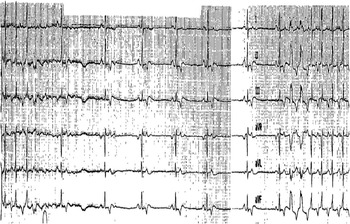
The diagnosis of supraventricular tachycardia with cardiogenic shock was made at the time. Quick vascular access was obtained via a large intravenous catheter to an external jugular vein. With the history of unsuccessful electrical cardioversion before arrival, intravenous adenosine was given with two repeated doses of 0.2 mg/kg by intravenous push. The electrocardiogram showed a short period of atrial fibrillation followed by a bradycardia consisting of sinus-echo beat couplets and then with the waning of the chemical atrioventricular block, quickly reverted to supraventricular tachycardia (Fig 1).
The electrocardiogram showed a short period of atrial fibrillation followed by bradycardia consisting of sinus-echo beat couplets and then with loss of block quickly returning to his supraventricular tachycardia.

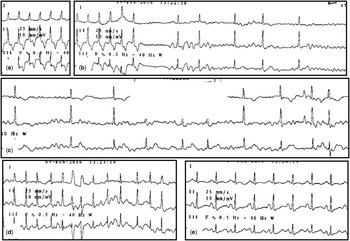
Further synchronised electrical cardioversion at 2 J/kg also failed. At this point the possibility of ventricular tachycardia was entertained and to help with this differential, a bolus of adenosine intravenous at 0.4 mg/kg intravenous was given. The electrocardiogram (Fig 2) showed asystole (Fig 2a) followed by sinus-echo beat couplets that then converted to atrial fibrillation with high-level block (Fig 2b). The conduction slowly improved with an irregularly irregular rhythm at a rate of 150–200 (Fig 2c) and then converted spontaneously to sinus rhythm at a rate of 140 (Fig 2d and e).
The supraventricular tachycardia ( a ) followed by asystole and sinus-echo beat ( b ). Atrial fibrillation developed ( c ) that then converted spontaneously to sinus rhythm ( d and e ).

A cross-sectional echocardiogram showed a severely dilated and poorly contracting left ventricle (left ventricular end diastolic diameter=2.7 cm), shortening fraction of 19%, and severe mitral regurgitation. The coronary arteries appeared normal.
During his stay in the paediatric ICU, the supraventricular tachycardia returned frequently only converting with high-dose adenosine. When normal doses of up to 0.2 mg/kg were tried, there was a short asystolic period followed by sinus-echo beat couplets that quickly reverted to what was then diagnosed as permanent junctional reciprocating tachycardia. All subsequent successful conversions required high-dose adenosine (0.4–0.6 mg/kg), resulting in persistant atrioventricular block until loss of one echo beat, with subsequent two consecutive sinus beats, which then returned to sinus rhythm.
The infant was started on Amiodarone, Digoxin, Flecainide, and a high-dose Esmolol drip. His cardiac function recovered after 3 days of rhythm control. Despite the above-mentioned multiple medications, his control was poor with a frequent need for further doses of intravenous adenosine. He was therefore transferred for an electrophysiology study. The study confirmed typical permanent junctional reciprocating tachycardia and a right posterior septal bypass tract, which was successfully ablated. Following this ablation, he was found to have inducible atrioventricular nodal re-entrant tachycardia and underwent a further ablation of the slow atrioventricular node pathway.
Discussion
Supraventricular tachycardia is the most common tachyarrhythmia in infants and children.
Although most patients with supraventricular tachycardia have a mild course, a few such as our patient may develop cardiac failure and cardiogenic shock if prolonged and/or not diagnosed.
Pediatric Advanced Life Support protocols recommend that an unstable patient with supraventricular tachycardia should be treated immediately with electrical synchronised cardioversion at 0.5–2 J/kg. A stable patient with or without mild symptoms should be treated with vagal manoeuvres and/or the use of a facial ice pack, failing which intravenous adenosine at 0.1–0.2 mg/kg with appropriate monitoring and a standby defibrillator should be followed. Immediate alternative solutions are lacking when this approach fails.
A review of the literature shows that in several studies the optimal dose of adenosine is higher than the 0.1 mg/kg recommendation. Doses ranging 0.2–0.3 mg/kg were more likely to be successful. Only 9–33% of the patients who received 0.1 mg/kg of adenosine responded and returned to normal sinus rhythm, with the remainder with 0.2 mg/kg and even 0.3 mg/kg.Reference Díaz-Parra, Sánchez-Yañez, Zabala-Argüelles, Picazo-Angelin, Conejo-Muñoz and Cuenca-Peiró 5 , Reference Qureshi, Hyder, Sheikh and Sadiq 6
Recently, a report showed that in a 33-year-old male with a refractory case of supraventricular tachycardia a higher dose of 36 mg (three times the recommended high dose) resolved his arrhythmia.Reference Bailey, Baum, Rose and Humphries 7 Our case represents an unusual refractory supraventricular tachycardia – permanent junctional reciprocating tachycardia – in an infant in cardiogenic shock. The cause probably stems from his complex persistant, electrically quite stable, re-entry pathway. His treatment regimen, starting with attempted pre-hospital cardioversion and then repeated doses of adenosine in the Emergency Department, suggested a complex case. The higher dose adenosine allowed a longer period of atrioventricular block, which then suppressed the continuing echo beats achieving successful cardioversion.
Using alternative medications such as amiodarone or flecainide may take a while to become effective in this unstable patient; likewise, Verapamil is contraindicated in supraventricular tachycardia with cardiogenic shock. Procainamide drip in the acute phase of treatment of a haemodynamically compromised patient may accentuate hypotension, although may be useful once the patient’s cardiac function recovers.
We suggest that, in cases of refractory supraventricular tachycardia with poor cardiac function, a higher dose of adenosine may be tried, which may convert the arrhythmia. With a suitably monitored patient, this approach may allow safe treatment and offer a quick solution when cardioversion is otherwise unsuccessful.
Acknowledgements
The authors thank Rami Fogelman, MD, Chief Electrophysiologist at Schneider’s Children’s Hospital, Petah Tikva, Israel, for skillfully performing the EP study. The authors thank Samuel Menahem, MD, for his help in reviewing the manuscript. Authors’ contribution: G.W. and G.D. conceived and drafted the manuscript. D.F. critically reviewed the manuscript and contributed to the final draft. All the authors agree and take full responsibility for the manuscript.
Financial Support
This research received no specific grant from any funding agency or from commercial or not-for-profit sectors.
Conflicts of Interest
None.
Ethical Standards
All the authors confirm that the information in the manuscript was obtained and presented with full ethical standards.