


Introduction
The prevalence of depression and anxiety is estimated at 1 in 6 among UK adults (Singleton, Bumpstead, O'Brien, Lee and Meltzer, Reference Singleton, Bumpstead, O'Brien, Lee and Meltzer2001) yet there are high levels of unmet need. Only a third seek help via primary care physicians (Bebbington, Meltzer et al., Reference Bebbington, Meltzer, Brugha, Farrell, Jenkins and Ceresa2000), the gatekeepers to specialist services. For those that overcome initial barriers to help-seeking, fewer than one in ten receive psychological therapy (Bebbington, Brugha et al., Reference Bebbington, Brugha, Meltzer, Jenkins, Ceresa and Farrell2000). Consequently, the UK government's investment in the Improving Access to Psychological Therapies (IAPT) programme (Department of Health, 2008) represents a major initiative to increase the availability of psychological therapy for anxiety and depression, particularly cognitive-behavioural therapy (CBT). However, a pre-requisite to receiving any benefit from psychological therapy, it is that people at least attend the offered session.
However, nonattendance at therapy sessions is a widespread and persistent problem (Barrett, Chua, Crits-Christoph, Gibbons and Thompson, Reference Barrett, Chua, Crits-Christoph, Gibbons and Thompson2008). As well as exacerbating the issue of unmet mental health needs, nonattendance results in substantial costs to health services (Hampton-Robb, Qualls and Compton, Reference Hampton-Robb, Qualls and Compton2003) and compromises the effectiveness of evidence-based treatments such as CBT (Bados, Balaguer and Saldana, Reference Bados, Balaguer and Saldana2007). Quantifying nonattendance is complicated by inconsistent definitions of what is varyingly termed “drop-out”, “disengagement”, “termination” or “attrition”. Therefore one approach is to focus on a clearly defined outcome of first appointment nonattendance. First appointments warrant specific consideration as they are associated with the highest nonattendance rates, ranging from 16 to 67% with a mean rate of 40% (Hampton-Robb et al., Reference Hampton-Robb, Qualls and Compton2003). Also, first appointments are less often rescheduled (Sparr, Moffitt and Ward, Reference Sparr, Moffitt and Ward1993) and even for those who do rearrange, early nonattendance predicts later drop-out (Aubrey, Self and Halstead, Reference Aubrey, Self and Halstead2003). Although there are few studies of initial nonattendance specifically within CBT services; one study reported a drop-out rate of 28% after the first session (Bados et al., Reference Bados, Balaguer and Saldana2007). Within IAPT settings, data from routine practice showed that one-third of referred individuals failed to opt-in, and a further quarter did not attend the first appointment, equating to an overall nonattendance rate of 50% of all referrals (K. Grant et al., Reference Grant, McMeekin, Jamieson, Fairfull, Miller and White2012).
Despite the magnitude of the issue, the reasons for nonattendance are poorly understood (Barrett et al., Reference Barrett, Chua, Crits-Christoph, Gibbons and Thompson2008). Previous studies have focused largely on demographic factors, but have often produced conflicting results. Still, among four previous reviews of psychotherapy nonattendance, the most consistent predictors were lower socio-economic status, lower education levels and black and minority group ethnicity (Baekeland and Lundwall, Reference Baekeland and Lundwall1975; Wierzbicki and Pekarik, Reference Wierzbicki and Pekarik1993; Garfield, Reference Garfield, Bergin and Garfield1994; Barrett et al., Reference Barrett, Chua, Crits-Christoph, Gibbons and Thompson2008). However, clinical factors such as severity of distress or diagnosis, or environmental factors such as transportation issues, have failed to produce consistent findings (Barrett et al., Reference Barrett, Chua, Crits-Christoph, Gibbons and Thompson2008). Such inconsistencies may partly reflect methodological differences among the studies reviewed. However, they also suggest multifaceted associations that may be mediated by additional factors. For example, psychological factors have been shown to account for the relationship between socioeconomic status and therapy attendance (Sheeran, Aubrey and Kellett, Reference Sheeran, Aubrey and Kellett2007).
Whereas demographic and diagnostic factors are static and less amenable to intervention, psychological factors are potentially modifiable and may inform strategies to reduce nonattendance (Reis and Brown, Reference Reis and Brown2006; Sheeran et al., Reference Sheeran, Aubrey and Kellett2007). The effects of psychological factors on attendance, such as beliefs, goals and attitudes towards therapy, are relatively under-researched. Furthermore, previous research into beliefs and attitudes towards therapy has relied on student rather than clinical populations, measurement of intentions to seek help rather than actual attendance at therapy appointments (Bayer and Peay, Reference Bayer and Peay1997; Shaffer, Vogel and Wei, Reference Shaffer, Vogel and Wei2006; Vogel and Wester, Reference Vogel and Wester2003) and use of retrospective designs (Amato and Bradshaw, Reference Amato and Bradshaw1985; Kushner and Sher, Reference Kushner and Sher1989). Moreover, few studies have examined positive attitudes towards therapy (Paige and Mansell, in press). The focus of previous literature has instead been on avoidance factors, such as fears of self-disclosure and stigma (Kushner and Sher, Reference Kushner and Sher1991; Vogel, Wester and Larson, Reference Vogel, Wester and Larson2007).
Positive attitudes towards therapy are of relevance as a missed first appointment raises questions as to people's initial motivation for seeking help. Subsequent nonattendance may therefore reflect ambivalence in the help-seeking process. This ambivalence has been described as an approach-avoidance conflict between competing factors that motivate or inhibit help-seeking (Kushner and Sher, Reference Kushner and Sher1989; Paige and Mansell, in press). However, further studies are required that consider a wider range of attitudes, as well as the relative importance and relationships between multiple psychological factors (Vogel, Wester, Wei and Boysen, Reference Vogel, Wester, Wei and Boysen2005). For example, severity of distress may interact with increased fear of treatment (Vogel et al., Reference Vogel, Wester, Wei and Boysen2005) and therefore ought not to be studied independently (Kushner and Sher, Reference Kushner and Sher1989).
Furthermore, to our knowledge, only one previous study has examined psychological predictors of first appointment attendance (Sheeran et al., Reference Sheeran, Aubrey and Kellett2007) as opposed to researching attendance after the person has already attended an intake assessment. Therefore the present study aimed to pilot a method of administering measures at the point of referral for therapy at a primary care mental health service delivering low-intensity CBT. The objectives of the study were to trial the method and observe the completion rate of the study measures, and to explore whether it was possible to identify attitudes towards therapy that predicted first point attendance, to inform the design of a larger study. Based on previous literature, we also generated some hypotheses to aid a preliminary evaluation of the predictive validity of the measure:
1. Positive attitudes towards therapy will be associated with increased attendance at the first appointment.
2. Negative attitudes towards therapy will be associated with reduced attendance at the first appointment.
3. Increased psychological distress will be associated with increased endorsement of negative attitudes towards therapy.
Method
Design
A prospective questionnaire-based study was conducted of individuals referred for low-intensity CBT in a general practice setting. Participants completed questionnaires at the time of referral for therapy, and data on subsequent attendance were used as an outcome.
Setting and participants
The study setting was a small general practice located near the urban centre of the City of Salford in the North West of England. Salford is ranked among the 10% most deprived local authority areas in England (Department of Communities and Local Government, 2011) and; 92% of its population of 225,100 are of white ethnicity (Office for National Statistics, 2011). A primary-care mental health team (PCMHT) provided low-intensity CBT at the general practice, as part of the IAPT programme (Department of Health, 2008). This involved delivery of interventions such as CBT-based guided self-help, for an average of 6 to 8, 30-minute sessions, and including strategies such as behavioural activation and cognitive restructuring. The study participants were individuals registered at the general practice who were referred to the PCMHT over a 22 month study period from September 2008 to June 2010. The general practice typically made five referrals per month. The inclusion criteria of the team were adults aged 16 years and over, with mild to moderate anxiety or depression. Exclusion criteria were people presenting with high risk to self or others, significant alcohol dependency, or psychosis. The team offers an initial assessment appointment to all referred individuals who book an appointment.
Procedure
Following an individual's initial presentation to their GP with symptoms of anxiety or depression, the GP may recommend an appointment for therapy with the PCMHT. Those who agreed to the referral were instructed to schedule a therapy appointment via the receptionist after the consultation. As part of this referral and appointment booking process, individuals completed several intake measures in a designated area of the practice waiting room, which are described below. Data on attendance at the first appointment were subsequently collected from an electronic patient records system. These data were routinely collected to inform service evaluation.
Measures
Depression. The Patient Health Questionnaire (PHQ-9) is a brief measure of the severity of depression. It has been validated for use in primary care (sensitivity, 88%; specificity, 88%) in the diagnosis of depression (Kroenke, Spitzer and Williams, Reference Kroenke, Spitzer and Williams2001).
Anxiety. The Generalized Anxiety Disorder Assessment (GAD-7) is a brief measure of the severity of GAD. It is valid in the diagnosis of GAD (sensitivity, 89%; specificity, 82%) (Spitzer, Kroenke, Williams and Lowe, Reference Spitzer, Kroenke, Williams and Lowe2006) and is moderately good at identifying other anxiety disorders (Kroenke, Spitzer, Williams, Monahan and Lowe, Reference Kroenke, Spitzer, Williams, Monahan and Lowe2007).
Psychological factors. The Initial Appointment Questionnaire (Mansell, Reference Mansell2010) is a 21-item measure of beliefs, goals and attitudes towards therapy (hereafter referred to as attitudes). It includes separate subscales of both positive and negative factors, and was developed as earlier measures did not fulfil this two-dimensional purpose. Items were informed by previous literature (Andersen, Reference Andersen1995; Farid and Alapont, Reference Farid and Alapont1993; Kourany, Garber and Tornusciolo, Reference Kourany, Garber and Tornusciolo1990; Kruse and Rohland, Reference Kruse and Rohland2002; Owens et al., Reference Owens, Hoagwood, Horwitz, Leaf, Poduska and Kellam2002; Vogel, Wade and Hackler, Reference Vogel, Wade and Hackler2008; Vogel et al., Reference Vogel, Wester, Wei and Boysen2005). Additional positive factors were generated from clinical experience, due to their underrepresentation in published research. Items were rated on a 3-point scale (no = 0; maybe = 1; yes = 2). The internal consistency (Cronbach's alpha) for the positive subscale was 0.7 and for the negative subscale was 0.8, in the current study.
Data analysis
The data were analyzed using SPSS version 16.0 (SPSS Inc., 2008). The linear chi square test was used to examine the association between individual items on the Initial Appointment Questionnaire (IAQ) and attendance at the first appointment. Ratings on the positive and negative subscales were also summed and differences by attendance status were examined (Mann-Whitney U). Differences in measures of psychological distress by attendance status were examined using the unpaired t-test. The correlation between measures of psychological distress and ratings on the IAQ was tested using Spearman's rho.
Results
Sample characteristics
There were 104 individuals at the general practice who booked an appointment with the PCMH service over the study period. They ranged in age from 16 to 70 years and 53% were female. Of these, 67 participants (64%) completed all items of the Initial Appointment Questionnaire, and this subset forms the study sample. Compared to those who booked an appointment without fully completing the questionnaire, fewer of the study sample were female, 45% vs. 66%, but the difference did not reach significance (Fisher's exact test p = .07). However, there was an age difference, with those completing the questionnaires being younger (median, IQR): 29.0 (21.8, 40.3) vs. 38 (27.0, 49.3), p = .004. In addition, 63 of the 67 (94%) participants completed the PHQ-9 measure of depression, and 35 (52%) also completed the GAD-7 measure of anxiety. The mean scores (SD) were 17.9 (5.9) and 15.0 (4.5) respectively, which were both within the moderate range of symptom severity.
Initial Appointment Questionnaire (IAQ, n = 67)
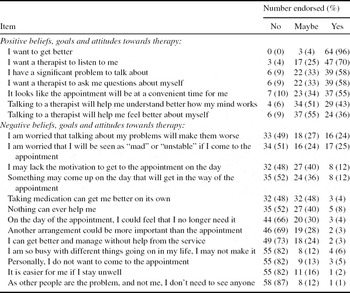
Table 1 shows the proportion of individuals endorsing each item on the IAQ. The two most frequently endorsed items on the positive subscale were “I want to get better” and “I want a therapist to listen to me”. The two most frequently endorsed items on the negative subscale were “I am worried that talking about my problems will make them worse” and “I am worried that I will be seen as ‘mad’ or ‘unstable’ if I come to the appointment”.
Number of clients endorsing items on the Initial Appointment Questionnaire

Questionnaire items associated with subsequent attendance (n = 67)
The overall first appointment nonattendance rate among the study sample was 45%. Each item from the IAQ was tested for a linear association with attendance at first appointment. Results are only reported for the item that reached statistical significance: “Talking to a therapist will help me understand better how my mind works”, which was associated with increased likelihood of attendance. Of those that responded “yes” to this item, 72% attended the appointment (Table 2). In addition, demographic factors of age and gender were examined for their association with attendance. The results were non-significant. The odds ratio for attendance for males vs. females was 1.1 (95% CI 0.4, 2.9). The median (IQR) age for attenders vs. non-attenders was 29.5 (26.0, 40.8) years vs. 27 (20.0, 36.5) years, p = .15. We also repeated the analysis on an individual item basis, irrespective of whether all 21 items had been completed (i.e. including questionnaires with some missing data) and the results were very similar. Based on 96 individuals (92% of booked appointments), the main finding in Table 2 remained significant (Linear-by-linear association = 8.2, p = .004).
Item associated with attendance at the first appointment

*Due to the zero cell count, the analysis was repeated using only the “maybe” and “yes” categories only. The result remained significant (Linear-by-linear association = 4.1, df = 1, p = .04).
Overall scores on the positive and negative subscales (n = 67)
Participants’ overall scores on the questionnaire subscales were summed and differences between participants who attended versus those who did not attend were examined. There were no significant differences in overall scores on the positive subscale by attendance status: median scores (IQR): 11.0 (10.0, 13.0) vs. 11.0 (9.0, 12.0) p = .96. Similarly, there were no significant differences in scores on the negative subscale: median scores (IQR): 5.0 (2.0, 7.5) vs. 5.0 (2.8, 7.3), p = .97.
Measures of depression (n = 63) and anxiety (n = 35)
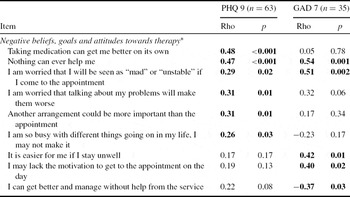
There was no difference in depression scores for those attending versus not attending: mean scores (SD): 18 (6) vs. 18 (6) and t = 0.22, p = .83. Similarly, there were no differences in anxiety scores by attendance status: mean scores (SD): 15 (5) vs. 15 (4) and t = 0.04, p = .97. However, both depression (Spearman's rho = 0.29, p = .02) and anxiety (Spearman's rho = 0.36, p = .03) were significantly correlated with the total subscale score for negative attitudes. Table 3 also shows the individual negative items that were significantly correlated with measures of depression and anxiety.
Questionnaire items associated with psychological distress as measured by the PHQ-9 and GAD-7

* Only those items that were significantly correlated with either of the measures of psychological distress (p < .05) are presented. Significant correlations are highlighted in bold.
Discussion
Main findings
The first-appointment nonattendance rate among the study sample was 45%. Participants who endorsed the positive item: “Talking to a therapist will help me understand better how my mind works”, were more likely to attend their appointment. Attendance was not associated with age or gender, overall ratings for positive or negative attitudes, or severity of anxiety or depression. However, higher depression and anxiety scores were associated with increased endorsement of negative attitudes towards therapy.
Strengths and limitations
This was a pilot study with a small sample which may not have been representative of the whole service cohort; therefore the results are preliminary and require cautious interpretation. Missing data was a limitation, as only 52% of the sample completed the anxiety measure, suggesting some questionnaire response fatigue. However, 64% of all individuals fully completed the attitude questionnaire, which compares favourably to the only previous psychological study of first appointments (Sheeran et al., Reference Sheeran, Aubrey and Kellett2007). Their study achieved a response rate of 29% via postal return of their attitude measure. Our completion rate therefore provides some evidence of the feasibility of administrating measures as part of a routine appointment booking process. The study design was also a strength in terms of maximizing external validity, especially as prospective, psychological studies of attendance are scarce. However, this was the initial pilot of our brief attitude measure, and further work is required to validate the subscales. Also, there was some non-response bias, with older people being less likely to fully complete the questionnaire. Still, the preliminary finding regarding the “mind works” item remained significant when the analysis was repeated using all available questionnaire data. Another limitation was the absence of information on ethnicity and socioeconomic variables, which may be associated with nonattendance (Wierzbicki and Pekarik, Reference Wierzbicki and Pekarik1993). Also, the study was based in one general practice, in IAPT service settings in a deprived urban area, and caution is needed in generalizing the findings elsewhere. Finally, the focus of our study was on individual attitudes and attendance. However, future studies may also wish to examine service-related factors such as how the referral was discussed with the client and whether this was client-led (Munro and Blakey, Reference Munro and Blakey1986).
Findings in relation to previous studies
Although this was a small, selected sample, the non-attendance rate was similar to a rate of 40% reported for first psychotherapy appointments (Hampton-Robb et al., Reference Hampton-Robb, Qualls and Compton2003), as well as reported in IAPT service settings elsewhere (K. Grant et al., Reference Grant, McMeekin, Jamieson, Fairfull, Miller and White2012). Regarding the ability of our measure to predict attendance, it was surprising that negative attitudes were not associated with reduced attendance as hypothesized, considering that previous research has focused on treatment fears and therapy avoidance (Vogel et al., Reference Vogel, Wester and Larson2007). However, the item, “Talking to a therapist will help me understand better how my mind works” did draw attention to a positive factor that was associated with attendance. This finding should be interpreted cautiously as it was based only on a single item in a pilot sample; however, it suggests that positive attitudes warrant further study.
Previous studies have identified an association between positive attitudes towards professional help with past service-use (Fischer and Turner, Reference Fischer and Turner1970) and with help-seeking intentions (Schomerus, Matschinger and Angermeyer, Reference Schomerus, Matschinger and Angermeyer2009). However, studies have not prospectively linked positive attitudes with actual attendance. Furthermore, the approach-avoidance conceptualization of ambivalent help-seeking defines motivation to seek help as arising mainly from mental distress (Kushner and Sher, Reference Kushner and Sher1991) rather than considering additional positive gains from therapy. The significant item in the current study might represent a goal that some individuals were motivated to approach i.e. to get help in understanding how their “mind worked”.
The item may also reflect the concept of psychological mindedness, as it is highly similar to an item from a measure that specifically assesses this concept: “I have a definite need to understand the way that my mind works” (A. Grant, Franklin, and Langford, Reference Grant, Franklin and Langford2002). Psychological mindedness has been defined as a predisposition to engage in acts of inquiry into how and why people behave, think, and feel in the way that they do, and involves processes of self-reflection and insight (A. Grant, Reference Grant2001). It has been suggested that psychological mindedness is associated with improved engagement and reduced dropout; however, the construct has often been poorly defined and confused with factors such as willingness to self-disclose (Barrett et al., Reference Barrett, Chua, Crits-Christoph, Gibbons and Thompson2008). Therefore attitudes associated with psychological mindedness require further elaboration in a larger study of therapy attendance.
With respect to the finding that negative attitudes were not associated with attendance, it is noted that only one previous study has found negative attitudes to predict actual nonattendance (Sheeran et al., Reference Sheeran, Aubrey and Kellett2007). In fact, another study found the reverse finding that anticipating risks of treatment predicted increased attendance (Vogel et al., Reference Vogel, Wester, Wei and Boysen2005). Although conclusions cannot be generated from the present data, previous studies have suggested a complex association due to an interaction with distress levels (Kushner and Sher, Reference Kushner and Sher1989; Vogel et al., Reference Vogel, Wester, Wei and Boysen2005). For example, higher distress has been associated with treatment fears (Kushner and Sher, Reference Kushner and Sher1989), thought to reflect greater fears of subjective pain when talking about highly distressing experiences (Vogel et al., Reference Vogel, Wester, Wei and Boysen2005). Conversely, high motivation to attend may also activate treatment fears, as feared aspects of treatment are about to be encountered (Kushner and Sher, Reference Kushner and Sher1989). Therefore interactions between attitudes and distress levels will need investigating in a full-scale study of attendance. However, our finding that distress levels were correlated with our measure of negative attitudes, as consistent with Kushner and Sher (Reference Kushner and Sher1989), suggests that the negative subscale has some validity.
We also did not observe any association between distress levels and attendance. Distress is thought to reflect greater need and approach motivation to seek treatment at the initial help-seeking stage (Andersen, Reference Andersen1995; Kushner and Sher, Reference Kushner and Sher1991) and predicts initial help-seeking to general practitioners in primary care settings (Bebbington, Meltzer et al., Reference Bebbington, Meltzer, Brugha, Farrell, Jenkins and Ceresa2000; Oliver, Pearson, Coe and Gunnell, Reference Oliver, Pearson, Coe and Gunnell2005). However, as mentioned, distress may activate treatment fears and avoidance later in the help-seeking process (Kushner and Sher, Reference Kushner and Sher1989). For example, after referral for therapy, symptom severity has been found to predict improved attendance (Issakidis and Andrews, Reference Issakidis and Andrews2004), to have no relationship (Pina, Silverman, Weems, Kurtines and Goldman, Reference Pina, Silverman, Weems, Kurtines and Goldman2003), or to predict treatment drop-out (Chasson, Vincent and Harris, Reference Chasson, Vincent and Harris2008). Therefore competing approach and avoidance processes may explain why severity of distress, as well as negative attitudes, does not have a clear relationship with therapy attendance.
Implications for further research
This pilot study showed that it was feasible to administer the questionnaires as part of a routine appointment booking procedure via receptionists. However, a larger study is required to generate more definitive conclusions. Ideally, the study measures would be routinely administered at service level, for referrals from all general practices covered by a PCMHT to achieve a large and representative sample. To maximize response rates, the measures should be brief and would be best administered at the time of the referring GP consultation. However, adaptations will be needed depending on local procedures. For example, where letter referrals are made, it would be preferable if GPs could administer the measures. Alternatively, patients could complete the measures in a designated area of the practice after the consultation and return them to reception staff. A larger sample would also allow for a factor analysis to assess the convergent and discriminant validity of the separate positive and negative subscales. There could also be scope for including additional positive items to relating to psychological mindedness, and for assessing construct validity of the positive subscale in relation to an existing therapy attitudes measure (Fischer and Farina, Reference Fischer and Farina1995).
Conclusions and clinical implications
These preliminary results highlighted a sizeable first appointment nonattendance rate within an IAPT service in a deprived area, and that endorsement of an item related to psychological mindedness was associated with attendance. A larger study is planned to validate these findings. Although these results are not definitive, they suggest that highlighting the benefits of therapy and enhancing positive attitudes may be of relevance; for example, via leaflets or brochures that could be offered by referring GPs or sent with appointment letters, as well as via websites or other promotional material. Specifically, highlighting that therapy provides an opportunity for people to reflect on themselves or understand how “their mind works” may encourage attendance for those who have motives to self-reflect.




Comments
No Comments have been published for this article.