The co-occurrence of gesture and speech in the performance of second language (L2) speakers is an emerging area of research in which one can investigate the interesting question of whether learning additional languages in adulthood results in conceptual shifts in how a person talks and, therefore, thinks about events in the world. Slobin (1996a, 2003) has conducted a number of cross-language studies to investigate a weak version of the Sapir-Whorf linguistic relativity hypothesis (Sapir, 1921; Whorf, 1956). According to Slobin (1996a), the strong version of the hypothesis is overly deterministic and is not supported by the evidence. On the other hand, a weaker version, which he calls thinking for speaking (TFS), is sustainable. This hypothesis suggests that in the activity of speaking, thinking is filtered through language as speakers undertake to verbalize events and states in the world. Certain distinctions, such as aspect, definiteness, voice, and—with regard to the present study—motion, are represented, learned, and expressed through the grammaticized categories of one's language (Slobin, 1996a). As we gain experience using our language, our minds are “trained in taking particular points of view for the purposes of speaking,” and it seems to become “exceptionally difficult for us to be retrained” (Slobin, 1996a, p. 91). Unlike grammatical categories, categories such as plural and instrumental markers entail linguistically encoded viewpoints that receive support from our sensory experience of the world; these, according to Slobin (1996a), are not all that difficult, relatively speaking, to retrain when learning another language. Slobin further contended that TFS holds even when there is a considerable time lag between experiencing and talking about events. He referred to this as the “anticipatory effects” of language, which he characterized as the “prelinguistic coding” that occurs at the time we experience events, as we attend “to those event dimensions that are relevant for linguistic coding” at speaking time, when we access “the linguistically codable dimensions” of the event (Slobin, 2003, p. 179). Slobin's argument is supported by the evidence on L2 use of motion verbs presented in this article.
Although Slobin's (1996a, 1996b, 2003) research has produced important results from a cross-language perspective, McNeill and his colleagues (e.g., Duncan, 2001; McNeill, 2000a, 2000b; McNeill & Duncan, 2000) have made a convincing argument that full understanding of the TFS framework requires incorporation of evidence from another, and often overlooked, aspect of communicative activity—gesture. According to McNeill (2000a), speaking and gesturing form a dialectical unity, or growth point (GP), that must be analyzed as a whole in order to fully understand the connection between thinking and speaking. The GP is closely related to Vygotsky's (1987) notion of inner speech, but, unlike inner speech, the GP combines “two distinct semiotic architectures” into a single meaning system, and because each component possesses “unique semiotic properties,” each can surpass “the meaning possibilities of the other” (McNeill & Duncan, p. 144). Gestures are the “material carriers of thinking” and, as such, provide “an enhanced window into mental processes” (McNeill & Duncan, p. 155). According to McNeill (2005), gestures, unlike speech, do not represent but rather depict events in the world, much in the way a painting does. Thus, the GP is a dialectical unity formed by an imagistic depiction and a verbal representation of events (see also McCafferty, 1998).
Slobin (2003) pointed to a number of areas in which languages differ with regard to TFS features, including temporal marking, spatial encoding (i.e., absolute vs. relative direction), and motion events. Motion events have been the focus of a good deal of gesture research and, with regard to L2 performance, constitute the topic of this article. Our analysis is not only framed by Slobin's (1996a, 2003) TFS framework and McNeill's (2005) GP hypothesis but is also informed by Talmy's (2000) motion event typology. We will explain Talmy's typology in more detail in the following section, but for now suffice it to say that the typology categorizes languages depending on how they encode path of motion: Languages pattern either like English, which most often encodes path in a satellite phrase (e.g., The cat ran out of the room), or like Spanish, which conflates path in the verb (e.g., El gato salió corriendo de la sala “The cat left running from the room”). L2 research on gesture in motion events has focused on whether L2 users are able to shift from their first language (L1) TFS framework to the preferred pattern in the L2. Not too surprisingly, most of the research on gesture and TFS has focused on English and, to a lesser extent, Spanish. To our knowledge, no study, until now, has focused on Korean, a language that Talmy situated in the same typological category as Spanish but that is in some respects quite different with regard to some of the options it has for encoding and depicting motion events.
Our goal in this article is to present evidence from a larger comparative study (Choi, 2008) on the gesture-speech interface in the narrative performance of L2 Korean and English speakers within Slobin's (1996a, 2003) TFS framework and in relation to McNeill's (2000a) GP hypothesis. We will first discuss Talmy's (2000) motion event typology. Next, McNeill's GP hypothesis and its relevance for the present study will be explained. We will then briefly review the L2 research on speech-gesture motion events. Finally, we will present the study itself, followed by a discussion of the findings and their implications for how we understand L2 learning from a conceptual and not just a linguistic perspective.
LEXICALIZATION OF MOTION EVENTS IN ENGLISH AND KOREAN
Talmy (2000) classified languages according to how they lexicalize motion events. Accordingly, a prototypical motion event has four components, as illustrated in (1).

Additionally, two optional features, manner (the particular way a motion is executed) and cause (the source of the change in motion or location), can be expressed (Talmy).
Talmy (2000) established two broad typological categories according to how languages indicate path of motion. One, referred to as satellite-framed or S-languages, prefers to encode the trajectory of a figure against a ground in particle or prepositional phrases, and the other, verb-framed or V-languages, tends to conflate path of a figure on the verb with the ground encoded in a separate phrase (Slobin, 2003). English is a typical S-language, as illustrated in (2), and Spanish is a typical V-language, as shown in (3).

Korean, classified as a V-language, encodes path through a biverbal construction that consists of a required deictic verb that shows motion and a path verb that indicates trajectory. Unlike English and Spanish, however, Korean is a head-final language; therefore, speakers generally mention the ground against which a figure moves prior to the motion verb construction, as in (4).

With regard to optional manner, speakers of S-languages demonstrate a stronger preference to encode manner of motion than do their counterparts in V-languages. This encoding is achieved by conflating manner on the verb. When manner is expressed in a V-language, with the exception of so-called basic manner verbs (e.g., run, walk, fly), it is generally not conflated on the verb but is instead expressed through separate lexical items. Examples of manner marking for English, Spanish, and Korean—from descriptions of the Tweety Bird cartoon used for the current study—are given in (5)–(7).

In the English example, the speaker encoded the manner of the cat's motion with the manner verb roll and expressed its trajectory with the satellite phrase out of the drainpipe. In the Spanish example, the speaker indicated the cat's trajectory with a basic path verb salir “exit” and expressed the manner in which the figure moves against the ground with the separate adverbial rodando “rolling.” Even when wishing to express such basic manner events as walking and running, Spanish speakers often avoid manner verbs in favor of lexical expression of manner, as in Llegamos a casa caminando “we arrive home walking.” In the Korean example, path was encoded in the path verb naylita “descend,” and manner was separately encoded in the onomatopoetic expression ccwulwulwuk (sound that an object makes as it rapidly slides down on a smooth surface). The path verb naylita “descend” was followed by the deictic verb ota “come,” and these two verbs were combined with a suffix –e/a.2
In Korean, manner verbs, path verbs, and deictic verbs are frequently combined through a suffix –e/a. Additionally, other suffixes, such as –ko “and” or –ese/ase “and then,” also integrate these three types of verbs (Oh, 2003). Unlike the verbs connected by –ko and –ese/ase, however, a verb compound connected through –e/a describes a single event (Lee, 2001).
Because Korean encodes motion, path, and manner in separate verbs, Choi and Bowerman (1991) described Korean as having an “exploded” fashion of encoding spontaneous motion events (p. 88). If motion is particularly salient, however—as is the case when Sylvester the Cat is pushed out of a drainpipe by a bowling ball in the Tweety Bird cartoon used in the current study—manner can indeed be expressed verbally in Korean through a manner verb, as illustrated in (4), in which the relatively low-frequency verb kwull-e “roll” is used to describe Sylvester the Cat's motion. However, Korean speakers, not unlike their Spanish counterparts (see Negueruela, Lantolf, Jordan, & Gelabert, 2004), can, and often do, omit manner expressions completely (if the motion is not salient), resulting in a [path] + [motion + deixis] construction. As we will discuss, even when manner is not particularly relevant to the events of a scene, English speakers still frequently encode it verbally.
CAUSED MOTION
The motion patterns described in the previous section deal with what Talmy (2000) called spontaneous motion events—events in which motion occurs in the absence of any obvious external cause. The distinction between English and Korean with respect to path becomes more complex in the case of caused motion events. According to Choi and Bowerman (1991), English does not overtly distinguish the way it encodes path for spontaneous and caused motion events. Examples (8) and (9) illustrate this point.

In both (8) and (9), path is encoded in the satellite phrase into. Korean, however, encodes path differently depending on whether the motion event is viewed as spontaneous or as caused (Choi & Bowerman, 1991). Examples (10) and (11) illustrate this distinction.

In caused motion events, in addition to path, Korean path verbs incorporate different aspects of the relationship between figure and ground. For instance, Korean uses the transitive path verb kkita to describe the caused action of putting one three-dimensional object into another where the fit is tight, as in the case of putting earplugs into one's ears, whereas it uses the transitive verb nehta when the fit is loose, as when placing a ball into a box (Choi, 1997). Moreover, when a ground is part of the human body, an even more fine-grained distinction is made between ssuta (put a clothing item on the head), sinta (put a clothing item on feet or legs), and ipta (put a clothing item on the trunk of the body) (Choi). Consequently, Korean speakers have to “distinguish actions of putting in/on/together that result in a fitting relationship from those that result in loose containment or surface contact” (Choi & Bowerman, p. 92).
In addition to inherently causative verbs, Korean also expresses caused motion events through a set of causative verbs that are morphologically derived from noncausative verbs through attachment of the intensifier -ttuli or one of the causative suffixes –y, –i, –hi, –li, –ki, –khi, –wu, –ywu, –iwu, –chwu, and –kwu (Sohn, 1999). For example, the intransitive path verb oluta “ascend” takes on causative meaning through the addition of the causative morpheme –i, with the result oll-i-ta “cause something to ascend.” Unlike inherently causative path verbs, which incorporate aspects of the relationship between figure and ground, morphologically derived causative verbs only encode path and motion and indicate nothing about the figure-ground relationship (Im, 2001).
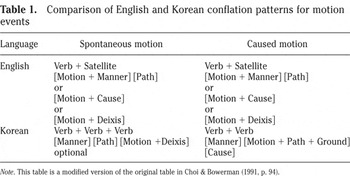
To summarize, Korean has two different lexicalization patterns for indicating path: one for spontaneous motions and one for caused motions. English uses the same pattern for both motion types. Table 1 summarizes this important difference between the two languages.
Comparison of English and Korean conflation patterns for motion events

Slobin (2003) described the English lexicon as “highly saturated” with verbs that conflate motion and manner (p. 163). Thus, English makes available to its speakers such fine-grained manner verbs as trudge, skip, hop, slide, sidle, shinny, slog, scamper, and sweep. Relative to Korean and Spanish, English-speaking children are no doubt immersed in speech that draws their attention to the fine-grained aspects of the manner in which a figure moves against a ground. Consequently, speakers of S-languages such as English are more likely to develop “rich mental imagery of manner of motion” that will be “salient in memory of events and in verbal accounts of events” (Slobin, p. 164) than are speakers of V-languages such as Korean and Spanish. Indeed, one L1 English speaker documented in the data collected in McNeill's laboratory at the University of Chicago coined the manner verb scritter to describe the way in which Sylvester the Cat moved his way up through the drainpipe in the Tweety Bird cartoon. Although V-languages include some fine-grained manner verbs in their lexicons, speakers often opt not to use them in spontaneous speech, as reported in Negueruela et al. (2004). As attested in the data of the L1 Korean speakers to be considered here, however, when manner is exceptionally salient, speakers of V-languages do use a relevant manner verb.
GESTURE AND MOTION EVENTS
McNeill (1992) proposed that communicating not only entails speech but also incorporates an imagistic dimension. The visual and the verbal components of communication are not, in his view, separate and distinct phenomena; rather, they form a dialectical unity in which both features contribute not only to the expression of meaning but also to its formation. According to McNeill, utterances develop from a “primitive stage [that] dialectically integrates into a single unit, properties of thinking that have contrary characteristics: imagistic and linguistic, idiosyncratic and social, global and segmented, holistic and analytic” (p. 220). McNeill referred to this imagistic-linguistic unit as the GP of an utterance, which, as mentioned earlier, integrates two meaning systems into a single system. Thinking, according to the GP hypothesis, “is both global ‘and’ segmented, idiosyncratic ‘and’ linguistically patterned” (McNeill & Duncan, 2000, p. 148). The GP emerges and is open to observation at that point in utterance production when the stroke of a gesture and relevant linguistic information co-occur or synchronize (McNeill, p. 221). The stroke is the most important phase of the gesture and is comprised of a semantic and a kinetic component. The semantic component depicts the meaning in focus, and the kinetic component, which synchronizes with coexpressive speech, is the phase of the gesture during which the most salient movement occurs. The stroke is preceded by a preparation phase, in which the hands move from a rest position to the position where the stroke phase is executed, and is followed by the retraction phase, in which the hands return to the rest position. According to McNeill, GP indicates the aspect of a particular event that a speaker considers to be most salient and, therefore, signals the focus of the speaker's attention.
According to McNeill and Duncan (2000), English speakers synchronize their path gestures with verbal satellites, with ground noun phrases (NPs), or with a combination of both. They show a strong propensity to conflate manner with motion verbs and indicate that manner of motion is in focus through synchronization of iconic manner gestures with motion verbs. When manner is not in focus, English speakers might still use a manner verb—although it usually will not be fine grained (e.g., scritter)—but they synchronize their gestures with path satellites or grounds. Speakers of V-languages, such as Spanish and Korean, on the other hand, manifest quite different synchronization patterns.
Consider (12) and (13), in which two different L1 English speakers recount a scene from the Tweety Bird cartoon in which a bowling ball dropped down the drainpipe by Tweety Bird pushes Sylvester the Cat out of the pipe (see Appendix B for transcription conventions):

In (12), the speaker brought the manner of the bowling ball's motion into focus, as indicated by the fact that the stroke of the wiggling gesture coincided with the manner verb roll. In (13), however, the speaker's focus was on the path of Sylvester the Cat's motion, as signaled by the fact that the stroke of the gesture synchronized with the satellite down and was held through the first segment of the ground phrase the drain. Notice that in (12), the speaker failed to even overtly mention the ground NP, but both speakers used the same manner verb. According to the GP hypothesis, the two utterances reflect differences in GP and, therefore, differences in what the speaker considers to be salient information. Thus, the difference between (12) and (13) signals a difference in TFS.
Speakers of V-languages synchronize their gestures and speech differently when talking about motion events. Spanish speakers tend to synchronize the stroke of their path gestures on path verbs, on ground NPs, or on a combination of both. They prefer to mark manner—if at all—lexically, gesturally, or through a combination of both, but they tend to avoid fine-grained manner verbs. Examples (14) and (15) were produced by the same speaker while describing the scene from the Tweety Bird cartoon.

In (14), the speaker used an iconic gesture to depict the shape of the ground (i.e., the drainpipe) only. In (15), however, the same speaker indicated path both verbally (goes-into through the drainpipe) and gesturally, by holding the shape of the drainpipe initiated in (14) while raising his hands upward. Moreover, he marked the manner of Sylvester the Cat's motion with gesture only through the rocking motion of his hands coordinated with the upward movement. According to McNeill and Duncan (2000), the presence of a manner gesture, as in (15), in the absence of verbally marked manner, is a manner fog, a frequently used pattern among speakers of V-languages. Thus, in Spanish, GPs “with manner are categorized and enter the linguistic system as path and/or ground” (McNeill & Duncan, p. 150).
The typological difference between S-languages, such as English, and V-languages, such as Spanish and Korean, with regard to how motion is encoded verbally and depicted through gestures gives rise to differences in the dynamics of TFS patterns. In English, gesture and speech “highlight manner when it is part of the speaker's focus and when manner is not in focus, gesture does not encode it and need not synchronize with a manner verb, even if one is present” (McNeill & Duncan, 2000, p. 151). In Spanish, and also in Korean, marking manner is a “challenge appearing only when it is a focused component, and it is often omitted even when it is potentially significant” (McNeill & Duncan, p. 152).
PREVIOUS RESEARCH
To our knowledge, only four previous studies framed by Slobin's (1996a, 2003) TFS and McNeill's (2000a) GP hypotheses have appeared in the L2 research literature. As is the case for the present study, the focus of the previous studies has been on whether L2 learners show evidence of shifting from their L1 pattern to a L2 pattern of TFS as indicated by changes in how they synchronize gestures with speech in describing motion events.
Two of the previous studies (Özyürek, 2002; Stam, 2006) limited the scope of their research to speakers of a V-Language (Turkish in Özyürek's study and Spanish in Stam's study) speaking in L2 English. A third study, by Kellerman and van Hoof (2003), included L1 speakers of Spanish (V-language) and Dutch (S-language), performing in L2 English. The fourth study, carried out by Negueruela et al. (2004), incorporated a crosslinguistic design whereby L1 speakers of a V-language (Spanish) and L1 speakers of an S-language (English) were asked to recount a story in the respective L2. Stam and Özyürek elicited their data with the same Tweety Bird cartoon used in the present study, whereas both Kellerman and van Hoof and Negueruela et al. used the story “Frog, where are you?” (Mayer, 1969). Some might speculate that the nature of the elicitation instrument—a static series of pictures (frog story) versus an animated cartoon with sound (Tweety Bird)—could well affect the performance of research participants. Although we do not think that the difference would influence whether speakers shift their TFS pattern, animation, especially when the sound of the motion is indicated, clearly makes manner of motion more salient than it is in static pictures. In the Tweety Bird cartoon, as we will discuss, the coupling of visual and auditory features of a motion event most likely compelled all but one of the Korean L1 speakers to encode manner verbally in their narrations. In Negueruela et al.'s study, on the other hand, none of the L1 Spanish speakers encoded manner verbally when they recounted the events of the frog story. Moreover, in our data, the L1 English speakers—as indicated through their gestures—clearly took note of subtle manner of motion that was not a core event of the story; this is another aspect of performance not reported in Negueruela et al.'s research.
Stam (2006) reported that some of her L1 Spanish participants learning English as a second language (ESL) displayed speech-gesture patterns that potentially indicated a shift toward English TFS for path gestures. These ESL speakers appeared to be aware that, in English, path satellite rather than verb is the preferred structure for encoding path of motion and thus began to appropriately synchronize their gestures on satellites rather than on verbs (the Spanish L1 pattern). However, they failed to accumulate path components in speech and gesture in a single phrase, and instead of producing an English pattern such as the frog jumped out of the boy's pocket, through the restaurant, and into the saxophone (with the exception of one advanced learner who verbally followed the English pattern), they adhered to the Spanish pattern of using three separate verb phrases to mark movement, as in the frog jumped out of the boy's pocket, went through the restaurant, and landed in the saxophone. More importantly for our purposes, Stam uncovered no significant evidence of shifts to an English TFS pattern for marking manner of motion.
Kellerman and van Hoof (2003) reported that their Spanish participants transferred the L1 pattern for marking path to the L2, synchronizing path gestures with path verbs rather than with satellites. They also reported what they described as a mysterious performance by the Dutch L1 speakers (because Dutch is an S-language like English), who appeared to use Spanish-like patterns to mark path in L2 English. Kellerman and van Hoof provided no information on manner of motion. Negueruela et al. (2004) found no evidence of pattern shifts for either group of participants in their research, either for path or for manner of motion. When L1 Spanish speakers marked manner in L2 English, they used the Spanish manner fog pattern, whereas the L1 English speakers avoided manner fogs and instead struggled, unsuccessfully, to find appropriate manner verbs in Spanish.
Only Özyürek (2002) uncovered any evidence of a shift in manner patterns. Although it is a V-language, Turkish, the L1 of the participants in her study, expresses path and manner (when expressed) in separate verbs. Thus, when describing the scene in which Sylvester the Cat rolls out of the drainpipe, L1 Turkish speakers said yuvarlan-arak iniyor “he is rolling, he goes down” (Özyürek, p. 501). The advanced L2 speakers in her study, who had spent at least 11 years living and studying in the United States, showed evidence of a shift to an Englishlike pattern to the extent that five out of six of these speakers used manner verbs with path encoded in satellites on at least one occasion (e.g., he rolls down the street). Three of these speakers used manner-path conflated gestures synchronized with the manner verb. However, no speaker from the less advanced groups showed any evidence of a shift. Unfortunately, Özyürek did not include sample utterances and instead reported the findings in quantitative form only. She concluded that
the verb and satellite constructions used dominantly [sic] by native speakers of English is a hard construction to master for Turkish speakers in L2 and needs years of practice in a country where the L2 is spoken. That is, typologically distinct and different constructions across languages are hard to learn in L2. (Özyürek, p. 508)
THE CURRENT STUDY
Given the typological differences between Korean and English, the current study intends to explore whether advanced L2 speakers of Korean and English retain their L1 TFS patterns or shift toward L2 TFS patterns when they narrate a series of motion events in their L2.
Research Predictions
1. L1 English speakers in L2 Korean
a. If L1 English speakers shift to L2 Korean TFS patterns, we expect their speech to become less manner salient: They should use verb constructions consisting of [path] + [deixis] rather than [manner] + [path] + [deixis]. If manner is encoded in speech, it should be encoded as onomatopoeia as well as through manner adverbs. Manner gestures should also be synchronized with a path or ground component when there is no manner in speech, indicating a manner fog, also a common feature of Korean L1 utterances. If L1 English speakers maintain their L1 English TFS patterns, they should attempt to employ manner verb constructions, which are rare in Korean. They should not synchronize manner gestures with nonmanner expressions such as path verbs or ground NPs.
b. If L1 English speakers shift to L2 Korean TFS patterns, they should pay more attention to path as well as to the relationship between path and ground in spontaneous and caused motion events. They should also synchronize their path gestures with path verbs, deictic verbs, ground NPs and their suffixes, or a combination of these.
2. L1 Korean speakers in L2 English
a. If L1 Korean speakers shift to a L2 English TFS orientation, they should use a variety of fine-grained manner verbs beyond basic manner verbs such as walk and run. They should also synchronize manner-path conflated gestures with manner verbs. If L1 Korean speakers maintain L1 Korean TFS patterns, they should not use complex English manner verbs. Manner fogs should be employed in the absence of manner verb plus satellite constructions.
b. With respect to path of motion, if L1 Korean speakers shift to L2 English TFS, they should use verb and satellite constructions to encode path in satellites. They should primarily synchronize path gestures with satellites when path is salient. If these speakers maintain their L1 Korean TFS patterns, they should try to use path verbs and synchronize path gestures with these rather than on path satellites.
Participants
A total of nine speakers participated in the study—two L2 Korean (L1 English) speakers (participants 1 and 2), two L2 English (L1 Korean) speakers (participants 3 and 4), and five Korean monolingual speakers (participants 5–9). We did not collect narrations from English monolingual speakers because robust data on L1 English narrations elicited by the same stimulus cartoon is readily available in several published works by McNeill and his colleagues (e.g., McNeill & Duncan, 2000).
All of the bilingual participants were highly proficient in their L2, having lived in a L2-speaking community for at least 4 years. One of the L2 Korean speakers, participant 1, was enrolled in a Korean Studies graduate program at a large Korean university and had been living in Korea for 8 years at the time of the study. As part of the university's admissions requirement, he took a Korean language proficiency test and scored 6 out of 6 on the speaking section and 5 out of 6 on the writing section of the exam. The other L2 Korean speaker, participant 2, was enrolled in a Korean language institute at a large Korean university, had been living in Korea for 4 years, and was living with a native Korean-speaking roommate at the time of the study.
Both L2 English speakers had earned doctoral degrees at universities in the United States and were faculty members at a suburban Midwestern university. Participant 3, a faculty member in a finance department, had been living in the United States for 20 years at the time of the study. The other L2 English speaker, participant 4, was on the faculty in early childhood education and had been living in the United States for 6 years at the time of the study.
All Korean monolingual speakers were undergraduate students at a Korean university. Although they had received English language education in their junior high and high schools, their only exposure to English was in classroom settings. None of them had experience in English-speaking communities outside of Korea.
A total of 12 listeners participated in the study to act as interlocutors for the participants. None of them had previously viewed the cartoon. The five Korean monolingual speakers were paired with five Korean monolingual listeners. Participants 1 and 3 were paired with two English monolingual listeners and two Korean and English bilingual listeners. Participants 2 and 4 were paired with three Korean and English bilingual listeners. The 12 interlocutors generally provided nonverbal feedback (nodding, smiling, etc.) to indicate that they understood the speakers' description of the cartoon.
Data Collection
Each bilingual speaker was asked to recall an animated cartoon story once in their L1 and once in their L2. They viewed the cartoon twice in sequence on a computer screen. Each speaker was instructed to remember as much of the cartoon as possible in order to be able to narrate the story to a listener who had not seen it. The narration was carried out immediately after viewing the cartoon. Participants 1 and 3 were asked to narrate the story first in their L1 and then in their L2. Participants 2 and 4 followed the opposite procedure. Each bilingual speaker narrated the story in each of the two languages to someone who was either a monolingual speaker or a highly proficient speaker of the relevant language. However, the native-speaking interlocutor who was to listen to participant 2's story in L1 English failed to meet his appointment; consequently, speaker 2 related the story in both languages to the same L1 Korean listener, who was very proficient in English. There was no break between the first and second narration. Each Korean monolingual speaker recounted the cartoon in Korean to a Korean monolingual listener.
Both narrations by the L2 Korean speakers (one in Korean and one in English) were collected in Seoul, Korea, and the L2 English speakers' English and Korean narrations were collected in a suburb of Chicago. The Korean monolingual speakers' narrations were collected in Jinjoo, Korea. Participants were informed that they would be both videotaped and audio-recorded, and they were told that the aim of the study was to investigate whether speakers of English and Korean construct narratives differently.
Cartoon Story
The elicitation stimulus was an animated cartoon, Canary Row (Freleng, 1950). The cartoon, which is about 7 min long, has eight episodes in which Sylvester the Cat unsuccessfully attempts to capture Tweety Bird. This particular cartoon has proven to effectively elicit utterances that simultaneously encode manner and path (McNeill, 1992, 2000b, 2005; McNeill & Duncan, 2000). The third episode, which contains the scene in which a bowling ball dropped down a drainpipe by Tweety Bird pushes Sylvester the Cat out of the pipe, was selected for a detailed analysis of speech and gesture interface.
Coding and Transcription
Among various types of gestures produced by the speakers, only gestures related to motion events were coded for analysis in this study. Given that the theoretical construct we are working with is McNeill's (2000a) notion of GP, our primary unit of analysis is the point at which speech and the stroke of a gesture synchronize, which, as we have explained, indicates the focus of the speaker's attention. However, L2 speakers on occasion produced gestures during pauses in the speech stream, which we also coded and analyzed. These are relevant to our analysis because they indicate points at which speakers encounter problems, such as when they have lexical access difficulties and use the gesture either to indicate the problem and ask the interlocutor for assistance or simply as a replacement for a linguistic expression (cf. Gullberg, 1998). Gestures depicting motion events are categorized into three types: path only, manner only, and manner-path conflated gestures. A path-only gesture communicates the change of location of a figure against some ground without depicting manner in any way (e.g., a hand, with the index finger extended, rises up). A manner-only gesture depicts an aspect of manner of motion with no indication of a change in location of a moving figure (e.g., both hands alternately rotate in one position to indicate a rolling motion). In a manner-path conflated gesture, both manner of motion and a change of location are communicated (e.g., both hands, alternately flapping, rise up to show a flying motion in an upward trajectory).
We used the gesture transcription system developed by McNeill (1992) and his colleagues, included in Appendix B, and we used the Final Cut Express HD software program for Macintosh to analyze the videos. This program allows for observation of gestures in slow motion without loss of audio and therefore facilitates decisions on the synchronization of speech and gestures. The first author carried out the initial analysis and then shared this with the second author, who checked the analysis using the slow-motion video. In cases of disagreement, which were very few, the authors examined the relevant video together and discussed the analysis until an agreement was reached.
ANALYSIS
Our analysis considers speaker performance in narrations of the third episode of the cartoon. This episode contains both spontaneous and caused motion events, includes concurrent manner and path movement, and presents a complex path event with multiple grounds. Given that English and Korean encode these event patterns differently, the performance of the L2 speakers should reveal the extent to which they shift their TFS from L1 to L2 or if they continue to maintain their L1 processes. The spontaneous motion event occurs in scene 1, in which Sylvester the Cat crawls into a drainpipe and begins to climb up the inside of the pipe. The caused motion event takes place in scene 2, in which Tweety Bird drops a bowling ball down the drainpipe that Sylvester is ascending from the inside. The concurrent manner and path events take place in scene 3, in which Sylvester swallows the bowling ball, which then ejects him from the drainpipe, and, with the ball inside his body, he rolls down the street and into a bowling alley. Finally, the crash of the ball against bowling pins is heard. The path trajectory followed by Sylvester the Cat in this scene (i.e., down the pipe, down the street, and into the bowling alley) also comprises the complex path event with multiple grounds.
For convenience, we will not follow the chronological order of events in the episode but will instead first present our full analysis of narrations of the spontaneous path and manner motion events of scenes 1 and 3. Then we will turn our attention to the analysis of the narrations of the caused motion event in scene 2. In each case, we will first present data on how L1 speakers of the respective languages narrate the events, and this will be followed by our analysis of the performance of the L2 speakers.
Spontaneous Motion Events
In this section, scenes 1 and 3 are analyzed in relation to spontaneous motion events. Scene 1 is less manner salient than scene 3; when recounting scene 1, all of the speakers most often considered the path of Sylvester the Cat's motion as the most salient information in the scene. This is because Sylvester climbing up inside the drainpipe in this episode is sharply contrasted with him climbing up outside the pipe in the preceding episode. We will first discuss the path of motion and the synchronization of gesture with path expressions (i.e., verbs or satellites). This is followed by an analysis of manner of motion in which we will consider the synchronization of manner verbs with manner and manner-path conflated gestures as well as the use of manner fogs. In each case, we begin with an analysis of the performance of L1 speakers of the respective languages, followed by analysis of the L2 speakers. Because we present data from the L2 speakers in their L1 as well as their L2, in order to keep things clear we differentiate between monolingual and bilingual speakers of each language according to the following scheme: L1 Korean monolingual, L1 Korean bilingual (when speaking in L1 Korean), L2 English bilingual (L1 Korean speaking in L2 English), L1 English bilingual (when speaking in L1 English), L2 Korean bilingual (L1 English speaking in L2 Korean). The L1 English monolingual data are drawn from the widely available publications of McNeill and his colleagues (e.g., McNeill & Duncan, 2000).
Path.
Looking first at English, McNeill (1997) reported that, for scene 1, L1 speakers predominantly focused their attention on Sylvester the Cat's path as he ascends inside the drainpipe. The example given in (16) clearly highlights the interiority of the drainpipe and Sylvester's upward trajectory both in gesture and in speech.

In (16), the speaker's hand rose up when he uttered up through. The core idea of the event for this speaker, and thus its GP, was Sylvester the Cat's upward trajectory inside of the pipe; this is indicated by the stroke of the gesture on the path satellite that was held until the ground was uttered. Further evidence that path rather than manner is in focus is the speaker's use of the deictic verb goes instead of a manner verb such as crawl or climb. However, when manner is in focus, gesture and speech jointly highlight manner, as is demonstrated by the English L1 utterance given in (17). In this example, the speaker synchronized a manner-conflated path gesture with the manner verb climb, in which he pumped his right hand up and down while simultaneously moving his arm in an upward trajectory.

In their L1 narrations, the L1 English bilingual speakers who participated in our study produced typical English patterns. They generated three manner-path conflated gestures, similar to (17), and two path-only gestures, as illustrated in (18). Here, participant 1, despite using a basic manner verb climb, nevertheless focused on path of motion, as indicated by the stroke of the gesture on the satellite particle up and the hold of the gesture through production of the ground NP the gutter.

The L1 Korean speakers, as documented in our data, typically produced the pattern illustrated in (19) to describe Sylvester the Cat's motion in scene 1. In (19), the speaker's right hand depicted the figure, Sylvester the Cat, and her left hand became the ground, the drainpipe. She moved her right hand upward, passing it through the left hand while simultaneously uttering the ground NP and its suffix, sok-ulo “interior-via.” The gesture stroke was held through the production of the path + deictic verb combination tul-e ka-se “enter + go.” Notice that she did not mention the figure of Sylvester the Cat in speech; she did, however, depict the figure in her gesture, which clearly manifests a GP focused on path of motion.

Of the 13 path-only gestures produced by L1 Korean speakers, 5 were synchronized with a combination of a ground NP (e.g., interior or hole) and its suffix, –ulo “via,” and 5 were synchronized with a combination of a path verb, tul-e “enter,” and a deictic verb, ka– “go.” Two gestures co-occurred with a combination of all four components (a ground NP, a suffix, a path verb, and a deictic verb), and one gesture co-occurred with the ground NP payswukwan “drainpipe.”
The L1 Korean bilinguals generated utterances that paralleled those of the Korean monolinguals, producing seven path-only gestures out of a total of eight gestures when narrating scene 1. A typical pattern is illustrated in (20):

The speaker's right hand rose up to mark an upward path, and this path-only gesture was synchronized with a combination of a path verb, a deictic verb, and a ground NP.
Turning now to the L2 Korean bilinguals, we note that they produced four path-only gestures out of a total of five gestures in their narrations of scene 1. This is similar to the L1 Korean performance. L2 Korean bilinguals synchronized two gestures with a combination of a ground NP, its suffix, a path verb, and a deictic verb (an-ulo tul-e ka “inside-via enter + go”), one gesture with a ground NP and its suffix (an-ulo “inside-via”), and one gesture with a combination of a path and a deictic verb (oll-a ka “ascend + go”).
In (21), participant 2 described scene 1 by using his right hand to depict the figure, Sylvester the Cat, while his left hand—with the palm and fingers aligned in a cupped position—became the ground NP, the drainpipe. The speaker raised his right arm up with his hand passing through the left hand, synchronizing this gesture with the ground NP and the suffix an-ulo “inside-via” as well as a path verb tul-e “enter” and a deictic verb, ka-se “go.”

Thus, the L1 and L2 Korean speakers used path-only gestures synchronized with the ground NP as well as with the path verb. The only difference is that the L1 speaker in (20) used sok “interior,” whereas the L2 speaker in (21) used an “inside” to represent the interior side of the drainpipe. Both options are acceptable in Korean.
Looking next at the L2 English bilingual speakers, we note that they showed a preference for path-only gestures when narrating scene 1, producing five path-only gestures out of a total of six gestures in their L2 narratives. In (22), the speaker's right hand, representing Sylvester the Cat, moved up, passing through his left hand, which represented the drainpipe, and he synchronized this path-only gesture with a combination of a path satellite and a ground NP. This pattern is not unlike the L1 English patterns [see (18)].

Manner.
When considering manner of motion, it will be useful to present the analysis of scenes 1 and 3 separately, because manner is indicated much more saliently in the latter than in the former, and, as we will see, speakers of both languages reacted differently to each scene. In narrating scene 1, the L1 Korean speakers (monolinguals and bilinguals) produced a total of seven manner gestures (manner-only and manner-path conflated gestures); however, none of these were synchronized with a manner verb in speech to result in a manner fog, which is common among speakers of V-languages. Rather, L1 Korean speakers' manner gestures co-occurred with speech expressing path, ground, figure, or more than one of these. Example (23) illustrates this point.

In this case, both hands rose up with a chopping motion; the speaker's hands depicted Sylvester the Cat's paws climbing up the drainpipe. Manner, however, was marked only through gesture, and the gesture stroke co-occurred with a combination of a path and a deictic verb, oll-a ka “ascend + go.” Similar patterns are attested among L1 speakers of Spanish, also a V-language (see McNeill, 2000b; McNeill & Duncan, 2000; Negueruela et al., 2004).
Turning now to the L2 Korean bilingual speakers, (24), produced by participant 2, reflects a pattern quite similar to L1 Korean speakers and, as such, appears to indicate a shift in TFS.

In (24), the speaker's hands rose up, simultaneously waving up and down in the shape of Sylvester the Cat's paws climbing up the drainpipe. Although manner was gesturally marked, the manner gesture co-occurred with a combination of a path and a deictic verb, oll-a ka “ascend + go.” The stroke of the gesture was also synchronized with the intensifier mak, which is roughly translated into English as “doing an action without thinking, continuously and intensely.” This intensifier usually modifies a wide range of verbs and does not specify in what manner an action is carried out. In other words, without a context, this clause can mean “went up by running,” “went up by climbing,” or “went up by walking.” Therefore, the speaker in (24) appears to have produced a manner fog pattern (i.e., manner gestures in the absence of manner expressed in speech) typical of speakers of V-languages.
Given this analysis, utterance (24) appears to be an instance of a shift in TFS from an Englishlike to a Koreanlike pattern. However, in a study of 20 English speakers, Duncan (2001) reported that 33% of the manner gestures they produced synchronized with speech expressing ground, path, or figure rather than with a manner gesture. To be sure, 64% of the manner gestures in Duncan's study co-occurred with manner verbs; nevertheless, given the minority pattern, it is difficult to determine definitively whether (24) represents a shift to the Korean TFS pattern or whether it reflects transfer of a possible L1 English pattern.
First language English speakers, on the other hand, have a strong tendency to use gestures to modulate manner expressed in their speech (McNeill, 2000b; McNeill & Duncan, 2000; Negueruela et al., 2004). When manner is not in focus, as we have seen in the earlier path analysis, English speakers—even if they use a manner verb—use gestures to depict path and therefore synchronize the stroke of the gesture with a satellite. When manner is in focus, however, gesture and speech jointly highlight manner. The presence of manner gestures without manner encoded in speech would be highly marked in English TFS patterns. The example given in (17) is typical of L1 English speakers' expressions of manner-path conflated gestures synchronized with manner verbs.
We encountered a very interesting case of manner-path conflation in L1 English generated by one of the L1 English bilinguals; it is presented in (25). The speaker appeared to produce a manner gesture without a manner verb in speech, resulting in what at first glance appears to be a manner fog.

The speaker described Sylvester the Cat's ascent through the inside of the drainpipe by depicting the shape of a bulge moving upward with his hands. Even though the original stimulus scene does not show a bulge moving up,3
There is, however, a scene in which a bulge moves in a downward direction.
As for the L2 English speakers, they did not produce any manner gestures that synchronized manner coexpressed in speech. Example (26) is representative of their pattern.

The speaker synchronized manner-only gestures with a silent, or unfilled, pause. The speaker's hands imitated Sylvester the Cat's motion of climbing without marking any trajectory in the absence of speech. His right hand then began to prepare the next gesture while his left hand returned to the rest position. Synchronized with the, the right hand rose up to mark an upward trajectory. Notice that the manner-only gesture preceded a manner verb, climbing, and this manner gesture was followed by a path-only gesture. When the interface between speech and gesture is taken into consideration, it is clear that this speaker did not follow an English TFS pattern. Even though in speech he utilized an Englishlike construction, a combination of a manner verb, climb, and a particle, through, he did not use an English gesture pattern. Indeed, his only manner gesture occurred during a pause in speech. The silent pause might indicate a lexical search for the word gutter (see Appel & Lantolf, 1994, and Goldman-Eisler, 1968, on the meaning of pauses in speech). The path-only gesture was synchronized with the beginning of the ground NP, the gutter, which is more typical of L1 Korean TFS patterns. We conclude that this L2 English speaker maintained a L1 Korean pattern in his L2 English performance because rather than producing a manner-path conflated gesture synchronized with climbing through, he decomposed manner and path separately.
Manner and Path Conflation
When manner of motion is clearly salient, as is the case in scene 3, differences between the L2 English and L2 Korean speakers become quite marked. Kita and Özyürek (2003) have analyzed narrations of scene 3 produced by L1 speakers of English, Japanese, and Turkish. Kita and Özyürek concluded that English (S-language) and Japanese and Turkish (V-languages) lexicalize manner and path differently in the target motion event rolling down. In English, manner and path are encoded in a single clause, a combination of manner verb and path satellite, which is a tighter linguistic package than the constructions employed by Japanese and Turkish speakers. In these languages, manner and path are encoded in two clauses that typically entail a manner verb and a path verb, respectively. Kita and Özyürek assumed that this different lexicalization pattern between English, on the one hand, and Japanese and Turkish, on the other hand, would influence how the speakers depict manner and path in gestures. Their analysis revealed that English (S-language) speakers make almost exclusive use of manner-path conflated gestures, whereas Japanese and Turkish (V-language) speakers prefer manner-only, path-only, or both types of gestures. These findings suggest that because V-languages encode manner and path in two separate verbs, the speakers of V-languages tend to separate manner and path gestures when they describe a motion event in which manner and path simultaneously co-occur, whereas speakers of S-languages like English conflate manner and path in a single gesture.
The L1 Korean monolingual and bilingual speakers in our data displayed similar patterns attested for the Japanese and Turkish speakers reported in Kita and Özyürek's (2003) research, preferring manner-only and path-only gestures over manner-path conflated gestures. Out of a total of 10 gestures produced in descriptions of scene 3, these speakers used 4 path-only gestures and 4 manner-only gestures but only 2 manner-path conflated gestures. All of the Korean L1 speakers also used the manner verb kwull-e “roll” to describe Sylvester the Cat's motion once he swallowed the bowling ball. However, none of the speakers synchronized a manner-path conflated gesture, the typical English pattern, when uttering this verb.
A typical L1 Korean TFS pattern is illustrated in (27), in which the L1 Korean monolingual speaker used a manner-only gesture in (27a) and a path-only gesture in (27b).

In (27a), the speaker's right hand repeatedly drew circular motions without marking any trajectory when the speaker uttered the onomatopoetic tteykwul tteykwul (sound and shape symbolic adverb of rolling continuously) as well as the manner verb kwull-e “roll.” The speaker then marked a straight-line trajectory from left to right, synchronized with the path verb tul-e “enter” in (27b). Notice that the speaker excluded the downward trajectory in both her gesture and her speech. In fact, five of the seven L1 Korean speakers completely excluded Sylvester the Cat's downward trajectory in gesture and speech. Two of them did, however, indicate Sylvester's trajectory in some way: One speaker encoded it in speech and the other depicted it in gesture, but, unlike their English counterparts, neither used gesture and speech for this purpose.
In contrast to the Korean speakers, both L1 English bilinguals used manner-path conflated gestures synchronized with roll down and a separate path-only gesture with into a bowling alley in their English narrations. Example (28) illustrates this pattern.

Example (28) is particularly interesting because the speaker even remarked on a very brief portion of the scene that is not relevant to its core idea (see 28a). As Sylvester the Cat exits the drainpipe, he slightly bounces once or twice before initiating the primary motion of rolling down the street. Even more interesting, and in violation of McNeill's (2005) general analysis of English, in (28a) the speaker failed to indicate the bouncing motion in his speech. Nevertheless, it is clear that he remembered this particular manner information and produced it in his manner gesture. This, we believe, is further evidence of the strong propensity for English speakers to perceive manner even when it is quite subtle and generally irrelevant to the thread of a story. In (28b), the speaker moved his right hand in the shape of an inverted cup, down and to the right, depicting a large circle. He synchronized the stroke of this gesture with the elongation of the vowel in the manner verb roll (ro:::ll). The manner-path conflated gesture was followed by a path gesture synchronized with into, in (28c).
The different TFS orientation between Korean and English seems to carry over to the L2 narrations in both languages. In their L2 English narrations, neither of the L1 Korean bilinguals produced manner-path conflated gestures, and they also failed to indicate Sylvester's downward trajectory either verbally or gesturally. Both speakers used path-only gestures to indicate the trajectory of Sylvester the Cat into the bowling alley. It is interesting to note that nothing in speech or in gesture indicated the precise nature of the path (i.e., downhill) in the narrations of the L2 English speakers. Thus, their patterns paralleled those of the L1 Korean monolinguals, who, as we have said, indicated path through a horizontal rather than a downward gesture.
In (29), participant 3, a L2 English bilingual, marked manner in speech but failed to depict it in gesture. The participant's speech became rather dysfluent, as he had difficulty accessing the manner verb roll.

Although the speaker used the manner verb roll, his hands swept from left to right without marking manner. He also did not indicate the downward trajectory through which the figure, Sylvester the Cat, traverses the ground. Instead, he repeated the same straight-line path gesture when uttering the ground, on the street. The speaker synchronized a path-only gesture with a manner verb, rolling, and, similar to most of the L1 Korean speakers, he did not indicate downward trajectory in his path gestures. Additionally, he decomposed a manner verb and satellite into two separate gesture segments. L1 English speakers tend to produce manner-path conflated gestures with a downward trajectory synchronized with roll down the street as a single gesture. Thus, we conclude that the pattern illustrated in (29) reflects a Korean rather than an English TFS orientation.
Both L2 Korean bilingual participants manifested English TFS patterns in recounting scene 3. Both speakers generated manner-path conflated gestures synchronized with nonmanner components (e.g., ground, path, or filled pause) in speech. In particular, participant 2 synchronized his gesture with a ground NP, kil “street,” a path verb, naylye “descend,” and a deictic verb, ota “come.” At first glance, this appears to indicate a shift toward a Korean TFS pattern. However, a closer examination confirms that this is not the case. Upon producing their manner-path conflated gestures, both speakers encountered a problem as they attempted to access the Korean equivalent of the English manner verb roll. For both speakers, a manner fog is not sufficient to mark the motion of rolling. They appeared to experience communicative pressure to find a way of focusing on manner both in speech and in gesture. The manner verb kwuluta “roll”—used by the L1 Korean speakers discussed earlier but not a necessary component of indicating manner in this language—is a fairly low-frequency verb.4
According to two Korean language corpora sites provided by Korea University and the Korean Advanced Institute of Science and Technology, the Korean manner verb kwuluta “roll” is a very low-frequency verb.
Example (30) illustrates the difficulty L2 speakers had recounting scene 3 in Korean.

In (30a), the speaker's right hand bounced up and down while moving down and to the lower right. He repeated this gesture again but with a less obvious bouncing motion. These manner-path conflated gestures were synchronized with the ground NP kil “road,” the path verb nayly-e “descend,” and the deictic verb wa-ss-eyo “came.” At first, the speaker seems to follow a Korean TFS pattern (i.e., manner fog), given that he marked motion of rolling through gesture only when there was no manner indication in speech. However, a manner fog is not psychologically acceptable for the speaker to indicate manner of motion. To highlight manner of motion in English calls for the synchronization of a manner-path conflated gesture with a coexpressive manner verb. As (30b) shows, instead of moving on to the next event, the speaker began to explore possible options for incorporating manner into his speech. During his lexical search, his speech became dysfluent while he rotated his right hand to indicate the prototypical image of an object rolling. However, he was unable to access an appropriate Korean manner verb and ended up constructing an inappropriate gerund clause: a combination of the first syllable of the verb roll, kwu–, a light verb, ha– “do,” and –myense “while.” Then finally he moved on to the next event in (30c) and said anyway, (the cat) entered a bowling alley while his left hand moved down to his right in an effort to depict Sylvester the Cat's trajectory.
Example (30) provides us with an extremely interesting observation on this speaker's TFS. Recall that in recounting the earlier scene of Sylvester the Cat ascending inside the drainpipe, the same speaker fluently produced a Korean-like pattern in which he synchronized manner gestures with a path verb, oluta “ascend,” and a deictic verb, kata “go,” an apparent indication of a shift to a Korean TFS pattern [see (24)]. Thus, the two examples present an apparent contradiction in TFS patterns. The contradiction might be explained by the fact that in the first scene, given in (24), the manner in which Sylvester the Cat ascends the drainpipe is not a salient aspect of the scene. One L1 English bilingual marked manner in English, but the other did not. However, in scene 3, as illustrated in (30), manner is clearly much more salient, as it is indicated not only visually but also auditorally through the sound of a bowling ball rolling down a bowling alley. It was so salient, in fact, that even the Korean speakers in their L1 marked it verbally with the low-frequency manner verb kwull-e “roll.”
Caused Motion Events
In scene 2, Tweety Bird drops the bowling ball down the drainpipe, which, according to Talmy's (2000) analysis, is a caused motion event. Korean distinguishes between spontaneous and caused motion events; in caused motion events, path as well as ground of motion is encoded on transitive path verbs. English, on the other hand, does not distinguish between spontaneous and caused motion events. A satellite, such as into, is thus used in both situations. Previous studies (Bowerman & Choi, 2001; Choi, 1997; Choi & Bowerman, 1991) on L1 acquisition of English and Korean have demonstrated that the different TFS orientations of the two languages are observed even among very young children.
We will begin with the analysis of Korean TFS patterns manifested in L1 Korean narrations by both monolingual and bilingual speakers. The L1 Korean speakers used two types of verb constructions to recount the scene in question. Five out of seven speakers used the construction cip-e neh-ta “pick up and put in a loose container,” illustrated in (31).

The speaker thrust his hands downward as he uttered cip-e ne (roughly translated as “insert”). The verb construction utilized here is a combination of two path verbs that encode two consecutive self-agentive motions: first picking up a ball and then putting it into a loose container. In Korean, the two verbs, joined with a suffix –e/a, usually describe a single event. Five of the seven L1 Korean speakers synchronized the stroke of their gestures (either path-only or manner-path conflated gestures) precisely with the verb, cip-e ne(h), as illustrated in (31). The other two Korean speakers used a causative path verb, ttel-e ttuli-ta “let fall,” derived from the intransitive path verb ttelecita “fall” by adding the causativizer –ttuli–; this is illustrated in (32). The speaker dropped her right hand vertically down when she uttered ttel-e ttu(lye).

Notice that the onomatopoetic expression ttak “with a bang” preceded the verb ttele ttulye “let fall.” The remaining Korean speaker used the same combination of onomatopoeia, ttak “with a bang,” and a causative path verb, ttele ttulita “let fall,” and synchronized this construction with the stroke of the path gesture.
Although Tweety Bird is presented as an agent of the actions that the verb constructions in (31) and (32) describe, the Korean speakers did not seem to focus on the action of Tweety Bird. The verb constructions in (31) and (32) do not provide any information regarding the manner in which Tweety Bird carries out the action. Instead, they entail the trajectory of a figure, the bowling ball, or its relationship to a ground, the drainpipe. Therefore, manner is not a focus among the L1 Korean speakers when they recount the scene. Yet most of them are found to focus on the aspect of ground, the drainpipe, and overtly encode it in a transitive path verb, nehta “put in a loose container.”
In contrast, the two L1 English bilinguals opted to use a manner verb with focus on Tweety Bird's action. They chose to use the manner verb throw for this motion event: One speaker described the scene as [Tweety Bird] throws the bowling ball inside, and the other speaker described it in virtually the same way, throws it down inside the gutter. It seems that both English speakers paid more attention to Tweety Bird's action on the ball than they did to the ball's path. Example (32) illustrates the typical English TFS pattern for scene 3.

In (33a), the speaker adopted a character viewpoint as indicated by his use of a two-handed manner-path conflated gesture. First, he raised his hands upward as if picking up a large round object (the bowling ball); this action synchronized with the phrase gets the. Next, he raised both hands slightly higher, indicating that Tweety Bird is about to heave the ball, and at this point his hands suddenly moved downward while he uttered bowling ball. Then, in (33b), he repeated the same manner-path conflated gesture on a smaller scale, synchronized with the manner verb throw.
Second language speakers consistently maintained their L1 TFS orientations for scene 2. The L2 Korean speakers did not utilize causative path verbs such as cipe nehta “put in a loose container” or ttele ttulita “let fall.” Instead, they both used the causative manner verb tencita “throw” synchronized with manner-path conflated gestures. Neither of the L2 English speakers used the manner verb throw and neither produced manner-path conflated gestures. One speaker produced a path-only gesture synchronized with drop into the gutter and the other produced a path-only gesture synchronized with and then put it on that hole, which seems to be a Koreanlike construction.
Example (34), from participant 2, shows that he relied on his L1 English TFS to narrate the scene.

In (34b) and (34d), the speaker generated similar two-handed manner-path conflated gestures as he did in (34a) and (34b). The first gesture co-occurred with the filled pause kuu and the second synchronized with the causal manner verb, tency-ess-eyo “threw.” In both L1 English and L2 Korean, the speaker's hands became Tweety Bird's hands and threw the invisible ball down the drainpipe, and this two-handed manner-path conflated gesture was accompanied by the same verb, throw. To this L1 English speaker, the salient aspect of the scene under consideration was that Tweety Bird throws a ball down, regardless of which language he used to relate the story. Consequently, in his L2 Korean narration, the speaker opted to use a causal manner verb, tencita “throw,” instead of a causal path verb, either cipe nehta “put in a loose container” or ttele ttulita “let fall,” which L1 Korean speakers preferred for recounting the same scene. In contrast to the L1 Korean speakers, who focused on the trajectory of the ball in relation to the drainpipe, participant 2 attended to Tweety Bird's action in both languages. This we take as a clear indication that he maintained his L1 TFS when narrating in his L2.
SUMMARY AND DISCUSSION
In both L1 Korean and L1 English narrations, path-only gestures co-occurred with speech that expressed a path component, a ground component, or both. L1 English speakers tended to synchronize path-only gestures with a path satellite, a ground NP, or both, whereas L1 Korean speakers tended to synchronize path-only gestures with a path verb, a deictic verb, a ground NP, a suffix, or a combination of these. The L2 speakers of both languages showed evidence of a shift to the appropriate TFS pattern to mark path in the respective language. L2 English speakers synchronized path gestures with path satellites and ground NPs when path of motion was in focus.
With regard to the L2 Korean speakers, it is necessary to distinguish between spontaneous and caused motion. For spontaneous motion, the speakers appropriately synchronized path gestures with ground NPs, suffixes, or path verbs + accompanying deictic verbs. The picture that emerged from our analysis of caused motion events is different. Recall that Korean, unlike English, makes a formal distinction between spontaneous and caused motion. Neither L2 Korean speaker used the causal path verb nehta “to put something into a loose container,” which was strongly preferred by the L1 Korean speakers when narrating scene 2, in which Tweety Bird drops the bowling ball down the drainpipe. Instead, both speakers highlighted the manner rather than the path of motion for this scene using the manner verb tencita “throw,” similar to L1 English narrations of the same scene. We conclude, therefore, that whereas the L2 Korean speakers show signs of a shift in TFS for spontaneous motion, they have not mastered the grammar of caused motion in their new language.
When manner of motion is taken into consideration, it seems that the L2 speakers retained their L1 TFS patterns. For scene 1, in which manner is not salient, L1 Korean speakers produced manner-only and manner-path conflated gestures without any manner expression in their speech. In contrast, L1 English speakers tended to highlight the manner component simultaneously through manner-path conflated gestures and manner verbs in speech. For scene 2, in the L1 Korean narrations, manner and path were primarily encoded separately in speech and in gesture, whereas in L1 English narrations, manner and path were more tightly packaged in speech and gesture, with manner verbs synchronized with manner-path conflated gestures.
Neither L2 English speaker showed much sensitivity to manner of motion when narrating in the L2. Participant 4 failed to produce a single manner verb when recounting any of the scenes analyzed in the study. Even though participant 3 used manner verbs such as climb and roll, they were not synchronized with manner gestures. For instance, when narrating scene 2, the speaker used the verb roll to recount Sylvester the Cat's motion, but he used only a manner gesture instead of a manner-path conflated gesture. This reflected the performance of the L1 Korean speakers.
In contrast, the L2 Korean speakers were sensitive to the perception of manner in both their L1 and L2 narratives. When they narrated in L1 English, both speakers encoded manner even when it was not the core idea of the scene. This strong tendency toward manner manifested in L1 English narrations carried over into their L2 Korean narrations. The problem the L2 Korean speakers encountered in this case, however, was that for scene 3, they were unable to access the low-frequency Korean equivalent of the English verb roll, kwull-e, which the L1 Korean speakers used in their narrations. Reminiscent of one of the L2 Spanish speakers in Negueruela et al. (2004), the L2 Korean speakers became dysfluent when they attempted to incorporate manner into their speech in recounting scene 3, as illustrated in (30).
With respect to the specific predictions posed at the outset of the article, the evidence supports, to some extent at least, a shift in TFS for path of motion in the case of both pairs of L2 speakers, as noted in predictions 1b and 2b. The L2 English speakers used verb and satellite constructions to encode path in satellites. They synchronized path gestures with satellites when path was salient, as in scene 1. The L2 Korean speakers, however, did not fully comply with the prediction. Although they did reflect Korean TFS patterns for spontaneous motion, they did not do so for caused motion in scene 3. In this case, they failed to use an appropriate causal verb and did not synchronize their gestures with grounds and suffixes, as did the L1 Korean speakers, to describe Tweety Bird's action with the bowling ball. As for manner of motion, we uncovered no evidence to support either prediction 1a or 2a. Both pairs of speakers used their L1 TFS patterns to narrate manner of motion in the respective L2. Although the L2 English speakers used English manner verbs, they did not synchronize manner-path conflated gestures with these verbs, especially in scene 3, in which manner of motion was clearly salient. One of the L2 Korean speakers appeared to use a manner fog (i.e., a manner gesture without a manner verb) in describing Sylvester the Cat's motion in scene 1, as illustrated in (23). However, as Duncan (2001) noted, English speakers do, at times, synchronize manner gestures with grounds and satellite particles, especially when manner is not salient. For scene 2, however, in which manner was clearly salient, the L2 Korean speakers relied on a L1 English TFS orientation. These L2 Korean speakers could have used a manner fog to express Sylvester the Cat's motion, but they were not satisfied with this option and instead struggled, unsuccessfully, to produce the complex manner verb kwull-e “roll” in their L2.
CONCLUSION
Although the data for the present study are drawn from only four L2 speakers, we nevertheless believe that the findings are quite suggestive if we situate them within the L2 TFS gesture research carried out to date. As we have mentioned, there is some evidence that a shift in TFS is possible in the case of path of motion. Stam's (2006) research in particular attested such a shift for L1 Spanish learners of English. The L2 participants in the present study also showed evidence of a shift in TFS when it came to path of motion. However, we need to keep in mind that Negueruela et al. (2004) reported no such shift for either group of L2 speakers (Spanish and English) examined in their research. As these researchers argued, however, a shift in the way path is described is more of a linguistic than a conceptual matter, given that path, according to Talmy (2000), is required for motion to occur in the first place.
Manner of motion, however, is another matter altogether. In Talmy's (2000) typology, it is optional and tends to be preferred by speakers of S-languages and dispreferred by speakers of V-languages. This claim is confirmed by results on actual speaker performance both within Slobin's (1996a, 2003) TFS framework and McNeill's (2000a) GP framework. Negueruela et al. (2004) argued that making a shift in TFS for manner is not merely a linguistic matter but is in fact a conceptual problem. It requires that a speaker must either develop the capacity to perceive and talk about (from the perspective of Vygotsky's, 1987, theory, these are closely related processes) manner of motion, or surrender this same capacity, when moving from a V- to a S-language and vice versa. Cast in terms of the GP hypothesis with its roots in Vygotsky's concept of inner speech, at issue is whether late learners of additional languages can develop a second inner speech with which to mediate their relationship to the world. Ushakova (1994) made a strong claim that additional languages are laid down on the inner speech that emerges from one's L1 and, therefore, that developing a L2 inner speech is highly unlikely. The overview of research in Lantolf and Thorne (2006) revealed that there is very little evidence to counter Ushakova's position.
To date, the only evidence of speakers being able to make the conceptual shift that manner of motion entails, as far as we are aware, comes from Özyürek's (2002) research, in which, as we have said, she reported that three of her most advanced Turkish L1 speakers of L2 English synchronized at least one manner-path conflated gesture with a coexpressive manner verb when describing the Tweety Bird cartoon. Neither Stam's (2006) research nor that of Negueruela et al. (2004) found any evidence of a shift for manner of motion. The present study corroborates the findings of these latter two studies. The advanced participants in Özyürek's study had a minimum of 11 years of experience living in an English-speaking community, whereas the participants in the other three studies, on average, had fewer years of equivalent experience. Given that two of the three other studies (Stam, Negueruela et al., and the present study) reported a shift for path but not for manner, it could be the case that path is indeed easier to change than is manner and that the claim made by Negueruela et al. regarding the linguistic versus conceptual distinction might in fact be correct. However, much more research is needed on this topic before a definitive conclusion can be reached. As anyone who has conducted research on the speech-gesture interface can attest, it is complex and labor-intensive; nevertheless, it is research well worth doing because Ushakova's (1994) claim is, in our view, one of the most interesting and important questions for L2 research to address.
APPENDIX A: ABBREVIATIONS USED TO LABEL LINGUISTIC TERMS IN KOREAN LANGUAGE EXAMPLES

APPENDIX B: TRANSCRIPTION KEY
Speech

Gesture