The consequences of childhood maltreatment are profound and long lasting (Cicchetti & Carlson, Reference Cicchetti and Carlson1989; Korbin & Krugman, Reference Korbin and Krugman2014; Myers, Reference Myers2002). Not only does the victim of abuse suffer as a child, but there is mounting evidence that a history of maltreatment places the next generation at risk. Children of mothers with a history of abuse have more difficulty regulating their emotions and are at greater risk for psychopathology (Bifulco et al., Reference Bifulco, Moran, Ball, Jacobs, Baines, Bunn and Cavagin2002; Roberts, O'Connor, Dunn, & Golding, Reference Roberts, O'Connor, Dunn and Golding2004). Based on a sample of 8,292 children of mothers with and without a childhood abuse history, Roberts et al. (Reference Roberts, O'Connor, Dunn and Golding2004) reported that children of abused mothers displayed significantly more conduct problems, emotional problems, and symptoms of hyperactivity. Studies conducted with rodents report similar results, such that the pups of dams that were exposed to chronic and unpredictable emotional stress prior to pregnancy have been shown to exhibit neural and behavioral indicators of risk for psychopathology (Li et al., Reference Li, Zhang, Fang, Lin, Wu and Huang2010; Ryzhavskii, et al., Reference Ryzhavskii, Sokolova, Uchakina, Fel'dsherov, Sapozhnikov, Vasil'eva and Eremenko2002), demonstrating intergenerational effects of mothers’ early adverse experiences.
Research investigating how mothers' experiences with abuse affect the next generation's psychobiological development and associated risk for psychopathology has identified several influencing factors, including parenting practices (Dixon, Browne, & Hamilton-Giachritsis, Reference Dixon, Browne and Hamilton-Giachritsis2005; Pears & Capaldi, Reference Pears and Capaldi2001; Sroufe, Egeland, Carlson, & Collins, Reference Sroufe, Egeland, Carlson and Collins2009) and postnatal parental mental health (e.g., Plant, Barker, Waters, Pawlby, & Pariant, Reference Plant, Barker, Waters, Pawlby and Pariante2013). However, based on studies that find that offspring developmental differences continue to be observed (and in some cases, are strengthened) after controlling for these postnatal variables, several authors (e.g., Danieli, Reference Danieli1998; Sotero, Reference Sotero2006; Yehuda et al., Reference Yehuda, Teicher, Seckl, Grossman, Morris and Bierer2007) have suggested that part of the intergenerational transmission of abuse may occur prior to birth, shaping the neurobehavioral development of the child via abuse-associated alternations in pregnant women's functioning and, consequently, in the in utero environment. Studies of emotional abuse, the most common and arguably most pernicious form of child maltreatment (Berzenski, Yates, & Egeland, Reference Berzenski, Yates, Egeland, Korbin and Krugman2014; Spertus, Yehuda, Wong, Halligan, & Seremetis, Reference Spertus, Yehuda, Wong, Halligan and Seremetis2003; Teicher, Samson, Polcari, & McGreenery, Reference Teicher, Samson, Polcari and McGreenery2006), may be particularly important for understanding the mechanisms through which a mother's abuse history has the ability to influence her child's development.
The Developmental Origins of Health and Disease (DOHaD) Model
According to the DOHaD model, experience-associated alterations in the in utero environment can influence fetal development in ways that may confer risk for mental and physical health problems later in life. Evidence from human and animal studies show that by-products of maternal health and health-related behaviors (e.g., maternal hormones and cytokines) can cross the placenta and influence fetal development (Seckl, Reference Seckl2004; Talge, Neal, Glover, & Early Stress, Translational Research and Prevention Science Network, Reference Talge, Neal and Glover2007; Wadhwa, Reference Wadhwa2005; Weinstock, Reference Weinstock2005; Welberg & Seckl, Reference Welberg and Seckl2001); it is through biological mechanisms of this nature that qualities of pregnant women's lives are thought to impact the fetus. Support for this model comes from a range of research designs, including studies that show that pregnancy-specific states and experiences are associated with (a) infant and child development, even after controlling for confounding postnatal factors (Davis et al., Reference Davis, Glynn, Schetter, Hobel, Chicz-Demet and Sandman2007; Davis & Sandman, Reference Davis and Sandman2010; O'Connor, Heron, Golding, Glover, & ALSPAC Study Team, Reference O'Connor, Heron, Golding and Glover2003); (b) adverse pregnancy outcomes that indicate differences in fetal growth and development, including preterm birth and lower birth weight (Dole et al., Reference Dole, Savitz, Hertz-Picciotto, Siega-Riz, McMahon and Buekens2003; Spicer et al., Reference Spicer, Werner, Zhao, Choi, Lopez-Pintado, Feng and Monk2013; Wadhwa, Sandman, Porto, Dunkel-Schetter, & Garite, Reference Wadhwa, Sandman, Porto, Dunkel-Schetter and Garite1993); and (c) variations in fetal neurobehavioral development (DiPietro, Reference Dipietro2012; DiPietro, Hilton, Hawkins, Costigan, & Pressman, Reference DiPietro, Hilton, Hawkins, Costigan and Pressman2002; Glover, Reference Glover2011; Monk et al., Reference Monk, Fifer, Myers, Sloan, Trien and Hurtado2000, Reference Monk, Sloan, Myers, Ellman, Werner, Jeon and Fifer2004; Wadhwa, Sandman, & Garite, Reference Wadhwa, Sandman and Garite2001), including indices of autonomic nervous system regulation such as fetal heart rate variability (HRV; DiPietro, Bornstein, Hahn, Costigan, & Achy-Brou, Reference DiPietro, Bornstein, Hahn, Costigan and Achy-Brou2007; DiPietro, Hodgson, Costigan, Hilton, & Johnson, Reference DiPietro, Hodgson, Costigan, Hilton and Johnson1996; Doyle et al., Reference Doyle, Werner, Feng, Lee, Altemus, Isler and Monk2015). Most of this data comes from studies investigating the prenatal effects of maternal psychological distress (see Glover, Reference Glover2011; Kinsella & Monk, Reference Kinsella and Monk2009, for reviews), yet research examining the consequences of women's abuse histories on children's development shows distinctly similar results. As reviewed above, children of women with childhood abuse histories are at greater risk for emotional and psychological difficulties, even when they are not exposed directly to any form of maltreatment. In addition, women who suffered abuse during childhood are at greater risk for adverse pregnancy outcomes, including lower birth weight and premature delivery (Gavin, Hill, Hawkins, & Maas, Reference Gavin, Hill, Hawkins and Maas2011; Grimstad & Schei, Reference Grimstad and Schei1999; Stevens-Simons & McAnarney, Reference Stevens-Simon and McAnarney1994). These studies are suggestive of an in utero effect of maternal abuse histories on child outcomes, though to date that hypothesis has not been tested.
Differences in Fetal Heart Rate Variability May Underlie the Second Generation's Risk
Studies of fetal neurobehavioral development are unique in their capacity to give insight into whether certain maternal behaviors or experiences (e.g., childhood abuse history) influence the second generation. Fetal studies allow for an examination of effects during the developmental period during which they are presumed to occur, and eliminate many of the inherent confounds in studies of prenatal influences on postnatal functioning. Given that mothers who were abused as children have been shown to display less sensitive and more harsh and controlling parenting behaviors (Dixon, Browne, & Hamilton-Giachritsis, Reference Dixon, Browne and Hamilton-Giachritsis2005; Pears & Capaldi, Reference Pears and Capaldi2001; Sroufe et al., Reference Sroufe, Egeland, Carlson and Collins2009), and that these same dimensions of parenting have been shown to influence children's developmental outcomes, including HRV (e.g., Perry, Mackler, Calkins, & Keane, Reference Perry, Mackler, Calkins and Keane2014; Propper et al., Reference Propper, Moore, Mills-Koonce, Halpern, Hill-Soderlund, Calkins and Cox2008), which continues to show rapid development in infancy and early childhood, this is not an insignificant contribution.
Studies of fetal HRV have particular potential to inform our understanding of the consequences of maternal childhood abuse. An index of parasympathetic nervous system functioning, HRV is considered a physiological substrate of emotion regulation (Porges, Reference Porges2001, Reference Porges2007; Porges, Doussard-Roosevelt, & Maiti, Reference Porges, Doussard-Roosevelt and Maiti1994). In correspondence with the maturation of the parasympathetic innervation of the heart (Dalton, Dawes, & Patrick, Reference Dalton, Dawes and Patrick1983; Freeman, Garite, Nageotte, & Miller, Reference Freeman, Garite, Nageotte and Miller2012), fetal HRV has been shown to increase across gestation (DiPietro et al., Reference DiPietro, Hodgson, Costigan, Hilton and Johnson1996, Reference DiPietro, Caulfield, Costigan, Merialdi, Nguyen, Zavaleta and Gurewitsch2004; Doyle et al., Reference Doyle, Werner, Feng, Lee, Altemus, Isler and Monk2015); alterations in the in utero environment have been associated with individual differences in both level and change in fetal HRV across pregnancy (DiPietro et al., Reference DiPietro, Hodgson, Costigan, Hilton and Johnson1996, Reference DiPietro, Caulfield, Costigan, Merialdi, Nguyen, Zavaleta and Gurewitsch2004; Doyle et al., Reference Doyle, Werner, Feng, Lee, Altemus, Isler and Monk2015). Maternal contextual and experiential factors, including psychological distress, socioeconomic status, and culture, have been associated with differences in both level and developmental trajectories of fetal HRV (DiPietro et al., Reference DiPietro, Hodgson, Costigan, Hilton and Johnson1996, Reference DiPietro, Caulfield, Costigan, Merialdi, Nguyen, Zavaleta and Gurewitsch2004; Pressman, DiPietro, Costigan, Shupe, & Johnson, Reference Pressman, DiPietro, Costigan, Shupe and Johnson1998). These factors are assumed to be related to differences in the intrauterine milieu, which, in turn, shape the development of the fetal autonomic nervous system. Most studies investigating the impact of these factors demonstrate a negative association between maternal stressors and fetal HRV; however, some have found evidence of accelerated development in the context of in utero stressors (e.g., DiPietro et al., Reference DiPietro, Hilton, Hawkins, Costigan and Pressman2002), and others report no direct association (e.g., Doyle et al., Reference Doyle, Werner, Feng, Lee, Altemus, Isler and Monk2015), though indirect effects via placental gene methylation have been observed (Monk et al., Reference Monk, Feng, Lee, Krupska, Champagne and Tycko2016).
Past research with children and adults has shown that resting HRV is associated with emotional, behavioral, and psychological functioning, such that higher resting HRV is associated with better emotional responding and regulation, whereas lower resting HRV is associated with greater risk for psychopathology and emotional problems (Appelhans & Luecken, Reference Appelhans and Luecken2006; Beauchaine, Reference Beauchaine2001; Beauchaine, Gatzke-Kopp, & Mead, Reference Beauchaine, Gatzke-Kopp and Mead2007; Calkins, Graziano, & Keane, Reference Calkins, Graziano and Keane2007). Fetal HRV during the third trimester, the developmental period when fetal HRV is most reliably measured and when the autonomic nervous and cardiovascular systems are most mature, also has been related to postnatal regulation such that lower resting fetal HRV predicts more difficult infant temperament (DiPietro, Ghera, & Costigan, Reference DiPietro, Ghera and Costigan2008). Resting HRV also has been shown to demonstrate good rank-order predictability to 2 and 10 years of age (Dipietro et al., Reference DiPietro, Bornstein, Hahn, Costigan and Achy-Brou2007; DiPietro, Costigan, Pressman, & Doussard-Roosevelt, Reference DiPietro, Costigan, Pressman and Doussard-Roosevelt2000; Thomas, Haslum, MacGillivray, & Golding, Reference Thomas, Haslum, MacGillivray and Golding1989), suggesting that it is a relevant index of future child functioning. We are unaware of research that has assessed maternal abuse history in relation to her child's HRV; however, the behavioral, emotional, and psychological difficulties that have been reported in children of previously abused women are consistent with individual differences in parasympathetic regulatory capacities.
Sleep as a Mediator
There are data indicating that resting fetal HRV likely will vary as a function of maternal abuse history, yet the mechanisms through which this difference may occur are unclear. Across the range of DOHaD studies, disrupted sleep has received little attention as a potential mediator shaping fetal development despite its strong associations with mood disturbance (Adrien, Reference Adrien2002; Morrison, McGee, & Stanton, Reference Morrison, McGee and Stanton1992), and, relevant here, abuse histories (Glod, Teicher, Hartman, Harakal, & McGreenery, Reference Glod, Teicher, Hartman, Harakal and McGreenery1997; Greenfield, Lee, Friedman, & Springer, Reference Greenfield, Lee, Friedman and Springer2011; Sadeh et al., Reference Sadeh, McGuire, Sachs, Seifer, Tremblay, Civita and Hayden1995).
Children and adolescents who are the victims of abuse have significant difficulties with sleep, as evidenced by increased nocturnal activity and impaired sleep maintenance (Beitchman et al., Reference Beitchman, Zucker, Hood, DaCosta, Akman and Cassavia1992; Glod et al., Reference Glod, Teicher, Hartman, Harakal and McGreenery1997; Moore, Reference Moore1989; Sadeh et al., Reference Sadeh, McGuire, Sachs, Seifer, Tremblay, Civita and Hayden1995). Sleep problems are common among individuals who have suffered abuse as a child (Briere & Runtz, Reference Briere and Runtz1987; Kendall-Tackett, Reference Kendall-Tackett2002; Teegen, Reference Teegen, Maercker, Schutzwohl and Solomon1999), even in the absence of other known sequelae, including depression and obesity. These sleep disturbances have been shown to persist into adulthood (Greenfield et al., Reference Greenfield, Lee, Friedman and Springer2011; Teegen, Reference Teegen, Maercker, Schutzwohl and Solomon1999) and can contribute to significant physical and mental health problems (Atkinson & Davenne, Reference Atkinson and Davenne2007; Morrison et al., Reference Morrison, McGee and Stanton1992). Believed to be the result of both psychological factors (e.g., feeling that sleep is not a safe state; Moore, Reference Moore1989) and biological ones (e.g., increased activation of the sympathetic adrenergic system results in difficulties initiating and maintaining sleep; Mellman & Hipolito, Reference Mellman and Hipolito2006; Ouyang, Hellman, Abel, & Thomas, Reference Ouyang, Hellman, Abel and Thomas2004), maternal sleep may have significant relevance for fetal development. Past research investigating sleep quality during pregnancy has found that sleep disturbances are associated with heightened risk for preterm delivery, longer labors, and a greater rate of cesarean sections (Chang, Pien, Duntley, & Macones, Reference Chang, Pien, Duntley and Macones2010; Lee & Gay, Reference Lee and Gay2004; Okun, Roberts, Marsland, & Hall, Reference Okun, Roberts, Marsland and Hall2009), indicating that maternal prenatal sleep quality affects the in utero environment, and thus possibly, fetal development.
The Current Study
Using data from a sample of pregnant adolescents, a population of women at heightened risk for childhood abuse (Hillis et al., Reference Hillis, Anda, Dube, Felitti, Marchbanks and Marks2004), the present study sought to examine associations among maternal childhood abuse history, maternal sleep disturbances during pregnancy, and fetal HRV. Specifically, we tested the following research questions: (a) is emotional abuse that the mother suffered as a child associated with resting fetal HRV during the third trimester and (b) is this association mediated by maternal sleep disturbances during pregnancy? We hypothesized that greater emotional abuse would be associated with lower fetal HRV, and that this association would be mediated by greater maternal sleep disturbances. The current study focused on emotional abuse because it is relatively common in nonclinical samples such as the one investigated here.
Past research has identified a number of correlates of maternal emotional abuse, maternal sleep disturbances, and fetal neurobehavioral development. For example, maternal age (DiPietro et al., Reference DiPietro, Hodgson, Costigan, Hilton and Johnson1996), ethnicity (Ogueh & Steer, Reference Ogueh and Steer1998), gestational age at assessment (DiPietro et al., Reference DiPietro, Caulfield, Costigan, Merialdi, Nguyen, Zavaleta and Gurewitsch2004), family income, and fetal sex (Pressman et al., Reference Pressman, DiPietro, Costigan, Shupe and Johnson1998) each have been associated with fetal neurobehavioral development. To rule out the possibility that these variables are exclusively responsible for any observed associations, we incorporated these as covariates in our investigation. Given that women with histories of interpersonal psychological trauma are at heightened risk for psychiatric difficulties during pregnancy (Seng, D'Andrea, & Ford, Reference Seng, D'Andrea and Ford2014), that depressed pregnant women tend to have more disturbed sleep (Field et al., Reference Field, Diego, Hernandez-Reif, Figueiredo, Schanberg and Kuhn2007), and that prenatal depression has been associated with fetal neurobehavioral development (Field, Diego, & Hernandez-Reif, Reference Field, Diego and Hernandez-Reif2006; Monk et al., Reference Monk, Fifer, Myers, Sloan, Trien and Hurtado2000, Reference Monk, Sloan, Myers, Ellman, Werner, Jeon and Fifer2004), we also considered the role that maternal depressive symptoms may play in the association between women's childhood history of emotional abuse and fetal HRV.
Method
Participants
Participants were part of an ongoing research project examining the effects of prenatal stress and nutrition on child development (N = 292). Pregnant adolescents, ages 14–19, were recruited through the Departments of Obstetrics and Gynecology at Columbia University Medical Center and Weill Cornell Medical College. All had a healthy pregnancy at the time of recruitment. Participants were excluded if they acknowledged smoking tobacco or use of recreational drugs, or lacked fluency in English. Participants also were excluded on the basis of frequent use of the following: nitrates, steroids, beta blockers, and triptans. None of these participants were taking psychiatric medications.
Recruitment procedures allowed for participant enrollment in either the first or second trimester of pregnancy. Most participants enrolled when they were 13–16 weeks pregnant (75.34%); the remaining women were 24–27 weeks pregnant. Individuals who were consented for enrollment but did not complete the first-trimester protocol (n = 17), and those who did not complete the abuse questionnaire (n = 13) were excluded from analyses. This yielded a final analytic sample of n = 262. Pregnant adolescents included in the current analyses were on average 17.81 years (SD = 1.29) at enrollment; 88.28% self-identified as Latina. The median household income was $16,000–$25,000 (range = $0–$15,000 to $101,000–$250,000). Forty-three percent of the fetuses were female.
Procedures
Participants completed laboratory sessions when they were 13–16, 24–27, and 34–37 weeks pregnant. At each session, participants completed a number of self-report questionnaires, including a measure of prenatal sleep quality. They also reported on household demographic variables and elements of their medical history. At enrollment, participants completed a retrospective report of childhood abuse history. During the third trimester of pregnancy (34–37 weeks), participants completed a fetal monitoring session that occurred in the late morning or afternoon; they also self-reported depressive symptoms during this session. Medical records were culled for relevant medical information, including the baby's sex. See Doyle et al. (Reference Doyle, Werner, Feng, Lee, Altemus, Isler and Monk2015) for additional details about the study design and procedures. All enrolled participants provided written informed consent, and all procedures were approved by the Institutional Review Board of the New York State Psychiatric Institute/Columbia University Medical Center.
Measures
Demographic covariates
At enrollment, participants reported on the following information: the participant's age at enrollment (in years), her ethnicity (0 = not Latina, 1 = Latina), the child's sex (0 = female, 1 = male), and their household annual income (1 = $0–$15,000, 2 = $15,000–$25,000, 3 = $26,000–$50,000, 4 = $51,000–$100,000, 5 = $101,000–$250,000, and 6 = above $250,000). The mother's gestational age at the fetal session was measured in weeks.
Maternal history of emotional abuse
When participants enrolled in the study, they completed the Childhood Trauma Questionnaire—Short Form (CTQ-SF; Bernstein & Fink, Reference Bernstein and Fink1998). This 28-item retrospective self-report measure indexes abuse and neglect during childhood. Respondents are asked to rate on a 5-point Likert-type scale (1 = never and 5 = very often) how frequently they experienced certain events. This scale yields five subscales: emotional abuse, emotional neglect, sexual abuse, physical neglect, and physical neglect; the five-item emotional abuse scale was used in the current study (α = 0.84). An example item reads “[When I was growing up] people in my family called me things like ‘stupid,’ ‘lazy,’ or ‘ugly.’” For the majority of participants (n = 199), this questionnaire was completed at the 13–16 week session; participants who enrolled in the second trimester (n = 64) completed this questionnaire when they were 24–27 weeks pregnant. Past research with both adolescent and adult samples has demonstrated that the CTQ-SF has good sensitivity and excellent convergent and discriminant validity (Bernstein, Ahluvalia, Pogge, & Handelsman, Reference Bernstein, Ahluvalia, Pogge and Handelsman1997; Bernstein et al., Reference Bernstein, Fink, Handelsman, Foote, Lovejoy, Wenzel and Ruggiero1994, Reference Bernstein, Stein, Newcomb, Walker, Pogge, Ahluvalia and Zule2003; Scher, Stein, Asmundson, McCreary, & Forde, Reference Scher, Stein, Asmundson, McCreary and Forde2001). The continuous emotional abuse score was used in all analyses; however, 89 participants (33.97%) scored greater than an 8 on the emotional abuse subscale, the CTQ-SF criterion for emotional abuse.
Maternal depressive symptoms
Maternal depressive symptoms were assessed using the Reynolds Adolescent Depression Scale (Reynolds, Reference Reynolds1987) at study enrollment and again at the 34–37 week session. This 30-item self-report measure asks respondents to rate on a 4-point Likert-type scale (0 = almost never and 3 = most of the time) how frequently in the past week they felt a number of different depressive symptoms. An example item reads “I felt like crying” (α = 0.89 for enrollment and α = 0.86 for the 34–37 week assessment). The reliability and validity of this measure is well established (e.g., Reynolds, 1994; Reynolds & Mazza, Reference Reynolds and Mazza1998). The two assessments of women's depressive symptoms were used as indicators of the maternal depressive symptoms latent variable.
Maternal sleep disturbances
Maternal sleep disturbances were measured at 13–16, 24–27, and 34–37 weeks gestation using the Pittsburgh Sleep Quality Index (Buysse, Reynolds, Monk, Berman, & Kupfer, Reference Buysse, Reynolds, Monk, Berman and Kupfer1989), a self-rated questionnaire that indexes sleep quality and duration over the previous month. In addition to being asked questions relevant to sleep times and duration, participants were asked to rate on a 4-point Likert-type scale (where 0 = not during the past month and 3 = three or more times a week), how frequently they had difficulty sleeping due to a number of reasons. The 9-item sleep disturbances subscale was used in the current study (e.g., “During the past month, how often have you had trouble sleeping because you wake up in the middle of the night or early morning?”; α = 0.66, 0.71, and 0.74 at the 13–16, 24–27, and 34–37 week sessions, respectively). Higher scores on this subscale indicate greater sleep problems. Building on past research that demonstrates that women's sleep profiles tend to remain stable across pregnancy (Field et al., Reference Field, Diego, Hernandez-Reif, Figueiredo, Schanberg and Kuhn2007; Lee, Reference Lee1998; Okun & Coussons-Read, Reference Okun and Coussons-Read2007), we planned to use the sleep disturbance scores from the 13–16, 24–27, and 34–37 weeks gestation assessments as three indicators of the latent variable, sleep disturbances, though we also confirmed this approach based on investigation of our data (see below). Previous research with pregnant women has shown that the Pittsburgh Sleep Quality Index is a valid and psychometrically sound measure of prenatal sleep quality (Carpenter & Andrykowski, Reference Carpenter and Andrykowski1998).
Fetal heart rate variability
When women were 34–37 weeks pregnant, they completed a fetal monitoring session. During this 20–min session, participants reclined in a semirecumbent position as fetal movement and fetal heart rate were acquired using a Toitu MT 325 fetal actocardiograph (Toitu Co., Ltd, Tokyo). The Toitu detects fetal heart rate and fetal movement via a single transabdominal Doppler transducer and processes this signal through a series of filters. For the duration of the monitoring session, women remained alone in the quiet laboratory room (without cellular phones or other distractions), and were asked to relax as much as possible without falling asleep.
Fetal heart rate and fetal movement data were collected from the output port of the Toitu MT 325 and digitized at 50 Hz using a 16-bit A/D card (National Instruments 16XE50). Data were analyzed offline using custom MATLAB 8.3 scripts (Mathworks Inc., Natrick, MA) developed for this project. As a first step in preprocessing, fetal heart rate below 80 beats per minute (bpm) or above 200 bpm was linearly interpolated and then low-pass filtered at 3 Hz using a 16-point finite impulse response filter. Mean and standard deviation of the resulting fetal heart rate were taken over noninterpolated values. Filtered fetal heart rate was further examined for artifact in the following way: times at which the absolute sample to sample (20 ms) change in fetal heart rate exceeded 5 bpm were found, and fetal heart rate was marked as an artifact until it returned to within 5 bpm of the previous value. The resultant gaps were linearly interpolated. Following previously published reports (DiPietro et al., Reference DiPietro, Bornstein, Hahn, Costigan and Achy-Brou2007; Doyle et al., Reference Doyle, Werner, Feng, Lee, Altemus, Isler and Monk2015; Fleisher, DiPietro, Johnson, & Pincus, Reference Fleisher, Dipietro, Johnson and Pincus1997), the standard deviation of the fetal heart rate over this 20-min period was used as this study's measure of resting fetal HRV.
Analytic strategy
Structural equation modeling was used to test the proposed models (Schumacker & Lomax, Reference Schumacker and Lomax1996). Models were parameterized using the Mplus 7.4 software package (Muthén & Muthén, Reference Muthén and Muthén1998–2012), using the robust maximum likelihood estimator. This estimator accommodates nonnormal data by adjusting standard errors using the Huber–White sandwich estimator. Model fit was examined using a number of fit indices, including the comparative fit index (CFI; Bentler, Reference Bentler1990), the Tucker–Lewis index (TLI; Tucker & Lewis, Reference Tucker and Lewis1973), and the root mean square error of approximation (RMSEA; Browne & Cudeck, Reference Browne, Cudeck, Bollen and Long1993). CFI and TLI values above 0.95 and RMSEA values below 0.06 indicate good model fit (Hu & Bentler, Reference Hu and Bentler1999). Mediation was tested using the model indirect command in Mplus.
Of the 262 women included in this study, 76 (29.01%) did not complete the third-trimester fetal monitoring session. Much of this missing data is because the study protocol initially only administered the fetal monitoring session to a random sample of participants; this resulted in 24 of these missing data points. In addition, a few of our participants missed the session because they were on bed rest or because they delivered before the fetal monitoring session occurred (n = 10); they aborted or miscarried the child (n = 3); they had maternal discomfort during the monitoring session (n = 1); they missed their appointments for unknown reasons (n = 11); or they withdrew their enrollment in the study prior to this session (n = 27). Sixteen participants (6.11%) were identified as outliers (defined as 2 SD above or below the mean) based on either their fetal heart rate (n = 5) or their fetal HRV values (n = 11); the fetal HRV values for these participants were set to missing. One participant's (.5%) fetal data file was lost during the data transfer process, and fetal data was not collected for two participants (1%) because of an equipment failure. Participants who missed the fetal monitoring session did not differ from the complete sample on any of the variables included in the current study. Rather than eliminating these observations when testing our research questions, we conducted all analyses using full information maximum likelihood (Arbuckle, Reference Arbuckle, Marcoulides and Schumacker1996), a missing data technique that uses all available information to produce estimates that have been shown to be unbiased and more efficient than those produced via other methods of handling data that are missing at random (e.g., listwise deletion and pairwise deletion; Allison, Reference Allison2003). To strengthen our confidence in the robustness of our findings, we repeated all analyses without these observations included (i.e., we used listwise deletion). Both methods of handling missing data yielded the same pattern of results. Thus, we present the results from the models in which full information maximum likelihood was used, given its demonstrated strengths.
To test our first research question (i.e., is emotional abuse that the mother suffered as a child associated with fetal resting HRV during the third trimester of pregnancy?), our measure of fetal HRV was regressed on the maternal emotional abuse variable. To examine the mediating role of maternal sleep (i.e., the second research question), the sleep disturbances latent variable was added to this model, as a mediator of the association between maternal emotional abuse and fetal HRV. That is, a path was estimated from maternal emotional abuse to the sleep disturbances latent variable, as was a path from the sleep disturbances latent variable to fetal HRV. In addition, fetal HRV was regressed on maternal emotional abuse. Paths were estimated from each of the demographic covariates (i.e., the mother's age at enrollment, maternal ethnicity, family income, and the child's sex) to fetal HRV. Nonsignificant paths from these demographic control variables were removed from the final model to preserve model parsimony. To examine the role that maternal depressive symptoms plays in these associations, fetal HRV was regressed on the maternal depressive symptoms latent variable. In addition, the maternal depressive symptoms latent variable was regressed on maternal emotional abuse.
Results
Descriptive statistics and bivariate correlations
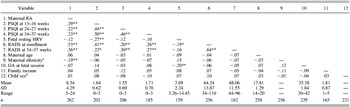
Means, standard deviations, and bivariate correlations between study variables are presented in Table 1. Associations among variables were largely as expected, such that maternal emotional abuse as a child was positively associated with maternal sleep disturbances at 13–16 (r = .29, p < .01), 24–27 (r = .22, p < .05), and 34–37 (r = .23, p < .01) week gestation. The various measures of maternal sleep disturbances were positively associated with one another (rs = .44 to .50, p < .01). The two measures of maternal depressive symptoms also were significantly associated with one another (r = .64, p < .01). Maternal sleep disturbances (rs = –.10 to –.27) and emotional abuse (r = –.12) were negatively correlated with resting fetal HRV; not all of these associations were statistically significant.
Descriptive statistics and bivariate correlations among study variables

Note: EA, Emotional abuse subscale of the Childhood Trauma Questionnaire—Short Form; PSQI, sleep disturbances subscale of the Pittsburgh Sleep Quality Index; HRV, heart rate variability; RADS, Reynolds Adolescent Depression Scale; GA, gestational age.
a 0 = Not Latina, 1 = Latina.
b 0 = Female, 1 = Male.
*p < .05. **p < .01.
Results from models testing our research questions
To test our first research question, fetal HRV was regressed on the mother's emotional abuse score. Contrary to expectation, there was no direct association between maternal abuse history and fetal HRV, though the association was in the predicted direction (β = –0.06, p = .13).
To test our second research question, the sleep disturbances latent variable was added to the previous model, as a potential mediator of the association between emotional abuse and fetal HRV. Because it is now recognized that significant mediation can be observed in the absence of significant total effects (and in accordance with the advice of quantitative experts, who recommend that investigators not require a significant total effect before proceeding with tests of mediation; Hayes, Reference Hayes2009; Mackinnon, Krull, & Lockwood, Reference MacKinnon, Krull and Lockwood2000; Mathieu & Taylor, Reference Mathieu and Taylor2006; Rucker, Preacher, Tormala, & Petty, Reference Rucker, Preacher, Tormala and Petty2011; Shrout & Bolger, Reference Shrout and Bolger2002), we proceeded to test whether there was an indirect effect of emotional abuse on fetal HRV, operating through maternal sleep disturbances.
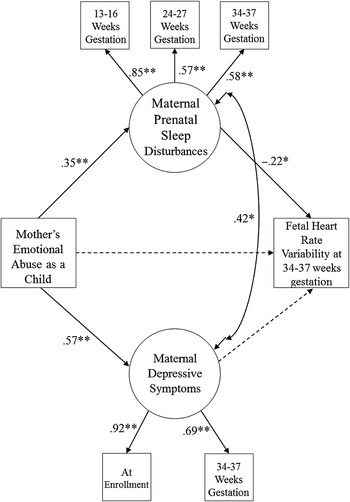
Figure 1 presents the results from this final model. As can be seen in this figure, maternal emotional abuse as a child was associated with greater sleep disturbances across pregnancy (β = 0.35, p < .01), which in turn were associated with lower resting fetal HRV (β = –0.22, p < .05). This indirect effect (from emotional abuse, through sleep disturbances, to fetal HRV) was statistically significant (β = –0.08, p < .05). As described above, this significant indirect effect (even in the absence of a significant total effect) can be interpreted as evidence of mediation (Hayes, Reference Hayes2009; Rucker et al., Reference Rucker, Preacher, Tormala and Petty2011; Shrout & Bolger, Reference Shrout and Bolger2002). Maternal emotional abuse was associated with greater maternal depressive symptoms (β = 0.57, p < .01), but maternal depressive symptoms were not associated with fetal HRV when considered in a model with maternal sleep disturbances. This model fit the data well, χ2 (8) = 10.12, p = .26, CFI = 0.99, TLI = 0.98, RMSEA = 0.03. None of the demographic control variables (i.e., maternal age, ethnicity, gestational age at the fetal assessment, family income, and fetal sex) were significantly related to fetal HRV, and thus were not retained in the final model.
Final model relating maternal childhood emotional abuse, sleep disturbances during pregnancy, and fetal heart rate variability; χ2 (8) = 10.12, p = .26, comparative fit index = 0.99, Tucker–Lewis index = 0.99, root mean square error of approximation = 0.03. *p < .05, **p < .01. All presented parameter estimates are standardized. The dashed line in this figure indicates a path that was estimated but that was not statistically significant. The indirect effect of maternal childhood emotional abuse through maternal prenatal sleep disturbances to fetal heart rate variability is statistically significant (β = –0.08, p < .05).

Discussion
Using data from a large sample of pregnant adolescents, the current study investigated whether pregnant women's experiences of prior emotional abuse were associated with their fetus' resting HRV, an index of parasympathetic regulation that is thought to underlie the many psychological and emotion regulatory difficulties identified in children of abused mothers. Contrary to expectation, this study did not find evidence of a direct association between maternal emotional abuse and variation in fetal HRV during the third trimester of pregnancy. However, there was a significant indirect effect of abuse, operating via maternal sleep disturbances across pregnancy. This effect was observed above and beyond the influence of maternal depressive symptoms, which are a common correlate of disrupted sleep and a history of childhood abuse. Although several authors have hypothesized an in utero effect of maternal abuse history, this is the first study to show maternal abuse-related differences in children's regulatory capacities prior to birth. These findings suggest that pregnant women's sleep quality, a modifiable health-related behavior, may be an important target for future research, as sleep disturbances appear to be part of how mothers' experiences with abuse impact the next generation.
Our findings add to a growing body of literature that supports the DOHaD model, extending previous research by considering an alternative influence on fetal development, maternal childhood history of emotional abuse, and by examining an underexplored mediator of this association, maternal sleep. Uniquely, this study provides evidence that maternal experiences prior to conception can have an impact on the developing child, operating through her experience-related behaviors during pregnancy. Although past research guided by the DOHaD model has shown that other aspects of maternal mental and physical health (e.g., psychological distress and nutrition) are related to fetal and child development, this is the first study to our knowledge to relate either abuse history or maternal sleep with fetal neurobehavioral development. In identifying sleep as a mediator of the association between maternal childhood emotional abuse and lower fetal HRV, we provide additional support for the DOHaD model, though these data do not give insight into the specific biological mechanisms through which sleep may alter the in utero environment and, thereby, impact the developing child. This is an important limitation of the current study. Elevated levels of maternal glucocorticoid production may play a role in this association. Past research examining the impact of abuse on child and adolescent hypothalamus–pituitary–adrenal axis functioning has found that cortisol is dysregulated in the context of past abuse (Cicchetti, Rogosch, Gunnar, & Toth, Reference Cicchetti, Rogosch, Gunnar and Toth2010; Gunnar & Vazquez, Reference Gunnar and Vazquez2001; Yehuda & Bierer, Reference Yehuda and Bierer2007) and that this dyregulation often persists into adulthood (Heim, Newport, Bonsall, Miller, & Nemeroff, Reference Heim, Newport, Bonsall, Miller and Nemeroff2003; Stein, Yehuda, Koverola, & Hanna, Reference Stein, Yehuda, Koverola and Hanna1997). Although glucocorticoids play a vital role in supporting healthy fetal development (Harris & Seckl, Reference Harris and Seckl2011; Liggins, Reference Liggins1994), elevated maternal cortisol levels have been associated with alterations in fetal (e.g., changes in fetal HRV trajectories; Doyle et al., Reference Doyle, Werner, Feng, Lee, Altemus, Isler and Monk2015) and infant (e.g., more difficult temperament; O'Connor, Bergman, Sarkar, & Glover, Reference O'Connor, Bergman, Sarkar and Glover2013; Werner et al., Reference Werner, Zhao, Evans, Kinsella, Kurzius, Altincatal and Monk2013) development, as well as epigenetic changes in the placenta (Monk, Spicer, & Champagne, 2013; Monk et al., Reference Monk, Feng, Lee, Krupska, Champagne and Tycko2016). Maternal systemic inflammation secondary to sleep problems also may account for the association between maternal sleep disturbances and lower fetal HRV. Sleep disruptions during pregnancy have been associated with elevated levels of circulating cytokines (Okun & Coussons-Read, Reference Okun and Coussons-Read2007; Okun et al., Reference Okun, Roberts, Marsland and Hall2009); in a separate body of literature, maternal inflammation during pregnancy has been shown to shape fetal brain development (Ponzio, Servatius, Beck, Marzouk, & Kreider, Reference Ponzio, Servatius, Beck, Marzouk and Kreider2007; Smith, Li, Garbett, Mirnics, & Patterson, Reference Smith, Li, Garbett, Mirnics and Patterson2007). Furthermore, systemic inflammation has been posited to be a causal mechanism in preterm birth (Wadhwa, Culhane, Rauh, & Barve, Reference Wadhwa, Culhane, Rauh and Barve2001; Wadhwa, Entringer, Buss, & Lu, Reference Wadhwa, Entringer, Buss and Lu2011). Though these are plausible explanations for the associations observed in the current study, more attention needs to be paid to maternal sleep, its biological correlates during pregnancy, and fetal development.
This study is the first to our knowledge to identify maternal nighttime functioning as a mediator in DOHaD models. Previous studies examining the mechanisms through which maternal experiences shape fetal development have largely utilized indices of daytime functioning (e.g., diurnal or daytime cortisol; Kivlighan, DiPietro, Costigan, & Laudenslager, Reference Kivlighan, DiPietro, Costigan and Laudenslager2008; Monk et al., Reference Monk, Fifer, Myers, Bagiella, Duong, Chen and Altincatal2011) or those collapsed over day and night (e.g., blood pressure; Spicer et al., Reference Spicer, Werner, Zhao, Choi, Lopez-Pintado, Feng and Monk2013), possibly obscuring unique nighttime effects that are apparent in these data. Given that past research has shown that nighttime-specific biological functioning (e.g., the presence or absence of a nighttime drop in blood pressure; O'Brien et al., Reference O'Brien, Coats, Owens, Petrie, Padfield, Littler and Mee2000) has unique and important implications for adult health, it seems that further investigation of nighttime mediators like sleep could give specific insight into the ways through which pregnant women's experiences are transmitted to the developing child.
Strengths of this study include consideration of a number of covariates identified by previous research, including demographic (e.g., maternal age) and psychological factors (e.g., maternal depressive symptoms). That our findings remained even after controlling for these confounding variables strengthens our confidence in this study's conclusion that maternal childhood emotional abuse is associated with fetal resting HRV in part via maternal prenatal sleep, independent of other factors such as maternal depression. The fact that this association persisted even after controlling for maternal depressive symptoms has implications for future research aimed at identifying the biological mechanisms through which sleep impacts fetal development. Specifically, these findings suggest that sleep disturbances exert an effect on fetal HRV via mechanism that are unrelated to associations between depression and fetal development, which may help narrow the field of possible mechanisms for future research.
These findings have a number of implications for intervention, including the following. That differences in regulatory capacities are observable in utero suggests that intervening after the child is born may miss aspects of the intergenerational transmission of trauma that already occur prior to birth and potentially contribute to the psychological and emotional regulatory difficulties for which children of abused mothers are at heightened risk. Given that lower resting fetal HRV has been associated with more difficult infant temperament (DiPietro et al., Reference DiPietro, Ghera and Costigan2008), this study's findings also suggest that children of abused mothers may enter the world more physiologically reactive and more difficult to soothe. Preventive programs that focus on teaching mothers behavioral techniques that can help to settle and soothe reactive infants (e.g., Werner et al., Reference Werner, Gustafsson, Lee, Feng, Jiang, Desai and Monk2016) may be particularly high yield when implemented in this population. Child HRV continues to undergo development throughout childhood (and has been shown to be influenced by contextual factors, including parenting behaviors; e.g., Perry et al., Reference Perry, Mackler, Calkins and Keane2014), suggesting that interventions of this nature may help children compensate for lower fetal HRV.
Despite its strengths, this study has some limitations. For example, participants self-reported their abuse history and their sleep disturbances, and thus there may be a common reporter bias. Although both of these widely used measures have been shown to have good reliability and validity, future research should examine whether these associations vary when utilizing more objective measures of sleep and abuse (e.g., data obtained via actigraphy, momentary ambulatory measures of sleep, or a laboratory-based sleep study and independent reports of abuse). An additional limitation of the current study is that the measure of childhood emotional abuse did not provide very detailed information about the timing or chronicity of the abuse. Given that these mothers are still quite young (i.e., 14–19 years at enrollment), it is possible that the reported emotional abuse did not occur very long ago (or potentially is still ongoing); the current study was unfortunately unable to examine whether variables of this nature moderate the associations reported in the current manuscript. Future research should collect more detailed information about women's abuse histories and should examine whether these and other characteristics of the abuse moderate any of the associations described here. The current study focused on emotional abuse because it has been argued to be the most pernicious form of childhood maltreatment (Berzenski et al., Reference Berzenski, Yates, Egeland, Korbin and Krugman2014; Spertus et al., Reference Spertus, Yehuda, Wong, Halligan and Seremetis2003; Teicher et al., Reference Teicher, Samson, Polcari and McGreenery2006); however, the CTQ-SF also assesses other types of abuse that the current study did not consider in its primary analyses. In post hoc sensitivity analyses, we reran all models using the total abuse score of the CTQ-SF, and found similar results. This effect, however, seems to be driven by participants' reports of emotional abuse, as the other subscales were not related to maternal sleep disturbances when considered in models together or by themselves. As one of the most common forms of childhood abuse (Spertus et al., Reference Spertus, Yehuda, Wong, Halligan and Seremetis2003), these results suggest that emotional abuse found in nonclinical, community samples such as ours may have consequences across generations. Although one of the strengths of the current study is that it identifies a mediator of the association between emotional abuse and fetal heart rate variability (i.e., sleep), there are many other potential mediators of this association, including maternal nutrition and obesity, and stress. Future research should consider the role that these variables may play in explaining or modifying the association between abuse history and fetal development. In a similar vein, emotional abuse is only one of many potential contributors to sleep disturbance; additional research, focusing on other influences on sleep quality is needed. Finally, the results of this study can only be generalized to a specific population, that is, adolescent mothers residing in a similar urban area to New York City. This population was ideally suited for the current study (given that they are at heightened risk for childhood abuse history); however, these findings may not extend to other populations, such as adult women, whose pregnancy and childhood abuse experiences may be separated by a larger number of years. Future research should examine the extent to which these associations replicate when using data from adult women with or without childhood abuse histories.
The current study adds an in utero time point to the growing body of literature demonstrating that women's adverse childhood experiences can exert effects on the next generation. Utilizing novel data collected from pregnant teenagers and their fetuses, this study is the first to provide evidence that at least part of the legacy of childhood abuse is passed down to the next generation prior to birth. These results point to a modifiable mechanism, maternal sleep quality, through which maternal abuse history impacts fetal parasympathetic nervous system functioning, and suggests that improving maternal sleep in those with abuse histories may help the pregnant woman, as well as, potentially, protect the neurobehavioral development of the next generation.