Introduction
Over the last 30 years, otolaryngologists have reported an increasing number of patients suffering from nonspecific laryngeal and respiratory disorders attributed to laryngopharyngeal reflux (LPR).Reference Altman, Stephens, Lyttle and Weiss1 An estimated 4 to 10 per cent of ENT patient consultations are prompted by LPR-related symptoms. Therefore, in-depth knowledge of diagnostic methods and treatment options for LPR is becoming more important.Reference Koufman, Weiner, Wallace and Castell2
In order to establish the diagnosis of LPR, validated patient symptom scores, laryngoscopy, oesophagoscopy, empirical trials of proton pump inhibitors and ambulatory 24-hour dual probe pH-monitoring have all been utilised.Reference Reichel, Hagedorn and Berghaus3
The most commonly used test for diagnosis of LPR is 24-hour pH monitoring, which is frequently taken to be the gold standard.Reference Reichel, Hagedorn and Berghaus3, Reference Karkos and Wilson4 From pH testing, the reflux area index can be determined; this is currently the most useful parameter for measuring LPR severity.Reference Vincent, Garrett, Radionoff, Reussner and Stasney5 First described by Vandenplas et al. in 1989, this parameter is derived from the number and duration of proximal reflux events, plus the degree to which these episodes drop below pH 4. This parameter is known as the reflux area index four.
However, pepsin, one of the aggressive components of refluxed gastric content, is able to cause mucosal injury in the laryngeal and pharyngeal areas at pH levels above five.Reference Piper and Fenton6–Reference Knight, Lively, Johnston, Dettmar and Koufman9 Thus, an additional threshold of at least pH<5 (generating a reflux area index five parameter) would be needed for exact analysis of pH in patients with suspected LPR.
At present, no normative values exist for the reflux area index five parameter. Therefore, the first aim of the present study was to attempt to define such values by examining 29 healthy volunteers. Furthermore, we wanted to assess the impact of different thresholds (pH<4 and pH<5) on analysis of 24-hour dual probe pH monitoring in patients with suspected LPR. Therefore, the number of patients with LPR diagnosed by a reflux area index four >6.3 and by a reflux area index five >72.6 was compared in 45 study patients.
Materials, methods and statistical analysis
The study was performed in accordance with the Declaration of Helsinki, good clinical practice and applicable regulatory requirements. Informed, written consent was obtained from all participants before initiation of any procedure.
In order to determine normal values for reflux area index five, 29 subjects (19 men, 10 women, mean age 58 years) without any history of gastroesophageal reflux disease or LPR, voluntarily underwent standard, ambulatory, 24-hour double probe pH monitoring, between January 2004 and November 2004. In all 29 patients, the reflux symptom index (a self-administered, nine-item instrument assessing outcomes for LPR) was determined before pH testing.Reference Belafsky, Postma and Koufman10 After flexible or rigid laryngoscopy, performed by the same otolaryngologist, the reflux finding score was recorded.Reference Belafsky, Postma and Koufman11 None of the subjects had received medication for reflux, including proton pump inhibitors, for at least three months prior to the study. All pH studies were performed at the Department of Otorhinolaryngology, Head and Neck Surgery of Ludwig Maximilians University Munich. All 29 pH probes were sited under flexible laryngoscopic guidance (Smit technique) by the same otolaryngologist, who was very experienced in this procedure.Reference Smit, Tan, Devriese, Mathus-Vliegen, Brandsen and Schouwenberg12
For data recording, we used the pH-Response-Reflux diagnostic system (Medtronic XOMED, Jacksonville, Florida, USA). The pH-measuring device consisted of a proximal (pharyngeal) and a distal probe, with a fixed distance of approximately 15 cm between the probes. The proximal probe was positioned immediately above the upper oesophageal sphincter, using transnasal placement with the aid of a local and decongestant anaesthetic spray.
Subjects kept a diary recording times and durations of meals, and body position (supine or upright). In order to rule out artefacts, subjects were instructed to avoid acidic food or drink. Furthermore, all meal intervals, plus the first two minutes of the immediate postprandial period, were eliminated from analysis. Upper probe events with pH<4 were only accepted as proximal reflux episodes when an association with a lower probe event could be clearly identified.
In order to evaluate the severity of distal reflux episodes in the 29 patients, the DeMeester score, a widely used classification system for gastroesophageal reflux disease, was determined.Reference Johnson and DeMeester13 This system scored each subject according to six different fields relating to reflux (i.e. number of episodes >5 minutes, duration, total time of reflux, duration of longest episode and total number of episodes). Due to the fact that the distal probe was not placed under manometric control, its position was too proximal to allow accurate DeMeester scoring.
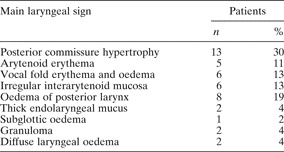
Subjects with the following were considered healthy: a reflux symptom index <13; a reflux finding score of less than seven; and no signs suspicious of LPR on flexible or rigid laryngoscopy (i.e. arytenoid erythema, vocal fold erythema and oedema, posterior commissure hypertrophy, irregular interarytenoid mucosa, oedema of the posterior larynx, and arytenoid oedema) (Table I).Reference Book, Rhee, Toohill and Smith14, Reference Milstein, Charbel, Hicks, Abelson, Richter and Vaezi15 Furthermore, a DeMeester score <14.72 (95th percentile) and a reflux area index four <6.3 for the total pH study duration were considered normal.
Laryngeal findings for 45 study patients with suspected laryngopharyngeal reflux

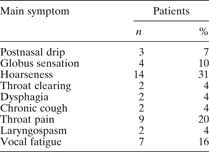
Forty-five patients (20 women, 25 men, mean age 57 years) with nonspecific laryngeal or respiratory complaints (Table II) and laryngeal findings suspicious for LPR (Table I) underwent 24-hour dual probe pH monitoring to rule out LPR, between January 2004 and January 2006. Again, all examinations and pH studies were performed by the same otolaryngologist, with an identical technique (described above), at the Department of Otorhinolaryngology, Head and Neck Surgery, Ludwig Maximilians University Munich. In order to compare the reflux area index values for different thresholds, the results of all 45 pH studies were analysed for pH thresholds of less than four and less than five. Based on the findings of our initial study with 29 healthy subjects, we assessed the number of patients in this study group with a normal reflux area index four and an elevated reflux area index five, indicating proximal reflux with potential peptic activity.
symptoms of 45 study patients with suspected laryngopharyngeal reflux

We used the Statistical Package for the Social Sciences PC+ version 12.0 (SPSS Inc, Chicago, Illinois, USA) for all statistical calculations.
Results
Ten of the 29 subjects were excluded from the initial study due to a reflux area index four >6.3, indicating LPR (four patients) or a DeMeester score >14.72 (95th percentile, three patients), indicating suspicion of asymptomatic gastroesophageal reflux disease. Three subjects showed a combination of both conditions. None of the 29 subjects had a reflux symptom index >13 or a reflux finding score greater than seven.
In total, the results of 19 healthy subjects (seven women, 12 men, mean age 59 years) were available for the assessment of a normative reflux area index five. These 19 subjects had a mean number of 4.6 proximal reflux events (threshold pH<4, range 0–19, 95th percentile 10.9) and a mean reflux area index four of 1.5 (range 0–4.3, 95th percentile 4.5). Their DeMeester score mean value was 6.8 (95th percentile 13.5, range 0.6–13.8). The mean reflux area index five was 20.3 (range 0.2–109.2, 95th percentile 72.6).
In 29 of the 45 patients with suspected LPR, 24-hour pH monitoring revealed a reflux area index four >6.3. The mean reflux area index value in this subgroup was 167.7 (range 7.9–1865.1). With a pH threshold of less than five, the reflux area index value was >72.6 (95th percentile) in 31 patients. Six patients had a reflux area index four <6.3 and a reflux area index five >72.6 (95th percentile). In four patients, pH monitoring revealed a reflux area index five <72.6 (95th percentile) but a reflux area index four >6.3. Comparing the diagnoses based on monitoring with the two different pH thresholds (less than four and less than five), 35 of 45 patients had identical results. In 10 patients, however, the diagnosis depended on the pH threshold used.
Discussion
In 2000, Vincent et al. introduced the reflux area index, presenting it as the most useful parameter for measurement of LPR severity.Reference Vincent, Garrett, Radionoff, Reussner and Stasney5 He was well aware that the available, standard parameters and composite scoring systems used to quantify distal oesophageal reflux may not be applicable at the level of the upper oesophageal sphincter. Nevertheless, a threshold of pH<4, frequently postulated to indicate gastroesophageal reflux disease, is also the main indicator of proximal reflux episodes.Reference Johnson and DeMeester13, Reference Tuttle and Ruffin16
As the laryngeal mucosa is more sensitive to acidic reflux than the oesophageal epithelium, a pH threshold of <4 may not be adequate for the pH analysis of patients with suspected LPR.Reference DelGaudio17, Reference Issing, Karkos, Perreas, Folwaczny and Reichel18 Pepsin, one of the aggressive components of gastric refluxate, shows damaging activity at pH levels as high as seven. Therefore, an additional threshold of pH<5 seems reasonable for the determination of reflux area index in pH monitoring.Reference Piper and Fenton6–Reference Knight, Lively, Johnston, Dettmar and Koufman9, Reference DelGaudio17–Reference Tasker, Dettmar, Panetti, Koufman, Birchall and Pearson19
Some authors even estimate pepsin to be the main injurious agent in reflux-related laryngitis.Reference Adhami, Goldblum, Richter and Vaezi20 One reason for this could be a break in the barrier function of the laryngeal epithelium, via an alteration in the intercellular junctional complex, caused by acidified pepsin.Reference Gill, Johnston, Buda, Pignatelli, Pearson and Dettmar21 Johnston et al. described down-regulation of E-cadherin, an important molecule for adequate cellular adhesion, in patients with LPR.Reference Johnston, Bulmer, Gill, Panetti, Ross and Pearson22
Another negative effect of exposure of the laryngeal mucosa to pepsin is irreversible depletion of metalloenzymes such as carbonic anhydrase III, one of 11 catalytically active isoforms of carbonic anhydrase. This effect predisposes laryngeal epithelium to reflux-related inflammatory damage.Reference Johnston, Bulmer, Gill, Panetti, Ross and Pearson22, Reference Johnston, Dettmar, Lively, Postma, Belafsky and Birchall23 Carbonic anhydrase III, a potential intrinsic defence mechanism of the laryngeal epithelium against LPR, catalyses the reversible hydration of carbon dioxide. In this chemical reaction, bicarbonate ions are produced in the epithelial cells. When actively pumped into the extracellular space via anion exchange, these bicarbonate ions are able to neutralise hydrogen ions. It has been suggested previously that pepsin can cause a decrease of the buffering capacity of carbonic anhydrase III.Reference Gill, Johnston, Buda, Pignatelli, Pearson and Dettmar21 Remarkably, pepsin at pH 4 or pH 2 has an irreversible effect on carbonic anhydrase III expression in the laryngeal epithelium, but not in the oesophageal epithelium.Reference Johnston, Bulmer, Gill, Panetti, Ross and Pearson22
Recently, Johnston et al. reported on changes in the normal acid-mediated stress protein response of laryngeal epithelium, caused by pepsin.Reference Johnston, Dettmar, Lively, Postma, Belafsky and Birchall23 Stress proteins such as squamous epithelial proteins 70 and 53 and heat shock protein 70 play an important role in cellular defence pathways. By participating in the repair or removal of damaged polypeptides and protecting cellular proteins from damage, these proteins have a major impact on cell function. Pepsin, however, seems to diminish intracellular levels of stress proteins in laryngeal epithelium.Reference Johnston, Dettmar, Lively, Postma, Belafsky and Birchall23
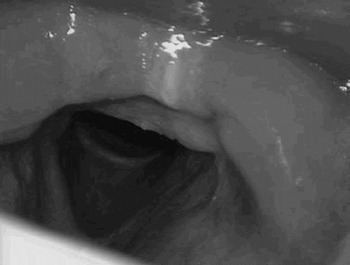
Considering all those findings, pepsin may play a major role in the pathogenesis of LPR. As a consequence, pH studies should use an additional threshold of pH<5 in order to consider the proteolytic activity of pepsin above pH<4. In our study, six of the 45 study patients could only be diagnosed as suffering severe proximal reflux by determining the reflux area index with an additional threshold of pH<5 (Figure 1). Nevertheless, the reflux area index with a threshold of pH<4 must also be determined; in four of our 45 study patients, LPR could not have been diagnosed if a threshold of pH<5 had been the only theshold used for pH analysis.
Larynx of a 48-year-old male patient (non-smoker), showing massive hypertrophy of the posterior commissure. The initial reflux area index four was 3.3; however, the reflux area index five was 499.1, indicating severe laryngopharyngeal reflux. (The left vocal fold had been resected two years previously due to carcinoma.)

Some clinicians doubt the usefulness of initial pH monitoring in patients with suspected LPR.Reference Belafsky, Vaezi and DeVault24 With a poor sensitivity (40–80 per cent for hypopharyngeal probes) for detecting proximal acid reflux, 24-hour dual probe pH monitoring is far from being an ideal test.Reference Belafsky, Vaezi and DeVault24 One reason for the poor sensitivity of this diagnostic procedure might be the fact that, currently, the reflux area index four is assumed to be the most useful parameter for measuring LPR severity. However, we identified another 13 per cent of patients as suffering from severe proximal reflux, by using an additional threshold of pH<5 for the analysis of pH studies. This addition might significantly improve the sensitivity of pH monitoring. Future trials with a larger study population are necessary to confirm our findings and to determine normal values for the reflux area index five parameter; the 19 healthy subjects examined in this study may not be sufficient to create a representative normative data base. However, Vincent et al. analysed the results of pH monitoring in not more than 23 healthy subjects, in order to define the degree of physiological laryngopharyngeal reflux reflected by a reflux area index four <6.3.Reference Vincent, Garrett, Radionoff, Reussner and Stasney5
• Currently, a threshold of pH<4 is generally used to assess proximal reflux episodes by pH study in patients with suspected gastroesophageal reflux. Pepsin, however, is able to damage the laryngeal mucosa at pH levels greater than four
• This study compared the results of pH monitoring in patients with suspected reflux, using thresholds of pH<4 and pH<5. When an additional threshold of pH<5 was used for analysis of pH monitoring, a higher number of patients with measurable reflux could be identified
• The authors recommend using both pH thresholds (i.e. pH<4 and <5) for analysis of pH monitoring, in order to identify all patients with suspected gastroesophageal reflux
We consider our study to have two main strengths. The first may be the elimination of variability in pH probe placement and analysis, as only one, experienced otolaryngologist performed all pH studies and interpreted all results. This would guarantee a constant quality of pH monitoring, as positioning of pH probes is supposed to be especially highly operator-dependent and variable.Reference Belafsky, Vaezi and DeVault24
The second strength is the fact that the mean age (59 years) of our 19 healthy subjects was above 45 years, and was quite similar to the mean age of the analysed consecutive study group (57 years). Vincent et al. examined a study population with a mean age of 28 years in order to establish normative data for the upper probe and for the reflux area index four parameter. However, our study reports findings for LPR patients with a higher mean age (>45 years). Our experience is confirmed by data from numerous published LPR trials analysing study populations with a mean age of >45 years. In a recently published randomised and placebo-controlled study, Vaezi et al. evaluated the efficacy of proton pump inhibitor therapy in 145 patients with suspected LPR; the mean age of both study groups was above 50 years (51.5 and 50.5 years).Reference Vaezi, Richter, Stasney, Spiegel, Iannuzzi and Crawley25 Belafsky et al. studied 40 patients with documented LPR and a mean age of 50 years in order to assess the validity and reliability of the reflux finding score.Reference Belafsky, Postma and Koufman11 Amin et al. performed a retrospective review in order to assess proton pump inhibitor resistance in LPR patients.Reference Amin, Postma, Johnson, Digges and Koufman26 In this study, the mean age of 167 patients with suspected LPR (undergoing pH monitoring to evaluate drug efficacy) was 49.33 years.Reference Amin, Postma, Johnson, Digges and Koufman26 In our opinion, the function of all physiological barriers protecting the upper aerodigestive tract from reflux injury (i.e. the lower oesophageal sphincter, oesophageal motor function with acid clearance, oesophageal mucosal tissue resistance and upper oesophageal sphincter) is influenced by age. Future trials attempting to create a normative data base for the reflux area index five should take this into account by including healthy volunteers aged greater than 45 years.
Conclusions
Pepsin plays a major role in predisposing laryngeal mucosa to reflux-related inflammatory damage. Refluxed pepsin is able to cause laryngeal injury at pH levels above five. Therefore, determining the reflux area index four parameter, by pH monitoring, is not sufficient to detect all patients with LPR. An additional threshold of pH<5 should be used for the analysis of 24-hour dual probe pH monitoring. Future trials with a larger number of healthy patients aged greater than 45 years are necessary in order to identify normative values for an additional reflux area index five parameter.