Introduction
Acquired brain injury (ABI) refers to any damage to the brain that occurs after birth (Greenwald, Burnett, & Miller, Reference Greenwald, Burnett and Miller2003) and is the leading cause of death and disability in children after infancy (Forsyth & Kirkham, Reference Forsyth and Kirkham2012). Common causes of ABI in children include traffic accidents, inflicted injuries, falls, infection and stroke (Forsyth & Kirkham, Reference Forsyth and Kirkham2012). Following discharge from hospital, the process of recovery from brain injury and return to everyday life can be long and extremely challenging for children with moderate to severe brain injury and their families. Each child and their family situation is different. However, they share in common the stresses and demands of the long-term consequences of brain injury that impact on every aspect of their life (Limond, Dorris, & McMillan, Reference Limond, Dorris and McMillan2009; van Tol, Gorter, Dematteo, & Meester-Delver, Reference van Tol, Gorter, Dematteo and Meester-Delver2011).
Transition to home is a major adjustment to family life and places demands on parents in fulfilling the role of carers. Most parents experience higher levels of stress during this initial period and do not know where to access social support (Youngblut & Brooten, Reference Youngblut and Brooten2006). In addition, parents often feel abandoned by health care services and do not know who to ask about their concerns of ‘what can my child do?’ (Kirk, Fallon, Fraser, Robinson, & Vassallo, Reference Kirk, Fallon, Fraser, Robinson and Vassallo2015). Parents view continuity of care as important but it is also an area that is currently lacking (Woodward, Abelson, Tedford, & Hutchison, Reference Woodward, Abelson, Tedford and Hutchison2004). The healthcare system is complex and parents often feel overwhelmed by how to access suitable services to meet their child's needs (Gan, Gargaro, Brandys, Gerber, & Boschen, Reference Gan, Gargaro, Brandys, Gerber and Boschen2010). Transition to school and community is the next major step for children and adolescents and their parents. The process of returning to school is often a confusing one for both parents and teachers for differing reasons. Parents report challenges with how to initiate the process and a lack of clarity concerning whose role this is (Gan et al., Reference Gan, Gargaro, Brandys, Gerber and Boschen2010). Teachers are keen to support their students’ needs but frequently do not know how to provide this support. These problems relate to the lack of communication of medical, cognitive and emotional needs with the school (Hawley, Ward, Magnay & Mychalkiw, Reference Hawley, Ward, Magnay and Mychalkiw2004; Mealings, Douglas, & Oliver, Reference Mealings, Douglas and Oliver2012) and poor understanding of childhood brain injury by teachers (Linden, Braiden, & Miller, Reference Linden, Braiden and Miller2013). Engaging in community activities has received little research attention but is an important area of life, not to be overlooked (Agnihotri, Keightley, Colantonio, Cameron, & Polatajko, Reference Agnihotri, Keightley, Colantonio, Cameron and Polatajko2010).
Underpinning every transition is the involvement and integration of the supports of many other professionals from both the health system (e.g., rehabilitation team) and education system (e.g., principals and teachers) in supporting the children and adolescents and their parents. Community-based case management plays a vital role in the coordination of these services in ensuring a smooth transition across the domains of everyday life and in addressing the range of needs in an effective and timely manner. These issues are highlighted in the following definition of community-based case management by Lukersmith, Fernandez, Millington, and Salvador-Carulla (Reference Lukersmith, Fernandez, Millington and Salvador-Carulla2015):
Community-based case management is a multidimensional and collaborative process. It involves a set of interventions for assessment, planning, coordinating and review of the options and services required to meet the client's health-related needs, and support them to reach their goals related to participation in life roles (p. 2 Glossary Appendix 3).
Two systematic reviews have examined the effectiveness of case management for adults with traumatic brain injury (TBI) (18 years and over) (Lannin et al., Reference Lannin, Laver, Henry, Turnbull, Elder, Campisi, Schmidt and Schneider2014; Patterson et al., Reference Patterson, Maynard, Chesnut, Carney, Mann and Helfand1999), but none has focused on children with ABI. Several systematic reviews address related areas impacting on children with ABI and their parents such as family functioning (Rashid et al., Reference Rashid, Goez, Mabood, Damanhoury, Yager, Joyce and Newton2014), return to school (Lindsay et al., Reference Lindsay, Hartman, Reed, Gan, Thomson and Solomon2015) and community integration (Agnihotri et al., Reference Agnihotri, Keightley, Colantonio, Cameron and Polatajko2010). Underpinning each of these areas is the need for case coordination or a key worker to support the family with transition to everyday life. A case manager or health professional who assumes a case management role is often part of a team, typically the rehabilitation team. Identifying the impact of interventions from each team member and contextual factors is complex. Typically, it is not possible to separate whether it was case management, therapy involvement or both that made the difference (Brombley, Reference Brombley2008).
The frameworks to support the analysis in this scoping review were the International Classification of Health Interventions (ICHI) (World Health Organisation Family Development Committee (WHO-FIC) 2013) and the Brain Injury Case Management Taxonomy (BICM-T), hereafter referred to as the case management taxonomy (Lukersmith et al., Reference Lukersmith, Fernandez, Millington and Salvador-Carulla2015). ICHI is an international classification system under development by an international collaboration of experts through the WHO-FIC. The development commenced in 2007 and is to be finalised in 2017. We used the latest version available at the time of the review, the Alpha 2013 version. The Alpha version was appraised, trialled and tested but continues to be reviewed. According to the ICHI, ‘A health intervention is an activity performed for, with or on behalf of a person or a population whose purpose is to improve, assess or modify health, functioning or health conditions’ (WHO-FIC, 2013, p. 6). Where there is only an ‘action’ but no specified ‘means’ it is considered an ‘activity’. The ‘means’ could be an approach, technique or method. It is important to note that the ICHI does not specify the provider of the intervention (e.g., case manager or other health professionals) and is neutral to the health condition.
The case management taxonomy is a type of classification which provides two taxonomy trees (service and interventions), tables and glossary. The taxonomy identifies the interventions (actions of the case managers), the relationship between these interventions, classification of the factors that influence the service context (mobility and intensity), and definitions. It was developed over a period of 2 years, and has since been disseminated nationally and internationally. Whilst in the development, brain injury was considered as an example of a complex health condition, the taxonomy is potentially relevant to any health condition. The impact analysis of dissemination by the developers of the taxonomy (Lukersmith et al., Reference Lukersmith, Fernandez, Millington and Salvador-Carulla2015) commenced in January 2016 and continues. Since its publication in late 2015, emerging uses of the taxonomy include aspects of the taxonomy interventions adopted in the most recent revision of ICHI (WHO-FIC, 2016); the taxonomy adopted in government policy, as a common language and framework for understanding different case management roles (Lifetime Care & Support Authority, 2016); as a common language by case managers in their work (reports and request for service approval to funders and also cited in published research on coordination (Madden, Fortune, Collings, Mockham, & Blackwood, Reference Madden, Fortune, Collings, Mockham and Blackwood2014).
This scoping review seeks to address the gaps in the literature on case management for children and adolescents with brain injury. The aim of the scoping review was to identify, analyse and critically review recent research literature (2005–2015) on the providers, approach, nature of service and intervention of community-based case management addressing the needs of children and adolescents with brain injury and their families.
Methods
Scoping Methodology
This scoping review used five of the six steps outlined by Levac, Colquhoun and O'Brien (Reference Levac, Colquhoun and O'Brien2010), similar to a recent scoping review on community-based case management for complex health conditions including brain injury, diabetes, mental health and spinal cord injury (Lukersmith, Millington, & Salvador-Carulla, Reference Lukersmith, Milliington and Salvador-Carulla2016). These steps consist of (1) identifying the research question, (2) identifying the research studies, (3) study selection, (4) charting the data, and (5) collating summarising, and reporting of results.
Search Strategy
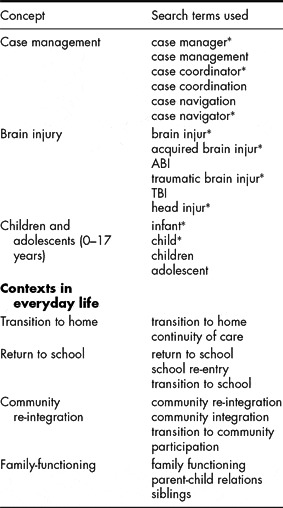
A comprehensive search of peer-reviewed published literature from four major databases including CINAHL, PUBMed, Embase, MEDLINE was conducted. The search consisted of subject headings and MeSH terms related to ‘brain injury’, ‘children’, ‘case management’, ‘coordination’, ‘transition-to-home’, ‘continuity of care’, ‘return-to-school’, ‘participation’, ‘family-functioning’ and ‘community re-integration’. Full search terms are available from the corresponding author on request and are summarised in Table 1. Limits set included English language and publication date between January 2005 and September 2015.
Key Concepts and Search Terms used

A trial search was completed combining ‘case management’, ‘brain injury’ and ‘children and adolescents’ using ‘AND’ function. Due to the small number of articles that were found in this initial search, the search was broadened to include everyday life contexts of children with brain injury (e.g., transition to home). ‘Case management’ was excluded from these secondary searches as it provided nil or irrelevant results. Searching by alternative professions such as social worker also did not reveal any further results. Hence, profession was omitted from the main search within this review. Article citations and reference lists were also reviewed for additional papers.
Article Selection
Articles were screened by the title and abstract. The inclusion criteria were (1) published in a peer-reviewed journal between January 2005 to September 2015, (2) diagnosed with brain injury (acquired or traumatic) at any level of severity, (3) age range 0–17 years within sample, (4) involved a case manager or health professional providing case management in a community setting, (5) included coordination in the contexts of transition to home, return to school, participation or community integration, (6) articles published in English and (7) case management provided in a setting other than hospital. Articles where the full-text was not available were excluded.
Data Extraction
The software program Endnote (version X7.7.1) was used to manage the articles and Excel was used to support data extraction. The level of evidence was determined using the Oxford Centre for Evidence-based Medicine (OCEBM) – Levels of Evidence (Centre for Evidence Based Medicine, 2009). Study characteristics extracted included author, date of publication, study participants, severity of brain injury, study location, outcome measures and key findings.
Analysing the Interventions
The case management interventions (activities) described in the study were analysed using the International Classification of Heath Interventions (ICHI) (WHO-FIC, 2013) on whether the tasks performed were an activity or an intervention. Further analysis using the BICM-T (Lukersmith et al., Reference Lukersmith, Fernandez, Millington and Salvador-Carulla2015) involved the two levels of interventions categories (main actions and actions) performed by the case manager and the service context parameters. Using the taxonomy, the case management service was categorised into the following categories: acute or non-acute; low, medium or high intensity. To better understand the case management approach described in the articles, we also analysed whether it was a holistic or focused approach to case management. An intervention that aimed to meet a range of needs (e.g., ongoing health care, family issues and school issues) was classified as a holistic approach, and an intervention that targeted a specific area of need (e.g., supports with return to school) was classified as a focused approach.
Results
A summary of the study identification, screening, eligibility and inclusion is shown with the Preferred Reporting Items for Systematic Reviews and Meta-Analyses (PRISMA) diagram (Figure 1). Overall, 2688 articles were identified for potential inclusion in this review. Titles and abstracts were imported into Endnote and reviewed, removing duplicates and excluding 1547 articles that did not meet the inclusion criteria. The remaining 178 articles were read with the inclusion criteria applied by the first author and an independent reviewer. Eight articles met the inclusion criteria. There was 100% agreement between the first author and independent reviewer.
PRISMA diagram of study identification, screening, eligibility and inclusion.

Study Characteristics
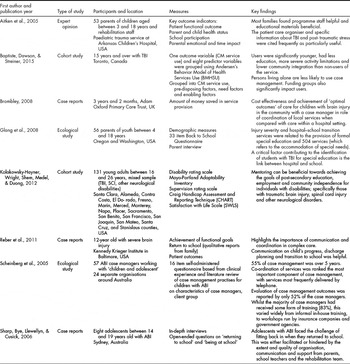
Studies included in this scoping review were published between 2005 and 2015. The highest level of literature available on the topic were cohort studies (Baptiste, Dawson, & Streiner, Reference Baptiste, Dawson and Streiner2015; Kolakowsky-Hayner, Wright, Shem, Medel, & Duong, Reference Kolakowsky-Hayner, Wright, Shem, Medel and Duong2012). Other studies were two ecological studies (Glang et al., Reference Glang, Todis, Thomas, Hood, Bedell and Cockrell2008; Scheinberg et al., Reference Scheinberg, Gibson, Hughes, Miles, Murphy and Noronha2005), three case reports (Brombley, Reference Brombley2008; Reber et al., Reference Reber, DiPietro, Paraway, Obst, Smith and Koller2011; Sharp, Bye, Llewellyn, & Cusick, Reference Sharp, Bye, Llewellyn and Cusick2006) and one expert opinion (Aitken et al., Reference Aitken, Korehbandi, Parnell, Parker, Stefans, Tompkins and Schulz2005). Details of the characteristics of each of the eight studies are outlined in Table 2.
Summary of Studies

The study participants varied from children and adolescents with TBI or ABI aged 3 to 26 years (Baptiste, Dawson, & Streiner, Reference Baptiste, Dawson and Streiner2015; Brombley, Reference Brombley2008; Kolakowsky-Hayner, Wright, Shem, Medel, & Duong, Reference Kolakowsky-Hayner, Wright, Shem, Medel and Duong2012; Reber et al., Reference Reber, DiPietro, Paraway, Obst, Smith and Koller2011; Sharp, Bye, Llewellyn, & Cusick, Reference Sharp, Bye, Llewellyn and Cusick2006), parents of children with brain injury (Glang et al., Reference Glang, Todis, Thomas, Hood, Bedell and Cockrell2008), case managers (Scheinberg et al., Reference Scheinberg, Gibson, Hughes, Miles, Murphy and Noronha2005) or a mixed participant group of families and the rehabilitation team (Aitken et al., Reference Aitken, Korehbandi, Parnell, Parker, Stefans, Tompkins and Schulz2005). In some studies, both children and young adults were included as the emphasis was on transition to adulthood. The severity of brain injury ranged from mild to severe and included both traumatic and non-traumatic injuries.
Four of the studies were from various states in the USA (Aitken et al., Reference Aitken, Korehbandi, Parnell, Parker, Stefans, Tompkins and Schulz2005; Glang et al., Reference Glang, Todis, Thomas, Hood, Bedell and Cockrell2008; Kolakowsky-Hayner et al., Reference Kolakowsky-Hayner, Wright, Shem, Medel and Duong2012; Reber et al., Reference Reber, DiPietro, Paraway, Obst, Smith and Koller2011), two from Australia (Scheinberg et al., Reference Scheinberg, Gibson, Hughes, Miles, Murphy and Noronha2005; Sharp et al., Reference Sharp, Bye, Llewellyn and Cusick2006), one from Canada (Baptiste et al., Reference Baptiste, Dawson and Streiner2015) and one from United Kingdom (Brombley, Reference Brombley2008).
The methods and outcome measures used were varied ranging from specific assessment tools such as Disability Rating Scale and Satisfaction with Life Scale (Kolakowsky-Hayner et al., Reference Kolakowsky-Hayner, Wright, Shem, Medel and Duong2012), questionnaires (e.g., Back to School Questionnaire) (Glang et al., Reference Glang, Todis, Thomas, Hood, Bedell and Cockrell2008; Scheinberg et al., Reference Scheinberg, Gibson, Hughes, Miles, Murphy and Noronha2005; Sharp et al., Reference Sharp, Bye, Llewellyn and Cusick2006), to open-ended interviews (Sharp et al., Reference Sharp, Bye, Llewellyn and Cusick2006), functional goals and outcomes (Aitken et al., Reference Aitken, Korehbandi, Parnell, Parker, Stefans, Tompkins and Schulz2005; Reber et al., Reference Reber, DiPietro, Paraway, Obst, Smith and Koller2011; Sharp et al., Reference Sharp, Bye, Llewellyn and Cusick2006) and cost-savings (Brombley, Reference Brombley2008).
Three studies explicitly reported on case management (Baptiste et al., Reference Baptiste, Dawson and Streiner2015; Brombley, Reference Brombley2008; Scheinberg et al., Reference Scheinberg, Gibson, Hughes, Miles, Murphy and Noronha2005), another three studies focused on the transition to school challenges (Aitken et al., Reference Aitken, Korehbandi, Parnell, Parker, Stefans, Tompkins and Schulz2005; Glang et al., Reference Glang, Todis, Thomas, Hood, Bedell and Cockrell2008; Reber et al., Reference Reber, DiPietro, Paraway, Obst, Smith and Koller2011; Sharp et al., Reference Sharp, Bye, Llewellyn and Cusick2006), one study addressed support for post-school education and employment (Kolakowsky-Hayner et al., Reference Kolakowsky-Hayner, Wright, Shem, Medel and Duong2012) and one study explored supports for families (Aitken et al., Reference Aitken, Korehbandi, Parnell, Parker, Stefans, Tompkins and Schulz2005).
Analysis of Case Management using the ICHI
Using the ICHI's definition, a health intervention was confirmed if the description of the action performed by the case manager also specified the ‘means’ (the technique or method of the action). When there was no ‘means’ specified then it was considered an ‘activity’. Two articles described health interventions (activities with ‘means’) provided by case managers; the ‘means’ of the interventions were a combination of telephone contact and home visits with families and attendance at team meetings with the purpose of improving health (Brombley, Reference Brombley2008) and education and family outcomes delivered by telephone (Scheinberg et al., Reference Scheinberg, Gibson, Hughes, Miles, Murphy and Noronha2005). One article had insufficient data provided to allow for categorisation as an ‘intervention’ (Baptiste et al., Reference Baptiste, Dawson and Streiner2015). Given the nature of the services provided, the action was likely an intervention but due to the absence of a specified ‘means’, it was classified as an ‘activity’ within this review.
Two studies involving case management support from other health professionals described a specific ‘means’ (Aitken et al., Reference Aitken, Korehbandi, Parnell, Parker, Stefans, Tompkins and Schulz2005; Kolakowsky-Hayner et al., Reference Kolakowsky-Hayner, Wright, Shem, Medel and Duong2012). In Aitken et al. (Reference Aitken, Korehbandi, Parnell, Parker, Stefans, Tompkins and Schulz2005), the ‘means’ were the elements of the programme called Be ALERT (Act, Listen, Educate and Respond to Trauma), which were designed to meet the parents’ needs (as the child's primary support person) after discharge from hospital by providing education on understanding TBI, self-care strategies for parents and supporting school re-integration. In Kolakowsky-Hayner et al. (Reference Kolakowsky-Hayner, Wright, Shem, Medel and Duong2012), the ‘means’ was a formalised mentoring programme between adolescents with brain injury and their mentors, with the specific aims to increase post-school education and employment opportunities. There were three studies which included other health professionals undertaking the ‘activities’ of a case manager (Glang et al., Reference Glang, Todis, Thomas, Hood, Bedell and Cockrell2008; Reber et al., Reference Reber, DiPietro, Paraway, Obst, Smith and Koller2011; Sharp et al., Reference Sharp, Bye, Llewellyn and Cusick2006). Both Reber et al. (Reference Reber, DiPietro, Paraway, Obst, Smith and Koller2011) and Sharp et al. (Reference Sharp, Bye, Llewellyn and Cusick2006) reported on the involvement of the rehabilitation team in the return-to-school process but no specific ‘means’ was described. Similarly in the study by Glang et al. (Reference Glang, Todis, Thomas, Hood, Bedell and Cockrell2008), there was insufficient data to assess greater involvement beyond provision of ‘activities’ associated with case coordination.
Analysis of Case Management Actions using the Case Management Taxonomy
Acute or Non-Acute Service (Community)
All studies selected provided case management in the context of the community setting. In four articles, case managers or health professionals were based in either community-based rehabilitation centres or community organisations (Aitken et al., Reference Aitken, Korehbandi, Parnell, Parker, Stefans, Tompkins and Schulz2005; Baptiste et al., Reference Baptiste, Dawson and Streiner2015; Brombley, Reference Brombley2008; Scheinberg et al., Reference Scheinberg, Gibson, Hughes, Miles, Murphy and Noronha2005). Two articles had health professionals providing case management support as a continuation of acute health care services with staff based in hospital settings (Reber et al., Reference Reber, DiPietro, Paraway, Obst, Smith and Koller2011; Sharp et al., Reference Sharp, Bye, Llewellyn and Cusick2006). Scheinberg et al. (Reference Scheinberg, Gibson, Hughes, Miles, Murphy and Noronha2005) provided the most concrete details of where case managers worked, with paediatric case managers based in either hospital or community settings. One article did not provide specific details (Glang et al., Reference Glang, Todis, Thomas, Hood, Bedell and Cockrell2008); hence, the context could not be determined.
Intensity and duration
Intensity of the ‘activities’ or ‘interventions’ was rarely mentioned in the articles. Rather it was inferred that the interventions were ‘low intensity’. Duration of case management involvement was not specified in seven of the eight articles reviewed. Case management support was given both in short-term (< 3 months) and longer term duration. Scheinberg et al. (Reference Scheinberg, Gibson, Hughes, Miles, Murphy and Noronha2005) reported specific details on duration of case management, which was provided for greater than 2 years in 60% of cases and over 5 years in 55% of cases. Less than 5% were provided case management for 6 months. Kolakowsky-Hayner et al. (Reference Kolakowsky-Hayner, Wright, Shem, Medel and Duong2012) stated that case management support was offered to adolescents with TBI to increase opportunities for education or employment, with intervention provided for up to 2 years. Other studies did not provide information on duration of case management involvement.
Holistic or Focused Approach
Approximately, one-third of the studies described the implementation of holistic approaches to case coordination (Aitken et al., Reference Aitken, Korehbandi, Parnell, Parker, Stefans, Tompkins and Schulz2005; Brombley, Reference Brombley2008; Scheinberg et al., Reference Scheinberg, Gibson, Hughes, Miles, Murphy and Noronha2005). In Brombley's (Reference Brombley2008) study, intervention included coordination of health services, accessing supports and providing some social support at home. Scheinberg et al.’s (Reference Scheinberg, Gibson, Hughes, Miles, Murphy and Noronha2005) survey showed that case managers provided supports across a range of needs such as family and school issues and ongoing health care. However, as this was a survey reflecting collective roles by case managers, it was difficult to ascertain whether a case manager would offer the full range of interventions to the same individual or family.
Other studies had a focused approach in providing supports for this target group (Glang et al., Reference Glang, Todis, Thomas, Hood, Bedell and Cockrell2008; Kolakowsky-Hayner et al., Reference Kolakowsky-Hayner, Wright, Shem, Medel and Duong2012; Reber et al., Reference Reber, DiPietro, Paraway, Obst, Smith and Koller2011; Sharp et al., Reference Sharp, Bye, Llewellyn and Cusick2006). Three articles focused on transition to school following brain injury (Glang et al., Reference Glang, Todis, Thomas, Hood, Bedell and Cockrell2008; Reber et al., Reference Reber, DiPietro, Paraway, Obst, Smith and Koller2011; Sharp et al., Reference Sharp, Bye, Llewellyn and Cusick2006) and one focused on increasing post-school education or employment opportunities (Kolakowsky-Hayner et al., Reference Kolakowsky-Hayner, Wright, Shem, Medel and Duong2012). In one study, no specific details were given on the approach as the focus was on factors influencing adolescents and adults with brain injury in accessing case management services (Baptiste et al., Reference Baptiste, Dawson and Streiner2015).
Mapping actions to the case management taxonomy
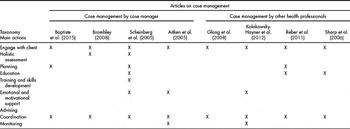
According to the case management taxonomy, there are nine main actions performed in case management (engage with client, holistic assessment, planning, education, training and skills development, emotional and motivational support, advising, coordination and monitoring) (Lukersmith et al., Reference Lukersmith, Fernandez, Millington and Salvador-Carulla2015). Mapping the description of the case management interventions in the articles to the taxonomy is summarised in Table 3.
Mapping of the Taxonomy for Brain Injury Case Management (BICM-T) to Selected Articles for Scoping Review

Key: X = indicates mentioned in article.
Engage with clients
All eight selected studies included the main action of engagement with clients (Aitken et al., Reference Aitken, Korehbandi, Parnell, Parker, Stefans, Tompkins and Schulz2005; Baptiste et al., Reference Baptiste, Dawson and Streiner2015; Brombley, Reference Brombley2008; Glang et al., Reference Glang, Todis, Thomas, Hood, Bedell and Cockrell2008; Kolakowsky-Hayner et al., Reference Kolakowsky-Hayner, Wright, Shem, Medel and Duong2012; Reber et al., Reference Reber, DiPietro, Paraway, Obst, Smith and Koller2011; Scheinberg et al., Reference Scheinberg, Gibson, Hughes, Miles, Murphy and Noronha2005; Sharp et al., Reference Sharp, Bye, Llewellyn and Cusick2006). Acceptance of the referral to their service was seldom reported but most indicated that the referral was for a specific intervention (Aitken et al., Reference Aitken, Korehbandi, Parnell, Parker, Stefans, Tompkins and Schulz2005; Brombley, Reference Brombley2008; Kolakowsky-Hayner et al., Reference Kolakowsky-Hayner, Wright, Shem, Medel and Duong2012; Reber et al., Reference Reber, DiPietro, Paraway, Obst, Smith and Koller2011; Scheinberg et al., Reference Scheinberg, Gibson, Hughes, Miles, Murphy and Noronha2005). Two mentioned the development and maintenance of partnerships, usually inferred from the positive feedback given by the families in the form of qualitative data (Brombley, Reference Brombley2008; Reber et al., Reference Reber, DiPietro, Paraway, Obst, Smith and Koller2011). However, it was sometimes difficult to determine whether feedback related to case managers or to the rehabilitation team.
Holistic Assessment
The reviewed articles contained no specific information on the assessment process by case managers or other health professionals, nor outcome measures. Brombley (Reference Brombley2008) referred to the lower costs of care as an outcome from a community-based approach compared with supports provided within the hospital setting. Kolakowsky-Hayner et al. (Reference Kolakowsky-Hayner, Wright, Shem, Medel and Duong2012) mentioned the need to use standardised assessments or outcome measures. Scheinberg et al. (Reference Scheinberg, Gibson, Hughes, Miles, Murphy and Noronha2005) highlighted the lack of validated outcome tools currently available to measure the effectiveness of case management; however, 52% of case managers in their study utilised evaluation measures.
Planning
Three studies provided some description of the planning process (Baptiste et al., Reference Baptiste, Dawson and Streiner2015; Reber et al., Reference Reber, DiPietro, Paraway, Obst, Smith and Koller2011; Scheinberg et al., Reference Scheinberg, Gibson, Hughes, Miles, Murphy and Noronha2005). Most commonly, this planning involved the case manager or health professional working closely with children and adolescents with brain injury and their families to facilitate the development of a support plan for transitioning to school and everyday life.
Education
Four studies reported on education focused on increasing the awareness of parents, teachers and peers about the impact of brain injury on everyday life. Scheinberg et al. (Reference Scheinberg, Gibson, Hughes, Miles, Murphy and Noronha2005) found case managers indicated being aware of the need for education for families. In the only study where health professionals were involved in schools, Sharp et al. (Reference Sharp, Bye, Llewellyn and Cusick2006) focused on the education provided to teachers and peers to increase their understanding of the child with brain injury and how to provide supports. In other studies, education was provided either as an information session for parents within a programme (Aitken et al., Reference Aitken, Korehbandi, Parnell, Parker, Stefans, Tompkins and Schulz2005) or as information booklets which parents can pass onto their child's school and physician (Reber et al., Reference Reber, DiPietro, Paraway, Obst, Smith and Koller2011). In the study by Aitken et al. (Reference Aitken, Korehbandi, Parnell, Parker, Stefans, Tompkins and Schulz2005), most families found programme staff helpful and educational materials beneficial.
Training and skills development
Three studies provided information on training and skills development. Kolakowsky-Hayner et al. (Reference Kolakowsky-Hayner, Wright, Shem, Medel and Duong2012) provided details on training and skills development for adolescents with brain injury in the context of increasing opportunities for post-school employment or further education. Aitken et al. (Reference Aitken, Korehbandi, Parnell, Parker, Stefans, Tompkins and Schulz2005) discussed the training provided to families, which included education on their child's medical condition and self-care strategies for parents. Training and skills development was ranked as one of the most important components of case management by paediatric case managers (Scheinberg et al., Reference Scheinberg, Gibson, Hughes, Miles, Murphy and Noronha2005).
Emotional and motivational support
Two studies specifically mentioned providing emotional and/or motivational support to parents (Aitken et al., Reference Aitken, Korehbandi, Parnell, Parker, Stefans, Tompkins and Schulz2005; Scheinberg et al., Reference Scheinberg, Gibson, Hughes, Miles, Murphy and Noronha2005). One study found that targeted motivational support was beneficial for achieving the goals of post-secondary education, employment and community independence for adolescents with TBI (Kolakowsky-Hayner et al., Reference Kolakowsky-Hayner, Wright, Shem, Medel and Duong2012).
Advising
No articles provided information on case managers advising. Although not directly stated, it was inferred that within the studies where coordination or mentoring was involved, there was likely to be some element of advice by a case manager or health professional (Aitken et al., Reference Aitken, Korehbandi, Parnell, Parker, Stefans, Tompkins and Schulz2005; Brombley, Reference Brombley2008; Scheinberg et al., Reference Scheinberg, Gibson, Hughes, Miles, Murphy and Noronha2005; Kolakowsky-Hayner et al., Reference Kolakowsky-Hayner, Wright, Shem, Medel and Duong2012).
Coordination
Coordination was the most widely mentioned action of case managers and is ranked the most important component of case management in the survey by Scheinberg et al. (Reference Scheinberg, Gibson, Hughes, Miles, Murphy and Noronha2005). Some element of coordination was included in all papers reviewed. The case management taxonomy defines the actions of coordination to include (1) navigating, (2) facilitating, (3) advocating, (4) collaborate and consult, (5) maintain feedback and (6) maintain documentation (Lukersmith et al., Reference Lukersmith, Milliington and Salvador-Carulla2016). Evidence relating to each of these six secondary categories of coordination actions is discussed below. In one study, there were insufficient descriptions to map to the taxonomy actions (Glang et al., Reference Glang, Todis, Thomas, Hood, Bedell and Cockrell2008).
Navigation: Three studies included a component of navigation (Aitken et al., Reference Aitken, Korehbandi, Parnell, Parker, Stefans, Tompkins and Schulz2005; Kolakowsky-Hayner et al., Reference Kolakowsky-Hayner, Wright, Shem, Medel and Duong2012; Scheinberg et al., Reference Scheinberg, Gibson, Hughes, Miles, Murphy and Noronha2005) with a focus on understanding and navigating the health system and available community-based resources. Facilitating: Three studies involved case managers or health professionals facilitating the return to school process or parents’ access to community supports (Aitken et al., Reference Aitken, Korehbandi, Parnell, Parker, Stefans, Tompkins and Schulz2005; Reber et al., Reference Reber, DiPietro, Paraway, Obst, Smith and Koller2011; Scheinberg et al., Reference Scheinberg, Gibson, Hughes, Miles, Murphy and Noronha2005). The Patient Care Organizer of the ALERT Program was cited frequently as particularly useful (Aitken et al., Reference Aitken, Korehbandi, Parnell, Parker, Stefans, Tompkins and Schulz2005, p. 178). Advocating: None of the studies explicitly mentioned case managers or health professionals advocating on behalf of this target group. Collaborate and consult: Four studies briefly discussed collaboration and consultation with adolescents with brain injury and their parents (Brombley, Reference Brombley2008; Kolakowsky-Hayner et al., Reference Kolakowsky-Hayner, Wright, Shem, Medel and Duong2012; Reber et al., Reference Reber, DiPietro, Paraway, Obst, Smith and Koller2011; Scheinberg et al., Reference Scheinberg, Gibson, Hughes, Miles, Murphy and Noronha2005). Often this process involved collaborative work between case manager, child and parents and other agencies involved such as school and other therapy services (Brombley, Reference Brombley2008; Reber et al., Reference Reber, DiPietro, Paraway, Obst, Smith and Koller2011). Reber et al. (Reference Reber, DiPietro, Paraway, Obst, Smith and Koller2011) emphasised the importance of communication and coordination in complex care and reported that communication on the child's progress, discharge planning and transition to school was helpful. Maintain feedback: Three studies stated that feedback was given to parents (Brombley, Reference Brombley2008; Scheinberg et al., Reference Scheinberg, Gibson, Hughes, Miles, Murphy and Noronha2005) or adolescents with brain injury (Kolakowsky-Hayner et al., Reference Kolakowsky-Hayner, Wright, Shem, Medel and Duong2012) on the progress with the intervention provided. Maintain documentation: Only Brombley (Reference Brombley2008) explicitly mentioned documentation on progress to demonstrate cost-effectiveness of the community-based approach to care. In other studies, documentation was implied through the system structures such as standards for governing health professionals and routine paperwork kept by case managers for individual cases.
Monitoring
Two studies explicitly reported on monitoring (Aitken et al., Reference Aitken, Korehbandi, Parnell, Parker, Stefans, Tompkins and Schulz2005; Kolakowsky-Hayner et al., Reference Kolakowsky-Hayner, Wright, Shem, Medel and Duong2012). Aitken et al. (Reference Aitken, Korehbandi, Parnell, Parker, Stefans, Tompkins and Schulz2005) tracked the functional outcomes of children and adolescents with TBI and the emotional impact to families. Kolakowsky-Hayner et al. (Reference Kolakowsky-Hayner, Wright, Shem, Medel and Duong2012) monitored the progress of their mentees regularly and completed follow-up assessments. There were two studies where monitoring was inferred, but not explicitly stated (Brombley, Reference Brombley2008; Scheinberg et al., Reference Scheinberg, Gibson, Hughes, Miles, Murphy and Noronha2005).
Discussion
This scoping review reveals the lack of high level evidence on the topic of community-based case management for children and adolescents with brain injury. The majority of studies were from North America with participant groups including children and adolescents with brain injury, parents and the rehabilitation team. It is hard to generalise our understanding of case management in supporting the needs of this group with different practises and contexts between countries and across both health and education systems. None of the studies investigated the experiences of children and adolescents with brain injury and their parents as a combined group of study participants. This approach may provide valuable information on the critical transitions to school and community. Considering this age group of 0–17 years, co-dependency and family functioning would be integral within everyday life for both child and parent as they adjust home, school and work life after brain injury. Furthermore, in some studies, the participant group were a mixed cohort of adolescents and adults, which made it difficult to draw conclusions about the paediatric group.
Using the ICHI and the Taxonomy in combination gives insight into the providers, approach and nature of services and case management interventions provided for children and adolescents with brain injury and their families. The ICHI is well-suited to this analysis because of its neutrality to provider which in the reviewed studies, community-based case management was provided equally by case managers and other health professionals. Based on the ICHI, most forms of case management provided, whether by case managers or health professionals, were classified as ‘activities’ and not ‘health interventions’. This was related to lack of reporting of the ‘means’ in the literature rather than a lack of an approach in practise.
The results from the analysis of actions using the case management taxonomy shows that case management is primarily provided by case managers based in the non-acute/community setting with a focused approach and for a duration of 2–5 years of intervention. However, there is a large variability in the approaches (e.g., outreach from hospital, phone contact, one-to-one support or meetings), intensity and duration. The most frequent context was case management to support the return to school. Transition to home and post-school options (e.g., employment, further education) is also acknowledged in a few studies. Of the nine actions from the taxonomy, the most common action completed was case coordination and the least common action was advising. Due to lack of reporting and a common language to describe case management in the literature, caution is needed for interpretation of the results and drawing of conclusions. For example, for the actions of advising and holistic assessment, the literature is not explicit although this action possibly did occur within the intervention provided. This is further complicated by the wide variability in the terminology and understanding of ‘case management’ and ‘case coordination’, what the actions of case management are, how they are defined and reported on within studies. The scoping review identified that there is limited assessment of the child and family circumstances performed by case managers and therefore few outcome measures reported. Understanding the actions performed by the case manager, and the measurement of outcomes is critical to the determining the effectiveness of case management. There is a strong need for a common language and understanding of case management for children and adolescents with brain injury to assist comparisons across services and contexts.
The review affirms the importance of clarity around who provides the case management, communication and coordination between various stakeholders (e.g., child, family, school, hospital) and the need to evaluate the intervention provided. While there is a small number of studies in this review, current evidence suggests that a coordinated approach improves outcomes for children with brain injury and their family, although further research is needed.
This scoping study highlights the need for conducting high quality studies to gain a better understanding of the nature of service and case management interventions in addressing the needs for children and adolescents with brain injury and their parents. Future studies would benefit from using the tools such as the case management taxonomy and ICHI as a common language to promote better consistency of reporting for comparisons across different contexts, transitions and countries, and enable quality and effectiveness analyses of case management. It would be helpful for future research to separate the under 18 year old cohort from adults in the participant group and explore child or adolescent and parents experiences as a family unit.
Areas for future research include exploring the nature of case management interventions in the context of transition to home, school and post-school options. Research into specific factors such as the timing of case manager involvement, the relevance of the case manager's discipline, and the actions completed by the case manager may reveal the critical components of effective case management for children and adolescents with brain injury and their families and whether their needs have been met.
Conclusion
This scoping study reveals a lack of information on this topic. It highlights the wide variability in how case management is reported in the literature and some key areas where case management is lacking. Improved reporting of case management interventions, and more research on case management is needed for children and adolescents with brain injury.
Supplementary Material
To view supplementary material for this article, please visit https://doi.org/10.1017/BrImp.2017.3.
Acknowledgements
We would like to thank Elaine Tam (Academic Liaison Librarian) from Health Sciences Library, University of Sydney for her assistance with the search strategy for this paper.
Financial Support
This research received no specific grant or funding from any agency, commercial or not-for-profit sectors.
Conflicts of Interest
None.
Ethical Standards
This desktop research did not involve human experimentation. Ethics approval was not required.