INTRODUCTION
The coral-eating gastropod Jenneria pustulata (Lighfoot, 1786: Jenner's cowry, pustulated cowry) is found in the Eastern Pacific from California to Peru and west to Hawaii and the Galápagos (Lorenz & Fehse, Reference Lorenz and Fehse2009). Jenneria pustulata inhabits rocky coasts and coral reefs, feeding at night and resting during the day, clustered around the coral being consumed (Bertsch, Reference Bertsch1984; Glynn, Reference Glynn1985).
Jenner's cowry has a strong feeding preference for branching corals of the genus Pocillopora (Glynn, Reference Glynn2004; Navas-Camacho et al., Reference Navas-Camacho, Rodríguez-Ramírez and Reyes-Nivia2010), a coral that is widely distributed in the Indo-West Pacific and Eastern Tropical Pacific regions, but absent in the upper Gulf of California. On rare occasions, J. pustulata has been observed feeding on other corals, such as Porites and Psammocora (Glynn, Reference Glynn1985).
High predation by this sea snail was reported only during bleaching events in the 1980s in Panama, where aggregations exceeded 50–100 individuals on a single coral colony of the genus Pocillopora (15–28 ind m−2) and with a rate of coral tissue consumption about twice that of the crown-of-thorns starfish (Acanthaster planci). However, these densities varied widely, depending on the abundance of corallivore populations (Glynn, Reference Glynn1985, Reference Glynn2004). In this report, we describe the first observation of high depredation by J. pustulata of coral colonies distinct from Pocillopora, in a high-latitude reef in Bahía de Los Ángeles in the northern part of the Gulf of California.
MATERIALS AND METHODS
Observations were recorded on 7 July 2011 at 2–5 m in Bahía de Los Ángeles (29°2.024′N 113°29.874′W). Jenner's cowries on colonies of the emerald coral Porites panamensis were photographed during undersea studies in this area. Photographs were taken with a waterproof digital camera during eight diurnal dives. Size of the snails and infested coral surface area were measured using ImageJ analysis software (http://rsb.info.nih.gov/ij/).
RESULTS AND DISCUSSION
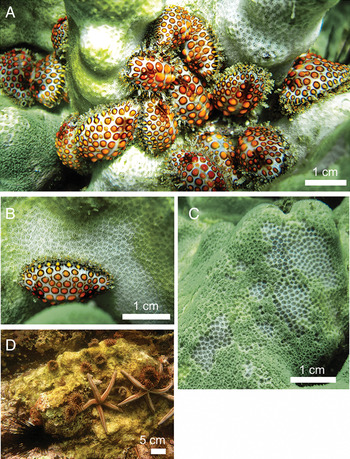
Porites panamensis corals were infested by 15 to 40 snails per colony (22 ± 7.25 ind 0.1 m−2 of Porites surface: Figure 1A). Coral colonies were 20–30 cm tall; average size of the snails were 1.7 ± 0.238 cm (N = 152). Density of the sea snails was less than in Panama in the 1980s (50–100 per colony: Glynn, Reference Glynn2004) on Pocillopora during bleaching events, but higher than in Colombia (up to 24 ind m−2: Glynn et al., Reference Glynn, von Prahl and Guhl1982) and the Pacific side of Panama (average 1.8 ind m−2: Glynn et al., Reference Glynn, Stewart and McCosker1972) on unbleached Pocillopora.
Predation by the corallivore gastropod Jenneria pustulata on colonies of emerald Porites panamensis: (A) group of snails on coral; (B) and (C) feeding scars left by snail; (D) dead coral colony inhabited by the blue sea star (Phataria unifascialis) and anemone (Anthopleura sp.). Scale bars: A–C, 1 cm; D, 5 cm.

This sea snail is nocturnally active and hides during the day (Bertsch, Reference Bertsch1984; Glynn, Reference Glynn1985), but during the immersions, individuals were always on the top of the coral colonies, moving and feeding at midday (10:00–13:00). Our observations recorded changes in the daily pattern of movement and feeding in this reef. Snails left oval scars on the coral (Figure 1B) that extend as trails through the colony (Figure 1C). High predation by this snail severely injured the coral; dead colonies were present in the reef. Blue sea stars (Phataria unifascialis) and anemones (Anthopleura sp.) were present on dead colonies (Figure 1D), indicating that colonies died several weeks earlier.
Despite the high density of J. pustulata and soft corals in the reef, soft corals were not eaten by the sea snails; only Porites panamensis corals were consumed. To date, 13 species of stony corals have been recorded in the Bahía de Los Ángeles and adjacent waters, but by far, the most common (over 90% of the colonies occur on rocks) is Porites panamensis (Reyes-Bonilla et al., Reference Reyes-Bonilla, González-Romero, Cruz-Piñon, Calderón-Aguilera, Danemann and Ezcurra2008). Colonies of Pocillopora corals are absent in the northern part of the Gulf of California.
This unusual aggregation of J. pustulata contrasts with surveys at 24 sites in the Bahía de Los Ángeles in 2004 and at several other locations in the Gulf of California between 2004 and 2012. In this time frame, Jenner's cowries were not present at these densities on or around coral colonies (Reyes-Bonilla et al., Reference Reyes-Bonilla, González-Romero, Cruz-Piñon, Calderón-Aguilera, Danemann and Ezcurra2008; D.A. Paz-García, personal observation). High densities and aggregation of these snails, as a consequence of the reproductive season, is discarded since most cowry species reproduce most of the year (Katoh, Reference Katoh1989; Osorio et al., Reference Osorio, Brown, Donoso and Atan1999; Kawai, Reference Kawai2009), but there is no study of Jenner's cowry.
Remarkably, this outbreak of J. pustulata does not seem to be associated with coral bleaching events, as occurred in Panama (Glynn, Reference Glynn1985). Morton et al. (Reference Morton, Blackmore and Kwok2002) suggested that the increased release of mucus and other cellular products by injured corals attracts the predatory snails and leads to high, local coral mortality. Causes of this high predation remain unknown. There is no evidence of anthropogenic or environmental disturbances at the Bahía de Los Ángeles.
As the first observation of high predation of J. pustulata in a reef in the northern Gulf of California, this finding emphasizes that regular monitoring is necessary to determine the effects of feeding activity by this snail on coral populations in this region.
ACKNOWLEDGEMENTS
We thank Gustavo Danemann and Jesús García-Pérez of Pronatura for logistical support and Ira Fogel of CIBNOR for editorial services. This work was funded by CONABIO grant (GD001) to E.F.B. and CONACYT grant 83339 to S. Lluch Cota. Recipients of student fellowships from CONACYT are D.A.P.G. (160065), A.A.M. (236332) and R.A.C.T. (212435).