Introduction
Introduced tree species are widely planted in urban environments but are frequently colonised by both native and exotic insect herbivores (Laćan and McBride Reference Laćan and McBride2008; Gulick Reference Gulick2014). The American elm (Ulmus americana Linnaeus; Ulmaceae), native to Carolinian forests and planted extensively in cities throughout North America, is no exception. In cities in Alberta, Canada, as well as Montana, United States of America, urban American elm trees are attacked by the introduced scale insect Eriococcus spurius (Modeer) (Hemiptera: Eriococcidae). Eriocoddus spurius is an invasive scale insect that occurs on various species of American elms in southern Alberta, as well as many other locations in North America and the world (Milonas et al. Reference Milonas, Kozár, Kontodimas, Branco, Franco and Hodgson2008; Kozár et al. Reference Kozár, Samu, Szita, Konczné Benedicty, Kiss and Botos2009; Japoshvili and Celik Reference Japoshvili and Celik2010; Gertsson Reference Gertsson2013). Both adult and larval E. spurius are fluid feeders on trees in the genus Ulmus Linnaeus (Williams Reference Williams1985). This insect is particularly damaging to American elms, although U. glabra Hudson, U. minor Miller, and U. elliptica Koch are also susceptible (Batsankalashvili et al. Reference Batsankalashvili, Kaydan, Kirkitadze and Japoshvili2017). Minor infestations of E. spurius on Siberian elms (U. pumila Linnaeus) also occur in Calgary, Alberta, but were not examined in this study. Adult females are sessile and feed on the fluids of young branches by inserting their mouthparts through the bark. They produce eggs in early summer and then die the following winter. Eggs hatch into nymphs, or “crawlers”, which migrate to leaves or new branches to feed. They feed for a portion of the season before migrating back to older branches where they enclose themselves in cocoon-like structures and overwinter without maturing. In the spring, nymphs that have successfully overwintered become adults and breed (Dreistadt and Hagen Reference Dreistadt and Hagen1994). Like most scale insects, males are rare and winged, and females are possibly capable of parthenogenesis (Williams Reference Williams1985). Because only the males are winged, and adult females are sessile, wind dispersal of crawlers is the primary method of spread for scale insects such as E. spurius (Greathead Reference Greathead1972; Washburn and Washburn Reference Washburn and Washburn1984).
Heavy infestations of E. spurius can kill branches and severely stress trees, making them susceptible to other mortality risks, including viral, fungal, and bacterial pathogens (Bey Reference Bey, Burns and Honkala1990). In Calgary, large portions of the American elm canopy have been thinned due to branch die back, and most trees within the city are now black with the sooty mould associated with insect frass. The systemic insecticide imidacloprid (C9H10ClN5O2) was used to reduce E. spurius populations in Calgary between 2005 and 2014. Imidaclorpid has also been used to control E. spurius on urban American elms elsewhere (Sclar and Cranshaw Reference Sclar and Cranshaw1996; Karimzadeh and Iranipour Reference Karimzadeh and Iranipour2017). Due to its nontarget effects on natural enemies in other systems (Rogers and Potter Reference Rogers and Potter2003) and increasing public scrutiny of neonicotinoid use, some municipalities are searching for other tools to control E. spurius on urban American elms. A parasitoid, Coccophagus gossypariae Gahan (Hymenoptera: Aphelinidae) is identified as a natural enemy of E. spurius, but little is known about its life history, role in suppression of E. spurius, or potential for use in biological control. Information gained about the parasitoid and its life history could be used to develop control strategies for E. spurius and to lower its impact in urban environments.
The family Aphelinidae (Hymenoptera) contains several commercially valuable control agents of insect pests (van Lenteren et al. Reference van Lenteren, Drost, Van Roermund and Posthuma-Doodeman1997), notably Encarsia formosa Gahan, which is successfully used for control of Trialeurodes vaporariorum Westwood (Hemiptera: Aleyrodidae) in greenhouses worldwide (Hoddle et al. Reference Hoddle, Van Driesche and Sanderson1998). While the genus Coccophagus Westwood lacks biological control agents used this widely, they are often parasitoids of economically damaging Hemiptera (van Lenteren Reference van Lenteren2012).
Biological control is used less commonly in urban forests than in greenhouses, but there are some promising examples of the use of insect parasitoids as biological control agents of urban tree pests. In California, United States of America, releases of Tamarixia radiata Waterston (Hymenoptera: Eulophidae) and Diaphorencyrtus aligarhensis Shafee, Alam, and Agarwal (Hymenoptera: Encyrtidae) have contributed substantially to the control of Diaphorina citri Kuwayama (Hemiptera: Liviidae) on both commercial and residential citrus trees (Milosavljević et al. Reference Milosavljević, Schall, Hoddle, Morgan and Hoddle2017). In eastern North America, efforts to establish and evaluate biological control agents of emerald ash borer, Agrilus planipennis Fairmarie (Coleoptera: Buprestidae) began in 2007; populations of three species of parasitoids from the families Eulophidae, Encyrtidae, and Braconidae (Hymenoptera) have since been established in the introduced range, and quantification of their long-term impact was ongoing as of 2018 (Duan et al. Reference Duan, Bauer, van Driesche and Gould2018). The present study examined some aspects of the life history and ecology of C. gossypariae in order to provide a first step in evaluating whether C. gossypariae could be put to similar use in urban American elm forests.
In order to evaluate C. gossypariae as a prospective biological control agent of E. spurius, it is necessary to understand its natural history, as well as its interactions with its host and the environment. Basic information on parasitoid life history and host discrimination could be important to the success of captive breeding, release, and establishment of a potential biological control agent (Mills and Gutierrez Reference Mills and Gutierrez1996; Mills and Kean Reference Mills and Kean2010). Life history should therefore be investigated before the use of any organism in biocontrol (Latham and Mills Reference Latham and Mills2010). Information on host–parasitoid interactions, including field behaviour of parasitoids and the direct effects they have on their host are vital, as these can influence the population dynamics between organisms and alter the realised biological control potential of the parasitoid (Briggs et al. Reference Briggs, Nisbet, Murdoch, Collier and Metz1995).
Adults and preimaginal stages of C. gossypariae have been morphologically described by Gahan (Reference Gahan1927), Griswold, (Reference Griswold1927), and Viggiani (Reference Viggiani1998, Reference Viggiani1999) based on laboratory-reared specimens from scale insects collected in the field. Griswold (Reference Griswold1927) noted based on anecdote that C. gossypariae may have at least two generations per growing season in Ithaca, New York, United States of America; the first emerging from male second instar E. spurius nymphs in late May and the second emerging from adult female E. spurius in mid-June. Viggiani (Reference Viggiani1999) expanded on the knowledge of the natural history and behaviour of C. gossypariae, observing that female C. gossypariae are synovigenic, containing 50–90 mature eggs at emergence, which can be resorbed if no suitable hosts are present. The earlier study also noted that unmated females attach their eggs (assumed to be haploid and therefore male) externally to their E. spurius host, indicating that the males may develop as ectoparasitoids, unlike endoparasitic female conspecifics. Viggiani (Reference Viggiani1999) did not observe whether these eggs developed successfully to adulthood. Successful gregarious parasitism has never been observed previously and it is therefore assumed to be a solitary parasitoid. While the complete range of C. gossypariae cannot be known, it has been observed as a parasitoid of E. spurius in Italy (Viggiani Reference Viggiani1998, Reference Viggiani1999), the United States of America (Griswold Reference Griswold1927), and Turkey (Japoshvili and Kaydan Reference Japoshvili and Kaydan2018).
Although earlier studies have provided useful insight into the natural history of C. gossypariae, information regarding the life history of C. gossypariae in an outdoor setting are lacking. Host discrimination to avoid superparasitism has also never been studied in C. gossypariae. Costs to fitness in superparasitising individuals are inherent, due to the induced larval competition, often between siblings (Gordh and Beardsley Reference Gordh, Beardsley, Bellows and Fisher1999), although superparasitism can be an advantageous strategy for some species in some situations (van Alphen and Visser Reference van Alphen and Visser1990). Understanding the field superparasitism rates is important in the evaluation of a potential biological control agent, as parasitoids can be rendered poor biological control agents if they limit their reproductive efficiency through conspecific interference at high densities (Eliopoulos et al. Reference Eliopoulos, Kapranas, Givropoulou and Hardy2017). We investigated the frequency of superparasitism of C. gossypariae on E. spurius in a field setting, to better understand the effects that host discrimination and superparasitism may have on the reproductive efficiency of this species.
The goal of this study is to establish a baseline of life history information to guide detailed studies of the influence of C. gossypariae on the populations of its host. This is the first investigation of the ecology of C. gossypariae in the field, answering several questions about basic C. gossypariae life history. Specifically, we investigated whether it is the dominant species in the E. spurius parasitoid complex in Calgary, its sex ratios and geographic range of establishment in the study area, the rate of parasitism in E. spurius, and whether it frequently superparasitises at densities found in the field.
Materials and methods
Tree selection
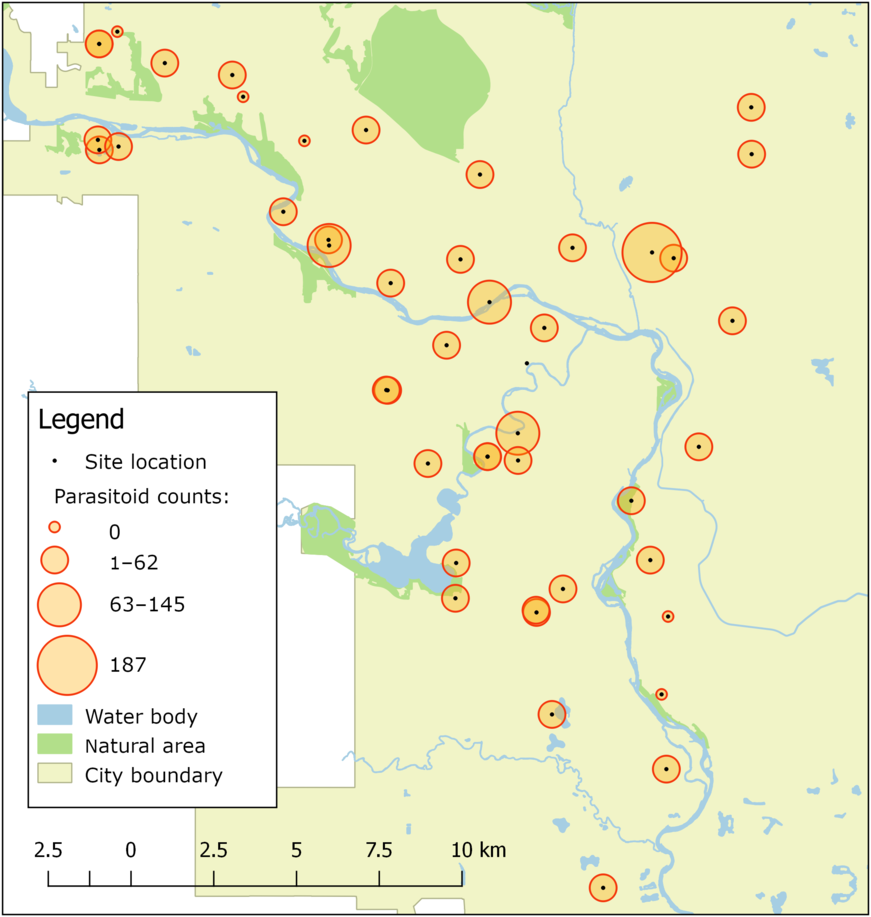
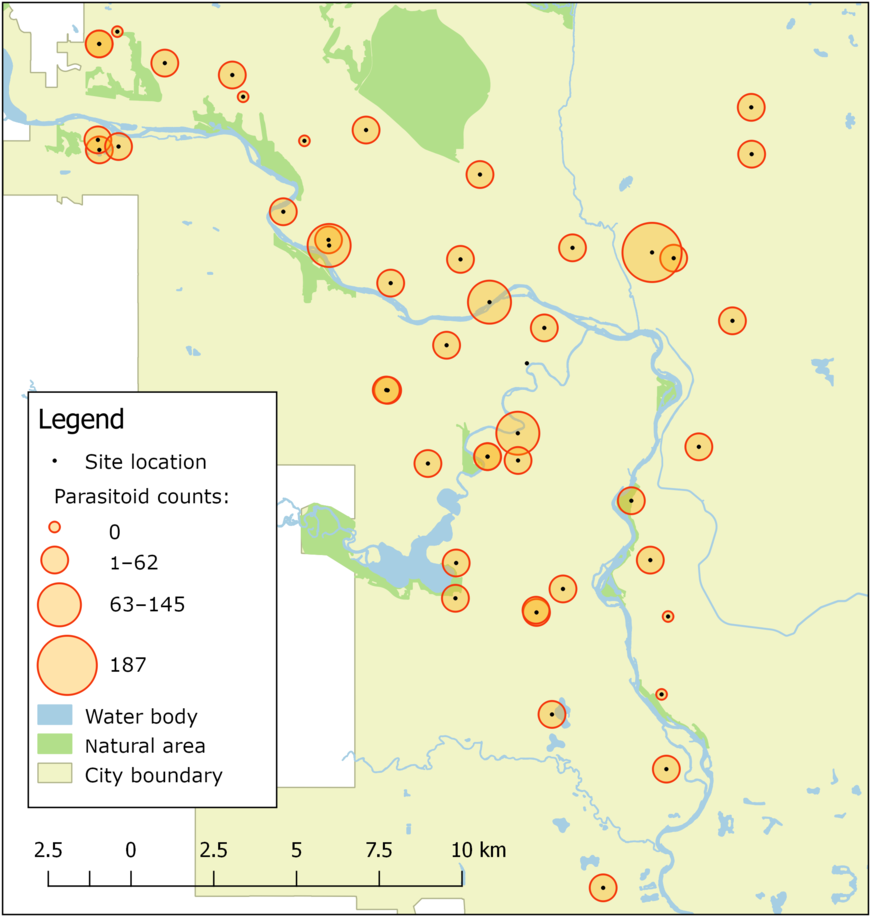
This study took place on 46 American elm trees, each in a different location on public property (Fig. 1), and each home to a population of E. spurius. A total of 108 candidate trees were examined while scouting for study locations and all had evidence of E. spurius infestation. Visual appraisals of study tree condition and scale infestation were deliberately ignored during the selection process to avoid bias towards heavily infested trees and to obtain an assortment of E. spurius infestation level within the studied trees. We deliberately chose study trees with a range of diameter at breast height, from 8.6 to 64.5 cm. Study trees also needed to have branches low enough to be accessed using a six-foot stepladder. For each untreated tree in the study, we attempted to include a treated tree of similar diameter at breast height, in a similar setting (park or boulevard).
Locations of the 46 trees (sites) used in Coccophagus gossypariae and Eriococcus spurius ecology studies. Each site consists of a single American elm tree (Ulmus americana) that hosted parasitoid emergence traps and live E. spurius collection for eight sampling periods, which ran from 19 May 2015 to 10 September 2015.
To avoid interference from recent systemic insecticide treatments used by the City of Calgary, this study excluded trees that had been treated with imidacloprid in the preceding four years, although some of the selected trees had been treated with imidacloprid at four or more years previously (Confidor SL 200, supplied by Bayer CropScience, with an imidacloprid concentration of 200 g/L, at a dosage of 0.06 g of active ingredient per cm diameter at breast height injected into the trunk approximately 3.8 cm deep and 50 cm above ground level). We did not expect the effects of these historical imidacloprid treatments to persist, as effects of systemic imidacloprid treatment are expected to last under three years, with a 20-fold decrease in imidacloprid concentrations in leaf tissues of ash (Fraxinus Linnaeus; Oleaceae) trees within the first-year postinjection (Tanis et al. Reference Tanis, Cregg, Mota-Sanchez, McCullough and Poland2012). However, there is some evidence that trace amounts of imidacloprid can be detected in tree tissues up to eight years after systemic injections (Cowles and Lagalante Reference Cowles, Lagalante, McManus and Gottschalk2009). To ensure that there was no lingering effect of historical imidacloprid treatment on these trees, we compared 12 historically treated and 12 historically untreated trees, paired by similar diameter at breast height and setting (street tree versus park tree), and compared the mean rates of parasitism of dissected scale insects on the trees.
Sampling scheme
During the 2015 growing season, we set up traps on elm trees throughout Calgary to collect parasitoids emerging from E. spurius. We also collected live E. spurius from other branches of the same trees and dissected them to search for larval parasitoids. We used the recovery rates of endoparasitoids from both methods to document parasitism and superparasitism rates, sex ratios, and level of establishment within the city. Our methods also provided a survey of the parasitoid assemblage associated with E. spurius within the study area.
Field trapping of adult parasitoids
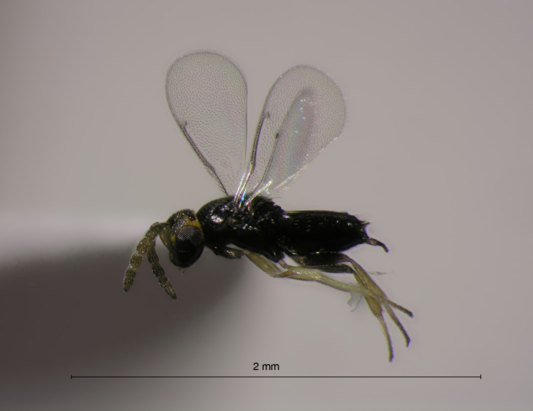
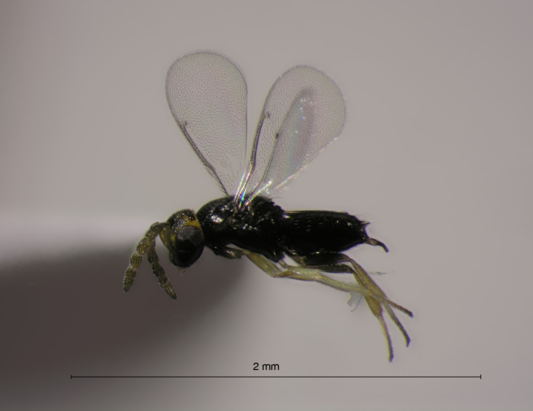
We used a repeated measures approach for sampling, visiting each study tree every two weeks from mid-May to mid-September, for a total of eight repetitions at each. During each sampling period, we collected adult parasitoids (Fig. 2) that had been caught in emergence traps over the previous two weeks, as well as adult and second instar scale insects for dissection in the laboratory.
Adult female Coccophagus gossypariae, emerged in laboratory from adult female Eriococcus spurius in September 2011.
To capture adult parasitoids as they emerged from their hosts, we set up mesh emergence traps on all 46 study trees. Each tree had emergence traps set up on four branch sections, and each trap covered 10–20 cm sections of branch with fine netting (no-see-um Nylon netting; maximum hole width 0.6 mm, BioQuip, Rancho Dominguez, California, United States of America). These branch sections were all between 3–5 cm in diameter at their widest points and had adult E. spurius present. We secured the netting using staples and electrical tape to ensure that study organisms could not enter or exit the enclosed area. Prior to enclosure, we removed all visible arthropods other than E. spurius, including any adult parasitoids. This was to ensure that all parasitoids later recovered from the net had emerged from the E. spurius already present in the netted area, and that no other entomophagus arthropods could predate the emerged C. gossypariae within the traps.
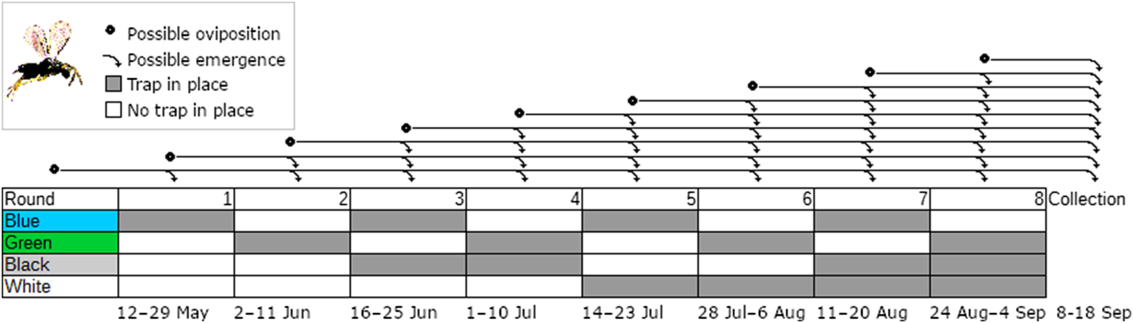
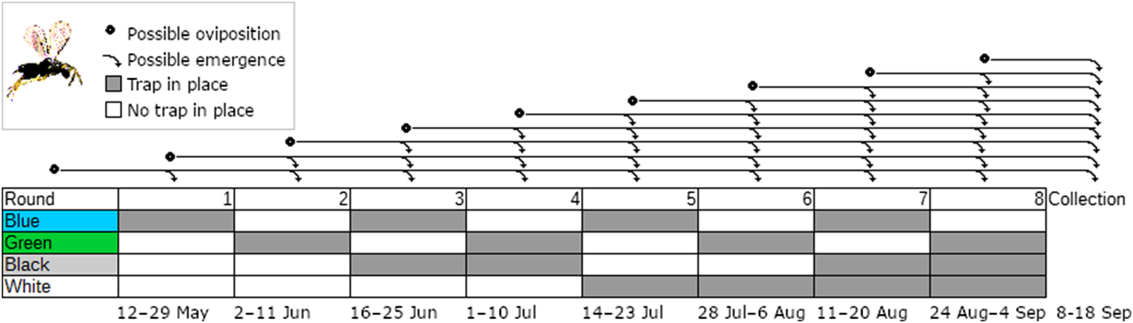
After setting these nets up in mid-May 2015, we returned to each study tree every two weeks, collected adult parasitoids that had been caught, and put new traps in place. We changed the locations of the traps throughout the study period because when a branch enclosure is in place, it excluded parasitoids in the external environment from ovipositing into the scale insects inside the net. To avoid inadvertently excluding parasitoids that were laid as eggs during these times from the study, we used different trap schedules in the four locations on each study tree (Fig. 3). At any given time throughout the study period, at least one trap was in place somewhere on the tree, but there were trap-free periods at each trap location to allow access by ovipositing parasitoids. The length of time between trapping sessions and trap-free periods ranges from two to eight weeks. We included this variation because of the dual unknowns of parasitoid oviposition timing and development time. This trap arrangement is designed so that for any combination of oviposition time and development period, one of the four branch locations would have a trap absent when the parasitoids were ovipositing, and present when they were emerging. Electrical tape marking the location of each emergence net was left on the branches during sampling periods when the net was not in place, to ensure that enclosures could be replaced covering the same branch sections in each successive sampling period. Colour coding of tapes (black, white, blue, and green) distinguished between the four locations, which allowed synchrony between the study trees. Adult female E. spurius are sessile, thus repeated measures in the same locations captured parasitoid emergences from the same group of adult female E. spurius in subsequent sampling periods, with the exception of individuals that fell off, or second instar nymphs that had migrated to the area between trapping sessions.
Schematic of net placement for parasitoid emergence trapping, replicated across each of 46 study trees. Grey squares indicate a period when a trap was in place for one of the four locations, and white squares indicate a time period when no trap was in place. Each study tree had four 10–20 cm branch sections, coded as blue, green, black, and white. The locations for the traps were marked semi-permanently on each tree with electrical tape of the corresponding colour. At the end of each sampling period, we collected and removed the trap(s) that had been in place for the preceding two weeks and put up traps in the assigned locations for the next sampling period.
When samples were collected, the enclosures were carefully cut from the branches and placed in plastic bags in such a way as to minimise the opportunity for any living parasitoids to escape during collection. We froze the bags at −20 °C to kill the specimens and store them until processing. In the laboratory, we counted all C. gossypariae recovered from the emergence netting, using a dissecting microscope of up to 45× magnification power. We separated the data by sampling period, study tree, and trap.
Field collection of Eriococcus spurius
Every sampling period, we collected up to 10 adult or second instar nymph E. spurius from the branches of each study tree. To avoid interference with the other sample collections, we did not remove scales from within the sections of branch used in emergence trapping. We attempted to collect E. spurius from all study trees during each collection period, but if five minutes elapsed without finding an adult or second instar E. spurius, we halted collection at that time. We froze all samples at −20 °C until processing.
Sample processing
All scale insects and parasitoids recovered from the emergence netting were counted using a dissecting microscope. To confirm the species as C. gossypariae, we measured diagnostic characteristics using a compound microscope. For one male and two female specimens (as represented in Fig. 2), we compared their colouration and morphological measurements of body length, head width, thorax width, scape length, scape width, F1 antennomere length and width, and F1 sensilla length to the descriptions of the species by Viggiani (Reference Viggiani1998, Reference Viggiani1999). Sex ratios of all C. gossypariae recovered from all sampling periods at two of the study trees were determined using descriptions of genitalia and sensilla length provided by Viggiani (Reference Viggiani1998, Reference Viggiani1999). Voucher specimens identified as C. gossypariae are deposited in the Strickland Entomology Museum (University of Alberta, Edmonton, Alberta, Canada).
In the laboratory, scale insects collected from the field were cleared in 10% KOH solution for 7–14 hours, depending on the length of time required to view developing parasitoid larvae and E. spurius eggs within the insect bodies. For each sampling period at each study tree, 10 adult or second instar scale insects were cleared, although for some trees, fewer scales were consistently available, due to low population densities in the field. Each of the cleared scales was dissected to count and determine the development stage of any parasitoid larvae, pupae, or eggs they contained.
Parasitoid species assemblage and sex ratio determination
To document the species assemblages and sex ratios, we used simple descriptive statistics. For species assemblage information, we counted the number of emerged parasitoids that morphologically appeared to be C. gossypariae, as well as parasitoids of other species that we keyed only to superfamily. We reported the proportion of C. gossypariae among all recovered parasitoids as a percentage. For sex ratios, we recorded the number of females to males for each sampling period, as well as in total.
Analysis of superparasitism
Using R software (www.r-project.org), we used simulated data to estimate the expected frequency of multiple parasitism if parasitoids were choosing their hosts randomly and not discriminating against previously parasitised scale insects. We adapted the following assumptions to a parasitoid host discrimination system following Rogers (Reference Rogers1975): (a) all hosts counted in the sample were available for parasitism, (b) encounters between parasitoids and hosts are random, (c) encounters between parasitoids and hosts are independent, (d) eggs are laid singly whenever a host is discovered, and (e) hosts can be reparasitised in subsequent encounters. We assumed the distributions of parasitism showed the Poisson distribution. Rogers (Reference Rogers1975) speculated that the deviations of the observed rates of parasitism from similar models were due to a violation of one or more of these assumptions. For each combination of study tree and sampling period, we took the number of scale insects dissected (Ns) and the number of parasitoids recovered in the dissections (Np). For each study tree-sampling period combination, we then created a vector of length Np, for which each element was a randomly generated number between 1 and (Ns). Elements in these vectors each represented an oviposited parasitoid, and the number assigned to it represented the individual scale insect that the female parasitoid “chose”. Repeats within a study tree-sampling period vector therefore represented a multiple parasitism event or two female parasitoids “choosing” the same scale insect. The total number of repeats for all study tree-sampling period combinations represented the number of superparasitism events in one iteration of the model. We ran the model 10 000 times to determine the expected frequency of superparasitism in our dataset given indiscriminate oviposition. We compared this distribution to the number of superparasitism events detected to our field data to determine the probability of the observed level of superparasitism occurring by chance.
Results
Parasitoid emergence rates and species assemblage
Parasitoids were widespread throughout our sampling areas but varied in abundance among study trees (Fig. 1). In total, we recovered 1057 adult parasitoids from the emergence traps. Of these, 1031 (98%) met the general morphological descriptions of C. gossypariae and 26 (2%) were from the family Pteromalidae (Hymenoptera) or other Chalcidoidae not keyed beyond superfamily. We did not recover any dipteran parasitoids. No other species of chalcidoids were found in the absence of C. gossypariae. Coccophagus gossypariae adults were present at 41 out of the 46 study trees where emergence traps were set up. At the most productive tree for C. gossypariae, 187 adults were recovered from traps in the season. Mean and median individual C. gossypariae recovered for each tree were 22.4 (standard deviation: 40.7) and 6, respectively. We did not find evidence of posttreatment effects lasting five years or more when examining 12 pairs of treated and untreated trees, matched by diameter at breast height and park or street setting.
Sex ratios of Coccophagus gossypariae
We determined the sex of 147 adult wasps from emergence samples collected on two study trees and recovered a total of 137 females and 10 males. The specimens represented a cumulative female:male sex ratio of 13.7:1.
Parasitism and superparasitism rates
We selected the 24 study trees with the greatest scale populations for dissection of scale insects, as these trees contained consistent adult scale insect populations throughout the season. None of the second instars that were cleared and dissected contained larval parasitoids, thus we only included adult scale insects for these analyses. Parasitoid larvae were recovered from living adult scales at all 24 study trees, but per cent of scales parasitised varied among trees from 6.8 to 81.0% (mean: 50.0%, standard deviation: 21.0%). Mean percentage of parasitism of E. spurius was 45.3% (standard deviation: 24%) across treated study trees, which was nearly identical to observed rate of parasitism of 46.0% (standard deviation: 19.0%) in E. spurius feeding on study trees with no imidacloprid treatment history. We therefore did not differentiate between these groups of study trees while performing other analyses.
Comparisons of simulated datasets to actual data demonstrate that the probability that C. gossypariae selects its prey at random is less than 0.0001%. In the 777 cleared and dissected scales at 24 study trees, 306 were parasitised with 307 parasites. There was only one instance of superparasitism detected in this study, in which an adult E. spurius contained both a parasitoid pupa and a parasitoid egg. This superparasitism event occurred at the study tree with the highest observed per cent parasitism (81%). Our simulations predicted a mean superparasitism frequency of 63.01 events (standard deviation: 5.4) given the same parasitoid to host ratios and number of ovipositions, with an instance of only one superparasitism event never occurring in 10 000 simulations. Given these predictions, the rarity of superparasitism in field populations suggests that C. gossypariae employs a highly effective strategy to avoid superparasitism, at least until 81% parasitism rates are reached.
Discussion
This is the first investigation of the ecology of C. gossypariae in the field, providing information about basic C. gossypariae life history, including the abundance and natural range worldwide or in Canada, the sex ratios, and the superparasitism behaviour.
Parasitoid abundance in Calgary
The widespread recovery of large numbers of C. gossypariae, with few other parasitoids from the emergence traps, indicates that it is well established as the dominant parasitoid of E. spurius in Calgary. We did not assess the effects of C. gossypariae parasitism on E. spurius population in this study, but E. spurius populations were high enough in 2015 that urban forest managers considered it an imminent threat to American elm forest in Calgary. These levels persisted despite the widespread occurrence of C. gossypariae, suggesting that the parasitoid was not universally suppressing E. spurius populations to below damaging levels during the study. However, multiyear studies of the populations of both species are required to truly assess population dynamics. Further investigation of population effects of C. gossypariae on its hosts are required to understand thresholds at which augmentative biological control could take place to increase the level of host suppression.
Sex ratios of Coccophagus gossypariae
The retrieval of both sexes of Coccophagus gossypariae from emergence traps supports the laboratory observations of Viggiani (Reference Viggiani1999) that both sexes can complete their development on E. spurius – a trait that cannot be assumed in the genus Coccophagus, as many species require different host species for the development of different sexes (Walter Reference Walter1983). We observed a highly female-biased sex ratio, which can be advantageous for reproductive efficiency in hymenopteran parasitoids (Hardy Reference Hardy1994). Sex ratio is not fixed in hymenopteran parasitoid species, nor are the reproductive advantages of a female-biased sex ratio universal (West and Rivero Reference West and Rivero2000). However, as this is the first study of wild populations of C. gossypariae, it provides a reference sex ratio for future work on the species.
Rates of parasitism and superparasitism
Superparasitism behaviour is most often studied in controlled conditions (Blumberg and Luck Reference Blumberg and Luck1990; González et al. Reference González, Montoya, Perez-Lachaud, Cancino and Liedo2007; Tormos et al. Reference Tormos, Asís, Sabater-Muñoz, Baños, Gayubo and Beitia2012; Bürgi and Mills Reference Bürgi and Mills2013; Chen et al. Reference Chen, Li, Wang, Zhang and Li2013; Tunca et al. Reference Tunca, Buradino, Colombel and Tabone2016). The field setting generally precludes some of the advantages of ex situ experiments, such as knowledge of absolute host–parasitoid ratios, consistent environments among study trees, and the ability to easily observe searching and oviposition behaviour. However, the current study provides insight into parasitoid host discrimination in more natural settings, where searching females must navigate the comparatively complex landscape.
The recovery of only one superparasitised host from the samples showed that single parasitism of a host makes subsequent oviposition less likely and suggests that C. gossypariae possesses a highly effective host discrimination strategy, which it employs when hosts and parasitoids are at the densities tested in this study. Other studies have demonstrated that chalcidoids use both external and internal cues to detect previously parasitised hosts and avoid superparasitism, often with individual parasitoids employing different strategies depending on how much time has passed since the host was parasitised. Outreman et al. (Reference Outreman, Le Ralec, Plantegenest, Chaubet and Pierre2001) observed that Aphidius rhopalosiphi De Stefani-Perez (Hymenoptera: Braconidae) used two strategies to reject previously parasitised Sitobion avenae Fabricius (Hemiptera: Aphididae). Within 16 hours, the parasitoids reacted to dried cornicle secretion produced by the aphids upon initial parasitism, which was detected by external antennation. The effectiveness of this method faded with time, and at 16 hours or more, parasitoids seemed to rely on internal changes of the host haemolymph. These were detected after probing with the ovipositor, a method that increased in effectiveness over time. Liang et al. (Reference Liang, Jia and Liu2017) found a similar pattern, with parasitoids rejecting after antennation of recently parasitised hosts, and after ovipositor insertion after 24 hours had passed. Bai and Mackauer (Reference Bai and Mackauer1990) also observed Aphelinus asychis Walker (Hymenoptera: Aphelinidae) rejecting superparasitised hosts after ovipositor probing and found that they did not need previous exposure to unparasitised hosts to avoid superparasitism. This ability to identify changes in host haemolymph following parasitism may be facilitated by gustatory sensilla found on chalcidoid ovipositors, which have been observed on Leptopilina heterotoma (Ruschioni et al. Reference Ruschioni, van Loon, Smid and van Lenteren2015) is a trait possibly shared widely with other chalcidoids that exhibit similar behaviour.
Searching parasitoids may also be able to avoid superparasitism by recognising conspecific marking pheromones on patches of hosts that have been previously searched (van Dijken et al. Reference van Dijken, Van Stratum and van Alphen1992; Castelo et al. Reference Castelo, Corley and Desouhant2003). Marking pheromones are used widely among insect taxa to avoid competition when egg laying, including insect parasitoids and phytophagous insects (Nufio and Papaj Reference Nufio and Papaj2001).
Our simulations to not exclude the potential that C. gossypariae females do not avoid superparasitism, but rather larval competition of several parasitoids within their hosts quickly leaves only a single remaining parasitoid. However, if larval competition was the only mechanism of superparasitism avoidance, we would expect to see more instances of superparasitism before the larval competition had a chance to occur.
In general, superparasitism rates depend heavily on host density and the rate of superparasitism tends to be highest when host to parasitoid ratios are lowest (Rogers Reference Rogers1975; Weisser and Houston Reference Weisser and Houston1993; Mackauer and Chow Reference Mackauer and Chow2016). The single occurrence of superparasitism in our samples took place in the study tree on which overall parasitism rate was highest (81%). As there is no way of knowing the absolute size of parasitoid populations at each study tree, we cannot directly evaluate whether this system represents a high or low host–parasitoid ratio. Parasitoid–host ratio at this tree may be at the upper threshold at which C. gossypariae maintains its effective avoidance of superparasitism, and rates of superparasitism may increase in situations where parasitism rate is higher than 80%. While C. gossypariae has demonstrated that it can avoid potentially costly superparasitism in the conditions we observed in the field, mass-rearing environments that push parasitism rate beyond this threshold may facilitate superparasitism. Studies of C. gossypariae in mass-rearing environments should therefore investigate the quality of adult parasitoids emerging from superparasitised hosts, as well as the overall effects on reproductive efficiency, should they occur.
Field observations on overwintering behaviour
We did not carry out a thorough study of overwintering behaviour, but there is a lack of previous records of this aspect of the life history of C. gossypariae. Griswold (Reference Griswold1927) remarked on the lack of such records, and no studies have addressed it since. We have therefore included some preliminary observations here. In early March 2016, we collected 10 second instar E. spurius from a study tree with a known high rate of parasitism. We dissected them in the laboratory and recovered parasitoid larvae from six of them, suggesting a plausible mechanism for C. gossypariae winter survival. This fits with the Griswold (Reference Griswold1927) observation that adult C. gossypariae emerge from second instar E. spurius, in early spring, and adults later in the season, and her postulation of a slightly different strategy of host stage parasitisation between the first and subsequent generation of C. gossypariae each year. While we did not observe parasitism of second instars during the repeated measures portion of this study, it is possible that our intensive sampling started too late in the season to detect parasitised second instars that had overwintered from the previous year before reaching adulthood. As we recovered parasitoids from emergence traps in all sampling periods, including the earliest and latest, it is likely that emergence season for C. gossypariae extends beyond our 16-week study period, and that our sampling missed the first and last parasitoids to emerge in the 2015 season.
Conclusions
Although the Aphelinidae are an important group in control of phytophagous pests, their small size and cryptic larval stages has resulted in a paucity of life history information on many species within this group (Gordh and Beardsley Reference Gordh, Beardsley, Bellows and Fisher1999). The current investigation establishes a baseline of information on field populations of C. gossypariae, contributing to the few existing studies of its biology as observed in laboratory settings. Many more questions still exist, such as the functional response of C. gossypariae to host densities, whether it is an opportunistic or obligate parasitoid of other host species, whether it is a recently introduced species in North America or a Holarctic species, and how many generations it has per year and per host generation. This study also avoided evaluation of the shorter-term, nontarget effects of imidacloprid, but other studies have demonstrated that it can cause mortality in hymenopteran parasitoids (Cohen et al. Reference Cohen, Horowitz, Nestel and Rosen1996; Byrne and Toscano Reference Byrne and Toscano2007). In future studies, short-term effects of imidacloprid should be considered while assessing on host–parasitoid interactions in this system. Broader analyses of this tritrophic system, including environmental factors contributing to E. spurius proliferation, and the effects of C. gossypariae on its host are also required to assess the potential for C. gossypariae in biological control.
Acknowledgements
This project was supported by the Urban Conservation Unit of the City of Calgary and the Alberta Conservation Association Grants in Biodiversity. The authors would like to thank Lien Luong and John Acorn for scientific guidance; technicians Daniel Gorham, April Papequash, and Ashley Pisesky for their care and attention to thousands of minute samples; Jonathan Cale and Jennifer Klutsch for statistical advice; and everyone in the Erbilgin laboratory for their feedback and camaraderie.