Within ecological communities, the distribution of species abundances follows a general pattern, where a small proportion of species present have high abundances while many more species are represented by very low abundances (i.e. are rare, see McGill et al., Reference McGill, Etienne, Gray, Alonso, Anderson, Benecha, Dornelas, Enquist, Green, He, Hurlbert, Magurran, Marquet, Maurer, Ostling, Soykan, Ugland and White2007). The low abundance of rare species is generally considered to increase their risk of extinction (e.g. Brook et al., Reference Brook, Sodhi and Bradshaw2008) and, hence, areas that support species that are rare and/or have restricted geographic distributions are often identified as priority areas for conservation (e.g. Ceballos et al., Reference Ceballos, Rodriguez and Medellin1998). This concept has been developed and applied primarily in terrestrial ecosystems and its relevance to marine ecosystems, where many species have offspring that disperse over a wide area (e.g. Veron, Reference Veron2000), has been questioned (e.g. Bianchi et al., Reference Bianchi, Morri and Pronzato2014). In high-diversity marine ecosystems, such as coral reefs, multiple factors influence the local abundances of species (see van Woesik, Reference van Woesik2002) and the relationship between rarity and extinction risk is unclear because species that are numerically rare do not also have small geographic ranges (Hughes et al., Reference Hughes, Bellwood, Connolly, Cornell and Karlson2015). Resolving how large scale patterns of species abundances are likely to change in the future depends on accurate representation of present-day geographic range sizes which, in turn, depends on accurate extrapolation of primary species occurrence records into representations of geographic ranges.
The hard coral order Scleractinia (Bourne, Reference Bourne and Lankester1900) includes more than 1200 species encompassing solitary and colonial species, and including both zooxanthellate and non-zooxanthellate species (Veron, Reference Veron2000). These corals are the ecosystem engineers responsible for building some of the most diverse ecosystems on the planet as they provide habitat for hundreds of species of coral reef fishes and thousands of invertebrate species (Stella et al., Reference Stella, Pratchett, Hutchings and Jones2011). For example, many species of small shrimps, crabs and other invertebrates associate with free-living mushroom corals, with some invertebrates occurring only in association with specific coral hosts (Hoeksema et al., Reference Hoeksema, van der Meij and Fransen2012). Among the reef-building scleractinians, a large proportion of species occur across a wide latitudinal range (>40° of latitude), although, there are also numerous species restricted either to a narrow band around the equator or to temperate locations (Veron, Reference Veron1995). Consistent with other ecosystems, surveys of coral communities indicate that most species found at a location are present with low abundances (e.g. Connolly et al., Reference Connolly, Hughes, Bellwood and Karlson2005; Dornelas & Connolly, Reference Dornelas and Connolly2008).
As part of an extensive study on coral spatial distributions (all authors, unpublished data), a single corallum of the rare species Echinomorpha nishihirai (Veron, Reference Veron1990) was recorded (Figure 1) among >11,000 coral colonies counted and identified at Lizard Island (northern Great Barrier Reef (GBR), Australia, 14°41′57.68″S 145°26′50.13″E). Only one other published study has reported the species occurring on the northern GBR (Table 1), and existing specimens of E. nishihirai from the region have all come from the outermost reefs of the GBR along the edge of the continental shelf, or from isolated reefs in the coral sea (eight specimens listed in the Queensland Museum collection, collected between 2007 and 2012). This species is distinctive due to the presence of a very large central corallite with a circular or elongate columella up to 20 mm diameter, septo-costae that radiate from the central corallite to the edge of the corallum, and the presence of relatively high and rounded dentations on the septo-costae (Veron, Reference Veron1990). These morphological characteristics are evident in field specimens (Figure 1A), which tend to be uniform or mottled dark browns or greens in colour (Veron, Reference Veron2000). Previously, E. nishihirai has been recorded to occur only in specific habitats that include reef crevices, or on lower reef slopes protected from wave action (Veron, Reference Veron2000). The specimen observed in the present study (Figure 1A) was 5 cm in diameter and was found in a crevice approximately 2 m depth below lowest astronomical tide on a reef slope/wall. Visually, E. nishihirai is easily distinguishable from other small, cryptic and solitary corals at the study location: the solitary Scolymia australis is saucer-shaped, with sturdy septa that feature blunt teeth (Figure 1B, see also Veron, Reference Veron2000) and solitary polyps of Lobophyllia pachysepta have very thick primary septa that feature 3–5 long, lobed teeth (Figure 1C, see also Veron, Reference Veron2000).
(A) Solitary Echinomorpha nishihirai in a crevice on the reef crest between South and Palfrey Islands within the Lizard Island group. (B) Solitary Scolymia australis. (C) Singular polyp of Lobophyllia pachysepta from the same reef and similar habitat.

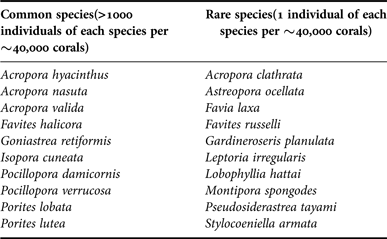
List of common and rare species for which geographic ranges reported in the Corals of the World online database and the IUCN Redlist database were compared. Common and rare species were distinguished based on their abundance at the study location in a previous extensive survey.
The genus Echinomorpha was described by Veron (Reference Veron2000) to distinguish E. nishihirai from the eight extant species of Echinophyllia (Klunzinger, Reference Klunzinger1879) with which the species was originally classified (see WoRMS for taxon details, WoRMS Editorial Board, 2015). The separation of Echinomorpha from Echinophyllia was based on the presence of a large central corallite, the rarity of colonial individuals and the occurrence of large saw-like teeth on the septocostae; characters that are not observed in any of the recognized species of Echinophyllia (see Veron, Reference Veron2000). However, a recent molecular phylogeny of the order Scleractinia places E. nishihirai within clade XIX, as a sister taxon to seven species of Echinophyllia (Huang, Reference Huang2012). Subsequently, taxonomic revision has reclassified both Echinophyllia and Echinomorpha within the new Indo-Pacific family Lobophyllidae (Dai & Horng, Reference Dai and Horng2009, see Budd et al., Reference Budd, Fukami, Smith and Knowlton2012), although the status of Echinomorpha as a separate genus is currently questioned. Regardless of its genus-level classification, the species is distinctive and relatively easily recognized in the field.
In discussing the identification of the observed specimen, we undertook an extensive literature and online search to resolve the geographic distribution of the species. This search revealed at least three different versions of the geographic range of E. nishihirai that vary substantially both in geographic extent and area (Figure 2). The species description of E. nishihirai refers to specimens collected at various locations in Japan, including the Ryukyu Islands (the type locality), Okinawa, Aka, Kerama, Tokunoshima and Amami Islands (Veron, Reference Veron1990). Subsequent coral biogeographic research noted that the species had not been recorded from the Central Indo-Pacific, Papua New Guinea or Australia (Veron, Reference Veron1993), but the geographic range was later extended to include Indonesia and the Philippines (Figure 2A), although the additional sites of collection/observation of the species were not specified (Veron, Reference Veron2000). In contrast, the species is not listed in the Census of Marine Life database, and two major coral biogeography databases report distinctly different ranges for this species. According to the online version of Veron's Corals of the World (http://coral.aims.gov.au, hereafter ‘COTW’), E. nishihirai also occurs in the Gulf of Thailand, at Christmas Island, on the northern GBR and around New Britain in northern Papua New Guinea (Figure 2B). In contrast, the IUCN database (http://www.iucnredlist.org, hereafter ‘IUCN’) records this species throughout the GBR and in some locations in the Coral Sea as well as in New Caledonia, Fiji, Samoa and the Solomon Islands, but not in northern Papua New Guinea or the Gulf of Thailand (Figure 2C). To our knowledge, there has not been a formal taxonomic revision of Echinomorpha, or of the closely related genus Echinophyllia, that could explain these differences.
Different reported geographic ranges for Echinomorpha nishihirai from (A) Veron (Reference Veron2000), (B) Corals of the World online (http://coral.aims.gov.au/factsheet.jsp?speciesCode=0865) and (C) IUCN database (http://maps.iucnredlist.org/map.html?id=132907). Both online maps were accessed 15 April 2015.
Rare and cryptic species can be easily overlooked, or mis-identified, in ecological surveys. To assess whether differences in the reported geographic ranges of Echinomorpha were likely due to its rarity, we compared the ranges from the COTW and IUCN databases for ten common species and ten rare species. These species (see Table 1) all had broad Indo-Pacific distributions and were selected based on their abundance in a previous survey of our study area, which counted and identified >40,000 coral colonies (Dornelas & Connolly, Reference Dornelas and Connolly2008). For each species, we counted the number of locations where the species was reported to occur in one dataset and not the other, but ignoring differences due solely to variation in how the ranges were drawn (e.g. IUCN tends to position range boundaries closer to land masses compared with COTW). Although species ranges differed by 13 locations, on average, for the common species, there were more differences between IUCN vs COTW ranges for the rare species (18 locations on average, one-way ANOVA, F 1,18 = 9, P < 0.01). Such discrepancies suggest that extrapolations of primary species occurrence records to quantify geographic ranges are more problematic for rare and cryptic species compared with abundant species.
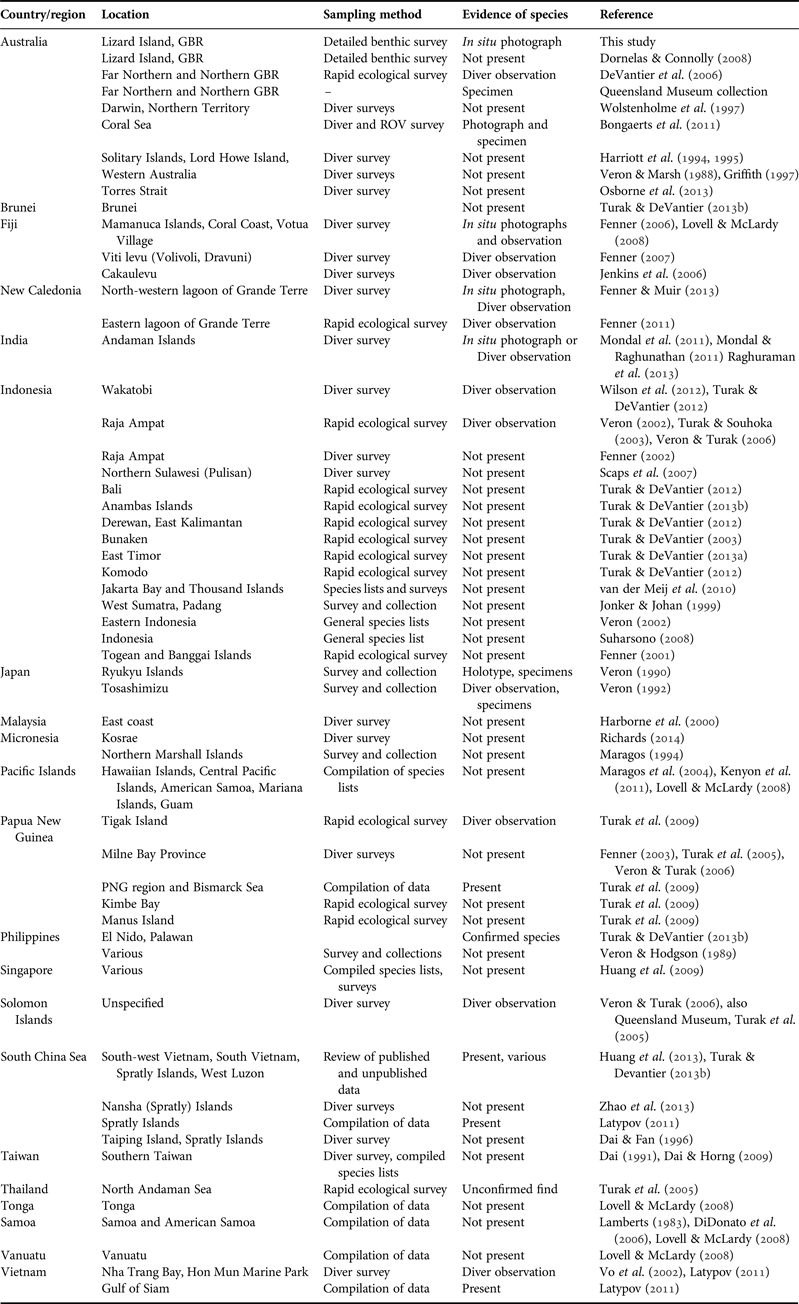
To resolve the geographic range of E. nishihirai, we undertook an extensive literature search for occurrence records in the Indo-Pacific that have been published since the species was described (Table 2). In all cases, where abundance of the species was noted, it was rare (e.g. Wilson et al. (Reference Wilson, Ardiwijaya and Prasetia2012) observed one colony among 24,337 corals; Turak & Souhoka (Reference Turak, Souhoka, Donnelly, Neville and Mous2003) found E. nishihirai at only one of 58 survey sites). Moreover, E. nishihirai colonies have rarely been collected and deposited in museum collections, with specimens listed in the Queensland Museum collections housed in Brisbane or Townsville, Australia, but not listed in searchable online resources for any of the other major museum collections of scleractinians. Despite extensive previous research on the corals of the GBR, recent studies have revealed that the diversity of certain taxonomic groups is greater than previously thought, and have highlighted that further consideration needs to be given to rarely known species (Hoeksema, Reference Hoeksema2015).
Published records of occurrences and absences for Echinomorpha nishihirai in the Indo-Pacific region, noting sampling method and type of observation. ‘Not present’ indicates that extensive surveys were conducted at the location, the observed species or genera were listed in the report, and the genus Echinomorpha and/or family Pectinidae were not recorded. ROV, remotely operated vehicle used in deep-water surveys; GBR, Great Barrier Reef; PNG, Papua New Guinea.
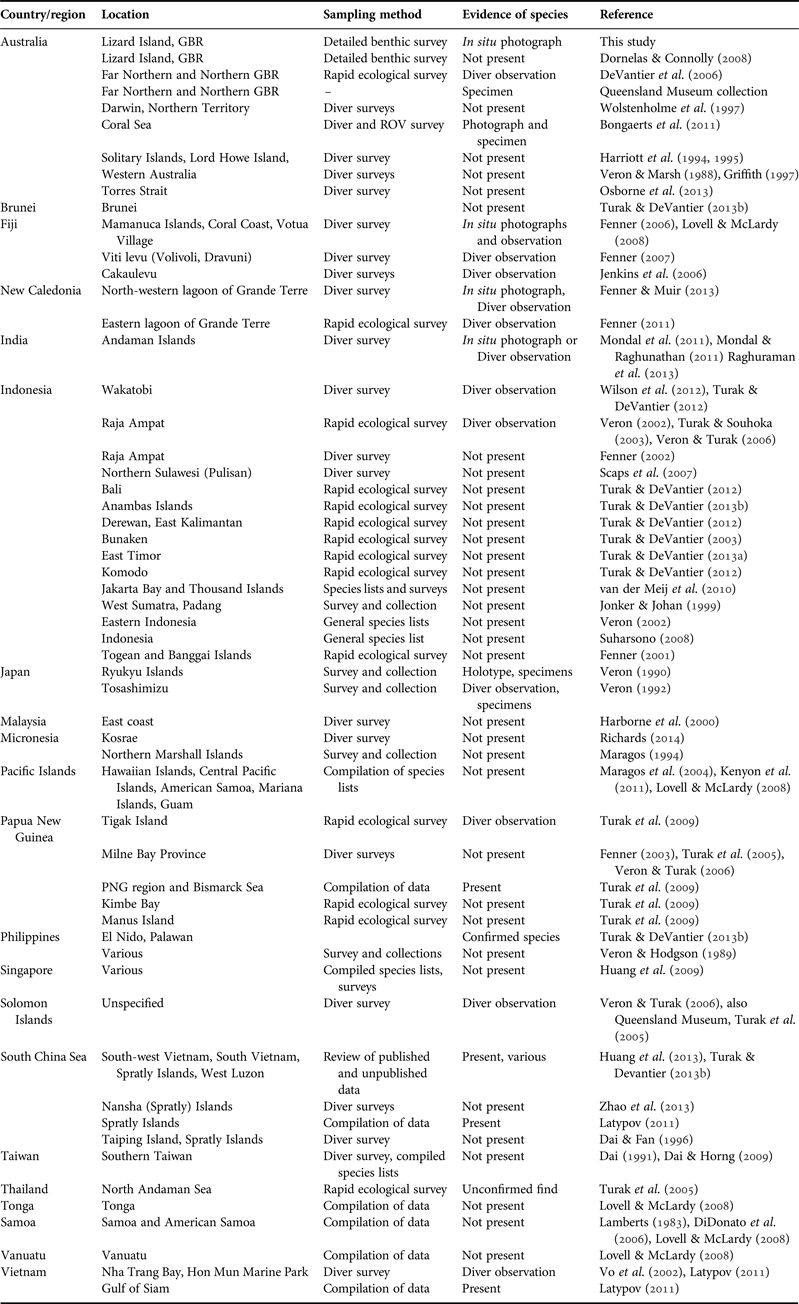
Based on an extensive literature search of published research and publicly available scientific reports (Table 2), E. nishihirai has not been recorded in the Arabian Gulf or the western Indian Ocean (Selin et al., Reference Selin, Latypov, Malyutin and Bokshakova1992; Hodgson & Carpenter, Reference Hodgson and Carpenter1995; Turak et al., Reference Turak, Brodie and DeVantier2007; Bigot & Amir, Reference Bigot and Amir2012), or in the Hawaiian or Pacific Islands (Maragos et al., Reference Maragos, Potts, Aeby, Gulko, Kenyon, Siciliano and van Ravenswaay2004; Kenyon et al., Reference Kenyon, Maragos and Fenner2011). The species range extends from an eastern boundary at Fiji, includes the Solomon Islands, New Caledonia and the northern and far northern GBR, through parts of Indonesia to a western boundary at the Andaman Islands and north to Tosashimizu in Japan (Figure 3). Coral surveys in Taiwan, Hong Kong and the south-eastern islands of Indonesia do not record E. nishihirai (Table 2; Cope, Reference Cope1984), nor have any species resembling it been recorded south of the northern GBR (Harriott et al., Reference Harriott, Smith and Harrison1994, Reference Harriott, Harrison and Banks1995; DeVantier et al., Reference DeVantier, De'ath, Turak, Done and Fabricius2006) or throughout the Indian Ocean (Sheppard, Reference Sheppard1987). While there are presently no data describing the reproductive mode of E. nishihirai (Baird et al., Reference Baird, Guest and Willis2009), which could give insight into its dispersal capacity, we note that the species distribution extends across a clear faunal break: based on species composition, coral communities are distinctly different in Eastern Australia compared with the central Indo-Pacific (Keith et al., Reference Keith, Baird, Hughes, Madin and Connolly2013).
Geographic range of Echinomorpha nishihirai based on published occurrence and absence records (extent indicated by dashed black line). Filled circles indicate occurrences, open circles indicate unconfirmed occurrences and red stars indicate locations where extensive coral surveys were conducted and the species was not recorded. Regions defined by solid black lines indicate sites where the species was reported to occur within a general area instead of a specific site.
Clearly, the species geographic range we have generated, based on the available data, differs in several ways from that of the other databases, notably around Papua New Guinea, the Andaman Islands, Taiwan and southern Indonesia (Figures 2 & 3). We expect that this variation is due to the extrapolation of the geographic range from both observed and inferred or projected locations of occurrence. The ranges of extant species represented in the IUCN database include areas where species are both known and thought very likely to occur, with the latter extrapolated based on expert opinion and the presence of suitable habitat (http://www.iucnredlist.org/technical-documents). Similarly, species ranges in COTW indicate the general regions where species have been recorded and notes that species may or may not occur in particular places within those region (Veron, Reference Veron2000). Although such an approach is appropriate for common and abundant species, it may lead to overestimation of the area of occupancy for rare species. While we applaud the enormous effort of IUCN and COTW in developing and maintaining global scale, publically available resources with wide taxonomic coverage, this study suggests a need for a more cautious treatment of rare species. This is particularly important because there are multiple ways in which a species can be ‘rare’ (Rabinowitz, Reference Rabinowitz and Synge1981), and species abundance distributions indicate that most species present at a particular location are found in low abundance, i.e. are rare (McGill et al., Reference McGill, Etienne, Gray, Alonso, Anderson, Benecha, Dornelas, Enquist, Green, He, Hurlbert, Magurran, Marquet, Maurer, Ostling, Soykan, Ugland and White2007). Hence, biased estimates of species ranges can lead to substantial bias in biodiversity estimates and macro-ecological patterns. Similarly, as species geographic range size is generally considered to be associated with extinction risk (e.g. Ceballos et al., Reference Ceballos, Rodriguez and Medellin1998), accurate assessment of species ranges is essential to inform conservation practices. Additionally, the effects of climate change will have impacts on range expansions or contractions for rare and common species (Rius et al., Reference Rius, Clusella-Trullas, McQuaid, Navarro, Griffiths, Matthee, von der Heyden and Turon2014). Climate change, along with anthropogenic influences on local and global scales, are likely to expand or fragment species ranges; hence, accurate species range maps today will assist in understanding future species range changes. Finally, we acknowledge that the species ranges depicted in COTW and IUCN are likely based on additional species records that are not publically available (e.g. unpublished data, as listed in Kenyon et al., Reference Kenyon, Maragos and Fenner2011). As such data are critically important for updating and cross-checking species distributional data, we suggest that greater transparency regarding the specific data sources included in different large-scale data compilations would be beneficial for the field of biogeography on the whole.
ACKNOWLEDGEMENTS
This research was funded by the ARC Centre of Excellence for Coral Reef Studies and James Cook University (MH, SB, GF, TC), the Australian Endeavour Scholarships and Fellowships (TC), a Royal Society Research Grant (RG140340) and the Scottish Funding Council (MASTS grant reference HR09011) (MD, KZ). We thank the staff of the Lizard Island Research Station for their assistance.