Introduction
Supplementation of natural feed additives in poultry diets is common and widely used in order to improve the nutrients utilisation (Dhama et al., Reference DHAMA, LATHEEF, MANI, ABDUL SAMAD, KARTHIK, TIWARI, KHAN, ALAGAWANY, FARAG, ALAM, LAUDADIO and TUFARELLI2015; Alagawany et al., Reference ALAGAWANY, ASHOUR and REDA2016). Since 2007, European countries have banned the use of antibiotics as growth promoters in animal feed industry (Castanon, Reference CASTANON2007). Therefore, research has been focused on using natural alternatives such as medicinal plants as natural feed additives in poultry diet to enhance production performance (Abaza et al., Reference ABAZA, SHEHETA, SHOEB and HASSAN2008). Some plant derived compounds have been reported to have anti-inflammatory, antioxidant, antibacterial, antiviral, hepatoprotective, antiallergic, antithrombotic and immunomodulatory activities in a number of in vitro and animal model studies. Nowadays, there is much interest into the use of plant derived flavonoids including flavones, flavonols, flavanones, isoflavones, flavanol and anthocyanins due to their multidimensional properties and immense availability (Anonymous, 2014). Quercetin is a flavonoids present in various foods like vegetables, tea, fruit, wine apples and onions that exerts positive effects on plasma IL-10 and IL-6 as well as on health and antioxidant status. Rupasinghe et al. (Reference RUPASINGHE, RONALDS, RATHGEBER and ROBINSON2010) showed that feeding diets supplemented with quercetin improved the oxidative status and meat quality of broiler chickens, and have been shown to possess anti-inflammatory activity in animals (Comalada et al., Reference COMALADA, BALLESTER, BAILON, XAUS, GALVEZ, DE MEDINA and ZARZUELO2006; Huang et al., Reference HUANG, YU, CHENG, OUYANG, FU and CHU2010). Quercetin has immunoregulatory benefits through enhancing IgY antibody production, lymphoid organs weights (spleen, thymus and bursa) and natural killer cell activity thereby improving productive performance (Manach et al., Reference MANACH, SCALBERT, MORAND, REMESY and JIMENEZ2004). A functional immune system is crucial for health, especially in broilers reared under high density conditions with more chance of contact with pathogens (Korver, Reference KORVER2012). The immune system comprises three major branches: T cell-mediated immunity (cell-mediated delayed-type hypersensitivity), humoral immunity (B cell-mediated antibody production) and non-specific cell mediated immunity (natural killer cell activity). All these were significantly enhanced in rats fed diets containing quercetin (Exon et al., Reference EXON, MAGNUSON, SOUTH and HENDRIX1998). Konrad et al. (Reference KONRAD, NIEMAN, HENSON, KENNERLY, JIN and WALLNER-LIEBMANN2011) confirmed the positive impact of quercetin on immunological parameters including total blood leukocytes and proinflammatory cytokines (IL-6, TNFα, GM-CSF, IFNγ, IL-1β, IL-2, IL-8 and IL-10) in human athletes fed quercetin for 15 minutes before running. Quercetin has the ability to exert neuroprotective and immunomodulatory effects and its conjugated metabolites are extremely lipophilic and can cross the blood brain barrier (Youdim et al., Reference YOUDIM, QAISER and BEGLEY2004).
In poultry diets, several studies confirmed the effective role of flavonoids on growth performance, carcass traits, meat and egg quality, oxidative status and other productive performance parameters (Goliomytis et al., Reference GOLIOMYTIS, ORFANOU, PETROU, CHARISMIADOU, SIMITZIS and DELIGEORGIS2014). Quercetin stimulated on immune function (IL-8, IL-1, IL-10) and enhanced antioxidant activities and aspartate transaminase (AST) and creatine kinase in rats treated with synthetic antibiotic (isoproterenol) (Liu et al., Reference LIU, ZHANG and LU2012). It has other biological actions such as anti-inflammatory, antioxidant, growth promoter, antiviral, hepatoprotective, antibacterial, antiallergic, anticarcinogenic, antithrombotic, and immunomodulator activities in various animal models and it has been reported that quercetin can block the replication of influenza A virus and rhinovirus (the source of common colds) when compared to the anti-flu drug Tamiflu (Ganesan et al., Reference GANESAN, FARIS, COMSTOCK, WANG, NANUA, HERSHENSON and SAJJAN2012). It showed more effective inhibitory effects against other viruses such as respiratory syncytial virus, Para influenza virus and adenovirus (the source of necrotic pancreatitis in broilers chicken) (Choi et al., Reference CHOI, SONG, PARK and KWON2009). Quercetin plays an important role in improving the bone mineral density and bone volume suggesting that it influences the micro-architecture of bone's tissue (Tsuji et al., Reference TSUJI, YAMAMOTO, SATO, MIZUHA, KAWAI, TAKETANI, KATO, TERAO, INAKUMA and TAKEDA2009).
Although published data on the biological activities of flavonoids in man and rodents are available, their role as safe supplements in poultry diets still needs more clarification. The objectives of this review are to clarify the potential benefits of quercetin in poultry as a replacement for growth promoters and immune stimulation.
Quercetin sources
Quercetin is a common flavonoid that is ubiquitously distributed in many plants such as grapes, apples, tea, berries, capers, brassica, shallots, onions and tomatoes as well as many seeds, barks, flowers, nuts and leaves, as shown in Figure 1 (Wiczkowski et al., Reference WICZKOWSKI, ROMASZKO, BUCINSKI, SZAWARA-NOWAK, HONKE, ZIELINSKI and PISKULA2008). The outermost rings of red onions have higher concentrations of this flavonoid (Smith et al., Reference SMITH, LOMBARD, PEFFLEY and LIU2003), it is found in honey (Petrus et al., Reference PETRUS, SCHWARTZ and SONTAG2011) and in high concentrations (234 mg/100g) in capers while black or green tea contain relatively low concentrations (2 mg/100 g) (Bhagwat et al., Reference BHAGWAT, HAYTOWITS and HOLDEN2011). In Australia, green and black teas are the most common sources of quercetin (Somerset et al., 2008). In USA and China, flavonol intake is about 13 and 18 mg/day for adult and young persons, respectively (Sampson et al., Reference SAMPSON, RIMM, HOLLMAN, DE VRIES and KATAN2002). Vegetables, such as tomatoes, red leaf lettuce, green pepper and asparagus, are excellent sources of quercetin (Nishimuro et al., Reference NISHIMURO, OHNISHI, SATO, OHNISHI-KAMEYAMA, MATSUNAGA, NAITO, IPPOUSHI, OIKE, NAGATA and AKASAKA2015).
Quercetin content in some foods (Anonymous, 2014).

Chemical structure and physical characteristics
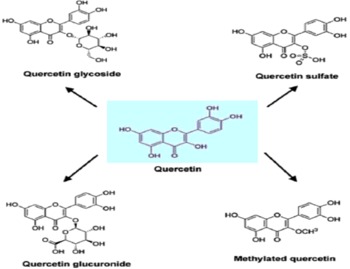
The chemical name for quercetin is 2-(3,4-dihydroxyphenyl)-3,5,7-trihydroxy-4H-chromen-4-one (Quercetin, C15H10O7) and its derivatives are shown in Figure 2 . There are many names for quercetin such as sophoretin, meletin, quercetine, xanthaurine, quercetol, quercitin, quertine and flavin meletin. Quercetin as a natural antioxidant and is highly lipophilic and slightly hydrophilic properties. As a powder, its colour tends to be yellow, is practically insoluble in water, but soluble in aqueous alkaline solutions. The melting point of quercetin is 316°C or 601°F and its molar mass is 302.23 g/mol (Ades, Reference ADES2009).
Molecular structure of quercetin and its derivatives.

Absorption of quercetin
The flavonoid (quercetin glycoside) is proficiently hydrolysed in the small intestine by beta-glucosidases converted into a glycone form that is easily absorbed (Ader et al., Reference ADER, WESSMANN and WOLFFRAM2000). Quercetin and its derivatives are very stable in gastric acid; however, reports concerning the absorption rate of quercetin in stomach are rare, but some studies suggested that it is absorbed in the upper part of the small intestine (Crespy et al., Reference CRESPY, MORAND and MANACH1999).
Quercetin is metabolised in the colon, liver, small intestine and kidney. Metabolites that have been formed in the liver and small intestine by biotransformation enzymes include the methylated, glucuronidated and sulpho-substituted forms (Day et al., Reference DAY, BAO, MORGAN and WILLIAMSON2000). Quercetin and its derivatives are transformed into various metabolites like phenolic acid by enteric enzymes and bacteria in intestinal mucosa and epithelial cells. These metabolites are absorbed, transformed or excreted later (Kim et al., Reference KIM, KIM, PARK and HAN1999). Quercetin metabolites were found in liver in concentrations lower than plasma where the hepatic metabolites were intensively (90%-95%) methylated (Manach et al., Reference MANACH, TEXIER, MORAND, CRESPY, RÉGÉRAT, DEMIGNÉ and RÉMÉSY1999) while, the continuous consumption of a diet containing quercetin leads to its accumulation in blood which increases its concentration in plasma (Koli et al., Reference KOLI, ERLUND, JULA, MARNIEMI, MATTILA and ALFTHAN2010).
Beneficial activities of quercetin
antioxidant effect of quercetin
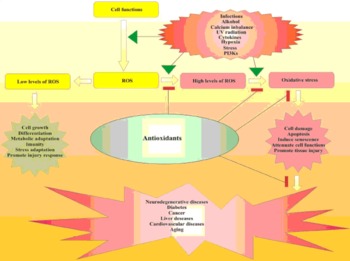
Antioxidative mediators are essential for poultry nutrition as they decrease lipid peroxidation, improve the organoleptic characteristics and nutritional value of eggs and meat, and can extend shelf life (Fellenberg and Speisky, Reference FELLENBERG and SPEISKY2006). Apart from being effective antioxidants, flavonoids possess immunomodulatory and, in particular, anti-inflammatory properties (Serafini et al., Reference SERAFINI, PELUSO and RAGUZZINI2010). The most effective feature of quercetin as an antioxidant agent (Figure 3) is its ability to scavenge free radicals (ROS) which can cause various diseases such as cancer, diabetes, and chronic inflammation (Alrawaiq and Abdullah, Reference ALRAWAIQ and ABDULLAH2014). Flavonoids can cause direct neutralisation of free radicals, inhibiting low density lipoprotein (LDL) oxidation as well as defending erythrocytes from damage initiated by smoking (Bentz, Reference BENTZ2009). ROS play a major role in endorsing cell growth and differentiation, physiological stresses and immune response as well as protection from pathogen invasion (Procházková et al., Reference PROCHÁZKOVÁ, BOUŠOVÁ and WILHELMOVÁ1999). In one in vitro study, flavonoids acted as preventive and chain breaking antioxidants by scavenging superoxide, alkoxyl, peroxyl, and hydroxyl radicals as well as preventing LDL oxidation and generated large amounts of simple phenolic acids which positively influences scavenging activity of other antioxidants (Pietta, Reference PIETTA2000).
Flow diagram showed the antioxidants effect of quercetin by modulating damaging effects of reactive oxygen species (ROS) through suppressing various processes.

antidotal effect of quercetin
Quercetin binds heavy metals (molybdenum, aluminium, palladium, cobalt, and nickel) and its chelating properties can result in decreasing metal toxicity. Therefore, quercetin supplementation can be considered as a promising antidote for heavy metal poisoning (Maleser and Kuntic, Reference MALESER and KUNTIC2007).
regulatory effect on cardiovascular health and blood pressure
Supplementing diets with quercetin can provide significant protection against cardiovascular disease (Larson et al., 2012). A significant reduction in total and LDL cholesterol was seen, but HDL cholesterol was increased with quercetin supplementation (Lee et al., Reference LEE, PARK, LEE, KIM, CHA, KIM, LEE and SHIN2011). In another study, quercetin decreased high blood pressure in animals by regulating the constriction of blood vessels and stimulating the production of nitric oxide, a vasodilator, in addition to inhibiting the angiotensin-converting enzyme (ACE) activity (Larson et al., 2012).
anti-obesity and antidiabetic effects of quercetin
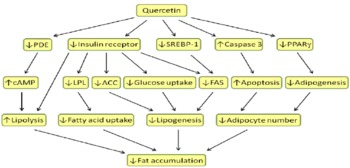
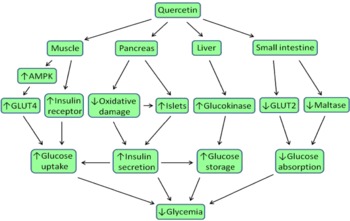
Anti-diabetic and anti-obesity effects of quercetin are given in diagrams illustrated in (Figures 4 and 5).
Flow diagram showed the effect of quercetin lower the body fat in adipose tissue. PDE: phosphodiesterase, ACC: acetyl-CoA carboxylase, FAS:fatty acid synthase, PPARγ: peroxisome proliferator-activated receptor γ, LPL: lipoprotein lipase, SRBP-1: sterol regulatory element-binding protein 1.

Mechanism illustrating the anti-diabetic effect of quercetin.

anti-inflammatory and immunomodulatory effects
Flavonoids have significant anti-inflammatory activities in animal and poultry species (Hodek et al., Reference HODEK, TREFIL and STIBOROVA2002). In previous in vivo and in vitro studies, quercetin boosted neutrophil function and NK cell cytolytic activity and may improve innate immune function (Exon et al., Reference EXON, MAGNUSON, SOUTH and HENDRIX1998). Quercetin could be used in the prevention and therapy of chronic inflammation, transplantation, and autoimmunity via the abolishment of the function and activation of dendritic cells (Ren-Yeong et al., Reference REN-YEONG, YU, CHENG, YANG, FU, HUANG, YU, CHENG, YANG, FU and CHU2010; Chirumbolo, Reference CHIRUMBOLO2010). Flavonoids, including quercetin, have been reported to reduce inflammatory immune function by moderating the production of pro- and anti-inflammatory molecules from cells of the innate and adaptive immune system (e.g. macrophages and T cells) in response to stimuli that upregulate inflammatory processes (Kumazawa et al., Reference KUMAZAWA, KAWAGUCHI and TAKIMOTO2006). It has anti-inflammatory potential that can be expressed on various cell types in animal and poultry species (Orsolic et al., Reference ORSOLIC, KNEZEVIC, SVER, TERZIC and BASIC2004; Chirumbolo, Reference CHIRUMBOLO2010).
Hager-Theodorides et al. (Reference HAGER-THEODORIDES, GOLIOMYTIS, DELIS and DELIGEORGIS2014) studied the immunomodulatory effect of quercetin on immune functions in broiler chickens, and found a linear increase in IgY antibody titres with increasing inclusion rates. Quercetin activity has been studied in NK cells, macrophages B cells and T cells (Kim et al., Reference KIM, CHO, ZOU, CHOI and CHUNG2005; Yu et al., Reference YU, MIN, AN, WON, HONG and HWANG2008), mast cells (Min et al., Reference MIN, CHOI, BARK, SON, PARK, LEE, PARK, PARK, SHIN and KIM2007) and neutrophils (Moreira et al., Reference MOREIRA, KANASHIRO, KABEYA, POLIZELLO, AZZOLINI, CURTI, OLIVEIRA, T-DO AMARAL and LUCISANO-VALIM2007).
Quercetin studies in poultry
Plum fruit possess a rich source of quercetin (118 to 237 mg/100g) and has been reported to have an immune augmenting effect. Feeding diets supplemented with plum powder to broilers showed positive effects including reducing faecal oocyte shedding, increasing spleen cell proliferation significantly and upregulating the levels of mRNAs for IL-15 and interferon in Eimeria acervulina challenged broilers (Lee et al., Reference LEE, PARK, HWANG, LEE and CHUNG2007). Quercetin has antioxidant activities which are important in the control of autoimmune diseases such as ascites (pulmonary hypertension syndrome) in broilers (Iqbal et al., Reference IQBAL, CAWTHON, BEERS, WIDEMAN and BOTTJE2002). In a study in broilers, Sohaib et al. (Reference SOHAIB, BUTT, ANJUM, KHAN and SHAHID2016) observed that diets supplemented with quercetin and alpha-tocopherol could be used to improve oxidative stability, texture, colour and sensory characteristics of broiler meat nuggets as well as decreasing oxidative degradation of lipids thus increasing their acceptability among consumers.
Kim et al. (Reference KIM, HONG, KIM, BANG, CHOI, JI, LEE and KIM2015) showed that supplementing quercetin to broilers enhanced performance and provided a positive influence on blood parameters. Laying hens fed diets containing quercetin showed positive effects on performance by modulation of antioxidant enzymes such as hepatic superoxide dismutase (SOD) activity and regulation of intestinal microbiota (Liu et al., Reference LIU, LIU, HU, SUO, ZHANG, JIN, FENG, TENG and LI2013; Rupasinghe et al., Reference RUPASINGHE, RONALDS, RATHGEBER and ROBINSON2010). Recent literature showed that flavones and isoflavones could improve the plasma antioxidant status of broilers chickens (Kamboh and Zhu, Reference KAMBOH and ZHU2013) and can alter the biomarkers of heat-stress positively due to their reducing action on free radicals generated by heat stress. Kamboh and Zhu, (Reference KAMBOH and ZHU2014) found that quercetin could ameliorate the negative effects of circulating endotoxaemia on animal production.
Conclusions
Published data from available reports show that quercetin can exert various benefits on the immune and antioxidant systems and at a gut level to moderate the risk of infectious diseases and improve poultry production. The research suggested that quercetin is a natural and safe supplement that could be used in poultry diets to replace the synthetic growth promoters and immune boosters and save veterinary costs whilst improving the growth and welfare of poultry.