The Houma 侯馬 and Wenxian 溫縣 covenant texts (mengshu 盟書) are excavated examples of a genre that the transmitted histories suggest was vital to political activity in early China. The genre of covenant and oath was used to bind individuals and groups together, demanding loyalty along with other specified actions or prohibitions. A requirement of this genre is a self-imprecation, to be triggered if the oath is broken. Almost all the different covenant types from Houma and Wenxian use the same imprecation, most commonly written with the characters ma yi fei shi 麻 非是.Footnote 1 Close to fifty years since the excavation of the Houma covenants, there is still no general agreement as to how this phrase should be understood. Based on a survey of this phrase and its variations in about 4,500 tablets from Houma and Wenxian, I argue that Zhu Dexi 朱德熙 and Qiu Xigui 裘錫圭's analysis of the phrase as mi yi bi shi 靡夷彼氏 “Wipe out that shi” is correct.Footnote 2 The term shi 氏 “lineage,” I believe, refers here to the covenantor and his direct male descendants, i.e. sons, grandsons, and so on.Footnote 3 This imprecation confirms that the elite producing these texts felt that the most coercive threat available to them was the breaking of an individual's patriline.
I surveyed examples of this imprecation in the Houma texts and the largely unpublished Wenxian covenants, with the aim of determining how variations in this phrase could throw light on its meaning. These variations include both the use of alternative characters to denote the same word, as well as variations in wording. I conclude that the majority of variants support Zhu and Qiu's analysis. I demonstrate that those variations which do not support this analysis can be explained as error or idiosyncrasy on the part of individual scribes in their reproduction of what was a formulaic phrase. This aspect of the analysis illustrates the need to be aware of individual scribal habits and formulaic language when analyzing excavated texts.
Introduction
Covenant and oath occur in all cultures and are particularly common during periods of social and political upheaval. When speaking of early societies, the term covenant refers to an agreement between two parties which are often unequal in status and power. In such cases, the obligations of the agreement may fall wholly on the weaker party. Covenant in ancient society is best understood not as a purely literary form, but a ritual event, involving ceremony and usually sacrifice, with the aim of solemnizing the oath being sworn and etching the experience and the oath into the minds of the participants.Footnote 4
During the Eastern Zhou period, covenants and oaths played an essential role in the frequent realignment of loyalties between and within states and other political groupings.Footnote 5 The transmitted histories frequently mention covenants (meng 盟) and oaths (shi 誓). Liu Boji 劉伯驥 calculates, for example, that 128 covenants are recorded for the 242 years of the Spring and Autumn period.Footnote 6 However, direct quotation of the oath being sworn is uncommon in the transmitted histories, and, when it does occur, the quote is usually partial, limited to one or two phrases. The Houma and Wenxian materials have allowed us, for the first time, to see examples of the full texts of ancient Chinese covenants, in the actual form in which they were created for the ritual enactment of the covenant ceremony.
The Houma covenant texts were excavated in 1965 in the city of Houma, in southern Shanxi province.Footnote 7 The Wenxian covenant texts were excavated in 1980–81 from Wenxian (Wen County) in northern Henan.Footnote 8 The covenants took place at different times during the fifth and early fourth centuries b.c.e.Footnote 9 They were organized by two of the ministerial families of the Jin 晉 state: the Zhao 趙 lineage in the case of the Houma site, and the Han 韓 lineage at the Wenxian site. At both sites, the covenant texts were written using brush and ink on stone tablets, which were then buried in pits dug into a raised earthen terrace located outside a walled-settlement. At Houma, the settlement is identified as Xintian 新田, the Jin capital from the early sixth to early fourth centuries b.c.e.Footnote 10 The walled site at Wenxian has not been excavated but is thought to be that of a settlement named in historical texts as Zhou 州.Footnote 11 The raised earthen terraces had been used for ritual activity over extended periods and contained many sacrificial pits. At Houma, this platform was 70 meters east to west, by 55 meters north to south. Archaeologists excavated 326 sacrificial pits on the terrace, mostly containing the bones of a sacrificial animal and a jade object. Among these, 43 pits also contained covenant tablets.Footnote 12 At Wenxian the terrace was 50 meters east to west by 135 meters north to south, 124 pits were discovered of which sixteen contained covenants on which writing was still legible.Footnote 13 The number of tablets within a pit varies from dozens to thousands.Footnote 14 The burial of the covenant tablets in a terrace dedicated to sacrifice, and the accompanying sacrifices and/or offerings often found with the tablets, strongly suggest the aim was to present the texts to the sanctioning spirit called on to oversee the oath being sworn in the covenant ceremony.Footnote 15
A number of different covenant types can be identified, the text of each type repeated on separate tablets, each tablet individualized with the name of a covenantor. The majority of these texts are oaths of allegiance. They include demands of loyalty to the head of the lineage, along with specific requirements and prohibitions, the majority aimed at the consolidation of the group centered on the lineage and the identification and rejection of named and unnamed enemies. The number of covenantors participating in each oath ranged from dozens to thousands. The fifth century b.c.e. was the period in which Jin was gradually torn apart by the lineages of Zhao, Han and Wei 魏, which, by the end of that century, had divided the state into three independent polities. I believe the excavated covenants reflect the process of group consolidation centered on the Zhao and Han lineages, which culminated in their independence.
One of the most striking aspects of the Houma and Wenxian covenant texts is their individualization. A single covenant type is repeated on many tablets, each one naming a different covenantor. This has important implications for our understanding of political and social organization at this time.Footnote 16 Its significance for the present study is that scribes created copies of the same text on many separate tablets. Given the highly formulaic language employed in the covenant texts, certain phrases are found hundreds, sometimes thousands of times. Formulaic language is seen in divination records on oracle bones and bamboo slips, and in bronze inscriptions. However, the mass production for a single event of great numbers of what are essentially identical texts is particular to the excavated covenants.
The rigid formulaic structure of the excavated covenant texts has been described by Susan Roosevelt Weld.Footnote 17 Weld observes that the written oath of each covenant type conforms to a basic four-clause structure of: name, stipulations, submission, and imprecation. The name clause includes the name of the covenantor and sometimes other phrases, most commonly one indicating the beginning of the period of effectiveness of the oath. The stipulations describe the specific requirements or prohibitions to which the covenantor is swearing to adhere. The first stipulation is usually a demand for loyalty to the leader of the covenanting group, and the following stipulation or stipulations require or prohibit specific actions. In the submission clause the spirit sanctioning the covenant is invoked to oversee the covenantor's adherence to the oath. The imprecation clause spells out the punishment to be inflicted on the covenantor by the sanctioning spirit if the oath is violated. This is the basic four-clause structure identifiable in all the main covenant types from Houma and Wenxian.Footnote 18 Of these clauses, it is the specific stipulations that vary most significantly between covenant types. All the other clauses tend to use stock formulaic phrases.
The repetition of these highly formulaic, brush-written texts makes them particularly suitable for the study of character and lexical variation.Footnote 19 Since copies of a single covenant type were intended to be identical in content (apart from the name of the covenantor), they provide an opportunity to observe the range of lexical variation found among “identical” texts. The formulaic nature of the texts means that certain stock phrases are used in several different covenant types, thus greatly increasing the frequency of their repetition. When considering lexical variations, formulaic phrases are of particular interest because they tend to be more open to misinterpretation, particularly as time passes and their original meaning becomes obscure and their language abstruse.
A further significant feature of these materials is that single scribes were responsible for writing the covenant text onto more than one tablet. This provides the opportunity to examine repeated copies of a single text made by one individual. As will be demonstrated, identification of individual scribal hands was essential for the present study as it revealed that certain variations were specific to individual scribes, allowing a more informed decision as to the significance of those variations. In particular, if a problematic variation occurs frequently but is in fact only produced by one or two scribes, it may be conjectured that the variation was not in fact a valid alternative, but due to an error or misunderstanding.
A number of studies have been based in whole or part on the analysis of individual scribal hands and variation between hands.Footnote 20 A pertinent example is Li Feng's 1997 article “Ancient Reproductions and Calligraphic Variations: Studies of Western Zhou Bronzes with ‘Identical’ Inscriptions.”Footnote 21 By identifying scribal hands, Li demonstrates that several individuals were responsible for preparing copies of a single text for casting on sets of bronze vessels. The copying of an identical text by different scribes is precisely the situation we have with the covenant tablets, although on a far greater scale. Methodologically, copies of a single text allow a straightforward comparison of matching graphs.Footnote 22 On this basis, calligraphic style and other features can be compared with the aim of identifying individual hands.
Li Songru 李松儒 provides a methodology for the analysis of scribal hands in brush-written texts, particularly bamboo-slip texts from the Chu region.Footnote 23 In her MA thesis she presents criteria to be considered when appraising and comparing scribal hands.Footnote 24 These include: 1. Proficiency of the hand, including: the smoothness and control of brushstrokes; the balance of the internal structure of characters (e.g. well proportioned); the arrangement of the text (e.g. even spacing between characters, consistency in character size); 2. Calligraphic style, referring to general tendencies including: style of the start and end point of individual strokes (e.g. to form wedge-style strokes, or horizontal strokes with downward-curving ends); cursive strokes (resulting from the increased speed of consecutive brushstrokes); the relative length (and width) of strokes; the relative spacing of different strokes within a character; the positioning of strokes where they meet or intersect with other strokes; the general arrangement of components within characters (e.g. relative positioning and distance, tight or loose); 3. Character formation, including: use of particular variant forms for specific graphs (both component-level variations as well as calligraphic variations); use of consistent forms for particular components; 4. Embellishments: i.e. the addition of ornamental strokes to characters (e.g. dots, short lines); 5. Layout of characters on the media, including character size and their general arrangement and spacing, and any tendency to slant characters into oblique forms. Li also raises important qualifying factors, for example the possibility that a scribe could have written in more than one style, or that the scribe's style might have changed over time, and that a scribe who was copying a text might have been influenced by the style of the original text.Footnote 25 All these criteria can be applied to the brush-written script of the excavated covenants when identifying individual scribes.
The identification of different hands is carried out on the basic principle that no two people write in exactly the same style. Identification of an individual scribal hand involves identifying a set of recognizable “features” of the hand, based on the criteria listed above. A further basic principle qualifies the first, and is that an individual does not write in exactly the same way twice, and that, within the recognizable set of features specific to an individual, one must expect a degree of “normal variation” between samples.Footnote 26
In the following, I firstly present the imprecation phrase ma yi fei shi麻非是 and the analysis of its meaning adopted here. I then introduce and discuss variations of this phrase, arguing that the majority of variations support this analysis. By identifying individual scribal hands, I show that variations which do not match this analysis can be attributed to the errors or idiosyncrasies of individual scribes.
The meaning of the imprecation phrase ma yi fei shi 麻 非是
Below is an example of the most common covenant type found at Wenxian, punctuated and laid out according to the four-clause structure discussed above. The transcription is interpretative, apart from the imprecation phrase which is left as a formal transcription.Footnote 27
Tablet WT1K1-3802Footnote 28
I. 十五年十二月乙未朔辛酉。自今以往,喬
II.A 敢不繩繩Footnote 29焉中心事其主
II.B 而敢與賊為徒者,
III. 丕顯岳公大冢,諦極Footnote 30視汝,
IV. 麻非是。
I. Fifteenth year, twelfth month, yiwei was the first day of the month, [today is] xinyou [the 27th day of the month]. From this day onward, [if] Qiao
II.A dares not vigilantly and loyally serve his ruler,
II.B and dares to join with the enemy as a follower,
III. resplendent Lord Yue, Great Mountain, attentively and tirelessly watching you [i.e. the covenantor, Qiao],Footnote 31
IV. 麻非是。
Having identified the Houma and Wenxian texts as oaths, we can be confident that the phrase ma yi fei shi 麻非是 is the self-imprecation, to be triggered if the oath is broken. This has been the assumption of all scholars working on these materials. This is corroborated by the only other phrase that occurs in this clause among the excavated covenants. That phrase is found in two covenant types from Wenxian, one in which it follows a variation of the standard ma yi fei shi, one in which it occurs alone. I analyze the phrase as denoting the words bi wu you zhouhou 俾毋有胄後 “Cause [you] to have no descendants,” which is undoubtedly an imprecation.Footnote 32
While there is full agreement that ma yi fei shi is an imprecation, there is no general agreement as to what the phrase means. A direct reading of the characters as the words they most commonly denote in received early texts produces a nonsensical phrase.Footnote 33 At least some of the characters must, then, be denoting different words, and the challenge is to identify those words.
At least eight analyses have been suggested to explain the phrase ma yi fei shi and I believe that of Zhu Dexi and Qiu Xigui to be the most convincing.Footnote 34 Zhu and Qiu's analysis is a revision of one presented by Chen Mengjia 陳夢家, who analyzed the phrase as meaning “Wipe out my lineage” mo yi wo shi 摩夷我氏.Footnote 35 I will introduce the analysis here, with further examples and explanation provided as necessary.
Graph 1: ma 麻
Chen Mengjia links the first graph of the phrase, ma 麻, to mo 摩 which has a Fangyan 方言 gloss of “to destroy, to extinguish” mie 滅 (“摩,滅也”).Footnote 36 Zhu and Qiu note that two other characters with the phonetic ma 麻, i.e. mi 靡 (read second tone) and mi 糜, are also found with this meaning in transmitted texts.Footnote 37 In fact, in some editions of the Fangyan, the gloss cited by Chen Mengjia uses mi 靡 rather than mo 摩, i.e.: “靡,滅也.”Footnote 38 The following passages include such usage of the characters mi 靡 and mi 糜:Footnote 39
Guo yu 國語 “Yue yu xia 越语下” (late fifth–fourth centuries b.c.e.Footnote 40)
王若行之,將妨於國家,靡王躬身。
If the king implements this, it will harm the state and destroy the king himself.Footnote 41
Meng zi 孟子 “Jin xin xia 盡心下” (fourth century b.c.e.)
梁惠王以土地之故,糜爛其民而戰之,
King Hui of Liang for the sake of land, crushed his people and forced them to fight, …Footnote 42
Han shu 漢書 “Jia Zou Mei Lu zhuan 賈鄒枚路傳” (first century c.e.)
萬鈞之所壓,無不糜滅者。
Nothing pressed upon by ten thousand jun (a unit of weight) is not crushed and destroyed.Footnote 43
Such usage is not commonly associated with the characters mo 摩, mi 靡, or mi 糜, which primarily denote the words: mo 摩 “to rub, to polish”; mi 靡 “not, there is not”; and mi 糜 “gruel, congee.” The semantic components of these characters suggest they were created with these usages in mind: shou 手 “hand” in mo 摩 “to rub, to polish”; fei 非, the negative copula, in the negative function word mi 靡; and mi 米 “rice” in mi 糜 “gruel, congee.” None of these characters was produced to explicitly represent the word denoted in the above examples. We can conjecture, then, that these characters are being used interchangeably, to denote a phonetically-close word meaning “crush,” “destroy,” for which there was no common dedicated character. In two texts dating after the Western Han we find two further variants that may have been produced to specifically denote this word. The Shuowen jiezi 說文解字 has a character mi  , otherwise unattested in early texts but glossed as sui 碎 “to smash to pieces,” which may well correspond to this word.Footnote 44 In the Hou Han shu 後漢書, we find the phrase “東攠烏桓” “In the east [they] destroyed the Wuhuan [peoples].” Here the word is written with the character 攠, i.e. mi 靡 with the shou 扌 “hand” radical added, which is presumably a variant intended to indicate this specific usage.Footnote 45 On this basis, we can conjecture that ma 麻, the phonetic signifier in all these characters, is used in the excavated covenants to denote the same word, meaning “to destroy.” It seems likely that this word was in fact an extension, possibly a derivation, of the word mo 摩 “to rub, to polish,” which can also mean “to grind,” a usage sometimes distinguished by use of the character mo 磨. The word found in the above examples and in the covenants would, then, be an intensification of this meaning, giving “to crush, to obliterate, to pulverize,” glossed as “to destroy.”Footnote 46 Below, when referring to this usage, the character mi 靡 will be used.Footnote 47
Graph 2: yi
Chen Mengjia takes the second graph, , to be a variant form of yi 夷, and gives the gloss from the Guangya 廣雅 of mie 滅 “to destroy” (“夷,滅也”).Footnote 48 Zhu Dexi and Qiu Xigui follow this analysis. The word yi 夷 and related words have a root meaning of “level,” and the verbal meaning “to make level.” The word can refer to the leveling of ground and buildings, leading to the gloss of “to destroy.” For example: Guo yu “Zhou yu xia 周語下:”是以人夷其宗廟, 而火焚其彝器. “Therefore [other] peoples destroyed their lineage temples and committed to flames their ritual vessels.”Footnote 49 The addition of the tu 土 “earth” in the variant graph found in the covenants, i.e. , is a semantic component and accords with such usage. The verb yi 夷 can also take people as its object, to mean “to wipe out, raze, exterminate,” and this is the specific usage found in the covenants, the object of the verb being the shi 氏, referring to the covenantor and his direct male descendants.
Examples of the graph from the Houma and Wenxian texts include the following component-level variations:

There are five examples of the first variant among the Houma texts. This variant adds the component e 歺, which is frequently found as a semantic signifier in characters that denote words related to death (including si 死 “to die” itself). Its addition here accords with the identification of the word denoted here as yi 夷, meaning “to wipe out, raze, exterminate.”Footnote 50
In the second variant, from Wenxian, the additional component is wu 烏, and a formal transcription of the graph is thus  (wu 烏 and niao 鳥 being equivalent as semantic signifiers). This graph is also found in the Shanghai slip text Bao Shuya yu Xi Peng zhi jian 鮑叔牙與隰朋之諫, where it denotes the word zhi 雉 “pheasant.”Footnote 51 The wu 烏 is a semantic signifier for what is clearly the graph's primary use to denote a type of bird. The use of this graph in the imprecation to write the word yi 夷 “to wipe out, raze, exterminate” is a case of erroneous use of a near-homophone by the scribe.Footnote 52
Based on the above analysis, the verbs mi yi 靡夷 combine in the imprecation phrase to give a meaning of “to crush and flatten,” used metaphorically to refer to the wiping out of the covenantor's male line.
Graph 3: fei 非
Zhu and Qiu objected to Chen Mengjia's analysis of the third character as wo 我, noting that the graph is identical to examples of fei 非 on bronze inscriptions.Footnote 53 They point out that the character fei 匪, which has the phonetic fei 非, often interchanges with fei 非 in early texts (to denote the negative fei 非), and that fei 匪, in turn, is phonetically close to bi 彼 and is commonly glossed (xun 訓) as bi 彼 “that” in received texts. It follows, they argue, that the fei 非 of the imprecation phrase can also be glossed as bi 彼 “that.” Their use of the term xun 訓 “gloss” (rather than du wei 讀為 “read as”) indicates that Zhu and Qiu are not assuming that fei 非 is being used to directly denote the word bi 彼, leaving open the possibility that there existed two separate demonstrative pronouns that had similar pronunciations, the standard character for one of them (i.e. fei 匪) sometimes used to denote the other (i.e. bi 彼). I would suggest that these graphs were all being used to denote a single demonstrative pronoun. While the Old Chinese reconstructions of fei 非 and fei 匪 differ only in the addition of the post-coda *-ʔ in fei 匪, it is the case that their main vowel differs from that of bi 彼: fei 非 < pj + j < *pəj and bi 彼 < pjeX < *pajʔ. However, Baxter notes that: “It is … likely that original *-aj and *-əj merged in some dialects, at least in some environments.”Footnote 54 We do not see fei 非 or fei 匪 functioning as a demonstrative pronoun in oracle bones or bronze inscriptions. I would conjecture then that cases of fei 匪 (or fei 非) acting as a demonstrative pronoun originate from regions where this merger had taken place and the graphs are simply being used to write the word bi 彼.
Graph 4: shi 是
Chen argued that the graph shi 是 is a loan for shi 氏 “lineage,” citing commentaries to the Yi li 儀禮 and Li ji 禮記 which gloss examples of shi 是 in these texts as shi 氏.Footnote 55 This usage is also very common in Warring States excavated texts.Footnote 56 The analysis is further supported by the many examples from both Houma and Wenxian, mostly published after Chen was writing, in which the character shi 氏 is used in place of shi 是 in this position.Footnote 57
On the basis of this analysis of these four graphs, the phrase ma yi fei shi 麻非是 is understood to denote the words mi yi bi shi 靡夷彼氏, literally meaning “Crush and flatten that shi,” that is to say “Wipe out that shi,” the term shi 氏 “lineage” referring, I suggest, to the covenantor, his sons, grandsons and any further direct male descendants.
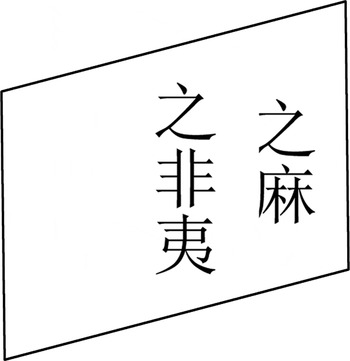
Two main objections to this analysis have been raised. Firstly, Qi Guiyan 戚桂宴, Li Yumin 李裕民 and Imre Galambos all take issue with the identification of fei 非 as bi 彼 “that.”Footnote 58 It is pointed out that this usage is not seen in other excavated texts, the only examples being in received texts, and that the word here is always written with fei 非, without a single variant that might support the bi 彼 reading. Secondly, Li Yumin calls attention to lexical variations in this phrase in the Houma texts that appear to contradict the above analysis: ma yi zhi fei shi 麻之非是 (HM 1:41 and HM 1:42) and … fei yi 非 ... (HM 79:8).Footnote 59 These issues, however, can be resolved without rejecting the above analysis.
Firstly, since these objections were made, a number of occurrences of fei 非 in subsequently excavated texts have been identified as representing the word bi 彼. Of these, the most convincing is the following example from the Shanghai Museum text Yongyue 用曰:
Yongyue 用曰 (fourth–third centuries b.c.e.)
唇亡齒寒。凡恭人,非(彼)人是恭,厥身是衛。
“If the lips are gone, the teeth get cold.” Whenever showing respect to another person, it is [to] that person [that one] shows respect, [but] it is one's self [that one] protects.Footnote 60
The opening idiom is used to refer to two separate persons or groups in some sort of dependent or interdependent relationship, and here it is followed by an illustrative example: when showing respect to another, one must also protect oneself. The 非(彼)人是恭 and 厥身是衛 phrases are syntactically identical, with their objects, both made up of a pronoun and noun, preposed and followed by the resumptive pronoun shi 是 before the verb. The use of the pronouns fei (bi) 非(彼) “that” and jue 厥 “my,” “one's” indicates a contrast between the other party and one's self.Footnote 61 This is, then, an extremely persuasive case of the graph fei 非 denoting the word bi 彼 “that.”Footnote 62
The use of a single graph to denote two common but semantically unrelated words, in this case fei 非 representing the negative copula fei 非 and the demonstrative pronoun bi 彼, is not at all unusual in early Chinese texts. In the covenant tablets, for example, er 而 also denotes two distinct words, the conjunction er 而 and the pronoun “your.” The relatively small number of examples of fei 非 (and fei 匪) denoting bi 彼 in excavated and received texts is explained by its being a regional feature. As noted above, fei 非 (and fei 匪) would only have been suitable characters to write bi 彼 in regions where *-aj and *-əj had merged, thus limiting this phenomenon to texts from those areas.
The lack of a single example of the graph bi 彼 used in place of fei 非 in this position in the Houma and Wenxian materials so far surveyed is, nonetheless, deserving of consideration. We have already seen in the case of shi 是 and shi 氏 that a graph (in that case shi 是) can almost completely replace the graph previously more commonly used (in that case shi 氏) to denote a particular word. But, in that particular case we still, nevertheless, find examples of shi 氏 being used. The demonstrative pronoun bi 彼 occurs in the late fourth-century Zhongshan bronzes written using the character pi 皮, and there is another possible example of this usage on a bell-type instrument from Jiangxi 江西 dating to the Spring and Autumn period.Footnote 63 It seems likely, then, that the scribes at Houma and Wenxian had the option to use the graph pi 皮 “hide, animal skin” to write bi 彼 in the imprecation phrase. However, it is significant that the most commonly seen use of pi 皮 in excavated materials from the Jin region is to write the name of a lineage with the name Pi 皮. This lineage name is common on Warring States weapons and coinage from Wei 魏 and Han 韓.Footnote 64 Thus, during this period, the use of the graph pi 皮 preceding shi 氏, i.e. pi shi 皮氏, would have been ambiguous and probably first understood to refer to the Pi lineage, rather than the phrase bi shi 彼氏 “that lineage.” The imprecation phrase would have appeared to read “Wipe out the Pi lineage,” the Pi lineage becoming the sole target of the curse. This perhaps explains why the Wenxian and Houma scribes were particularly careful to avoid writing pi 皮 in the phrase, and to use the alternative graph fei 非 to denote the word bi 彼.
Both Qi Guiyan and Li Yumin object to identifying fei 非 as bi 彼 on the grounds that, if a pronoun was intended here before the word shi 氏, it would be qi 其 “his, her” or er 而 “your,” as these are commonly used as possessive pronouns referring to the covenantor elsewhere in the texts. I would argue, however, that the use of bi 彼 “that” here is intentional because it functions to clearly distinguish the narrowly defined shi 氏 of the covenantor, comprising just himself and his direct male descendants, from the more broadly defined shi 氏, i.e. the main lineages of Zhao and Han. As just discussed, bi 彼 “that” refers to a person or object that is not close to the speaker, contrasting with ci 此 “this” or ji 己 “oneself” (or jue 厥, as in the Yongyue example above). The use of bi 彼 indicates that the target of the imprecation is restricted to each individual covenantor and his male offspring, and not the whole lineage. The significance of this choice of pronoun, along with the formulaic nature of the phrase, would have shielded it from replacement with the more commonly seen pronouns qi 其 “his, her” or er 而 “your.” The insulation to variation of pronouns in set phrases is also seen in English, for example “fare thee well.”
While Qi and Li both object to identifying fei 非 as bi 彼, neither provides a convincing alternative analysis. Li argues that not only are the graphs ma 麻 and yi verbs meaning “to destroy,” but so is fei 非. He suggests that the variation ma yi zhi fei shi 麻之非是 (HM 1:41 and HM 1:42) is the full form of the phrase, in which a pronoun-object zhi 之 follows yi , so that the phrase should be understood as made up of two clauses: ma yi zhi 麻之, meaning “Destroy him [the covenantor]” and fei shi 非氏 “Destroy [his] lineage.” Li argues that this zhi 之 is usually omitted because a zhi 之 referring to the covenantor is already found in the preceding phrase, di ji shi zhi 諦極視之 (which I translate “attentively and tirelessly watching him”). This analysis then accounts for the variants ma yi zhi fei shi 麻之非是 and “… fei yi 非 ...” (HM 79:8). Both these arguments are problematic. The omission of the pronoun-object zhi 之 after the co-verb yi 以 and after transitive verbs in negative sentences is a well-recognized feature of classical Chinese grammar, but its omission in the middle of a series of three verbs (all synonyms) would be most unusual and could not be inferred. If the object-pronoun was exceptionally omitted, we would expect to see the full phrase, ma yi zhi fei shi 麻之非是, commonly used, but it is found only twice, both examples written by a single scribe (as will be discussed in the next section). Furthermore, Li gives no evidence to support his suggestion that fei 非 can mean “to destroy” and I find no examples of such usage.Footnote 65 Thus, Li does not give a convincing alternative analysis of the phrase ma yi fei shi 麻非是. Nevertheless, Li is correct to draw attention to the variants ma yi zhi fei shi 麻之非是 and “… fei yi 非 ... .” I will argue below that these, as well as several other variants, are due to scribal idiosyncrasies or errors and do not, in fact, disprove or weaken the proposed analysis.
Variations of the phrase ma yi fei shi 麻非是
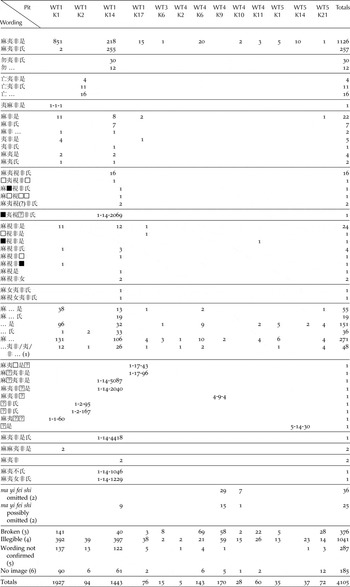
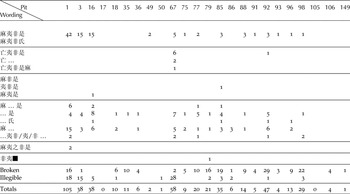
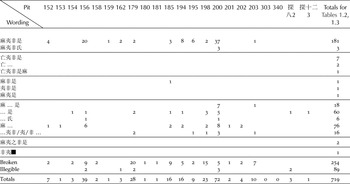
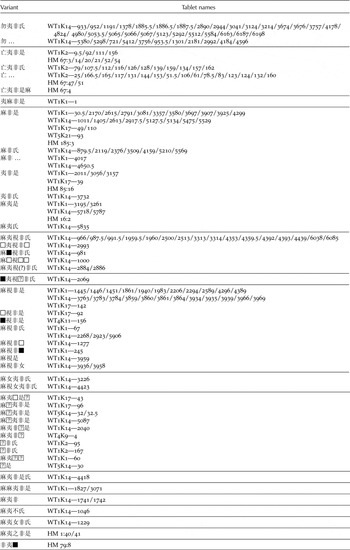
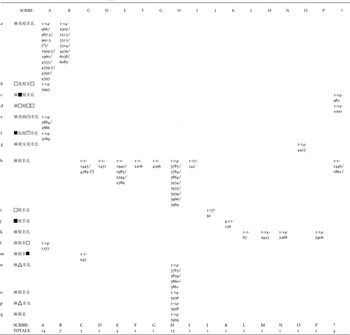
In order to better our understanding of the imprecation ma yi fei shi, I surveyed examples of this phrase and its variants as found in the Houma and Wenxian covenant tablets. For the Houma covenants, the data set was the collection of 656 brush-written copies of the texts given in the excavation report, the Houma mengshu.Footnote 66 For the Wenxian covenants, the survey was based on about 3,900 images of tablets that had been selected for photography by their excavators, Hao Benxing 郝本性 and Zhao Shigang 趙世綱, in preparation for their publication.Footnote 67 The following variations were recorded: the use of one or more different graph/s in place of the expected graph/s; the addition or omission of a graph from the phrase; the re-ordering of graphs in the phrase. Calligraphic and component-level variants clearly representing the same word as the more common forms were ignored. The tabulated results of the survey are presented in Appendix 1.
Overall, the phrase is most commonly written in the form ma yi fei shi 麻夷非是.Footnote 68 Among the images of the Wenxian tablets, of 2,155 examples which had all or part of the phrase legible, 1,126 had the ma yi fei shi 麻夷非是 fully legible, compared to 504 tablets for which a variant could be confirmed. For the Houma tablets, there were 376 examples with part or the entire imprecation clause legible, of which 181 had the common four characters fully legible and just 25 had confirmed variants. Among the two data sets, the number of variants for which all characters could be confidently identified was 26. There were also eleven variants which included one or two unidentified graphs, giving a possible total of 37 variations for the phrase. However, some of the eleven examples with unidentified graphs may not be distinct variants, which would lower the total variant count to something below this.
The variants are introduced and discussed below. The common variations, and many of the less common variations, support the proposed analysis of this phrase to mean mi yi bi shi 靡夷彼氏 “Wipe out that shi.” These are introduced first. I then discuss those variations which appear to contradict the proposed analysis. I demonstrate that, by identifying the individual hands responsible for these variations, they can be explained as scribal errors or idiosyncrasies that do not, in fact, challenge the proposed analysis.
Variations
1. 麻夷非氏
In this, the most common variant found, the last character of the phrase is written with the character shi 氏 in place of shi 是. Taking into account all cases surveyed in which the last graph in the phrase is shi 氏 (regardless of other variations or lacunae) there are almost 400 examples. These two characters are also commonly found in both received and excavated texts (from the Warring States and on) interchanging to denote both shi 氏 “lineage” and the demonstrative pronoun shi 是.Footnote 69 This evidence clearly supports the argument that shi 是 is used in the imprecation to denote the word shi 氏 “lineage.”Footnote 70
2. 亡夷非是/氏
In this variation the character wang 亡 is used in place of the graph ma 麻.Footnote 71 The variant is found both at Houma, in two pits (pits 67 and 92), and Wenxian, in just one pit (WT1K2). In the Wenxian case, in legible examples of the phrase, wang 亡 is used exclusively. In Houma pit 67 both wang 亡 and ma 麻 are found with almost equal frequency, while in pit 92 only one tablet uses wang 亡. The use of wang 亡 in place of ma 麻 can be analyzed either as a lexical variation, taking the wang 亡 to mean “to destroy,” or as evidence of a segmentation error.
Li Yumin reads this variant directly as wang 亡 “to destroy.”Footnote 72 If this is correct, it would be an early example of a usage which is generally very rarely found prior to the Han period. The word wang 亡 is commonly used in early texts with the meaning “to lose,” as in the phrase wang guo 亡國 “to lose one's state” (and attributively, i.e. “a lost state”) and also with the intransitive sense “to be lost” with the connotation of something being destroyed or wiped out, as in the phrase guo bi wang 國必亡 “the state will certainly be lost/destroyed.” The character is much less commonly found in pre-Han texts with the sense of “X destroys Y” which would be required in the Houma and Wenxian phrase, i.e. the sanctioning spirit will “destroy that lineage.” In his article, Li Yumin quotes the text of a covenant, recorded in the Zuo zhuan 左傳, which does appear to use wang 亡 in this sense. The relevant section of the imprecation is given here (the appropriate translation is discussed in the main text):
Zuo zhuan Xiang 襄 11.3 (fifth–fourth centuries b.c.e.)
… 明神殛之,俾失其民,隊(墜)命亡氏,踣其國家。Footnote 73
The use of the wang 亡 here, however, is somewhat ambiguous: it could be understood as “destroy [his] lineage”, but we could also take the bi 俾 “to cause to” as governing the three verbs shi 失, zhui 墜, and wang 亡, all synonyms meaning “to lose”, thus: “… the bright spirits will kill him, cause [him] to lose his people, [cause him] to lose his mandate, [cause him] to lose his lineage, and [let] fall his state.”
There are, however, examples where the word could certainly be interpreted in the sense that would be required in the covenant texts, e.g.:
Zuo zhuan Zhuang 莊 6.3 (fifth–fourth centuries b.c.e.)
… 亡鄧國者,必此人也。
The one who destroys the state of Deng, will certainly be this man. (i.e. “This man will destroy Deng.”)Footnote 74
However, the great majority of such examples are in Han-period texts such as the Shi ji 史記 and Zhanguo ce 戰國策, e.g.:
Shi ji “Wei shi jia 魏世家” (second–first centuries b.c.e.)
知伯曰:“吾始不知水之可以亡人之國也,乃今知之。”
The Earl of Zhi said: “I did not originally understand water's being able to be used to destroy a people's state, but now I know it.” [Commenting on the use of a diverted river in an attack on the settlement of Jinyang 晉陽.]Footnote 75
Zhanguo ce “Wei 魏 4” “Qin Wang shi ren wei Anling Jun 秦王使人谓安陵君” (late first century b.c.e.)
... 秦滅韓亡魏,...
… Qin wiped out Han and destroyed Wei, …Footnote 76
In excavated texts, this usage is found in Han-period materials, for example in the Mawangdui silk manuscripts:
Zhanguo zonghengjia shu 戰國縱橫家書 “Qin keqing Zao wei Rang Hou 秦客卿造謂穰侯” (text buried: 168 b.c.e.)
吳不亡越,越故亡吳,齊不亡燕,燕故亡齊。吳亡於越,齊亡於燕,…
Wu did not destroy Yue, [so] Yue was bound to destroy Wu, Qi did not destroy Yan, [so] Yan was bound to destroy Qi. Wu was destroyed by Yue, Qi was destroyed by Yan, …Footnote 77
In earlier excavated texts, wang 亡 has not been found with this meaning. In oracle bones the graph wang 亡 appears to be used only as a negative adverb. In bronze inscriptions wang 亡 is also found following a noun with the intransitive meaning of “to be lost,” “to be destroyed.” For example, in the “Ban gui 班簋” (tenth century b.c.e.) Duke Mao 毛 reports to Tian 天 on the campaign against the eastern states: 惟民亡遂在彜,眛天命,故亡, “It was that the people were not in accord with the norms, ignored Tian's mandate, and so [they] were destroyed.”Footnote 78 The later “Zhongshan Wang Cuo hu 中山王 壺” (late fourth century b.c.e.) has the phrase: 邦
 (亡)身死 “the state was lost/destroyed, he himself died.”Footnote 79 The graph is also found with the transitive meaning “to lose [s.th.],” “to suffer the loss of s.th.,” for example in the “Shu Jia Fu fu 叔家父簠” (eighth–seventh centuries b.c.e.): 用祈眉考無疆,慎德不亡 “Use [this vessel] to pray for long life without limit, pay due attention to de, not losing [it].”Footnote 80 And the “Zhongshan Wang Cuo ding 中山王
 鼎” (late fourth century b.c.e.) has the phrase
 (亡)其邦 “[He] suffered the loss of his state.”Footnote 81 In the Warring States and Han periods the graph is also commonly found denoting the existential negative wu 無, as well as being used nominally to mean “loss.”
On the basis of this evidence, we may conclude that use of wang 亡 to denote “X destroys Y” has not yet conclusively been seen in pre-Han excavated texts and is very rare in transmitted pre-Han texts. The covenant texts date to the fifth and early fourth centuries b.c.e., so the use of wang 亡 with this meaning would be an exceptional early example of this usage.
An alternative explanation is that the use of wang 亡 originates from a segmentation error in which the boundary between the first two words of the phrase was misinterpreted.Footnote 82 The ma 麻 of the imprecation clause denotes, it is proposed, a word meaning “to destroy,” represented in texts using a variety of characters with phonetic ma 麻, for example, mi 靡. The graph wang 亡 is not an appropriate loangraph for this word since their codas do not match: 靡 mi < mje < *m(r)aj; 亡 wang < mjang < *maŋ. However, wang 亡 is very frequently used in place of the negative wu 無 “not have” in transmitted and excavated texts.Footnote 83 Such usage is also attested in the Wenxian covenants in the covenantor name Wuzhi 亡智 (e.g. WT1K1-1223). Pulleyblank writes: “The two words are no doubt etymologically closely related. Wang 亡 is in fact the graphic form found on the oracle bones where wu 無 would appear in later texts.”Footnote 84 If, as is generally assumed, wang 亡 was read as wu 無 in this usage, then the phonetic similarity with mi 靡 becomes closer: 亡/無 wu < mju < *ma; and mi < mje < *m(r)aj.Footnote 85 The lack of the *-j coda in 無 wu may have been offset by the phonetically similar initial of the following word yi 夷. This would be evidence of a segmentation error in which there had been a reanalysis of the division of two adjacent syllables.Footnote 86 The reconstruction for the second word is: yi 夷 < yij < *ləj. If the *l- initial of this word had already started its development to y-, then it would have been a phonetic match for the coda of the previous word, the *-j of 靡 < mje < *m(r)aj, providing conditions for a segmentation error in which the first syllable was divided before its coda.Footnote 87 In this case, wu 無 becomes an ideal first syllable in the phrase:

The formulaic and possibly archaic imprecation phrase is just the type of language in which one would expect to find this phenomenon occurring (a further example from these texts is discussed below). Scribes may have been uncertain as to the identity of the first word, leading to the segmentation error.
The wang yi fei shi 亡夷非是/氏 variant is found almost exclusively on tablets from just two pits: Houma pit 67 and Wenxian pit WT1K2.Footnote 89 The covenant type found in each of these two pits is unique to that pit and found on all legible tablets from that pit.Footnote 90 Among legible examples from the Houma pit, nine use wang 亡 and ten use ma 麻, showing concurrent use of the two graphs among scribes preparing tablets for a single pit. The total number of tablets in this pit was 58 so we can assume a small number of scribes produced these tablets and, given that the imprecation was a stock formulaic phrase, we can conjecture that they, and whoever was overseeing their work, would have been aiming to write a single version of the phrase on all the tablets. This would preclude the use of two versions of the phrase with different words at the start of the phrase, supporting the theory that the use of wang 亡 was originally due to a segmentation error, albeit one that had become an acceptable variant for use in the phrase. In the Wenxian pit WT1K2, all 31 tablets with a legible graph in this position have wang 亡, suggesting that for these scribes the graph wang 亡 was the preferred and perhaps only option. Significantly, the two covenants from these two pits are of a very similar style, in which the usual loyalty oath to the covenant lord is omitted, and the stipulations share an almost identical structure of the form: “If the covenantor does X, or if he knows of someone doing X and does not report him, … .” These shared characteristics set these two covenants apart from the other covenant types. In content, they are both more like ad hoc regulations than oaths of allegiance, perhaps reflecting a period some time after the consolidation of power that was the purpose of the other covenants. The use of wang 亡 in these covenants may, then, reflect a change in the preferred choice of initial character in the imprecation phrase. The use of both ma 麻 and wang 亡 in Houma pit 67 may suggest wang 亡 was a recent innovation, the condition for which would have been the sound change in the initial of yi 夷 discussed above.Footnote 91 For the scribes writing the tablets for pit WT1K2 at Wenxian, this usage was already consolidated, and we only find wang 亡. This change might have been due to a reanalysis of the variation with the wang 亡, motivated by uncertainty about the meaning of what had become an archaic phrase. The wang 亡 may have come to be understood to be denoting the word wang 亡 “to destroy.” Regardless of which of the proposed analyses is correct, we can conclude that the variant with wang 亡 does not suggest an alternative reading of the phrase that challenges the proposed reading.
3. 勿夷非氏
In this variant ma 麻 is replaced by wu 勿, and shi 是 by the variant shi 氏 discussed above. This variant with wu 勿 is seen only on a number of tablets from pit WT1K14 at Wenxian. Among legible examples from this one pit, we find 42 in which the phrase begins with the character wu 勿 as opposed to 678 which use ma 麻, a frequency of 5.8 percent.
The identification of the graph as wu 勿 is not problematic. A number of examples of the graph as it appears on the Wenxian tablets are given here:

The Shuowen jiezi small seal form for wu 勿 is:  , which is a close match for these forms.Footnote 92 Excavated texts with transmitted counterparts verify that this identification is correct. For example, the Guodian Laozi materials frequently use the graph wu 勿 where the received version has wu 物, and the form, for example
 (Laozi A, slip 31), matches that of the Wenxian texts.Footnote 93
Unlike the variant wang 亡 discussed above, there is no possibility that wu 勿 is used here due to a phonetic similarity to the first word of the phrase since neither the main vowel nor the coda match: wu 勿 < mjut < *mut; ma 麻 < mae < *mˤraj. We may then conjecture that the character represents a lexical variation. Reading the character with its common use to denote the negative imperative wu 勿 does not fit the proposed analysis for this phrase, nor could it denote wu 物 “things” as is common in the Guodian texts and other excavated materials.Footnote 94 In fact, the word this graph wu 勿 was originally created to denote, that is wen 刎 “to cut apart, to cleave”, fits the context here. As Qiu Xigui has shown, the graph wu 勿 is comprised of the character dao 刀 “blade” (small-seal form:  ) with the addition of two shorter lines depicting something cut.Footnote 95 The word is later written with the character wen 刎 in which dao 刀 “blade” has been added as a semantic component to distinguish this usage from the loangraph use for the negative function word wu 勿. The word wen 刎 comes to be used specifically to denote the cutting of the throat, particularly in an act of suicide, and dictionary definitions generally reflect this. However, the original usage was broader, as is evident from examples in oracle bones and passages in transmitted texts. Qiu notes the following examples from transmitted texts:
Xunzi 荀子 “Qiang guo 彊國” (third–first centuries b.c.e.)
剝脫之,砥厲之,則劙槃盂、刎牛馬,忽然耳。
If one smooths and sharpens [the sword], then it will cut into [bronze] vessels, and cleave cattle and horses, in a trice.Footnote 96
Li ji 禮記 “Tan gong xia 檀弓下” (first century c.e.)
虞人致百祀之木,可以為棺椁者斬之,不至者,廢其祀,刎其人。
The Yuren official delivers the “hundred sacrifices” wood [for the coffin for the Son of Tian 天子]: [the wood] which can be used to make the coffin, [the subordinate officials] cut it down [to be delivered]. If there is anywhere that [has such wood but] does not deliver [it], then put an end to its sacrifices, [and] cut down its people.Footnote 97
Taking the wu 勿 to denote wen 刎 “to cut apart, to cleave,” the variant phrase reads: 刎夷彼氏 “cut down and wipe out that shi,” and accords with the suggested meaning of the standard phrase.Footnote 98
4. 麻/亡夷我(?)氏/是
In this variation the character fei 非 is written in a form which is similar to that of the character wo 我.Footnote 99 The variation also occurs with examples in which the first character is written wang 亡 or the last character is written shi 氏. The character fei 非 is commonly written in the covenants with the following form:

However, there are a small number of quite distinct variants:

The third to fifth graphs (1-14-1943/1946/5196) were written by the same scribe. The examples from pit WT1K2 (1-2-126/78.5) may have been written by the same scribe but there are not enough legible characters on these tablets to compare and confirm this. In the majority of these examples, a stroke is added joining the two components. The resulting form is very similar to examples of wo 我 from palaeographic materials, for example:Footnote 100

The last four examples are Jin-region script. The Wenxian tablets include the personal name E 誐 in which wo 我 is a component:

The Wenxian variant forms for fei 非 vary in their similarity to these examples of wo 我, examples like 1-14-5196, 1-2-126, and 1-17-39 being particularly close. Nevertheless, one will note that, at least in the Jin-script examples of wo 我, the lower diagonal stroke of the right-hand ge 戈 component always intersects the vertical stroke, but in the unusual fei 非 forms, the corresponding stroke does not appear to cross that line. If the scribes were indeed confusing the two forms, it may imply that they thought wo 我 was a suitable graph for this position, supporting the suggestion that the fei 非 should itself be understood as a pronoun (i.e. bi 彼 “that”). If the variants are treated as wo 我, the phrase then reads: 靡夷我氏 “Wipe out my lineage,” an unambiguous self-imprecation.Footnote 101
5. Examples with a character omitted
There are a number of variants in which a character is omitted from the standard phrase. They are as follows (with total number of occurrences given):

These examples are relatively rare and may well be unintentional scribal omissions. However, they do all make sense using the suggested analysis for the words of the standard phrase, thus:
(a,b) 麻非是/氏: 靡彼氏 “Destroy that lineage”
(d,e) 夷非是/氏: 夷彼氏 “Wipe out that lineage”
(f,g) 麻夷是/氏: 靡夷氏 “Destroy and wipe out [that] lineage”
While there are thirty-one examples that omit the yi 夷, giving ma fei shi 麻非是/氏, there are only six which omit the ma 麻, to write yi fei shi 夷非是/氏. This suggests that scribes felt the first verb, identified as mi 靡 “to crush, to destroy,” was the more significant action, the yi 夷 “to make level,” “to wipe out,” a secondary stage in the process of destruction. In support of this, we see only one example in which the two verbs are reversed: 夷麻非是 (WT1K1-1).
6. 麻女夷非氏 (WT1K14-3226) and 麻□夷非是 (WT1K17-96)
These two variants add a graph between the ma 麻 and yi 夷. The two additional graphs do not appear to match. Tablet WT1K14-3226 adds nü 女, which is common in the excavated covenants denoting ru 汝 “you.” This gives the reading: 靡汝夷彼氏 “Destroy you [and] wipe out that lineage.” This accords with the suggested analysis for the phrase, supporting the identification of ma 麻 and yi 夷 as verbs.
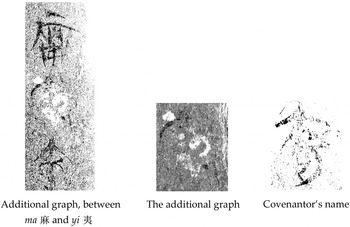
Tablet WT1K17-96 also has an additional graph between ma 麻 and yi 夷, but the graph is almost completely illegible. Figure 1 shows the graph, between the ma 麻, at the top, and the yi 夷 below it, along with an enhancement of the graph, and a close-up of the covenantor's name from the name clause of the same tablet. The few strokes one can make out do not suggest nü 女, the additional graph in the example just discussed. It does seem possible, however, that the graph is the name of the covenantor, which is seen on this tablet in the name clause.Footnote 102 The covenantor's name (Qi 奇?) is not completely legible, but the top component is clearly da 大 and the top-left stroke of the unidentified graph could be part of the same form. If the unidentified graph is the covenantor's name then we have the same “verb-object, verb-object” construction as the first example, i.e.: 靡奇(?)夷彼氏 “Destroy Qi (?) [and] wipe out that shi.” Both examples would support the proposed analysis for the phrase but, given their infrequency, we cannot rule out the possibility that they are some sort of unintentional scribal error.
Tablet WT1K17-96

All the above examples can be explained as variations of the standard phrase ma yi fei shi 麻夷非是, according with the proposed analysis for this phrase. There remain, however, a number of problematic variations, some of which clearly do not fit the suggested analysis. In these cases, in order to judge their significance, it was necessary to consider to what extent a particular variation could be identified as the work of an individual scribe. These examples are discussed in the following section.
Variations and individual scribes
Whether a repeated variation is the work of several scribes or a single scribe should clearly affect our consideration of its validity. This is based on the reasonable assumption that a variation repeated by only one scribe is more likely to be an error (or idiosyncratic understanding of the phrase) than a variation which is used independently by several different scribes. For variants that did not easily accord with the proposed analysis of the imprecation phrase, I considered whether they could be explained in this way. In most cases, the evidence supported this conjecture. This led me to conclude that these variations were errors or misunderstandings of the phrase and did not require rejection of the proposed analysis for this imprecation.
Since the following discussion rests partly on the assumption that scribes did at times make mistakes, let us first briefly consider the broader evidence for scribal error. Traditional textual criticism in China has paid close attention to the identification and categorization of copying errors in transmitted texts, and there are many reference works which provide extensive lists and examples of these errors.Footnote 103 Discoveries since the early twentieth century of brush-written manuscripts in significant numbers have provided scholars with the opportunity to observe early cases of scribal error in hand-written manuscripts. Several studies have been published identifying such errors, and demonstrating the need to be aware of this phenomenon when analyzing these manuscripts.Footnote 104
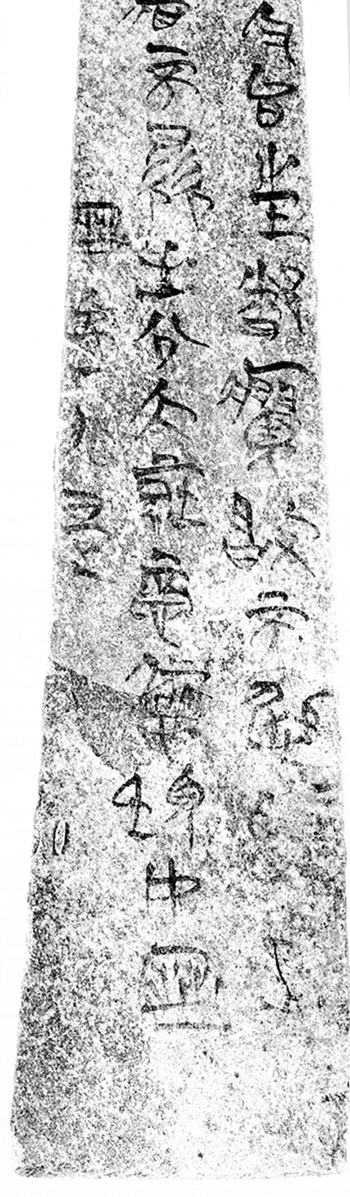
In some cases, scribal error is very obvious. For example, on tablet WT1K1-3071 the scribe wrote the imprecation phrase as ma ma yi fei shi 麻麻夷非是, i.e. accidentally writing the first graph of the phrase twice (see Figure 2). The scribe writes the graph at the end of the second column, then moves to start the final column and repeats the graph. Similar unequivocal errors are not unusual in the covenant tablets, for example character omission is quite common, sometimes with the omitted character written in later at the side of the column. Such examples are easily identified and clearly attributable to unintentional error.
WT1K1-3071 lower section of tablet

Some variations, however, can be harder to classify conclusively as error, particularly when the meaning of the phrase in which they occur is debated, as is the case for the imprecation clause. In such cases analysis is aided by a familiarity with the types and variety of written error commonly found in received and excavated texts.Footnote 105 It is also helpful to bear in mind that variations and errors, particularly at the level of the individual graph, can generally be categorized as involving phonological, semantic or orthographic factors (or a combination of these), corresponding to a graph's representation of a word's sound and meaning using a particular graphic form (or forms).Footnote 106 And, in turn, an understanding of the way in which these factors are processed in the brain can suggest explanations for the production of certain variations and errors. David Moser demonstrates the potential for such an approach in a study of errors in modern Chinese speech and writing.Footnote 107 Such an approach can also be productive in appraising variations and possible errors in early manuscripts and so here I will briefly summarize a model for the cognitive process of writing, before going on to look at specific variations in the Wenxian texts.
Cognitive models of writing distinguish separate components involved in the writing process, including a semantic system (the knowledge of words and their meanings), a phonological lexicon (the store of the sounds of known words), and an orthographic lexicon which stores written forms of words (and their subcomponents).Footnote 108 Different models are proposed for the process of writing a word, but a basic distinction is made between a lexical route for familiar words, corresponding to learned graphic forms, and a sub-lexical (or “non-lexical”) route, which relies on phonological spelling (using the available orthographic lexicon), for unfamiliar words. In the lexical route, the semantic system normally activates the orthographic lexicon both directly, and also via the phonological lexicon. This combined input avoids the potential for the activation of incorrect forms or words. Thus, to avoid possible homophone production (e.g. “bare” for “bear”) there must be simultaneous input from the semantic system to the orthographic lexicon when retrieving the appropriate graphic form. Similarly, without input from the phonological lexicon, there is the potential for semantically incorrect activation, for example, of a synonym (e.g. “road” for “street”). The sub-lexical route to writing is employed when the graphic form (or forms) associated with a particular word is not stored in the orthographic lexicon (i.e. has not been learned) and the word is spelled using a phonological-to-orthographic transcription (e.g. “nife” for /naɪf/, instead of “knife”). There is also evidence that the lexical and sub-lexical routes interact, as demonstrated, for example, in experiments showing that recently activated items in the orthographic lexicon may influence the results of spelling via the sub-lexical route, and this supports the view that the sub-lexical and lexical routes activate the same orthographic lexicon.Footnote 109 In Chinese, in which written forms denote syllabic units and components of graphs can be semantic or phonetic signifiers, we would, then, expect the sub-lexical route to result in the retrieval (from the orthographic lexicon) of a phonetically equivalent graph, or possibly a variant form constructed using both a phonetic and a semantic component.Footnote 110 Whatever route is used, the retrieved graphic form is temporarily activated in working memory as further processing takes place (e.g. conversion into specific letter forms). For Chinese it is argued that the basic processing unit in working memory does not necessarily correspond to a semantic or phonetic component, but rather to the lowest-level component that could be recognized as a potentially independent graph. For example, while we would generally analyze hu 湖 as comprising a semantic component shui 氵 and a phonetic component hu 胡, it is argued that in working memory the basic processing units would correspond to the elements 氵, 十, 口 and 月.Footnote 111
This model is relevant because it helps us to predict the range and nature of errors that might be produced in the writing process, and thus better appraise variations as legitimate or erroneous. In applying this model to scribal copying, we additionally need to consider how the process is affected by the act of copying, either from an exemplar or from dictation (possibly self-dictation from a memorized text).
When approaching written variations and errors in early texts we can, then, apply a methodology that makes use not only of comparison to previously identified categories of error, but also appraises the nature of the variation in the light of an understanding of the cognitive process involved in writing. With this in mind, we will now consider whether we can suggest explanations for variants that do not accord with the proposed analysis for the imprecation.
1. Variations with the graph 
A number of variations are found with the graph . In some of these cases, this graph is replaced by the following variant form:  (1-14-3860). The following variations are found (the number of examples is given and the variant form of the graph is indicated using the symbol “△”):Footnote 112

The graph , common to these variations, also occurs in the excavated covenants in the submission clause that directly precedes the imprecation clause in almost all covenant types. It is analyzed in that phrase as a variant form of shi 視 “to look, to watch.”Footnote 113 The submission-clause phrase, as I understand it, reads: di ji shi ru/zhi 諦極視汝/之 “attentively and tirelessly watching you/him/her,” referring to the overseeing of the covenantor by the sanctioning spirit.Footnote 114
In the above variants, shi (視) is added after or replaces the word yi 夷 “to wipe out, raze, exterminate” and thus cannot be understood to mean “to look, to watch” if we follow the proposed analysis in which a word synonymous with “destroy” is expected here. To better judge the significance of these variations, I identified their frequency among individual scribes.
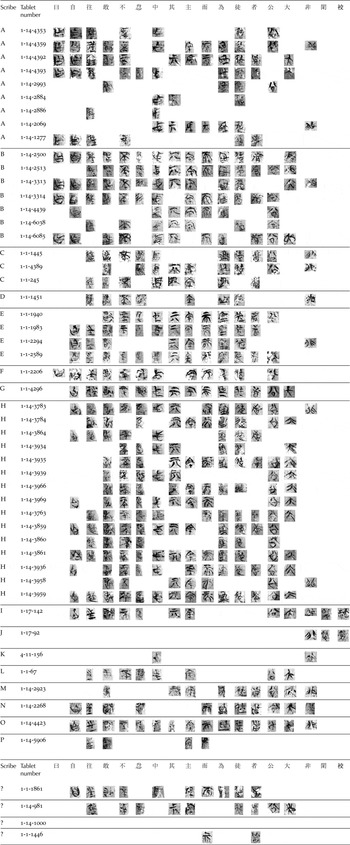
Appendix 2, Table 1 lists the 58 tablets on which these variations occur, grouped by scribal hand. A selection of graphs from each tablet is given for comparison, in order to demonstrate the basis on which identification was made. Texts were identified as having been written by individual scribes based on consistency in the usage of a set of identifiable features, allowing for expected normal variation. Such consistency is particularly noticeable at the level of character formation, with scribes tending to use certain variant forms (at the component and calligraphic levels) for characters, and to use consistent forms for commonly seen components. Consistency in calligraphic style is also apparent in the repeated use of, for example, short wedge strokes, horizontal strokes thickening in the mid-section, horizontal strokes that curve down at the right-hand end, and so on. Use of embellishments is also generally consistent, for example a scribe will either add a short horizontal stroke above long horizontal strokes or will not do so (e.g. in the graphs denoting bu 不 and pi 丕, qi 其, er 而, zhu 主). Individual scribes also show consistency in the size and layout of characters, although these features are not apparent from these tables. Appendix 2, Table 2 gives the variant wordings that include shi (視) and lists the tablets with these variations under the scribe which produced them. This allows one to see which scribes produced which variations and the frequency in each case.
The identification of scribal hands allows us to make the following observations. Fifteen separate hands were identified among the fifty-eight tablets. These fifty-eight tablets come from three different pits (WT1K1, WT1K14, and WT1K17) but no single scribe wrote tablets for more than one pit. The variation in which shi (視) is found in place of yi 夷, giving ma shi fei shi 麻視非是/氏, was written by at least eleven scribes and is found in all three pits. If lacunae are ignored for other examples, this figure rises to fourteen scribes. The variation in which yi 夷 is retained and shi (視) added, giving ma yi shi fei shi 麻夷視非氏 was, in contrast, produced by only two scribes, scribes A and B, both writing for pit WT1K14.Footnote 115 The examples in which the shi (視) graph is written with the variant form, e.g. (1-14-3860), were all produced by a single scribe, scribe H. Among the scribes identified, scribe H is particularly prone to writing variations for this phrase: this scribe also writes the phrase using the graph shi (視), and is also solely responsible for three other variations: 麻非女, 麻△非女 and 麻是. I have also found two tablets written by this scribe in which the phrase is omitted completely (WT1K14-3764/3855).
These observations allow us to make the following conjectures. The variation in which yi 夷 is replaced by shi (視), to give ma shi fei shi 麻視非是/氏, occurs relatively frequently, suggesting it was either considered legitimate, or was an easily made mistake. The variation in which yi 夷 is retained and shi (視) added, giving ma yi shi fei shi 麻夷視非氏, can only be confirmed for two scribes and so is more likely to be due to idiosyncratic behavior on their part, particularly given that it does not suggest a persuasive alternative analysis for the meaning of the phrase. Scribe H is unpredictable and we may be duly wary of all the variations produced by this scribe. Our first task, then, is to explain why eleven or more scribes replaced the character yi 夷 with shi (視).
The use by at least eleven, and probably fourteen, scribes of shi (視) in place of yi 夷, to give ma shi fei shi 麻視非是/氏, suggests that, for these scribes, shi (視) was phonetically close to yi 夷 and, having just written the character in the previous phrase, they used it again for the near-homophone in the imprecation phrase. In the Baxter/Sagart reconstruction system, shi 視 is reconstructed as shi 視 < dzyijH<*gijʔ-s. However, the variant graph used in the excavated covenants, i.e. shi , has di 氐 as its phonetic, for which the reconstruction is: di 氐 < tejX < *tˤijʔ. This implies that in fifth- to early fourth-century b.c.e. Jin, at the time the covenants were produced, the initial of the word shi 視 had already become dental, and we can reconstruct its pronunciation as 視 *dʑijʔ.Footnote 116 The word yi 夷 is “phonologically ambiguous” in that we cannot be sure whether it belongs to rhyme category *-ij or *-əj.Footnote 117 On the basis of Shijing rhyme evidence, the current Baxter/Sagart reconstruction for yi 夷 adopts the *-əj rhyme category giving yi 夷 < yij < *ləj, with a final which does not match that of shi (視) *dʑijʔ. Baxter notes, however, that *-ij and *-əj are often found in irregular rhymes which mix the two.Footnote 118 He gives the example of di 弟, which rhymes with *-əj words in the earlier parts of the Shijing and with *-ij words in the later sections, suggesting a development from *-əj > *-ij. We may posit a similar case for yi 夷, in which this development had already occurred in Jin at this time.Footnote 119 In this case, we can reconstruct the yi 夷 of the covenant tablets as 夷 *lij. Turning to the initials of the two words, contacts between dental initials, such as the *dʑ- of shi (視), and lateral initials, such as the *l- of yi 夷 *lij, are unusual. However, yi 夷's xiesheng 諧聲 series (i.e. the set of characters which share yi 夷 as their phonetic signifier) contains words with dental initials in Middle Chinese (e.g. ti 洟, ti 荑, ti 桋), and graphs with yi 夷 as the phonetic component often loan for words with Middle Chinese dental initials.Footnote 120 For example: yi 夷 is phonetic in ti 洟 < thejH < * ˤəj-s; yi 夷 is used as phonetic in loangraphs for chi 遲 < drij < *lrəj; in Mawangdui texts, yi 夷 is denoted by di 娣< dejX < *lˤəjʔ.Footnote 121 Furthermore, as noted earlier, the Wenxian texts include the graph as a variant for yi 夷 in the imprecation phrase, and the same graph occurs in the Shanghai slip text Bao Shuya yu Xi Peng zhi jian denoting the word zhi 雉 < drijX < *lrijʔ. If the development to the dental initial had begun in some of these words, it is possible to conjecture that a reading error led to mispronunciation of the word with a dental initial. Indicating a non-specific dental initial using [T], this gives us a reconstruction of yi 夷 *[T]ij, and the phonetic similarity to shi (視) *dʑijʔ becomes apparent. On the basis of the cognitive model of writing presented above, we can conjecture that, since the shi (視) had just been activated for use in the previous phrase, di ji shi ru/zhi 諦極視汝/之 “attentively and tirelessly watching you/him/her,” this primed the near-homophone substitution for the misread yi 夷 in the following phrase.Footnote 122 One would expect a generally attentive scribe to not repeatedly make such an error, and indeed for the majority of scribes only one or two examples are seen. However, certain scribes do repeat the mistake: scribe E four times, and the unpredictable scribe H ten times.
We now turn to the variations produced by scribes A and B, in which the graph shi (視) is added to the imprecation after the yi 夷, giving: ma yi shi fei shi 麻夷視非氏.Footnote 123 Both scribes repeat the variant several times (nine times in Scribe A's case) suggesting this was not an unintentional mental lapse. Scribe A also writes the variant just discussed in which the yi 夷 is replaced by shi (視) to give ma shi fei shi 麻視非是, and so we may conjecture that the scribes were aware of both this and the standard form (ma yi fei shi 麻夷非是/氏) and conflated the two. Alternatively, the scribes may have been confused by a correction made to the variant ma shi fei shi 麻視非是, the intention of which had been to indicate that yi 夷 should be written instead of shi 視, and had instead understood both graphs to be needed.Footnote 124
The conjecture that Scribes A and B were unsure of the meaning of certain formulaic phrases being used in the text is supported by a variant in the preceding phrase. Both scribes write the preceding formulaic phrase with a variation which can be explained as a segmentation error. The phrase is normally written di ji shi ru/zhi 諦極視汝/之 “attentively and tirelessly watching you/him/her.” The first word of the phrase, di 諦 “attentively,” is commonly written with the graph  or
 , or some other variant form that retains the phonetic di 帝. Scribes A and B, however, write instead the character shi 是. The words shi 是 and di 諦 are phonetically similar, but not identical: 諦 di < tejH < *tˤek-s; 是 shi < dzyeX < *deʔ. The initials are both dentals, the vowels are identical, but the *-k coda in di 諦 is absent in the word shi 是. This suggests that the use of the shi 是 is almost certainly due to a segmentation error resulting from a reanalysis of the division between this syllable and the following word, ji 極, whose root has a velar initial, matching the velar coda of the preceding di 諦, i.e.: ji 極 < gik < *[g](r)ək. Scribes A and B made a segmentation error and divided the first syllable before its coda, and used shi 是 to denote this syllable, thus:

We may infer from this that scribes A and B were not aware of the correct word choice for the first two words in the submission-clause's phrase di ji shi ru/zhi 諦極視汝/之. This provides circumstantial evidence to support the conjecture that their variation for the imprecation clause, ma yi shi fei shi 麻夷視非氏, is also due to a misunderstanding. It is intriguing that both scribes make the same two unusual variations and we may speculate that they were copying or being dictated to from the same model, or that one copied from the other, or they were working as a pair and jointly concluded these erroneous variants were correct.
We can now consider the unpredictable scribe H. Scribe H writes the common variation in which shi (視) replaces yi 夷, on the basis, we have suggested, of phonetic similarity. Scribe H also writes this variation without fei 非 in one instance, i.e. ma shi shi 麻視是. Taking shi (視) as a loan for yi 夷, this is equivalent to the variants ma yi shi 麻夷是/氏 discussed earlier. Scribe H is alone in writing the ma shi fei shi 麻視非是 variation with a variant form of the shi (視) graph: e.g. (1-14-3860). This variant replaces the form this scribe usually writes for the graph, e.g.  (1-14-3939). The graphs share the same left-hand component, di 氐, but the right-hand component is replaced by one which is difficult to identify, resembling a zhi 豸 underneath a mian 宀. This form is close enough to the regular right-hand component to suggest it is a copying error.Footnote 127 This would necessarily imply that Scribe H was copying from a tablet with the variation in which shi (視) replaces yi 夷 (ma shi fei shi 麻視非是). We can conjecture that this is an example of a delayed copying error, in which the temporary activation of the graph in working memory was compromised and replacement components then retrieved when writing the graph. It should be further noted that in the cases in which scribe H uses this variant graph in the ma shi fei shi 麻視非是 phrase, the graph is generally not used for the shi (視) of the immediately preceding submission-clause phrase, di ji shi ru 諦極視汝.Footnote 128 This may suggest that the scribe was aware, although perhaps not consciously, that these were not in fact the same words, and that this was partly responsible for the compromised activation of the graph in working memory.
Scribe H is also responsible for the two variants 麻非女 and 麻△非女, in which the last character of the phrase is replaced by nü 女. On the basis of the proposed analysis, this would give the nonsensical phrase 靡夷彼汝, with the demonstrative pronoun bi 彼 “that” preceding the second-person pronoun ru 汝, giving an ungrammatical “that you.” It seems likely that having just written nü 女 (ru汝) as the last word of the preceding phrase (di ji shi ru 諦極視汝 “attentively and tirelessly watching you”) the scribe unintentionally replaced the last word of the following phrase with the same graph. This suggests both inattention and also uncertainty as to the meaning of the phrase.Footnote 129 The two cases I have noted in which scribe H simply leaves out the imprecation phrase may also reflect lack of confidence about its meaning. Scribe H's many variations do not suggest a valid alternative analysis for the imprecation phrase, but rather uncertainty about its meaning and its standard written form.
The remaining variation that includes the graph shi (視) is 麻女夷非氏 (WT1K14-4423), the work of Scribe O.Footnote 130 In this tablet the scribe omits the preceding phrase di ji shi ru 諦極視汝 “attentively and tirelessly watching you.” Furthermore, in two other tablets, this scribe uses a short version of the preceding phrase, writing just shi ru 視汝, omitting di ji 諦極. It seems likely, then, that this variation was due to a confusion in which the shi ru 視汝 was inserted into the ma yi fei shi 麻夷非氏.Footnote 131
Two further variations in Scribe O's execution of the final phrase are worthy of attention. Firstly, the scribe writes the final graph of the imprecation phrase with di 氐, e.g.  (WT1K14-4423). This is clearly an error for the graphically similar shi 氏, e.g.
 (WT1K14-4158). The graph shi (視) used in the previous phrase has di 氐 as its phonetic, and so we can conjecture that the recent activation of this form influenced the retrieval of this graph in place of the shi 氏. That Scribe O may have been unsure about this last word is suggested by a further variation: ma yi fei shi di 麻夷非是氐 (WT1K14-4418). Here the scribe not only uses the shi 是 commonly found in this position as a loan for shi 氏, but also writes di 氐, the error for shi 氏. This may be a case, similar to Scribes A and B's use of both yi 夷 and shi (視), where the scribe conflated two variations or was confused by a corrected version of the phrase. Overall, Scribe O's variations suggest uncertainty about the meaning and standard written forms of the imprecation phrase.
2. 麻夷不氏 (WT1K14-1046) and 麻夷女非氏 (WT1K14-1229)
A single scribe wrote both these variants: 麻夷不氏 (WT1K14-1046) and 麻夷女非氏 (WT1K14-1229). Both variant wordings are unique among the legible examples of this phrase surveyed for this study. The variant 麻夷不氏 (WT1K14-1046), which makes no sense however one might analyze the phrase, can be explained as a substitution error attributable to the phonetic similarity of fei 非 and bu 不 (不 bu < pjuw < *pə and 非 fei < pjəj <*pəj), coupled with their association as negative function words.Footnote 132 In the variant 麻夷女非氏 (WT1K14-1229) nü女 (ru 汝) is added after the ma yi 麻夷 and before the fei shi 非氏. Significantly, in this tablet, the scribe appears to omit the pronoun object from the preceding submission-clause phrase, leaving just di ji shi 諦極視, without the expected nü 女 (ru 汝), suggesting unintentional transposing of the word order for the two phrases.Footnote 133 Other tablets written by this scribe demonstrate a tendency to carelessness. In tablet WT1K14-1047, the scribe writes the standard ma yi fei shi 麻夷非氏, but omits both the preceding submission-phrase clause di ji shi ru 諦極視汝, and the da zhong 大塚 of the phrase before that (Yue gong da zhong 岳公大塚). In the same tablet, the scribe omits the yu 與 from the phrase yu zei wei tu 與賊為徒 “join with the enemy as a follower.” In tablet WT1K14-1141, this scribe leaves out the tu 徒 from this same phrase. In three tablets, WT1K14-1046, 1047, and 1235, the scribe leaves out the bu 不 from the first stipulation 敢不繩繩焉中心事其主 “dares not vigilantly and loyally serve his ruler,” the resulting phrase being the direct opposite of the intended meaning, the oath now stating that the self-imprecation will be triggered if the covenantor is loyal to his lord. The scribe was clearly careless and we can be confident in the analysis of the two variations of the imprecation clause as errors and not valid alternatives to the standard wording.
3. 麻夷之非是 (HM 1:40 and HM 1:41)
There are two examples from Houma pit 1 in which a zhi 之 has been added between ma yi 麻夷 and fei shi 非是 (tablets HM 1:40 and HM 1:41). Both these tablets, and another tablet, HM 1:42, were written by a single scribe.Footnote 134 The phrase does not appear in tablet HM 1:42, and the copy of that tablet suggests the scribe ran out of space and omitted the phrase.Footnote 135 The two examples of this variant were, as discussed, one of the main reasons Li Yumin argued against the analysis of the phrase put forward by Chen Mengjia, Zhu Dexi, and Qiu Xigui. However, I would argue that this variant is almost certainly either a mistake or reflects an idiosyncratic understanding of the phrase by this individual scribe. We have already noted that Li Yumin's alternative analysis of this phrase is not convincing. If, as Li argues, this variant is actually the full form of the phrase, we would expect to see other examples, yet there is not a single further case, it is unique to this single scribe.Footnote 136
Nevertheless, while in the cases discussed above there is persuasive evidence that scribes responsible for problematic variants were prone to carelessness or were uncertain as to the meaning of the imprecation phrase, this scribe is responsible for several valid variations which suggest a clear understanding of the content of the oath. Firstly, the language of the first stipulation is changed in two ways. The standard wording is:
[covenantor's name] 敢不判其腹心以事其主
[If] _____[covenantor's name] dare to not split open his guts and heart [i.e. display true loyalty] in serving his lord, …
This scribe changes this to:
[covenantor's name] 敢不剖判其腹心以事嘉 …
[If] _____[covenantor's name] dare to not cut and split open his guts and heart [i.e. display true loyalty] in serving Jia ...
The scribe adds the verb pou 剖 “to cut open” in front of the commonly found pan 判 “to split open,” giving a compound of two synonyms: pou pan 剖判 “to cut and split open.”Footnote 137 The scribe also replaces the term “his lord,” referring to the leader of this covenant, to “Jia,” which is the personal name of this individual.Footnote 138 These variations are unique to this one scribe, but they are legitimate variations.
This scribe also makes use of a unique graphic variant for the graph that denotes bian 變 “to change” in the Houma covenants. The common form for this graph in the Houma tablets is:  (HM 85:2) but there are many variants.Footnote 139 Common to almost all these variants, however, is the phonetic component
 , an abbreviated form of the graph bian
 (=弁).Footnote 140 The only exception is the one legible example of this graph written by the scribe discussed here, who reduces the graph to:
 (HM 1:40).Footnote 141 This highly abbreviated form ignores the general principle observable in the Houma tablets that variations of a single graph retain the phonetic component.Footnote 142 Removed from its context, it is highly unlikely this graph would have been recognizable.
These legitimate lexical variations suggest this scribe understood the text and not only had the competence but also the confidence to make these changes. Nevertheless, the scribe could also be careless, as is evident from an omission of bu 不 in tablet HM 1:41 from the phrase 敢不盡從嘉之盟 “dare to not fully abide by Jia's covenant.” The highly abbreviated form of the graph used to denote bian 變 could be taken as insensitivity to basic principles of orthography, but alternatively might be regarded as a sign of confidence in the writing of the script that led to extreme (perhaps playful) abbreviation. I conjecture that the scribe was competent but prone to idiosyncratic variation and that, if the variation in the imprecation phrase is not an error, it reflects a personal understanding of the phrase that does not accord with its standard meaning. Unlike the valid lexical variations made by this scribe, it is not clear what this variation could mean.Footnote 143 This point, along with the variation's unique association with an idiosyncratic scribe, lead me to conclude that it is not equivalent to the standard formula used in the imprecation phrase. This variation does not, I conclude, present a challenge to the proposed analysis for this phrase.
4. 非夷■ (HM 79:8)
This variant occurs on a fragment from pit 79 at Houma. One side of the small fragment has two columns of characters (see Figure 3).Footnote 144 The left-hand column is ■之非夷■. The zhi 之 is assumed to be the last character in the submission-clause phrase which, for this category of tablet (the Pledge Texts), is yong ji shi zhi 永極視之 “forever tirelessly watching him.” The imprecation phrase following would normally start with ma yi 麻夷, but here the scribe has written fei yi 非夷. This variant was cited by Li Yumin, along with the variation just discussed (ma yi zhi fei shi 麻夷之非是), to support his argument that the fei 非 should be regarded as a verb. However, this is more likely to be scribal error than a conscious lexical variation. Firstly, this is the only example of this variation among 1,750 tablets from Houma and Wenxian in which the imprecation phrase is fully legible, an occurrence of just 0.057%. Furthermore, even within this single tablet, this scribe did not consistently use this variation. This fragment's right-hand column has two graphs: ■之麻■. In the Pledge Texts, several oaths appear together on each tablet and, as a result, the submission and imprecation clauses are repeated twice. These two graphs belong to the first occurrence of these phrases in this tablet. The graphs' original context can be reconstructed as such: [永亟 ]之, 麻[夷非是]. Thus we can see that, in this case, the scribe starts the imprecation phrase with the expected ma 麻, and not the fei 非 of the variant wording. Given that only a single scribe writes this variation, and the scribe does not do so consistently even within a single tablet, we can be confident that this is much more likely to be a case of scribal error than a valid alternative to the standard phrase.
HM 79:8 (diagrammatic representation)

In this section I have demonstrated that variations in the imprecation phrase that do not accord with the proposed reading can be attributed to specific scribes and the observed scribal habits of these individuals support the conjecture that these variations are errors or, in rare instances, may reflect an idiosyncratic understanding of the phrase.Footnote 145 I have shown that the majority of these variations conform to recognized categories of writing error common in hand-written Chinese text, and that in several cases these errors can be explained in terms of our understanding of the cognitive process involved in writing.
Discussion
This study of variations in the Houma and Wenxian covenant texts' imprecation ma yi fei shi 麻夷非是 supports Zhu and Qiu's analysis of the phrase as “Wipe out that shi” mi yi bi shi 靡夷彼氏. The study demonstrates that over 2,000 previously unseen examples of this phrase from the Wenxian covenant texts support this reading. While variations do exist that do not accord with the proposed analysis, I conclude that, based on the identification of individual scribal hands, these variations can be explained as errors or possibly, in a very few cases, idiosyncratic interpretations of the phrase by particular scribes.
These results confirm that the most common formula used in the imprecation clause in the excavated covenants is a threat to the covenantor's shi 氏, which I believe refers to the covenantor and his direct male descendants. The threat is not to the covenantor's wider lineage, but to his own patriline. This reflects the focus in these covenants on the individual, and the assumption that the individual could act independently of the wider lineage when it came to choices about political allegiance.Footnote 146
Attention to the writing habits of individual scribes was essential in making an informed appraisal of variations in this imprecation phrase. This required the identification of scribal hands using objective criteria to identify a set of features particular to a single hand. The finding that certain variations were associated with certain scribes avoided erroneous conclusions about their significance based purely on frequency of occurrence. It was established that relatively high-frequency variations could be the work of just one or two scribes, raising the possibility that these variations were not valid alternatives to the standard phrase. For these and other variations it was possible, in many cases, to demonstrate that the variations accord with categories of scribal errors well known from received texts and Chinese writing in general, supporting the theory that many scribes were producing variations that were unintentional errors or were based on a misunderstanding. This reminds us that an appreciation of scribal habits and common scribal errors allows a more informed analysis of excavated palaeographic materials.
This study's focus on repeated problematic variations by individual scribes should not be taken to suggest that a variation attributable to just one or two scribes is inevitably an error. We noted, for example, the Houma scribe of tablets HM 1:40/41/42 who made particular but valid variations to the loyalty stipulation. A variation made by a single scribe can, in some cases, provide a clue that solves a major problem of identification. For example, it was a single scribe's use of a variant character that led to the identification of the sanctioning spirit invoked in the covenants as Lord Yue 岳公.Footnote 147 Essentially, in that case, the single-scribe variation suggested an analysis which accounted for the associated evidence more satisfactorily than any previous proposal. However, in cases where a persuasive analysis already exists, an uncommon variation that does not fit the analysis, and does not suggest a more convincing analysis, should be treated cautiously.
The analysis brought to light interesting distribution patterns of variants among the pits at Wenxian. It was noted that the variation in which the ma 麻 is replaced by wang 亡 is almost exclusive to just two pits, one at Houma and one at Wenxian, both of which share a particular style of covenant formula. These shared features may suggest that both pits date to a period somewhat later than the majority of covenants from these two sites. The dramatic difference between pits WT1K1 and WT1K14 in the ratio of frequency of use of shi 是 or shi 氏 for the last graph of the imprecation was also discussed as possibly reflecting different dates for these two very large covenant ceremonies, each of which involved thousands of participants.
The identification of scribal hands undertaken for this article suggests that individual scribes were generally consistent with respect to writing style and individual character formation. This is a preliminary finding given the limited size of the data set analyzed. Nevertheless, consistency in a set of recognizable features would be expected from an individual scribe (unless the scribe was consciously trying to write in different styles). The Houma and Wenxian covenant texts are well known for the great variation they show between graphs.Footnote 148 Based on this study, I would tentatively conjecture that such variation reflects the habits of different scribes, rather than individual scribes employing a wide variety of different variants and styles when writing.
An awareness of the highly formulaic nature of the covenants was a key factor in the analysis of the imprecation phrase. Many of the phrases used in the oaths were stock formulae. Some are straightforward and were no doubt in common usage, such as the phrase used in the covenants to indicate the period of effectiveness, i.e. “from today onwards” zi jin yi wang 自今以往. However, others, such as the imprecation phrase, may have had more restricted use, were possibly archaic, and were thus more liable to be misunderstood, increasing the chance of error when writing the phrase down.
The conclusion that the imprecation ma yi fei shi 麻夷非是 was a stock formula used in oaths lends credence to the insightful suggestion, proposed by Zhu and Qiu, that the same phrase is found, albeit in an almost completely unrecognizable form, in a covenant recorded in the Gongyang zhuan 公羊傳 (text: third century b.c.e.).Footnote 149 The words of the oath are: 苟有履衛地食衛粟者,昧雉彼視.Footnote 150 The stated condition is clear, “If any one of us steps on Wei land or eats Wei grain,” but the phrase that follows, 昧雉彼視, which must be the imprecation, is opaque. The He Xiu 何休 (129–182 c.e.) commentary suggests it means that those swearing the oath watched (shi 視) a bird (zhi 雉) being killed (wei 昧) to let them know the fate of one betraying the oath. However, syntactically this is highly problematic. Zhu and Qiu suggest that the phrase is the same imprecation found in the covenant texts, written phonetically (apart from the bi 彼 which uses the correct graph, although perhaps not intentionally). The phonetic argument is convincing.Footnote 151 This is evidence for a wider usage of the phrase, extending to areas outside Jin, and the recording of its use in written records. Yet the characters used suggest that the precise meaning of the phrase had been lost by the stage this example was written down. This is in contrast to the phrase as it is written in the excavated covenants, which employ what would have been graphs in common usage for the proposed readings.
The evidence presented in this study is relevant to a broader discussion of manuscript production and reproduction but an in-depth analysis of the issues would be premature prior to identification of all the scribal hands and the variations associated with each scribe. Below I will make just a few preliminary remarks on this topic.Footnote 152
The excavated covenants from Houma and Wenxian were produced to function as a central part of a mechanism of political control and organization of subordinate groups by lineage elites in Jin during the fifth and early fourth centuries b.c.e. The thousands of individualized covenants tell us that elites were engaged in the production of texts that projected the authority of the written word over a very wide spectrum of groups and ranks.Footnote 153 They are relatively early examples of the spread of writing that takes place in the Warring States period, implying widespread functional literacy.Footnote 154
In considering the production of these particular texts, we may first note that the genre of oath and covenant had a strong oral component.Footnote 155 As such, the basic structure and standard formulaic phrases used in oaths would have been widely known.Footnote 156 The Zuo zhuan is full of both oral and written examples of oaths, many made on the spur of the moment in response to particular events. Examples in which covenants are written down imply the presence of a scribe or other literate individual. For example, there is a case in which the parties to a covenant argue about the content of the text at the time of covenanting, with one party making the demand, “Change the covenant text” (gai zaishu 改載書).Footnote 157 Another example describes the falsification of a written covenant.Footnote 158 In such episodes, the covenant is written or revised before its dispatch to the sanctioning spirit or spirits during the covenant ceremony (e.g. using burial or submersion). The Zhouli includes a Supervisor of Covenants (simeng 司盟) whose responsibilities include the writing of the covenants, proclaiming words of the covenant to the spirits during the covenant ceremony, making and keeping copies of covenants, and so on.Footnote 159 The Zuo zhuan provides evidence that, in addition to copies prepared for the overseeing spirits, the texts of at least some covenants were preserved by officials in the form of written records. There is mention of an archive dedicated to covenants, the mengfu 盟府, and cases in which ancestral covenants are quoted suggest records of them had been kept.Footnote 160
On the basis of such historical records and the excavated covenants themselves, we can make a number of conjectures concerning the production of the Houma and Wenxian texts. The excavated covenants contain one or more highly specific stipulations that require or prohibit some particular behavior on the part of the covenantors. These stipulations were the motivation for the covenant and we can reasonably assume that their composition would have been initiated and finally approved by the head of the lineage, perhaps in consultation with other high-ranking members of the lineage-centered group. The formulaic non-specific sections of the oath could potentially have been left to the relevant official to complete, although the lineage elites would have almost certainly been familiar enough with the genre to provide precise language themselves if they so wished. Apart from the formulaic language and specific stipulations, the individual name of each participating covenantor would have had to be added separately for each tablet during the copying process. The complete text, then, contains three distinct elements: formulaic sections; at least one stipulation particular to the oath type; and an individual name which is specific to each copy.
The Houma and Wenxian oaths were to be copied on tablets for the covenant ceremony and almost certainly also archived in some form, so it is likely that a written version was made as soon as the specific content had been decided on, and exemplars provided to the official overseeing the copying process. Many of the scribes would have been familiar with the stock formulaic phrases common to the oaths. However, they would have had to learn the stipulations specific to the oath. For the Wenxian oaths these are generally very short and could have been quickly memorized, but some of the Houma examples contain multiple oaths with long lists of enemy names that would have taken more time to memorize. Regardless of the extent to which a scribe had memorized the content of the oath, every time a copy was made the scribe would have had to be provided with the name of the individual covenantor for whom the text was being prepared.Footnote 161
There are two ways in which the name of each covenantor could have been provided to the scribe: either directly by the covenantor, or from a pre-existing list of names. If each covenantor needed to be present while a scribe wrote the full text of the individualized tablet, then for those covenants with thousands of participants this would have presented a significant logistical challenge and covenantors would have had to arrive well in advance of the ceremony itself to go through this process. It seems clear, based on records of covenants and oaths in early texts, that all covenantors would have been expected to be present for the actual ceremony. The covenantors would have gathered together in advance of the ceremony and their presence been confirmed in some way.Footnote 162 Thus it is certainly possible that the scribes worked during this period directly prior to the ceremony, seeing each covenantor in person. Nevertheless, working from pre-existing lists of names would have been logistically simpler and this possibility is worth considering. In this case, lists might have been partly based on existing written registers, but given that at least some of these covenants appear to be aimed at consolidating groups of people during times of upheaval, members of which may have previously been affiliated with different elites, we can also conjecture that lists of names would also have been drawn up specifically for these events.Footnote 163 Such lists might have been produced by heads of smaller groups that were swearing allegiance to the Han or Zhao leader and then provided to representatives of those leaders for use in preparing the covenants.Footnote 164 There are cases among the Wenxian texts of sets of tablets that were prepared by a single scribe for a group sharing the same lineage name, and placed as a set in the pit.Footnote 165 This would accord with a single scribe working from a list of names organized by lineage affiliation.Footnote 166
The scribes would have been faced with a document that had a standard structure and included several familiar phrases, although perhaps in some cases archaic stock phrases, but also one or more stipulations specific to the oath, and finally a requirement that every copy of the text be individualized with a personal name. The content of the oath must have been provided to the scribes either in written form, or possibly a written model was read out to them. Given that the texts were generally short (particularly those from Wenxian), included many stock formulae and were repeatedly copied, we can speculate that, once familiar with the text, the scribes may well have written fully or partly from memory (possibly vocalizing as they wrote). However, before starting on a new tablet, in order to be able to personalize the text, they would have needed the name of the covenantor, either from the covenantor in person, or by referring to a list of names.
On the basis of representations in painting and sculpture from the Han and later periods, Li Songru concludes that Warring States scribes wrote in a kneeling position and that the writing material was not separately placed on any sort of stand when writing but held up in one hand, the brush held in the other.Footnote 167 The shape and material of the covenant tablets make them well suited for being held in one hand to be written on in this way. A low stand is shown in some of the later representations for placing writing materials, ink and brushes, and so on, and we can conjecture something of this nature would have been used by the scribes preparing the covenant texts. They would also have needed space for the blank tablets and a further space to place the completed tablets (unless assistants delivered and collected each tablet). Li does not discuss where an exemplar would have been placed, but presumably this would have been on the low stand, or possibly held by an assistant.Footnote 168 Having to refer to an exemplar while both hands are occupied means no hand is free to keep one's place in the exemplar and one must rely solely on the eyes to find one's place, which can lead to various errors.Footnote 169 In the case of the covenants, the name of the individual covenantor also had to be taken, or found in a list each time a tablet was written, further complicating the writing task. Further distractions include the need to reload the brush with ink.Footnote 170 Overall, the reproduction of the texts, particularly if an exemplar was used, would have required attention to, and switching between, different tasks, increasing the likelihood of distraction leading to written errors. Dictation of the text would have reduced some of these distractions but opened the way for other types of written error. As to the environment in which the scribes were working, we can assume that levels of light and noise, heat and cold, would have varied, and that individual scribes may have had visual or hearing impairments, all factors that could have affected performance.Footnote 171
This reconstruction suggests external factors possibly significant in the production of the observed errors. For example, segmentation errors, in which word boundaries are misconstrued, were identified as the likely cause of one, possibly two variations, and such errors accord with the suggestion that there was an oral component to the copying process.Footnote 172 William Baxter in discussing the causes of such errors explains: “The scribe may have been writing from dictation by someone (perhaps himself) … without always understanding what it meant; thus sometimes he would write the wrong character because of inaccuracies in either pronunciation or hearing, or through inattention.”Footnote 173 The fact that misunderstanding is a factor in segmentation errors supports the view that certain formulaic phrases, such as the imprecation, may have become archaic and not fully understood by some scribes. The imprecation's appearance in almost unrecognizable form in the Gongyang zhuan suggests it went on to be used and transmitted long after its precise meaning had ceased to be understood.
Dictation (possibly to oneself) would also explain the variation in which shi (視) replaces the phonetically similar but graphically dissimilar yi 夷. However, the subcategory of this variation in which shi (視) in this position is written by one scribe (Scribe H) with a different but graphically very similar graph, suggests the scribe was referring to a copy (quite possibly the scribe's own) with the variation just discussed, in which shi (視) replaces yi 夷. This example, as well as other cases of scribes who make a variety of errors, suggest these scribes were not paying close attention to a written exemplar. More generally, valid variations like the use of shi 是 for shi 氏, the common interchange of personal pronouns like zhi 之 and ru 汝, er 而 and qi 其, lexical variants, and the numerous calligraphic and component-level variations seen at the level of individual graphs, all indicate that scribes were not slavishly following a written exemplar, even if one was to hand.
We can, then, conjecture that while written exemplars were available, scribes were not always directly copying from such exemplars, that in some cases the text may have been dictated to them, or memorized and vocalized when writing, or even copied from one of their own completed tablets. The apparent lack of concern for complete accuracy in the copies is also indicated by the relatively few cases where corrections were made to the texts. One does sometimes see omitted graphs added at the side of a column but errors are not consistently corrected. It appears that there was not a demand for complete accuracy in texts prepared for the sanctioning spirit, the inclusion of the name of each covenantor perhaps being considered the most essential piece of information. The scribes and the officials directing the work were aware that the tablets would soon be buried in the ground, unavailable for later scrutiny, and this may have meant there was less demand for precision.Footnote 174
These preliminary observations, based on the limited analysis presented in this study, show the potential that a comprehensive analysis of the materials would have to provide a clearer picture of the range and nature of scribal variation, and a better understanding of the production and reproduction of these texts.
Appendix 1: A survey of the phrase ma yi fei shi and its variants in the Wenxian and Houma Covenant Texts—tabulated results
The results are given in three tables, one for the Wenxian texts and two for the Houma texts. The survey on which these tables are based looked at all tablets photographed during the first major round of photography in 1999–2000, but was completed prior to a further round of photography carried out in 2009 (see the main text for further details). The following key applies to all three tables.
Key:
• The variant wordings along with different combinations of legible and illegible graphs are given in the first column on the left. A number of different combinations of legible graphs that occur with illegible graphs and/or broken sections of tablet have been treated as one category when this does not obscure significant variation in wording. In such cases the symbol “…” indicates some combination of graphs and/or illegible or broken areas which have not been included. Thus, for example, the category “… 是” includes tablets with the wordings: □□非是; □夷□是; □□□是; ■非是; ■是.
• Lines between rows divide the rows into groups based on some obvious shared feature. For example, all the examples that begin with the graph wang 亡 are grouped together.
• Pit numbers are given at the top of each subsequent column. The number of examples of each different wording is given for each pit. If no number appears in the box, the number was zero.
• The total number of examples for each category of wording is given in the last column. Totals for each pit are given in the last row.
• When the number of examples of a particular wording from a pit was only one and this is considered to be an important example, the actual tablet number is given in the cell, for example 1-17-43 indicates tablet WT1K17-43.
• The following symbols are used: □ = A graph appears to be present but is too illegible to be confidently identified; ■ = break in the tablet—the number of graphs missing was not estimated so ■ indicates a space of one or more graphs;
= legible (or partly legible) but unidentified graph.• The graph usually written in the texts as
is given in the table as 夷. The graph usually written as in the texts is given here as 視.• Wenxian pit WT4K5 has tablets belonging to a single category that does not use the ma yi fei shi phrase, so this pit is not included in the table. Wenxian pit WT1K3 has just a small number of tablets, most of which are largely illegible, and none of these has any sign of the ma yi fei shi phrase, so this pit is not included in the table. Wenxian pit WT1K4 has only three tablets with partly legible text, none of which has a legible imprecation clause, so this pit is not included in the table.
• In the Houma tablets, in the Pledge Text category, the phrase ma yi fei shi occurs twice and these are treated as separate occurrences.
• Where a wording has a number in brackets after it, this refers to a further note placed at the end of the table.
 = legible (or partly legible) but unidentified graph.
Wenxian Covenant Texts

Houma Covenant Texts, part 1

Houma Covenant Texts, part 2

Wenxian and Houma covenant texts—list of less common variant wordings with individual tablet names
The following categories are not included: 麻夷非是; 麻夷非氏; 麻 … 是; 麻 … 氏; … 是; … 氏; 麻 …; …夷非/夷/非 …; ma yi fei shi omitted; ma yi fei shi possibly omitted; Broken; Illegible; Wording not confirmed; No image.

Appendix 2
Categorization by scribe of tablets with the variation that includes shi (視), with a sample set of graphs to show the basis for identification
The table groups tablets by scribe. From the left, the first column identifies the scribe as A, B, etc. The second column gives the tablet number. The remaining column headings are a set of characters found in all or some of these tablets. The column headings give the standard modern form for the graph, or a formal transcription of the graph if no standard form is attested (bu 不 denotes both bu 不 and pi 丕;  has several variant forms). For each tablet, an image of each of these graphs is given when available and legible. The graphs are not to scale. The images are grayscale and the contrast between the ink and stone has been digitally enhanced and the degree of contrast varies from image to image.
Graphs for comparison

Variant wordings for the ma yi fei shi phrase that include the character shi (視)—categorized by scribe.
The variant wordings are given in the second column from the left. The scribes are identified as A, B, etc. The tablet numbers for each tablet with the given variant are recorded for each individual scribe. The pit label is only given once, after which the individual tablet numbers are listed and separated by a forward slash. If there was some doubt about the identification of the scribe, a question mark is placed in brackets after the tablet number. In the case of a tablet for which the hand could not be confidently categorized, the tablet number is placed in the final right-hand column. The variants which use the variant graph for shi 視, e.g. (1-14-3860), are given separately and the variant indicated by △.

 , if taken to be a variant for yi 夷 means “to make level,” fei 非 “to be not,” “be wrong,” shi 是 “this,” “be right.”


 非氏 (WT1K14-2069). The tablet is broken before the yi 夷 but we can conjecture that the missing graph is the ma 麻 we would expect in this position. The “
 . This form is a reasonable match for the character er 二 “two” as it appears in the date found on tablets from pit WT1K1 at Wenxian, e.g.:
 (1-1-1991). No straightforward explanation would account for the addition of the word er 二 “two” here and I assume that this is a further sign of Scribe A's uncertainty as to how to write this phrase correctly.
 . I had wondered whether this was shu 庶 “children of secondary wives,” which would have fitted the proposed analysis well (combining with the shi 氏, the male offspring of the primary wife). However, the match with shu 庶 is not fully convincing, and it turns out that this scribe is unpredictable. This tablet is one among three from this pit (tablets 43, 110 and 112) written by the same scribe, all of which do not use the standard covenant type for this pit but instead a very basic text just requiring loyalty, without any specific stipulations and, in each copy, the scribe varies the wording of the loyalty phrase. Furthermore, in tablet 43, the scribe appears to have left out the covenantor's name in the name clause and so it may be simpler to conjecture that the additional graph is the covenantor's name, which the scribe has appended at the end.
 (Yuan ding 員鼎);
 ,
 ,
 (Zhongshan Wang Cuo zhaoyu tu 中山王
 (Ping Yin ding 平陰鼎);
 (Xin'an jun ding 信安君鼎);
 (He zun 何尊). This of course would suggest shi 視was an ideal graph with which to denote shi 氏. There may, then, be more to be said about the reconstruction of shi 視's Old Chinese pronunciation. Nevertheless, the vowels *-i- and *-e- are already close, and the *-j coda in *-ij may have brought the *-i- closer to the *-e-. So, overall the use of shi 視 for shi 氏 seems plausible. The fact that those speaking and recording this phrase may have been uncertain as to the precise identity of the individual words of which it is composed may also have led to some confusion as to the correct pronunciation of its component syllables.