I. INTRODUCTION
Historians of economics have acknowledged the significant role François Quesnay and the Physiocrats played in the early development of mathematical economics. According to Joseph Schumpeter ([1954] Reference Schumpeter1987, p. 232), Quesnay’s contribution was important not only because “he did genuinely econometric work,” but also because the Tableau économique was the first “explicit conception of the nature of economic equilibrium.” Wassily Leontiev has mentioned the role played by Quesnay’s Tableau in the development of his own model of input-output (Leontiev Reference Leontiev1936, p. 105). Footnote 1 Indeed, since then the Tableau has been considered as a major forerunner of modern (mathematical) economic models. Footnote 2 It is, however, important to note that this judgment is based mostly on rational reconstructions of Physiocratic theory, for “the Tableau was mathematical [only] in character” (Theocharis Reference Theocharis1961, p. 61). Likewise, Ross Robertson (Reference Robertson1949, p. 523) states in his “Survey on Mathematical Economics before Cournot” that the Physiocrats “used only arithmetic devices, and although the Tableau économique could well be translated in algebra, [they] did not do this.”
As part of our research on one of the least-known collaborators of François Quesnay, Charles Richard de Butré, we have uncovered documents that show that one Physiocrat did use algebra to explain his theoretical conceptions. Footnote 3 From the mid-eighteenth century to the Revolution, the French political economy blossomed (Théré Reference Théré and Faccarello1998, pp. 18–23). By the mid-1760s, the physiocratic political economy was turning into a complete theory of the functioning of society and its government. In parallel, mathematical analysis (especially algebra) was becoming a standard instrument in the hands of mathematicians (Hankins Reference Hankins1985, pp. 17–20). At the summit of the discipline, Alexis-Claude Clairaut and Jean le Rond D’Alembert stand as two famous algébristes and salonniers; while, at the bottom, college courses were opening and introductory manuals were being published at an accelerating pace. Footnote 4 Butré’s research stands at the crossroads of these two largely unrelated scientific communities. In two texts written at the end of 1766 and the beginning of 1767, Butré systematically used algebra as an aid for economic reasoning. Our argument is that these texts provide very interesting insights into the development of early mathematical economics.
In the following, we investigate the sources that might have inspired Butré in applying a mathematical method to political economy and the type of mathematical method he used. In a second section, we open a general discussion on Butré’s significance in the history of early French mathematical economics and go further into how his contribution allows us to better understand the context in which several French economic writers developed an interest in applying mathematics to economic issues.
II. BUTRÉ AS A MATHEMATICAL ECONOMIST
Charles Richard de Butré met Quesnay while he was staying in Versailles in one of the king’s bodyguard units. Military by profession, Butré had pursued a degree in philosophy in his youth. It was then that he was introduced to elementary mathematics, which was one of the courses that the students had to take. Butré must have been impressed by this introduction because, throughout the course of his intellectual life, he showed a particular interest in numeracy and the search for numerical relationships, especially in his economic works. Indeed, Butré wrote two pieces at the end of 1766 and the beginning of 1767: an essay he sent to the Agricultural Society of Limoges and a short treatise named Elémens d’oeconomie politique. These are distinctive from the writings of other Physiocrats (including François Quesnay) in their sweeping use of algebra. Indeed, when Anne Robert Jacques Turgot received Butré’s essay, he was bewildered by it. In a letter from 22 December 1766, Turgot confided to his friend and Physiocrat Pierre Samuel Du Pont: “I am afraid for M. Butré that he is the author of a rough dissertation from Tours lightly sprinkled with algebra. M. de Saint-Péravy is extremely above him” (Turgot [1766] Reference Turgot and Schelle1914, p. 520–521). Turgot’s reaction is probably typical of the skepticism and even incomprehension met by Butré’s theoretical experiments, and his fellow Physiocrats were every bit as doubtful. Aside from the letter just quoted above, we were unable to find even one mention of Butré’s mathematical economics. In this work, Butré was clearly inspired by Quesnay’s 1766 articles: “Analysis of the Arithmetical Formula of the Tableau économique of the Distribution of Annual Expenditure in an Agricultural Nation” and “[First] Economic problem.” Footnote 5 Like Quesnay, Butré wanted to apply the “analytical method” to philosophy and social science. Footnote 6 However, in contradistinction to Quesnay, who rejected the use of unknowns in economics and favored arithmetic, Butré privileged algebra in the two works mentioned above. In addition to personal tastes—Quesnay seemed to have preferred geometry to algebra—their choices might be a consequence of their different educational backgrounds. While Quesnay never went to college and was completely self-taught in the realm of mathematics, Butré was at least introduced to basic algebra and geometry in the final years of his college studies. Footnote 7
However, Butré certainly needed to refresh and update the mathematical knowledge he obtained from his education when he first thought of applying algebra to political economy. Although public lectures of natural philosophy were disseminating in Paris from the 1750s on (Lynn Reference Lynn2006), Butré most likely read and worked from one or several mathematical manuals that circulated at that time. Footnote 8 Butré’s papers contain only one specific mention of the mathematical manuals he may have used. Footnote 9 As we will see in the following, we can nevertheless achieve some degree of confidence about the sources Butré consulted and was inspired by when he began working on an algebraic presentation of his economic ideas.
The first possibility we explored is that he might have used one of the manuals he worked on as a student in the 1730s. In that case, a likely hypothesis is that he used a manual produced by a Jesuit. There were two published at that time: the manual of the widely known Parisian professor of mathematics, Father Louis-Bertrand Castel, published in 1728; and the one published in 1737 by Father Jean-Baptiste Duclos, professor in mathematics at Lyon. However, the most successful manual was by far Dominique-François Rivard’s Elémens de géométrie, avec un abrégé d’arithmétique et d’algèbre, which was published in 1732 and widely used in Jesuit colleges and elsewhere for at least the next half-century. Footnote 10 There is at least one mention of Rivard’s manual in Butré’s papers, in the context of a discussion with Quesnay on the latter’s research on geometry published at the beginning of the 1770s. Footnote 11 However, the edition used by Butré in this instance was not the first, but one published at the earliest in 1744 and therefore after his college studies. In addition to these three, there are at least three other worthy candidates that were all published between the time when Butré finished his studies and 1766: Charles-Etienne-Louis Camus’s Cours de mathématique (1749–1752); Alexis-Claude Clairaut’s Elémens d’Algèbre (1749); and Jean-Mathurin Mazéas’s Elémens d’arithmétique, d’algèbre et de géométrie (1758). Footnote 12 Since Quesnay and Butré were working together on these topics throughout the 1760s, it is interesting to note that all these manuals (with the exception of Duclos and Mazéas) appeared in the record of Quesnay’s after-death inventory (Longhitano Reference Longhitano, Longhitano and Cartelier2012, pp. 197 and 200–201).
With the exception of Castel, all these manuals contained “problems” that applied the general principles of algebra in a didactic manner. Most of them adopted a similar style of presentation with only slight variations: the author begins with a exposition of principles and definitions and goes on to present a series of problems that illustrate and apply these principles. Likewise, the solution of the problems follows a similar pattern in all the manuals: the author first states the problem in everyday language before extracting one or several equations from this statement. He then reduces these equations to only one algebraic formula and replaces the algebraic signs with the known values in the formula to solve the problem by computing the numerical value of the unknown variable. The exercise invariably finishes with a comment analyzing the solution and the method followed. Footnote 13
Of all the mathematical manuals explained above, Clairaut’s is the worthiest for understanding the work of Butré more fully. Along with D’Alembert, Clairaut was one of the French mathematical stars of his time and, like Quesnay, he was a member of the Paris Academy of Sciences. Footnote 14 His Elements of Algebra stands out as the most didactic as well as one of the most advanced of all the available manuals, at least in algebra. He adopted a distinct style of presentation by harmoniously integrating the examples, the problems, and the theoretical principles. Lastly (and this is, in our opinion, the most important point), he is the only one to provide a detailed account of what was then known as the “analytical method”: that is, the “general method for resolving problems.” With this method, the student solves problems “by using, instead of numbers given in a specific context, letters which express all kinds of values (grandeurs); & I show how to extract particular solutions from general ones by means of substituting numbers in place of letters” (Clairaut Reference Clairaut1746, p. iii). Moreover, the problems he uses to illustrate the analytical method are strikingly similar in form to those written by Butré in the Elémens d’oeconomie politique (see the Appendix of this article for further proof of this point).
In the Encyclopédie, D’Alembert defined the analytical method “as the method for solving mathematical problems,” and he added that it was through its use that “we have made over these last two centuries such beautiful discoveries in mathematics” (D’Alembert Reference D’Alembert1751, p. 400). Another definition from one of the manuals cited above illustrates vividly the potential that analysis might have had for Butré: “Analysis is the method that one uses to discover a truth, in decomposing and in examining it, and in comparing all the ratios, so that by means of those which one knows, one is able to discover those ratios that he did not know first-hand” (Duclos Reference Duclos1737, p. 176). Butré seemed to have adopted the point of view of mathematicians like D’Alembert and Clairaut, who identified analysis with algebra. Footnote 15 Hence, like the authors of the mathematical manuals of the time, he solved his problems with algebra. Butré used it in two different economic works: the essay sent to Limoges and the Elémens d’oeconomie politique. In the latter, algebraic reasoning is concentrated in the last two chapters. Footnote 16 In the first part of the Elémens, Butré presented his principles. He finished with a series of “nine problems resolved with the analytical method,” in which he made use of algebra to generalize his results. Conversely, the essay and the last chapter of the Elémens are dedicated to a specific issue: the consequences of indirect taxation.
Butré began each of the problems with a literary exposition of it. The wording of his Problème 1er fondamental is typical: Footnote 17 “The total value of annual productions of a nation, the costs and gains of food trade (commerce comestible) … and those of industry, and the relationship or ratio between the spending on food and on manufactured goods being given; find out what the ratio between the [value of] raw subsistence goods and the [value] of raw materials should be to have an equal balance in food, primary goods and industry” (Butré Reference Butré1767, notebook 3, f. 1) Then, Butré engaged in the first stage of problem solving through the analytical method; that is, he translated the problem into a set of equations. Footnote 18 For example, in the first problem, Butré stated:
“To solve the problem in a general manner, I will name:
a, the production of the productive trade;
x, the [value of] raw material [used by the industry];
a − x, will be the [value of] raw food [alimens]” and so on.
He then established his first general equation in order to find his unknown x: Footnote 19
“ a − x + g = nx + nf ” where g represents the cost and gains of the food sector, f represents the costs of manufacturing, and n represents the ratio between the spending in food and in manufactured goods (idem.). He went on to accomplish the second task set by the mathematicians, which is to isolate the unknown:
“
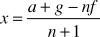 $x = {{a + g - nf} \over {n + 1}}$
, a general formula that gives the value of the unknown in all possible cases; let’s make an application [of it]” (idem.). That is, he solved the problem by replacing the letters with known numerical values.
Butré concluded that “
 $x = {1 \over 3}a$
” and he added, “One can see that the found ratio meets the criteria of the problem. Hence, when in a nation the food expenses equal the expenses on manufactures, it is necessary that the value of annual production is two-thirds on raw food and one-third on raw material, to have an equal balance between [the value of the production of] food, raw material and industrial goods....” (idem.)
Butré labeled this first problem as “fundamental,” because it gives the ratio of the distribution of the goods produced by the productive sector, which guarantees that each of the three sectors of the economy is self-sufficient; that is, they do not need to trade with foreign countries. Footnote 20 Hence, it is fair to state that the ratio Butré found in this first problem is an equilibrium condition. Butré considered this ratio and the numerical results he deduced from it in his first problem to be a yardstick by which he compared the ratios and numerical results issued from the other eight problems. Footnote 21 Butré classified these problems according to pairs of symmetrical cases. Hence, in problems 2 and 3, Butré studied the transformation that occurs when the value of primary goods distributed from the productive sector to the industrial sector is either more (problem 2) or less (problem 3) than one-third. In problems 4 and 5, Butré examined the consequences of an identical breach in the proportions of raw food and material output in the productive sector, while the external trade of the industrial sector is in equilibrium. In problems 6 and 7, he assumed that external trade is unbalanced (either positive or negative) in raw food, and he studied its consequences on the economy and its trade. Finally, in the last two problems, he proposed that there is disequilibrium in either the external trade of the industrial sector or in raw food, and he computed the changes that occur accordingly.
Using the analytical method, Butré was therefore able to calculate general ratios or mathematical relationships between the variables of his economic model—and to go further than Quesnay, who was never able to set and resolve his economic problems algebraically. It is also important to note that the demonstrations made by Butré produced original results; that is, results that are not self-contained in the hypotheses. However, Butré never tried to provide a complete algebraic representation of the economy. Even if it is quite easy to construct the algebraic model that underlies the Elémens d’oeconomie politique, Butré himself was not concerned at all with this issue. Footnote 22 What might appear as a limitation of his theoretical contribution for a present-day economist is, however, completely in line with the mathematical sources he emulated. In a nutshell, Butré thought in terms of “problems” to be solved rather than in abstract models, as we are now accustomed to doing. This is particularly clear when one looks at the economic significance of these problems. While the results of the first three problems are very interesting from an economic point of view, the others give results that are either insignificant or even absurd. Reading through the last six problems and their solutions, one gets the impression that Butré was simply exploring the possibilities that arose from applying the analytical method to political economy. Again, we can draw a strong parallel with problems explained in contemporary mathematical manuals, for which the important issue was the method used to resolve the problem, but not the subject matter of the problem, which was trivial.
III. GENERAL DISCUSSION
To what extent can the work of Butré be considered an important moment in the history of applying mathematics to economics and in what way? According to Reghinos Theocharis’s study of early mathematical economics, the first use of algebraic notation in the context of French political economy was ascribed to François Véron de Forbonnais, specifically in the entry “Change,” which was published in the third volume of Denis Diderot and D’Alembert’s Encyclopédie in 1753 (Theocharis Reference Theocharis1983, pp. 56–57; Véron de Forbonnais Reference Véron de Forbonnais1753). Footnote 23 In it, Forbonnais provided an elementary example of equilibrium in the exchange rates of several related currencies, and he further described the way this equilibrium was re-established when the value of one currency changed. He also used simple algebra to discuss cases of changes in the ratio of value between gold and silver. The writings of Forbonnais bore little conceptual resemblance to those of Butré: their only common point is that both used basic algebra—that is, first degree equations—as an aid to their economic reasoning. Footnote 24
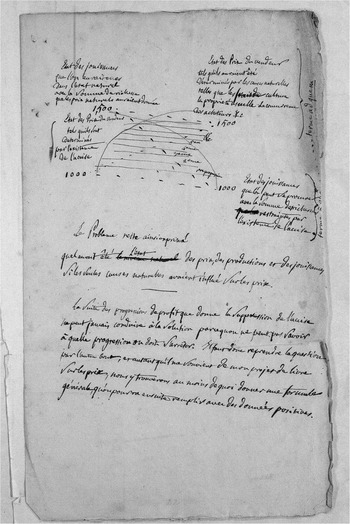
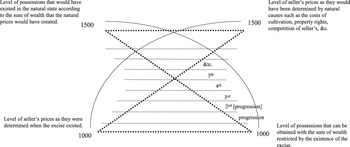
It is more interesting to compare what Butré had done with the work of authors influenced by Quesnay and his Tableau économique. Two works, both written after that of Butré, fit into this category. First, in 1774 Du Pont wrote a short piece to the Margrave of Baden to show the progressive consequences of removing a sales tax on the price of goods. His discussion was illustrated by a curve, for which he solicited help from Daniel Bernoulli, the brilliant mathematician (Theocharis Reference Theocharis1983, pp. 57–61; see also Appendix, excerpt 3). Footnote 25 In his contribution, nothing that Du Pont wrote in this text or elsewhere indicates that he had read Butré’s effort to apply mathematical analysis to political economy. Footnote 26 From the draft that we present in the Appendix, it is quite clear that Du Pont was aware that his curve illustrated a “general equation.” Moreover, he pointed out that if one wants to apply the general relationship described by the curve to “positive data”—that is, data collected from surveys—such an equation would be needed. However, he did not himself wish to go into that sort of detail, which conversely fascinated Butré, and the former was happy to stay at a higher level of abstraction. It is important to note that Du Pont presented his analytical reasoning as part of a “Problem,” just like Quesnay and Butré did earlier. Footnote 27 Finally, the issue dealt with by Du Pont—the influence of indirect taxation on the price of goods—was very close to the one investigated by Quesnay in his “Second Economic Problem,” as well as by Butré in both the Limoges essay and the last chapter of the Elémens d’oeconomie politique.
However, the most interesting comparison is perhaps with the work of the engineer Achille-Nicolas Isnard. The Traité des richesses, published in 1781, was an ambitious application of mathematics to economy. Footnote 28 Although he was no Physiocrat, Isnard was influenced by Quesnay’s work, and he used linear equations to analyze economic relationships inside the economy and to determine the ratio of their values (Robertson Reference Robertson1949, pp. 531–533; Theocharis Reference Theocharis1961, pp. 61–65; Steenge and Van den Berg Reference Steenge and Van den Berg2001, pp. 126–134; Van den Berg Reference Van den Berg2006, pp. 24–30 and 33–38). While Isnard and Butré’s interest in mathematical economics stem from the same source of inspiration —the Tableau économique of François Quesnay—their mutual research interests developed along very different paths. Isnard concentrated on Quesnay’s model of reproduction. In this regard, his work “can be seen as a generalization of Quesnay’s, specifically with respect to the idea of distribution” (Steenge and Van den Berg Reference Steenge and Van den Berg2001, p. 131). He began with a very simple linear model of an economy that uses and produces two goods with no money. He then goes on to provide an abstract discussion on the role of relative prices to ensure the reproduction of such an economy and their impact on the distribution of the net product.
We believe that the important differences between the approaches of Butré, on the one hand, and Isnard, on the other, are not related to the theoretical content of their work. Rather, the differences lie in their methodological intent and their educational backgrounds. In effect, while Isnard conceived of his Traité des richesses as a work of pure theory (including a powerful analytical critique of Quesnay’s Tableau and system), Butré believed that his own work was to provide a set of instruments and concrete methods that can be applied by rulers in managing the economy of their respective countries. The other source of their differences is their very different training in mathematics. An engineer of the prestigious Ponts-et-Chaussées, Isnard was trained in advanced mechanics; hence, his willingness and his ability to employ linear equations in economics. Butré, who did not have such training, commanded only basic algebraic tools. From a technical point of view, his economic problems are not impressive: they emulated rather straightforwardly the problems from basic textbooks in algebra. The creativity of his work lies in the idea of applying the analytical method of the mathematicians to a new set of problems, not in the technical prowess displayed to solve them. More generally, the examples of Butré, Du Pont, and Isnard illustrate the extent to which Quesnay’s claim struck a chord with his contemporaries: that political economy was a new science and that it should be developed rigorously with the instruments of science; that is, mathematics.
Quesnay’s own work, as well as those of the three authors mentioned above, suggests that applying mathematics to economics at the end of the eighteenth century can be linked to two sets of explanatory factors.
First, there is the development of mathematical education and the high reputation of mathematical analysis. The latter is particularly marked in the French context, as compared with other geographical areas. As to individual authors, we have shown the importance of the type of mathematical education that one had received (or not). The peculiarities of each author’s analysis can be related to the latter. Quesnay was an autodidact, and he did use and praise the analytical method, although he was unwilling to use the analytical instruments (algebra) created by mathematicians for this purpose. Conversely, Butré, Du Pont, and Isnard were ready to use it, but on levels that reflected their mathematical training: Du Pont, being also self-taught in mathematics, mentioned the possibility of writing an equation but did not do so; Butré used algebra, but used a technique, that of the problem, he borrowed quite straightforwardly from the mathematical manuals of his time; while Isnard, being the only one trained in advanced mathematics and classical mechanics, was also the one who used linear algebra in a more modern fashion.
Second, the development of Physiocracy led to its becoming the one economic theory that motivated individual economists to use more quantitative tools. Quesnay’s formulation of the Tableau économique created a breakthrough in the application of mathematics to political economy. The Tableau in particular and Physiocracy in general created an interest in applying mathematics to macroeconomic and policy problems. Footnote 29
Each of the individual cases we reviewed in this section can be understood as a specific combination of these factors. For example, we can point out that although Quesnay, Butré, and Du Pont discussed the same issue (the impact of indirect taxation on the economy) and formulated it as a “problem,” their solutions used very different sets of tools. Footnote 30 Quesnay combined arithmetic with a synthetic visual device of his own creation; Butré combined arithmetic with basic algebra; and Du Pont used a curve. To conclude, Butré’s 1766–67 texts were part of a very interesting moment in the early history of mathematical economics. Inspired by Quesnay’s mid-1760s articles, he developed a distinct research program. He was not interested at all in the issue of relative prices and the condition of reproduction of the economy, but in “applied economics” issues like indirect taxes. Rather than presenting his reasoning as a set of equilibrium equations, Butré did it in the form of “problems” in which he used algebra mainly to compute the impact of the transformation of one ratio (the output of the productive sector) on the equilibrium of the economy, in particular, on its economic relationships with the rest of the world. Although Butré’s straightforward application of mathematical analysis to economic issues naturally makes him a forerunner of modern economics, the Physiocrat developed it in a very specific and narrow epistemic culture, one that was strictly framed by the mathematical manuals of his time.
APPENDIX
In the following, we provide three different excerpts, numbered 1 to 3. The first one is taken from Elémens d’oeconomie politique (Butré Reference Butré1767, 3rd notebook, pp. 1–2), and it covers the first problem given by Butré, which he called “fundamental.” We are providing a translation that is as close to the original text as possible. In order to make it comprehensible for the modern reader, we have supplemented it with a few editorial notes and a few words in square brackets whenever the original spelling was ambiguous—which is often. We also give the original page number in bold and in brackets. The page numbers we give in bold are those that Butré indicated at the head of each page of his text; we have not reproduced the numbering later added by an archivist from the Archives Départementales. We have decided not to reproduce or indicate the rare eliminations Butré made. In general, Butré has a fluctuating vocabulary for designating economic quantities, and we have decided to ease the burden on the reader by being more systematic in our translation than he was in the original. More specifically, Butré sometimes designates the industrial sector by commerce d’industrie, but also by industrie or more problematically by fabrique (literally “fabrication”); we translated these expressions into “industry.” Likewise, he uses the expressions commerce comestible or simply comestible to designate the food-processing industry, but he also uses the expression commerce alimentaire (albeit less often), which is a bit odd, since aliment in his text designates “raw food” and not “food”. Footnote 31
The second and third excerpts are simpler. The first one is a translation from the manual Elemens d’algèbre, by the French mathematician Alexis-Claude Clairaut. It is provided to show the striking similarity in presentation and wording between Clairaut’s text and that of Butré’s Elémens d’oeconomie politique. Finally, we also reproduce and translate a very short text from Du Pont that is presented as a “problem,” which he solved by means of a geometrical method. As this text is of significant interest to the early history of mathematical economics and was never published, we believe that it deserves to be published alongside the two former extracts.
Excerpt 1: Extract from Elémens d’oeconomie politique
Source: Butré (Reference Butré1767, 3rd notebook, pp. 1–2).
[1] 3rd notebook
Problem of political economy
First fundamental problem
The total value of annual productions of a nation, the costs and gains of food trade (commerce comestible)… and those of industry, and the relationship or ratio between the spending on food and on manufactured goods being given; find out what the ratio between the [value of] raw subsistence goods and the [value] of raw materials should be to have an equal balance in food, primary goods and industry. Footnote 32
To solve the problem in a general manner, I will name:
a, the production of the productive trade;
x, the [value of] raw material [used by the industry];
a − x, will be the [value of] raw food;
g costs and gain of the food trade;
f costs of the industry; n the ratio between spending on food and spending on manufactured goods;
a + x + g will be the value of [the production of] food;
x + f will be that of industrial goods consumed by the nation; because notwithstanding that there is an equal balance in raw material, it is self-evident that the raw material destined to the manufactures of that nation should equal that of the country. Footnote 33
We see that there is only one unknown in this problem, which is x, or the raw materials of the country; meaning those necessary for the manufactured goods, all the rest are given or the ratios are established according to a few conjectures, [which are] easy to make in each nation; here’s how one can find this unknown; as the ratio of expenses in food to expenses in manufactured goods is expressed by n, we will have the following proportion: the [value of the production of] food is to industry, as n is to 1, which we can express as such:
 ${{a - x + g} \over {x + f}} = {n \over 1}$
. That in turn gives the equation a − x + g = nx + nf, so nx + x = a + g − nf and, by isolating the unknown, we have
 $x = {{a + g - nf} \over {n + 1}}$
, a general formula that gives the value of the unknown in all possible cases; let’s make an application [of it].
[2] As the costs and gains of food trade are more or less half the value of raw subsistence, and that the costs of industry or of [the value of] the preparation of raw material are the double of this raw material
Footnote a
if the expenses of a nation are half on food, half on industrial goods, in that case n = 1,
 $g = {1 \over 2}a - {1 \over 2}x$
, f = 2x, and the general formula
 $x = {{a + g - nf} \over {n + 1}}$
, becomes, by substituting the values of n, g, and f,
 $x = {{a + {\raise0.7ex\hbox{$1$} \!\mathord{\left/ {\vphantom {1 2}}\right.\kern-\nulldelimiterspace}\!\lower0.7ex\hbox{$2$}}a - {\raise0.7ex\hbox{$1$} \!\mathord{\left/ {\vphantom {1 2}}\right.\kern-\nulldelimiterspace}\!\lower0.7ex\hbox{$2$}}x - 2x} \over 2} = {{{\raise0.7ex\hbox{$3$} \!\mathord{\left/ {\vphantom {3 2}}\right.\kern-\nulldelimiterspace}\!\lower0.7ex\hbox{$2$}}a - {\raise0.7ex\hbox{$5$} \!\mathord{\left/ {\vphantom {5 2}}\right.\kern-\nulldelimiterspace}\!\lower0.7ex\hbox{$2$}}x} \over 2}$
and by transposing and isolating the unknown, we have
 $x = {1 \over 3}a$
, which means that the total value of annual productions
Footnote 34
should be divided into two-thirds of raw food and one-third of raw material and that the value of raw material necessary for the industrial goods used by the nation should be equal to one-third of the annual production.
Example:

One can see that the found ratio meets the criteria of the problem.
Hence, when in a nation the food expenses equal the expenses on manufactures, it is necessary that the value of the annual production is two-thirds on raw subsistence and one-third on raw material, to have an equal balance between [the value of the production of] food, raw material and on industrial goods, and that the value of raw materials manufactured by the nation is equal to that of the country. Footnote 35 See the first table above. Footnote 36
In all the following problems we assume the equality of food expenses and expenses on manufactures, and all the ratios established in this one [the first problem]; this means that we make our computations according to the etat constitutif established in our Elemens, which should help to guide each nation in the researches that it would like to do according to its own etat constitutif. Footnote 37
Excerpt 2: Extract from the Elemens d’algèbre by Clairaut
Source: Clairaut (Reference Clairaut1746, pp. 30–32).
XXVI
After one has found the way to generalize a problem by using letters instead of numbers, one has almost always put problems in their utmost generality by using letters instead of numbers; it is therefore necessary to accustom beginners to working through them likewise. In this view, we are going to solve the following problem.
Fifth Problem.
One worker can do a certain job expressed by a in a time expressed by b; a second one does a job c in a time d, a third does a job e in a time f; we ask how much time these three workers working together will need to do a job g.
Let x be the duration we are searching for; the job done by the first worker in this period of time is given by the following proportion:
 $$b*a = x*{{ax} \over b}$$
We will have the job done during the same time by the second worker with the proportion
 $$d*c = x*{{cx} \over d}$$
Finally, we will have the job done during the same time by the third worker with this proportion
 $$f*e = x*{{ex} \over f}$$
Hence
 ${{ex} \over f} + {{cx} \over d} + {{ax} \over b}$
is the job of the three workers working together during the length of time we are looking for, but this job should equal g; we then have the equation:
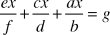 $${{ex} \over f} + {{cx} \over d} + {{ax} \over b} = g$$
To solve it, we multiply all the elements of the above equation by the product fdb of divisors according to the principles established in section XVIII, and we have
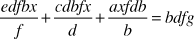 ${{edfbx} \over f} + {{cdbfx} \over d} + {{axfdb} \over b} = bdfg$
which is reduced to edbx + fcbx + adfx = fdbg, in which we remark that edb + fcb + adf should explain the number of x contained in the other side [of the equation], we will have
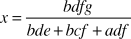 $$x = {{bdfg} \over {bde + bcf + adf}}$$
XXVII
Example with numbers
To make an application of this problem, let us suppose that a mason could build seven feet of a wall in 5 days, that a second mason could build 10 feet in 3 days, and that a third 11 feet in 4 days; we ask in how much time these three masons working together will make 150 feet of this same wall.
We will have these assumptions
a = 7; b = 5; c = 10; d = 3; e = 11; f = 4; g = 150, and therefore bdfg = 5 * 3 * 4 * 150 = 9000; bde = 5 * 3 * 11 = 165; bcf = 5 * 10 * 4 = 200; adf = 7 * 3 * 4 = 84, which will give for the [32] value of x,
 ${{9000} \over {449}}$
or
 $20 + {{20} \over {449}}$
number days in which the job proposed will be done.
Excerpt 3: Problème économique by Du Pont.
Source: State archives of Baden-Württemberg (Generallandesarchiv, Karlsruhe), Family Archiven, Correspondence 5 Bd 26, Hfk-Hs Nr. 196, piece n° 26.
“Problème économique” by Du Pont de Nemours.

“Economic curve” by Du Pont de Nemours.

The Problem thus explained[:]
What would have been the state of prices, of productions and possessions if only natural causes influenced prices [?]
—————
The series of the progression of profits caused by the removal of the excise can never lead to the solution because one cannot possibly know at which step of the series one must stop. One should take the issue from another side, and as far as I remember from my book’s project on prices, we will at least find a way to provide a general equation, which we would then apply with positive data.