Introduction
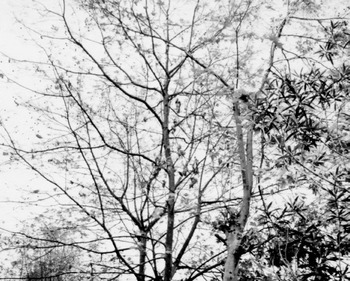
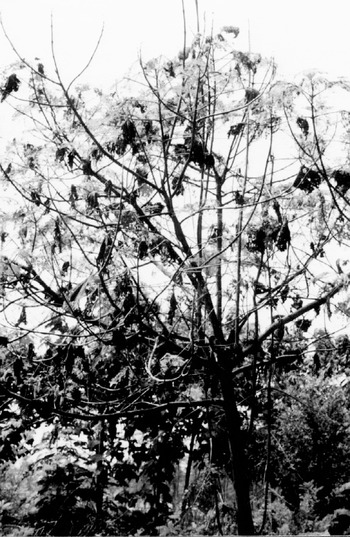
The fall webworm, Hyphantria cunea (Drury) (Lepidoptera: Arctiidae), is a serious invasive defoliator pest in China. It was first found in China in 1979 at Dandong City bordering North Korea, Liaoning Province (Yan & Wang, Reference Yan and Wang1984; Wang, Reference Wang1995). Since its invasion, the pest attacked most cultivated plants in infested areas in China, particularly the ornamentals, man-made forests and fruit trees. Soon it spread into Liaoning, Hebei, Shandong and Shaanxi Provinces, and the Tianjin and Shanghai Municipalities. Frequent outbreaks occur in these areas and great economic losses have been caused subsequently (Qu et al., Reference Qu, Li, Ao, Ren, Guo and Wang1987; Wang, Reference Wang1995; Zhang & Yu, Reference Zhang and Yu1985). The pest became a big problem to the planting projects in northern China (figs 1 and 2). The fall webworm usually has two generations per year. The first generation is in summer and the second one overwinters in the pupal stage and emerges in late April to early May of the following year. As an important invasive pest – it usually lives and damages ornamental trees around residential areas, towns and cities, it is essential to avoid using insecticides for control.
Ornamental trees severely attacked by the fall webworm.

Greening trees defoliated by the fall webworm larvae.

The fall webworm was also accidentally introduced into Europe, having been first reported in Hungary in 1940, and soon dispersed to many other European countries. Insect natural enemies of the fall webworm were surveyed in North America by Tadic (Reference Tadic1963) and in other areas of the world by Warren and Tadic (Reference Warren and Tadic1967). In a biological control program for the fall webworm in former Yugoslavia, Czechoslovakia and USSR, ten insect parasitoids (eight species of parasitic wasps and two species of tachinid flies) were imported from the USA and Canada, where the pest is native, between 1952 and 1966. However, these parasitoids all failed to establish in the new environments and the program was ultimately not successful (Tadic, Reference Tadic1958; Clausen, Reference Clausen and Clausen1978).
From 1996 to 1999, a series of investigations on native insect natural enemies of the fall webworm was carried out in Yantai of Shandong Province, Dalian of Liaoning Province, Qinhuangdao of Hebei Province, Guanzhong area of Shaanxi Province and in the Tianjin Municipality (Yang, Reference Yang1989, Reference Yang1990b; Yang et al., Reference Yang, Wang and Wei2001, Reference Yang, Wei and You2002, Reference Yang, Qiao and Han2003a,Reference Yang, Wang and Liub, Reference Yang, Wang, Wang, Qiao and Pang2005; Yang & Wei, Reference Yang and Wei2003; Yang & Baur, Reference Yang and Baur2004). A great deal of native natural enemies have been found in China, and then an augmentative biological control program was carried out against this invasive pest (Yang et al., Reference Yang, Wang, Wang, Qiao and Pang2005, Reference Yang, Wei and Wang2006).
Materials and methods
In the fall webworm damaged areas, i.e. Yantai of Shandong Province, Dalian of Liaoning Province, Qinhuangdao of Hebei Province, Guanzhong area of Shaanxi Province and in the Tianjin Municipality, a forest stand (0.1 ha) was selected as the investigated site where the favourable host trees of the fall webworm were distributed and predominate, e.g. populars (Populus spp.), elms (Ulmus pumila) and ashes (Fraxinus velutina). Every 7–10 days 30 trees were selected randomly for sampling during the field survey. The eggs, larvae and pupae of the fall webworm were randomly collected in both the damaged forest and ornamental tree stands in those areas. They were reared in the laboratory at a temperature of 20–26°C, and checked each day to collect emerged parasitoids. Later, the natural enemies reared from every stage of the fall webworm were identified and their numbers, parasitic rates and sex ratio were assessed. At the same time, direct observations and collection of predators of the fall webworm were made.
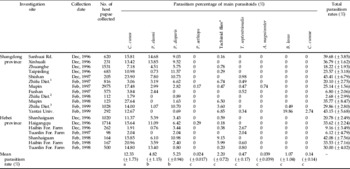
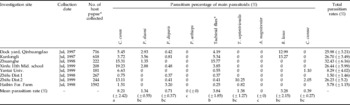
For egg parasitoids, the egg clusters of the fall webworm (each stand has about ten egg clusters, which were laid about five days previous) were randomly collected and kept in glass test tubes (150 mm length and 45 mm diameter) sealed with absorbent cotton for rearing in the laboratory. The fall webworm larvae have 6–7 instars; the 1st–4th instar larvae live in the web, while the later instars disperse for feeding. Larvae of each instar (each stand has about 100 larvae) were, therefore, randomly collected for rearing separately in cages (300×250×250 mm with glass on all sides except for a door with metal gauze) and fed every day with host tree leaves. Because the fall webworm pupae were concealed in the crevices of host tree barks, building walls, litters etc. with loose cocoons, they were searched out and collected randomly for the survey of pupal parasitoids. The number collected in each stand is shown in tables 1 and 2, respectively. The fall webworm pupae were conserved in vials (75 mm in length and 10–13 mm in diameter) individually and plugged tightly with cotton in order to maintain moisture for rearing. The remains of the moth pupae, from which parasitoids had been reared, were later dissected carefully to examine whether or not they had contained primary or hyper parasitoids.
Parasitism of each parasitoid on the overwintering the fall webworm pupae (1996–1999).

1 The numbers in bracket are the confidence interval value of parasitism rates at 95% confidence limit of binomial distribution.
2 The same letters after the mean parasitism rate values of each parasitoid in the last line in the table showed no significant differences between enemies based on TSRT (F=21.59, P<0.0001).
3* Tachinid flies: Exorista japonica, Compsilura concinnata.
Parasitism of each parasitoid on the fall webworm pupae of the summer generation (1996–1999).

The same letters after the mean parasitism rate values of each parasitoid in the last line in table showed no significant differences between enemies based on TSRT at 0.05 level (F=3.97, P=0.0007).
* Tachinid flies: Exorista japonica and Compsilura concinnata.
All experimental data were analyzed by means of the software Statistical Analysis System (SAS procedure, version 8.2) (Chen & Xu, Reference Chen and Xu1997). Analyses of variance (GLM Procedure, SAS) followed by Tukey's Studentized Range Test (TSRT) were used to compare the differences in parasitism rates between natural enemies attacking the fall webworm. Regression analyses were used to determine the parasitism rates of all natural enemy species together, and the parasitism rates of every single parasitoid, whereby the goodness-of-fit of the equations were judged by the correlation coefficients and F-values at the P=0.05 level of significance. Multiple comparisons were analyzed by using the T-method (Sokal & Rohlf, Reference Sokal and Rohlf1981).
The contribution of each species (variable xi – with x 1 being Chouioia cunea, x 2 being Pediobius elasmi, x 3 being Pimpla disparis, x 5 being Tachinid flies, x 6 being Tetrastichus septentrionalis, x 8 being Brachymeria lasus and x 9 being Conomorium cuneae) to the total parasitism (variable y) was evaluated in a multiple regression analysis. According to the percent parasitism of each enemy and total parasitism percentage of all parasitoid species in the investigation plot, the correlation between them was analyzed using the method of multiple regression analysis, whereby parasitism rates were standardized by the formula  . A linear regression model was obtained through a stepwise procedure of SAS Software (Proc Reg).
Results and discussion
Species of insect natural enemies
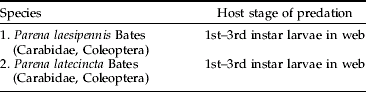
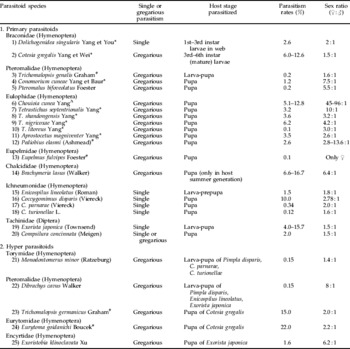
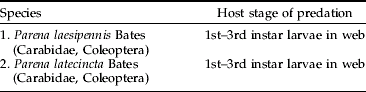
The species of predators and parasitoids of the fall webworm are given in tables 3 and 4, respectively. Although a scelionid species (Hymenoptera: Scelionidae) was observed in the field, of the inspect the eggs of the fall webworm, no egg parasitoid was reared out of a total 165 egg clusters containing about 132,000 eggs collected from many host tree stands. The probable reason was that the scale-like hairs secreted by the oviposition female covered the eggs and protected them from being parasitized. Two species of carabid predators (Coleoptera: Carabidae) and two braconid parasitoids (Hymenoptera: Braconidae) were discovered in the webworm larva stage. More natural enemies were still found in the pupal stage. Eighteen species of primary parasitoids (including two species of larval-pupal parasitoids) as well as five species of hyper-parasitoids were reared from pupae. A total of 23 species of parasitic wasps (Hymenoptera) and two species of tachinid flies (Diptera) were recovered. Among them, one genus and nine species are new to science, and four species were new to China (Yang, Reference Yang1989; Yang et al., Reference Yang, Wang and Wei2001, Reference Yang, Wei and You2002, Reference Yang, Qiao and Han2003a,Reference Yang, Wang and Liub; Yang & Wei, Reference Yang and Wei2003; Yang & Baur, Reference Yang and Baur2004).
Predator species of the fall webworm.
Parasitoid species of the fall webworm.

Δ New genus and species found in the present investigation
* new species found in the investigation
# new record for China.
Biology of insect natural enemies of the fall webworm
The two carabid species are predatory. All primary parasitoid species were endo-parasitic. However, two of the hyper-parasitoids were ecto-parasitic on the primary parasitic hosts inside fall webworm pupae.
Parena laesipennis Bates (Carabidae)
The carabid female adult lays eggs in webs of the fall webworm. These are ootheca-shaped, covered with a white foam material, with usually 3–5 eggs. Both larvae and adults prey on young larvae of the fall webworm and live inside the host web. Generally, two to three adult beetles live together in a web. Within the web there are usually 110–265 larvae, which are all consumed by the beetles. Subsequently, the beetles move to another web for feeding. They may consume host larvae from three to four webs, so many empty webs of the fall webworm were found on ornamental trees close to forest stand. The carabids destroy about 3.2% of the moth webs in the Dalian area, Liaoning Province.
Parena latecincta Bates (Carabidae)
The biology of this species is similar to the above species, P. laesipennis, and the two predators are found together in the same web.
Dolichogenidea singularis Yang & You (Braconidae)
This braconid is a solitary endoparasitoid of 1st–3rd instar larvae of the fall webworm; the mature larva of the wasp kills its host larva, makes its way out of host body, spins a cocoon and pupates inside the host. The white cocoon frequently is attached to the web far away from the remains of its host (Yang et al., Reference Yang, Wei and You2002).
Cotesia gregalis Yang & Wei (Braconidae)
This braconid is a gregarious endoparasitoid of the mid-instar to mature larvae of the fall webworm (Yang et al., Reference Yang, Wei and You2002). When its larvae finish development in the late larval stage of their host, they kill the host, emerge and spin white cocoons that surround their host mummy. As many as 18–38 adult wasps emerge from one host mature larva.
Trichomalopsis genalis Graham (Pteromalidae)
This species overwinters as a full-grown larva in host pupa. The female wasp lays her eggs into the 4th instar host larvae and the offspring complete their development in the host pupa. Adults emerge from the host pupae the following spring. From one pupa, 15 wasps were reared. This species is also a parasitoid of gypsy moth larvae in China. However, when Graham (Reference Graham1969) described the species, he mentioned that it was reared from Masicera senilis (Meigen) (Diptera: Tachinidae) on Pyrausta nubilalis Hübner (Lepidoptera: Pyralidae), which would suggest a hyperparasitic lifestyle not in accordance with our observations.
Conomorium cuneae Yang & Baur (Pteromalidae)
This gregarious species overwinters as mature larvae in the host pupa and emerges in May of following year. From one host, 14–30 wasps, with an average of 17, were reared. Parasitism rate is low (usually 1.2%) in the overwintering host pupae, but reaches 12% in some local areas, e.g. Yantai, Shandong Province (Yang & Baur, Reference Yang and Baur2004).
Pteromalus bifoveolatus Foester (Pteromalidae)
This species gregariously parasitizes pupae of the fall webworm, and 11–22 individuals of the wasp may be reared from one host pupa. It overwinteres as a mature larva in the pupal stage of the fall webworm and emerges in the next spring.
Chouioia cuneae Yang (Eulophidae)
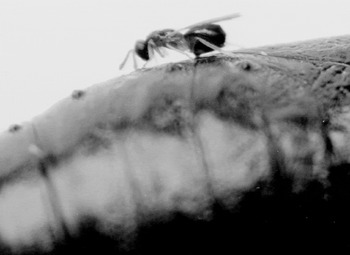
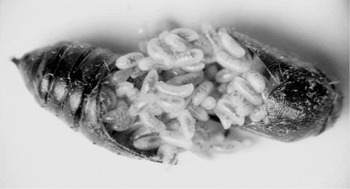
This gregarious pupal parasitoid of the fall webworm (Yang, Reference Yang1989, Reference Yang1990b) develops from the egg to the pre-oviposition adult stage inside its host pupa (figs 3 and 4). It is only 1.1–1.5 mm in length. From a single host pupa, an average of 124 adult wasps, with a maximum of 365, was reared (Yang, Reference Yang1990a). For oviposition, the female wasp attaches itself to the body of the mature fall webworm larva by hidding in the thick hair of the host larvae. This causes its host to pupate about one week earlier than normal. When the host spins its cocoon, the female wasp(s) is enclosed inside it. The parasitoid inserts her eggs into the pupa only after the host pupates. Alternatively, the female wasp can also access the host pupa for oviposition by biting a hole in the host cocoon. The wasp overwinters as a mature larva in the host pupa. The larva pupates the next spring, usually in early May. The adult wasps first mate inside their host pupa, and then bite a hole in the host pupal shell. The other wasps find their way out by using this same hole. Thus, the adult females can parasitize new hosts soon after their ‘emergence’ (Yang & Xie, Reference Yang and Xie1998). The species is predominant in all areas of the fall webworm. Its parasitism rates in overwintering pupae and in those of the summer generation of the fall webworms are 12.76% and 5.09%, respectively. Besides the fall webworm, this species also parasitizes other lepidopterous forest defoliators, e.g. Clostera anachoreta (Fabricius), Micromilalopha troglodyta (Graeser) (Notodontidae), Stilpnotia salicis (L.), S. candida Staudinger, Ivela ochropoda (Fabricius) (Lymantriidae), Clania variegeta Snelleny (Psychidae) (Yang, Reference Yang1989). Since its description, the wasp also has been founded to parasitize fall webworm in Japan (Kamijo, Reference Kamijo1991) and Europe (Boriani, Reference Boriani1991).
Female wasp of Chouioia cunea Yang is laying eggs into a pupa of the fall webworm.

Larvae of Chouioia cunea Yang consumed up all contents of the fall webworm pupa.

Tetrastichus septentrionalis Yang (Eulophidae)
This gregarious species overwinters as mature larvae in the host pupa and pupates in late April of the following year. Usually the adult wasps emerge in May. From one pupa of the fall webworm, 118–248 wasps have been reared, with an average of 149. The species also parasitizes pupae of Clostera anachoreta Fabricius (Lepidoptera: Notodontidae), Stilpnotia candida Staudinger and S. salicis (L.) (Lepidoptera: Lymantridae). It is also found in Korea as a parasitoid of the fall webworm (Yang et al., Reference Yang, Wang and Wei2001).
Tetrastichus shandongensis Yang (Eulophidae)
This gregarious species overwinters as mature larvae in fall webworm pupa, and emerges in May of the next year. From one host pupa, 48–115, with an average of 77, wasps were reared. The female can survive for 12–15 days at 25°C (Yang & Wei, Reference Yang and Wei2003).
Tetrastichus nigricoxae Yang (Eulophidae)
This gregarious species overwinters as mature larvae in fall webworm pupa (Yang & Wei, Reference Yang and Wei2003). From one host pupa, 86–168 wasps have been reared, with an average of 124. In addition, within the distribution of the fall webworm, the species also parasitizes the pupae of Micromelalopha troglodyta Graeser (Lepidoptera: Notodontidae) and Stilpnotia candida Staudinger (Lepidoptera: Lymantridae).
Tetrastichus litoreus Yang (Eulophidae)
This species has been found only in Qinhuangdao, Hebei Province. Six wasps were reared from one fall webworm pupa (Yang et al., Reference Yang, Qiao and Han2003a).
Aprostocetus magniventer Yang (Eulophidae)
This gregarious species overwinters in pupae of the fall webworm as mature larvae and emerges from its host in May. From one host pupa, 45–105 wasps were reared, with an average of 64. The species has only been found in Yantai, Shandong Province (Yang et al., Reference Yang, Wang and Liu2003b).
Pediobius elasmi (Ashmead) (Eulophidae)
This species overwinters in the pupa of the fall webworm as mature larvae and pupates in late April. Usually the adult wasp emerges in May. One host pupa produces an average of 62 wasps with a maximum of 154. The species is common in areas where the fall webworm occurs.
Eupelmus fulvipes Foester (Eupelmidae)
Only three female wasps of this species were reared from a single fall webworm pupa overwintering in Qinhuangdao, Hebei Province. The species occurs in western Europe, where it parasitizes the gall midge Perrisia bupleuri Wachtl (Diptera: Cecidomyiidae) (Nikolskaya, Reference Nikolskaya1952).
Brachymeria lasus (Walker) (Chalcididae)
This species parasitizes the pupae of the summer generation of the fall webworm. In most cases, only one adult wasp emerges per host pupa, rarely two. Its parasitism rate avereged 6.56%, but in Hangu District, Tianjin Municipality, it reached 16.7%.
Enicospilus lineolatus (Roman) (Ichneumonidae)
This species is a solitary endo-parasitoid in the larval to pre-pupal stages of the fall webworm. It does not kill its host in the larval stage until the host cocoons, then emerges from the host pre-pupa and spins a cocoon inside the host to overwinter as a pupa. Thus, a thick, dark brown cocoon of the parasitoid is found on the mummy of host pre-pupa inside the cocoon of the fall webworm. The species also parasitizes many other lepidopterous defoliators, including Dendrolimus punctatus Walker (Lepidoptera: Lasiocampidae) and Spilarctia subcarnea Walker (Lepidoptera: Arctiidae) (Tang, Reference Tang1990).
Pimpla disparis (Viereck) (Ichneumonidae)
The species overwinters as a mature larva inside the host pupa. The exoskeleton of the parasitized host pupa, thereby, becomes thin and stretched between the segments, which make it easy to distinguish between healthy and paraisitized host pupae. After emergence in May of the next year, the emerging adult wasp completely consumes the host pupal integument. In China, the species is found to parasitize 36 other lepidopterous defoliators, e.g. Malocosoma neustria (L.), Dendrolimus punctatus Walker, D. tabulaeformis Tsai et Liu, D. spectabilis Butler (Lasiocampidae), Lymantria dispar (L.) (Lymantridae) (He et al., Reference He, Chen and Ma1996).
P. aethiops Curtis (Ichneumonidae)
The biology of this species is similar to that of P. disparis, but its parasitism percentage is only 0.34% in the overwintering pupa of the pest. Besides the fall webworm, it has a broad host range, with 17 species of lepidopterous defoliators, e.g. Canephora asiatica Staudinger (Psychidae), Malocosoma Neustria (L.) (Lasiocampidae) etc. (He et al., Reference He, Chen and Ma1996).
P. turionellae L. (Ichneumonidae)
The biology of the species is similar to that of P. disparis. It rarely occurred in the investigation areas and only 12 specimens were collected in the course of the entire study.
Exorista japonica (Townsend) (Tachinidae)
This species parasitizes larvae of the fall webworm but does not kill the host larvae until they pupate. The parasitoid overwinters inside the host pupa as a full-grown larva, and emerges to pupate beside its host pupa the following spring. Generally, only one parasitoid develops from a host pupa. Its parasitism rate in the fall webworm is usually 4.0% but reaches 15.7% in some survey areas of Yantai City, Shandong Province. The species has a wide host range and has been recorded from more than 20 species of lepidopterous defoliators (Fan, Reference Fan1992; Zhao & Liang, Reference Zhao and Liang1984).
Compsilura concinnata (Meigen) (Tachinidae)
This species overwinters inside fall webworm pupae as mature larvae or pupae. The next spring, the adult fly emerges from the host pupa, with one to three individuals per host, depending on the host size. This species is recorded from 104 lepidopterous host species (Zhao & Liang, Reference Zhao and Liang1984).
Monodontomerus minor (Ratzeburg) (Torymidae)
This hyper-parasitic species is an ecto-parasitioid of several ichneumonid species, such as Pimpla disparis, P. aethiops and P. turionellae, which are primary solitary parasitoids of the fall webworm. M. minor overwinters as a mature larva beside its killed host larva or pupa, inside the pupa of the fall webworm. In the next spring, usually in early May, the larvae pupate. The emergence holes made by the adult wasps on the pupal shell of the fall webworm led to the wrong conclusion that it is a primary parasitoid (Tadic, Reference Tadic1963; Warren & Tadic, Reference Warren and Tadic1967). From one pupa of the fall webworm, on average 12 wasps, ranging from 9 to 14, emerge.
Dibrachys cavus Walker (Pteromalidae)
This hyper-parasitic species ecto-parasitizes larvae and/or pupae of the primary parasitoids Pimpla disparis, Enicospilus lineolatus and Exorista japonica inside pupae of the fall webworm. From one pupa of the fall webworm that is parasitized by P. disparis, 18–26 wasps, with an average of 20, were reared. The female to male adult sex ratio was 8:1 with a parasitism rate of 0.5% on the host species. From one cocoon of E. lineolatus, an average of 34 wasps of the species was reared. The sex ratio of female to male adults was 7:1; its parasitism rate was 3.2% on the ichneumonid host. After emergence, the adult wasps make their way out from the brown thick cocoon of the ichneumonid by biting a hole. From one puparium of E. japonica, an average of 35 wasps of the species emerges. The female to male adult sex ratio is 2.5:1 and the parasitism rate is 4.2% on the tachinid host.
Trichomalopsis germanicus Graham (Pteromalidae)
This hyper-parasitic species parasitizes the pupa of Cotesia gregalis inside the cocoon. Its biology is similar to that of Eurytoma goidanichi Boucek below. Its parasitism rate for all cocoons of a web was 0.3%. The species was originally described by Graham (Reference Graham1969) as parasitizing Apanteles glomeratus (L.) (Hymenoptera: Braconidae) on Pieris brassicae (L.) (Lepidoptera: Pieridae) in Europe.
Eurytoma goidanichi Boucek (Eurytomidae)
This species hyperparasitizes pupae of Cotesia gregalis, which gregariously cocoon around the dead larva of the fall webworm. Its overall parasitism percentage is 0.6%; the parasitism rate among the cocoons of an infected web is 65%, with a maximum of 85%. Only one wasp develops from each host cocoon. The parasitized host cocoons change from white to brown and become harder. After emergence, the adult wasp bites an irregular exit hole, which differs from its host's emergence hole, which is round and always at the top of the cocoon. Thus, for survey purposes, it is easy to distinguish the two types of emergence holes. The species was originally described by Boucek (Reference Boucek1970) from Italy, where it parasitized Apanteles glomeratus (L.) Apanteles orobena (Hymenoptera: Braconidae) on Pieris brassicae (L.) (Lepidoptera: Pieridae).
Exoristobia klinoclavata Xu (Encyrtidae)
This hyper-parasitic species gregariously parasitizes larvae or pupae of the tachinid fly, Exorista japonica. From one host puparium, an average of 47 wasps was reared. The species had originally been described by Xu and Lou (Reference Xu and Lou2000).
Parasitism and control effects of the parasitoids of the fall webworm pupae
Although the classical biological control was considered as the first choice in China to manage the invasive pest, it means that the natural enemies of the fall webworm should be introduced from its native countries (USA and Canada). However, as the lessons in former USSR etc. mentioned above, we focused on searching for native insect enemies of the fall webworm in different areas in China, trying to find effective species as potential biological control agents. From 1996 to 1999, 13,114 overwintering pupae, and from 1997 to 1999, 4,048 1st generation pupae of the fall webworm were collected and reared out in laboratory. As the natural enemies developed and emerged from the collections, the species were identified, and taxonomic studies on the parasitic wasps were undertaken. The numbers of each species, the female/male ratio of the adults, the parasitism percentages and other data were recorded from the rearing (tables 1 and 2).
Table 1 shows that the parasitism percentages of the natural enemies in the overwintering pupae of the fall webworm at the 19 study sites varied, and ranged from 2.68% to 43.41%, with a mean of 25.80%. For parasitism rates of the natural enemies of the 1st generation pupae of the fall webworm (i.e. 1st generation pupa) at various sites, see table 2. They ranged from 1.50% to 32.43% and averaged 16.13% and were generally lower than those on overwintering host pupae.
The percent parasitism of most parasitoids in the overwintering host pupae was generally higher than the one of the summer generation, and percentages for Choioia cunea were significantly higher than those of the other species in both host pupae of the overwintering generation and the 1st generation, with 12.76% and 5.09%, respectively. The parasitism rate of Pimpla disparis in the overwintering host pupae was also relatively high, reaching 6.38%.
The parasitism by Brachymeria lasus and the tachinid flies were higher in the 1st generation host pupae than in the overwintering host pupae. Where tree and bush diversity was rich, the total parasitism rate among all natural enemies was particularly high and reached 40% in some plots. However, rates were lower (below 10%) in plots with monocultures of trees or poor biodiversity.
Regression analysis of parasitism rates of the main parasitoid species
First, the parasitism rate (table 1) of the main parasitoid species in each study plot was calculated from data in tables 3 and 4 collected from 1996 to 1999. Then, according to the percent parasitism of each enemy and total parasitism percentage of all parasitoid species in the investigation plot, the correlation between them was analyzed using the method of multiple regression analysis. A linear regression model was obtained as follows:

From the results above, it is clear that the regression model established the parasitism rates of each parasitoid species to the total parasitism rate ( ) on the fall webworm were highly significant. The coefficient of Chouioia cunea was the highest (0.7953), indicating that the parasitism rate of C. cunea was the largest contribution to the total parasitism rate.
Multiple comparison analysis of the parasitism of parasitoid species on the fall webworm
Based on the standardized original data in table 1 with the parasitoid species as x-values and different sites as repetitions, the mean parasitism rates of every parasitoid were compared. Results showed that the rate of parasitism for Chouioia cunea was significantly different with those for every other parasitoid species (df=8, 234, F=21.808, P<0.0001). Comparison of the mean parasitism rates for the nine parasitoid species (the mean values of two generations of the fall webworm pupae in all survey sites), showed that percent parasitism of Chouioia cunea was much higher than that of all other parasitoids (fig. 5). This parasitoid has been successfully used in the subsequent biological control program in China as an augmentative strategy (Fuester, Reference Fuester2004; Yang et al., Reference Yang, Wang, Wang, Qiao and Pang2005, Reference Yang, Wei and Wang2006; Murphy, Reference Murphy2006).
Comparison of the mean parasitism rates for the nine parasitoids. Xi, parasitoids; 1, Chouioia cunea; 2, Pediobius elasmi; 3, Pimpla disparis; 4, Pimpla parnasae; 5, Tachinid flies; 6, Tetrastichus septentrionalis; 7, Aprostocetus magniventer; 8, Brachymeria lasus; 9, Conomorium cuneae.

Acknowledgements
We thank Professors Wang Shu-fang and Zhao Jian-ming in the Institute of Zoology, Chinese Academy of Sciences, for helping in identification of tachinid flies and ichneumonid parasitoids. Our thanks are also due to Dr John C. Moser, USDA Forest Service, Southern Forestry Experiment Station, Pineville, LA, and Dr Imre S. Otvos, Canadian Forest Service, Pacific Forest Research Central, Victoria BC, for reviewing the manuscript and helpful comments. This research project was supported by the China National Science Funds for Distinguished Young Scholars.