Introduction
Among other organisms, lichens were exposed to simulated space and Mars conditions but also to space in low-Earth orbit (LEO) in various experiments (de Vera et al. Reference de Vera, Horneck, Rettberg and Ott2003, Reference de Vera, Horneck, Rettberg and Ott2004a, Reference de Vera, Horneck, Rettberg and Ottb, Reference de Vera, Rettberg and Ott2008, Reference de Vera, Möhlmann, Butina, Lorek, Wernecke and Ott2010; de la Torre et al. Reference de la Torre, Sancho, Pintado, Rettberg, Rabbow, Panitz, Deutschmann, Reina and Horneck2007, Reference de la Torre2010; Sancho et al. Reference Sancho, de la Torre, Horneck, Ascaso, de los Ríos, Pintado, Wierzchos and Schuster2007; Stöffler et al. Reference Stöffler, Horneck, Ott, Hornemann, Cockell, Moeller, Meyer, de Vera, Fritz and Artemieva2007; Horneck et al. Reference Horneck2008; de Vera & Ott Reference de Vera, Ott, Seckbach and Grube2010; Raggio et al. Reference Raggio, Pintado, Ascaso, de la Torre, de los Ríos, Wierzchos, Horneck and Sancho2011; Onofri et al. Reference Onofri2012; Sánchez et al. Reference Sánchez, Mateo-Martí, Raggio, Meeßen, Martínez-Frías, Sancho, Ott and de la Torre2012, Reference Sánchez, Meeßen, Ruiz, Sancho, Ott, Vílchez, Horneck, Sadowsky and de la Torre2014; Scalzi et al. Reference Scalzi, Selbmann, Zucconi, Rabbow, Horneck, Albertano and Onofri2012; Brandt et al. Reference Brandt, de Vera, Onofri and Ott2014). Under LEO-conditions lichens experience a multitude of extreme abiotic stressors such as intense solar radiation (including UVA(320–400 nm), UVB(280–320 nm) and UVC(100–280 nm) at about 236, 41.2 and 13.8 W m−2, respectively), cosmic ionizing radiation, freeze–thaw cycling with temperatures between −22 and +43 °C and vacuum of 10−7–10−4 Pa which also causes extreme desiccation (Berger et al. Reference Berger, Hajek, Bilski, Körner, Vanhavere and Reitz2012; Rabbow et al. Reference Rabbow2012; Schuster et al. Reference Schuster, Dachev, Richter and Häder2012; Brandt et al. Reference Brandt, de Vera, Onofri and Ott2014). Despite these hostile conditions, lichens survive real-space exposure as well as single or combined simulation parameters. The remarkable resistance of lichens towards non-terrestrial conditions is attributed to a range of morphological adaptations (Meeßen et al. Reference Meeßen, Sánchez, Brandt, Balzer, de la Torre, Sancho, de Vera and Ott2013), a set of protective secondary compounds (Meeßen et al. Reference Meeßen, Sánchez, Sadowsky, de Vera, de la Torre and Ott2014a) and their ability to pass into anhydrobiosis, an ametabolic state when desiccated (Ertl Reference Ertl1951; Crowe et al. Reference Crowe, Hoekstra and Crowe1992; Kranner et al. Reference Kranner and Birtić2005).
Lichens are symbioses of fungi (mycobionts) and photoautotrophic partners (photobionts (PBs)). The PB's photosynthetic capacity is crucial for the nutrition of both symbionts (Jahns Reference Jahns and Galun1988) and, consequently, the impairment of its photosynthetic activity is used to measure the lichens' viability after exposure (de la Torre et al. Reference de la Torre2010, Sánchez et al. Reference Sánchez, Mateo-Martí, Raggio, Meeßen, Martínez-Frías, Sancho, Ott and de la Torre2012, Reference Sánchez, Meeßen, Ruiz, Sancho, Ott, Vílchez, Horneck, Sadowsky and de la Torre2014; Brandt et al. Reference Brandt, de Vera, Onofri and Ott2014). These measurements were performed with entire lichens where the PB benefits from protective thallus structures and secondary substances formed by the mycobiont and from the anhydrobiotic (i.e. desiccated) state.
Since wavelengths below 290 nm do not penetrate its atmosphere (Jansen et al. Reference Jansen, Gaba and Greenberg1998), UVC is not found on the Earth but a typical stressor of space conditions. It damages essential biological macromolecules as DNA (Sass et al. Reference Sass, Spetea, Máté, Nagy and Vass1997) and amino acids (Vass et al. Reference Vass, Szilárd, Sicora and Pessarakli2005) and thus strongly affects vital cell physiological processes. As one of the most lethal factors in space it constitutes a dramatic threat on life (Horneck Reference Horneck1999; Nicholson et al. Reference Nicholson, Schuerger and Setlow2005) and detailed knowledge on its damage potential is essential in astrobiological research. In a recent study, isolated and metabolically active PBs from the astrobiologically relevant model lichens Circinaria gyrosa and Buellia frigida were exposed to various doses of UVC254 nm and its effect on photosynthesis was assessed (Meeßen et al. Reference Meeßen, Backhaus, Sadowsky, Mrkalj, Sánchez, de la Torre and Ott2014b). It examined the damage on photosynthetic activity when the PB is without symbiotically conferred protection. The present study represents a first step beyond and was designed to get insight into the combined effects of characteristic extraterrestrial stressors on the photosynthesizing symbiont: as space exposure itself and most space simulations apply a combination of extreme abiotic stressors, the present approach combines the effects of UVC254 nm and desiccation as well as of UVC254 nm and subzero temperatures on the photosynthetic activity of isolated PBs. The PBs used in the present study were again isolated from C. gyrosa and B. frigida, which were previously used in space simulation studies (de Vera & Ott Reference de Vera, Ott, Seckbach and Grube2010; Sánchez et al. Reference Sánchez, Mateo-Martí, Raggio, Meeßen, Martínez-Frías, Sancho, Ott and de la Torre2012, Reference Sánchez, Meeßen, Ruiz, Sancho, Ott, Vílchez, Horneck, Sadowsky and de la Torre2014), in space experiments (C. gyrosa only, Sancho et al. Reference Sancho, de la Torre, Horneck, Ascaso, de los Ríos, Pintado, Wierzchos and Schuster2007, Reference Sancho, de la Torre and Pintado2008; de la Torre et al. Reference de la Torre2010) and also included in the current BIOMEX mission (Biology and Mars Experiment) that exposes various organisms to LEO and simulated Mars conditions on EXPOSE-R2 at the International Space Station (ISS, ESA call ILSRA-AO 2009). The results allow comparison to previous studies and provide supportive insights for the BIOMEX mission.
Material and methods
Material
C. gyrosa Sohrabi (Reference Sohrabi2012) originates from arid areas and deserts of the Northern hemisphere. It is a vagrant lichen adapted to heat, drought and high insolation (Sancho et al. Reference Sancho, Schroeter and del Prado2000). Samples were collected at Zaorejas, Spain (40°45′40″N, 02°12′08″E) in 2010, air-dried and stored dark. Its PB was identified as Trebouxia sp. (Meeßen et al. Reference Meeßen, Backhaus, Sadowsky, Mrkalj, Sánchez, de la Torre and Ott2014b).
B. frigida Darb. (Reference Darbishire1910) is an endemic, crustose lichen of maritime to continental Antarctic habitats down to 84°S (Øvstedal & Lewis Smith Reference Øvstedal and Lewis Smith2001). Samples were collected at Gerlach Inlert, North Victoria Land (74°38′S, 164°13′E) in 2009/2010, air-dried and stored at −25 °C. Its PB was identified as Trebouxia sp. clade S (Sadowsky & Ott Reference Sadowsky and Ott2012).
Methods
Isolation and cultivation
The PB was isolated according to Yoshimura et al. (Reference Yoshimura, Yamamoto, Nakano, Finnie, Krammer, Beckett and Varma2002), pre-cultured on solid Trebouxia Organic Medium (TOM, Ahmadjian Reference Ahmadjian1967) for 2 months at 12 °C under a 14 h daytime photosynthetically active photon flux density (PPFD) of 20 μmol m−2 s−1 and finally transferred to 75 ml of liquid TOM for further cultivation. The cultures were shaken at 95 rpm for 6 weeks at 12 °C under 12 h daytime PPFD of 15–25 μmolm−2 s−1. The post-irradiation recovery was performed at the same conditions. Depending on the performed assay, 1.00, 0.67 and 0.33 ml of homogeneous PB suspension (with ca. 10.7 × 106 PB cells ml−1) were transferred to sterile polyvinylidene difluoride filter pieces of ca. 1 cm2 (Durapore®, Millipore, 0.44 μm pore size) and placed on TOM-agar plates. The PB was kept overnight on the agar to adjust, and subsequently tested.
Irradiation with UVC
The irradiation was performed in an air circulation cabinet (Mühlenkamp GmbH) equipped with a HNS 30W G13 G30T8/OF UVC lamp (Puritec®, Osram, >93% emission at 254 nm, 110 μW cm−2 at 1 m distance). After 20 min pre-run, the UVC254 nm irradiance ranged between 455 and 487 μW cm−2 (UVP UVX dosimeter, sensor 25 at 254 nm) regarding the given distance of 44 cm between the samples on the air cabinet bench and the UVC lamp. The irradiation times were adjusted accordingly to ensure comparable UVC-flux.
Chlorophyll a fluorescence measurements
The activity of photosystem II (PS II) was analysed by chlorophyll a fluorescence and measured by a pulse–amplitude-modulated fluorometer (Walz Mess- & Regeltechnik GmbH). The maximum quantum yield (QY(Fv/Fm)) of PS II was measured by applying a saturating light pulse (5000 μmolm−2 s−1 PPFD) to dark acclimatized samples and calculated as F v/F m = (F m–F 0)/F m with F v = variable fluorescence, F m = max. fluorescence and F 0=min. fluorescence (Schreiber et al. Reference Schreiber, Bilger and Neubauer1994).
UVC-irradiation and subzero temperature
Filter pieces with 0.33 ml of applied PB suspension (18 replicates) were placed in their TOM-agar plates on a block of ice, frozen for 24 h at ca. −25 °C and finally irradiated on the ice-block for 15 min with UVC254 nm-doses of 0.43 and 3.50 J cm−2. To allow octuplication of the UVC-dose in the same period of time, the distance between irradiation source and sample was reduced from 44 cm (see above) to 15.6 cm as calculated on base of the inverse-square law equation I 2 = I 1 (r 1/r 2)2, confirmed by the UVX dosimeter and facilitated by use of a vertically adjustable laboratory lifting platform (Carl Roth GmbH). Additional measurements demonstrated that initial temperatures of the ice block surface as well as of the agar plate surface did not change rapidly during the irradiation period of 15 min (from −29.3 ± 1.6 °C to −23.9 ± 0.7 °C and −25.2 ± 1.5 °C to −22.3 ± 1.5 °C, respectively, with n = 3 measurements by a SS5380 infrared thermometer (SainSonic)) while the air temperature in the cabinet stayed constant at room temperature (RT). The QY(Fv/Fm) was measured before freezing, directly after irradiation and removal from the ice-block as well as after subsequent recovery periods of 1, 2, 3, 24, 96 and 240 h. Both PBs thawed on the TOM-agar plates.
Resumption of photosynthetic activity after freezing
Filter pieces with 0.33 ml of PB suspension (nine replicates) were frozen for 24 h at ca. −25 °C. After a first measurement on ice, the filters were immediately placed on a sample holder and the resumption of QY(Fv/Fm) was measured over time. The data were pooled and plotted (GraphPadPrism 6.04) to estimate the speed of photosynthetic recovery after freezing.
UVC-irradiation and desiccation
Filter pieces with 1.00, 0.67 and 0.33 ml of applied PB suspension (18 replicates each) were irradiated with UVC254 nm-doses of 20.8 and 41.7 J cm−2 (corresponding to 12 and 24 h of exposure). The samples desiccated continuously during the irradiation process, which is demonstrated by the reduction of the water content of the agar from 100% at the beginning of the irradiation period to 39.2 ± 9.1, 25.9 ± 10.2, 15.8 ± 8.9, 11.8 ± 7.7 and 5.5 ± 4.2% after 12, 15, 18, 21 and 24 h of irradiation (with n = 5), respectively, while the agar temperature is not significantly raised during irradiation (ca. 1.0–1.5 °C above RT). After irradiation the samples were subsequently rewetted with sterilized tab water to allow regeneration. The QY(Fv/Fm) was measured directly before and after irradiation as well as after 1, 2, 24, 48, 120 and 240 h of recovery.
Resumption of photosynthetic activity after short-time desiccation
To test the speed of photosynthetic recovery after desiccation filter pieces with 1.00, 0.67 and 0.33 ml of applied C. gyrosa-PB suspension (two measurements each) were desiccated under ambient conditions for 24 h, and the filters were rewetted on water-soaked cotton. The QY(Fv/Fm) as a measure of photosynthetic activity was measured every 30 s for 17 min.
Resumption of photosynthetic activity after different desiccation periods
To test the speed of photosynthetic recovery after different desiccation periods filter pieces with 0.33 ml of applied C. gyrosa-PB suspension (three replicates each) were desiccated under ambient conditions for 24 h and subsequently stored in a exsiccator over orange gel for 1, 5, 10, 20 and 30 days. The filters were re-wetted on water-soaked cotton and their QY(Fv/Fm) was measured every 30 s for 25 min.
Results
UVC-irradiation and subzero temperature
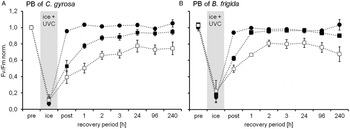
The PBs of C. gyrosa and B. frigida were irradiated for 15 min with UVC254nm-doses of 0.43 and 3.50 J cm−2 in the frozen state to test the effect of subzero temperatures (ca. −25 °C) on the UVC-induced impairment of PS II. In the frozen state and directly after irradiation, the QY(Fv/Fm) was reduced to 7–12% of the pre-exposure QY(Fv/Fm) in the C. gyrosa-PB and down to 15–22% in the B. frigida-PB. In both PBs, the higher UVC-dose led to a more severely impaired QY(Fv/Fm) (Fig. 1(a) and (b)). In the C. gyrosa-PB the QY(Fv/Fm) increased within 24 h to its maximum of 95% after 0.43 J cm−2 and to a maximum of 77% after 3.50 J cm−2 (Fig. 1(a)). In the B. frigida-PB, the maximum was reached 2 h after thawing, leading to 96% of QY(Fv/Fm)-recovery after experiencing 0.43 J cm−2 and to 80% after 3.50 J cm−2 (Fig. 1(b)). The data show that the recovery process was faster in the PB of the cold-adapted Antarctic endemite B. frigida than in the one of C. gyrosa. Nonetheless, the B. frigida-PB showed a decrease in QY(Fv/Fm) after 96 h of recovery (less pronounced but as found in Meeßen et al. Reference Meeßen, Backhaus, Sadowsky, Mrkalj, Sánchez, de la Torre and Ott2014b) while the C. gyrosa-PB did not show such a reaction. Comparing the QY(Fv/Fm) of C. gyrosa and B. frigida 240 h after the combined application of UVC and subzero temperatures with the respective data of UVC-irradiation at RT it can be seen that the impairment of photosynthetic activity is less pronounced when the samples were irradiated at subzero conditions (Table 1). Compared to RT, subzero temperatures attenuated the reduction of initial QY(Fv/Fm) by about 50 and 20% in the C. gyrosa-PB and by about 40 and 20% in the B. frigida-PB after doses 0.43 and 3.5 J cm−2, respectively.
Recovery of the photosynthetic activity of the isolated photobionts of C. gyrosa (Fig. 1(a)) and B. frigida (Fig. 1b) after 24 h of freezing at ca. −25 °C, subsequent irradiation with UVC-doses of 0.43 J cm−2 (■) and 3.50 J cm−2 (□) on ice for 15 min and a recovery period of up to 240 h alongside a control (●, on ice but not irradiated). F m/F v data normalized to the respective initial control value with n = 18 replicates for each measurement. The x-axis is not in scale, dashed lines for orientation only.

Comparison of the QY(Fv/Fm) in percentage of the pre-control values after UVC-irradiation at room temperature (RT, ca. +20 °C) or ca. −25 °C and subsequent recovery of 240 h. 1Data at RT from Meeßen et al. (Reference Meeßen, Backhaus, Sadowsky, Mrkalj, Sánchez, de la Torre and Ott2014b) with n = 18 replicates, data at ca. −25 °C with n = 9 replicates

Resumption of photosynthetic activity after freezing
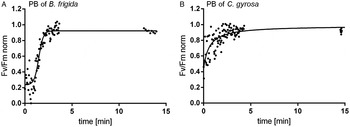
In the C. gyrosa-PB, the maximum quantum yield QY(Fv/Fm) of PS II was asymptotically resumed when the samples started to thaw and came back to ca. 90% of its pre-freezing level within 5 min (Fig. 2(b)). Within the following 10 min, the QY(Fv/Fm) slowly increased to ca. 95% of the pre-freezing value. While starting from a lower initial level, the B. frigida-PB also regained more than 90% of its QY(Fv/Fm) within the first 4 min after removal from the freezer by a sigmoid curve progression (Fig. 2(a)). Afterwards the QY(Fv/Fm) did not change within in the course of the experiment.
Recovery of the photosynthetic activity of the isolated photobionts of B. frigida (Fig. 2a) and C. gyrosa (Fig. 2b) after 24 h of freezing at ca. −25 °C and subsequent thawing. Pooled data of n = 9 replicates each were plotted by GraphPadPrism 6.04 software to estimate the speed of photosynthetic recovery after freezing.

UVC-irradiation and desiccation
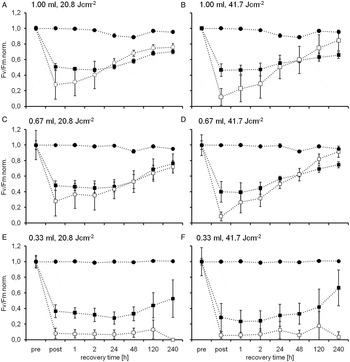
After irradiating the C. gyrosa-PB with UVC for 12 and 24 h (equivalent to 20.8 and 41.7 J cm−2) under continuously wet and desiccating conditions, those samples with applied algal suspension volumes of 1.00 and 0.67 ml (Fig. 3(a)–(d)) showed a peculiar pattern of dose- and recovery-dependent QY(Fv/Fm). In all four cases, the post-irradiation QY(Fv/Fm) in the desiccating samples decreased stronger compared to the wet irradiated samples, also eliciting a slightly stronger decrease with doses of 41.7 J cm−2 compared to 20.8 J cm−2 (compare Fig. 3(a) to (b) and Fig. 3(c) to (d)). Despite this stronger initial impairment of QY(Fv/Fm) in desiccating samples that experienced 20.8 J cm−2 of UVC, the QY(Fv/Fm) raised to virtually the same level as the corresponding wet samples after 240 h of recovery (Fig. 3(a) and (c)). Desiccating samples that experienced 41.7 J cm−2 even surpassed the mean recovery of the corresponding wet irradiated samples (Fig. 3(b) and (d)), showing a stronger rate of QY(Fv/Fm)-increase over time and nearly reaching the QY of the control samples after 240 h. The results for applied algal suspension volumes of 0.33 ml also revealed a stronger initial impairment of photosynthetic activity compared to the wet irradiated samples (Fig. 3(e) and (f)). But in the course of the experiment, the samples that were irradiated under desiccating conditions showed no recovery of QY(Fv/Fm) contrasting an recovery between 20 and 40% in the respective wet irradiated samples. The desiccating conditions are exemplified by the constant loss of water in the agar plates on which the PB-bearing filter pieces were positioned.
Combined effect of UVC-irradiation at doses of 20.8 J cm−2 (12 h, left column) and 41.7 J cm−2 (24 h, right column) and simultaneous desiccation (□) versus the effect of mere irradiation with the same UVC-doses (■, constantly wet) on the photosynthetic activity of the isolated photobiont (PB) of C. gyrosa. After irradiation the samples were allowed us to recover for up to 240 h alongside a control (●). PB suspension volumes of 1.00 ml (top row), 0.67 ml (middle row) and 0.33 ml (bottom row) were used to test the effect of algal layer thickness. F m/F v data normalized to the respective initial control value with n = 18 replicates for each measurement. The x-axis is not in scale, dashed lines for orientation only.

Resumption of photosynthetic activity after short-time desiccation
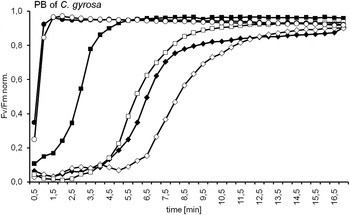
After desiccation for 24 h under ambient conditions, filter pieces with the C. gyrosa-PB were placed on water-soaked cotton and their resumption of photosynthetic activity was assessed by QY(Fv/Fm)-measurements in intervals of 30 s (Fig. 4). The data demonstrate that the rate of photosynthetic resumption depended on the volume of applied PB suspension. The two samples with 0.33 ml of applied algal suspension volume resume their max. photosynthetic activity completely within 1.5–2.0 min after rewetting. The two samples with 0.67 ml of algal suspension volume regained their max. QY(Fv/Fm) within 6 and 12 min showing much higher intersample variety. At 1.00 ml of applied algal suspension the maximum QY(Fv/Fm) was regained after 17 min. These results show that the resumption of photosynthetic activity was the more prolonged the more algal cells were applied to the filter, but also that in any case pre-desiccation QY(Fv/Fm) (1.0 ≙ 0.687 ± 0.018 with n = 18 replicates) was resumed to about 90% within 17 min.
Effect of short-term desiccation and variable amounts of desiccated photobiont (PB) cells on the recovery of the photosynthetic activity in the isolated PB of C. gyrosa. The recovery was measured for 17 min after 1 day of desiccation of PB suspension volumes of 0.33 (●/○), 0.67 (■/□) and 1.00 (♦/◊) ml and subsequent wetting. Two measurements each, F m/F v data normalized to 1.0 ≙ 0.687 ± 0.018 with n = 18 replicates.

Resumption of photosynthetic activity after different desiccation periods
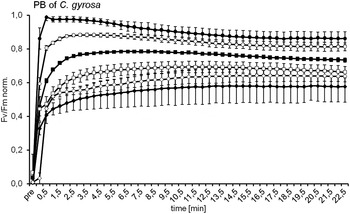
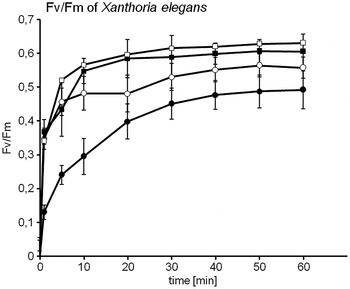
After desiccation over silica gel in the exsiccator, filters with the C. gyrosa-PB were measured in the dry state and then placed on water-soaked cotton. Immediately, the measurements were continued and the resumption of photosynthetic activity was assessed by QY(Fv/Fm)-measurements in intervals of 30 s (Fig. 5). The data demonstrate that the rate of photosynthetic resumption depended on the length of the desiccated period. Although a desiccation period of 1 day in the exsiccator resembles what was already seen under ambient drying condition (Fig. 4, 0.33 ml of algal suspension volume), the speed and extend of photosynthetic recovery were decreased with prolonged desiccation periods (Fig. 5). As pre-desiccation QY(Fv/Fm) (1.0 ≙ 0.687 ± 0.018 with n = 18 replicates) is not reach after any desiccation period, the maximum QY(Fv/Fm) after 22.5 min was subsequently reduced from 86% via 81, 73, 66 and 58% to 64% after 1, 3, 5, 10, 20 and 30 days, respectively. For these measurements the respective QY(Fv/Fm)-maxima were reached after 1.0, 3.5, 6,5, 11.0, 14.0 and 14.0 min. The results demonstrate that recovery of photosynthetic activity depended on the length of the experienced desiccation period until the 20th day, while longer desiccation period did not produce further decrease of photosynthetic activity or delay of its recovery. Even after 30 days of strong desiccation, rewetting completely restored the photosynthetic activity of the PB (QY(Fv/Fm) of 0.672 ± 0.008 after 24 h, with n = 3 replicates, data not shown in the graph). To substantiate these results, we assessed the recovery of photosynthetic activity in complete thalli of Xanthoria elegans by repeated wetting after a 4-year dry storage period at ca. −25 °C (Fig. 6). Four rewetting events were performed for four successive days, demonstrating that each wetting elicited faster and stronger recovery of photosynthetic activity than the previous one (Fig. 6) leading to QY(Fv/Fm)-values of 0.49, 0.56, 0.61 and 0.63 after the 1st, 2nd, 3rd and 4th rewetting event, respectively.
Effect of long-term desiccation on the rate and capacity of the recovery of the photosynthetic activity in the isolated photobiont of C. gyrosa. The recovery was measured for 22.5 min after 1(●), 3(○), 5(■), 10(□), 20(♦) and 30(◊) days of desiccation (exsiccator over silicagel, dark, RT) and subsequent wetting with n = 3 replicates. F m/F v data normalized to 1.0 ≙ 0.687 ± 0.018 with n = 18 replicates.

Recovery of photosynthetic activity after a 4 year storage period of dry X. elegans thalli after repeated wetting. Rewetting of the thalli was performed for 2 h for four successive days (1st wetting (●), 2nd wetting (○), 3rd wetting (■), 4th wetting (□)) with n = 4 replicates, drying and storage at RT under dark and dry conditions in between.

Discussion
Effects of UVR on photosynthesis
UVR causes a wide range of damaging effects on the cell physiology of many organisms. These effects are predominantly elicited by UVB and UVC as the DNA action spectrum sharply increases around 260 nm (Sass et al. Reference Sass, Spetea, Máté, Nagy and Vass1997) and amino acids strongly absorb wavelengths about 280 nm (Vass et al. Reference Vass, Szilárd, Sicora and Pessarakli2005). UVR causes direct as well as indirect DNA-damage by formation of reactive oxygen species (ROS, Horneck et al. Reference Horneck, Baumstark-Khan, Facius, Clément and Slenska2006), inducing photoproduct formation (Takeuchi et al. Reference Takeuchi, Murakami, Nakajima, Kondo and Nikaido1996), base-pair deletions and insertions, DNA–protein crosslinks and double-strand breaks (Strid et al. Reference Strid, Chow and Anderson1994; Britt Reference Britt1999). UVR-effects on photosynthesis are predominantly investigated by UVB, whereas detailed information on the effect of UVC is scarce (Jansen et al. Reference Jansen, Gaba and Greenberg1998). Although UVB and UVC have different action sites on photosynthesis (Jenkins et al. Reference Jenkins, Christie, Fuglevand, Long and Jackson1995; Takeuchi et al. Reference Takeuchi, Murakami, Nakajima, Kondo and Nikaido1996), both types induce the formation of ROS, destroy photosynthetically essential enzymes (Vass et al. Reference Vass, Szilárd, Sicora and Pessarakli2005) and pigments leading to a concomitant loss of photosynthetic activity (Strid et al. Reference Strid, Chow and Anderson1994; Nogués & Baker Reference Nogués and Baker1995; Rao et al. Reference Rao, Paliyath and Ormrod1996; Rozema et al. Reference Rozema, van de Staaij, Björn and Caldwell1997; Jansen et al. Reference Jansen, Gaba and Greenberg1998; Nasibi & M'Kalantari Reference Nasibi and M'Kalantari2005; Rahimzadeh et al. Reference Rahimzadeh, Hosseini and Dilmaghani2011). The photosynthetic apparatus is found to be a prime site of UVR-damage and the PS II-complex – especially the D1 protein – is its most sensitive part (Aro et al. Reference Aro, Virgin and Andersson1993; Teramura & Sullivan Reference Teramura and Sullivan1994; Rozema et al. Reference Rozema, van de Staaij, Björn and Caldwell1997). Therefore, a detailed characterization of UVC-induced damages on the photosynthesis of astrobiological model organisms is advantageous to understand the effects of long-time space exposure experiments like BIOMEX on EXPOSE-R2 on the participating lichens B. frigida and C. gyrosa.
UVC-irradiation and subzero temperature
The photosynthetic activity of both lichen PBs, measured as QY(Fv/Fm), is impaired after exposure to UVC on ice (Fig. 1(a) and (b)) while they rapidly and fully recover their photosynthetic activity immediately after freezing without irradiation (Fig. 2). It can be concluded that the measured impairment of QY(Fv/Fm) after cold UVC-exposure is due to the UVC-exposure itself. Lichens from cold environments as Antarctica are known to have low temperature optima, can take up water directly from snow, are able to prevent ice nucleation in intracellular spaces and thus can retain positive net photosynthesis at subzero temperatures down to −17 °C (Kieft & Ahmadjian Reference Kieft and Ahmadjian1989; Kappen et al. Reference Kappen, Schroeter, Scheidegger, Sommerkorn and Hestmark1996; Kappen Reference Kappen2000; Pannewitz et al. Reference Pannewitz, Schlensog, Green, Sancho and Schroeter2002). As the ice and sample temperatures in the present exposure experiment range below that limit, it can be assumed that the PBs are (photosynthatically) inactive during the irradiation period. Moreover, recent studies show that isolated B. frigida-PB reveals a high potential of cold resistance and a relatively long retention of PS II activity during freezing but show no long-term stress reactions after thawing (Sadowsky & Ott Reference Sadowsky and Ott2012). Thus, subzero temperatures are not seen as the stressor that reduces the PBs' photosynthetic activity. Despite its mechanism is not yet understood, subzero temperatures attenuate the UVC-induced reduction of photosynthetic activity as comparison between samples irradiated at RT (ca. +20°) with those irradiated on ice (ca. −25 °C) reveals (Table 1).
UVR-irradiation and desiccation
The results depicted in Fig. 3(a)–(d) indicate that the combination of desiccation and UVC may improve the ability of the photosynthetic apparatus to recover from its impairment. It may be concluded that simultaneous exposure to both stressors confers an additional, desiccation-induced protective effect on the investigated PB. In general, the poikilohydric lifestyle of lichens results in a complete physiological shutdown during desiccation and makes both symbionts less susceptible to stressors accompanying drought (Kranner et al. Reference Kranner, Cram, Zorn, Wornik, Yoshimura, Stabentheiner and Pfeifhofer2008). Many environmental stresses such as drought, ultraviolet radiation (under terrestrial conditions only UVA and UVB) and excess light are important sources of oxidative stress for lichen PBs (Kranner et al. Reference Kranner and Birtić2005) and trigger the production of ROS (Kranner & Birtić Reference Kranner and Birtić2005; Suzuki et al. Reference Suzuki, Koussevitzki, Mittler and Miller2012; Cruces et al. Reference Cruces, Huovinen and Gómez2013), consequently linking both stressors. Especially H2O2 is an integral component of common stress response cascades (Pandey et al. Reference Pandey, Ranjan, Deeba, Pandey, Singh, Shirke and Pathre2010) which increase the production of antioxidants and ROS-scavenging enzymes (Jansen et al. Reference Jansen, Babu, Heller, Gaba, Mattoo and Edelman1996, Reference Jansen, Gaba and Greenberg1998; Pandey et al. Reference Pandey, Ranjan, Deeba, Pandey, Singh, Shirke and Pathre2010). By this, desiccation preconditions the photosynthetic apparatus to UVR-stress (Rao et al. Reference Rao, Paliyath and Ormrod1996; Nasibi & M'Kalantari Reference Nasibi and M'Kalantari2005; Vass et al. Reference Vass, Szilárd, Sicora and Pessarakli2005; Pandey et al. Reference Pandey, Ranjan, Deeba, Pandey, Singh, Shirke and Pathre2010). For the lowest applied amount of PB cells (Fig. 3(e) and (f)) this effect is not recognized. Two factors may explain this. First, higher volumes result in higher algal layers which confer better UVC-protection for the underlying PB cells (Meeßen et al. Reference Meeßen, Backhaus, Sadowsky, Mrkalj, Sánchez, de la Torre and Ott2014b). Second, the thicker the algal layer is the more water it retains, in turn prolonging the desiccation period and giving more time to form desiccation-induced protective effects. For the lowest applied amount of PB cells both effects are supposed to be lowest, putatively leading to critical impairment of the photosynthetic apparatus from which no recovery is observed. The results presented in Fig. 4 support this interpretation. They demonstrate that the time to rehydrate organic material is depending on its amount, as higher quantities of applied algal cells need more time to regain photosynthetic activity completely. Sufficient rehydration of the sample is supposed to be the crucial factor to resume photosynthetic activity.
The present results on the restoration of photosynthetic activity after desiccation show a fast initial QY(Fv/Fm) recovery within the first minute after rewetting and irrespective of the duration of desiccation over silica gel. They also show a successive decline of QY(Fv/Fm) with prolonging desiccation periods from ca. 90% after 1 day of desiccation to ca. 60% after 10–30 days. Both observations were previously reported for free-living desiccation-tolerant Trebouxia species (Lüttge & Büdel Reference Lüttge and Büdel2010) and represent an adaption to limited water availability (Häubner et al. Reference Häubner, Schumann and Karsten2006). Moreover, the results of complete X. elegans thalli indicate that the decline of QY(Fv/Fm) correlates with the duration and strength of desiccation. Such reaction is also demonstrated by repeated wetting events and the subsequent restoration of photosynthetic activity in X. elegans even after 1.5 years of exposure to the extremely desiccating conditions of LEO (Brandt et al. Reference Brandt, de Vera, Onofri and Ott2014). To explain such results, a model of intracellular hydration kinetics may be helpful (Harańczyk et al. Reference Harańczyk, Ligezowska and Olech2003): As investigated in the lichen Turgidosculum complicatulum and its PB Prasiola crispa (Trebouxiophyceae), lichens as well as isolated PBs contain a pool of loosely bound intracellular water, two fractions of tightly bound water and water that is strongly bound to ‘primary’ water-binding sites. The first three fractions evaporate at different rates during ambient desiccating conditions, while the latter is not removed by incubation over silica gel. However, prolonged periods of desiccation, long-term storage under dry and cold conditions and LEO-exposure (Brandt et al. Reference Brandt, de Vera, Onofri and Ott2014) may subsequently remove water from the ‘primary’ water binding sites. As rehydration is necessary for functional conformation of biomolecules, it may be necessary to replenish that water by longer or repeated wetting events before close-to-control QY(Fv/Fm) values can be reached again at the PS II (compare to Figs 4 and 6).
Implications for astrobiological experiments
In non-terrestrial environments as LEO and Mars, organisms are exposed to high levels of UVR accompanied by extreme desiccation, low temperatures and repeated freeze–thaw cycles. Such combination of parameters formed the basis for the present studies on lichen PBs. For example, during LIFE (Lichen and Fungi Experiment) on the ISS exposed the lichen X. elegans to ca. 291 MJm−2 of UVR110–400 nm, vacuum conditions of 10−4–10−7 Pa and ca. 100 freeze–thaw cycles with temperatures of −22 to +43 °C during its 1.5 years of space exposure (according to RedShift Protocol Reference RedShift, van Bavinchove and Beuselinck2011, Rabbow et al. Reference Rabbow2012; Onofri et al. Reference Onofri2012). Under the simulated Mars conditions of LIFE X. elegans was exposed to ca. 314 MJm−2 of accumulated UVC200–400 nm in a 103 Pa Mars atmosphere under the temperature conditions mentioned above. These conditions mimicked the surface of Mars which is classified as a hyperarid cold desert (Marchant & Head Reference Marchant, Head, Doran, Lyons and McKnight2010) and irradiated by UVC200–400 nm-doses that would generate 1000 times more DNA damage compared to present-day Earth (Cockell et al. Reference Cockell, Catling, Davis, Kepner, Lee, Snook and McKay2000; Cockell Reference Cockell2014).
To obtain better knowledge on the detrimental effects of non-terrestrial UVC on photosynthesis, a previous study characterized UVC-induced damage in the isolated PBs of B. frigida and C. gyrosa, revealing the high susceptibility of the photosynthetic apparatus even at low doses of UVC, but also its partial post-exposure recovery (Meeßen et al. Reference Meeßen, Backhaus, Sadowsky, Mrkalj, Sánchez, de la Torre and Ott2014b). In extension, the present results demonstrate PB resistance towards desiccation and freezing which both seem to attenuate the photo-damaging effect of UVC. These results expand our knowledge on the effects of the non-terrestrial stressor UVC, help to assess the limits and limitations of photosynthetic organisms in astrobiological studies, and stress the tolerance of isolated PBs when not protected by the surrounding thallus. Although various studies discuss the desiccation protective mechanisms that are provided by the lichen symbiosis (Valladares et al. Reference Valladares, Sancho and Ascaso1997; Schlensog et al. Reference Schlensog, Schroeter, Pannewitz, Green, Huiskes, Gieskes, Rozema, Schorno, van der Vies and Wolf2003; Kranner & Birtić Reference Kranner, Cram, Zorn, Wornik, Yoshimura, Stabentheiner and Pfeifhofer2005; Kranner et al. Reference Kranner and Birtić2005, Reference Kranner, Beckett, Hochman and Nash2008; Kosugi et al. Reference Kosugi, Arita, Shizuma, Moriyama, Kashino, Koike and Satoh2009), the present study expands the understanding of the inherent resistance of isolated PBs towards stressors as desiccation, cold and UVC-irradiation. Recent findings on cross-stressor conferred resistance were reported from Bacillus subtilis where directed evolution towards higher UVR-resistance led to a significant increase in tolerance towards desiccation and ionizing radiation (Wassmann et al. Reference Wassmann, Moeller, Reitz and Rettberg2010) and from numerous thermophilic and hyperthermophilic archaea and bacteria where subzero temperatures (−20 and −70 °C) improve the resistance towards desiccation (Beblo et al. Reference Beblo, Rabbow, Rachel, Huber and Rettberg2009). The complementary finding of the PBs’ reaction to one stressor (as desiccation) attenuating the effect of another one – even if it is a non-terrestrial stressor as UVC – may be one piece of the puzzle to explain the consistently high resistance of lichens towards real and simulated space exposure found in previous studies (de Vera et al. Reference de Vera, Horneck, Rettberg and Ott2003, Reference de Vera, Horneck, Rettberg and Ott2004a, Reference de Vera, Horneck, Rettberg and Ottb, Reference de Vera, Rettberg and Ott2008, Reference de Vera, Möhlmann, Butina, Lorek, Wernecke and Ott2010; de la Torre et al. Reference de la Torre, Sancho, Pintado, Rettberg, Rabbow, Panitz, Deutschmann, Reina and Horneck2007, Reference de la Torre2010, Sancho et al. Reference Sancho, de la Torre, Horneck, Ascaso, de los Ríos, Pintado, Wierzchos and Schuster2007; Stöffler et al. Reference Stöffler, Horneck, Ott, Hornemann, Cockell, Moeller, Meyer, de Vera, Fritz and Artemieva2007; Horneck et al. Reference Horneck2008; de Vera & Ott Reference de la Torre2010; Raggio et al. Reference Raggio, Pintado, Ascaso, de la Torre, de los Ríos, Wierzchos, Horneck and Sancho2011; Onofri et al. Reference Onofri2012; Scalzi et al. Reference Scalzi, Selbmann, Zucconi, Rabbow, Horneck, Albertano and Onofri2012; Sánchez et al. Reference Sánchez, Mateo-Martí, Raggio, Meeßen, Martínez-Frías, Sancho, Ott and de la Torre2012, Reference Sánchez, Meeßen, Ruiz, Sancho, Ott, Vílchez, Horneck, Sadowsky and de la Torre2014; Brandt et al. Reference Brandt, de Vera, Onofri and Ott2014).
Acknowledgements
We would like to thank S. Ott for collecting the samples of B. frigida during the GANOVEX 10 expedition (DFG, OT 96/15-1 as part of the Antarctic Priority Program 1158) as well as for highly valuable discussions. The authors also acknowledge the German Federal Ministry of Economics and Energy (BMWi) and the German Aerospace Center (DLR) for funding the work of Joachim Meeßen (50BW1153) as well as ESA and DLR for supporting the space experiment BIOMEX (ESA-ILSRA 2009-0834, PI: J.-P. de Vera). Finally, we thank the anonymous reviewers for their comments and suggestions.