Introduction
±3,4-Methylenedioxymethamphetamine (MDMA; ‘ecstasy’) damages serotonin neurones in animals (Ricaurte et al. Reference Ricaurte, Forno, Wilson, DeLanney, Irwin, Molliver and Langston1988), as demonstrated with neurochemical (Battaglia et al. Reference Battaglia, Yeh and De Souza1988) and immunohistological (Wilson et al. Reference Wilson, Cockburn, Baddeley and Hiorns1989b) techniques. Lowered cerebrospinal fluid levels of the serotonin metabolite 5-hydroxyindoleacetic acid (5-HIAA; McCann et al. Reference McCann, Ridenour, Shaham and Ricaurte1994) and blunted neuroendocrine response to pharmacological challenge (McCann et al. Reference McCann, Eligulashvili, Mertl, Murphy and Ricaurte1999) indicate lowered serotonergic function in some human ecstasy users. The extent to which putative alterations to the serotonin system cause behavioural impairments in ecstasy users continues to be debated (Cole et al. Reference Cole, Sumnall and Grob2002; Hoshi et al. Reference Hoshi, Mullins, Boundy, Brignell, Piccini and Curran2007).
One behavioural domain previously investigated is cognition. Thought to be partially mediated by serotonergic function, a range of evidence suggests that ecstasy users have lower cognitive function than non-users (e.g. Bolla et al. Reference Bolla, McCann and Ricaurte1998; Fox et al. Reference Fox, McLean, Turner, Parrott, Rogers and Sahakian2002; Kalechstein et al. Reference Kalechstein, De La Garza, Mahoney, Fantegrossi and Newton2007). Findings, however, are inconsistent. Some studies report comparative deficits in verbal but not visual memory (Bhattachary & Powell, Reference Bhattachary and Powell2001), others in the visual but not the verbal domain (Back-Madruga et al. Reference Back-Madruga, Boone, Chang, Grob, Lee, Nations and Poland2003), whereas others suggest lowered executive function (Halpern et al. Reference Halpern, Pope, Sherwood, Barry, Hudson and Yurgelun-Todd2004). Conversely, some data indicate that ecstasy users have lowered memory but not executive function (Gouzoulis-Mayfrank et al. Reference Gouzoulis-Mayfrank, Thimm, Rezk, Hensen and Daumann2003), while others report an effect of drugs other than ecstasy (Croft et al. Reference Croft, Mackay, Mills and Gruzelier2001; Hoshi et al. Reference Hoshi, Mullins, Boundy, Brignell, Piccini and Curran2007). In a notable exception, comparatively light ecstasy users demonstrated lowered function on a broad range of tests (Yip & Lee, Reference Yip and Lee2005). The results of a recent meta-analysis indicate that ecstasy use is associated with impairments in a variety of domains (Kalechstein et al. Reference Kalechstein, De La Garza, Mahoney, Fantegrossi and Newton2007). These analyses did not, however, include more recent studies reporting few ecstasy-specific impairments (e.g. Lamers et al. Reference Lamers, Bechara, Rizzo and Ramaekers2006; Roiser et al. Reference Roiser, Rogers and Sahakian2007). Moreover, even criteria used in the ‘stringent’ meta-analyses did not take account of many potential confounds associated with this field (Cole et al. Reference Cole, Sumnall and Grob2002), discussed later.
The results of longitudinal investigations are also inconsistent. Whereas Zakzanis & Campbell (Reference Zakzanis and Campbell2006) found that continuing ecstasy users declined and ex-users improved in memory over time, Gouzoulis-Mayfrank et al. (Reference Gouzoulis-Mayfrank, Fischermann, Rezk, Thimm, Hensen and Daumann2005) reported no change over 18 months. Another longitudinal study showed lowered verbal memory in ex-users but not current ecstasy users at baseline (Thomasius et al. Reference Thomasius, Petersen, Buchert, Andresen, Zapletalova, Wartberg, Nebeling and Schmoldt2003) and a relative absence of functional changes over 2 years (Thomasius et al. Reference Thomasius, Zapletalova, Petersen, Buchert, Andresen, Wartberg, Nebeling and Schmoldt2006). In the only prospective study to date, incidental ecstasy use had no effect on cognitive function in one subset (Jager et al. Reference Jager, de Win, Vervaeke, Schilt, Kahn, van den Brink, van Ree and Ramsey2007); however, in another subset, beginning ecstasy users failed to demonstrate retest improvements in verbal memory shown by the naïve group (Schilt et al. Reference Schilt, de Win, Koeter, Jager, Korf, van den Brink and Schmand2007).
These inconsistencies are probably related partially to different methodologies, with existing evidence subject to a range of substantial methodological limitations (Cole et al. Reference Cole, Sumnall and Grob2002), including:
(1) Self-report drug histories. Use of self-report ecstasy dose measures in a population with possible memory impairments is problematic (Bedi & Redman, Reference Bedi and Redman2006). Estimation methods using contextual cues (e.g. life events) to improve recall may produce better estimations (Bedi & Redman, Reference Bedi and Redman2006), but few studies have used such methods.
(2) Compliance with drug-free periods. Many studies have not biochemically confirmed drug-free status at assessment (e.g. Croft et al. Reference Croft, Mackay, Mills and Gruzelier2001).
(3) Demographics. Some studies have not controlled for effects of gender, age and education (e.g. Fox et al. Reference Fox, McLean, Turner, Parrott, Rogers and Sahakian2002), which may impact on cognition (Lezak et al. Reference Lezak, Howieson, Loring, Hannay and Fischer2004).
(4) Family of origin. The presence of mental illness (Ozgur & Munir, Reference Ozgur and Munir2005) and alcoholism/substance abuse (Giancola & Tarter, Reference Giancola and Tarter1999) in the family of origin may affect cognitive development. Very few studies have included control for family of origin variables (for an exception, see Halpern et al. Reference Halpern, Pope, Sherwood, Barry, Hudson and Yurgelun-Todd2004).
(5) Pre-morbid intelligence. Although most previous studies have included control for estimated pre-morbid intelligence, some have not (e.g. Zakzanis & Campbell, Reference Zakzanis and Campbell2006).
(6) Mood. Most studies have not controlled for possible effects of lowered mood at assessment (Lezak et al. Reference Lezak, Howieson, Loring, Hannay and Fischer2004).
(7) Lifestyle. Although some designs have included control for effects of sleep deprivation and erratic nutrition associated with the rave subculture (e.g. Halpern et al. Reference Halpern, Pope, Sherwood, Barry, Hudson and Yurgelun-Todd2004), many have not (e.g. Fox et al. Reference Fox, McLean, Turner, Parrott, Rogers and Sahakian2002).
(8) Other drugs. Most ecstasy users consume other drugs in addition to ecstasy, many of which may be associated with lowered cognition (Halpern et al. Reference Halpern, Pope, Sherwood, Barry, Hudson and Yurgelun-Todd2004). Although recent studies have used polydrug comparison groups or statistical methods to control for other drug use, many earlier studies did not (e.g. Parrott et al. Reference Parrott, Lees, Garnham, Jones and Wesnes1998). Recruitment of rare ‘pure’ ecstasy-using samples may also avoid interpretative difficulties (Halpern et al. Reference Halpern, Pope, Sherwood, Barry, Hudson and Yurgelun-Todd2004). However, preclinical evidence of interactive effects between MDMA and other drugs (e.g. Clemens et al. Reference Clemens, Cornish, Li, Hunt and McGregor2005) suggests that it is important to assess for ecstasy effects in the context of polydrug use. A recent study investigating the effects of ecstasy in polydrug users with a well-matched polydrug, non-ecstasy comparison found deficits associated with cannabis rather than ecstasy use (Lamers et al. Reference Lamers, Bechara, Rizzo and Ramaekers2006). Another recent investigation found no substantive differences in cognition between current ecstasy users and either polydrug or drug-naive controls (Roiser et al. Reference Roiser, Rogers and Sahakian2007). However, earlier studies found ecstasy users to have lowered function compared to both polydrug and drug-naïve controls (e.g. Gouzoulis-Mayfrank et al. Reference Gouzoulis-Mayfrank, Daumann, Tuchtenhagen, Pelz, Becker, Kunert, Fimm and Sass2000), suggesting that further investigation is required.
There is substantial variability in the extent to which previous research has addressed the issues outlined above. Some early studies addressed few or none of the eight methodological issues (e.g. Parrott et al. Reference Parrott, Lees, Garnham, Jones and Wesnes1998), whereas others have included some control for most (e.g. Halpern et al. Reference Halpern, Pope, Sherwood, Barry, Hudson and Yurgelun-Todd2004). To our knowledge, no previous study reports attempting to address all of these issues.
The present study aimed to assess cognition in relation to ecstasy use, while better controlling for the methodological issues outlined above. Because the majority of previous studies used small sample sizes, we also recruited larger samples to increase statistical power and reduce sampling bias. In line with earlier research, we focused on higher-level functions such as memory and executive function.
We hypothesized that, even after control for potential confounds, ecstasy users would demonstrate lower cognition than non-users (both other polydrug users and legal drug users). It was further anticipated that there would be a dose-dependent relationship between the extent of ecstasy use and the functions assessed.
Method
Participants
Participants (n=133) were 45 ecstasy polydrug users (EP; use of ecstasy and cannabis ⩾10 times), 48 cannabis polydrug users (CP; use of cannabis ⩾10 times, variable other drug use), and 40 legal drug (e.g. alcohol) users (LD; use of cannabis ⩽5 times, any other illicit drug ⩽1 time). All participants were over 18 years. No CP or LD participant reported ecstasy use. We recruited participants using ‘snowball’ sampling (Parrott et al. Reference Parrott, Lees, Garnham, Jones and Wesnes1998) and advertisements in local universities, shops, the ‘street’ press, and on websites (e.g. www.pillreports.com).
Full exclusion criteria have been presented elsewhere (Bedi & Redman, Reference Bedi and Redmanin press). In summary, participants were excluded based on:
• past/current medical problems likely to impact on cognition.
• previous/current psychiatric diagnosis/treatment except mood disorders.
• benzodiazepine use ⩾weekly for ⩾6 months; intravenous opiate use; current use of >3 units of alcohol/day >five times/week, of cocaine >once/month, or of opiates or amphetamines >once/week; current substance dependence excluding ecstasy, cannabis or nicotine; positive urinalysis for any drug except cannabis (see Simon & Mattick, Reference Simon and Mattick2002); and a positive breathalyser reading.
• insufficient English fluency, as measured by the Wechsler Test of Adult Reading (WTAR) raw score <25.
Procedure
A cross-sectional cohort design was used, with CP controls included to allow assessment of whether any group differences were ecstasy specific (Morgan, Reference Morgan1999).
Participants attended two sessions after phone screening. In-person assessment was divided to minimize fatigue due to the 3- to 4-h protocol. In session 1, participants provided demographic and drug-use information and completed self-report memory measures and prospective memory tasks. In session 2, participants completed neuropsychological testing and anxiety and depression measures. Participants provided written informed consent and were reimbursed $AUD40 according to procedures approved by Monash University human ethics committee.
Participants were asked to abstain from alcohol for 24 h, caffeine for 2 h, and ecstasy and all recreational drugs other than cannabis for 10 days prior to attendance. They were requested to abstain from cannabis for 24 h (Fox et al. Reference Fox, Toplis, Turner and Parrott2001). Although heavy cannabis use may affect cognition for 7 days (Pope et al. Reference Pope, Gruber, Hudson, Huestis and Yurgelun-Todd2001), possible subacute effects were weighed against withdrawal effects if longer abstinence was required (Pope & Yurgelun-Todd, Reference Pope, Yurgelun-Todd, Castle and Murray2004). We balanced these concerns by requesting a cannabis-free period of 24 h and controlling statistically for recent cannabis-use effects where necessary. Because nicotine withdrawal reduces cognitive function (Parrott et al. Reference Parrott, Garnham, Wesnes and Pincock1996), participants smoked cigarettes as usual.
In 21 cases, data from participants reporting failure to fully comply with requirements were included, where the abstinence period approximated that requested and the amount of substance used was small (see Croft et al. Reference Croft, Mackay, Mills and Gruzelier2001). Minimum abstinence periods were: alcohol 16 h; ecstasy 9 days; hallucinogens 5 days; benzodiazepines 5 days; and cannabis 20 h. ‘Pure sample’ analyses excluding these cases were conducted where necessary.
Participants had no major change to their sleeping routine for 4 days and sessions occurred between 13:00 and 20:00 hours to minimize circadian variations. Participants ate an amount they would normally consume for lunch to reduce possible low blood sugar effects.
Assessments were administered individually. Participants provided a breath sample using a Lion Alcometer SD-2 in both sessions (no positive reading was detected). Urine samples were collected in each session; however, resource restrictions limited the number analysed. A randomly selected subset (n=40) of session 2 samples was subject to immunoassay screening for drugs of abuse (Dorevitch Pathology, Melbourne, Australia). One EP sample tested positive for opiates and one recorded a low creatinine level, indicating possible dilution (both datasets were excluded). Three EP and two CP samples tested positive to cannabis metabolites. Because metabolites can be detected for days after use, these datasets were not excluded (see Simon & Mattick, Reference Simon and Mattick2002).
Demographic and drug-use information
Demographic and drug-use information was collected with a structured interview (see Bedi & Redman, Reference Bedi and Redmanin press). Substance dependence was assessed using DSM-IV-based questions (APA, 1994). A Family of Origin Risk Index was developed for this study as a composite of the number of first-degree relatives diagnosed with psychiatric disorders, the number who used illegal drugs, and the number with alcohol-related problems. These variables were selected because family of origin mental illness and alcoholism/substance use may affect cognitive development (Giancola & Tarter, Reference Giancola and Tarter1999; Ozgur & Munir, Reference Ozgur and Munir2005). EP participants provided ecstasy-use information with an ‘Ecstasy Use Timeline’ (Bedi & Redman, Reference Bedi and Redman2006). Participants were asked about use of nicotine, alcohol, cannabis, stimulants, dissociatives, hallucinogens, opiates, inhalants, and tranquillizers.
Prospective memory tests
Two prospective memory tasks were embedded in session 1. The first, designated Reminder, was a modified version of the Rivermead Behavioural Memory Test Belonging subtest (Wilson et al. Reference Wilson, Cockburn, Baddeley and Hiorns1989a). As the participant and researcher entered the room, the participant was asked to remind the researcher to lock the door at the end of the session. A reminder at the appropriate time scored one, whereas no reminder scored zero. The second prospective memory test, designated Crosses, was modified from the 2-min event-based task used by Hannon et al. (Reference Hannon, Adams, Harrington, Fries-Dias and Gipson1995). The modified task used a self-report memory questionnaire as the distracter. While filling out this questionnaire, participants marked the bottom of each page with a cross. Scores reflected the number of pages correctly marked.
Neuropsychological battery
English language capacity (see Morgan, Reference Morgan1999)/estimated pre-morbid intelligence were measured using the WTAR (The Psychological Corporation, 2001). Verbal memory was assessed with the Rey Auditory Verbal Learning Test (RAVLT; Schmidt, Reference Schmidt1996). Standard RAVLT variables included Immediate Recall, Delayed Recall, Learning (highest score in first five trials minus Trial 1), Short-Term Index (sum of Trials 1, 2 and List B) and Recognition (List A targets correctly identified; see Schmidt, Reference Schmidt1996). Recognition – Correct Negatives (distractors correctly identified; Spreen & Strauss, Reference Spreen and Strauss1998) was also included to assess impulsive responding. Executive function was measured with the six subscores and overall profile score of the Behavioural Assessment of the Dysexecutive Syndrome (BADS; Wilson et al. Reference Wilson, Alderman, Burgess, Emslie and Evans1996). Verbal association fluency, also associated with frontal lobe function, was assessed using the Controlled Oral Word Association test (COWA; Lezak et al. Reference Lezak, Howieson, Loring, Hannay and Fischer2004). COWA variables included total FAS and Animal scores and errors (Spreen & Strauss, Reference Spreen and Strauss1998). Visual memory was measured with the Copy, Immediate and Delayed Recall and Recognition trials of the Rey Complex Figure Test (RCFT; Meyers & Meyers, Reference Meyers and Meyers1995). Forward and Backward trials of the Digit Span subtest of the Wechsler Adult Intelligence Scale – Third Edition (WAIS-III; Wechsler, Reference Wechsler1997) were used. Digit Span Forwards measures short-term auditory memory span and Digit Span Backwards tests verbal working memory (Lezak et al. Reference Lezak, Howieson, Loring, Hannay and Fischer2004).
Mood
Depressive symptomatology was rated using the Center for Epidemiologic Studies Depression Scale – Revised (CESD-R; Eaton et al. Reference Eaton, Smith, Ybarra, Muntaner, Tien and Maruish2004). Anxiety symptomatology was assessed with the Beck Anxiety Inventory (BAI; Beck & Steer, Reference Beck and Steer1993).
Three self-report memory questionnaires and a memory monitoring exercise were also completed. These data are reported elsewhere (Bedi & Redman, Reference Bedi and Redmanin press).
Statistical analyses
One-way analyses of variance (ANOVAs), independent t tests and χ2 tests assessed for group differences in demographics, mood and drug use. Following ANOVA, post-hoc comparisons with Bonferroni corrections were used as follows: (1) EP v. CP; (2) where EP=CP, EP+CP v. LD; and (3) where EP≠CP, EP v. CP+LD. This approach determined whether differences were specific to ecstasy, or were associated with drug use in general. Because t tests and ANOVAs are relatively robust to violations of the assumption of normality (Gravetter & Wallnau, Reference Gravetter and Wallnau2004), we retained non-normal data.
Discriminant Function Analysis (DFA) assessed whether individual cognitive variables and/or patterns of variables differentiated groups. The analysis was carried out in four parts: the first examined verbal memory, the second visual memory, the third executive function and the fourth variables measuring attention, verbal working memory and short-term prospective memory. Within the DFAs, the discriminative value of individual variables was assessed with ANOVAs. For the dichotomous cognitive variable (the Reminder prospective memory test), group differences were examined using a χ2 test.
Relationships between drug-use variables and cognitive outcomes were examined in the whole sample. Drug-use variables included total lifetime ecstasy dose, average and largest ecstasy dose, ecstasy use in the preceding month, total lifetime cannabis dose, cannabis use in the preceding month, total lifetime dose of amphetamines, cocaine, LSD and alcohol, and polydrug use (number of recreational drugs ever used).
Principal Components Analysis (PCA) reduced the number of dependent variables (Tabachnick & Fidell, Reference Tabachnick and Fidell2001) for dose–response analyses (the full set of cognitive variables was used in earlier DFAs). Hierarchical multiple regression analyses separated contributions of demographic variables/pre-morbid intelligence, mood and drug use to variability on the cognitive factor scores yielded. To reduce the number of independent variables, backward multiple regressions were used to identify the demographic/pre-morbid intelligence variables most likely to contribute to prediction of each factor, the most relevant mood variables and the most relevant drug-use variables. We entered variables retained in preliminary backward regressions into final models, with pre-morbid intelligence/demographics entered first, mood variables second, and drug-use measures last. Examination of the drug-use variable correlation matrix indicated no threat to analyses due to multicollinearity, using the r<0.9 threshold (Tabachnick & Fidell, Reference Tabachnick and Fidell2001). Examination of tolerance statistics also indicated an absence of multicollinearity in regressions. Analyses were performed using SPSS version 12.0 (SPSS Inc., Chicago, IL, USA).
Results
Demographics
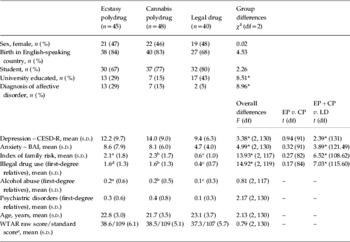
Table 1 shows that groups did not differ in age, pre-morbid intelligence, gender, birth in an English-speaking country, or student status. There was a non-significant trend towards the LD group having lower rates of birth in an English-speaking country than EP and CP groups [χ2(2)=4.53, p=0.10]. Groups differed in university degree completion, with LD and EP participants more likely to have done so than CP users. There were differences in affective disorder diagnoses, with EP users having the highest rates and LD users the lowest. The combined polydrug group endorsed more depression and anxiety symptoms, and had more familial risk (secondary to higher rates of familial illegal drug use), than LD controls.
Demographic features of participants

EP, Ecstasy polydrug users; CP, cannabis polydrug users; LD, legal drug users; CESD-R, Center for Epidemiologic Studies Depression Scale – Revised; BAI, Beck Anxiety Inventory; WTAR, Wechsler Test of Adult Reading; df, degrees of freedom; s.d., standard deviation.
a n=37 due to missing data.
b n=47 due to missing data.
c n=36 due to missing data.
d n=39 due to missing data.
e Standard scores were calculated from mean raw scores using US norms and are presented in Table 2 to facilitate interpretation. Raw scores were used in subsequent analyses because Australian norms are not available for this test.
* p<0.05, with Bonferroni corrections where necessary.
Drug use
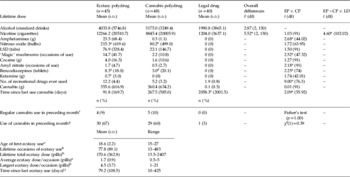
As presented in Table 2, groups did not differ in alcohol use, but the combined polydrug group had smoked more cigarettes than LD controls. There were no significant differences between EP and CP groups in nitrous oxide, cocaine or ketamine use. Ecstasy users had higher lifetime use of amphetamines, ‘magic’ mushrooms, amyl nitrate and benzodiazepines, and reported use of more recreational drugs than CP users. The two polydrug groups were well matched on lifetime cannabis dose and cannabis use in the month preceding assessment.
Patterns of drug use

EP, Ecstasy polydrug users; CP, cannabis polydrug users; LD, legal drug users; df, degrees of freedom; s.d., standard deviation.
a n=44 due to missing data.
b n=46 due to missing data.
c n=46 due to missing data.
d n=47 due to missing data.
e n=10.
f Defined as use four or more times per week.
g Last reported use of cannabis within 30 days of participation.
h In EP group, n=45.
i n=44 due to missing data.
j Prior to neuropsychological assessment session.
* p<0.05, with Bonferroni corrections where necessary.
Cognitive function – group analyses
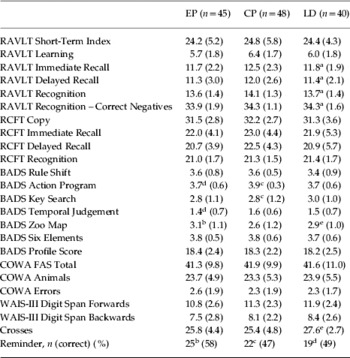
Table 3 shows mean neuropsychological scores. None of the DFAs yielded functions that differentiated EP from CP or LD users. Examination of the discriminative capacity of individual variables revealed only one variable that differentiated groups [Crosses; F (2, 128)=3.22, p=0.04]. Although this finding would have emerged if 23 univariate analyses were conducted without Bonferroni correction, this is likely to represent a Type 1 error given the number of analyses. Post-hoc comparisons show that, although polydrug users scored lower on this measure than LD controls, there was no difference between EP and CP users. The χ2 test indicated no relationship between group membership and performance on the Reminder test.
Cognitive function in EP, CP and LD users

EP, Ecstasy polydrug users; CP, cannabis polydrug users; LD, legal drug users; RAVLT, Rey Auditory Verbal Learning Test; RCFT, Rey Complex Figure Test; BADS, Behavioural Assessment of the Dysexecutive Syndrome; COWA, Controlled Oral Word Association; WAIS-III, Wechsler Adult Intelligence Scale – Third Edition.
Values are mean (s.d.), except ‘Reminder’.
a n=39 due to missing data.
b n=43 due to missing data, valid percentages are presented (where relevant).
c n=47 due to missing data, valid percentages are presented (where relevant).
d n=44 due to missing data, valid percentages are presented (where relevant).
e n=38 due to missing data.
Because there was a non-significant trend towards LD users having lower rates of birth in an English-speaking country, and this trend might have contributed to negative results, all group analyses were repeated using only participants born in an English-speaking country (n=105). These analyses also revealed no differences. Because patterns of cognitive function did not discriminate groups, and all other potential confounds would favour LD participants over EP and CP groups, we did not assess for possible impacts of other demographic/mood covariates, nor did we undertake ‘pure sample’ analyses excluding participants who did not fully comply with abstinence requirements.
Data reduction
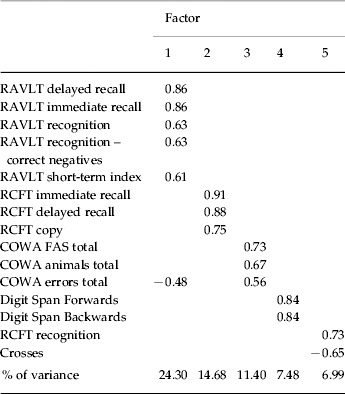
After removal of nine unfactorable variables, PCA using varimax rotation resulted in the extraction of five factors. As shown in Table 4, four of the five factors were readily interpretable, with the first representing verbal memory, the second visual memory, the third verbal fluency and the fourth attention/working memory. The fifth factor was not interpretable and was excluded from further analyses. Factor scores were obtained using the regression method (Tabachnick & Fidell, Reference Tabachnick and Fidell2001).
Rotated component matrix: principal components analysis

RAVLT, Rey Auditory Verbal Learning Test; RCFT, Rey Complex Figure Test; COWA, Controlled Oral Word Association test.
Relationships between drug-use variables and cognitive function
Preliminary regression analyses indicated that for each of the PCA-extracted cognitive factors, one or more of the demographic and drug-use variables contributed to the regression equation. Neither mood variable was retained in any of the preliminary analyses. Hierarchical regressions, therefore, included only two steps, with relevant demographic variables entered first and drug-use variables second.
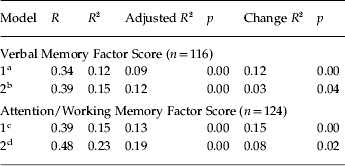
Drug-use variables did not contribute to prediction of visual memory or verbal fluency, once demographic variability was accounted for. As shown in Table 5, ecstasy lifetime dose predicted verbal memory, with higher use associated with lower verbal memory performance (sr=−0.20, sr 2=0.04). A combination of drug-use variables predicted attention/working memory. Weak negative semi-partial correlations were found between average dose of ecstasy (sr=−0.24, sr 2=0.06) and lifetime LSD dose (sr=−0.10, sr 2=0.01) and attention/working memory scores. A weak positive correlation was found between this cognitive measure and lifetime cocaine dose (sr=0.14, sr 2=0.02) and use of ecstasy in the month prior to participation (sr=0.20, sr 2=0.04).
Demographic and drug-use variables as predictors of verbal memory and attention/working memory
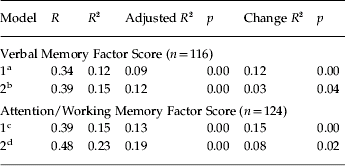
a Predictors: Sex, Index of Family Risk, Completed University degree.
b Predictors: Sex, Index of Family Risk, Completed University degree, Lifetime total dose of ecstasy.
c Predictors: Birth in English-speaking country, WTAR raw score, Full-time employed.
d Predictors: Birth in English-speaking country, WTAR raw score, Full-time employed, Average dose of ecstasy, Use of ecstasy in past month, Lifetime total dose of LSD, Lifetime total dose of cocaine.
To investigate possible impacts of failure to fully comply with drug-related requirements, follow-up regression analyses were conducted excluding these 21 cases (n=112). These analyses revealed a similar pattern of relationships between cognitive factor scores and drug-use variables. Higher lifetime dose of ecstasy was weakly associated with lower verbal memory performance and no drug-use variable contributed to prediction of visual memory or verbal fluency, once demographic factors were accounted for. The same drug-use variables predicted attention/working memory scores, with relationships between individual variables in the same direction and of similar magnitude to those reported above. The only difference apparent in follow-up analyses was the addition of a very small relationship between amphetamine use and verbal memory, with higher lifetime dose associated with better function (sr=0.12, sr 2=0.01).
Discussion
The hypothesis that ecstasy users would display lower cognition than non-users was not supported. There was some support for dose–response relationships, with ecstasy variables predicting verbal memory and attention/working memory. However, individual relationships were small.
Mean group performance on the RAVLT (Schmidt, Reference Schmidt1996), COWA (Ruff et al. Reference Ruff, Light, Parker and Levin1996), BADS (Wilson et al. Reference Wilson, Alderman, Burgess, Emslie and Evans1996) and Digit Span (Wechsler, Reference Wechsler1997) fell within clinically normal ranges. Some mean RCFT scores were below average but not indicative of clinically significant impairment (Meyers & Meyers, Reference Meyers and Meyers1995).
There are a number of possible reasons for the absence of group-level ecstasy effects. Assessments were primarily clinical neuropsychological tests, which may not have been sufficiently sensitive to detect subtle alterations. Research using acute tryptophan depletion has, however, found a version of the RAVLT and a set-shifting task similar to the BADS Rule Shift Cards subtest to be sensitive to experimentally lowered 5-HT (Park et al. Reference Park, Coull, McShane, Young, Sahakian, Robbins and Cowen1994; Riedel et al. Reference Riedel, Klaassen, Deutz, van Someren and van Praag1999), supporting the capacity of this protocol to detect variations arising from altered serotonergic function. However, it remains possible that ecstasy use was associated with subtle neuronal dysfunction without detectable cognitive consequences.
An alternative explanation is that MDMA dosages were not sufficient to produce serotonergic damage and cognitive dysfunction. Recently manufactured ecstasy may not be as potent as earlier tablets, which could explain the difference between the present and some earlier findings. However, such a difference would not explain other recent findings of ecstasy-specific cognitive dysfunction (e.g. Yip & Lee, Reference Yip and Lee2005). It is also possible that ecstasy in Australia may be less potent than that available in other countries. However, given that the majority of Australian MDMA-containing pills originate in Western Europe (Australian Crime Commission, 2005), substantial content differences between Australia and Europe are unlikely. Australian ecstasy users do appear to use less ecstasy per session than those in the UK, possibly lowering the potential for neurotoxicity. British samples typically use more than three tablets (Sumnall et al. Reference Sumnall, Tyler, Wagstaff and Cole2004), whereas Australians use one tablet per occasion (Ward et al. Reference Ward, Hall and Haslam2006). Ecstasy-use patterns in the current sample are similar to those reported in other Australian samples (e.g. Stafford et al. Reference Stafford, Degenhardt, Agaliotis, Chanteloup, Fischer, Matthews, Newman, Proudfoot, Stoove and Weekley2004; Ward et al. Reference Ward, Hall and Haslam2006), suggesting that this sample is broadly representative.
Other samples with similar or lower levels of use have previously been reported to have reduced cognitive function (e.g. Ward et al. Reference Ward, Hall and Haslam2006), indicating that lower doses alone are not entirely responsible for the difference between current and some earlier findings. It is also likely that control for a broader range of confounds contributed to the absence of group-level findings in this study. This is supported by recent studies, using better methodological controls than earlier research, that have also reported limited ecstasy-specific effects (e.g. Lamers et al. Reference Lamers, Bechara, Rizzo and Ramaekers2006; Hoshi et al. Reference Hoshi, Mullins, Boundy, Brignell, Piccini and Curran2007; Roiser et al. Reference Roiser, Rogers and Sahakian2007).
In addition to the absence of group ecstasy effects, there was no group cannabis effect. Lowered cognition in heavy cannabis users is likely to be due to subacute effects that ‘wash-out’ over around 1 month (Pope et al. Reference Pope, Gruber, Hudson, Huestis and Yurgelun-Todd2001). Therefore, heavy use in the past month is likely to be the most relevant cannabis-use dimension impacting cognition. Very few EP or CP users in this study reported heavy cannabis use prior to participation. Because few previous ecstasy studies have reported this cannabis-use dimension, it is possible that some earlier positive results were due to recent cannabis use rather than chronic effects (see Hoshi et al. Reference Hoshi, Mullins, Boundy, Brignell, Piccini and Curran2007).
Although there were no ecstasy-specific group effects, inverse associations were found between ecstasy-use measures and verbal memory and attention/working memory. The association between ecstasy and verbal memory is among the more consistent findings in previous research, and verbal memory is the only cognitive dimension where prospective data have indicated that ecstasy may have an effect (Schilt et al. Reference Schilt, de Win, Koeter, Jager, Korf, van den Brink and Schmand2007). However, the present pattern of results does not present a compelling picture of substantial cognitive dysfunction, with heavy ecstasy use only weakly associated with lowered cognition. It is possible that subtle effects in young adults may become more pronounced with ageing, with ecstasy users perhaps at greater risk for earlier/more severe cognitive declines (Morgan, Reference Morgan2000). Indeed, it is possible that the present absence of group ecstasy effects could be due to the relatively young sample, who may have had intact compensating mechanisms. Despite being a potential public health issue in the future, however, longer-term effects of ecstasy use remain unknown.
Although this study aimed to better address methodological issues than previous research, limitations remain. The absence of pre-morbid data and non-experimental design limits possible causal interpretation. Although we attempted to control for non-ecstasy drug use, the possibility of other drug effects cannot be entirely excluded in any polydrug sample. Despite the noted importance of verification of drug-free status, we were only able to perform urine assays on a subset of samples. Participants were not, however, informed of this, which may have encouraged compliance. A further limitation involves the focus on memory and executive function, meaning that differences in cognitive dimensions not assessed may have gone undetected. However, test selection was based on previous evidence regarding functions most likely to be affected.
Inconsistencies in previous findings suggest that there may be substantial individual variability in vulnerability to ecstasy-related sequelae, differences that might explain the divergent results in the overall body of literature. Future research should focus on identification of ecstasy users at particular risk of negative effects. Although heavier use seems to increase risk, it has yet to be established whether individual characteristics also confer heightened vulnerability. There is preliminary evidence that acute and possibly chronic effects of ecstasy might differ based on sex (see Bolla et al. Reference Bolla, McCann and Ricaurte1998; Allott & Redman, Reference Allott and Redman2007). Another possibility is that genetic predispositions interact with use of ecstasy, making some users more vulnerable than others. Preliminary evidence examining interactions between genotype for a 5-HT transporter polymorphism and ecstasy use in terms of cognition has been contradictory, with one study reporting an interaction (Roiser et al. Reference Roiser, Rogers, Cook and Sahakian2006) but another finding no such interactive effect (Reneman et al. Reference Reneman, Schilt, De Win, Booij, Schmand, Van den Brink and Bakker2006). It is also possible that early-onset ecstasy use, particularly occurring during the developmentally sensitive period of adolescence, may increase negative impacts (Jacobsen et al. Reference Jacobsen, Mencl, Pugh, Skudlarski and Krystal2004); however, this has yet to be assessed. Similarly, no previous research has examined possible differential effects of ecstasy based on pre-morbid cognitive levels.
In the absence of clear evidence about particular groups at risk, public health messages should convey potential dangers associated with ecstasy in a balanced and credible manner. At higher doses, ecstasy use seems to be weakly associated with reduced function in some cognitive domains. Although such effects seem to be subclinical in young adults, they may be associated with adverse consequences in the longer term.
Acknowledgements
We thank Kim Ng, John H. Halpern, Kelly Allott, Leila Greenfield, Nicholas Van Dam and participants. This project was funded by Monash University, Department of Psychology. G. B. was funded by an Australian Postgraduate Award.
Declaration of Interest
None.