

1 Introduction
When valuing fatality risk reductions, benefit-cost analysts often rely on reviews that synthesize the results of several studies, recognizing that each study has advantages and limitations. In the USA, analysts frequently follow the recommendations of federal regulatory agencies, which reflect substantial examination of the literature and advice from independent experts. Three U.S. agencies have issued related guidance: the Environmental Protection Agency (EPA), the Department of Transportation (DOT) and the Department of Health and Human Services (HHS) (EPA, 2010a; DOT, 2016; HHS, 2016). While each agency developed its estimates at different times based on different reviews of the literature, the values are all derived from studies of adult willingness to pay (WTP) for changes in their own risks. As of 2016, the central value per statistical life (VSL) estimates used by these agencies were generally between $9 million and $10 million.
The number of studies that investigate the value of reducing risks to children has increased substantially in recent years, providing an opportunity to explore whether different values should be used for children than for adults.Footnote 1 While the results are diverse, they appear to suggest that risk reductions that accrue to children are valued more highly than risk reductions that accrue to adults, at least in high-income countries. For example, an OECD (2012) report suggests that when a policy is focused specifically on children, adult values should be multiplied by a factor of 1.5–2.0, based on previous reviews (EPA, 2003; Alberini et al., Reference Alberini, Bateman, Loomes and Ščasný2010). However, both reviews note that these values are uncertain and neither recommends a specific adjustment. Similarly, the Norwegian Ministry of Finance (2012) suggests multiplying adult values by a factor of 2.0 in supplemental analysis, based on these and other reviews. None of these sources references a criteria-driven review of the literature that directly addresses the appropriate adjustment factors. This article fills that gap, focusing on estimates potentially suitable for use in benefit-cost analyses that address the national U.S. population while encompassing studies conducted in other high-income settings.
We begin by discussing the conceptual framework for valuing fatality risk reductions. We then describe the approach we used to conduct our criteria-driven review and the results, concluding with a summary of the implications.
2 Conceptual framework
In benefit-cost analysis, the definition of value is derived from welfare economic theory. Two key assumptions are particularly important in this context. The first is the concept of “opportunity cost.” Using resources (such as labor or raw materials) for one purpose means that they are not available for other productive uses. Thus, the value of a resource is determined by its most productive or beneficial use. The second is “consumer sovereignty.” Conventionally, benefit-cost analysis attempts to determine whether consumers in the aggregate judge themselves better off with a policy than without. Choosing to purchase a good or service presumably indicates that an individual values that item more than the other things he or she could use that money to buy. Thus, the amount of money individuals are willing to exchange for a good or service provides an estimate of its value, i.e. the opportunity cost of not providing it.
Consistent with these concepts, VSL represents an individual’s willingness to trade spending on other goods and services for a small reduction in his or her own risk of death. It is the individual’s marginal rate of substitution between money and fatality risk (Hammitt, Reference Hammitt2000, Reference Hammitt2017). VSL can be estimated as the value of a specified risk change divided by the risk change. For example, if an individual’s WTP for a 1 in 10,000 reduction in his or her own fatality risk in the current year is $900, then that individual’s VSL is $9 million ($900 divided by 1 in 10,000).
2.1 Valuation methods
Because these risk reductions are not directly bought and sold in the marketplace, two methods are commonly used to estimate VSL: revealed preferences and stated preferences.Footnote 2 Revealed preference studies use data on actual behaviors and market decisions to infer how individuals trade off risks and wealth, such as decisions to purchase protective equipment or to select a safer job. Stated preference studies instead use surveys to elicit values.
Revealed preference research includes wage-risk and averting-behavior studies. Wage-risk studies (often referred to as hedonic-wage studies) estimate these values by modeling earnings as a function of job and personal characteristics, including the risk of occupational fatality. Similarly, averting-behavior studies infer these values by studying defensive measures or consumer products used to protect against perceived risks, such as bicycle helmets or seat belts. Under either approach, researchers face the challenge of distinguishing the value of fatality risk reduction from the value of potentially confounding attributes, such as reductions in nonfatal risks, time costs and comfort or convenience. One question that arises when using these studies is whether the risks associated with the marketed good or service are sufficiently similar to the risks associated with the policy to provide a suitable measure of value.
Stated-preference studies rely on survey research involving contingent valuation or discrete choice experiments. Researchers ask individuals to consider hypothetical scenarios and directly or indirectly value a change in risk. For example, they may ask respondents whether they would be willing to pay $900 in the current year for a risk reduction of a specific magnitude and duration that is associated with a hypothetical government project or medical treatment. Stated preference studies have the advantage that they can be designed to address the population and risk of interest. However, the hypothetical nature of the payment means that careful design and implementation are needed to ensure that the results are reasonably valid.
Both revealed preference and stated preference studies are routinely used by U.S. Federal agencies in estimating VSL for application in their regulatory analyses. Historically, agencies have relied more frequently on wage-risk studies than on studies of averting behavior or stated preferences, due in part to the availability of studies of each type and in part to concerns about quality and applicability (EPA, 2010a; DOT, 2016; HHS, 2016). However, wage-risk studies include only employed individuals and do not address the value of risks to young children. Thus valuing risks to children requires relying on studies of averting behavior and stated preference research.
2.2 Approaches for valuing risks to children
The studies used by Federal agencies and others in benefit-cost analysis generally consider how adults value reductions in their own risk of death rather than risks to friends, family, or other members of society. This approach is consistent with the notion of consumer sovereignty–that each individual is the best (or the most legitimate) judge of his or her own well-being. However, eliciting a child’s WTP for his or her own risk reduction is problematic.
Researchers typically expect that children will find it difficult to make informed, rational choices if faced with the need to trade off fatality risks and monetary wealth, especially at very young ages. Understanding the concept of risk is difficult for many adults and likely even more difficult for children. In addition, children typically do not possess or control the financial resources to make these trade-offs.Footnote 3
Instead, researchers commonly consider either the preferences of the general adult population for children in the population or the preferences of parents for their own children.Footnote 4 In benefit-cost analysis, counting preferences both for oneself and for others raises issues related to distinguishing between pure and paternalistic altruism (Jones-Lee, Reference Jones-Lee1992; Bergstrom, Reference Bergstrom and Jones-Lee1982, Reference Bergstrom2006). A pure altruist respects the preferences of others, placing the same relative weight on the costs and benefits others bear as they would themselves. In contrast, a paternalistic altruist places greater or lesser weight on some outcomes than would those affected. While including pure altruism does not affect the determination of whether the benefits of a policy exceed its costs, counting the preferences of a paternalistic altruist may do so by placing a greater weight on some outcomes. Because distinguishing between pure and paternalistic altruism is very difficult, altruism is generally not included in the values conventionally used in benefit-cost analysis.
For children whose preferences are not directly incorporated into a benefit-cost analysis, the relevant question is whether society at large or parents are the best judge of the child’s well-being.Footnote 5 Studies that elicit values from the general population indicate the values that individuals place on reducing the risks faced both by their own children and by the children of others, which is at times described as the societal perspective. The parental perspective instead focuses on the allocation of the household’s own resources across its members. An advantage of this perspective is that parents have good information about their children’s well-being and are generally interested in improving their welfare. They are also responsible for making safety decisions for children, such as choosing which protective equipment to purchase and which activities to allow or prohibit.Footnote 6
A related issue is how researchers model the household decision-making process for allocating resources between safety and other goods (see, for example, Adamowicz et al., Reference Adamowicz, Dickie, Gerking, Veronesi and Zinner2014; Dickie & Salois, Reference Dickie, Salois, Blomquist and Bolin2014). The prevailing approach assumes that household decision-makers, generally parents or caretakers, maximize household well-being in accordance with a unified set of preferences and pooled financial resources. The practice of eliciting WTP from one parent may be justified by the notion of a parental consensus around such decision-making. Researchers have also modeled household decisions using a pluralistic approach in which preferences are allowed to differ across household members. These preferences are then pooled to reach a collective decision.
While researchers have explored some reasons why values may vary for adults and children, these reasons are not well understood. They may include children’s longer life expectancies and concerns about “fair innings”; i.e. that younger individuals have not yet had an opportunity to experience a full life. Other factors also influence these values. For example, Birchenall and Soares (Reference Birchenall and Soares2009) explore and parameterize a conceptual model that accounts for the effect of fatality risk reductions on adult decisions to have children and concerns about future generations, which increases the value of risk reductions accruing to young adults as well as to children.
3 Analytic approach
In our review, we follow the benefit transfer (or value transfer) framework, which involves defining the outcome to be valued, searching the literature to identify relevant research, evaluating the available studies for quality and applicability and synthesizing the results. The outcome in this case is fatality risk reductions that accrue to children in the USA, focusing on adjustment factors that could be applied to independently derived adult VSL estimates. We also review studies conducted in other high-income countries, although we expect that this ratio varies across countries due to cultural and other factors.Footnote 7
The research base for adults in the USA and other high-income countries is extensive and has been subject to substantial review, providing a strong basis for estimating adult values (see, for example, Robinson & Hammitt, Reference Robinson and Hammitt2016; Viscusi, Reference Viscusi2018). As noted earlier, U.S. Federal agencies recommend similar adult values despite relying on reviews that apply differing criteria and were conducted at different times. The research base for children is limited and does not provide as strong a foundation for developing independent VSL estimates. We instead focus on studies that indicate the ratio of adult and child values. This ratio is likely to be more stable and well-estimated than the monetary values; study-specific factors that bias estimated VSL upward or downward will be common to both adult and child values. Comparing adult and child values within the same study eliminates the need to attempt to control statistically for the numerous differences across studies.
We consider only studies that use a consistent approach to estimate values for both groups; using the same study design and sample to evaluate a substantially similar outcome for both children and adults within the same population. While this approach excludes several studies that only consider risks to children, it avoids potentially misleading comparisons. Comparing VSL estimates across studies that only address adults and studies that only address children requires separating the effects of factors such as the methodology used, the types of risks addressed and the population sampled, which can substantially influence the monetary values. It would be difficult to know whether any differences in the results were attributable to the focus on adults versus children or to other differences between the studies.Footnote 8
We rely on a systematic qualitative review that follows a well-defined structured approach to identify studies and to evaluate their quality and applicability. While this review could be used as a starting point for additional quantitative assessment, such as meta-analysis, the limited number of studies and the lack of consistent reporting of key variables make such analysis difficult. Our approach includes three phases: criteria development, literature search and literature review. We discuss the first two phases below and then discuss the results of the review in the next section.
3.1 Criteria development
We began by establishing two sets of criteria to guide our work. First, we developed selection criteria to identify studies for detailed review. These selection criteria are straightforward, resulting in a simple “yes/no” determination. They are intended to ensure that the studies measure a reasonably consistent outcome and are potentially suitable for application in analyses of U.S. policies. Such selection is necessary for any form of research synthesis – qualitative or quantitative. By being explicit about the criteria we use and the rationale, we hope to clarify the basis for our estimates.
Second, we developed evaluation criteria to assess the quality and applicability of studies. These criteria require detailed review of each study and some involve substantial professional judgment. We use these evaluation criteria to investigate the relative strengths of each study and the implications of including or omitting them from our analysis.
As a starting point, we considered criteria recently used to evaluate adult VSL studies for application in U.S. regulatory analyses (Robinson & Hammitt, Reference Robinson and Hammitt2016; HHS, 2016), which in turn were based on advice provided by previous expert panels (e.g. EPA, 2010b; Environmental Economics Advisory Committee, 2011). We adapted these criteria to reflect our focus on the risks to children aged 0–17. Some changes reflect the difference in context. For example, studies of risks to adults generally focus on individuals’ WTP for changes in their own risks, whereas studies of risks to children require considering adult WTP for others. In addition, because the valuation literature on adult risks is relatively large and well-developed while the literature on children is much smaller, we use somewhat less stringent criteria to avoid ignoring studies that may provide useful insights.
3.1.1 Selection criteria
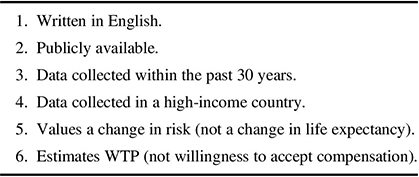
The selection criteria we use to identify these studies are presented in Table 1 and described below.
Selection criteria.

Criteria 1 and 2 (written in English, publicly available) reflect the purpose of most, if not all, benefit-cost analyses, which is to inform decision-makers, other stakeholders and the general public about potential policy impacts. To achieve this goal, the studies underlying the VSL estimates should be accessible to those reviewing the analyses. We considered publicly available sources, including peer-reviewed journal articles, papers published as part of a working paper series and government documents (e.g. guidance documents or expert panel reports).
Under criterion 3, we limit our review to studies based on data collected within the past 30 years (between 1987 and 2017).Footnote 9 Older studies are less likely to reflect current preferences for trading income for small risk changes, given the substantial changes in society, technology and the economy that have occurred over time. In addition, older studies do not reflect evolving standards for best practices. These result, for example, from many years of research on the influence of questionnaire design on survey response validity, and from the increased ability to conduct more sophisticated statistical analysis as computing power has risen substantially.
Criterion 4 addresses the country in which the research was conducted. Ideally, for analyses of U.S. policies, we would rely on studies of the U.S. population because cultural and numerous other factors may affect preferences across countries (Hammitt, Reference Hammitt2017). However, we include studies from a wider range of countries in our initial selection because they may provide useful information and the overall number of studies is relatively small. We use population-average income as a rough proxy for differences in preferences across countries. We select studies from high-income countries defined as those with gross national income (GNI) per capita of 50 percent or more of U.S. GNI per capita, according to World Bank data.Footnote 10
Criteria 5 and 6 aim to ensure that the outcomes valued are similar to the outcomes addressed in the adult VSL studies to which adjustment factors might be applied, such as those that underlie the recommendations of U.S. regulatory agencies (EPA, 2010a; DOT, 2016; HHS, 2016). More specifically, criterion 5 focuses on studies that expressly address specified individual risk changes, consistent with the studies that are typically used to estimate the adult VSL. We exclude studies that instead estimate the value of a change in life expectancy or an outcome that occurs with certainty. We also exclude studies that consider the value of a policy or other intervention more holistically, without separating the value of a specified risk reduction from the value of other attributes.
Criterion 6 is primarily relevant to stated preference studies and requires that they elicit WTP rather than willingness to accept compensation (WTA).Footnote 11 WTP is more often used in benefit-cost analyses because policy options typically involve expenditures for improvements from the status quo rather than compensation for damages. WTP is also more frequently studied and the estimates are generally considered more reliable; the large and variable differences between estimated WTP and WTA are not well understood (Horowitz & McConnell, Reference Horowitz and McConnell2002; Tuncel & Hammitt, Reference Tuncel and Hammitt2014).
3.1.2 Evaluation criteria
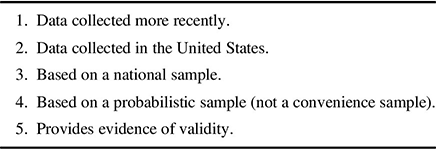
We developed five criteria to guide our evaluation of each study that meets our selection criteria, as summarized in Table 2 and described below. These criteria are designed to aid us in exploring the strengths and limitations of each study, rather than in accepting or rejecting studies.
Evaluation criteria.

The first four evaluation criteria narrow the focus of the selection criteria to reflect relative weighting of the studies based on their applicability. Because we are interested in preferences of the current U.S. population, and the ratio of child-to-adult values may vary over time and across countries, criteria 1 and 2 indicate that we prefer recent U.S. studies. We are interested in estimates applicable to the national U.S. population; criterion 3 addresses whether the study considers a narrower subgroup (e.g. a specific city or region) rather than the general population. The fourth criterion, relying on a probability sample rather than a convenience sample, reflects our interest in values that are representative of the population studied. However, we recognize that studies based on a convenience sample may provide useful insights.
Criterion 5 addresses evidence of validity. Applying this criterion requires considering the evidence that each study presents regarding the quality of the data, the appropriateness of the methods used and the validity of the results. Thus, it requires substantial professional judgment, and the factors we consider are tailored to the approach used in each study.
In particular, a major concern in stated preference studies is that respondents may not understand the size of small probabilities, reporting the same or similar WTP for risk reductions that vary in magnitude. Economic theory suggests that WTP should increase nearly proportionately to the size of the risk change, as long as WTP is a small fraction of income (Corso et al., Reference Corso, Hammitt and Graham2001; Alolayan et al., Reference Alolayan, Evans and Hammitt2017). These tests help to validate whether respondents comprehend the outcome to be valued and can be seen more generally as an indicator of whether the researchers are conscientiously adhering to standards for high quality work. In addition, the common practice of applying a constant VSL across differently sized small risk changes rests on this assumption.Footnote 12
Revealed preference studies that address risks to children generally consider averting behaviors, i.e. defensive measures or consumer products used to protect against perceived risks, such as seat belts or bicycle helmets. Issues to be considered in evaluating these studies include whether the researchers probe individuals’ understanding of the size of the risk change and whether and how they separately estimate the value of key inputs such as the time spent in the activity.
In several cases, we are able to easily determine whether studies satisfy our evaluation criteria (e.g. whether they address the U.S. population). In other cases, the criteria require more detailed review of each study and the application of judgment. The extent to which each study meets each criterion is a matter of degree, and the criteria are not necessarily equal in importance. In addition, the studies vary in the extent to which they report information that is useful in making these judgments. Thus, we use the evaluation criteria to weigh the advantages and limitations of each study rather than as firm dividing lines between studies of higher and lower quality.
3.2 Literature search
We began our search for primary research studies by exploring other recent reviews (e.g. Alberini et al., Reference Alberini, Bateman, Loomes and Ščasný2010; Gerking & Dickie, Reference Gerking and Dickie2013). We followed an iterative process of (i) identifying studies cited within these reviews, (ii) using the references cited in each study to identify additional studies, and (iii) conducting forward searches for each study using the cited by feature in Google Scholar to identify newer work. We also searched for studies using the keywords “(children OR child) AND (WTP OR VSL)” in the EconLit bibliographic database. When we found unpublished conference papers and presentations or working papers, we searched for published versions, writing to the authors to determine the status of the study if needed. We also wrote to leading researchers to identify additional studies.
We applied the selection criteria presented in Table 1 to identify relevant studies. We found seven publications that used a consistent approach to value fatality risks to adults and children and met these criteria. These seven publications cover seven unique studies as discussed below.Footnote 13
4 Results
In this section, we discuss the results of our review of the studies that meet the selection criteria presented in Table 1 and also discuss the extent to which they adhere to the evaluation criteria in Table 2. As discussed earlier, we limit our review to studies that (i) estimate values for children and adults for the same population using a consistent approach and (ii) report the ratio(s) of adult and child values or data from which this ratio can be directly calculated. We then discuss supplemental evidence provided by studies of nonfatal risks.
4.1 Evaluation of studies of fatal risks
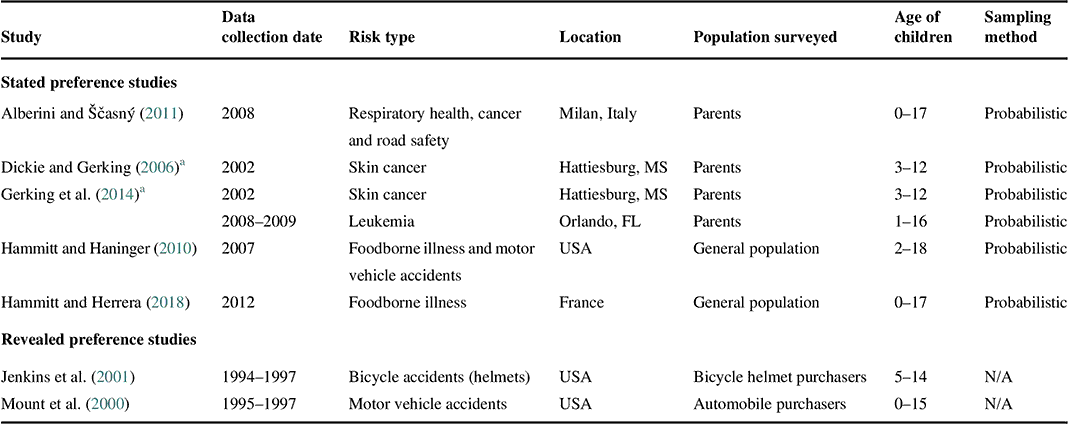
As summarized in Table 3, the seven publications that address fatality risks include a total of five stated preference surveys and two revealed preference studies, for a total of seven unique studies.Footnote 14 More specifically, the Hattiesburg skin cancer survey is discussed in two publications (Dickie & Gerking, Reference Dickie and Gerking2006; Gerking et al., Reference Gerking, Dickie and Veronesi2014), the second of which also discusses a separate leukemia survey.
Description of selected studies.

Notes: N/A = not applicable.
a These two publications include data from the same skin cancer survey.
Below, we explore the extent to which each study is consistent with the evaluation criteria listed in Table 2. In this discussion, we focus on the count of studies rather than the count of publications, including five unique stated preference surveys and two revealed preference studies.
The date of data collection varies by study design: the five stated preference studies use data sets from 2002 to 2012, while the two revealed preference studies use data sets from 1994 to 1997. Thus, the stated preference studies come closer to satisfying evaluation criterion 1 (data collected more recently).
Three studies (one stated preference study and the two revealed preference studies) address members of the U.S. population, as discussed under evaluation criteria 2 and 3 (data collected in the USA, national sample). However, only one represents the general population (Hammitt & Haninger, Reference Hammitt and Haninger2010); the other national studies address purchasers of specific products (bicycle helmets and automobiles). Of the remaining four studies, two were conducted outside the USA and two use data from specific U.S. cities.
Three of the five stated preference surveys sample parents and two sample the general adult population; all rely on probabilistic sampling techniques consistent with criterion 4. The revealed preference studies match data on purchases with data from other sources on accident rates and on attributes of those using these products.Footnote 15
Determining the extent to which each study provides evidence of validity under evaluation criterion 7 is more complicated. Applying this criterion requires considering the evidence that the researchers provide regarding the quality of the data, the appropriateness of the methods used and the validity of the results.
For stated preference studies, we evaluate whether the authors implement tests of scope sensitivity (i.e. examine the sensitivity of WTP to the magnitude of the risk change) and assess the results of these tests. In particular, we consider whether the results are consistent with economic theory on two dimensions: (i) WTP should be higher for larger risk reductions and (ii) WTP should increase nearly proportionally to the size of the risk change for small changes in risks. The second (proportionality) test is less frequently satisfied but nonetheless provides important evidence of validity as discussed previously. All of the stated preference surveys provide evidence that WTP is higher for larger risk reductions. However, the authors report that the results are close to proportional in only two cases (Hammitt & Haninger, Reference Hammitt and Haninger2010; Hammitt & Herrera, Reference Hammitt and Herrera2018).Footnote 16 , Footnote 17 Several studies provide additional evidence of validity.
Interpreting the results of two of the five stated preference studies is somewhat challenging. The skin cancer study reported in Dickie & Gerking (Reference Dickie and Gerking2006) and Gerking et al. (Reference Gerking, Dickie and Veronesi2014), and the leukemia study reported in Gerking et al. (Reference Gerking, Dickie and Veronesi2014), address the risk of illness and the conditional risk of death after becoming ill. Determining the implications of the results for the ratio between adult and child values for fatality risks requires sorting out the effects of nonfatal risks on these estimates. We focus on the results adjusted to reflect unconditional fatality risk because they are more comparable to the adult VSLs used in many benefit-cost analyses than the conditional estimates. For example, the values recommended by U.S. regulatory agencies are generally derived from studies that do not involve significant morbidity prior to death, although death is not always immediate (Gentry & Viscusi, Reference Gentry and Kip Viscusi2016; Robinson & Hammitt, Reference Robinson and Hammitt2016). For skin cancer, the findings also depend on whether the values are adjusted for the perceived latency of the risk; i.e. the effect of undertaking protective measures in the current period on the risk of skin cancer in the future. The skin cancer findings also vary somewhat across publications, since each relies on differing approaches to the data analysis. For leukemia, the authors report estimates for mean WTP to reduce a child’s unconditional fatality risk but do not provide a comparable estimate for parents due to challenges related to interpreting the results. Thus, we include the ratios for unconditional fatality risk from the skin cancer survey but exclude the leukemia survey from our comparisons.
We also evaluate the validity of the results of the two revealed preference studies. These studies consider averting behaviors which involve defensive measures or consumer products used to protect against perceived risks: bicycle helmets in the case of Jenkins et al. (Reference Jenkins, Owens and Wiggins2001) and vehicle safety features in the case of Mount et al. (Reference Mount, Weng, Schulze and Chestnut2000). The validity of these studies is difficult to assess in part because we did not find other studies that use similar methods to which the results could be compared. However, the authors of both studies indicate that more work is needed to validate the results and refine the methods and models.Footnote 18 Jenkins et al. note that their approach is novel and suggest that their results should not be used in policy analysis. The Mount et al. study is a working paper and the authors describe their analysis as “preliminary.”
In both studies, the results are sensitive to key assumptions. Jenkins et al. (Reference Jenkins, Owens and Wiggins2001) assume that time and disutility costs (such as the degree of comfort) associated with using a bicycle helmet are zero, potentially underestimating VSL for children and adults with an uncertain impact on the ratio of these values. Their finding that VSL is higher for adults than children is based upon the assumption that all helmets last four years; it is reversed if the authors instead assume that children’s helmets last two years and adults’ helmets last eight years. Similarly, the Mount et al. (Reference Mount, Weng, Schulze and Chestnut2000) results are sensitive to the assumed VSL income elasticity. They find that average VSL for children is the same as average VSL for adults if income elasticity is 0.65. At larger elasticities, the value for children is greater than the value for adults; the reverse is true at lower elasticities. In addition, neither publication makes clear whether individuals are likely to be aware of the magnitude of the risk reductions afforded by the products.Footnote 19 , Footnote 20
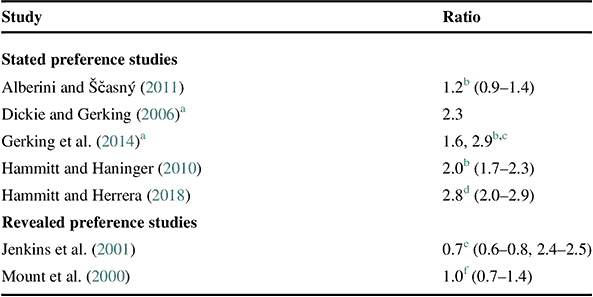
In Table 4, we report the ratio of child and adult values from each study. Because the goals of these studies vary, they also vary in the extent to which they report these ratios or provide the data needed for us to directly calculate the ratio. Some highlight only one or two ratios; others provide ratios resulting from several model specifications. In the table, we first report the estimate highlighted by the study authors in their abstract or conclusions or the midpoint if they highlight a range of estimates. In parentheses, we report other ratios provided in the article; where the authors report ratios from several model specifications, we include the range. We exclude the results for leukemia from Gerking et al. (Reference Gerking, Dickie and Veronesi2014) because of the lack of an adult value for unconditional fatality risks. Most ratios are greater than 1.0, except for those from the two revealed preference studies.
Ratio of child-to-adult VSL a .

a Both publications report results from the same skin cancer survey; table excludes results for leukemia due to the lack of an adult value for unconditional fatality risks.
b Estimate highlighted by authors.
c Ratios reflect results without and with adjustment for latency.
d Estimate highlighted by authors excludes invalid responses.
e Estimate highlighted by authors; higher range in parentheses assumes longer life span for adult helmets.
f Midpoint of reported range.
We find that the two revealed preference studies are relatively weak in terms of applicability and quality. They rely on older data sets and on novel approaches that require further investigation of validity. Although the stated preference studies vary in the extent to which they meet our evaluation criteria, they generally appear better suited for application. These stated preference studies suggest that the ratio of child-to-adult VSL estimates ranges from 0.9 to 2.9; most estimates are greater than 1.5.
4.2 Supplemental evidence
In addition to the above studies, we identified four publications that address nonfatal risks to both adults and children and otherwise meet our selection criteria. These include three publications not discussed previously (Adamowicz et al., Reference Adamowicz, Dickie, Gerking, Veronesi and Zinner2014; Hammitt & Haninger, Reference Hammitt and Haninger2007; Hammitt & Haninger, Reference Hammitt and Haninger2017), as well as the skin cancer study that also addresses fatality risks and was discussed above (Dickie & Gerking Reference Dickie and Gerking2006; Gerking et al., Reference Gerking, Dickie and Veronesi2014).Footnote 21 Because the 2014 Gerking et al. study includes two surveys, the total count of studies across these publications is five. We review these studies to gain more insights. However, because fatal and nonfatal risks differ in significant respects, we do not necessarily expect to find the same relationships between child and adult values.
All five studies are based on stated preference research conducted in the USA between 2000 and 2014 and were probabilistic samples of either the general adult population or of parents. All but the studies conducted by Dickie and Gerking (Reference Dickie and Gerking2006) and Gerking et al. (Reference Gerking, Dickie and Veronesi2014) were based on national samples. The studies generally provide evidence that WTP is higher for larger risk reductions as expected, but some do not report the extent to which the estimates change proportionately. In their study of foodborne illness, Hammitt and Haninger (Reference Hammitt and Haninger2007) find that WTP is significantly less sensitive to the risk change than required by conventional theory. In their study of environmental exposures, Hammitt and Haninger (Reference Hammitt and Haninger2017) find that WTP is nearly proportional to the specified risk change.
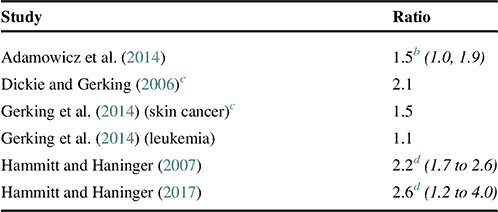
The ratio of child-to-adult values found in these five surveys is reported in Table 5. Again, we first report the preferred or central estimates highlighted by the study authors and then report the range of additional estimates they provide. Similar to the results for fatality risks, these ratios range from 1.0 to 4.0, providing additional evidence that the value of reducing risks to children is likely to be equal to or greater than the value for adults.Footnote 22
Ratio of child-to-adult values for morbidity a .

a The estimated ratio from some studies includes the risk of fatality.
b Midpoint of values for mother and father, provided in parentheses.
c Based on the same skin cancer survey.
d Midpoint of range.
The studies reviewed above address children at a variety of ages, which raises questions about the extent to which the results may vary depending on the age of the child. For fatality risk reductions, two surveys suggest that estimated WTP declines with the age of the child (Gerking et al., Reference Gerking, Dickie and Veronesi2014, skin cancer survey; Hammitt & Haninger, Reference Hammitt and Haninger2010), but two surveys find no significant impact (Alberini & Ščasný, Reference Alberini and Ščasný2011; Gerking et al., Reference Gerking, Dickie and Veronesi2014, leukemia survey). Hammitt and Herrera (Reference Hammitt and Herrera2018) do not report whether WTP differs by children’s age.
The evidence from studies of nonfatal risk reductions is similarly mixed. While two surveys find that WTP may decline with children’s age (Gerking et al., Reference Gerking, Dickie and Veronesi2014, skin cancer survey; Hammitt & Haninger, Reference Hammitt and Haninger2007), results from two other surveys find no significant relationship (Gerking et al., Reference Gerking, Dickie and Veronesi2014, leukemia survey; Hammitt & Haninger, Reference Hammitt and Haninger2017). Adamowicz et al. (Reference Adamowicz, Dickie, Gerking, Veronesi and Zinner2014) do not report whether WTP may differ by children’s age. Thus, more work would be needed to determine the extent to which the ratio of adult values to the values for children varies depending on the age of the child.
5 Conclusion
Our review indicates that the number of studies that compare the value of reducing risks to children to the value for adults, while increasing, is relatively small. We review five stated preference surveys and two revealed preference studies that provide VSL estimates for both children and adults. If we include the estimates from each model reported in each study, we find ratios of child-to-adult values that range from 0.6 to 2.9. However, the quality and applicability of the revealed preference studies are comparatively weak. The four stated preference studies suggest that the VSL for children generally exceeds the VSL for adults; the estimated ratio of child-to-adult VSL is between 0.9 and 2.9 and most estimates are greater than 1.5. Although fatal and nonfatal risks vary in many important respects, we also review five studies that address nonfatal risks, and find they similarly indicate that values for children equal or exceed adult values. These findings appear consistent with the recommendations included in the OECD report and Norwegian guidance referenced earlier.
These results suggest that the value of reducing risks to children is likely larger than the value of reducing risks to adults, but that the magnitude of this difference is uncertain. In the near term, these findings imply that analysts should explore the implications of using larger values for children than for adults in sensitivity analysis. More research is needed to support adjustment factors that could be used in the primary results.
In addition, the extent to which these values vary depending on the age of the child is uncertain. The commonly used adult VSL estimates reflect population averages for an adult of average working age (between 35 and 40 years old). The age ranges for the children considered in the studies we review vary significantly. It seems reasonable to assume that the value of reducing risks to children depends on age; it is unlikely that these values are the same for a young infant as for a teenager on the verge of adulthood. Simply multiplying the value of risk reductions that accrue to all children by the factors derived from these studies ignores the varying age ranges they include.
Other factors also likely influence these ratios, including the characteristics of the population considered and the risks addressed. The literature base is not yet large enough to comprehensively assess the effects of these and other attributes. As noted in the reviews we cite, even the much larger literature on adult values does not yield firm conclusions on the effects of factors, such as income and age, or of the types of risks considered. In addition, this and other attempts to synthesize the literature are significantly inhibited by the lack of consistent reporting of the variables of interest. Given the extensive use of benefit transfer in benefit-cost analysis, developing standard reporting requirements would aid in significantly advancing the field.
Acknowledgments:
This article builds on work conducted for the U.S. Consumer Product Safety Commission (CPSC) under contract to Industrial Economics, Incorporated (IEc). The CPSC project manager was C. Krishnan; the IEc project manager was J. Baxter. We thank them both as well as W. Zamula, G. Rodgers and R. Franklin of CPSC for their helpful comments on our earlier work. We are also grateful for the insightful and useful comments provided by G. Blomquist and the anonymous reviewers. The views expressed in this article are our own and do not reflect the views nor the endorsement of CPSC.